NSTSE Sample Paper Solutions Class 10 – Text
Read the full text of this solution below — useful to quickly search, copy and reference the content online without downloading the PDF.
📄 View text version (2 pages)
Page 1
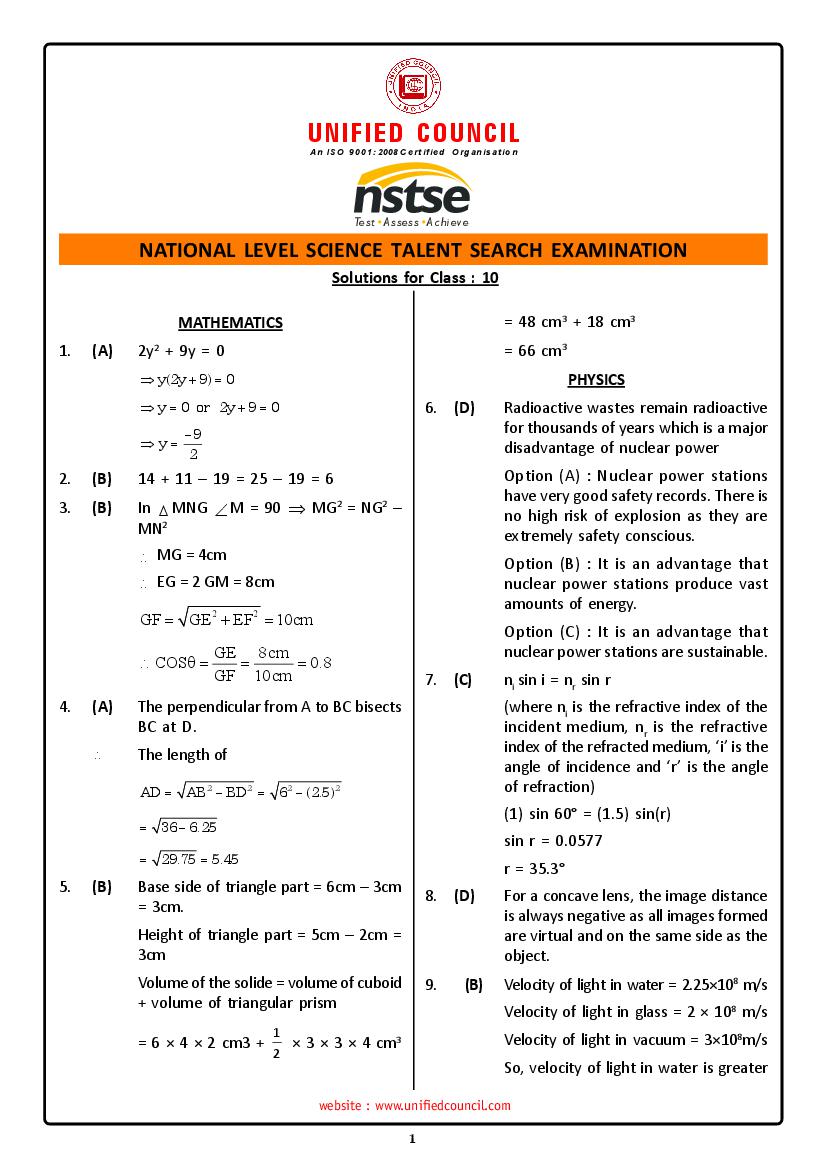
UNIFIED COUNCIL A n I S O 9 0 0 1 : 2008 C e r t i f i e d O r g a n i s a t i o n Test Assess Achieve NATIONAL LEVEL SCIENCE TALENT SEARCH EXAMINATION Solutions for Class : 10 MATHEMATICS = 48 cm3 + 18 cm3 1. (A) 2y2 + 9y = 0 = 66 cm3 y(2y 9) 0 PHYSICS y 0 or 2y 9 0 6. (D) Radioactive wastes remain radioactive 9 for thousands of years which is a major y disadvantage of nuclear power 2 2. (B) 14 + 11 – 19 = 25 – 19 = 6 Option (A) : Nuclear power stations have very good safety records. There is 3. (B) In MNG M = 90 MG2 = NG2 – no high risk of explosion as they are MN2 extremely safety conscious. MG = 4cm Option (B) : It is an advantage that EG = 2 GM = 8cm nuclear power stations produce vast amounts of energy. GF GE 2 EF2 10cm Option (C) : It is an advantage that GE 8 cm nuclear power stations are sustainable. COS 0.8 GF 10 cm 7. (C) ni sin i = nr sin r 4. (A) The perpendicular from A to BC bisects (where ni is the refractive index of the BC at D. incident medium, nr is the refractive index of the refracted medium, ‘i’ is the The length of angle of incidence and ‘r’ is the angle AD AB2 BD2 62 (2.5)2 of refraction) (1) sin 60° = (1.5) sin(r) 36 6.25 sin r = 0.0577 29.75 5.45 r = 35.3° 5. (B) Base side of triangle part = 6cm – 3cm 8. (D) For a concave lens, the image distance = 3cm. is always negative as all images formed Height of triangle part = 5cm – 2cm = are virtual and on the same side as the 3cm object. Volume of the solide = volume of cuboid 9. (B) Velocity of light in water = 2.25×10⁸ m/s + volume of triangular prism Velocity of light in glass = 2 × 10⁸ m/s 1 = 6 × 4 × 2 cm3 + × 3 × 3 × 4 cm3 Velocity of light in vacuum = 3×10⁸m/s 2 So, velocity of light in water is greater website : www.unifiedcouncil.com 1
Page 2
than glass but velocity of light in water 15. (D) Elements like calcium, strontium and is less than the velocity of light in barium form a triad based on the given vacuum. characteristics. 10. (A) The light coming from the object, enters BIOLOGY our eye through the cornea (X). The lens 16. (D) When we see an object that is near or (Y) lies behind the pupil (Y). X is cornea far, an image is formed on the retina of and Y is lens. the eye. It plays an important role in CHEMISTRY sensing the images of various objects in the surroundings. 11. (C) Highly reactive metals (like potassium, sodium, calcium, magnesium and 17. (D) Plants take in carbon dioxide during aluminium) are very stable and cannot photo-synthesis to synthesis their food be reduced by the most common and give out oxygen. Animals take in reducing agent ’carbon’ to obtain free oxygen and give out carbon dioxide metals. This is because these metals during respiration. have more affinity (more attraction) for 18. (B) Pollen grains germinate on stigma by oxygen than carbon. So, carbon is absorbing water and nutrients. unable to remove oxygen from these metal oxides and hence cannot convert 19. (A) ‘R’ represents Medulla oblongata. them into free metals. Thus, the highly Medulla oblongata controls heart reactive metals cannot be extracted by beating, respiration swallowing, reducing their oxides with carbon. coughing and sneezing. Magnesium metal is extracted by 20. (C) The digested food in the small intestine electrolysis. In this method the metal passes through the walls of the small compound is melted and then broken intestine and blood vessels to get into down by electricity to obtain pure metal. the bloodstream. The blood in the blood 12. (C) As ethanoic acid is a weak acid and is vessels carries the digested food to only partially dissociated, more acid different parts of the body. molecules need to undergo dissociation CRITICAL THINKING in order to form the hydrogen ions for 21. (D) complete neutralisation. The dissociation process is endothermic and 22. (B) requires energy. Hence, a less 23. (C) exothermic reaction results. 13. (C) Sodium sulfate and water are the 24. (A) products of the neutralisation of sodium 25. (A) hydroxide and sulfuric acid. Options (A) and (D) : Sodium sulfate and water (not hydrogen) are the products of neutralisation of sodium hydroxide and sulfuric acid. Option (B): Sodium sulfate (not chloride) and water would be the products of neutralisation of sodium hydroxide and sulfuric acid. 14. (D) An unbalanced chemical equation has an unequal number of atoms of one or more elements in the reactants and products. website : www.unifiedcouncil.com 2