AHSEC HS 2nd Year Question Paper 2019 Chemistry
Finished viewing? Save it for later —
Download AHSEC HS 2nd Year Question Paper 2019 Chemistry (PDF · 16 pages)About AHSEC HS 2nd Year Question Paper 2019 Chemistry
AHSEC HS 2nd Year Question Paper 2019 Chemistry is available here for free download. Published by Assam Board for Class 12, this question paper can be viewed online or downloaded as a PDF (16 pages). Candidates preparing for Class 12 can use AHSEC HS 2nd Year Question Paper 2019 Chemistry to understand the exam pattern, the type of questions asked, and the overall difficulty level.
Frequently Asked Questions
How can I download AHSEC HS 2nd Year Question Paper 2019 Chemistry?
Open this page and click the Download button to save AHSEC HS 2nd Year Question Paper 2019 Chemistry as a PDF. It is completely free on AglaSem Docs.
Is AHSEC HS 2nd Year Question Paper 2019 Chemistry free to download?
Yes. AHSEC HS 2nd Year Question Paper 2019 Chemistry can be viewed online and downloaded as a PDF free of cost on AglaSem Docs.
How many pages does AHSEC HS 2nd Year Question Paper 2019 Chemistry have?
AHSEC HS 2nd Year Question Paper 2019 Chemistry contains 16 pages, which you can read online or download together as a single PDF.
Where can I find more Class 12 study material?
You can find more Class 12 question papers, sample papers, syllabus, and answer keys on AglaSem Docs.
AHSEC HS 2nd Year Question Paper 2019 Chemistry – Text
Read the full text of this question paper below — useful to quickly search, copy and reference the content online without downloading the PDF.
📄 View text version (16 pages)
Page 1
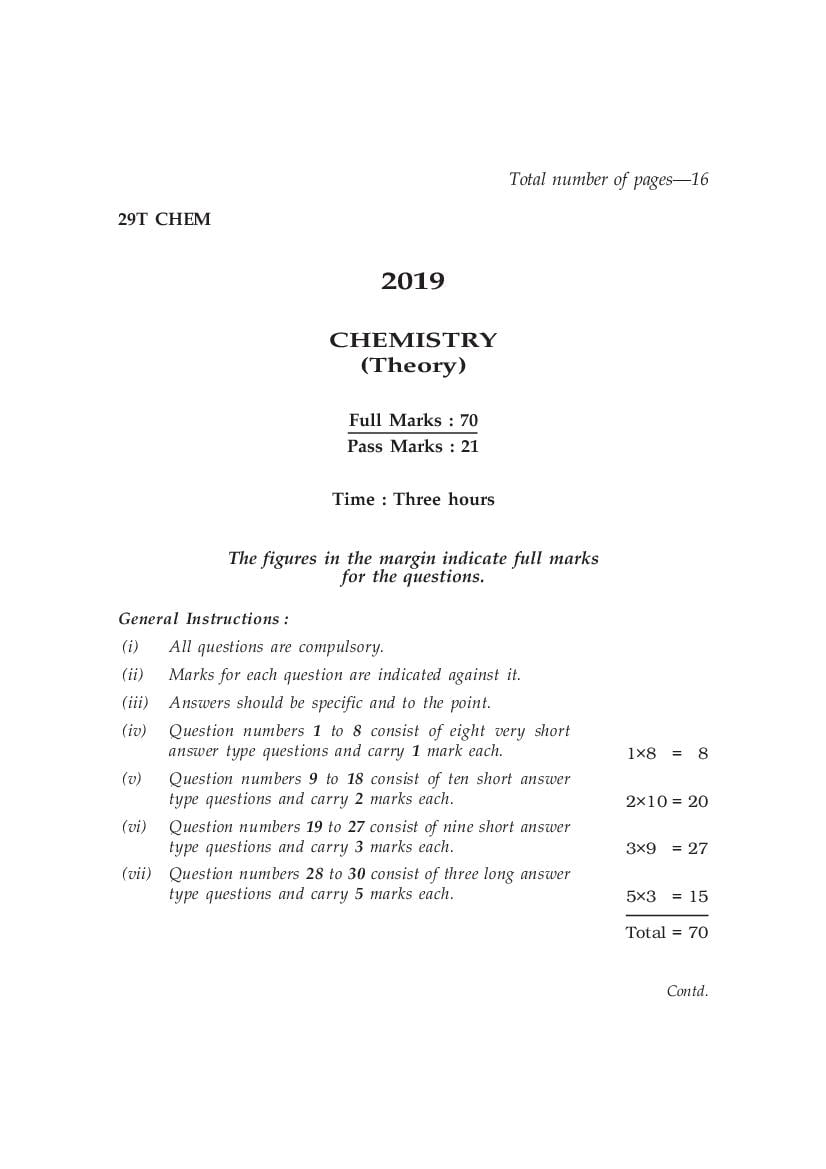
29T CHEM
2019
CHEMISTRY
(Theory)
Full Marks : 70
Pass Marks : 21
Time : Three hours
The figures in the margin indicate full marks
for the questions.
General Instructions :
(i) All questions are compulsory.
(ii) Marks for each question are indicated against it.
(iii) Answers should be specific and to the point.
(iv) Question numbers 1 to 8 consist of eight very short
answer type questions and carry 1 mark each. 1×8 = 8
(v) Question numbers 9 to 18 consist of ten short answer
type questions and carry 2 marks each. 2×10 = 20
(vi) Question numbers 19 to 27 consist of nine short answer
type questions and carry 3 marks each. 3×9 = 27
(vii) Question numbers 28 to 30 consist of three long answer
type questions and carry 5 marks each. 5×3 = 15
Total = 70
Contd.
Page 2
Ó¬˘Ó¬ ά◊À~‡ fl¬1± Œfl¬±ÚÀȬ± Œ˘øȬÂ√1 Œ¬Ûøfl¬— é¬Ó¬± ’±È¬±˝◊Ó¬Õfl¬ Œ¬ıøÂ√ ∑
(a) simple cubic closed packed (ccp) lattice
¸1˘ ‚Úfl¬œ˚˛ øÚ1g™ (ccp) Œ˘øȬÂ√
(b) body-centered cubic (bcc) lattice
˙1œ1 Œfl¬fœÓ¬ ‚Úfl¬œ˚˛ (bcc) Œ˘øȬÂ√
(c) hexagonal closed packed (hcp) lattice
¯∏άˇˆ≈¬Êœ˚˛ øÚ1g™ ¸—fl≈¬ø˘Ó¬ (hcp) Œ˘øȬÂ√
2. Define molality of a solution. 1
¤È¬± ^ª1 ˜À˘ø˘øȬ1 ¸—:± ø˚˛±º
3. For a zero order reaction will the molecularity be equal to zero ? Explain.
1
˙”Ú… Sê˜1 ø¬ıøSê˚˛± ¤È¬±1 ’±Ìøªfl¬Ó¬± (molecularity) ˙”Ú… ˝¬ı ¬¬Û±À1ÀÚ ∑ ¬ı…±‡…± fl¬1±º
4. In the first transition series of elements, which element shows highest
oxidation state ? 1
√õ∂Ô˜ ¸—Sê˜Ì˙œ˘ Œ|Ìœ1 Œ˜Ã˘À¬ı±11 øˆ¬Ó¬1Ó¬ Œfl¬±ÚÀȬ± Œ˜Ã˘˝◊ ¸À¬ı«±2‰¬ ʱ1Ì ’ª¶ö± Œ‡≈ª±˚˛ ∑
5. Write the IUPAC names of [Co(NH3)4Cl(NO2)]Cl and K2 [NiCl4]. 1
[Co(NH3)4Cl(NO2)]Cl ’±1n∏ K2 [NiCl4] Œ˚÷≈Ȭ±1 IUPAC Ú±˜ ø˘‡±º
6. Give one example of globular protein. 1
¬ıÓ«¬≈˘±fl¬±1 √õ∂øȬÚ1 ¤È¬± ά◊±˝1Ì ø˚˛±º
7. The curve showing the variation of adsorption with pressure at constant
temperature is called . (Fill in the blank) 1
ø¶ö1 ά◊¯ûÓ¬±Ó¬ ‰¬±¬Û1 ˘·Ó¬ ’øÒÀ˙±¯∏Ì1 ¬Ûø1¬ıÓ«¬Ú Œ‡≈›ª± ˜±Úfl¬ Œ¬ı±˘± ˝˚˛º
[‡±˘œ ͬ±˝◊ ¬Û≈1Ì fl¬1±]
29T CHEM [2]
Page 3
¬ı≈Ú±-S 1±¬ı±11 ˜Ú혱1¸˜”˝ øfl¬ øfl¬ ∑
9. What is meant by positive deviations from Raoult’s law ? How is the sign of
mix H related to positive deviations from Raoult’s law ? 1+½+½=2
1±Î¬◊åȬ1 ¸”S1 ÒÚ±Rfl¬ ø¬ı‰≈¬…øÓ¬ ‚Ȭ± ¬ı≈ø˘À˘ øfl¬ ¬ı≈ʱ ˚±˚˛∑ 1±Î¬◊åI◊1 ¸”S1 ÒÚ±Rfl¡ ø¬ı‰≈¬…øÓ¬1 Δ¸ÀÓ¬
H ø‰¬˝êÀȬ±1 ¸•Ûfl«¡ øfl¡∑
mix
10. Calculate the mass of compound (molar mass = 256 g mol –1 ) to be dissolved
in 75 g of benzene to lower its freezing point by 0.48 K (Kf = 5.12 K kg mol–1 ).
2
75 g Œ¬ıÚøÊÚ1 ˘·Ó¬ Œfl¬±ÀÚ± ¤È¬± Œ˚÷ [’±Ìøªfl¬ ˆ¬1‘ 256 g mol –1 ] ^¬ıœˆ”¬Ó¬ fl¬ø1À˘ Œ¬ıÚøÊÚ1
ø˝˜±—fl¬ 0.48 K fl¬ø˜ ˚±˚˛ (Kf = 5.12 K kg mol–1 ) º Œ˚÷ÀȬ±1 ˆ¬1 øÚÌ«˚˛ fl¬1±º
1.0 g of a nonelectrolyte solute dissolved in 50g of benzene lowered the
freezing point of benzene by 0.40 K. The freezing point depression constant
of benzene is 5.12 K kg mol–1. Find the molar mass of the solute.
1.0 g ø¬ı≈…» ’ø¬ıÀù≠¯∏… ^±¬ı… ¤È¬± 50g Œ¬ıÚƒøÊÚÓ¬ ^ªœˆ”¬Ó¬ fl¬ø1À˘ Œ¬ıÚƒøÊÚ1 ø˝˜±—fl¬ ’ªÚ˜Ú ˝˚˛
0.40 K. Œ¬ıÚƒøÊÚ1 ø˝˜±—fl¬ ’ªÚ˜Ú ÒËn ªfl¬ Δ˝ÀÂ√ 5.12 K kg mol–1º ^±¬ı…ÀȬ±1 ˜í˘±1 ˆ¬1 øÚÌ«˚˛
fl¬1±º
11. State Faraday’s first law. How much charge in terms of Faraday is required
for the reduction of 1 mole of Cu 2+ to Cu ? 1+1=2
Ù¬±1±Àά1 √õ∂Ô˜ ¸”SÀȬ± ø˘‡±º 1 mole Cu2+ fl¬ Cu Δ˘ ø¬ıʱø1Ó¬ fl¬ø1¬ıÕ˘ øfl¬˜±Ú ¬Ù¬±1±Àά ’±Ò±Ú
(charge) ˘±ø·¬ı ∑
29T CHEM [3] Contd.
Page 4
in concentration and why ?
¤È¬± ø¬ı≈…»ø¬ıÀù≠¯∏… ^ª1 ¬Ûø1¬ı±ø˝Ó¬±1 ¸—:± ø˚˛±º ·±Ï¬ˇÓ¬± fl¬˜±1 ˘À· ˘À· ˝◊ Œfl¬ÀÚÀ1 ’±1n∏ øfl¬˚˛
¬Ûø1¬ıøÓ¬«Ó¬ ˝˚˛ ∑
12. Calculate e.m.f. of the following cell at 298 K : 2
Ó¬˘Ó¬ ø˚˛± Œfl¬±¯∏ÀȬ±1 e.m.f. 1 ˜±Ú 298 K Ó¬ øÚÌ«˚˛ fl¬1± .
2 3
2Cr s 3Fe 0.1 M 2Cr 0.01M 3Fe s
Given : [ø˚˛± ’±ÀÂ√]
E 3
Cr Cr 0.74V &
E 2
Fe Fe 0.44V
What type of a battery is the lead storage battery? Write the anode and the
cathode reactions and the overall reaction occurring in a lead storage battery.
½+1½=2
Œ˘Î¬ ©ÜíÀ1Ê Œ¬ıȬ±1œ øfl¬ √õ∂fl¬±11 Œ¬ıȬ±1œ ∑ Œ˘Î¬ ©ÜíÀ1Ê Œ¬ıȬ±1œÓ¬ ¸—‚øȬӬ Œ˝±ª± ¤Úíά ’±1n∏
Œfl¬Ôíά1 ø¬ıøSê˚˛± ’±1n∏ ¸•Û”Ì« ø¬ıøSê˚˛±ÀȬ± ø˘‡±º
13. For a reaction A B P , the rate is given by — 1½+½=2
Rate = [A][B]2
(i) How is the rate of reaction affected if the concentration of B is doubled ?
(ii) What is the overall order of reaction if A is present in large excess ?
A B P , ø¬ıøSê˚˛±ÀȬ±1 fl¬±1ÀÌ ø˚˛± ’±ÀÂ√ ,
˝±1 = [A][B]2
(i) ˚ø B 1 ·±Ï¬ˇÓ¬± ≈&Ì ˝˚˛, ŒÓ¬øÓ¬˚˛± ø¬ıøSê˚˛±ÀȬ±1 ˝±1 Œfl¬ÀÚÕfl¬ ¬Ûø1ªÓ«¬Ú ˝¬ı ∑
(ii) ˚ø A1 ά◊¬Ûø¶öøÓ¬ ¬ıUÓ¬ Œ¬ıøÂ√ ˝˚˛ ŒÓ¬ÀôL√ ø¬ıøSê˚˛±ÀȬ±1 ˜≈ͬ Sê˜ øfl¬˜±Ú ˝¬ı ∑
29T CHEM [4]
Page 5
For a reaction : 2NH3 (g) N2 (g) + 3H2 (g) 1+1=2
Rate = k ;
(i) Write the order and molecularity of this reaction.
(ii) Write the unit of k.
Pt
¤˝◊ ø¬ıøSê˚˛±ÀȬ±1 fl¬±1ÀÌ . 2NH3 (g) N2 (g) + 3H2 (g)
˝±1 = k ;
(i) ø¬ıøSê˚˛±ÀȬ±1 Sê˜ ’±1n∏ ’±Ìøªfl¬Ó¬± ø˘‡±º
(ii) k-1 ¤fl¬fl¬ ø˘‡±º
14. What are alloys ? Name the metals used for the formation of bronze.
1+1=2
¸—fl¬1 Ò±Ó≈¬ øfl¬ ∑ ¬ıË?1 ·Í¬ÚÓ¬ ¬ı…ª˝+Ó¬ Ò±Ó≈¬Àfl¬˝◊Ȭ±1 Ú±˜ ø˘‡±º
2 salts are coloured. Give reason.
15. Zn 2 salts are colourless while Cu
2
2
Zn 2 ˘¬ı̸˜”˝ ¬ı1Ì˝œÚ ’±Ú˝±ÀÓ¬ Cu ˘¬ı̸˜”˝ 1„œÚº fl¬±1Ì À˙«±ª±º
Calculate the number of unpaired electrons in Cr 3+ and V 3+ ions.
3+
Cr ’±1n∏ V 3+ ’±˚˛ÚÓ¬ Ôfl¬± ’˚≈¢¨ ˝◊À˘"™√Ú1 ¸—‡…± ·ÌÚ± fl¬1±º
16. How will you convert the following (any two) ? Give chemical equations
only. 1+1=2
Ó¬˘Ó¬ ø˚˛±À¬ı±1 Œfl¬ÀÚÀ1 ¬Ûø1ªÓ«¬Ú fl¬ø1¬ı± [ø˚Àfl¬±ÀÚ± ≈Ȭ±] ∑ Œfl¬ª˘ 1±¸±˚˛øÚfl¬ ¸˜œfl¬1Ì ø˚˛±º
(i) Ethane to bromoethene
˝◊ÀÔÚ1 ¬Û1± ¬ıËí˜í ˝◊øÔÚÕ˘
29T CHEM [5] Contd.
Page 6
Œ¬ıÚøÊÚ1 ¬Û1± ¬ı±˝◊øÙ¬Ú±˝◊˘Õ˘
(iii) Aniline to chlorobenzene
¤øÚø˘Ú1 ¬Û1± ¬flv¬í1íÀ¬ıÚøÊÚÕ˘
17. Give reasons : 2
fl¬±1Ì À˙«±ª± .
(a) n-Butyl bromide has higher boiling point than t-Butyl bromide.
n-ø¬ıά◊Ȭ±˝◊˘ ¬ıË혱˝◊ά1 ά◊Ó¬˘±—fl¬ t-ø¬ıά◊Ȭ±˝◊˘ ¬ıË혱˝◊ά1 ά◊Ó¬˘±—fl¬Ó¬Õfl¬ Œ¬ıøÂ√º
(b) Racemic mixture is optically inactive.
Œ1ø‰¬˜œ˚˛ ø˜| ’±À˘±fl¬œ˚˛ˆ¬±À¬ı øÚø©ç¬˚˛º
What are ambident nucleophiles ? Give two examples of it.
¤ø•§ÀάKȬ øÚά◊øflv¬’íÙ¬±˝◊˘ øfl¬ ∑ ˝◊˚˛±1 ≈Ȭ± ά◊±˝1Ì ø˚˛±º
18. Answer the following questions : (any one)
Ó¬˘1 √õ∂ùüÀfl¬˝◊Ȭ±1 ά◊M1 ø˚˛± . [ø˚Àfl¡±ÀÚ± ¤È¬±]
(i) Give reason for the higher boiling point of ethanol in comparison to
methoxymethane. 2
˝◊Ô±Ú˘1 ά◊Ó¬˘±—fl¬ ø˜Ôø'ø˜ÀÔÚ1 Ó≈¬˘Ú±Ó¬ øfl¬˚˛ Œ¬ıøÂ√ fl¬±1Ì À˙«±ª±º
(ii) Aniline does not undergo Friedel-Crafts reaction. Why ? 2
¤øÚø˘ÀÚ øÙˬÀά˘-Sê±Ùƒƒ¬È¬ ø¬ıøSê˚˛± ‚Ȭ±¬ı ŒÚ±ª±À1º øfl¡˚˛∑
29T CHEM [6]
Page 7
the total number of voids in 0.5 mol of it ? How many of these are
tetrahedral voids ? 2
¤È¬± Œ˚÷˝◊ ¯∏άˇˆ≈¬Êœ˚˛ øÚ1g™ ¸—fl≈¬ø˘Ó¬ (hcp) ·Í¬Ú1 ¸‘ø©Ü fl¬À1º ¤˝◊ Œ˚÷ÀȬ±1 0.5 mol Ó¬
˜≈ͬÀÓ¬ øfl¬˜±ÚȬ± 1g™ ’±ÀÂ√ ∑ ˝◊˚˛±À1 øfl¬˜±ÚȬ± ‰¬Ó≈¬Ù«¬˘fl¬œ˚˛ 1g™ ∑
(b) What is the formula of a compound in which the element Y forms cubic
closed packed (ccp) lattice and atoms of X occupy l/3rd of tetrahedral
voids ? 1
Œfl¬±ÀÚ± ¤È¬± Œ˚÷Ӭ Y ’Ì≈Àª ‚Úfl¬œ˚˛ øÚ1g™ ¸—fl≈¬ø˘Ó¬ (ccp) ·Í¬Ú1 ¸‘ø©Ü fl¬À1 ’±1n∏ X
’Ì≈Àª ‰¬Ó≈¬Ù«¬˘fl¬œ˚˛ 1g™1 ¤fl¬ Ó‘¬Ó¬œ˚˛±—˙ [l/3] ’øÒfl¬±1 fl¬À1º Œ˚÷ÀȬ±1 ¸—Àfl¬Ó¬ øÚÌ«˚˛
fl¬1±º
Calculate the packing efficiency of a simple cubic lattice. 3
¤È¬± ¸1˘ ‚Ú±fl‘¬øÓ¬ Œ˘øȬÂ√ 1 ¬Û≈?œfl¬1Ì é¬Ó¬± ·ÌÚ± fl¬1±º
20. (a) What will be the effect of temperature on rate constant ? 1
ø¬ıøSê˚˛±1 ·øÓ¬ ÒËn ªfl¬1 ›¬Û1Ó¬ ά◊¯ûÓ¬±1 √õ∂ˆ¬±ª Œfl¬ÀÚ ˝√√¬ı∑
(b) A first order reaction has a rate constant of 102 s 1 . How much time
will be taken for 20g of the reactant to be reduced to 5g ?
2
¤È¬± √õ∂Ô˜ Sê˜1 ø¬ıøSê˚˛±1 ·øÓ¬ ÒËn∏ªfl¡1 ˜±Ú 102 s1 º ¤˝◊√ ø¬ıøSê˚˛±Ó¬ ø¬ıøSê˚˛±Ê±Ó¬ ¬Û±Ô«
20g 1 ¬Û1± 5g Δ˘ ˝}√±¸ ˝√√¬ıÕ˘ øfl¡˜±Ú ¸˜˚˛ ˘±ø·¬ı∑
21. What are the differences between physisorption and chemisorption ? Give
reason why a finely divided substance is more effective as an adsorbent.
2+1=3
Œˆ¬ÃøÓ¬fl¬ ’øÒÀ˙±¯∏Ì ’±1n∏ 1±¸±˚˛øÚfl¬ ’øÒÀ˙±¯∏Ì1 √¬Û±Ô«fl¬… øfl¬ øfl¬ ∑ Œ¬ıøÂ√Õfl¬ &øάˇ fl¬1±¬ ¬Û±Ô« øfl¬˚˛
’øÒÀ˙±ø¯∏Ó¬ ¬Û±Ô« ø˝‰¬±À¬Û Œ¬ıøÂ√ fl¬±˚«fl¬1œ ∑
29T CHEM [7] Contd.
Page 8
isotherm write the expression for absorption of gases on solids in the form
of an equation. 1+2=3
’øÒÀ˙±¯∏Ì ’±˝◊Â√íÔ±˜« fl¬±fl¬ Œ¬ı±À˘ ∑ ŒÙˬGø˘fl¬ ’øÒÀ˙±¯∏Ì ’±˝◊Â√íÔ±˜«1 ¸˝±˚˛ Δ˘ Œ·Â√1 ’øÒÀ˙±¯∏Ì1
’øˆ¬¬ı…øMêÀȬ± ¸˜œfl¬1Ì ø˝‰¬±À¬Û ø˘‡±º
22. Explain role of the following in the processes mentioned :
1½+1½=3
(i) Depressant in froth floatation process
(ii) Limestone in the metallurgy of iron.
ά◊À~‡ fl¬1± ¬ÛXøÓ¬À¬ı±1Ó¬ Ó¬˘Ó¬ ø˚˛± ^ª…À¬ı±11 ˆ”¬ø˜fl¬± ¬ı…±‡…± fl¬1± .
(i) ŒÙ¬Ú ›¬Û„Ú ¬ÛXøÓ¬Ó¬ øÚ•ßfl¬±1œ ^ª…
(ii) ’±˝◊ 1Ú1 Ò±Ó≈¬ø¬ı…±Ó¬ ‰”¬Ìø˙˘º
Write short notes on : 1½+1½=3
(i) Zone refining
(ii) Froth floatation process
‰¬˜≈ ŒÈ¬±fl¡± ø˘‡± –
(i) Ê√í Ú ø1Ù¬±˝◊√øÚ—
(ii) ŒÙ¬Ú ›¬Û„√√Ú ¬ÛXøÓ¬
29T CHEM [8]
Page 9
Ó¬˘Ó¬ ø˚˛±À¬ı±11 ά◊M1 ø˚˛± .
(a) Noble gases have very low boiling points. Why ? 1
¸z±ôL√ Œ·Â√¸˜”˝ 1 ά◊Ó¬˘±—fl¬ ’Ó¬…ôL√ fl¬˜º øfl¬˚˛ ∑
(b) Copper does not dissolve in HCl while it does dissolve in HNO3.
Explain. 2
fl¬í¬Û±1 HCl Ó¬ ^ªœˆ”¬Ó¬ Ú˝˚˛ øfl¬c HNO3 Ó¬ ^ªœˆ”¬Ó¬ ˝˚˛º ¬ı…±‡…± fl¬1±º
24. Explain the following with an example : 1½+1½=3
ά◊±˝1̸˝ Ó¬˘Ó¬ ø˚˛±À¬ı±1 ¬ı…±‡…± fl¬1± .
(i) Kolbe’s reaction.
fl¬í{§1 ø¬ıøSê˚˛±º
(ii) Reimer-Tiemann reaction.
Œ1˝◊˜±1-øȬÀ˜Ú ø¬ıøSê˚˛±º
(i) A Grignard reagent reacts with methanal to form
CH 3 CH CH 2 OH
|
CH 3
Identify the Grignard reagent. 1
¤È¬± ø¢∂·Ú±Î«¬1 ø¬ıfl¬±1Àfl¬ ø˜Ô±ÀÚ˘1 ˘·Ó¬ ø¬ıøSê˚˛± fl¬ø1 CH 3 C| H CH 2 OH
CH 3
ά◊»¬Ûiß fl¬À1º ø¢∂·Ú±Î«¬1 ø¬ıfl¬±1fl¬ÀȬ± ø‰¬Ú±Mê fl¬1±º
29T CHEM [9] Contd.
Page 10
ø¬ıøSê˚˛±ÀȬ±1 Ú±˜ ø˘‡± .
OH OH
CHO
CHCI3 + aq. NaOH
H
(iii) Write IUPAC names of the following ether. 1
Ó¬˘Ó¬ ø√˚˛± ˝◊√Ô±11 IUPAC Ú±˜ÀȬ± ø˘‡±º
H3 C CH3
OC2H5
25. What happens when — 1+1+1=3
øfl¬ ‚ÀȬ, Œ˚øÓ¬˚˛± —
(i) Cyclohexanecarbaldehyde reacts with PhMgBr and then H3O+.
‰¬±˝◊flv¬íÀ˝À'Úfl¬±À¬ı«˘øά˝±˝◊1 Δ¸ÀÓ¬ PhMgBr ’±1n∏ H3O+ Œ˚˛ ø¬ıøSê˚˛± fl¬À1º
(ii) Carbonyl compound is treated with zinc - amalgam and concentrated
hydrochloric acid.
fl¬±¬ı«øÚ˘ Œ˚÷fl¬ øÊ—fl¬ ¤˜±˘·±˜ ’±1n∏ ·±Ï¬ˇ ˝±˝◊Eíflv¬ø1fl¬ ¤øÂ√ά1 ¬Z±1± ø¬ıøSê˚˛± ‚Ȭ±À˘ øfl¬
˝¬ı ∑
(iii) Write the major and minor product of ‘Bromination of anisole in
ethanoic acid medium’.
˝◊√Ô±Úø˚˛fl¡ ¤ø‰¬Î¬ ˜±Ò…˜Ó¬ ¤øÚÂ√˘1 ¬ıËí ø˜ÀÚÂ√Ú ø¬ıøSê˚˛±Ó¬ ά◊»¬Ûiß Œ˝√√±ª± ˜≈‡… ’±1n∏ Œ·ÃÌ
ø¬ıøSê˚˛±Ê√±Ó¬ ¬Û√±Ô« Œfl¡˝◊√Ȭ± ø˘‡±º
29T CHEM [ 10 ]
Page 11
derivative, reduces Tollens’ reagent and undergoes Cannizzaro reaction. On
vigorous oxidation, it gives 1, 2-benzenedicarboxylic acid. Identify the
compound. 3
C9H10O ’±Ìøªfl¬ ¸”S1 ¤È¬± Δʪ ’Ì≈Àª 2, 4-DNP ŒÎ¬ø1Àˆ¬øȬˆƒ¬ ·Í¬Ú fl¬À1, ø˚ ȬÀ˘k1
ø1¤ÀÊ∞I◊fl¬ ø¬ıʱø1Ó¬ fl¬À1 ’±1n∏ Œfl¬øÚ7¬¬¬±1í ø¬ıøSê˚˛± Œ‡≈ª±˚˛º Ó¬œ¬ıˈ¬±À¬ı ʱø1Ó¬ fl¬1±1 ¬Û±Â√Ó¬ ˝◊
1, 2-Œ¬ıÚøÊÚά±˝◊fl¬±¬ı«ø'ø˘fl¬ ’•° øÀ˚˛º Œ˚÷ÀȬ± øÚÌ«˚˛ fl¬1±º
26. Identify the product of the following reactions : (any two) 1½+1½=3
Ó¬˘Ó¬ ø˚˛± ø¬ıøSê˚˛±À¬ı±11 ø¬ıøSê˚˛±Ê±Ó¬ ¬Û±Ô«À¬ı±1 ø‰¬Ú±Mê fl¬1± . [ø˚Àfl¡±ÀÚ± ≈√Ȭ±]
( i ) H N NH 2
(a) CH 3 C O 2 ?
|
( ii ) KOH / Glycol ,
CH 3
NaOH I 2
(b) C 2 H 5 CO CH 3 ?
O
|| conc. KOH ?
(c) 2
C
CH 3 H
27. Give one chemical test to distinguish between the following pairs of
compounds : 1½+1½=3
(i) Methylamine and dimethylamine
(ii) Aniline and benzylamine
29T CHEM [ 11 ] Contd.
Page 12
(i) ø˜Ô±˝◊˘¤˜±˝◊Ú ’±1n∏ ά±˝◊ø˜Ô±˝◊˘¤˜±˝◊Ú
(ii) ¤øÚø˘Ú ’±1n∏ Œ¬ıÚʱ˝◊˘¤˜±˝◊Ú
Account for the following :
(i) Ethylamine is soluble in water whereas aniline is not.
(ii) Methylamine in water reacts with ferric chloride to precipitate hydrated
ferric oxide.
Ó¬˘Ó¬ ø˚˛±À¬ı±11 ¬ı…±‡…± ’±·¬ıÀϬˇ±ª± .
(i) ˝◊Ô±˝◊˘¤˜±˝◊Ú ¬Û±ÚœÓ¬ ^ªœˆ”¬Ó¬ ˝˚˛ øfl¬c ¤øÚø˘Ú Ú˝˚˛º
(ii) ¬Û±ÚœÓ¬ ø˜Ô±˝◊˘¤˜±˝◊ÀÚ ŒÙ¬ø1fl¬flv¬í1±˝◊ά1 Δ¸ÀÓ¬ ø¬ıøSê˚˛± fl¬ø1 Ê˘˚≈Mê ŒÙ¬ø1fl¬ ’í'±˝◊ά1
’Ò–Àé¬¬Û Œ¬Û˘±˚˛º
28. Answer the following questions :
Ó¬˘Ó¬ ø˚˛±À¬ı±11 ά◊M1 ø˚˛± .
(a) In which classes, the polymers are classified on the basis of molecular
forces ? 2
’±Ìøªfl¬ ¬ı˘1 ’±Ò±1Ó¬ Œ|Ìœø¬ıˆ¬±ÊÚ fl¬1± ¬ıUÀ˚±·œÀ¬ı±1 Œfl¬±ÚÀfl¡˝◊√Ȭ± Œ|̜Ӭ ¬ÛÀ1 ∑
(b) Sleeping pills are recommended to patient suffering from sleeplessness
but it is not advisable to take them without consulting the doctor. Justify.
1
ά±Mê√À1 øÚ^±˝œÚÓ¬±Ó¬ ˆ≈¬ø· Ôfl¬± Œ1±·œfl¬ ŒÈ¬±¬ÛøÚ ’Ú± ¬ıøάˇ ¢∂˝Ì1 ¬Û1±˜˙« øÀ˚˛, øfl¬c
ά±Mê11 ¬Û1±˜˙« ’ø¬ı˝ÀÚ ˝◊˚˛±fl¬ ¢∂˝ Ì fl¬1± ά◊ø‰¬Ó¬ Ú˝˚˛º ˚≈øMê ø˚˛±º
29T CHEM [ 12 ]
Page 13
Œ¬∏C—fl≈¬˝◊˘±˝◊ʱ1 ¬ı± ¸≈5fl¬±1œ øfl¬ ∑ ¤È¬± ά◊±˝1Ì ø˚˛±º
(d) Name one chemical responsible for the antiseptic property of Dettol.
1
ŒÎ¬È¬˘1 ¬ıœÊ±Ì≈¬ı±1fl¬ Ò˜« Œ‡≈›ª± 1±¸±˚˛øÚfl¬ ^¬ı… ¤È¬±1 Ú±˜ ø˘‡±º
29. Answer the following :
Ó¬˘1 √õ∂ùüÀ¬ı±11 ά◊M1 fl¬1± .
(a) What happens when sulphur dioxide gas is passed through
acidified potassium permanganate solution ? Write equation. 1
¤øÂ√ά ø˜ø|Ó¬ ¬ÛȬ±øÂ√˚˛±˜ ¬Û±1˜±—À·ÀÚȬ ^ª1 ˜±ÀÊø Â√±˘Ù¬±1 ά±˝◊ ’'±˝◊ά Œ·Â√ ¬Ûøͬ˚˛±À˘
øfl¬ ˝¬ı ∑ ø¬ıøSê˚˛±ÀȬ± ø˘‡±º
(b) Draw the structure of the following molecule and mention its shape :
2
XeF4
Ó¬˘Ó¬ ø˚˛± ’Ì≈ÀȬ±1 ·Í¬Ú-¸—Àfl¬Ó¬ ’“±øfl¬ Ó¬±1 ’±fl‘¬øÓ¬¬ ά◊À~‡ fl¬1± –
XeF4
(c) Complete the following reactions : (any two) 2
Ó¬˘1 ø¬ıøSê˚˛±À¬ı±1 ¸•Û”Ì« fl¬1± . [ø˚Àfl¬±ÀÚ± ≈Ȭ±]
(i) PCl3 + H2O
?
(ii) XeF6 + H2O
?
(iii) P4 + SO2Cl2
?
29T CHEM [ 13 ] Contd.
Page 14
as reducing agent. Why ? 2
H2S Œ˚˛ Œfl¬ª˘ ø¬ıʱ1fl¬ ø˝‰¬±À¬Û øSê˚˛± fl¬À1 ’±Ú˝±ÀÓ¬ SO2 Œ˚˛ ʱ1fl¬ ’±1n∏ ø¬ıʱ1fl¬
ά◊ˆ¬˚˛ˆ¬±Àª øSê˚˛± fl¬À1, øfl¬˚˛ ∑
(b) Describe the manufacture of ammonia by Haber’s process with
favourable conditions. 3
Œ˝¬ı±11 ¬ÛXøÓ¬À1 ¤˜íøÚ˚˛±1 ά◊»¬Û±Ú ’Ú≈fl”¬˘ ‰¬Ó«¬¸˜”˝ 1 Δ¸ÀÓ¬ ¬ı…±‡…± fl¬1±º
30. Answer the following questions :
Ó¬˘1 √õ∂ùüÀ¬ı±11 ά◊M 1 fl¬1± .
(a) Specify the oxidation numbers of the metals in the following
coordination entities : ½×4=2
Ó¬˘Ó¬ ø˚˛± ¸˜i§˚˛œ Œ˚÷1 Ò±Ó≈¬ø¬ı˘±fl¬1 ʱ1Ì ¸—‡…± øÚÌ«˚˛ fl¬1± .
(i) Co H 2O CN en2 2
(ii) CoBr2 en2
(iii) PtCl 4 2
(iv) K 3 Fe CN 6
29T CHEM [ 14 ]
Page 15
Why polysaccharides are called non-sugars ? 3
fl¬±¬ı«í˝±˝◊ÀEȬÀ¬ı±1 øfl¬ ∑ fl¬±í¬ı«˝±˝◊ÀEȬÀ¬ı±11 ¸±Ò±1Ì ¸—Àfl¬Ó¬ ø˘‡±º ¬Ûø˘À‰¬fl¬±1±˝◊άÀ¬ı±1fl¬
øfl¬˚˛ ’Ú±-˙fl«¬1± Œ¬ı±˘± ˝˚˛ ∑
———— ×————
29T CHEM [ 15 ]
Page 16
Document Details
| Board / Org | Assam Board |
| Exam | Class 12 |
| Type | Question Paper |
| Pages | 16 |
| Updated | 09 Jun 2026 |