Uttrakhand Board Class 11 Syllabus 2020-21 (Deleted)
Finished viewing? Save it for later —
Download Uttrakhand Board Class 11 Syllabus 2020-21 (Deleted) (PDF · 28 pages)About Uttrakhand Board Class 11 Syllabus 2020-21 (Deleted)
Uttrakhand Board Class 11 Syllabus 2020-21 (Deleted) is available here for free download. Published by Uttarakhand Board for Class 11, this syllabus can be viewed online or downloaded as a PDF (28 pages). Candidates preparing for Class 11 can use Uttrakhand Board Class 11 Syllabus 2020-21 (Deleted) to understand the exam pattern, the type of questions asked, and the overall difficulty level.
Frequently Asked Questions
How can I download Uttrakhand Board Class 11 Syllabus 2020-21 (Deleted)?
Open this page and click the Download button to save Uttrakhand Board Class 11 Syllabus 2020-21 (Deleted) as a PDF. It is completely free on AglaSem Docs.
Is Uttrakhand Board Class 11 Syllabus 2020-21 (Deleted) free to download?
Yes. Uttrakhand Board Class 11 Syllabus 2020-21 (Deleted) can be viewed online and downloaded as a PDF free of cost on AglaSem Docs.
How many pages does Uttrakhand Board Class 11 Syllabus 2020-21 (Deleted) have?
Uttrakhand Board Class 11 Syllabus 2020-21 (Deleted) contains 28 pages, which you can read online or download together as a single PDF.
Where can I find more Class 11 study material?
You can find more Class 11 question papers, sample papers, syllabus, and answer keys on AglaSem Docs.
Uttrakhand Board Class 11 Syllabus 2020-21 (Deleted) – Text
Read the full text of this syllabus below — useful to quickly search, copy and reference the content online without downloading the PDF.
📄 View text version (28 pages)
Page 1
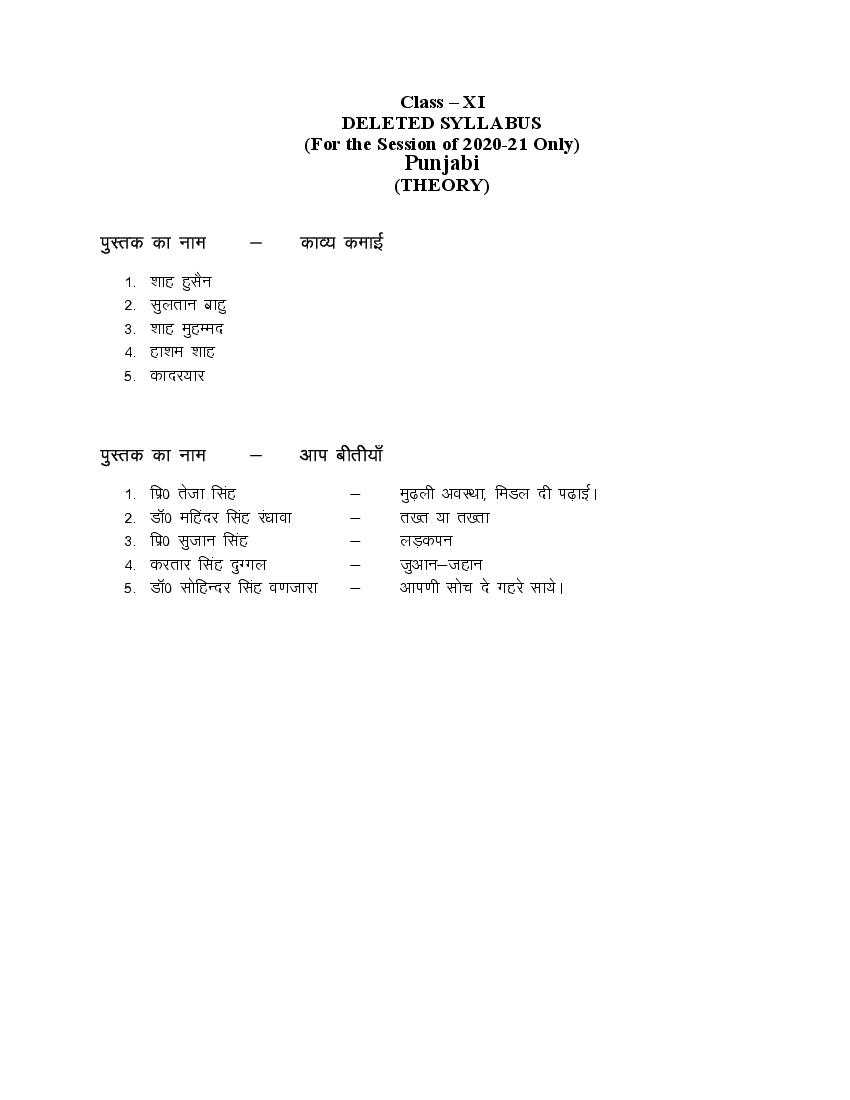
iqLrd dk uke & dkO; dekbZ
1- “kkg gqlSu
2- lqyrku ckgq
3- “kkg eqgEen
4- gk”ke “kkg
5- dknj;kj
iqLrd dk uke & vki chrh;k¡
1- fiz0 rstk flag & eq<+yh voLFkk] feMy nh i<+kbZA
2- MkW0 efganj flag ja/kkok & r[r ;k r[rk
3- fiz0 lqtku flag & yM+diu
4- djrkj flag nqXxy & tqvku&tgku
5- MkW0 lksfgUnj flag o.ktkjk & vki.kh lksp ns xgjs lk;sA
Page 2
PART- I
Unit- 1
1& lSU; foKku % ifjp;
2& lSU; foKku dk vU; fo’k;ksa ls lEcU/k
¼v½ vFkZ”kkL= ¼c½ euksfoKku
PART- II
Unit- 3 Hkkjr rFkk mlds iM+kslh
9& Hkkjr&ckaXykns”k lEcU/k
10& Hkkjr&Jhyadk lEcU/k
PART- III
Unit- 4 lSU; euksfoKku
14& ny&Hkkouk
PART- IV
Unit- 7 fldUnj dk vkxeu rFkk ekS;Zdkyhu lSU; i)fr
5& dkSfVY; dk ;q) n”kZu
Geology
Page 3
1- ifjp;
Unit- III
2- fgeknh& Hkw&oSKkfud dk;Z mRrjk[k.M ds izeq[k fgeun rFkk izeq[k Hkw&vkd`fr;kaA
3- Okk;q& Hkw& oSKkfud dk;ZA
Unit- IV lapjpukRed HkwxHkZ foKku
4- ifjHkk’kk & dBksjrk] vkisf{kr ?kuRo] ped] pki>hyA
la{ksi esa fVIi.kh& ufr] LVªkbd] iad fonj fly rFkk MkbdA
Unit- VI fØLVy foKku
5- fØLVy dh ifjHkk’kk
6- fØLVy ds ckgjh y{k.k % :i] fdukjk] dks.k rFkk fLFkfrA
7- laf{kIr fVIi.kh % 1- vUr% [kafMr Qyd
2- lefefr dsUnz
3- lekUkkUrj ‘kVQyd
Page 4
Part A: Financial Accounting - I
Unit 1: Introduction to Accounting
Qualitative characteristics of Accounting information-reliability, relevance,
understandability and comparability.
Unit 2: Theory Base of Accounting
Cost Concept, Conservatism, Materiality
Accounting Standards- Concept
Bases of Accounting - Cash Basis, Accrual Basis
Unit 3: Recording of Business Transactions
preparation of Accounting vouchers
Recording of Transactions: Special Purpose Books:
i) Purchases Book, Sales Book, Purchase Returns Book, Sales Returns Book
Unit 4: Trial Balance and Rectification of Errors
Errors: compensating errors; errors not affecting Trial Balance.
Detection and Rectificition of Errors (One Sided and Two Sided)
Unit 5: Depreciation, Provisions and Reserves
Method of recording depreciation-charging to asset account, creating provision for
depreciation/accumulated depreciation account; Treatment of disposal of asset.
types of Reserves: Revenue Reserve, Capital Reserve, General Reserve, Specific
Reserve and Secret Reserves.
Unit 6: Accounting for Bills of Exchange Transactions
Negotiation, Endorsement
Accounting treatment of trade bills and accomodation bills.
Page 5
Unit 7: Financial Statements
Capital Expenditure and Deferred Revenue Expenditure
Balance Sheet: Vertical Presentation of Financial Statements.
provision for discount on debtors, manager's commission.
Unit 8: Accounts from incomplete records
Conversion method.
Unit 9: Computers in Accounting
Applications of computers in accounting:
- data exchange with other information systems
Highlighting advantages and limitations of automation
Tailor-made accounting system.
Unit 10: Accounting and Database System
Queries and reports in the context of Accounting System.
Page 6
Section – A
Writing Skills : Advertisements
Applied Grammer
1- Ism ki Qismein : Marafa, Nakra.
2- Sifat ki Qismein : Zati, Nisbati, Adadi, Miqdari.
Section – B
Prose
Book I : Abbu Khan Ki Bakri By Dr Zakir Husain.
Kahaniyan : (i) Poori jo kadhai se nikal bhagi.
(ii) Murghi Ajmer Chali.
(iii) Murghi ka nirala bachcha.
(iv) Usi se thanda usi se garam.
(v) Aao ghar ghar khelein.
Book II : Dehli ka Yadgar Mushaira by Farhatullah Beg.
Chapter : (i) Takmeel.
(ii) Taqdeer.
Page 7
UNIT 1: COMPUTER FUNDAMENTALS
Software Concepts:
Commonly used operating systems
LINUX, Windows, BhartiOO, Solaris, UNIX;
Number System : Binary, Octal, Decimal, Hexadecimal and conversion between two different
number systems;
Internal Storage encoding of Characters: ASCII, ISCII (Indian scripts Standard Code for
Information Interchange), and UNICODE;
Microprocessor : Basic concepts, Clock speed (MHz, GHz), 16 bit, 32 bit, 64 bit processors; Types
– CISC, RISC;
Input Output Ports / Connections: Serial, Parallel and Universal Serial Bus, PS-2 Port, Infrared
port, Bluetooth.
UNIT 4: PROGRAMMING IN C++
User Defined Functions:
Defining a function; function prototype, Invoking/calling a function, passing arguments to
function, specifying argument data types, default argument, constant argument, call by value, call
by reference, returning values from a function, calling functions with arrays, scope rules of
functions and variables; local and global variables;
User-defined Data Types
Need for User defined data type:
Defining a symbol name using typedef keyword and defining a m acro using #define directive;
Structures:
Passing structure of Functions as value and reference argument/parameter, Function returning
structure, Array of structures, passing an array of structure as an argument/ a parameter to a
function.
Page 8
[k.M ¼v½ f”k{kk fl}kUr&
1- bdkbZ 1 & izLrkouk & f”k{kk dk Lo:i&vkSipkfjd ,oa vukSipkfjd A
3- bdkbZ 3 & f”k{kk ds vfHkdj.k& LFkkuh; laLFkk,a] jkT;A
4 bdkbZ 4 & f”k{kk iz.kkfy;k¡& MkYVu] izkstsDVA
[k.M ¼c½ f”k{kk euksfoKku
7 bdkbZ 7 & vf/kxe& lEc) izR;korZu ,oa vuqdj.k dk fl}kURkA
8- bdkbZ 8 & izfRkHkk”kkyh ,oa fiNM+s ckydA
Page 9
I. Diversity in Living World
Classification of the living organisms (five kingdom classification, major groups and
principles of classification within each kingdom).
Systematics
Plant (major groups; Angiosperms up to class) classification, Botanical gardens, herbaria,
zoological parks and museums.
II. Structural Organisation in Animals and Plants
Morphology, anatomy and functions of different parts of flowering plants: Root, stem, leaf,
inflorescence, flower, fruit and seed.
An insect (cockroach)
IV. Plant Physiology
Movement of water, food, nutrients and gases, Plants and Water Mineral nutrition,
Plant growth and development.
V. Human Physiology
Digestion and absorption.
Locomotion and movement.
Neural control and coordination,
BUSINESS STUDIES
Page 10
Unit 2: Forms of Business Organisations
Choice of form of business organizations
Unit 3: Private, Public & Global Enterprises
Global Enterprises : meaning and features,Joint ventures- meaning, benefits
Unit 4: Business Services
Postal and Telecom services
Unit 5: Emerging Modes of Business
Outsourcing- concept, need and scope
Unit 6: Social Responsibility of Business and Business Ethics
Business ethics: concept and elements.
Part B: Organisation, Finance and Trade
Unit 8: Sources of Business Finance
Borrowed funds
Unit 10: Internal Trade
Types of Retail Trade:
- Itinerant retailers and fixed shops.
Unit 11: International Business
Export-Import Procedures and documentation. Foreign Trade Promotion.
Nature and importance of Export Processing,WTO
Page 11
dsoy d`f’k oxZ Hkkx & 1
¼fo’k; dksM & 134½
d`f’k & “kL; foKku
izFke iz”u&i=
QkeZ dh lk/kkj.k Qlysa & dikl] Tokj] cktjk] ewaxQyh] lw;Zeq[kh] rEckdwA
fefV~V;ka& fefV~V;ksa dh mRifRr] feV~Vh dh jpuk ij HkkSfrd ,oa jklk;fud dkjdksa dk izHkkoA
Hkwfe laj{k.k dh fofHkUu fof/k;ksa ds ewy fl)kUrA
tSo rFkk vtSo [kknas] Qlyksa rFkk fefV~V;ksa ij muds izHkko lEcU/kh vUrj] [kkn rFkk moZjdksa
ds ds Mkyus dh fof/k;ka] xkscj dh [kkn rFkk dEIkksLV [kkn dk laj{k.kA
1- i;kZoj.k dh lkekU; tkudkjhA
2- vk/kqfud d`f’k dk i;kZoj.k ij izHkkoA
¼c½ ugj }kjk flpkbZ vkSj tyØkfUr ¼okVj ykWfxax½A
3- Hkwfe iz;ksx tula[;k nckoA
dsoy d`f’k oxZ Hkkx & 1 ds fy;s
¼fo’k; dksM & 135½
¼d`f’k& ouLifr foKku½
f}rh; iz”u&i=
Page 12
4 fu’kspu& fØ;k fof/k dk v/;;u ,oa fMfu’kspu dk egRoA
5 Qy dk izdh.kZuA
6 cht dh lajpuk rFkk vadqj.kA
7 vUr% vdkfjdh& dksf”kdk foHkktu ¼fe;kfll½ dksf”kdkvkas dk mRkd ds :i esa laxBu] i.kZ dh
vkUrfjd vkdkfjdh f}cht i=h LrEHk vkSj ewy esa f}rh; o`f} ¼Secondary Growth)A
8 & ¼d½ ty dk ikS/kksa }kjk vUrxzg.k ewy dh lajpukA
¼x½ dkoZu Lokaxhdj.k
¼M-½ “olu ds izk:i vkSj dk;ZA
9 {ks=h; m|ku ds lkekU; ikS/kksa ds okuLifrd ¼y{k.kksa dk v/;;u½ dqdqjfonslh] ekYcslhA
10 lw{e tSfodksa dk izkjfEHkd v/;;u&
¼d½ ok;jlA
¼x½ QatkbZA
¼M-½ tUrq ¼lw{e½
dsoy d`f’k oxZ Hkkx & 1 ds fy;s
¼fo’k; dksM & 136½
¼d`f’k& HkkSfrd ,oa tyok;q foKku½
r`rh; iz”u&i=
Page 13
dksf”kRo RkFkk cy] ruko] ok;q e.Myh; nkc] ok;qnkcekih] ?kuRo cksryA
?k’kZ.k vkSj mlds fu;eksa ds ljy mnkgj.kA lk/kkj.k iEiksa dk dk;Z pkyu] m’ek] laokgdrkZ]
vkisf{kd m’ek] fefV~V;ksa ds fo”ks’k lanHkZ esaA
lw{en”khZ vojDRk] ijkcSXkuh rFkk n`”; fofdj.k ij izkjfEHkd fopkjA
fo|qr izkFkfed rFkk lapk;d lsy] iksLV vkWfQl ckWDl] foHkoekih dk laf{kIRk v/;;uA
dsoy d`f’k oxZ Hkkx & 1 ds fy;s
¼fo’k; dksM & 137½
¼d`f’k vfHk;a=.k½
prqFkZ iz”u&i=
d`f’k ;aU=ksa dks cukus esa iz;ksx gksus okys yksgk] ydM+h] IykfLVd rFkk fVu fo”ks’krk RkFkk xq.k&nks’k
dk v/;;uA
2& gy& dsej gy] ;w0ih0 ua0&1 rFkk ;w0ih0 ua0&2 gyA
3& ¼v½ vU; d`f’k ;U=& [kqjpjh ¼LØij½ ikVk] cypfyr dVkbZ ;U=] “kfDr pkfyr Fkzslj] vkslkbZ
ia[kk ds fofHkUu Hkkx ,oa muds dk;ZA
5& ¼v½ Vjokbu iEi] lcefLkZoy ¼tyIyouh;½ iEiA
¼c½ fo|qr eksVj dh cukoV] “kfDr mRiUu djus dh dk;Z fof/kA
¼l½ d`f’k eas rkykc] dqavk] uydwi dk egRo] fuekZ.k fof/k] dek.M {ks= ,oa j[k&j[kkoA
dsoy d`f’k oxZ Hkkx & 1 ds fy;s
¼fo’k; dksM & 138½
¼d`f’k& xf.kr rFkk izkjfEHkd lkaf[;dh½
iape iz”u&i=
chtxf.kr& y?kq xq.kdksa dk O;ogkfjd Kku] gjkRed Jsf.k;ka Øe lap; rFkk lap;A
fdlh Hkh fpUg vkSj eki ds dks.k ds fy, foRrh; QyuA
Page 14
Bksl T;kfefr& xksykA
funs”kkad T;kfefr& f=Hkqtksa ds {ks=Qy ljy js[kkvksa ,oa o`Rrksa ;k muds lehdj.kksa ls vkys[kuA
ek/;] fopyu rFkk ekud fopyuA
Page 15
Foundations of Psychology
Unit VI : Learning
Concept learning, Transfer of learning, Learning styles; Some Applications of learning
principles.
Unit VII : Human Memory
Knowledge representation and organisation in memory.
Page 16
B. UNDERSTANDING SOCIETY
Unit 6: Structure, Process and Stratification
Social Structure
Social Processes: Cooperation, Competition, Conflict
Social Stratification: Class, Caste, Race, Gender.
Unit 8: Environment And Society
Ecology and Society
Environmental Crises and Social Responses
Page 17
UNIT-I: SETS AND FUNCTIONS
1. Sets :
Difference of sets. Complement of a set.
2. Relations & Functions:
(upto R x R x R). Sum, difference, product and quotients of functions.
3. Trigonometric Functions:
General solution of trigonometric equations of the type sinØ = sin α, cosØ= cosα and
tanØ= tan α
.UNIT-II: ALGEBRA
1. Principle of Mathematical Induction:
Processes of the proof by induction, motivating the application of the method by looking at
natural numbers as the least inductive subset of real numbers. The principle of
mathematical induction and simple applications.
2. Complex Numbers and Quadratic Equations:
Polar representation of complex numbers.
4- Permutations & Combinations:
derivation of formulae
5- Binomial Theorem:
History, statement and proof of the binomial theorem for positive integral indices. Pascal's
triangle, General and middle term in binomial expansion, simple applications.
6- Sequence and Series:
Sum to n terms of the special series ∑n, ∑n and ∑n .
2 3
UNIT-III: COORDINATE GEOMETRY
2- Conic Sections:
a point, a straight line and pair of intersecting lines as a degenerated case of a conic
section.
UNIT-V: MATHEMATICAL REASONING
1. Mathematical Reasoning:
Mathematically acceptable statements. Connecting words/ phrases - consolidating the
understanding of "if and only if (necessary and sufficient) condition", "implies", "and/or",
Page 18
to real life and Mathematics. Validating the statements involving the connecting words
difference between contradiction, converse and contra positive.
UNIT-VI: STATISTICS & PROBABILITY
1. Statistics:
Analysis of frequency distributions with equal means but different variances.
2. Probability:
Axiomatic (set theoretic) probability, connections with the theories of earlier classes.
Page 19
Book I : Indian Constitution at Work
UNIT TOPICS
7 Federalism (Completely Deleted)
Local Governments
These topics are deleted from this unit:
8
Why do we need Local Governments ?
Growth of Local Government in India.
Book II : Political Theory
16 Secularism (Completely Deleted)
17 Nationalism (Completely Deleted)
18 Citizenship (Completely Deleted)
Page 20
Unit II: Know myself : Issues related to adolescents
Important developmental tasks: Preparing for career; reproductive health and prevention of
anemia.
Population Education : Desire for male child; small family norms.
Unit III : Nutrition for Self and Family
Maximum nutritive value from food by proper selection, preparation, cooking and storage:
Preparation of food; loss of nutrients during preparation of food and their minimization
Method of enhancing nutritive value-germination, fermentation, fortification and proper food
combination.
Unit IV: My Resources
Resources: need to manage the resources; methods of conservation of shared resources.
Management: decision making and its role in management.
Time and energy management: work simplification: meaning and methods; role of different
members of the family in efficient running of a home.
Unit V: My Apparel
Fabric Construction: effect of weaves on appearance, durability and maintenance of garment.
Finishing: special: mercerisation, shrinkage control, water proofing
Page 21
Part A : Statistics for Economics
Unit 3: Statistical Tools and Interpretation
Measures of Dispersion - (range, quartile deviation, mean deviation); (co-efficient of quartile-
deviation, co-efficient of mean deviation,);
Correlation - Spearman’s rank correlation.
Introduction to Index Numbers - Index of industrial production
Page 22
Part A: Fundamentals of Physical Geography
Unit-2: The Earth
Origin and evolution of the earth.
Unit-3: Landforms
Landforms and their evolution
Unit 4: Climate
Pressure- Pressure belts; winds-planetary, seasonal and local; air masses
and fronts; tropical and extratropical cyclones.
World Climates- Classification (Koeppen), greenhouse effect, global
warming and climatic changes.
Unit 5: Water (Oceans)
Hydrological Cycle.
Oceans - distribution of temperature and salinity
Part B. India - Physical Environment
Unit 9: Physiography
Structure and Relief;
Unit 10: Climate, Vegetation and Soil
Indian monsoon: mechanism, onset and withdrawal, variability of rainfalls :
spatial and temporal; Climatic types (koeppen)
Unit 11: Natural Hazards and Disasters: Causes, Consequences and Management
(One case study to be introduced for each topic)
Floods and droughts
Earthquakes and Tsunami
Cyclones
Landslides
Page 23
THEMES IN WORLD HISTORY
S.No. Topics Theme Deleted Portion
(according to Book)
1 From the Beginning of time Theme - 1 Complete Chapter
2 Nomadic Empires Theme - 5 Complete Chapter
3 Confrontation of Cultures Theme - 8 Complete Chapter
` No Change in Map Work
Page 24
l= 2020&21 gsrq ikB~;Øe ls fuEufyf[kr v/;k; gVk fn, x, gS %&
d{kk&11 ikB~;iqLrd&HkkLorh v/;k;&¼1½ oL=foØ;%
¼2½ ;n~Hkwrfgra rRlR;e~
¼3½ l es fiz;%
¼4½ vFk f”k{kka izo{;kfe
Page 25
Unit I: Physical World and Measurement
Physics - scope and excitement; nature of physical laws; Physics, technology and society.
Unit II: Kinematics
Frame of reference. Motion in a straight line: Position-time graph, speed and velocity.
Unit III: Laws of Motion
Intuitive concept of force. Inertia, Newton’s first law of motion; momentum and Newton’s second
law of motion; impulse; Newton’s third law of motion.
Unit V: Motion of System of Particles and Rigid Body
Statement of parallel and perpendicular axes theorems and their applications.
Unit VI: Gravitation
Keplar’s laws of planetary motion. Acceleration due to gravity
Unit VII: Properties of Bulk Matter
Elastic behaviour, Shear, modulus of rigidity, Heat, temperature, Heat transfer-conduction,
convection and radiation.
Unit VIII: Thermodynamics
Heat engines and refrigerators.
Unit X: Oscillations and Waves
Fundamental mode and harmonics, Doppler effect.
Page 26
Unit I: Some Basic Concepts of Chemistry
Natureof matter, laws of chemical combination. Dalton’s atomic theory: concept of elements,
atoms and molecules.
Unit II: Structure of Atom
Discovery of electron, proton and neutron; atomic number, isotopes and isobars. Thomson’s
model and its limitations, Rutherford’s model and its limitations.
Unit III: Classification of Elements and Periodicity in Properties
Significance of classification, brief history of the development of periodic table.
Unit V: States of Matter: Gases and Liquids
Liquefaction of gases, critical temperature. Liquid State - Vapour pressure, viscosity and surface
tension (qualitative idea only, no mathematical derivations).
Unit VI: Thermodynamics
Heat capacity and specific heat, criteria for equilibrium.
Unit VII: Equilibrium
Hydrolysis of salts (elementary idea).
Unit VIII: Redox Reactions
Applications of redox reactions.
Unit X: s- Block Elements (Alkali and Alkaline earth metals)
Preparation and properties of some important compounds:
Sodium carbonate, sodium chloride, sodium hydroxide and sodium hydrogen carbonate,
biological importance of sodium and potassium. CaO, CaCO3 and industrial use of lime and
limestone, biological importance of Mg and Ca
Unit XI: Some p-Block Elements
General Introduction to p-Block Elements
Group 13 elements: Some important compounds: borax, boric acids, boron hydrides.
Aluminium: uses, reactions with acids and alkalies.
Group 14 elements: Carbon; uses of some important compounds: oxides.
Important compounds of silicon and a few uses: silicon tetrachloride, silicones, silicates
and zeolites.
Unit XII: Organic Chemistry - Some Basic Principles and Techniques
Methods of qualitative and quantitative analysis.
Unit XIII: Hydrocarbons
Classification of hydrocarbons
Free radical mechanism of halogenation, combustion and pyrolysis.
Unit XIV: Environmental Chemistry
Environmental pollution - air, water and soil pollution, chemical reactions in atmosphere, smog,
major atmospheric pollutants; acid rain, ozone and its reactions, effects of depletion of ozone
layer, greenhouse effect and global warming - pollution due to industrial wastes; green
chemistry as an alternative tool for reducing pollution, strategy for control of environmental
pollution.
Page 27
l= 2020&21 gsrq ikB~;Øe ls fuEufyf[kr ikB gVk fn, x, gS %&
dkO; [k.M ¼vkjksg Hkkx& 1½ f=ykspu & paik dkys dkys vPNj ugha phUgrh
vDd egknsoh & ¼d½ gs Hkw[k! er epy]
¼[k½ gs esjs twgh ds Qwy tSls
bZ”oj
vorkj flag ik”k&lcls [krjukd
x| [k.M ¼vkjksg Hkkx& 1½ lR;ftr jk; & viw ds lkFk <+kbZ lky
lS;n gSnj jtk & vkRek dk rki
jke ujs”k f=ikBh & ifFkd
ckyeqdqan xqIr & fonkbZ laHkk’k.k
eUuw HkaMkjh & jtuh
laLd`r izcksf/kuh ¼Hkkx& 1½ iz”uksÙkj&fouksn%
izk.ksH;% laLd`fr% Js’Bk
of.kxoS|;ks% okrkZyki%
Page 28
Writing
Letters to the editor (giving suggestions/opinions on an issue)
Application for a job with a bio-data or resume
Article & Report Writing
Grammer
Modals
Clauses
Error Correction, editing task
Literature
HORNBILL
1. Father To Son
2. The Adventure
SNAPSHOTS
1. The Ghat of the Only World
2. The Tale of Melon City
Document Details
| Board / Org | Uttarakhand Board |
| Exam | Class 11 |
| Type | Syllabus |
| Pages | 28 |
| Updated | 22 Jul 2026 |