Uttrakhand Board Class 11 Syllabus 2020-21
Finished viewing? Save it for later —
Download Uttrakhand Board Class 11 Syllabus 2020-21 (PDF · 60 pages)About Uttrakhand Board Class 11 Syllabus 2020-21
Uttrakhand Board Class 11 Syllabus 2020-21 is available here for free download. Published by Uttarakhand Board for Class 11, this syllabus can be viewed online or downloaded as a PDF (60 pages). Candidates preparing for Class 11 can use Uttrakhand Board Class 11 Syllabus 2020-21 to understand the exam pattern, the type of questions asked, and the overall difficulty level.
Frequently Asked Questions
How can I download Uttrakhand Board Class 11 Syllabus 2020-21?
Open this page and click the Download button to save Uttrakhand Board Class 11 Syllabus 2020-21 as a PDF. It is completely free on AglaSem Docs.
Is Uttrakhand Board Class 11 Syllabus 2020-21 free to download?
Yes. Uttrakhand Board Class 11 Syllabus 2020-21 can be viewed online and downloaded as a PDF free of cost on AglaSem Docs.
How many pages does Uttrakhand Board Class 11 Syllabus 2020-21 have?
Uttrakhand Board Class 11 Syllabus 2020-21 contains 60 pages, which you can read online or download together as a single PDF.
Where can I find more Class 11 study material?
You can find more Class 11 question papers, sample papers, syllabus, and answer keys on AglaSem Docs.
Uttrakhand Board Class 11 Syllabus 2020-21 – Text
Read the full text of this syllabus below — useful to quickly search, copy and reference the content online without downloading the PDF.
📄 View text version (60 pages)
Page 1
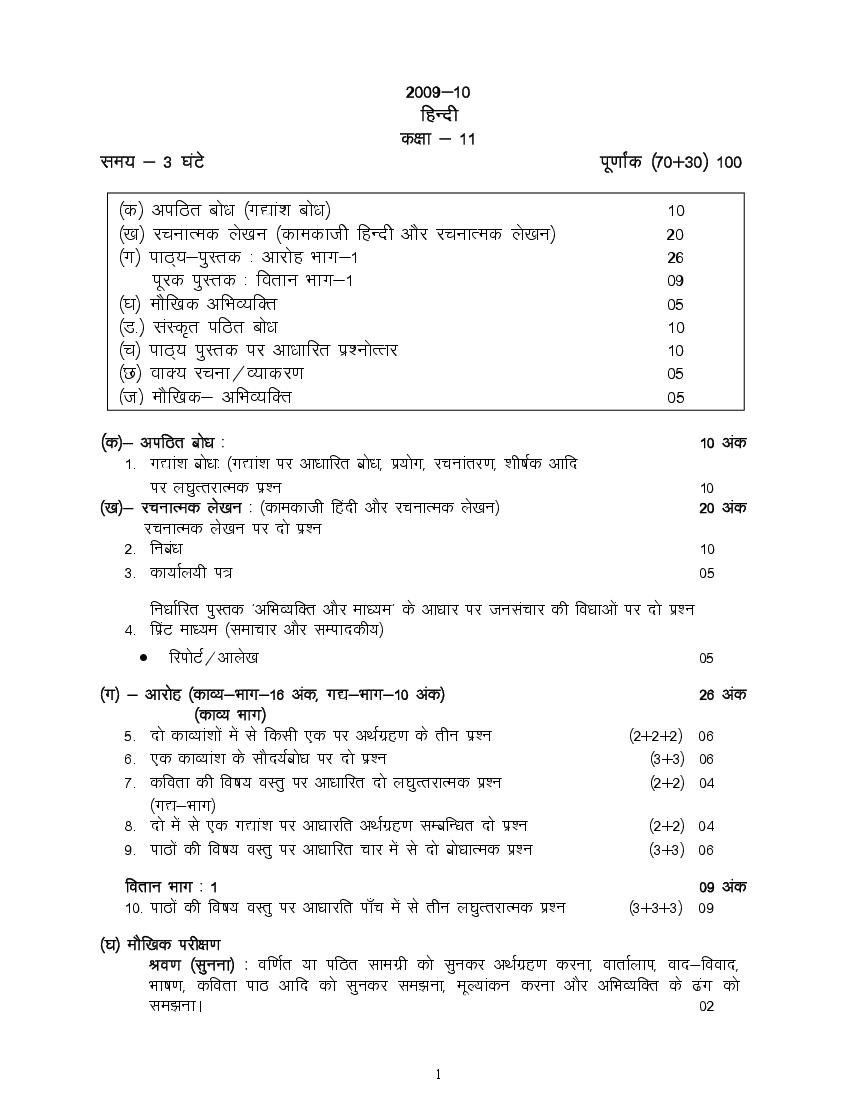
fgUnh
d{kk & 11
le; & 3 ?kaVs iw.kkZad ¼70$30½ 100
¼d½ vifBr cks/k ¼x|ka”k cks/k½ 10
¼[k½ jpukRed ys[ku ¼dkedkth fgUnh vkSj jpukRed ys[ku½ 20
¼x½ ikB~;&iqLrd % vkjksg Hkkx&1 26
iwjd iqLrd % forku Hkkx&1 09
¼?k½ ekSf[kd vfHkO;fDr 05
¼M-½ laLd`r ifBr cks/k 10
¼p½ ikB~; iqLrd ij vk/kkfjr iz”uksRRkj 10
¼N½ okD; jpuk@O;kdj.k 05
¼t½ ekSf[kd& vfHkO;fDRk 05
¼d½& vifBr cks/k % 10 vad
1- x|ka”k cks/k% ¼x|ka”k ij vk/kkfjr cks/k] iz;ksx] jpukarj.k] “kh’kZd vkfn
ij y?kqRrjkRed iz”u 10
¼[k½& jpukRed ys[ku % ¼dkedkth fganh vkSj jpukRed ys[ku½ 20 vad
jpukRed ys[ku ij nks iz”u
2- fuca/k 10
3- dk;kZy;h i= 05
fu/kkZfjr iqLrd ^vfHkO;fDr vkSj ek/;e^ ds vk/kkj ij tulapkj dh fo/kkvksa ij nks iz”u
4- fizaV ek/;e ¼lekpkj vkSj lEikndh;½
fjiksVZ@vkys[k 05
¼x½ & vkjksg ¼dkO;&Hkkx&16 vad] x|&Hkkx&10 vad½ 26 vad
¼dkO; Hkkx½
5- nks dkO;ka”kksa esa ls fdlh ,d ij vFkZxzg.k ds rhu iz”u ¼2$2$2½ 06
6- ,d dkO;ka”k ds lkSn;Zcks/k ij nks iz”u ¼3$3½ 06
7- dfork dh fo’k; oLrq ij vk/kkfjr nks y?kqRrjkRed iz”u ¼2$2½ 04
¼x|&Hkkx½
8- nks esa ls ,d x|ka”k ij vk/kkjfr vFkZxzg.k lEcfU/kr nks iz”u ¼2$2½ 04
9- ikBksa dh fo’k; oLrq ij vk/kkfjr pkj esa ls nks cks/kkRed iz”u ¼3$3½ 06
forku Hkkx % 1 09 vad
10- ikBksa dh fo’k; oLrq ij vk/kkjfr ik¡p esa ls rhu y?kqRrjkRed iz”u ¼3$3$3½ 09
¼?k½ ekSf[kd ijh{k.k
Jo.k ¼lquuk½ % of.kZr ;k ifBr lkexzh dks lqudj vFkZxzg.k djuk] okrkZyki] okn&fookn]
Hkk’k.k] dfork ikB vkfn dks lqudj le>uk] ewY;kadu djuk vkSj vfHkO;fDr ds <ax dks
le>ukA 02
1
Page 2
vFkok ?kVuk lqukuk] ifjp; nsuk] Hkkokuqdwy laokn&okpu 03
[k.M M- & laLd`r ifBr cks/k 10 vad
1- laLd`r ikB~;iqLrd ds iznRRk x|ka”k ij vk/kkfjr i¡kp y?kwRrjh; iz”uksa esa
ls rhu iz”uksa ds mRrj ¼2$2$2½ 06
ikB~;iqLrd ds iznRr “yksd ij vk/kkfjr pkj y?kqRrjh; iz”uksa esa ls nks iz”uksa
ds mRrj ¼2$2½ 04
[k.M p& laLd`r ikB~;&iqLrd ij vk/kkfjr iz”uksRrj 10 vad
ikB~;iqLrdksa ds ikBksa ij vk/kkjfr vkB y?kqRrjh; iz”uksa esa ls ik¡p iz”uksa ds
laLd`r esa iw.kZ okD;ksa esa mRrj ¼2$2$2$2$2½ 10
[k.M N& laLd`r okD; jpuk 05 vad
lqcUr frM-Ur vO;; vkfn ls lEcfU/kr N% inksa esa ls rhu inksa dks ysdj
laLd`r esa rhu okD;ksa dh jpuk djukA 3
gy ¼O;atu½ lfU/k& Lrks%”pquk”pq% ‘Vquk’Vq%] eksbuqLokj% 2
[k.M t& ekSf[kd vfHkO;fDr 05 vad
fgUnh ikB~;Øekuqlkj
okrkZyki dh n{krk,¡%
okrkZyki dh n{krkvksa dk ewY;kadu fujarjrk ds vk/kkj ij ijh{kk ds le; gksxkA
Jo.k ¼lquuk½ fVIi.kh dk ewY;kadu %
ijh{kd fdlh izklafxd fo’k; ij ,d vuqPNsn dk Li’V okpu djsxkA vuqPNsn] rF;kRed ;k
lq>kokRed gks ldrk gSA vuqPNsn YkxHkx 250 “kCnksa dk gksuk pkfg,A ijh{kd@v/;kid dks
lqurs&lqurs ijh{kkFkhZ vyx dkxt ij fn;s gq, Jo.k&cks/k ds vH;klksa dks gy dj ldsaxsA
okpu ¼cksyuk½ dk EkwY;kadu %
1- fp=ksa ds Øe ij vk/kkfjr o.kZu % bl Hkkx esa vis{kk dh tk;sxh fd fooj.kkRed Hkk’kk dk iz;ksx
djsaA
2- fdlh fp= dk o.kZu % fp= yksxksa ;k LFkkuksa ds gks ldrs gSaA
3- fdlh fu/kkZfjr fo’k; ij cksyuk] ftlls fo|kFkhZ@ijh{kkFkhZ vius O;fDrxr vuqHko dk izR;kLej.k
dj ldsA
4- dksbZ dgkuh lquuk ;k fdlh ?kVuk dk o.kZu djukA
fVIIk.kh%
ijh{k.k ls iwoZ ijh{kkFkhZ dks dqN rS;kjh ds fy, le; fn;k tk,A
fooj.kkRed Hkk’kk esa orZeku dky esa iz;ksx vko”;d gSA
fu/kkZfjr fo’k; ijh{kkFkhZ ds vuqHko&txr ds gksa tSls&
dksbZ pqVdqyk ;k gkL; izlax lqukukA
gky esa i<h+ iqLrd ;k ns[ks flusek dh dgkuh lqukukA
tc ijh{kkFkhZ cksyuk vkjEHk dj ns arks ijh{kd de ls de gLr{ksi djsaA
2
Page 3
¼bl ckr dk fu”p; djuk fd D;k fo|kFkhZ esa Jo.k vkSj okpu dh fuEufyf[kr ;ksX;rk,¡ gSaA½
Jo.k ¼lquuk½ okpu ¼cksyuk½
fo|kFkhZ esa & fo|kFkhZ esa &
1- ifjfpr lanHkksZa esa iz;qDr “kCnksa vkSj inksa dks 1- dsoy vyx&vyx “kCnksa vkSj inks ads
le>us dh lkekU; ;ksX;rk gS fdUrq og iz;ksx dh ;ksX;rk iznf”kZr djrk gS fdUrq
lqlac) vk”k; dks ugha le> ikrkA ,d lqlac) Lrj ij ugha cksy ldrkA
2- NksVs lEc) dFkuksa dks ifjfpr lanHkksZa esa 2- ifjfpr lanHkksZa dks dsoy NksVs lac) dFkuksa
le>us dh ;ksX;rk gSA dk lhfer “kq)rk ls iz;ksx djrk gSA
3- ifjfpr ;k vifjfpr nksuksa lanHkksZa esa dfFkr 3- vis{kkd`r nh?kZ Hkk’k.k esa vf/kd tfVy
lwpuk dks Li’V le>us dh ;ksX;rk gSA dFkuksa ds iz;ksx dh ;ksX;rk iznf”kZr djrk
gS] vHkh Hkh dqN v”kqf);ka djrk gS ftlls
izs’k.k esa :dkoV vkrh gSA
4- nh?kZ dFkuksa dh J`[kyk dks i;kZIr “kq)rk 4- vifjfpr fLFkfr;ksa esa fopkjksa dks rkfdZd
ls le>us vkSj fu’d’kZ fudky ldus dh <ax ls laxfBr dj /kkjk izokg :i esa
;ksX;rk gSA izLrqr djrk gS ftuls izs’k.k esa :dkoV
ugha vkrhA
5- tfVy dFkuksa ds fopkj&fcUnqvksa dks 5- mn~ns”; vkSj Jksr ds fy, mi;qDr “kSyh
le>us dh ;ksX;rk iznf”kZr djus dh {kerk dks viuk ldrk gS] dsoy ekewyh xyfr;k¡
gS] og mn~ns”; ds vuqdwy lquus dh djrk gSA
dq”kyrk iznf”kZr djrk gSA
fu/kkZfjr iqLrdsa %
1- vkjksg Hkkx & 1
2- forku Hkkx & 1
3- vfHkO;fDr vkSj ek/;e
4- laLd`r ikB~;&iqLrd&izcksf/kuh Hkkx & 1
fuEufyf[kr ikBksa dk ewY;kadu ugha fd;k tk;sxk %&
1& vkjksg Hkkx&1 & 1- vkRek dk rki
2- vIiw ds lkFk <kbZ lky
3- f=ykspu dh dfork
2& forku Hkkx&1 & 1- yrk eaxl s dj
3
Page 4
ikB~;Øe ls 30 izfr”kr dh dVkSrh fuEuor~ dh tkrh gS%&
Class – XI
DELETED SYLLABUS
(For the Session of 2020-21 Only)
HINDI
(THEORY)
dkO; [k.M ¼vkjksg Hkkx& 1½ f=ykspu & paik dkys dkys vPNj ugha phUgrh
vDd egknsoh & ¼d½ gs Hkw[k! er epy]
¼[k½ gs esjs twgh ds Qwy tSls
bZ”oj
vorkj flag ik”k&lcls [krjukd
x| [k.M ¼vkjksg Hkkx& 1½ lR;ftr jk; & viw ds lkFk <+kbZ lky
lS;n gSnj jtk & vkRek dk rki
jke ujs”k f=ikBh & ifFkd
ckyeqdqan xqIr & fonkbZ laHkk’k.k
eUuw HkaMkjh & jtuh
laLd`r izcksf/kuh ¼Hkkx& 1½ iz”uksÙkj&fouksn%
izk.ksH;% laLd`fr% Js’Bk
of.kxoS|;ks% okrkZyki%
4
Page 5
ENGLISH
Class XI
One paper 3 Hours Marks: 100
Unitwise Weightage
Marks
Unit/Areas of Learning
A. Reading Unseen Passages (Two) 20
B. Writing 20 50
C. Grammar 10
D. Textual Questions
(i) Textbook 30 40
(ii) Supplementary Reader 10
E. Conversation Skills
(i) Listening 05 10
(ii) Speaking 05
SECTION-A
Reading unseen Passages for comprehension and Note-making 20 Marks
Two unseen passages with a variety of questions including 05 marks for vocabulary such as
word formation and inferring meaning. The total length of both the passages together should be
around 1100 words.
1. The passages could be any of the following two type:
2. (a)Factual Passages e.g. instructions, descriptions, reports.
(b) Discursive passage involving opinion e.g. argumentative, persuasive.
SUMMARY - Class XI
Unseen No of words Testing Areas Marks
Passages allotted
1. 12 marks around 600 Short answer type questions to test local, 10
global and inferential comprehension
Vocabulary 02
2. 08 marks around 500 Note-making in an appropriate format 05
Vocabulary 03
One of the passages should have about 600 words carrying 12 marks, the other passage
should have about 500 words carrying 8 marks.
The passage carrying 08 marks should be used for testing note-making for 5 marks and
testing vocabulary for 3 marks. Vocabulary for 2 marks may be tested in the other passage
carrying 12 marks.
5
Page 6
WRITING 20 Marks
3. One out of two tasks such as a factual description of any event or incident,
a report or a process based on verbal input provided (80-100 words). 04
4. One out of two compositions based on a visual and/or verbal input 08
(in about 100-150 words). The output may be descriptive or
argumentative in nature such as an article for publication in a
newspaper or a school magazine or a speech.
5. Writing one out of two letters based on given input. Letter 08
types include (a) business or official letters (for making enquiries,
registering complaints, asking for and giving information, placing
orders and sending replies); (b) letters to the editors (giving
suggestions, opinions on an issue of public interest) or (c)
application for a job.
SECTION C
GRAMMAR 10 Marks
Different grammatical structures in meaningful contexts will be tested. Item types will
include gap-filling, sentence-reordering, dialogue-completion and sentence-transformation.
The grammar syllabus will include the following areas:
6. Determiners, Tenses, Clauses, Modals and Error Correction 04
7. Editing Task 04
8. Reordering of sentences 02
SECTION D
TEXTUAL QUESTIONS 40 Marks
Questions on the prescribed textbooks will test comprehension at different levels: literal,
inferential and evaluative based on the following prescribed text books:
1. Hornbill : Text book.
2. Snapshots : Supplementary Reader,.
English Reader 30 Marks
9. One out of two extracts based on poetry from the text to test 04
comprehension and appreciation.
10. Two out of three short answer questions from the poetry section to 06
test local and global comprehension of text (upto 30 words).
11. Five out of six short answer questions on the lessons from 2x5=10
prescribed text (upto 30 words)
12. One out of two long answer type questions based on the text 10
6
Page 7
(Expected word limit would be about 100-125 words each)
Supplementary Reader 10 Marks
13. One out of two long answer type questions based on 04
Supplementary Reader to test comprehension of theme,
character and incidents. (upto 100 words)
14. Two out of three short answer questions from the 3+3 = 06
Supplementary Reader (upto 30 words)
dksfoM 19 egkekjh ds dkj.k “kSf{kd l= 2020&21 gsrq fo’k;& vaxzsth ¼d{kk&11½ esa mijksDr
ikB~;Øe ls 30 izfr”kr dh dVkSrh fuEuor~ dh tkrh gS%&
Class – XI
DELETED SYLLABUS
(For the Session of 2020-21 Only)
ENGLISH
(THEORY)
Writing
Letters to the editor (giving suggestions/opinions on an issue)
Application for a job with a bio-data or resume
Article & Report Writing
Grammer
Modals
Clauses
Error Correction, editing task
Literature
HORNBILL
1. Father To Son
2. The Adventure
SNAPSHOTS
1. The Ghat of the Only World
2. The Tale of Melon City
7
Page 8
Page 9
laLd`r
d{kk&11
,de~ iz”ui=e~ vof/k% gksjk=;e~ iw.kkZadk % 100
vfLeu~ iz”ui=s pRokj %% [k.Mk% Hkfo’;fURk
[k.M% ^^d^^ vifBrka”k&vocks/kue~ 10
[k.M% ^^[k^^ jpukReddk;Ze~ 15
[k.M% ^^x^^ vuqiz;qDrO;kdj.ke~ 25
[k.M% ^^?k^^ 50
¼v½ ifBr&vocks/kue~ 35
¼c½ laLd`rlkfgR;sfrgklL; ifjp;% 15
izfr[k.Ma foLr`rfooj.ke~
[k.M% ^d^
¼vifBrka”kkocks/kue~½
v³~dk% 10
80&100 “kCnifjfer% ,d ljy% vifBr% x|ka”k%A laLd`rlkfgR;ifjpk;da fo’k;oLrq L;kr~A
iz”uoSfo/;e~
i. ,dinsu mRrje~ 02
ii. iw.kZokD;su mRrje~ 02
iii. okD;s drZ̀fØ;k&inp;ue~ 01
iv. loZukeLFkkus laKkiz;ksx% 01
v. fo”ks’k.k&fo”ks’;@i;kZ;@foyksekfnp;ue~ 02
vi. leqfpr”kh’kZdiznkue~ 02
[k.M% ^[k^
¼laLd`rsu jpukReda fyf[krdk;Ze~½
v³~dk% 15
1- vukSipkfjda i=ke@izkFkZuki=ke~ 05
2- y?kqdFkk ¼”kCnlwphlkgk¸;su] fjDrLFkkuiwfrZ&ek/;esu½@okrkZykis ,di{kiwj.ke 05
3- fp=kef/kd`R;@fufnZ’V”kCnlwphlkgk¸;su ¼ladsrk/kkfjre~½ vuqPNsnys[kue~ 05
9
Page 10
¼vuqiz;qDrO;dj.ke~~½
v³~dk% 25
1- ¼v½ o.kkZuke% mPpkj.kLFkkue~ 02
¼vk½ orZuh 02
o.kZfo;kstue~] o.kZla;kstue~
2- lfU/k%& ikB~;iqLrdsa iz;qDrinkuka lfU/kPNsn% lfU/kdj.ke~ 03
LojlfU/k%& nh?kZ%] xq.k%] o`f)] ;.k~] v;kfn%] izd`frHkko%
O;atulfU/k& “pqRo] ‘VqRo] t”Ro] ‘kRo] .kRofo/kkue~] vuqLokj%] ijlo.kZ%
folxZlfU/k& lRo] mRo] :Ro] yksi%] folxZLFkkus l~] “k~] ‘k~A
3- “kCn:ikf.k 05
okD;s’kq lfoHkfDRkdiz;ksx%
¼d½ vtUrk%& ckyd] QYk] jek] dfo] ifr] efr] okfj] unh] f”k”kq] /ksuw]
e/kq] o/kq] fir`] ekr`] drZ` ,oa lekukUrjiz;ksxk%A
¼[k½ gyUrk%& jktu~] xPNr~] Hkor~] vkReu~] fo}l~] pUnzel~] okp~ ,oa lekukUrjiz;ksxk%A
¼x½ loZukekfu& loZ] ;r~] rr~] fde~] bne~] ¼f=k’kq fy³~xs’kq½ vLen~] ;q’en~
¼?k½ la[;kokpd”kCnk%& ,dla[;kr% nlla[;ki;ZUre~ ¼f=k’kq fy³xs’kq½ ,dr% “kri;ZUra la[;kKkue~
4 /kkrq:ikf.k& ¼yV~] y~V] yksV~] Yk³~] fof/kfy³~ bfr½ iapydkjs’kq v/kksfyf[kr/kkrquka@
lekukFkZd/kkrwuka okD;s’kq iz;ksx%A 05
¼d½ ijLeSifnu%& Hkw] iB~] xe~] fy[k~] ik] LFkk] n`”k] vl~] dFk] Hk{k] ?kzk] Øq/k] gu~]
Jq] u`r~] Li`”k] pqj~] dFkA
¼[k½ vkReusifnu%& yHk~] lso~] eqn] ;kp~A
¼x½ mHk;ifnu%& d`] â] fØ] Kk] xzg~] “kd~] ¼dsoya yV~&y`V&ydkj;ks%½
5 dkjd& miinfoHkfDriz;ksx% 05
6 lkekU;&okP;& ifjorZue ¼dsoya yV~&ydkjs½ 03
10
Page 11
iw.kkZad % 50
Hkkx% ¼ i½ 35
¼ifBrka”k vocks/kue~~½
ifBrlkexzh&vocks/kue~
1- ¼v½ va”k=k;e~ 15
,d% x|ka”k%] ,d% i|ka”k% rFkk ,d% ukV~;ka”k%] ¼5$5$5½
ikB~;ka”k&vk/kkfjre~ iz”uoSfo/;e~
,dinsu mRrje~ 01
iw.kZokD;su mRrje~ 02
fo”ks’k.k&fo”ks’;&vfUofr%@i;kZ;@foyksep;ue~ drZ̀&fØ;k&inp;ue~ 01
loZukeLFkkus laaKkiz;ksx% 01
2- mn~/k`rka”kkuke~ izla³~xlUnHkZys[kue~ d% de~ dFk;fr@lUnHkZxzUFkL; ys[kdL; p ukeksYys[kue~ 04
3- nRrs HkkokFkZs fjDrLFkkuiwfrZ% 04
4- mn/k`r”yksdkuke~@iznRrs’kq vUo;s’kq fjDrLFkkuiwfrZ% 04
5- iznRrokD;ka”kkuke~ lkFkZda la;kstue~ 04
6- iznRriafDr’kq izla³~xkuqlkja f”y’Vinkuke~@inkuke~ vFkZys[kue~ 04
Hkkx% ¼ii½ 15
¼lkekU;% laLd`r&lkfgR;&ifjp;%½
1- laLd`rsu oLrqfu’B@vfry?kwRrjiz”uek/;esu v/kksfyf[krlaLd`rlkfgR;fo’k;da ijh{k.ke~
laLd`r”kCnL; O;qRifRr% ifjHkk’kk p 02
osn%] mifu’kn~] iqjk.ke~] Le`fr%] jkek;.ke~] egkHkkjre~ 05
x|dkO;e~] i|dkO;e~] pEiwdkO;e~ 04
ukVde~ izeq[kukV~;rRokuka iznRrifjHkk’kklq “kq)ifjHkk’kkp;ue 04
11
Page 12
ikB~;Øe ls 30 izfr”kr dh dVkSrh fuEuor~ dh tkrh gS%&
Class – XI
DELETED SYLLABUS
(For the Session of 2020-21 Only)
Sanskrit
(THEORY)
d{kk&11 ikB~;iqLrd&HkkLorh v/;k;&¼1½ oL=foØ;%
¼2½ ;n~Hkwrfgra rRlR;e~
¼3½ l es fiz;%
¼4½ vFk f”k{kka izo{;kfe
12
Page 13
HISTORY
Class XI
Paper One Time: 3 hours 100 Marks
Units Marks
1. Introduction to World History
Section A: Early Societies 15
2. Introduction
3. From the beginning of time
4. Early Cities
Section B: Empires 25
5. Introduction
6. An empire across three continents
7. Central Islamic lands
8. Nomadic Empires
Section C: Changing Traditions 25
9. Introduction
10. Three orders
11. Changing cultural traditions
12. Confrontation of cultures
Section D: Paths to Modernization 25
13. Introduction
14. The Industrial Revolution
15. Displacing indigenous People
16. Paths to modernization
Map work (units 1-16) 10
Class XI: Themes in World History
Themes Objectives
1. Introduction to World History
SECTION A: EARLY SOCIETIES
2. Introduction
3. From the Begining of Time Familiarize the learner with ways of
13
Page 14
Discuss whether the wxperience of
Focus: Africa, Europe till 15000 BC of
reconstructing human evolution. present- day hunting- gathering people
can be used to understand early societie.
(a) Views on the origin of human beings. _
Discuss whether the experience of
(b) Early societies. present-day hunting-
gathering
(c) Historians' views on present-day hunting-
people can be used to understand
gathering societies. early societies.
4. Early Cities Familiarize the learner with the nature
Focus: Iraq, 3rd millennium BC _ of early urban centres.
Familiarize the learner with the
(a) Growth of towns. (b) Nature of early
nature of early urban centres. urban
societies. _ Discuss whether writing is Discuss whether writing is significant
as a marker of civilization.
(c) Historians' Debate on uses of writing.
significant as a marker of civilization.
SECTION B: EMPIRES
5. Introduction
6. An Empire across Three Continents Familiarize the learner with the history
Focus: Roman Empire, 27 B.C to A.D of a major world empire
history of a major world empire 600.
(a) Political evolution (b) Economic
significant element in the expansion Discuss whether slavery was a
significant element in the economy.
(c) Religion (d) Late Antiquity. economy.
(e) Historians views on the institution of
Slavery.
7. Central Islamic Lands:
Focus: 7th to 12th centuries rise of Familiarize the learner with the rise of
Islamic empires in the Islamic empires in the Afro- Asian
territories and its implications for
(a) Polity (b) Economy (c) Culture. economy and society.
(d) Historians viewpoints on the nature of the Understand what the crusades meant in
crusades. these regions and how they were
experienced.
8. Nomadic Empires: (10) Familiarize the learner with the varieties
of nomadic society and their institutions
Focus: the Mongol, 13th to 14th century
Discuss whether state formation is
(a) Thenatureofnomadism.(b) possible in nomadic societies.
Formation varieties of nomadic
society and of empires. (c)
Conquestsand relations their
institutions. with other states. (d)
Historians’ views on nomadic
14
Page 15
SECTION C: CHANGING TRADITIONS
9. Introduction
10. Three Orders Familiarize the learner with the nature
Focus: Western Europe, 13th-16th century of economy and society of the period
nature of the economy and society and the changes within them.
(a) Feudal society and economy: (b) Show how the debate on the decline of
Formation of states. (c) Church and feudalism helps in understanding
Society. (d) Historian’s views on decline processes of transition.
of feudalism
11. Changing cultural traditions Explore the intellectual trends in the
period.
Focus on Europe, 14th to 17th century’.
(a) New ideas, and new trends in literature Familiarize students with the paintings
the period. and arts. (b) Relationship with and building of the period.
earlier ideas (c) The contribution of West Introduction the debate around the idea
Asia. of ‘ Renaissance’.
(d) Historian’s view points on the of the
notion ‘European Renaissance’.
12. Confrontation of Cultures
Focus on the America 15th to Discuss changes in European economy
18th century. that led to the voyages.
(1) European voyages of exploration. (b) Discuss the implications of the
Search for gold; enslavement, raids, conquests for the indigenous people.
conquests for the indigenous
extermination. (c) Indigenous people and Explore the debate on the nature of the
cultures - the Arawaks, the Aztecs, the slave trade and see what this debate
Incas. (c) The history of displacements. tells us about the meaning of these “
discoveries”.
(d) Historian's view points on the slave
trade,
SECTION D:
PATHS TO MODERNIZATION
13. Introduction
14. The Industrial Revolution. Understand the nature of growth in the
period and its limits.
Focus on England, 18th and 19th century.
Initiate students to the debate on the
(a) Innovations and technological change the idea of industrial revolution.
period and its limits.
(b) Patterns of growth. (c) Emergence of a
working class.
(d) Historians' viewpoints Debate, 'Was
there an Industrial Revolution?
15. Displacing indigenous People.
Sensitizes students to the processes of
Focus on North America and Australia, displacements that accompanied the
15
Page 16
(a) European colonists in North America Understand the implication of such
Australia. and Australia. (b) Formation of processes for the displaced populations.
hite settler societies. (c) Displacement and
epression of local people, (d) Historians
iew points on the impact of European on
ndigenous population.
16. Paths to Modernization.
Focus on East Asia. Late 19th and 20th Make students aware that.
century. (a) Militarization and economic transformation in the modern world
growth in Japan. (b) China and the takes many different forms.
Communist alternative. Show how notions like ‘modernization’
(d) Historians' Debate on meaning of need to be critically assessed.
modernization
17. Map Work on Units 1-15
dksfoM 19 egkekjh ds dkj.k “kSf{kd l= 2020&21 gsrq fo’k;& bfrgkl ¼d{kk&11½ esa mijksDr
ikB~;Øe ls 30 izfr”kr dh dVkSrh fuEuor~ dh tkrh gS%&
Class – XI
DELETED SYLLABUS
(For the Session of 2020-21 Only)
HISTORY
(THEORY)
THEMES IN WORLD HISTORY
S.No. Topics Theme Deleted Portion
(according to Book)
1 From the Beginning of time Theme - 1 Complete Chapter
2 Nomadic Empires Theme - 5 Complete Chapter
3 Confrontation of Cultures Theme - 8 Complete Chapter
` No Change in Map Work
16
Page 17
REVISED SYLLABUS
(For the Session of 2020-21 Only)
Geography
(THEORY)
Part A: Fundamentals of Physical Geography
Unit-1: Geography as a Discipline
Geography as an integrating discipline, as a scienceof spatial attributes; Branches of
geography; importance of physical geography
Unit-2: The Earth
Interior of the earth; Wegener’s continental drift theory and plate tectonics;
earthquakes and volcanoes.
Unit-3: Landforms
Rocks: major types of rocks and their characteristics; Geomorphic processes-
weathering, mass wasting, erosion and deposition; soil-formation
Unit 4: Climate
Atmosphere- composition and structure; elements of weather an climate.
Insolation-angle of incidence and distribution; heat budget of the earth-heating
and cooling of atmosphere (conduction, convection, terrestrial radiation and
advection); temperaturefactors controlling temperature; distribution of
temperature-horizontal and vertical; inversion of temperature.
Precipitation-evaporation; condensation-dew, frost, fog, mist and cloud; rainfall-
types and world distribution.
Unit 5: Water (Oceans)
Movements of ocean water waves, tides and currents; submarine reliefs.
Unit 6: Life on the Earth
Biosphere - importance of plants and other organisms; biodiversity and
conservation; ecosystem and ecological balance.
Unit 7: Map work on identification of features based on the above units on the outline
political map of the world.
Part B. India - Physical Environment
Unit 8: Introduction
Location-space relations and India’s place in the world.
17
Page 18
Unit 9: Physiography
Drainage systems: concept of watershed; the Himalayan and the Peninsular;
Physiographic divisions.
Unit 10: Climate, Vegetation and Soil
Weather and climate — spatial and temporal distribution of temperature,
pressure winds and rainfall.
Natural vegetation-forest types and distribution; wild life; conservation;
biosphere reserves;
Soils - major types (ICAR’s classification) and their distribution, soil
degradation and conservation.
Unit 12: Map Work of features based on above units for locating and labelling on the
Outline Political map of India.
C. Practical Work
Unit 1: Fundamentals of Maps
Maps -types; scales-types; construction of simple linear scale, measuring
distance; finding direction and use of symbols.
Latitude, longitude and time.
Map projection- typology, construction and properties of projections : Conical
with one standard parallel and Mercator’s projection.
Unit 2: Topographic and Weather Maps (28 Periods)
Study of topographic maps (1 : 50,000 or 1 : 25,000 Survey of India maps);
contour cross section and identification of landforms-slopes, hills, valleys,
waterfall, cliffs; distribution of settlements.
Aerial Photographs: Types & Geometry-vertical aerial photographs;
difference between maps & aerial photographs; photo scale determination.
Satellite imageries, stages in remote sensing data-acquisition, platform &
sensors and data products, (photographic & digital).
Identification of physical & cultural features from aerial photographs &
satellite imageries.
Use of weather instruments: thermometer, wet and dry-bulb thermometer,
barometer, wind vane, raingauge.
Use of weather charts: describing pressure, wind and rainfall distribution.
Unit 3: Practical Record Book and Vivavoce'.
18
Page 19
REVISED SYLLABUS
(For the Session of 2020-21 Only)
Economics
(THEORY)
Part A : Statistics for Economics
In this course, the learners are expected to acquire skills in collection, organisation and
presentation of quantitative and qualitative information pertaining to various simple
economicaspects systematically. It also intends to provide some basic statistical tools to analyse,
and interpret any economic information and draw appropriate inferences. In this process, the
learners are also expected to understand the behaviour of various economic data.
Unit 1: Introduction
What is Economics?
Meaning, scope and importance of statistics in Economics
Unit 2: Collection, Organisation and Presentation of data
Collection of data - sources of data - primary and secondary; how basic data is collected; methods of
collecting data; Some important sources of secondary data: Census of Indiaand National Sample
Survey Organisation. Organisation of Data: Meaning and types of variables; Frequency Distribution.
Presentation of Data: Tabular Presentation and Diagrammatic Presentation of Data:
(i) Geometric forms (bar diagrams and pie diagrams), (ii) Frequency diagrams (histogram,
polygon and ogive) and (iii) Arithmetic line graphs (time series graph).
Unit 3: Statistical Tools and Interpretation
(For all the numerical problems and solutions, the appropriate economic interpretation may be
attempted. This means, the students need to solve the problems and provide interpretation for the
results derived)
Measures of Central Tendency- mean (simple and weighted), median and mode Measures of
Dispersion - absolute dispersion (standard deviation); relative dispersion (co-efficient of
variation); Lorenz Curve: Meaning and its application.
Correlation - meaning, scatter diagram; Measures of correlation - Karl Pearson’s method (two
variables ungrouped data)
Introduction to Index Numbers - meaning, types - wholesale price index, consumer price index,
uses of index numbers; Inflation and index numbers.
19
Page 20
The students may be encouraged to develop projects, which have primary data, secondary data or
both. Case studies of a few organisations / outlets may also be encouraged. Some of the examples
of the projects are as follows (they are not mandatory but suggestive):
(i) A report on demographic structure of your neighborhood;
(ii) Consumer awareness amongst households
(iii) Changing prices of a few vegetables in your market
(iv) Study of a cooperative institution: milk cooperatives
The idea behind introducing this unit is to enable the students to develop the ways and means by
which a project can be developed using the skills learned in the course. This includes all the steps
involved in designing a project starting from choosing a title, exploring the information relating to
the title, collection of primary and secondary data, analysing the data, presentation of the project
and using various statistical tools and their interpretation and conclusion.
Part B: Indian Economic Development
Unit 5: Development Policies and Experience (1947-90)
A brief introduction of the state of Indian economy on the eve of independence. Common goals of
Five Year Plans.Main features, problems and policies of agriculture (institutional aspects and new
agricultural strategy, etc.), industry (industrial licensing, etc,) and foreign trade.
Unit 6: Economic Reforms since 1991
Need and main features - liberalisation, globalisation and privatisation; An appraisal of LPG
policies
Unit 7: Current challenges facing Indian Economy
Poverty- absolute and relative; Main programmes for poverty alleviation: A critical assessment;
Rural development: Key issues - credit and marketing - role of cooperatives; agricultural
diversification; alternative farming - organic farming Human Capital Formation: How people
become resource; Role of human capital in economic development; Growth of Education Sector
in India Employment: Growth, informalisation and other issues: Problems and policies
Infrastructure: Meaning-and Types: Case Studies: Energy and Health: Problems and Policies- A
critical assessment; Sustainable Economic Development: Meaning; Effects of Economic
Development on Resources and Environment.
Unit 8: Development Experience of India:
A comparison with neighbours
India and Pakistan
India and China
Issues: growth, population, sectoral development and other developmental indicators.
20
Page 21
REVISED SYLLABUS
(For the Session of 2020-21 Only)
Home Science
(THEORY)
Unit I: Concept of Home Science and its Scope
Home Science, its scope.
Unit II: Know myself : Issues related to adolescents
Adolescence, meaning, early (12-15 years) and late (16 - 18 years) adolescence, early and
late maturers.
Characteristics: Cognitive Development: Transition from concrete to formal operations;
physicalDevelopment: Growth spurt, sexual development; Social and Emotional development:
importance of peer group, interest in the opposite sex, varied and changing interests, concern
about future; adolescence a period of strain and stress.
Important developmental tasks: accepting one’s physique; achieving new and more
maturedrelations with agemates of both sexes; achieving a masculine/feminine social gender
role; achieving emotional independence from parents.
Individual differences: difference between same sex, differences across the two sexes, early
andlate maturers, role of heredity and environment (family, peers, school and neighbourhood).
Interpersonal Skills: with the family, peers and members of the community.
Special needs of adolescents - (i) Nutritional requirements: qualitative and quantitative;
(ii) exercise and entertainment; importance of physical activity in social development and
prevention of obesity (iii) understanding from parents.
Some problems of adolescence: awkwardness due to growth spurt; freedom and
control;depression; alcohol, drugs and smoking; delinquency; problem related to sex; ignorance
and increased curiosity; prevention of HIV / AIDS and other sexually transmitted diseases;
Population Education: problems of over population; neglect of girl child: causes,
prevention,legal and social laws, government incentives to improve status of girl child.
21
Page 22
Definition and relationship between food, nutrition, health: nutritional status; classification
offoods on the basis of nutrients and functions; nutritional status and calorie intake as a basis of
poverty line.
Functions of food: body building, energy giving, protective, regulatory;
physiological,psychological and socio-cultural; signs of good health; physical status,
psychological status, mental ability, mortality and longevity.
Selection of foods for optimum nutrition and good health: basic knowledge of nutrients -
sources, functions, deficiency and prevention; proteins, carbohydrates, fat, dietary fibre, vitamins
- A, D. B 1, B2, niacin, folic acid, B 12 and vitamin C; minerals-calcium, iron and iodine. Basic
food groups (ICMR) and their contribution; concept of balanced diet; food and nutritional
requirements for family (ICMR tables); factors influencing selection of food: culture, family
food practices, media, peer group and availability of foods.
Maximum nutritive value from food by proper selection, preparation, cooking and storage:
Selection and storage of foods-perishable, semi-perishable, non-perishable; convenience foods;
Reasons for spoilage; brief description of household methods of preservation-refrigeration,
dehydration, use of chemicals and household preservatives. Cooking; principles of cooking;
Methods of cooking-boiling, steaming, pressure cooking, deep and shallow frying, parboiling,
sauteing, roasting and grilling; Effect of cooking on the nutritive value of food..
Unit IV: My Resources
Resources: meaning, types: (i) human-knowledge, skills, time, energy, attitudes; (ii)
material:oney, goods, property; (iii) community facilities; Schools, parks, hospitals, roads,
transport, water, electricity, fuel, fodder.
Management: meaning and need for management; steps in management: planning,
organizing,controlling, implementing and evaluation.
Time and energy management: need and procedure for managing time for occupation
andleisure; activities in the home: sleeping, studying, cooking, eating, bathing, washing,
entertaining-need to organize space for these activities; use of colours and accessories to make
these centres attractive.
Work ethics: meaning and importance; discipline at work place; reaching on time, staying in
seat,knowing the job, using polite language.
Unit V: My Apparel
Fibre Science: types of fibres: (i) natural-cotton, silk and wool; (ii) man-made pure rayon
nylonand polyester) and blend (terrycot, terrysilk, terrywool,).
Fabric Construction: Basic procedure of any yarn making (spinning, mechanical
spinning,chemical spinning, weaving: plain, twill & satin, other methods-knitting and nonwoven.
Finishing: meaning and importance; types: (i) basic: cleaning, bleaching, stiffening, tantering;
(ii) dyeing and printing.
22
Page 23
REVISED SYLLABUS
(For the Session of 2020-21 Only)
Political Science
(THEORY)
.
Part A: Indian Constitution at work
1. The Constitution : Why and How? The authority of a
Constitutuion Why do we need a constitution?
2. Rights in the Indian Constitution
The Importance of Rights, Fundamental Rights in the Indian Constitution, Directive
Principles of State Policy, Relationship between Fundamental Rights and Directive
Principles
3. Election and Representation
Elections of Democracy, Election System in India, Reservation of Constituencies,
Free and Fair Elections, Electoral Reforms
4. Legislature
What do we need a Parliament? Two Houses of Parliament. Functions and Power of
the Parliament, Legistative functions, control over executive. Parliamentary comittees.
Self-regulation.
5. Executive
What is an Executive? Different Types of Executives. Parliament ary Executive in
India: Prime Ministers and Council of Ministers. Permanent Executive-Bureaucracy,
6. Judiciary
Why do we need an Independent Judiciary? Structure of the Judiciary, Judicial
Activism, Judiciary and Rights, Judiciary and Parliament
8- Local Governments
73rd and 74th Amendments, implementation of 73rd and 74th Amendments
9- Constitution as a Living Document
Are Constitutions static? The procedure to amend the Constitution. Why have there
been so many amendments? Basic Structure and Evolution of the Constitution.
Constitution as a Living Document
10- The Philosophy of the Constitution
What is meant by Philosophy of the Constitution? The Political philosophy of
our Constitution? Procedural Achievements, Criticisms
23
Page 24
11. Political Theory: An Introduction
What is Politics? What do we study in Political Theory? Putting Political Theory to
practice.
Why should we study Politial Theory?
12. Freedom
The Ideal of Freedom. What is Freedom? Why do we need constraints? Harm
principle. Negative and Positive Liberty
13. Equality
Significane of Equality. What is Equality? Various dimensions of Equality. How can
we promote Equality?
14. Social Justice
What is Justice? Just Distribution. Justice as fairness. Pursuing Social Justice
15. Rights
What are Rights? Where do Rights come from? Legal Rights and the State. Kinds of
Rights. Rights and Responsibilities
19- Peace
What is Peace? Can violence ever promote peace? Peace and the State. Different
Approaches to the pursuit of peace. Contemporary challenges to peace.
20- Development
What is development? Criticism of the dominant. Development Model. Alternative
conceptions of development
24
Page 25
REVISED SYLLABUS
(For the Session of 2020-21 Only)
Psychology
(THEORY)
Foundations of Psychology
Unit I : Introduction to Psychology
The unit seeks to help understanding and appreciating psychology as a discipline, its
applications and relationships with other sciences through appropriate and interesting examples
and analysis of everyday experiences.
Nature of psychology; Basic concepts: Person, Consciousness, Behaviour and Experience:
Similarities and variations in psychological attributes; Evolution of the discipline of psychology;
Developments in psychology in India; Psychology and other disciplines; Linkages across
psychological processes.
Unit II: Methods of Psychology
The objective of this unit is to familiarize with the methods of studying and understanding
psychological questions and issues.
Goals of psychological enquiry; Some important methods: Observation, Naturalistic,
Experimental; Correlational study; Interview, Case study; Psychological tools: Tests,
Questionnaires and gadgets; Analysis of data: Concepts and computation of the Measures of
Central Tendency: Graphical Presentation of Data: Bar, Histogram, Polygon; Ethical issues in
the study of psychological processes.
Unit III: The Bases of Human Behaviour
This unit focuses as on the role of biological and socio-cultural factors in the shaping of
human behaviour and experience.
Evolutionary perspective on human behaviour; Biological and cultural roots; Nervous
system and endocrine system: Structure and relationship of with behaviour and experience; Brain
and behaviour, Role of Neurotransmiters in behaviour. Sleep and weakfulness. Genetic bases of
behaviour; Culture and human behaviour: Socialization, Enculturation and Acculturation;
Globalization; Diversity and pluralism in the Indian context.
Unit IV: Human Development
This unit deals with variations in development and the developmental tasks across the life
span.
Meaning of development; Factors influencing development; Contexts of development;
Overview of developmental stages: Prenatal development, Infancy, Childhood, Adolescence
(particularly issues of identity, health, social participation), Adulthood and Old age.
25
Page 26
This unit aims at understanding how various sensory stimuli are received, attended to and
given meaning.
Knowing the world; Nature of stimuli; Nature and functioning of sense modalities; Sensory
Adaptation; Attention : Nature and determinants; Selective and sustained attention; Principles of
perceptual organization; Role of perceiver , characteristics in perception; Pattern recognition;
erceptual phenomena : After images; Space Perception, Perceptual constancy, Illusions, Person
perception; Socio-cultural influences on perception.
Unit VI : Learning
This unit focuses on how human beings acquire new behaviour and how changes in
behaviour take place.
Nature of learning and learning curve: Paradigms of learnings: Classical and Operant
Conditioning, Observational Learning, Cognitive learning, Verbal learning, skill-learning;
Factors facilitating learning; Types and Applications, Learning disabilities.
Unit VII : Human Memory
This unit deals with how information is received, stored, retrieved and lost. It will also
discuss how memory can be improved.
Nature of memory; Information Processing Approach; Levels of processing; Memory
systems - Sensory memory, Short-term memory, Long -term memory; Memory as a constructive
process; Nature and causes of forgetting; Enhancing memory; Pathologies related to memory.
Unit VIII : Language and Thought
This unit deals with thinking and related processes like reasoning, problem-solving,
decision making and creative thinking and relationship between thought and language.
Thought and language: Nature and interrrelationship; Stages of cognitive development:
Introduction to the ideas of Piaget, Vygotsky, and Information Processing Approach;
Development of language and language use; Reasoning: Problem-solving; Decision making;
Creative thinking: Nature, process and development.
Unit IX: Motivation and Emotion
This unit focuses on why human beings behave as they do. It also deals with how people
experience positive and negative events and respond to them.
Human existence and nature of motivation; Biological needs; Social and psychological
motives: Achievement, Affiliation and Power, Maslow's hierarchy of needs; Emerging concepts:
Competence, Self efficacy and Intrinsic Motivation: Nature of emotions; Physiological, cognitive
and cultural bases of emotions; Expression of emotions; Positive emotions; Happiness,
Optimism, Empathy and Gratitude; Development of positive emotions; Managing negative
emotions such as anger and fear.
26
Page 27
REVISED SYLLABUS
(For the Session of 2020-21 Only)
Sociology
(THEORY)
A. INTRODUCING SOCIOLOGY
Unit 1: Society & Sociology and Relationship with other social sciences
Introducing Society: Individuals and collectivities. Plural Perspectives
Introducing Sociology: Emergence. Nature & Scope. Relationship to other disciplines
Unit 2: Basic Concepts
Social Groups
Status and Role
Social Stratification
Social Control
Unit 3: Social Institutions
Family and Kinship
Political and Economic Institutions
Religion as a Social Institution
Education as a Social Institution
Unit 4: Culture And Society
Culture. Values and Norms: Shared, Plural, Contested
Socialization: Conformity, Conflict and the Shaping of Personality
Unit 5: Practical Sociology: Methods & Techniques
Tools and Techniques: Observation, Survey, Interview
The Significance of Field Work in Sociology
B. UNDERSTANDING SOCIETY
Unit 7: Social Change
Social Change: Types and Dimensions; Causes and Consequences.
Social Order: Domination, Authority & Law; Contestation, Crime & Violence
Village, Town & City: Changes in Rural & Urban Society
27
Page 28
Karl Marx on Class Conflict
Emile Durkheim on Division of Labour
Max Weber on Bureaucracy
Unit 10: Indian Sociologists
G.S. Ghurye on Race and Caste
D.P. Mukerji on Tradition and Change
A.R. Desai on the State
M.N. Srinivas on the Village
28
Page 29
REVISED SYLLABUS
(For the Session of 2020-21 Only)
Education
(THEORY)
[k.M ¼v½ f”k{kk fl}kUr&
1- bdkbZ 1 & izLrkouk & f”k{kk dk vFkZ] izpfyr] ladqfyr] oSKkfud ,oa O;kid vFkZ]
f”k{kk dk egRo] vko”;drk ,oa mi;ksfxrkA
2- bdkbZ 2 & f”k{kk dk mn~ns”;& ¼d½ O;fDrxr&lkekftd ¼[k½ O;kolkf;d orZeku
ifjfLFkfr;ksa ds lUnHkZ esa Hkkjr esa f”k{kk ds mn~ns”;A
3- bdkbZ 3 & f”k{kk ds vfHkdj.k& ?kj] fo|ky;] leqnk;A
4 bdkbZ 4 & f”k{kk iz.kkfy;k¡& ek.Vsljh fd.MjxkMZu ,oa csfld f”k{kk iz.kkyhA
[k.M ¼c½ f”k{kk euksfoKku
5- bdkbZ 5 & f”k{kk euksfoKku& vFkZ] {ks=] egRo] mi;ksfxrkA
6 bdkbZ 6 & ckyd dk fodkl& ¼d½ izkjfEHkd ckY;dky& “kkjhfjd ,oa ekufld
fodkl] Hkk’kk ] laosxkRed ,oa lkekftd fodklA
¼[k½ iwoZ fd”kksjkoLFkk& “kkjhfjd] ekufld] laosxkRed ,oa lkekftd
fodklA
7 bdkbZ 7 & vf/kxe& vFkZ] lh[kus dh izfØ;k] lh[kus ds fu;e] lh[kus ds fl}kUr
,oa =qfV] lw>A
8- bdkbZ 8 & O;fDRkxr Hksn&vFkZ] “kkjhfjd] ekufld ,oa O;fDrxr HksnA
29
Page 30
REVISED SYLLABUS
(For the Session of 2020-21 Only)
Military Science
(THEORY)
PART- I
Unit- 1
1- lSU; foKku % ifjp;] ifjHkk’kk] {ks= rFkk egRo
2- lSU; foKku dk vU; fo’k;ksa ls lEcU/k
¼v½ jktuhfr”kkL= ¼c½ Hkwxksy ¼l½ bfrgkl
PART- II
Unit- 2 jk’Vªh; lqj{kk
3- jk’Vªh; lqj{kk % ifjHkk’kk rFkk {ks=
4- jk’Vªh; lqj{kk ds rRo
5- Hkkjr dh lqj{kk esa HkkSxksfyd rRo
Unit- 3 Hkkjr rFkk mlds iM+kslh
6- Hkkjr&ikd lEcU/k
7- Hkkjr&phu lEcU/k
8- Hkkjr&usiky lEcU/k
PART- III
Unit- 4 lSU; euksfoKku
11& eukscy
12& vuq”kklu
13& usr`Ro
15& ekou izcU/k
Unit- 5 ukxfjd lqj{kk
16& ukxfjd lqj{kk % ifjHkk’kk] {ks=] egRo
17& ukxfjd lqj{kk ds mik;
18& ukxfjd lqj{kk laxBu
30
Page 31
Unit- 6 oSfnddkyhu rFkk egkdkO; dkyhu lSU; laxBu
19& oSfnddkyhu lSU; i)fr
20& egkdkO;dkyhu lSU; i)fr
Unit- 7
21& >sye dk ;q) ¼326 bZ-iw-½
22& ekS;Zdkyhu lSU; i)fr
Unit- 8 fgUnwdkyhu lSU; i)fr
24& xqIr lkezkT; dh lSU; i)fr
25& g’kZdkyhu lSU; i)fr
Unit- 9 eqxydkyhu lSU; i)fr
26& ikuhir dk izFke laxzke ¼1526 bZ-½
Unit- 10 jktiwr lSU; i)fr
27& gYnh?kkVh dk ;q) ¼1576 bZ-½
31
Page 32
REVISED SYLLABUS
(For the Session of 2020-21 Only)
Geology
(THEORY)
Unit- I HkkSfrd Hkw foKku
1- ifjp;
Unit- II
3& Ik`Foh dh mRifRr
ySiykl dh ifjdYiuk
thUl ,oa tSQjh dh ifjdYiuk
,-lh- cSuthZ dh ifjdYiuk
4& i`Foh dh vk;q % vk/kqfud fof/k }kjk vk;q Kkr djuk
5& i`Foh dh vkUrfjd lajpuk dk izkjfEHkd Kku
Unit- III
7& unh& voLFkk,a rFkk muds Hkw&oSKkfud dk;Z] mRrjk[k.M dh izeq[k ufn;kaA
8& Tokykeq[kh& ifjHkk’kk] dkj.k ,oa izdkj
9& HkwdEi& ifjHkk’kk] HkwdEi ukius dh fof/k] dkj.k] Hkkjr esa HkwdEih; {ks=] mRrjk[k.M dh laf{kIr
HkwdEih; fLFkfrA
Unit- IV
11& Hkaz”k & ifjHkk’kk] oxhZdj.k rFkk igpkuA
12& oyu & ifjHkk’k] oxhZdj.k rFkk igpkuA
13& fo’ke foU;kl & ifjHkk’kk] oxhZdj.k rFkk igpkuA
Unit- V [kfut foKku
15& [kfutkas dh ifjHkk’kk
16& [kfutksa ds HkkSfrd xq.k
17& [kfutksa ds jklk;fud xq.k
18& [kfutksa dk o.kZu& ¼d½ ck;ksVkbV ¼[k½ eLdksokbV ¼x½ VkYd ¼?k½ DokVZt
¼p½ ekbØksDyhu ¼N½ dSYlkbV ¼t½ ghjk ¼>½ eSXusVkbV ¼V½ gsesVkbV
¼B½ pkYdksikbjkbV ¼M½ vkSyhohu eksg dk dBksjrk Ldsy
32
Page 33
Page 34
REVISED SYLLABUS
(For the Session of 2020-21 Only)
Mathematics
(THEORY)
UNIT-I: SETS AND FUNCTIONS
1. Sets :
Sets and their representations. Empty set. Finite & Infinite sets. Equal sets.Subsets. Subsets
of the set of real numbers especially intervals (with notations). Power set. Universal set.
Venn diagrams. Union and Intersection of sets.
2. Relations & Functions:
Ordered pairs, Cartesian product of sets. Number of elements in the cartesian product of two
finite sets. Cartesian product of the reals with itself. Definition of relation, pictorial diagrams,
domain. codomain and range of a relation. Function as a special kind of relation from one set to
another. Pictorial representation of a function, domain, co-domain & range of a function. Real
valued function of the real variable, domain and range of these functions, constant, identity,
polynomial, rational, modulus, signum and greatest integer functions with their graphs.
3. Trigonometric Functions:
Positive and negative angles. Measuring angles in radians & in degrees and conversion
from one measure to another. Definition of trigonometric functions with the help of unit
circle. Truth of the identity sin x + cos x=1, for all x. Signs of trigonometric functions and
2 2
sketch of their graphs. Expressing sin (x+y) and cos (x+y) in terms of sin x, sin y, cos x&
cos y. Deducing the identities like the following:
Identities related to sin 2x, cos2x, tan 2x, sin3x, cos3x and tan3x.
.
34
Page 35
2- Complex Numbers and Quadratic Equations:
Need for complex numbers, especially , to be motivated by inability to solve every
quadratic equation. Brief description of algebraic properties of complex numbers. Argand
plane. Statement of Fundamental Theorem of Algebra, solution of quadratic equations in
the complex number system.
3- Linear Inequalities:
Linear inequalities. Algebraic solutions of linear inequalities in one variable and their
representation on the number line. Graphical solution of linear inequalities in two
variables. Solution of system of linear inequalities in two variables- graphically.
4- Permutations & Combinations:
Fundamental principle of counting. Factorial n.(n!)Permutations and combinations, and
their connections, simple applications.
6- Sequence and Series:
Sequence and Series. Arithmetic progression (A. P.). arithmetic mean (A.M.) Geometric
progression (G.P.), general term of a G.P., sum of n terms of a G.P., geometric mean (G.M.),
relation between A.M. and G.M.
UNIT-III: COORDINATE GEOMETRY
1. Straight Lines:
Brief recall of 2D from earlier classes. Slope of a line and angle between two lines. Various
forms of equations of a line: parallel to axes, point-slope form, slope-intercept form,
twopoint form, intercepts form and normal form. General equation of a line. Distance of a
point from a line.
2. Conic Sections:
Sections of a cone: circle, ellipse, parabola, hyperbola. Standard equations and simple
properties of parabola, ellipse and hyperbola. Standard equation of a circle.
3. Introduction to Three -dimensional Geometry
Coordinate axes and coordinate planes in three dimensions. Coordinates of a point.
Distance between two points and section formula.
UNIT-IV: CALCULUS
1. Limits and Derivatives:
Derivative introduced as rate of change both as that of distance function and
geometrically, intuitive idea of limit. Definition of derivative, relate it to slope of tangent
of the curve, derivative of sum, difference, product and quotient of functions. Derivatives
of polynomial and trigonometric functions.
35
Page 36
1. Statistics:
Measure of dispersion; mean deviation, variance and standard deviation of
ungrouped/grouped data.
2. Probability:
Random experiments: outcomes, sample spaces (set representation). Events: occurrence of
events, 'not', 'and' and 'or' events, exhaustive events, mutually exclusive events. Probability
of an event, probability of 'not', 'and' & 'or' events.
36
Page 37
Page 38
REVISED SYLLABUS
(For the Session of 2020-21 Only)
Physics
(THEORY)
Unit I: Physical World and Measurement
Need for measurement: Units of measurement; systems of units; SI units, fundamental and derived
units. Length, mass and time measurements; accuracy and precision of measuring instruments;
errors in measurement; significant figures. Dimensions of physical quantities, dimensional
analysis and its applications.
Unit II: Kinematics
Uniform and non-uniform motion, average speed and instantaneous velocity. Uniformly
accelerated motion, velocity-time, position-time graphs, relations for uniformly accelerated
motion (graphical treatment). Elementary concepts of differentiation and integration for
describing motion. Scalar and vector quantities: Position and displacement vectors, general
vectors and notation, equality of vectors, multiplication of vectors by a real number; addition and
subtraction of vectors. Relative velocity. Unit vector; Resolution of a vector in a plane -
rectangular components. Motion in a plane. Cases of uniform velocity and uniform acceleration-
projectile motion. Uniform circular motion.
Unit III: Laws of Motion
Law of conservation of linear momentum and its applications. Equilibrium of concurrent forces.
Static and kinetic friction, laws of friction,
rolling friction.Dynamics of uniform circular motion: Centripetal force, examples of circular
motion (vehicle on level circular road, vehicle on banked road).
Unit IV: Work, Energy and Power
Scalar product of vectors. Work done by a constant force and a variable force; kinetic energy,
work-energy theorem, power. Notion of potential energy, potential energy of a spring,
conservative forces: conservation of mechanical energy (kinetic and potential energies); non-
conservative forces: elastic and inelastic collisions in one and two dimensions.
Unit V: Motion of System of Particles and Rigid Body
Centre of mass of a two-particle system, momentum conversation and centre of mass motion.
Centre of mass of a rigid body; centre of mass of uniform rod. Vector product of vectors; moment
of a force, torque, angular momentum, conservation of angular momentum with some examples.
Equilibrium of rigid bodies, rigid body rotation and equations of rotational motion, comparison of
linear and rotational motions; moment of inertia, radius of gyration. Values of moments of inertia
for simple geometrical objects (no derivation).
Unit VI: Gravitation
The universal law of gravitation. and its variation with altitude and depth. Gravitational potential
energy; gravitational potential. Escape velocity. Orbital velocity of a satellite. Geo-stationary
satellites.
38
Page 39
Stress-strain relationship, Hooke’s law, Young’s modulus, bulk modulus, Pressure due to a fluid
column; Pascal’s law and its applications (hydraulic lift and hydraulic brakes). Effect of gravity
on fluid pressure. Viscosity, Stokes’ law, terminal velocity, Reynold’s number, streamline and
turbulent flow. Bernoulli’s theorem and its applications. Surface energy and surface tension,
angle of contact, application of surface tension ideas to drops, bubbles and capillary rise.
Thermal expansion; specific heat - calorimetry; change of state - latent heat. Thermal
conductivity, Newton’s law of cooling.
Unit VIII: Thermodynamics
Thermal equilibrium and definition of temperature (zeroth law of thermodynamics). Heat, work
and internal energy. First law of thermodynamics. Second law of thermodynamics: reversible
and irreversible processes.
Unit IX: Behaviour of Perfect Gas and Kinetic Theory
Equation of state of a perfect gas, work done on compressing a gas. Kinetic theory of gases -
assumptions, concept of pressure. Kinetic energy and temperature; rms speed of gas molecules;
degrees of freedom, law of equipartition of energy (statement only) and application to specific
heats of gases; concept of mean free path, Avogadro’s number.
Unit X: Oscillations and Waves
Periodic motion - period, frequency, displacement as a function of time. Periodic functions. Simple
harmonic motion (S.H.M) and its equation; phase; oscillations of a spring–restoring force and force
constant; energy in S.H.M.-kinetic and potential energies; simple pendulum–derivation of expression
for its time period; free, forced and damped oscillations (qualitative ideas only), resonance. Wave
motion. Longitudinal and transverse waves, speed of wave motion. Displacement
relation for a progressive wave. Principle of superposition of waves, reflection of waves, standing
waves in strings and organ pipes, Beats.
39
Page 40
REVISED SYLLABUS
(For the Session of 2020-21 Only)
Agriculture for f1
(THEORY)
¼fo’k; dksM & 134½
d`f’k & “kL; foKku
izFke iz”u&i=
¼”kL; foKku&lk/kkj.k Qlysa] feV~Vh rFkk [kkn½
¼fl)kUr½
QkeZ dh lk/kkj.k Qlysa& xsgaw] /kku] eDdk] lks;kchu] ljlksa] vjgj] eVj] puk] cjlhe] vkyw
vkSj xUus dk fuEu “kh’kZdksa ds vUrXkZr v/;;u&
laLrqr iztkfr;ka muds eq[; xqa.k] izns”k ds mi;qDr {ks=] cksus dk le;] cht] nj] cksus dh
fof/k] [kkn nsuk] flpkbZ djuk] Qly j{kk] mi;qZDr Qlyksa ds [kj&irokj] eq[; dhV ,oa jksxksa ds y{k.k
rFkk fuokj.k] Qly dkVuk] eMkbZ] mit rFkk budk chtksRiknuA
fefV~V;ka& fefV~V;ksa dk oxhZdj.k& ctjhyh] cyqbZ] nkseV] flYV] rFkk fpduh feV~Vh] feV~Vh
ds HkkSfrd xqa.kA
[kkn rFkk [kkn nsuk] ikS/ks dh o`f) ds fy, vko”;d iks’kd rRo] [ksr dks eq[; Qlyksa }kjk
feV~Vh ls yh tkus okyh ukbVªkstu] QkLQksjl rFkk iksVk”k dh ek=k] [kkn nsus dh vko”;drk] gjh [kkn dh
Qlysa vkSj muds mi;ksxA
fuEu [kknksa dk v/;;u&
xkscj dh [kkn] dEiksLV] vj.Mh dh [kyh] ewaxQyh dh [kyh] ;wfj;k] veksfu;e lYQsV] lqij
QkLQsV] jkd QkLQsV] iksVsf”k;e lYQsV] E;wjsV vkQ iksVk”k] fefJr [kkn] MkbZ veksfu;k QkLQsV rFkk
tSfod [kkn& oehZdYpj Cyw] xzhu]] ,yxh] jkbtksfo;e dYpj
1- tyok;q vkSj e`nk dk i;kZoj.k iznw’k.k vkSj thfor lalkj ij blds izHkkoA
2- vk/kqfud d`f’k dk i;kZoj.k ij izHkkoA
¼d½ vf/kd mit iznku djus okyh fdLeksa ds iz;ksx dk HkkoA
¼l½ moZjdkas ,oa Qly lqj{kk jlk;u ds iz;ksx dk i;kZoj.k ij izHkko
3- ouksa dh {kh.krk] pkjkxkgksa ,oa Qlyksa dk i;kZoj.k ij izHkko
4- iznw’k.k fu;a=.k ds mik;A
40
Page 41
¼d`f’k& ouLifr foKku½
f}rh; iz”u&i=
¼fl)kUr½
1- ouLifr ikni vaxksa dk okg~; vkdkfjdh&ewy LrEHk vkSj i.kZ] muds dk;Z vkSj :ikUrjA
3- ijkx.k& ijkx.k dk izk:fid v/;;u fof/k rFkk fØ;kfof/kA
4 Qy ds izk:i] muds dk;ZA
5 cht ds izk:i] dk;Z vkSj izdh.kZuA
6 vUr% vdkfjdh&ouLifr dksf”kdk lajpuk] dksf”kdk ds vUroZLrq] ¼ekbVkfll½ rFkk fo’ke mrdksa
ds dk;ZA ,d chti=h vkSj f}cht&i=h ewy LrEHk
7 ikni “kjhj fØ;k ¼dsoy izkjfEHkd v/;;u½
8 & ¼[k½ ok’iksRltZu rFkk ewyh; nkc] mldk dk;Z vkSj egRoA
¼x½ ja/kzksa dh lajpuk vkSj dk;Z] dkoZu Lokaxhdj.k dh n{kdk;Z fØ;k esa lgk;d dkjdA
¼?k½ [kk| inkFkksZa dk LFkkukUrj.k rFkk laxzgA
9 oxhZdj.k ouLifr foKku vkSj ouLifRk txr dk izkjfEHkd ifjp; tgka rd lEHko gks lds
izsfeuh] ØwlhQsjks] ysxew uslh] lksyksuslhA
10 lw{e tSfodksa dk izkjfEHkd v/;;u&
¼d½ ok;jlA
¼x½ QatkbZA
¼M-½ tUrq ¼lw{e½
41
Page 42
¼d`f’k& HkkSfrd ,oa tyok;q foKku½
r`rh; iz”u&i=
¼fl)kUr½
lkekU; ek=d] ekiu] foek] foek ds mi;ksx] cfuZ;j rFkk lw{e ekih iSekus cyksa dk laxBu vkSj
fo?kVu cy] cy ;qXe] cy dk ?kw.kZA
osx rFkk Roj.k] laosx] xfr ds fu;e] xq:Rok/khu xfr] xq:Roktfur Roj.k] o`Rrh; xfr]
vidsUnzh; rFkk vfHkdsUnzh; cyA mixzg dk d{kh; osx] iyk;u osx] nzoksa ij nkc] Bksl nzo dk visf{kd
?kuRo] fudYlu gkbMªksehVjA
ljy e”khusa tSls f?kjh rFkk mRrksydA lk/kkj.k iEiksa dk dk;Z “kfDr rFkk ÅtkZ] Å’ek rFkk rki
laogu] lapkyu rFkk fofdj.k Å’ek pkydrk xq.kkadA
m’ek ds dkj.k feV~Vh esa HkkSfrd ifjorZu] xqIr Å’ek ,oa dk;Z esa lEcU/k] vkslkad] visf{kr
vknzZrk vkSj bldk fuokj.k
es?k] dqgjk] dqglk] ikyk] fge] vksyk vkfn dh jpuk ekSle iwokZuqeku ij izkjfEHkd fopkj m’ek vkSj dk;Z esa
lEcU/kA
izdk”k lapj.k ds fu;e] le rFkk xksyh ryksa ls ijkorZu rFkk orZu rky ¼ysUl½A O;fDrdj.k ,oa
/kzqo.k dh laf{kIr tkudkjh /ofu osx vko`fRr rjax] nS/;Z esa lEcU/k] vuqizLFk] vuqnS/;Z dh rjax dh ifjHkk’kk]
vko`fRr rjax] nS/;Z es lEcU/k] vuqizLFk] vuqnS/;Z rjax dh ifjHkk’kk] vko`fRr vkSj vkorZdky esa lEcU/ka
/kkjk] oksYVrk vkSj izfrjks/k ¼ch0vks0Vh0½ fo|qr “kfDr] “kfDr dh ;kaf=d ,oa fo|qr ekidksa ds
lEcU/k] fo|qr ek=d] fo|qr ds mi;ksxA OghV LVksu lsrq dk fl}kar] ehVj lsrqA
42
Page 43
¼d`f’k vfHk;a=.k½
prqFkZ iz”u&i=
¼fl)kUr½
2& gy& gyksa ds fofHkUu izdkj rFkk&ns”kh gy] esjVu gy] lkokl gy] pkgokg gy] foDVªh gy]
iztk gy&budh cukoV fofHkUu Hkkx ,oa muds dk;Z jpuk esa iz;ksx gksus okyh lkexzh] pkSM+kbZ&xgjkbZ de
vf/kd djuk] [kM+h RkFkk iMh+ f>jh muds dk;Z] dk;Z djrs le; vko”;d leUtu ,oa lko/kkfu;ka fofHkUu
gyksa dk rqyukRed v/;;u izpyu esa O;ogkfjd cka/kk,a
3& ¼v½ vU; d`f’k ;U=& dYVhosVj] gks] gSjks] cht RkFkk moZjd] fMªy] Lizs;j] MLVj] f=Qkyh ds
fofHkUu Hkkx ,oa muds dk;ZA VSªDVj& mlds iz;ksx VSªDVj pykus esa vkus okyh leL;kvksa vkSj mudk
fuokj.kA
¼c½ gLr pfyr RkFkk “kfDr pfyr dqV~Vh dkVus dh e”khu] cSy pfyr rFkk “kfDr pfyr xUuk]
dksYgw cSy pfyr vkyw [kksnd ;U= ds dk;Z] izeq[k Hkkx ,oa muds iz;ksx esa lko/kkfu;ka ,oa j[k&j[kkoA
4& ;U=ksa ds f[kpko dh eki] MkbuksehVj] f[kpko ij izHkko Mkyus okys dkjd] “kfDr p;u esa
f[kpko ds izHkko dk egRoA
5& ¼v½ ty mRiknd ¼okVj fy¶Vj½ lsUVªh¶;wxy iEi dh cukoV] dk;Z] ty fUk’dklu dh ek=k]
izfrfnu flfpr {ks=Qy :dkoV ,oa funku] lko/kkfu;ka rFkk j[k&j[kkoA
¼c½ ,d flfy.Mj Mhty batu dh cukoV] lk/kkj.k O;o/kku rFkk funku] batu eksVj dk p;u]
j[k&j[kko rFkk lko/kkfu;kaA
6& Hkw&ifj’dj.k&
¼v½ d’kZ.k ds mn~ns”;] fof/k] izdkj] le; rFkk jklk;fud ,oa HkkSfrd izHkkoA
¼c½ tqrkbZ dh fof/k;ka] xq.k] nks’k rFkk izHkko] vUr% d`f’k dh vko”;drk] fofHkUu Qlyksa esa vURk% d`f’k
gsrq iz;ksT; d`f’k ;U=ksa ds uke] jklk;fud ,oa HkkSfrd izHkkoA
7& iV~Vk] f?kjh vkSj xs;j }kjk “kfDRk izs’k.k dh fof/k] lhek,a] lko/kkfu;ka rFkk j[k j[kkoA pky ,oa
eki Kkr djus lEcU/kh lkekU; iz”uksa dh x.kukA
43
Page 44
¼d`f’k& xf.kr rFkk izkjfEHkd lkaf[;dh½
iape iz”u&i=
¼fl)kUr½
chtxf.kr& ?kkrkad fl}kUr] fooj.k] lekUrj] xq.kksRrj ij ljy iz”uA
f=dks.kfefr& o`Rrh; Qyuksa dh ifjHkk’kk rFkk muds dks.kksa 0 º, 30 º, 45 º, 90 º, 180 º fdlh ds
foRrh; Qyuks ds ekudksa dks 90$B] 180$B
nks dks.kkas ds ;ksx vkSj vUrj ds T;k] dksT;k vkSj LiT;k ds f=dks.kferh; vuqikr] T;k vkSj
dksT;k ds xq.kuQyksa dk ;ksx vkSj vUrj ds :i eas O;Dr djukA
Bksl T;kfefr& vk;rkdkj] Bksl] Cksyu] “kadq ds vk;ru vkSj i`’Bksa dks Kkr djus esa lw=ksa dk
iz;ksxA
funs”kkad T;kfefr& dkrhZ; funZs”kkad] nks fcUnqvksa ds chp dh nwjh ,oa mUgsa fn;s gq, vuqikr esa
foHkkftr djus okys ds funZs”kkad bu ij iz”uA
lkaf[;dh vkadM+ksa dk laxzg] oxhZdj.k rFkk lkj.khdj.k ckjEckjrk caVu] dsUnzh; Hkkx] lekUrj
ek/;] ekf/;dk] cgqyd ek/;A
1& 1$1$1$1$2$2 ¾ 08
2& 1$1$2$4 ¾ 08
3& 1$1$2$4 ¾ 08
4& 1$1$2$4 ¾ 08
5& 6$6$6 ¾ 18
50
44
Page 45
URDU (Core) Code No. 106
CLASS XI
One Paper 3 Hours Marks: 100
Section – A
Marks : 60
1. Reading Skills :
(i) Comprehension of an unseen passage (factual) of about 150 10
words followed by five questions.
2. Writing Skills : 30
a) Paragraph Writing 10
b) General study of news papers, magazines and periodicals in the
language with the object of writing :
(i) Letter to the Editor 10
(ii) Writing and elaborating small news 05
(iii) Advertisements 05
3. Applied Grammar : 20
a. Knowledge of Part of Speech 10
(i) Ism Ki Qismein
Marafa
Nakra
(ii) Zameer Ki Qismein
Mutakallim
Hazir
Ghaeb
(iii) Sifat Ki Qismein
Zati
Nisbati
Adadi
Miqdari
b. Correction and transformation of words and sentences 05
(all grammatical forms)
c. Sentence making with the help of idiomatic phrases 05
45
Page 46
Marks : 40
1. Prose : Prescribed Text-Books
A. Book I 20
Abbu Khan Ki Bakri By Dr. Zakir Hussain,
Published by the National Book Trust of India, New Delhi.
(i) One out of two extracts from the prescribed book followed by short 07
answer type questions for comprehension
(ii) One essay type question about 100 words on content/theme. 05
(iii) Four short answer type questions on the lesson of prescribed lessons. 08
B. Book II 20
Delhi Ka Yadgar Mushaira By Farhatullah Beg
Published by Anjuman Taraqqi Urdu, New Delhi.
(i) One out of two extracts from the prescribed book followed by short 07
answer type questions for comprehension
(ii) One essay type question about 100 words on content/theme. 05
(iii) Four short answer type questions on characters/event/evaluative in
Nature 08
Recommended books :
(i) Urdu Qawaid, Published by the NCERT, New Delhi
46
Page 47
ikB~;Øe ls 30 izfr”kr dh dVkSrh fuEuor~ dh tkrh gS%&
Class – XI
DELETED SYLLABUS
(For the Session of 2020-21 Only)
Urdu (Sub. Code 106)
(THEORY)
Section – A
Writing Skills : Advertisements
Applied Grammer
1- Ism ki Qismein : Marafa, Nakra.
2- Sifat ki Qismein : Zati, Nisbati, Adadi, Miqdari.
Section – B
Prose
Book I : Abbu Khan Ki Bakri By Dr Zakir Husain.
Kahaniyan : (i) Poori jo kadhai se nikal bhagi.
(ii) Murghi Ajmer Chali.
(iii) Murghi ka nirala bachcha.
(iv) Usi se thanda usi se garam.
(v) Aao ghar ghar khelein.
Book II : Dehli ka Yadgar Mushaira by Farhatullah Beg.
Chapter : (i) Takmeel.
(ii) Taqdeer.
47
Page 48
REVISED SYLLABUS
(For the Session of 2020-21 Only)
Computer Science
(THEORY)
UNIT 1: COMPUTER FUNDAMENTALS
Evolution of computers; Basics of computer and its operation: Functional Components and their
interconnections, concept of Booting.
Software Concepts:
Types of Software - System Software, Utility Software and Application Software;
System Software: Operating System, Compilers, Interpreters and Assembler;
Utility Software : Anti Virus, File Management tools, Compression tools and Disk Management
tools (Disk Cleanup,Disk Defragmenter, Backup);
Application Software as a tool: Word Processor, Presentation tools, Spreadsheet Package,
DatabaseManagement System; Business software (for example: School Management System,
Inventory Management System, Payroll System, Financial Accounting, Hotel Management, and
Reservation System);
Operating System : Need for operating system, Functions of Operating System (Processor
Management, Memory Management, File Management and Device Management), Types of
operating system – Interactive (GUI based), Time Sharing, Real Time and Distributed;
Illustration and practice of the following tasks using any one of the above Operating Systems:
• Opening / Closing Windows
• Creating / Moving / Deleting Files / Folders
• Renaming Files / Folders
• Switching between Tasks
Memory Concepts :
Units : Byte, Kilo Byte, Mega Byte, Giga Byte, Tera Byte, Peta Byte
Primary Memory : Cache, RAM, ROM,
Secondary Memory : Hard Disk Drive, CD / DVD Drive, Pen Drive, Blue Ray Disk;
UNIT 2: PROGRAMMING METHODOLOGY
General Concepts; Modular approach; Clarity and Simplicity of Expressions, Use of proper
Names for identifiers, Comments, Indentation; Documentation and Program Maintenance;
Running and Debugging programs, Syntax Errors, Run-Time Errors, Logical Errors; Problem
Solving Methodology and Techniques: Understanding of the problem, Identifying minimum
number of inputs required for output, Step by step solution for the problem, breaking down
solution into simple steps, Identification of arithmetic and logical operations required for
solution, Using Control Structure: Conditional control and looping (finite and infinite);
48
Page 49
Getting Started:
C++ character set, C++ Tokens (Identifiers, Keywords, Constants, Operators), Structure of a
C++ Program (include files, main function); Header files – iostream.h, iomanip.h; cout, cin; Use
of I/O operators (<< and >>), Use of endl and setw(), Cascading of I/O operators, Error
Messages; Use of editor, basic commands of editor, compilation, linking and execution; standard
input/output operations from C language: gets(), puts() of stdio.h header file;
Data Types, Variables and Constants:
Concept of Data types; Built-in Data types: char, int, float and double; Constants: Integer
Constants, Character Constants (Backslash character constants - \n, \t ), Floating Point Constants,
String Constants; Access modifier: const; Variables of built-in data types, Declaration/
Initialisation of variables, Assignment statement; Type modifier: signed, unsigned, long;
Operators and Expressions:
Operators: Arithmetic operators (-,+,*,/,%), Unary operator (-), Increment and Decrement
Operators (—,++), Relational operators (>,>=,<,<=,==,!=), Logical operators (!, &&, ||),
Conditional operator: <condition>?<if true>:<else>; Precedence of Operators; Expressions;
Automatic type conversion in expressions, Type casting; C++ shorthand’s (+=, -=, *=, /=, %=);
UNIT 4: PROGRAMMING IN C++
Flow of control:
Conditional statements: if-else, Nested if, switch..case..default, Nested switch..case, break
statement (to be used in switch..case only); Loops: while, do - while , for and Nested loops;
String Functions:
Header File: string.h
Function: isalnum(), isalpha(), isdigit(), islower(), isupper(), tolower(), toupper();
Character Functions:
Header File: ctype.h
Functions: isalnum(), isalpha(), isdigit(), islower(), isupper(), tolower(), toupper(), strcpy(),
strcat(), strlen(), strcmp(), strcmpi();
Mathematical Functions:
Header File-math.h, stdlib.h;
Functions: fabs(), log(), log10(), pow(), sqrt(), sin(), cos(), abs(),
Other Functions:
Header File- stdlib.h;
Functions: randomize(), random();
49
Page 50
Defining a function; function prototype, Invoking/calling a function, passing arguments to
function, specifying argument data types, default argument, constant argument, call by value,
call by reference, returning values from a function, calling functions with arrays, scope rules of
functions and variables; local and global variables;
Structured Data Type: Array
Declaratrion/initialisation of One-dimensional array, Inputting array elements, Accessing array
elements, Manipulation of Array elements (sum of elements, product of elements, average of
elements, linear search, finding maximum/minimum value); Declaration/Initialization of a
String, string manipulations (counting vowels/consonants/digits/ special characters, case
conversion, reversing a string, reversing each word of a string);
Two-dimensional Array :
Declaration/initialisation of a two-dimensional array, inputting arry elements Accessing array
elements, Manipulation of Array elements (sum of row element, column elements, diagonal
elements, finding maximum/minimum values);
Structures:
Defining a Structure, Declaring structure variables, Accessing structure elements
Class – XI
REVISED SYLLABUS
(For the Session of 2020-21 Only)
Business Studies
(THEORY)
A Part: Foundations of Business
Unit 1: Nature and Purpose of Business
Concept and characteristics of business
Business, profession and employment - distinctive features
Objectives of business - economic and social, role of profit in business
Classification of business activities: Industry and Commerce
Industry - types: primary, secondary, tertiary
Commerce: Trade and Auxiliaries
Business risks - nature and causes,
Unit 2: Forms of Business Organisations
50
Page 51
limitations;
Partnership- meaning, types, registration, merits, limitations, types of partners;
Cooperative Societies-types, merits and limitations
Company: Private Ltd., Public Ltd. - merits, limitations;
Starting a business - Basic factors.
Unit 3: Private, Public & Global Enterprises
Private Sector and Public Sector
Forms of organising public sector enterprises
Departmental Undertaking
Statutory Corporation .
Government Company
Changing role of public sector
51
Page 52
Nature and types of Business services - Banking, Insurance, Transportation,
Ware housing, Communication.
Banking - types of Banks, Functions of Commercial banks, E- banking
Insurance - principles, types: life, fire and marine
Warehousing: types and functions
Unit 5: Emerging Modes of Business
E-Business - Meaning, scope and benefits, Resources required for successful
e-business implementation, On-line transactions, payment mechanism,
security and safety of business transactions;
Unit 6: Social Responsibility of Business and Business Ethics
Concept of social responsibility.
Case for social responsibility;
Responsibility towards owners, investors, employees, consumers, government
and community
Environmental protection and business
Part B: Organisation, Finance and Trade
Unit 7: Formation of a Company
Stages in the formation of a company;
Promotion,
Incorporation, and
Commencement of business
Unit 8: Sources of Business Finance
Nature and significance of business finance
Owner's funds
Sources of raising Finance:
- Equity and Preference shares
- Debentures and Bonds
- Loan from Financial Institutions
- Retained Profits
- Global Depository Receipt, American Depository Receipt
- Loans from commercial Banks
- Public deposits
- Trade Credit
52
Page 53
Small Scale Industry; Tiny Sector; cottage and rural industry; ,
Role of small business in rural India;
Problems of small business in India.
Government Assistance and Special Schemes for Industries in rural, backward
and hilly areas.
Unit 10: Internal Trade
Meaning and types of internal trade: wholesale and retail.
Services of a wholesaler and a retailer
Types of Retail Trade:
- Departmental store, super market, malls, chain store, mail order
business, consumer’s cooperative store.
- Automatic Vending Machine
Role of Chamber of Commerce and Industry in promotion of internal trade.
Unit 11: International Business
Nature, Importance and complexities involved in International Business;
Ways of entering into international Business. Organizational support and
incentives; Zone/special Economic Zone; International Trade Institutions and
Agreement: UNCTAD, World Bank, IMF.
Unit 12: Project Work
Suggestive/Illustrative Projects
Any one of the following:-
(i) Find out from local sample business unit (s) the various objectives they pursue.
(ii) Problems of setting up and running business units.
(iii) Enquiry into the ethics of running business through questionnaires.
(iv) Survey of quality of bank services in the local branch office.
(v) Study of postal and courier mail services.
(vi) Availability and use of agency services, advertising, packaging, investments in
savings schemes, etc.
(vii) Survey of the popularity of credit cards issued by different banks.
(viii) Study the profile of a sole trader/partnership commenting on the nature and working
of business.
(ix) Study of a Joint Hindu family business.
(x) Study of the working of any cooperative society.
(xi) Study of a small business unit regarding source of finance.
53
Page 54
reference to types of goods, capital investment, turnover.
(xiii) Study of weekly bazaar in a locality.
(xiv) Study of franchise retail store.
(xv) Study of export/import procedure of any article.
(xvi) Problems of women entrepreneurs in business.
(xvii) Survey of waste/garbage disposal by a business enterprise
(xviii) Study of pavement trade.
(xix) Prepare a scrapbook and collect articles on the changing role of public sector and any
other topics related to the syllabus.
Marks may be suitably distributed over the different parts of the Project Report-
1. Objectives 2. Methodology 3. Conclusions - findings and suggestions
54
Page 55
REVISED SYLLABUS
(For the Session of 2020-21 Only)
Accountancy
(THEORY)
Part A: Financial Accounting - I
Unit 1: Introduction to Accounting
Accounting- meaning, objectives, Accounting as source of information, internal and
external users of Accounting information and their needs
Basic Accounting Terms - Asset, Liability, Capital, Expense, Income, Expenditure,
Revenue, Debtors, Creditors, Goods, Cost, Gain, Stock, Purchase, Sales, Loss,
Profit, Voucher, Discount, Transaction, Drawings.
Unit 2: Theory Base of Accounting
Accounting Principles - meaning and nature
Accounting Concepts: Entity, Money Measurement, Going Concern, Accounting
Period, Dual Aspect, Revenue Recognition (Realisation), Matching, Accrual, Full
Disclosure, Consistency.
Process of accounting-from recording of business transactions to preparation of trial
balance.
Unit 3: Recording of Business Transactions
Voucher and Transactions: Origin of Transactions-Source Documents and Vouchers,
Accounting Equation Approach - Meaning and Analysis of transactions using
Accounting Equation: Rules of Debit and Credit.
Recording of Transactions: Books of original entry - Journal:
i) Cash Book - Simple, Cashbook with Bank column and Petty Cashbook, ii)
Ledger-meaning, utility, format; posting from Journal and Subsidiary books;
Balancing of Accounts.
Bank Reconciliation Statement: Meaning, Need and Preparation, Corrected Cash
Book Balance
Unit 4: Trial Balance and Rectification of Errors
Trial Balance: meaning, objectives and preparation.
Errors: Types of Errors: Errors of omission, commission, principles and affecting
Trial Balance.
Detection and Rectificition of Errors (One Sided and Two Sided).
Unit 5: Depreciation, Provisions and Reserves
55
Page 56
depreciation, methods of depreciation-Straight Line method, Written Down Value
method (excluding change in method).
Provisions and Reserves: meaning, importance, difference between Provisions and
Reserves.
Unit 6: Accounting for Bills of Exchange Transactions
Bills of exchange and Promissory Note: definition, features, parties, specimen and
distinction.
Important Terms: Term of Bill, Accommodation Bill, Days of Grace, Date of
Maturity, Bill at Sight, Discounting of Bill, Dishonour, Retirement and Renewal of a
Bill.
Part B: Financial Accounting - II
Unit 7: Financial Statements
Financial statements: meaning and users.
Capital Expenditure and Deferred Revenue Expenditure
Trading and Profit and Loss Account: Gross Profit, Operating and net profit.
Balance Sheet: need, grouping and marshalling of Assets and Liabilities. Vertical and
Horizontal Presentation of Financial Statements.
Adjustments in preparation of financial statements with respect to closing stock,
outstanding expenses, prepaid expenses, accrued Income, Income received In
advance, depreciation and bad debts, provision for doubtful debts, provision for
discount on debtors, manager's commission.
Preparation of Trading and Profit & Loss Account and Balance Sheet of sole
proprietorship.
Unit 8: Accounts from incomplete records
Incomplete records : meaning, uses and limitations. Ascertainment of profit/loss by
statement of affairs method, conversion method.
Unit 9: Computers in Accounting
Introduction to Computer and Accounting Information System (AIS)
Applications of computers in accounting:
- Automation of accounting process, designing accounting reports, MIS
reporting, data exchange with other information systems
Comparison of accounting processes in manual and computerized accounting,
highlighting advantages and limitations of automation
Sourcing of accounting system: readymade and customized and tailor-made
accounting system. Advantages and disadvantages of each option.
56
Page 57
Accounting and Database Management System
Concept of entity and relationship: entities and relationships in an Accounting
System: designing and creating simple tables, forms, queries and reports in the
context of Accounting System.
57
Page 58
REVISED SYLLABUS
(For the Session of 2020-21 Only)
Biology
(THEORY)
I. Diversity in Living World
Diversity of living organisms
Binomial System of nomenclature
Salient features of animal (non-chordates up to phylum level and chordates up to class
level) and viruses, viroids, lichens.
II Structural Organisation in Animals and Plants
Tissues in animals and plants.
Morphology, anatomy and functions of different systems of an annelid (earthworm)
and an amphibian (frog).
III CELL: STRUCTURE AND FUNCTION
Cell: Cell theory; Prokanyotic and encaryotic cell, cell wall, cell membrane and
cell organelles’
(plastids, mitochondria, endoplasmic reticulum, Golgi bodies/dictyosomes,
ribosomes, lysosomes, vacuoles, centrioles) and nuclear organization.
Mitosis, meiosis, cell cycle.
Basic chemical constituents of living bodies.
Structure and functions of carbohydrates, proteins, lipids and nucleic
acids. Enzymes: types, properties and function.
IV. Plant Physiology
Respiration, Photosynthesis.
V. Human Physiology
Breathing and respiration.
Body fluids and circulation.
Excretory products and elimination.
chemical coordination and regulation.
58
Page 59
Page 60
Document Details
| Board / Org | Uttarakhand Board |
| Exam | Class 11 |
| Type | Syllabus |
| Pages | 60 |
| Updated | 22 Jul 2026 |