AHSEC HS 2nd Year Question Paper 2019 Economics
Finished viewing? Save it for later —
Download AHSEC HS 2nd Year Question Paper 2019 Economics (PDF · 8 pages)About AHSEC HS 2nd Year Question Paper 2019 Economics
AHSEC HS 2nd Year Question Paper 2019 Economics is available here for free download. Published by Assam Board for Class 12, this question paper can be viewed online or downloaded as a PDF (8 pages). Candidates preparing for Class 12 can use AHSEC HS 2nd Year Question Paper 2019 Economics to understand the exam pattern, the type of questions asked, and the overall difficulty level.
Frequently Asked Questions
How can I download AHSEC HS 2nd Year Question Paper 2019 Economics?
Open this page and click the Download button to save AHSEC HS 2nd Year Question Paper 2019 Economics as a PDF. It is completely free on AglaSem Docs.
Is AHSEC HS 2nd Year Question Paper 2019 Economics free to download?
Yes. AHSEC HS 2nd Year Question Paper 2019 Economics can be viewed online and downloaded as a PDF free of cost on AglaSem Docs.
How many pages does AHSEC HS 2nd Year Question Paper 2019 Economics have?
AHSEC HS 2nd Year Question Paper 2019 Economics contains 8 pages, which you can read online or download together as a single PDF.
Where can I find more Class 12 study material?
You can find more Class 12 question papers, sample papers, syllabus, and answer keys on AglaSem Docs.
AHSEC HS 2nd Year Question Paper 2019 Economics – Text
Read the full text of this question paper below — useful to quickly search, copy and reference the content online without downloading the PDF.
📄 View text version (8 pages)
Page 1
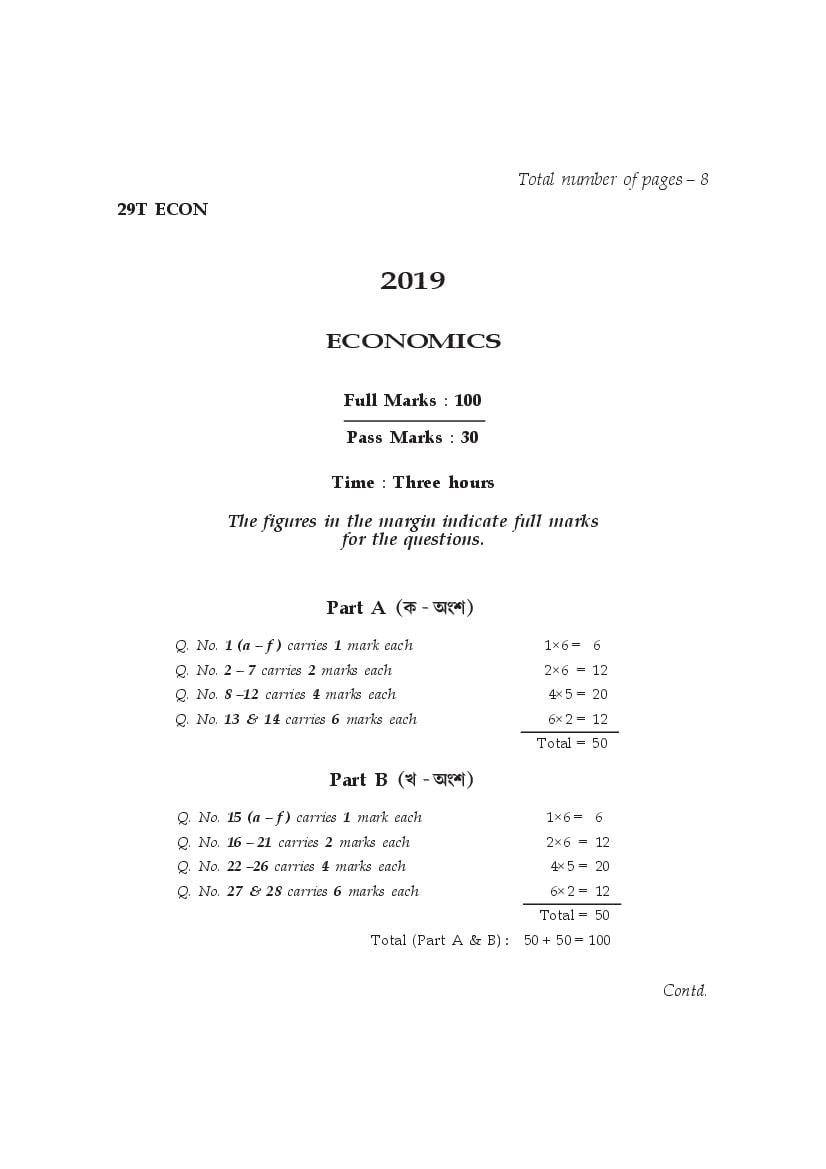
29T ECON
2019
ECONOMICS
Full Marks : 100
Pass Marks : 30
Time : Three hours
The figures in the margin indicate full marks
for the questions.
Part A [fl¡ - ’—˙]
Q. No. 1 (a – f ) carries 1 mark each 1×6 = 6
Q. No. 2 – 7 carries 2 marks each 2×6 = 12
Q. No. 8 –12 carries 4 marks each 4×5 = 20
Q. No. 13 & 14 carries 6 marks each 6×2 = 12
Total = 50
Part B [‡ - ’—˙]
Q. No. 15 (a – f ) carries 1 mark each 1×6 = 6
Q. No. 16 – 21 carries 2 marks each 2×6 = 12
Q. No. 22 –26 carries 4 marks each 4×5 = 20
Q. No. 27 & 28 carries 6 marks each 6×2 = 12
Total = 50
Total (Part A & B) : 50 + 50 = 100
Contd.
Page 2
1. (a) Define the term scarcity as used in economics. 1
’Ô«ÚœøÓ¬Ó¬ ¬ı…ª˝+Ó¬ ≈©x±¬Û…Ó¬±1 Ò±1̱ÀȬ±1 ¸—:± ø˚˛±º
(b) What is opportunity cost ? 1
¸≈À˚±· ¬ı…˚˛ øfl¬ ∑
(c) If marginal utility of a commodity is higher than the price, then the
consumer will buy more of the commodity. 1
(Write true or false)
˚ø ¤È¬± ^¬ı…1 √õ∂±øôL√fl¬ ά◊¬ÛÀ˚±ø·Ó¬± ^¬ı…ÀȬ±1 1Ó¬Õfl¬ ’øÒfl¬ ˝˚˛, ŒÓ¬ÀôL√ ά◊¬ÛÀˆ¬±Mê±˝◊
^¬ı…ÀȬ± Sê˚˛1 ¬Ûø1˜±Ì ¬ı‘øX fl¬ø1¬ıº [qX ŒÚ ’qX ø˘‡±]
(d) What will be the effect of price change on supply of a commodity
with perfectly inelastic supply ? 1
¸•Û”Ì« ’ø¶öøÓ¬¶ö±¬Ûfl¬ Œ˚±·±Ú¸•Ûiß ¤È¬± ^¬ı…1 Œé¬SÓ¬ 1 ¬Ûø1ªÓ¬«Ú1 √õ∂ˆ¬±ª øfl¬ ˝í¬ı ∑
(e) How will an increase in the price of inputs shift the supply curve ?
1
ά◊¬Û±±Ú¸˜”˝1 1-¬ı‘øXÀ˚˛ Œ˚±·±Ú Œ1‡±1 Œfl¬ÀÚ ¶ö±Ú±ôL√ 1 ¸±ÒÚ fl¬ø1¬ı ∑
(f) What is shut-down price ? 1
Ó¬˘±¬ıg ±˜ øfl¬ ∑
2. Why the production possibility curve slopes downward from left to right ?
2
ά◊»¬Û±Ú ¸y√√±ªÚœ˚˛Ó¬± Œ1‡± øfl¬˚˛ ¬ı±›“Ù¬±˘1 ¬Û1± Œ¸“±Ù¬±˘Õ˘ øڕߘ≈‡œ Ϭ±˘˚≈Mê ˝˚˛ ∑
3. Give two reasons of a leftward shift in the demand curve. 2
‰¬±ø˝± Œ1‡± ¬ı±›“Ù¬±À˘ ¶ö±Ú±ôL√ø1Ó¬ fl¬1±1 ≈Ȭ± fl¬±1Ì Î¬◊À~‡ fl¬1±º
4. The price elasticity of demand of a commodity is 4 and the percentage
change in price is 8. Find the percentage change in the quantity
demanded. 2
¤È¬± ^¬ı…1 ‰¬±ø˝±1 1 ø¶öøÓ¬¶ö±¬Ûfl¬Ó¬± 4 ’±1n∏ 11 ˙Ó¬fl¬1± ¬Ûø1ªÓ«¬Ú 8. ‰¬±ø˝±1 ¬˙Ó¬fl¬1±
¬Ûø1ªÓ«¬Ú ·ÌÚ± fl¬1±º
5. What is fixed factor ? Give one example. 1+1=2
ø¶ö1 ά◊¬Û±±Ú øfl¬ ∑ ¤È¬± ά◊±˝1Ì ø˚˛±º
29T ECON [2]
Page 3
1+1=2
’ø¶öøÓ¬¶ö±¬Ûfl¬ Œ˚±·±Ú øfl¬ ∑ ¤Î¬±˘ ’ø¶öøÓ¬¶ö±¬Ûfl¬ Œ˚±·±Ú Œ1‡± ’—fl¬Ú fl¬1±º
7. Mention two differences between monopoly and perfectly competitive
market. 2
¤fl¬À‰¬øȬ˚˛± ¬ıʱ1 ’±1n∏¬ ¬Û”Ì« √õ∂øÓ¬À˚±ø·Ó¬±˜”˘fl¬ ¬ıʱ11 ≈Ȭ± ¬Û±Ô«fl¬… ά◊À~‡ fl¬1±º
8. Distinguish between change in quantity demanded and change in
demand. 4
‰¬±ø˝±1 ¬Ûø1˜±Ì1 ¬Ûø1ªÓ«¬Ú ’±1n∏ ‰¬±ø˝±1 ¬Ûø1ªÓ«¬Ú1 ˜±Ê1 ¬Û±Ô«fl¬… Œ‡≈›ª±º
9. Mention the relationship between total utility and marginal utility. 4
˜≈ͬ ά◊¬ÛÀ˚±ø·Ó¬± ’±1n∏ √õ∂±øôL√fl¬ ά◊¬ÛÀ˚±ø·Ó¬±1 ˜±Ê1 ¸•Ûfl«¬ ά◊À~‡ fl¬1±º¬
10. What is variable cost ? Why the average variable cost (AVC) curve
becomes U shaped ? 1+3=4
¬Ûø1ªÓ«¬Ú˙œ˘ ¬ı…˚˛ øfl¬ ∑ ·Î¬ˇ ¬Ûø1ªÓ«¬Ú˙œ˘ ¬ı…˚˛ Œ1‡± (AVC) øfl¬˚˛ U ’±fl‘¬øÓ¬1 ∑
11. The production function of a firm is Q = 2L½ . K 2 .
Find the amount required of factor K if the firm wants to produce 200
units with available 16 units of factor L .
(Q = Output, K=Capital, L = Labour) 4
¤‡Ú ¬ı…ª¸±˚˛ √õ∂øӬᬱÚ1 ά◊»¬Û±Ú Ù¬˘ÚÀȬ± ˝í˘ Q = 2L½ . K 2 º √õ∂øӬᬱڇÀÚ √õ∂±‰≈¬˚« 16 ¤fl¬fl¬
L ά◊¬Û±±Ú1 √õ∂À˚˛±À·À1 200 ¤fl¬fl¬ ^¬ı… ά◊»¬Û±Ú fl¬ø1¬ı ø¬ı‰¬±ø1À˘ √õ∂À˚˛±ÊÚ Œ˝±¬ª±
K-ά◊¬Û±±Ú1 ¬Ûø1˜±Ì ·ÌÚ± fl¬1±º [Q = ά◊¬»¬Û±Ú1 ¬Ûø1˜±Ì, K = ˜”˘ÒÚ, L = |˜]º
12. Mention the effects of the following on the supply of a commodity.
2+2=4
(i) Fall in the price of factors.
(ii) Rise in the per unit tax.
¤È¬± ^¬ı…1 Œ˚±·±Ú1 ›¬Û1Ó¬ Ó¬˘Ó¬ ά◊À~‡ fl¬1± ¸˜”˝1 √õ∂ˆ¬±ª ά◊À~‡ fl¬1±º
(i) ά◊¬Û±±Ú¸˜”˝1 11 ˝ò±¸º
(ii) √õ∂øÓ¬ ¤fl¬fl¬ ^¬ı…Ó¬ fl¬1 ¬ı‘øXº
29T ECON [3] Contd.
Page 4
ø‰¬S1 ¸˝±˚˛Ó¬ ¬Ûø1ªÓ¬Ú«˙œ˘ ά◊¬Û±±Ú ø¬ıøÒÀȬ± ¬ı…±‡…± fl¬1±º
Or / ’Ô¬ı±
The total fixed cost of a firm is Rs. 200. Fill in the blanks of the following
table. 6
¤‡Ú √õ∂øӬᬱÚ1 ˜≈ͬ ø¶ö1 ¬ı…˚˛1 ¬Ûø1˜±Ì 200 Ȭfl¬±º Ó¬˘1 Ó¬±ø˘fl¬±‡Ú ¸•Û”Ì« fl¬1±º
Output TC AC AVC MC
ά◊»¬Û±Ú
1 — — 100 —
2 460 — — —
3 — 250 — —
4 — — — 230
14. Explain the process of Long-run Equilibrium Price determination of
perfectly competitive industry with diagram.
6
¬Û”Ì« √õ∂øÓ¬À˚±ø·Ó¬±˜≈˘fl¬ ά◊À…±·1 œ‚«fl¬±˘œÚ ˆ¬±1¸±˜… 1 øÚÒ«±1Ì1 √õ∂øSê˚˛±ÀȬ± ø‰¬S1 Êø1˚˛ÀÓ¬
¬ı…±‡…± fl¬1±º
Or / ’Ô¬ı±
Show the effects of change in demand of a commodity on equilibrium
price, if 3+3=6
(i) the supply of the commodity is perfectly elastic
(ii) the supply of the commodity is perfectly inelastic.
¤È¬± ^¬ı…1 ˆ¬±1¸±˜… 11 ›¬Û1Ó¬ ‰¬±ø˝± ¬Ûø1¬ıÓ«¬Ú1 √õ∂ˆ¬±ª Œ‡≈ª± ˚øÀ˝ ñ
(i) ^¬ı…ÀȬ±1 Œ˚±·±Ú ¬Û”Ì« ø¶öøÓ¬¶ö±¬Ûfl¬
(ii) ^¬ı…ÀȬ±1 Œ˚±·±Ú ¬Û”Ì« ’ø¶öøÓ¬¶ö±¬Ûfl¬º
29T ECON [4]
Page 5
15. (a) In what circumstances, the GDP of an economy can be equal to
GNP ? 1
øfl¬ ’ª¶ö±Ó¬ ¤‡Ú Œ˙1 GDP, GNP 1 ¸˜±Ú ˝¬ı ¬Û±À1∑
(b) What is transfer payment ? 1
˝ô¶∏±ôL√ø1Ó¬ ¬Ûø1À˙±Ò øfl¬ ∑
(c) What is voluntary unemployment ? 1
Œ¶§2±fl‘¬Ó¬ øÚ¬ıÚ≈ª± øfl¬ ∑
(d) What is Break-Even income ? 1
¸˜Ó¬±ˆ¬—· ’±˚˛ øfl¬ ∑
(e) What is the full form of GST ? 1
GST 1 ¸•Û”Ì« 1+¬ÛÀȬ± øfl¬ ∑
(f) What is zero primary deficit ? 1
˙”Ú… √õ∂±Ôø˜fl¬ ‚±øȬ øfl¬ ∑
16. Mention two subject matters of Macroeconomics. 2
¸˜ø©Ü¬ı±œ ’Ô«¬ø¬ı:±Ú1 ≈Ȭ± ø¬ı¯∏˚˛¬ıd ά◊À~‡ fl¬1±º
17. Mention any two types of leakages found in the Circular Flow of Income.
2
’±˚˛1 ‰¬Sêœ˚˛ √õ∂ª±˝Ó¬ ά◊æª Œ˝±ª± ø˚Àfl¬±ÀÚ± ≈Ȭ± ¸≈1n∏„±1 ø¬ı¯∏À˚˛ ά◊À~‡ fl¬1±º
18. What is investment multiplier ? Write the relationship between investment
multiplier and MPC. 1+1=2
ø¬ıøÚÀ˚˛±· &Ìfl¬ øfl¬ ∑ ø¬ıøÚÀ˚˛±· &Ìfl¬ ’±1n∏ MPC-1 ˜±Ê1 ¸•Ûfl«¬ÀȬ± ø˘‡±º
29T ECON [5] Contd.
Page 6
˜≈^±1 ≈Ȭ± ˜≈‡… fl¬±˚« ά◊À~‡ fl¬1±º
20. Mention two differences between revenue receipts and capital receipts.
2
¬1±Ê˝ √õ∂±ø5 ’±1n∏ ˜”˘ÒÚœ √õ∂±ø51 ˜±Ê1 ≈Ȭ± ¬Û±Ô«fl¬… ø˘‡±º
21. State two sources of supply of foreign currency. 1+1=2
Δ¬ıÀø˙fl¬ ˜≈^±1 Œ˚±·±Ú1 ≈Ȭ± ά◊»¸ ά◊À~‡ fl¬1±º
22. The value of MPC of an economy is 0· 4. What amount of new investment
is required to generate new income of Rs. 500 crore in the economy ?
4
¤‡Ú ’Ô«ÚœøÓ¬Ó¬ MPC 1 ˜±Ú 0· 4º ’Ô«ÚœøÓ¬‡ÚÓ¬ ÚÓ≈¬ÚÕfl¬ 500 Œfl¬±øȬ Ȭfl¬± ’±˚˛ √õ∂ª±ø˝Ó¬ fl¬1±1
¬ı±À¬ı øfl¬ ¬Ûø1˜±Ì1 ÚÓ≈¬Ú ø¬ıøÚÀ˚˛±·1 √õ∂À˚˛±ÊÚ ˝¬ı ∑
23. Explain any two fiscal measures to solve the problems of excess demand in
an economy. 2+2=4
¤‡Ú ’Ô«ÚœøÓ¬1 ’Ó¬…øÒfl¬ ‰¬±ø˝±1 ¸˜¸…± ¸˜±Ò±Ú fl¬1±1 ¬ı±À¬ı ø˚Àfl¬±ÀÚ± ≈Ȭ± 1±ÊÀfl¬±¯∏œ˚˛ ¬ı…ª¶ö±
¬ı…±‡…± fl¬1±º
24. Mention four factors causing disequilibrium in Balance of Payment of a
country. 4
¤‡Ú Œ˙1 ¬Ûø1À˙±Ò ¸˜Ó¬±Ó¬ ˆ¬±1¸±˜…˝œÚÓ¬± ¸‘ø©Ü fl¬1± ‰¬±ø1Ȭ± ά◊¬Û±±Ú ά◊À~‡ fl¬1±º
25. Write down four differences between Direct Tax and Indirect Tax. 4
√õ∂Ó¬…é¬ fl¬1 ’±1n∏ ¬ÛÀ1±é¬ fl¬11 ˜±Ê1 ‰¬±ø1Ȭ± ¬Û±Ô«fl¬… ø˘‡±º
26. What is Budget Deficit ? What are the three types of Budgetary Deficit ?
1+3=4
¬ı±ÀÊȬ ‚±øȬ øfl¬ ∑ ¬ı±ÀÊȬ ‚±øȬ1 øÓ¬øÚȬ± √õ∂fl¬±1 øfl¬ øfl¬ ∑
29T ECON [6]
Page 7
¤‡Ú øÓ¬øÚȬ± ‡G˚≈Mê ’Ô«ÚœøÓ¬1 ’±˚˛1 ‰¬Sêœ˚˛ √õ∂ª±˝1 ø¬ıª1Ì ø˚˛±º
Or / ’Ô¬ı±
Explain the Expenditure Method of calculating Gross Domestic Product
(GDP). 6
˜≈ͬ ‚1n∏ª± ά◊»¬Û±Ú ·ÌÚ±1 ¬ı…˚˛ ¬ÛXøÓ¬ÀȬ± ¬ı…±‡…± fl¬1±º
28. Explain the process of credit creation by commercial banks. 6
¬ı±øÌøÊ…fl¬ Œ¬ı—fl¬1 Ÿ¬Ì ¸‘ø©Ü1 √õ∂øSê˚˛±ÀȬ± ¬ı…±‡…± fl¬1±º
Or / ’Ô¬ı±
Describe the Quantitative methods adopted by the Central Bank to control
credit created by commercial banks. 6
¬ı±øÌøÊ…fl¬ Œ¬ı—Àfl¬ ¸‘ø©Ü fl¬1± Ÿ¬Ì øÚ˚˛LaÌ1 ¬¬ı±À¬ı Œfl¬fœ˚˛ Œ¬ı—Àfl¬ ¢∂˝ Ì fl¬1± ¬Ûø1˜±Ì·Ó¬ ¬ÛXøÓ¬ÀȬ±
’±À˘±‰¬Ú± fl¬1±º
———— ×————
29T ECON [7]
Page 8
Document Details
| Board / Org | Assam Board |
| Exam | Class 12 |
| Type | Question Paper |
| Pages | 8 |
| Updated | 09 Jun 2026 |