CBSE Class 10 Question Paper 2025 Solution Apparel
Finished viewing? Save it for later —
Download CBSE Class 10 Question Paper 2025 Solution Apparel (PDF · 10 pages)About CBSE Class 10 Question Paper 2025 Solution Apparel
CBSE Class 10 Question Paper 2025 Solution Apparel is available here for free download. Published by CBSE for Class 10, this solution can be viewed online or downloaded as a PDF (10 pages). Candidates preparing for Class 10 can use CBSE Class 10 Question Paper 2025 Solution Apparel to understand the exam pattern, the type of questions asked, and the overall difficulty level.
Frequently Asked Questions
How can I download CBSE Class 10 Question Paper 2025 Solution Apparel?
Open this page and click the Download button to save CBSE Class 10 Question Paper 2025 Solution Apparel as a PDF. It is completely free on AglaSem Docs.
Is CBSE Class 10 Question Paper 2025 Solution Apparel free to download?
Yes. CBSE Class 10 Question Paper 2025 Solution Apparel can be viewed online and downloaded as a PDF free of cost on AglaSem Docs.
How many pages does CBSE Class 10 Question Paper 2025 Solution Apparel have?
CBSE Class 10 Question Paper 2025 Solution Apparel contains 10 pages, which you can read online or download together as a single PDF.
Where can I find more Class 10 study material?
You can find more Class 10 question papers, sample papers, syllabus, and answer keys on AglaSem Docs.
CBSE Class 10 Question Paper 2025 Solution Apparel – Text
Read the full text of this solution below — useful to quickly search, copy and reference the content online without downloading the PDF.
📄 View text version (10 pages)
Page 1
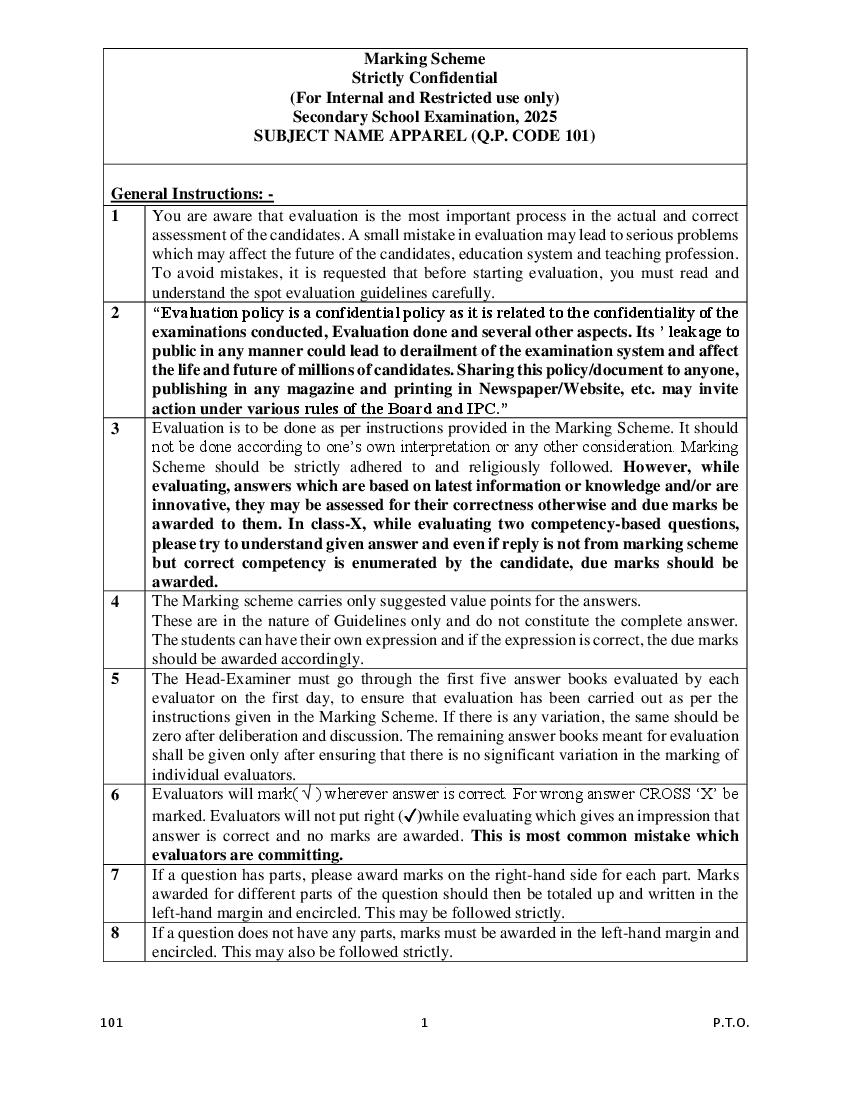
Strictly Confidential
(For Internal and Restricted use only)
Secondary School Examination, 2025
SUBJECT NAME APPAREL (Q.P. CODE 101)
General Instructions: -
1 You are aware that evaluation is the most important process in the actual and correct
assessment of the candidates. A small mistake in evaluation may lead to serious problems
which may affect the future of the candidates, education system and teaching profession.
To avoid mistakes, it is requested that before starting evaluation, you must read and
understand the spot evaluation guidelines carefully.
2 “Evaluation policy is a confidential policy as it is related to the confidentiality of the
examinations conducted, Evaluation done and several other aspects. Its ’ leakage to
public in any manner could lead to derailment of the examination system and affect
the life and future of millions of candidates. Sharing this policy/document to anyone,
publishing in any magazine and printing in Newspaper/Website, etc. may invite
action under various rules of the Board and IPC.”
3 Evaluation is to be done as per instructions provided in the Marking Scheme. It should
not be done according to one’s own interpretation or any other consideration. Marking
Scheme should be strictly adhered to and religiously followed. However, while
evaluating, answers which are based on latest information or knowledge and/or are
innovative, they may be assessed for their correctness otherwise and due marks be
awarded to them. In class-X, while evaluating two competency-based questions,
please try to understand given answer and even if reply is not from marking scheme
but correct competency is enumerated by the candidate, due marks should be
awarded.
4 The Marking scheme carries only suggested value points for the answers.
These are in the nature of Guidelines only and do not constitute the complete answer.
The students can have their own expression and if the expression is correct, the due marks
should be awarded accordingly.
5 The Head-Examiner must go through the first five answer books evaluated by each
evaluator on the first day, to ensure that evaluation has been carried out as per the
instructions given in the Marking Scheme. If there is any variation, the same should be
zero after deliberation and discussion. The remaining answer books meant for evaluation
shall be given only after ensuring that there is no significant variation in the marking of
individual evaluators.
6 Evaluators will mark( √ ) wherever answer is correct. For wrong answer CROSS ‘X’ be
marked. Evaluators will not put right (✓)while evaluating which gives an impression that
answer is correct and no marks are awarded. This is most common mistake which
evaluators are committing.
7 If a question has parts, please award marks on the right-hand side for each part. Marks
awarded for different parts of the question should then be totaled up and written in the
left-hand margin and encircled. This may be followed strictly.
8 If a question does not have any parts, marks must be awarded in the left-hand margin and
encircled. This may also be followed strictly.
101 1 P.T.O.
Page 2
should be retained and the other answer scored out with a note “Extra Question”.
10 No marks to be deducted for the cumulative effect of an error. It should be penalized only
once.
11 A full scale of 50 marks (as given in Question Paper) has to be used. Please do not hesitate
to award full marks if the answer deserves it.
12 Every examiner has to necessarily do evaluation work for full working hours i.e., 8 hours
every day and evaluate 20 answer books per day in main subjects and 25 answer books
per day in other subjects (Details are given in Spot Guidelines).This is in view of the
reduced syllabus and number of questions in question paper.
13 Ensure that you do not make the following common types of errors committed by the
Examiner in the past:-
● Leaving answer or part thereof unassessed in an answer book.
● Giving more marks for an answer than assigned to it.
● Wrong totaling of marks awarded on an answer.
● Wrong transfer of marks from the inside pages of the answer book to the title page.
● Wrong question wise totaling on the title page.
● Wrong totaling of marks of the two columns on the title page.
● Wrong grand total.
● Marks in words and figures not tallying/not same.
● Wrong transfer of marks from the answer book to online award list.
● Answers marked as correct, but marks not awarded. (Ensure that the right tick mark
is correctly and clearly indicated. It should merely be a line. Same is with the X for
incorrect answer.)
● Half or a part of answer marked correct and the rest as wrong, but no marks awarded.
14 While evaluating the answer books if the answer is found to be totally incorrect, it should
be marked as cross (X) and awarded zero (0)Marks.
15 Any unassessed portion, non-carrying over of marks to the title page, or totaling error
detected by the candidate shall damage the prestige of all the personnel engaged in the
evaluation work as also of the Board. Hence, in order to uphold the prestige of all
concerned, it is again reiterated that the instructions be followed meticulously and
judiciously.
16 The Examiners should acquaint themselves with the guidelines given in the “Guidelines
for Spot Evaluation” before starting the actual evaluation.
17 Every Examiner shall also ensure that all the answers are evaluated, marks carried over
to the title page, correctly totaled and written in figures and words.
18 The candidates are entitled to obtain photocopy of the Answer Book on request on
payment of the prescribed processing fee. All Examiners/Additional Head
Examiners/Head Examiners are once again reminded that they must ensure that
evaluation is carried out strictly as per value points for each answer as given in the
Marking Scheme.
101 2 P.T.O.
Page 3
$
MARKING SCHEME
APPAREL
______________________________________________________________________________
SECTION A
(Objective Type Questions )
1. Any 4 out of the given 6 questions on Employability skills. 4X1=4
(i) (C) Confidence 1
(ii) (B) Recycle Bin 1
(iii) When a person is motivated to do something because of external factors; money/ post/
marks/ goodwill/ fame/ faith/ praise/ reward/ recognition/ . (Any one) 1
(iv) Use of organic manure/ natural fertilizers/ earth resources without chemical
pesticides/ fertilizers to increase the production. E.g. cow dung etc. 1
(v) (C) Ctrl + V 1
(vi) Making decisions, Managing the business, Divide income, Taking risk, Create a new
method, Idea or Product, Creating jobs/ Employment/ Research (Any relevant
point) 1
2. Any 5 out of the given 6 questions 5X1=5
(i) Form 1
(ii) Lotus flower, Floral scrolls, Tree of life, Creepers, Animals and birds form, Fish,
Sea monsters, Mermaids, Ships, Submarine scenes, House hold items- Mirrors,
Pictures, Nut crackers, Umbrellas, Musical instruments, Human figures, Gods &
Goddesses, Horsemen, Fisherwomen, Solar moon, Wheel, Swastik, Kalka.
(Any two) (½ + ½)
(iii) Bagh is the traditional embroidery shawls from rural/ west Punjab. 1
(iv) Himachal Pradesh 1
(v) Chenille Needle 1
(vi) - The use of incorrect type and size of needle/thick needle for thin fabric.
- Adding a lot of stitches on the same spot.
101 3 P.T.O.
Page 4
- Fabric damage caused when stitches are pulled.
- Damage caused due to recurring needle piercing, especially around the corners of
the embroidery. (Any one) 1
3. Any 5 out of the given 6 questions. 5X1=5
(i) Running stitch, Back stitch, Split stitch, Stem stitch, Chain stitch, Couching stitch.
(Any one) 1
(ii) Running stitch , Back stitch , Split stitch, Stem stitch, Cross stitch , Herringbone
stitch, Couching stitch ,Fish bone stitch Long and short stitch, Satin stitch
(Any two) (½ + ½)
(iii) Regular, Progressive, Flowing (Any two) (½ + ½)
(iv) Stitches, which are missed need to be modified with any hand embroidery stitch/
Simplest way is to thread a hand sewing needle with a double strand embroidery
thread matching the base fabric and do a hand satin stitch to fill in the area.
(Any one) 1
(v) Patch work / embroidery with any decorative stitch/ use of trimmings e.g.- lace,
buttons etc. (Any one ) 1
(vi) Value/ Tint & Shade. 1
OR
Tint / Shade (½ + ½)
4. Any 5 out of the given 6 question. 5X1=5
(i) Contrast 1
(ii) Blanket stitch/ Buttonhole stitch/ loop stitch 1
(iii) Running stitch, Back stitch , Herringbone, Satin , Long and Short , fishbone,
Chain stitch, Button hole, Fly Stitch, French knot. (Any two) (½ + ½)
(iv) French knot/Bullion stitch. 1
(v) To protect the finger / Thumb/ Hand/Skin,while doing embroidery
To direct the needle through the fabric. (Any one) 1
101 4 P.T.O.
Page 5
/stitch is not dense.
(Any one) 1
5. Any 5 out of given 6 question. 5X1=5
(i) To avoid /prevent discoloration/ damage/ destruction/ fading 1
(ii). Kantha 1
(iii). Red. - Blue- green. & Yellow- green
Blue. - Red. - Orange & Yellow- orange
Yellow - Blue- violet & Red- violet
Green - Red - violet & Red- orange
Orange- Blue- violet. & Blue- green
Violet - Yellow- green &. Yellow- orange
(Any one) 1
(iv). Any light weight/ medium weight permeable/ breathable fabric. (e.g. Cotton, net,
matty, jute, linen etc.) (Any one) 1
(v). (A) Chain stitch 1
(vi) Pin, wrist cuff, necklace, cap, tote bag, mobile case, head band , handkerchief,
scarf etc. (Any two. ) (½ + ½ )
SECTION- B
(Subjective Type Questions)
Any 3 out of the given 5 questions on Employability skills (20 to 30 words each)
3X2=6
6. Hard working, Optimistic, Independent, Self- confident, Energetic, Perseverant
(Any two) (1 +1)
101 5 P.T.O.
Page 6
Taking cloth bags to market.
Donate things we do not use.
Buy and eat seasonal fruits and vegetables from local growers.
Reusing plastic, paper, water etc.
Repair leaking taps and pipes to avoid water wastage.
Sort and treat garbage before disposing.
(Any other relevant point) (Any four) (½ + ½ + ½ + ½)
8. Dancing, Reading, Meditation, Yoga, Gardening, Games, Painting, Bike riding,
Walking, Exercising or any other hobby. (Any two) (1 + 1)
9. Android OS / Android, Windows OS / Windows, IOS. (Any two) (1 + 1)
10. Barriers of effective communication-
Linguistic barrier- Inability to communicate using a language.
Physical barrier- Due to geographical or environmental reasons.
Interpersonal barrier- Lack of will to communicate, social anxiety, poor
self- esteem, not willing to talk or express feeling, emotional
disconnection.
Organizational barrier- Inadequate flow of information amongst
employees working at different levels of hierarchy.
Cultural barrier- Clash of mindset of people of different cultures which
gives rise to prejudices and stereotypes (Any two) (1 + 1 )
Any 4 out of the given 6 questions (20 to 30 words each) 4X2=8
11. Balance relates to the visual weight in a composition. It is defined as harmonious
relationship between the positive and negative spaces in a design.
Symmetrical
Asymmetrical (1 + ½ + ½)
12. Motifs used in Kasuti embroidery:
Temple Architecture- Gopurams, Raths, and Palanquins
101 6 P.T.O.
Page 7
Birds- Peacock, Swan, Squirrel, Parrot
Everyday objects- Cradles, Chess Squares, Anklets, Bells, Flower pots, Rudrakshas
(Any four) (½ + ½ + ½ + ½)
13. General steps to be taken by the embroiderer;
The following basic steps need to be followed while doing any kind of
embroidering and can be used for both flat as well as loop stitches. Once the
embroiderer has prepared herself/himself by following these steps, s/he may follow
the specific steps of a particular style of embroidery.
The fabric of the traced embroidery design should be firmly fixed in the frame.
Fix the fabric in such a way that the design is in the centre of the embroidery
frame or hoop. Gently fix the fabric between the two rings of the hoop and tighten
with the screw of the hoop or frame.
Collect all the appropriate tools and materials required for doing embroidery
work.
Thread the needle with required strands of the thread.
Pull the thread on the upper side of the fabric at the initial point of the design
from the back side of the fabric. Attach the end of the thread by a very small knot,
or hiding the end with the stitches on the back side of the fabric.
Make sure your hands are clean and washed so as not to leave stains on the fabric
or the thread. (Any two) (1 + 1)
14. Steps to construct a wrist cuff-
Take the measurement of the wrist.
Cut two rectangles of fabric.
Sew together right sides facing, leaving a small opening for turning inside out.
Sew the opening shut and add a fastener. 2
15. Fabric- Hand spun Khadi, Khaddar, Georgette, Chiffon, Cotton, Machine made
cloth
Thread- Silk floss-Patt or Rayon floss/ Blended cotton thread. (1 + 1)
101 7 P.T.O.
Page 8
untrimmed.
Thread loop in the opposite direction- needs to be trimmed as closely to the
stitches as possible. (1 + 1)
Any 3 out of the given 5 questions (50 to 80 words each) 3 X 4 = 12
17. Origin- Inspiration from Kashmir landscape.
Motifs- Flowers, Butterflies, Maple leaves, Almonds, Cherries, Grapes, Plum,
Birds such as Magpie, King fisher, the pine cone, Mangoes, Lotus, Creepers.
Stitches- Chain, Stem, Satin, Talibar, Darning, Fly, Vatachik, Couching with zari
thread.
Fabric- Wool, Cotton, Silk, Cots wool (1 + 1 + 1 + 1)
18. Follow the steps for making the long and short stitch:
(i). Make an outline of the design with a running stitch.
(ii). Make the design by making one stitch long and the next one short. Carry
this out using a single colored thread.
(iii). The other shade of the colour should be used in such a way so that it
intermingles correctly with the previous shade of the same colour. There
should be no gaps remaining between the two colours of stitches.
(iv). Continue embroidering the design in this way.
(v). Take stitches very close to one another so that they intermingle.
(vi). Make a loop and pull the thread from the loop to end the stitch on the
backside of the fabric.
( 2+2)
101 8 P.T.O.
Page 9
(i) Hand care is the most significant aspect for a hand embroiderer. Different types of
needles may harm the hands while doing needle work; hence, the embroiderer should be very
careful towards the healing of wounds in the fingers. They should also apply suitable cream
or oil on their hands for necessary care and prevent them from getting very dry. Hand gloves
should also be used.
(ii) Embroiderers’ workplace should have fire extinguishers to prevent damage or loss, in
case of emergencies.
(iii) The work environment should be dust-free and with proper ventilation.
(iv) The workplace should be free from insects and bugs.
(v) Use face or nose masks during allergies and infections. Make use of head covering for
hair fall.
(vi) Maintaining correct posture (straight back) is very important while doing embroidery to
avoid back pain.
(vii) Hand embroiderers can consult experts for the correct body posture while at their
workplace. (1 + 1 + 1 + 1)
20. Raw material- Cotton, White muslin, Linen, Nylon, Georgette, Chiffon, Synthetic fabrics
Stitches- Satin, Stem, Back, Herringbone, Button hole
Products- Sari, Blouse, Kutras, Sari borders, Curtains, Bed sheets, Pillow cover, Cushion
cover, Table cover. (1 ½ + 1 ½ + 1)
101 9 P.T.O.
Page 10
This stitch is used to finish buttonholes; thus, the name ‘buttonhole stitch’. This stitch is to create
an outline, finish the edges or attach appliqués. It is also used for attaching mirrors in embroidery
patterns. Though the buttonhole stitch can be used in any type of design, it is mostly used for doing
floral designs. These stitches are placed very close together to form a firm edge. At times, this
stitch is used in the centre of a motif. The needle enters the same hole in the centre each time,
making a hole in the centre while the wheel around it is filled completely. The buttonhole stitch is
used for outlining and attaching mirrors in embroidery, for example, most of the mirror work in
Gujarat and Rajasthan uses this stitch. It is used to make the corners of table covers, bed sheets,
sofa covers, chair covers, saree borders, etc
After following the general steps for embroidering, follow the steps for making the buttonhole
stitch:
1. Bring the needle out from below upwards, on the design line.
2. Based on the width of the stitch, insert the needle at one edge and take out from the other.
3. Before pulling the needle through the fabric, carry the thread under the needle point.
4. Embroider carefully to keep the width of the stitch even and work all the stitches very close
together to keep the continuity. (2 + 2)
---------------------------------------------------------------------------------------------------------------------
101 10 P.T.O.
Document Details
| Board / Org | CBSE |
| Exam | Class 10 |
| Type | Solution |
| Pages | 10 |
| Updated | 24 Sep 2026 |