ISC Class 12 Syllabus 2024 Biotechnology
Finished viewing? Save it for later —
Download ISC Class 12 Syllabus 2024 Biotechnology (PDF · 12 pages)About ISC Class 12 Syllabus 2024 Biotechnology
ISC Class 12 Syllabus 2024 Biotechnology is available here for free download. Published by CISCE for Class 12, this syllabus can be viewed online or downloaded as a PDF (12 pages). Candidates preparing for Class 12 can use ISC Class 12 Syllabus 2024 Biotechnology to understand the exam pattern, the type of questions asked, and the overall difficulty level.
Frequently Asked Questions
How can I download ISC Class 12 Syllabus 2024 Biotechnology?
Open this page and click the Download button to save ISC Class 12 Syllabus 2024 Biotechnology as a PDF. It is completely free on AglaSem Docs.
Is ISC Class 12 Syllabus 2024 Biotechnology free to download?
Yes. ISC Class 12 Syllabus 2024 Biotechnology can be viewed online and downloaded as a PDF free of cost on AglaSem Docs.
How many pages does ISC Class 12 Syllabus 2024 Biotechnology have?
ISC Class 12 Syllabus 2024 Biotechnology contains 12 pages, which you can read online or download together as a single PDF.
Where can I find more Class 12 study material?
You can find more Class 12 question papers, sample papers, syllabus, and answer keys on AglaSem Docs.
ISC Class 12 Syllabus 2024 Biotechnology – Text
Read the full text of this syllabus below — useful to quickly search, copy and reference the content online without downloading the PDF.
📄 View text version (12 pages)
Page 1
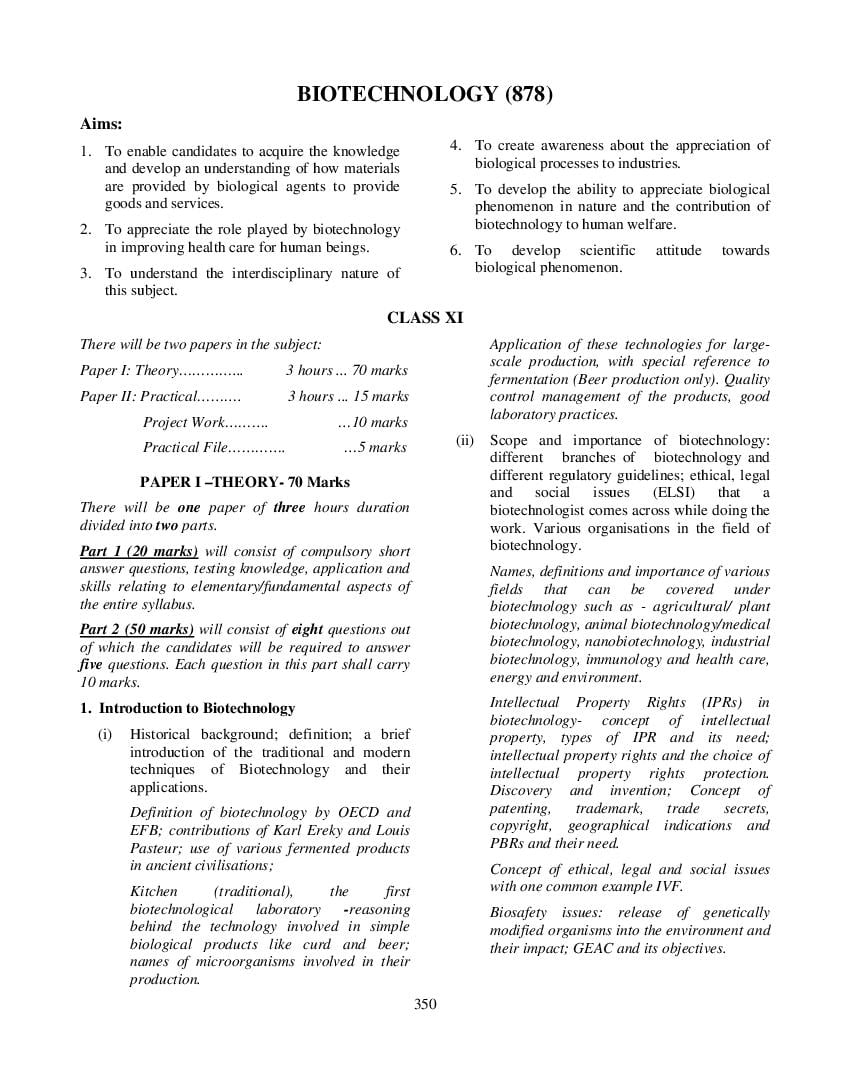
Aims:
1. To enable candidates to acquire the knowledge 4. To create awareness about the appreciation of
and develop an understanding of how materials biological processes to industries.
are provided by biological agents to provide 5. To develop the ability to appreciate biological
goods and services. phenomenon in nature and the contribution of
2. To appreciate the role played by biotechnology biotechnology to human welfare.
in improving health care for human beings. 6. To develop scientific attitude towards
3. To understand the interdisciplinary nature of biological phenomenon.
this subject.
CLASS XI
There will be two papers in the subject: Application of these technologies for large-
scale production, with special reference to
Paper I: Theory…………... 3 hours ... 70 marks
fermentation (Beer production only). Quality
Paper II: Practical………. 3 hours ... 15 marks control management of the products, good
Project Work………. …10 marks laboratory practices.
Practical File…………. …5 marks (ii) Scope and importance of biotechnology:
different branches of biotechnology and
PAPER I –THEORY- 70 Marks different regulatory guidelines; ethical, legal
and social issues (ELSI) that a
There will be one paper of three hours duration biotechnologist comes across while doing the
divided into two parts. work. Various organisations in the field of
Part 1 (20 marks) will consist of compulsory short biotechnology.
answer questions, testing knowledge, application and Names, definitions and importance of various
skills relating to elementary/fundamental aspects of fields that can be covered under
the entire syllabus. biotechnology such as - agricultural/ plant
Part 2 (50 marks) will consist of eight questions out biotechnology, animal biotechnology/medical
of which the candidates will be required to answer biotechnology, nanobiotechnology, industrial
five questions. Each question in this part shall carry biotechnology, immunology and health care,
10 marks. energy and environment.
1. Introduction to Biotechnology Intellectual Property Rights (IPRs) in
biotechnology- concept of intellectual
(i) Historical background; definition; a brief property, types of IPR and its need;
introduction of the traditional and modern intellectual property rights and the choice of
techniques of Biotechnology and their intellectual property rights protection.
applications. Discovery and invention; Concept of
Definition of biotechnology by OECD and patenting, trademark, trade secrets,
EFB; contributions of Karl Ereky and Louis copyright, geographical indications and
Pasteur; use of various fermented products PBRs and their need.
in ancient civilisations; Concept of ethical, legal and social issues
Kitchen (traditional), the first with one common example IVF.
biotechnological laboratory -reasoning Biosafety issues: release of genetically
behind the technology involved in simple modified organisms into the environment and
biological products like curd and beer; their impact; GEAC and its objectives.
names of microorganisms involved in their
production.
350
Page 2
Various institutes, centres and funding species, e.g. man, mouse, Drosophila and
agencies - NBTB, CCMB, ICGEB, ICMR, pea.
ICAR, DBT, DST which deal with
Techniques in cytology – microscopy (light
biotechnology and bioinformatics in India:
and electron microscope), karyotyping and
names only.
centrifugation (principle and applications
(iii) Basic concepts of Biochemical technology only).
and biostatistics: What does the biochemical
(ii) Cell Division and cell cycle: types of cell
technology mean? An understanding of
divisions and various other activities of cell
various statistical methods involved in
such as biochemical transformations.
biotechnology.
Types and significance of cell division and a
Concept of buffer, type and preparation of
brief note about the different stages of cell
buffers, pH, physical variables;
division – mitosis and meiosis.
fermentation; An understanding of bio-
reactors, idea of sampling – quadrat and Basic concept of cell cycle and cell cycle
transect; measures of central tendency – regulation – CdK method only, definition of
mean, median, mode; standard deviation and Mitotic Index.
standard error; concept of probability – Biochemical Transformations:
theoretical and experimental.
An understanding of biochemical
2. Cell Biology transformations, different biochemical
(i) Cell: Justification of cell as a basic unit of pathways involved in respiration - aerobic
life. Prokaryotic cell and eukaryotic cell; A and anaerobic.
brief note on the cell components with Aerobic respiration - Glycolysis, Krebs’
special reference to nucleus. Various cycle, electron transport chain and oxidative
cytological techniques used in identifying the phosphorylation.
cell and chromosomes.
Anaerobic respiration - lactic acid,
Differentiation prokaryotic and eukaryotic fermentation and alcohol fermentation –
cellular systems. definition only.
Structure of bacteria (in brief, with reference (iii) Errors in cell division: what happens if the
to plasmid). Gram+ and Gram- bacteria. cell does not divide normally? An
An understanding of cell components, their understanding of different numerical and
basic structure and functions - cell wall, cell structural abnormalities.
membrane, cytoplasmic reticulum, Golgi Concept of mutation: causes; types –somatic,
apparatus, mitochondria, ribosomes, germinal, spontaneous, induced, gene,
vacuoles, plastids, lysosomes, nucleus and chromosomal and genomatic mutations,
other important inclusions of the cell. euploidy, aneuploidy, monosomy, nullisomy,
Chromosomal structure and composition – trisomy and tetrasomy; various factors
organisation of chromatids, concept of causing mutations.
homologous and non-homologous Concept of non-disjunction: meiotic
chromosomes, sister and non-sister non-disjunction and mitotic non-disjunction.
chromatids, classification of chromosomes on Non-disjunction in sex chromosomes –
the basis of position of the centromere on the Turner’s syndrome and Klinefelter’s
chromosome, basic idea about telomere, syndrome - chromosomal composition and
chromatin and nucleosome. An idea about symptoms only.
banding patterns (Q, R, C and G) and their
application.
351
Page 3
respect to autosomes, i.e. Down’s syndrome and key model; induced fit hypothesis; factors
–chromosomal composition and symptoms affecting enzyme activity (temperature, pH,
only. substrate concentration, enzyme
concentration, inhibitors (competitive, non-
Structural chromosomal abnormalities –
competitive).
deletions, duplications, translocations,
inversions. Optical activity of biomolecules
(dextrorotatory and laevorotatory).
Polyploidy and its significance in plants.
Concept of supramolecular assembly.
Inborn errors of metabolism - basic concept
and examples like albinism, sickle cell (ii) Techniques used for separation of
anaemia, phenylketonuria and alkaptonuria. biomolecules
Ion exchange chromatography and paper
3. Biomolecules and related techniques
chromatography.
(i) Introduction to biomolecules- definition and
types. Carbohydrates, proteins, lipids, 4. Developmental Biology and Immunology
vitamins and enzymes – their structure and
(i) Animal and plant development: development
properties.
of an organism from zygotic cell in both
Biomolecules – definition and types plants and animals.
Structure and functions of carbohydrates. Animal development – fertilisation, zygote to
blastocyst formation.
Sugars and derivatives; classification of some
important mono, di and polysaccharides - Plant development. Double fertilisation
glucose, fructose, glycogen, cellulose, chitin including formation of primary endosperm
and peptidoglycan. Physical and chemical nucleus.
properties of sugars.
(ii) An understanding of defence strategies in
Structure, functions and classification of living organisms.
proteins i.e. simple, complex and derived;
Immune system in higher animals, concept of
building blocks of proteins - the amino acids:
immunity, immunisation, antigen and
chemical structure, types (acidic, basic and
antibody. Various cells involved in immune
neutral); physical and chemical properties of
response in humans. An introduction to
amino acids. 3D - structure of proteins.
human leukocyte antigens with reference to
Different types of protein structures - primary,
organ transplantation; Types of immunity -
secondary (alpha helix, beta pleated sheet and
innate and acquired. ELISA Technique
random structures), tertiary, quaternary;
(Enzyme Linked Immuno Sorbent Assay).
protein sequencing by MALDI-MS.
Secondary metabolites in plants and their
Structure and functions of lipids – fatty acids
significance
and alcohol; types (simple, conjugated and
derived lipids with one example of each); Defence strategies in bacteria – endospores
chemical and physical properties of lipids. and R plasmids.
Vitamins: Definition, types (fat soluble and 5. Genetics
water soluble vitamins); co-enzyme forms of
water soluble vitamins; deficiency diseases of (i) Laws of Inheritance: An account of
vitamins. Mendel’s experiments. Different types of
genetic inheritance.
Enzymes: Structure and functions of enzymes:
chemical nature of enzymes; characteristics Mendel’s experiment on pea plant and his
and properties of enzymes. An understanding laws of inheritance.
of enzyme activity on the basis of activation
352
Page 4
genotype, homozygosity, heterozygosity and blood drop in an indiscriminatory way.
hemizygosity. Types of inheritance:
2. Identification of different types of blood cells by
autosomal inheritance - dominant, co-
preparing blood smear using Leishmann’s stain.
dominant, recessive, polygenic, pleiotropic
and cytoplasmic inheritance (plastidial Requirements: Blood sample, disposable needles,
inheritance). slides, Leishmann’s stain. Make a blood smear
on a slide, use the stain to colour the smear,
Pedigree construction using different
wash and observe under microscope.
standard symbols.
Sex chromosome inheritance - with special 3. Instruments – their names, use and principles (if
reference to X chromosomal inheritance applicable).
with suitable examples (colour blindness Water bath, pH meter, weighing balance,
and haemophilia). desiccators, microfiltration unit, magnetic
(ii) Gene Mapping: mapping of genes on stirrer, LAF, haemocytometer, micropipette,
chromosomes using linkage analysis. vortex mixer, colorimeter/spectrophotometer, hot
Cancer and its genetics. air oven, autoclave, incubator, electrophoresis
chamber, colony counter, autoclave, hot plate.
Mapping of genes on chromosomes with
respect to COV (Crossing Over Value). 4. Finding out the pH of water by using pH meter or
Basic concept of linkage (types not pH paper on tap water and water containing acid,
required) and crossing over. Genetic base.
recombination. Take tap water in three test tubes, add two drops
Cancer: Causes (physical, chemical, of dil. HCl in one, two drops of NaOH in the
biological – TSG and oncogenes); diagnosis second while leaving the third test tube with tap
and treatment. water. Use pH meter or pH paper to find their
specific pH.
(iii) Genes in populations: how do genes behave
in populations from generation to 5. Observation of steps of mitosis by using the root
generation? Various ways of studying tip of onion.
population genetics. The students should be given practice in
preparing slides for study of mitosis by crush
Concept of gene pool and allele frequency, smear method. They should be able to identify
definition of Hardy Weinberg law, its different stages (at least four stages). The
applications. requirement for this set of experiments is
Possibility of disease resistant and Acetocarmine stain slides, coverslips,
susceptible genes in population. Definition microscopes and spirit-lamp.
and application of pharmacogenetics and
pharmacogenomics. 6. Measurement of mitotic index.
Mitotic index is the ratio of number of cells
PAPER II undergoing mitosis to the number of cells in the
field.
PRACTICAL WORK – 15 Marks No. of cells showing mitosis
Candidates are required to complete the following MI =
experiments. Total no. of cells in the field
1. Determination of blood group by using antisera. 7. Observation of various stages of meiosis under
The students can perform this experiment on microscope.
their own blood groups. Proper instructions For the study of meiosis, the students should be
however are to be given for ‘prick’ – e.g. (a) shown permanent slides of meiosis and they
Sterilize finger with alcohol/disinfectant. (b) Use should be able to identify at least six stages of
only disposable sterile needle. (c) Use the needle meiosis from the slides.
353
Page 5
using Lactobacillus bacteria at 37oC, 60oC and lactometer.
10oC. Put the instrument in milk. If it sinks down
Optimum temperature for curdling of milk is and reaches the mark ‘M’ mentioned on
37oC due to active form of bacteria at this lactometer, it means that the milk is pure or
temperature; it is inactive at low temperature if not, it means that the milk is impure. If the
and dies at high temperature. milk is mixed with water, it would sink higher
than mark ‘M’. If it stands at the mark 3 it
9. Food tests: means that the milk is 75% pure and
(i) Carbohydrates – starch by iodine solution respectively 2 for 50% purity and 1 for 25%
turning blue - black in colour. purity.
Reducing and non-reducing sugars by using 11. Construction of pedigree showing different
Fehling’s solution / Benedict’s solution – types of inheritance.
reducing the cupric ion (blue) to cuprous ion The students are to observe the traits like,
(red). rolling of the tongue/ attached earlobe/
widow’s peak.
(ii) Protein test – Biuret test, Xanthoproteic
and Millon’s test 12. Preparation of karyotypes.
Demonstration of any metaphasic plate of
(a) For Biuret test –The protein produces
mitosis.
deep blue – violet colour due to the
involvement of cupric ion in the product 13. Sampling methods – quadrat and transect by
formed. using different techniques.
(b) For Millon’s Reagent – A pinkish red To be done in groups. Use yellow and green
colour is observed with mercuric pea seeds. Make a quadrat (30 cm X 30 cm)
chloride. with blocks of 6 cm X 6 cm. Spread the seeds
randomly on the table top. Put the quadrat
(c) For Xanthoproteic Test: When and count the number of yellow and green
concentrated nitric acid is boiled with peas per block; find the frequency of each
protein a yellow colour is observed. On type of pea seed.
addition of ammonium hydroxide or 14. Data collection – primary and secondary.
liquor ammonia orange yellow
precipitate is obtained. Collect any type of primary data and
secondary data, tabulate the data and draw
(iii)Lipids – Sudan III, Acrolein test, paper test conclusion.
(a) Sudan III is a red fat-soluble dye used for
identification of the presence of lipids, PROJECT WORK AND PRACTICAL FILE
triglycerides and lipoproteins. It reacts – 15 marks
with the lipids or triglycerides and gives Project Work – 10 Marks
red colour.
Candidates are to creatively execute one
(b) Acrolein test is used to detect fat. When project/assignment on any aspect of Biotechnology.
fat is heated strongly in the presence of Teachers may assign or students may choose any one
potassium bisulphate/ sodium bisulphate project of their choice. The report should be kept
(KHSO 4 /NaHSO 4 ) that acts as a simple, but neat and elegant.
dehydrating agent, the glycerol is
Practical File – 5 Marks
dehydrated to form an unsaturated
aldehyde called acrolein that gives a Teachers are required to assess students on the basis
pungent and irritating odour. of the practical file maintained by them during the
academic year.
354
Page 6
1. CCMB:Centre for Cellular and Molecular 15. ICGEB: International Centre for Genetic
Biology Engineering and Biotechnology
2. CdK: Cyclin dependent Kinase 16. ICMR: Indian Council for Medical Research
3. COV: Cross Over Value 17. IEF : Iso Electro Focussing
4. CSIR: Council of Scientific and Industrial 18. IPP: Intellectual Property Right Protection Act
Research 19. IPR: Intellectual Property Right
5. DBT: Department of Biotechnology 20. IVF: In–Vitro Fertilization
6. DST: Department of Science and Technology 21. MALDI-MS: Matrix Assisted Laser Desorption
7. EFB: European Federation of Biotechnology Ionization – Mass Spectrometry
22. MI: Mitotic Index
8. ELISA: Enzyme Linked Immuno Sorbent Assay
23. NADPH/NADP: Nicotinamide Adenine
9. ELSI: Ethical, Legal and Social Issues Dinucleotide Phosphate (reduced) / Nicotinamide
10. ETS/ETC: Electron Transport System / Electron Adenine Dinucleotide Phosphate
Transport Cycle 24. NBTB: National Biotechnology Board
11. FMN/FAD: Flavin Mono Nucleotide / Flavin 25. OECD: Organization for Economic Cooperation
Adenine Dinucleotide and Development
12. GEAC: Genetic Engineering Approval 26. PBR: Plant Breeder’s Right
Committee
27. TPP: Thiamine Pyrophosphate
13. HLA: Human Leucocyte – associated Antigen
28. TSG: Tumour Suppressor Gene
355
Page 7
There will be two papers in the subject: Techniques of nucleic acid estimation –
colorimetry and UV-visible
Paper I: Theory……………. 3 hours ... 70 marks
spectrophotometry.
Paper II: Practical…………. 3 hours ... 15 marks
(ii) Protein Synthesis: synthesis of different
Project Work………. …10 marks RNAs, and the complete mechanism of
Practical File………… … 5 marks polypeptide chain formation.
Concept of central dogma.
PAPER I: THEORY- 70 Marks
From genes to proteins:
There will be one paper of three hours duration
(a) Concept of transcriptional unit,
divided into two parts.
promoter, structural and terminator
Part 1 (20 marks) will consist of compulsory short region; concept of split gene - intron and
answer questions, testing knowledge, application and exon; monocistronic and polycistronic
skills relating to elementary/fundamental aspects of RNA, hnRNA;
the entire syllabus.
(b) Transcription – explanation of the
Part 2 (50 marks) will consist of eight questions out complete process including enzymes
of which the candidates will be required to answer involved in the process; Post-
five questions. Each question in this part shall carry transcriptional changes and their
10 marks. significance in eukaryotes –
1. Molecular Biology polyadenylation, capping and RNA
splicing;
(i) Nucleic acids and their estimation: an
understanding of nucleic acids, their (c) Concept of reverse transcription;
biochemical structure. (d) Genetic code – properties of genetic
DNA as the genetic material (Hershey and code, start and stop codons, anticodons.
Chase experiment). (e) The translation of RNA to protein –
DNA (B-DNA)– physical and chemical complete mechanism of chain initiation,
structure; definition, double helical model of elongation and termination, the role of
DNA, (Watson and Crick’s); Nucleotide and tRNA, mRNA and rRNA in protein
nucleoside; Chargaff’s Law, method of synthesis. (Post translational changes
replication of DNA, various replicative not included).
enzymes in both prokaryotic and eukaryotic (iii) Gene regulation in prokaryotes
organisms, example topoisomerases,
helicase, SSBs polymerases, primases, Operon concept – lac operon and trp
ligases. Concept of semi conservative (with operon.
respect to Messelson and Stahl experiment 2. Genetic Engineering
and Taylor et.al experiment on Vicia faba
(i) Introduction to gene cloning and genetic
using radiolabelled thymidine) and semi-
engineering: concept of cloning and vectors.
discontinuous replication, (leading and
lagging strands), okazaki fragments. Tools of recombinant DNA technology, types
of restriction endonucleases and other
RNA – definition, various types of RNAs such
enzymes used in gene cloning; techniques
as mRNA, tRNA (Clover leaf model with
involved in extraction and purification of DNA
diagram; brief introduction to L-shaped
from bacterial, plant and animal cells.
model), rRNA their structure and functions.
356
Page 8
prokaryotic. involved in recombinant DNA technology.
Vectors: Characteristics and types such as DNA probes – definition and use.
plasmids -pBR322, pUC (in pBR322- presence
of two antibiotic resistant genes and in Low resolution mapping techniques: gel
pUCpresence of lac Z gene to be taught), electrophoresis, southern blotting (details of
cosmids, phages (M13 and λ), YACs, BACs (to the technique to be taught), western and
be taught with reference to stability and their northern blotting (a brief idea and their
carrying capacity), animal and plant viruses uses).
(CaMV, retrovirus, SV40 – only names of High resolution techniques: DNA
viruses, no details). sequencing- sequencing by chain
Transfer of recombinants into host cells – termination, automated DNA sequencing.
Site directed mutagenesis.
(a) Vectorless methods - basic concept of
transformation, transfection, DNA amplification by Polymerase chain
electroporation, liposome mediated gene reaction (PCR)– applications of PCR, steps
transfer, microinjection, biolistic and application of DNA profiling or DNA
finger printing.
(b) Vector-mediated method - Agrobacterium
tumefaciens induced gene transfer. 3. Cell culture technology
Methods of identification of recombinants- A brief idea of tools and techniques involved in
Direct selection (green fluorescent cell culture technology and their applications in
selection) and Insertional inactivation microbial, plant tissue and animal cell cultures
(Blue-white selection, antibiotic respectively.
resistance). (i) General tools and techniques used in cell
A basic understanding of DNA libraries – culture technology
construction of genomic and cDNA (a) Instruments - centrifuge, LAF hood and
libraries. biosafety cabinets, pH meter, autoclave,
Construction of a recombinant DNA vortex mixer, hot air oven, magnetic
molecule. stirrer, weighing balance, micro
filtration unit, incubator, CO 2
(ii) Innovations in Biotechnology: produced by incubator, inverted microscope,
using modern biotechnological tools, (select bioreactor (diagram, its components
examples of products already available) and their function)-stirred tank and
sparged type (brief idea only), use of T
(a) Plants: Production of Flavr Savr flasks to propagate animal cells.
tomatoes, Bt-crops and Golden rice.
Only uses of the above instruments to
(b) Healthcare: Production of recombinant
be studied.
hepatitis-B vaccine, Humulin, interferon
and edible vaccines. (b) Sterilization techniques for culture
(c) Animal: Dolly the cloned sheep, Sources room, apparatus, transfer area, media,
and characteristics of stem cells and vitamins, and living material;
their applications. (c) Cryopreservation (need and steps).
(d) Environmental biotechnology: (d) Cell counting (direct counting by
bioremediation using oil-eating bacteria haemocytometer), cell viability by
as an example. Evan’s blue stain and cell sorting
(FACS only)
(e) Industrial biotechnology: applications
of industrial enzymes – rennet,
subtilisin, amylase, papain.
357
Page 9
semi-synthetic/differential,
(iv) Animal cell culture and its application.
complex/natural)
Primary cell culture with mechanical and
Preparation of media: microbial media- enzymatic disaggregation and its drawbacks;
LB agar and LB broth; Plant media-MS Types of cell-lines: finite, continuous,
and White’s media; Animal media- adherent and suspension; scale up-mono
RPMI, DMEM and FBS - brief idea layer by Roller bottle, application of animal
cell culture-tissue, hybridoma technology,
only. (includes inorganic and organic tissue engineering (definition only).
macronutrients and micronutrients,
4. Bioinformatics
antibiotics, growth regulators for
(i) Introduction to bioinformatics; global
plants: auxins and cytokinins).
bioinformatics databases and data retrieval
Importance of pH and solidifying agents. tools; genomics, different types of sequences,
types of sequence analysis.
(ii) Microbial culture and its application. Introduction to bioinformatics: definition and
Fermentation process and growth kinetics- need.
batch culture, fed batch culture, continuous An introduction to global bioinformatics
culture (with the help of graphs only): databases (nucleotide and protein
Definition of turbidostat and chemostat: databases). Information sources such as
Products and application-SCP (definition EMBL, NCBI, DDBJ, SWISSPROT,
and use), industrial enzyme-subtilisin (source GenBank, GENSCAN.
and its use). Data retrieval tools- ENTREZ, Taxonomy
Browser.
(iii) Plant tissue culture and its application.
(ii) Genomics: Definition, introduction, tools used
Isolation of single cell by mechanical and in Genomics and its applications.
enzymatic methods, synchronisation of cell Definition of genomics. Types of genomics-
culture by chemical methods like starvation, structural and functional. Basic criteria in
inhibition and mitotic arrest. selecting the organism for its genome
Cellular totipotency-definition of cellular sequencing. Different types of sequences –
differentiation, de-differentiation, re- cDNA, genomic DNA, ESTs (Expressed
differentiation. Application of plant cell Sequence Tags) and STSs (Sequence Tagged
culture technology (methodology not Sites) and the different softwares (example
required, only brief idea needed): gene scan).
(a) Haploid production-androgenesis and Types of sequence analysis by using BLAST
and FASTA –global, local, pair wise and
gynogenesis and their significance.
multiple.
(b) Triploid production-understanding and
Human Genome Project - its objectives, the
need for triploid production and its countries involved, its achievements and
application (seedless crops). significance.
(c) In-vitro pollination- concept and its DNA microarray technology – definition and
application. application only.
(d) Zygotic embryo culture- concept and its Concept of Single Nucleotide Polymorphisms
application, Embryo rescue (brief idea (SNPs).
only). (iii) Proteomics: definition, introduction and
(e) Somatic hybridisation-protoplast fusion databases.
(Pomato). Types of Proteomics – structural, functional
(f) Micropropagation and its significance. and expression; Important protein databases
(g) Developing virus free plants and synthetic available for the public on the internet like
seeds. PDB (Protein Data Bank), PIR (Protein
Identification Resources).
358
Page 10
(at an angle of 45o) until it sets.
PRACTICAL WORK – 15 marks
6. Inoculation and incubation of Lactobacillus on
Candidates are required to complete the following the culture medium in the Petri plate.
experiments.
Use of inoculation loop or inoculation needle for
1. Paper Chromatography – separation of the purpose.
photosynthetic pigments
7. Identification of bacteria by Gram +ve and Gram
Take any leaf. Extract chlorophyll in 80% –ve (from curd /saliva and/or soil solution)
acetone. Take a strip of paper or prepare a thin
layer of silica gel on a slide. Load chlorophyll (i) Prepare a bacterial smear on a slide (ii) Stain
extract at one end of the paper/gel. Keep paper with crystal violet stain. (iii) Rinse with water.
or gel in the rising medium in test tube or jar for (iv) Add a few drops of iodine solution. (v) Add
about 30 minutes. The rising medium should few drops of 90 % ethanol (vi) Counterstain with
have methanol/ acetic acid, n-butanol or safranin solution (vii) Observe the red and blue
benzene. The rising fluid should always be at the colonies under the microscope
bottom below the point of loading of 8. Action of enzymes on starch under: (a) variable
chlorophylls. After 30 minutes, three spots: temperature (b) variable substrate concentration –
yellow, bluish green and light green will be plotting of K m value by graph
observed corresponding to carotenes, (i) Soluble starch solution (0.5% - 1%) to be
chlorophyll A & chlorophyll B. prepared. Test with iodine. Collect saliva,
2. Preparation of buffers – phosphate, acetate and dilute 1: 5, add 1 ml of saliva to 10 ml of
borate buffers starch solution. Incubate for 15 minutes.
This experiment should be done to make the Again test for presence of starch with iodine.
basics clear to the students. Basic calculation for Also test for the presence of reducing sugars
buffer preparation should be known. The in solution. Repeat the same process at the
approach should be to utilize easily available variable volumes of starch
chemicals at reasonable costs. Phosphate, borate (ii) To study the effect of variable temperature on
and acetate buffers can give the range of pH 4 - the activity of the enzyme salivary amylase.
pH 9.2 9. Isolation of DNA from plants
3. Preparation of culture media Take half a ripe and peeled banana into a beaker
(i) Bacterial culture Media - Luria Bertani and add 50 ml of extraction fluid (1.5gm table
(L.B.) media - Peptone/ Tryptone, yeast salt +10 ml liquid detergent +90 ml distilled
extract and NaCl. (Nutrient broth / Nutrient water). Place the beaker in a water bath set at 60
Agar). degrees C for 15 minutes. Stir gently with a glass
(ii) Plant Tissue culture medium (Sugars + rod. Filter 5ml of cooled content into a clean test
Coconut milk + Agar Agar). tube and add 5ml of cold 90% ethanol. DNA
molecules separate out and appear as white
4. Sterilization of culture medium and other fibres. [DNA can also be extracted from pea
materials. seeds and soaked wheat grains]
(i) Dry Physical method – heat or radiation. 10. DNA estimation by colorimeter by DPA method.
(ii) Wet Physical methods – steam sterilization. 11. Protein estimation by colour reaction – Bradford
(iii) Chemical Sterilization/ Surface sterilization test.
Disinfection with 70% alcohol and Sodium Bradford’s Assay is a Dye binding assay based
hypochlorite solution carbolic acid on the differential change of colour of a dye in
5. Preparation of various forms of culture media – response to various concentrations of proteins.
Petri plate, slant and suspension. Bradford’s assay can be performed for
Luria Bertani (L.B) media to be prepared, qualitative as well as quantitative assessment of
autoclaved and cooled to 60 degrees C. To proteins in a sample.
prepare nutrient plates the media is poured into Dilute 1 volume of Bradford’s dye with 4 volumes
presterilized petri-dishes under a LAF. To of distilled water. Filter the dye through
prepare slants the media is poured into several Whatman filter paper and store at room
359
Page 11
different aliquots of standard Bovine Serum 1. Effluent analysis.
Albumin (BSA solution), for example (0.2, 0.4, 2. A study of the technological details of malt
0.6, 0.8 and 1.0 ml) in different test tubes Make preparation.
up the volume to 1ml with distilled water. To 3. A study of the technological details of the
each tube add 2ml of Bradford’s dye. Extent of brewing industry.
colour development can be made by rough 4. A study of the organisation of a fermenter.
estimate using + signs to show the concentration 5. Technological analysis of the process of drug
of protein in the sample. Alternatively, OD can development, drug designing and drug targeting.
be read using colorimeter or spectrophotometer. 6. A study of the technological details of vaccine
Take the unknown sample to be estimated and development.
perform the experiment. Similarly read the OD
7. Diagnosis of diseases by modern techniques like
and note the corresponding concentration of
ELISA, RIA and Antibody targeting.
protein in it using the graph.
8. DNA finger-printing.
12. Cell viability test by Evan’s blue dye. 9. DNA foot-printing.
13. Isolation of milk protein – wet weight and dry 10. Microbiological contaminants in food and food
weight. products.
11. Isolation of microbes from air, water and soil.
Milk proteins are isolated by adding 0.4 N HCl
12. Methods of identifying microbes (various
into the milk sample. Casein start coagulating at
staining techniques and biochemical reactions).
its isoelectric point (i.e. at pH 4.6). The
precipitate is filtered and weighed to quantify the 13. Tissue Culture and its applications.
protein present. 14. Stem Cell Technology
15. Nanotechnology
14. Chromatography to find adulteration in spices by 16. Bioinformatics
using mixer of turmeric and metanil yellow.
17. Genetic Engineering
15. Demonstration of cell counting by 18. Cloning
haemocytometer by using diluted blood. 19. Instrumentation in biotechnology
16. Experiment to show the process of 20. Forensic Biotechnology
saponification. 21. Ethical, Legal and Social Issues (ELSI) related
to Biotechnology/ GMOs
PROJECT WORK AND PRACTICAL FILE 22. Biopiracy- Case Studies
– 15 Marks Practical File – 5 Marks
Project Work – 10 Marks The Visiting Examiner is required to assess students
on the basis of the practical file maintained by them
The Project Work is to be assessed by a Visiting during the academic year.
Examiner appointed locally and approved by the
Suggested Evaluation Criteria for Project Work:
Council.
Format of the Project:
Candidates are to creatively execute one
project / assignment on an aspect of Biotechnology. – Content
– Introduction
Teachers may assign or students may choose any one – Presentation (graphs, tables, charts, newspaper
project of their choice. The report should be kept cuttings, diagrams, photographs, statistical
simple, but neat and elegant. analysis if relevant)
– Conclusion/ Summary
– Bibliography
360
Page 12
1. Table-top Centrifuge 12. Incubator
2. Vortex - Mixer 13. Magnetic stirrer with hot plate
3. Thermostatic water-bath 14. Laminar flow cabinet
4. Spectrophotometer (UV visible range)/ 15. Weighing Balance (Electrical)
Colorimeter 16. Hot plate
5. Refrigerator 17. Binocular Microscope
6. Lactometer 18. Haemocytometer
7. pH meter 19. Colony counter
8. Hot air oven 20. Antiserum
9. Autoclave 21. Electrophoresis chamber
10. Desiccators 22. Micropipettes
11. Micro-filtration unit
LIST OF ABBREVIATIONS TO BE STUDIED
1. BAC: Bacterial Artificial Chromosomes 21. NCBI: National Centre for Biotechnology
2. BLAST: Basic Local Alignment Search Tool Information
3. CTAB: Cetyl Trimethyl Ammonium Bromide 22. NHGRI: National Human Genome Research
4. DBM: Diazo–benzyl oxy–methyl paper Institute
5. DDBJ: DNA Database/ Data Bank of Japan 23. PAGE: Polyacrylamide Gel Electrophoresis
6. ddNTP: Dideoxy Nucleoside triphosphate 24. PCR: Polymerization Chain Reaction
7. DMEM: Dulbecco Modified Eagle Medium 25. PDB: Protein Database/ Data Bank
8. EBI: European Bioinformatics Institute 26. PHB: Poly 3–Hydroxyl Butyrate
9. EMBL: European Molecular Biology Laboratory 27. PIR: Protein Information Resource
10. EST: Expressed Sequence Tag 28. RFLP: Restriction Fragment Length
11. FACS: Fluorescence Activated Cell Sorting Polymorphism
12. FASTA: Fast All 29. RNA: Ribonucleic acid
13. FBS: Foetal Bovine Serum 30. RPMI medium: Roswell Park Memorial Institute
14. HEPA: High Energy Particulate Air medium
15. HGP: Human Genome Project 31. SCP: Single Cell Protein
16. IBPGR: International Board of Plant Genetic 32. SDS – PAGE: Sodium Dodecyl Sulphate–
Resources Polyacrylamide Gel Electrophoresis
17. ICGEB: International Centre for Genetic 33. SNP: Single Nucleotide Polymorphism
Engineering and Biotechnology 34. SSBs: Single Stranded Binding Proteins
18. IFN: Interferon 35. STS: Sequence Tagged Site
19. LB medium: Luria and Bertani Medium 36. VNTR: Variable Number of Tandem Repeats
20. MS medium: Murashige and Skoog medium 37. YAC: Yeast Artificial Chromosome
361
Document Details
| Board / Org | CISCE |
| Exam | Class 12 |
| Type | Syllabus |
| Pages | 12 |
| Language | english |
| Updated | 22 Jul 2026 |