ISC Class 12 Syllabus 2024 Fashion Designing
Finished viewing? Save it for later —
Download ISC Class 12 Syllabus 2024 Fashion Designing (PDF · 8 pages)About ISC Class 12 Syllabus 2024 Fashion Designing
ISC Class 12 Syllabus 2024 Fashion Designing is available here for free download. Published by CISCE for Class 12, this syllabus can be viewed online or downloaded as a PDF (8 pages). Candidates preparing for Class 12 can use ISC Class 12 Syllabus 2024 Fashion Designing to understand the exam pattern, the type of questions asked, and the overall difficulty level.
Frequently Asked Questions
How can I download ISC Class 12 Syllabus 2024 Fashion Designing?
Open this page and click the Download button to save ISC Class 12 Syllabus 2024 Fashion Designing as a PDF. It is completely free on AglaSem Docs.
Is ISC Class 12 Syllabus 2024 Fashion Designing free to download?
Yes. ISC Class 12 Syllabus 2024 Fashion Designing can be viewed online and downloaded as a PDF free of cost on AglaSem Docs.
How many pages does ISC Class 12 Syllabus 2024 Fashion Designing have?
ISC Class 12 Syllabus 2024 Fashion Designing contains 8 pages, which you can read online or download together as a single PDF.
Where can I find more Class 12 study material?
You can find more Class 12 question papers, sample papers, syllabus, and answer keys on AglaSem Docs.
ISC Class 12 Syllabus 2024 Fashion Designing – Text
Read the full text of this syllabus below — useful to quickly search, copy and reference the content online without downloading the PDF.
📄 View text version (8 pages)
Page 1
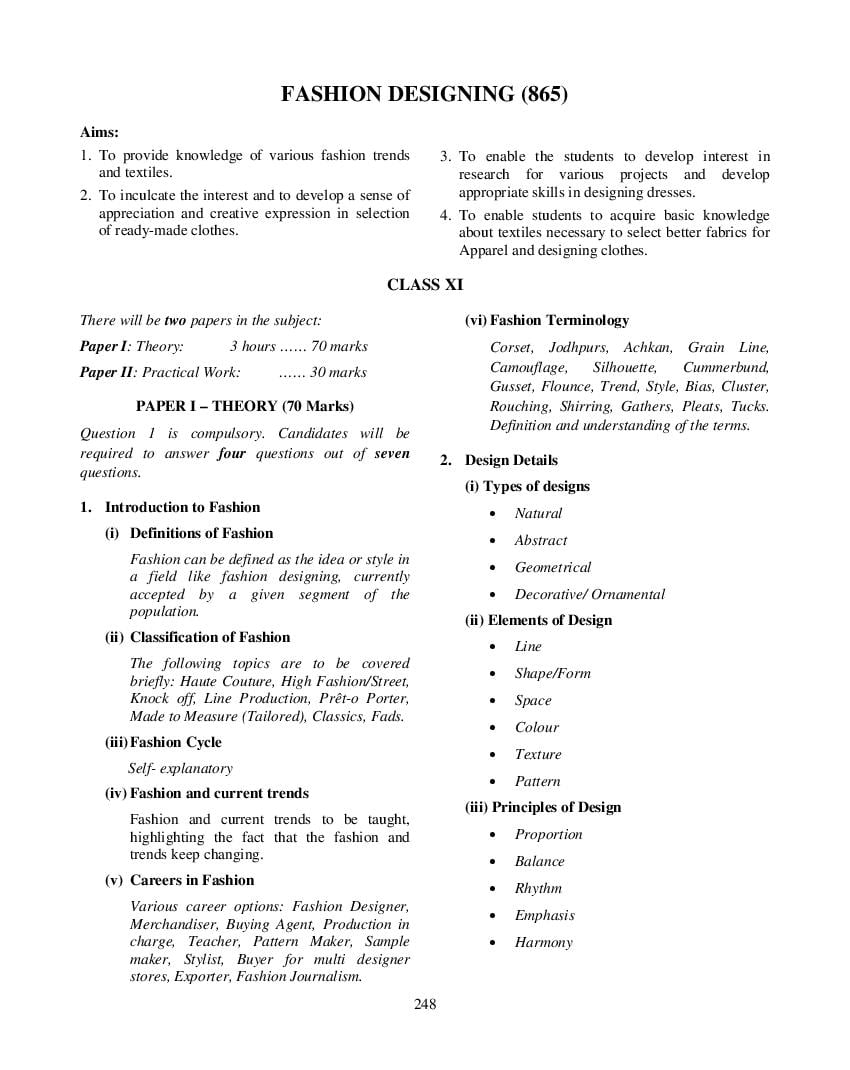
Aims:
1. To provide knowledge of various fashion trends 3. To enable the students to develop interest in
and textiles. research for various projects and develop
2. To inculcate the interest and to develop a sense of appropriate skills in designing dresses.
appreciation and creative expression in selection 4. To enable students to acquire basic knowledge
of ready-made clothes. about textiles necessary to select better fabrics for
Apparel and designing clothes.
CLASS XI
There will be two papers in the subject: (vi) Fashion Terminology
Paper I: Theory: 3 hours …… 70 marks Corset, Jodhpurs, Achkan, Grain Line,
Paper II: Practical Work: …… 30 marks Camouflage, Silhouette, Cummerbund,
Gusset, Flounce, Trend, Style, Bias, Cluster,
PAPER I – THEORY (70 Marks) Rouching, Shirring, Gathers, Pleats, Tucks.
Definition and understanding of the terms.
Question 1 is compulsory. Candidates will be
required to answer four questions out of seven 2. Design Details
questions.
(i) Types of designs
1. Introduction to Fashion • Natural
(i) Definitions of Fashion • Abstract
Fashion can be defined as the idea or style in
• Geometrical
a field like fashion designing, currently
accepted by a given segment of the • Decorative/ Ornamental
population.
(ii) Elements of Design
(ii) Classification of Fashion
• Line
The following topics are to be covered
briefly: Haute Couture, High Fashion/Street, • Shape/Form
Knock off, Line Production, Prêt-o Porter, • Space
Made to Measure (Tailored), Classics, Fads.
• Colour
(iii) Fashion Cycle
• Texture
Self- explanatory
• Pattern
(iv) Fashion and current trends
(iii) Principles of Design
Fashion and current trends to be taught,
highlighting the fact that the fashion and • Proportion
trends keep changing. • Balance
(v) Careers in Fashion
• Rhythm
Various career options: Fashion Designer,
• Emphasis
Merchandiser, Buying Agent, Production in
charge, Teacher, Pattern Maker, Sample • Harmony
maker, Stylist, Buyer for multi designer
stores, Exporter, Fashion Journalism.
248
Page 2
(i) Different figure types • Dip Method
An understanding of: • Sponge Method
• Ideal Figure Type
• Steam Method
• Triangular Figure Type
• Inverted Triangular Figure Type (iii) Storage and Maintenance of Clothes
• Rectangular Figure Type • Importance and Function of Closet
• Hourglass Figure Type Organization;
• Diamond-shaped Figure Type • Storage of special clothes: Storage of
• Tubular Figure Type Velvet, Brocade, Tissue, Suede, Organza;
• Rounded Figure Type Storing of Knits, Lingerie, Underwear,
Socks and Hosiery, Gloves, Belts, Shoes,
(ii) Buying Fabrics Handbags, Hats, Scarves, Jewellery.
• Shopping for fabrics • Maintenance: General tips on how to
• Special buying considerations take care of clothes of all types and
• Underlining fabrics -- types and materials.
selection (iv) Principles of Closet Organization
(iii) Clothing as a powerful resource • Visibility,
• Life cycle clothing needs • Reachability
• Professional Image Types - typical fields • Grouping by Category
and recommended dress for each.
4. Designers PAPER II - PRACTICAL WORK (30 Marks)
Learning in detail about five Indian and five Candidates will be expected to complete the practical
International designers (one Japanese, one work listed below and maintain a Journal for the
Italian, one French, one American and one same.
British) along with their styles of clothes.
The journal will be assessed internally by the
5. Care of Clothes Teacher out of 30 Marks.
(i) Some common stains and their removal: List of Practical Work to be done throughout
• Ink the year
• Lipstick
1. Creative use of various types of decorations
• Oil Paint
Hand embroidery stitches
• Perfume
• Outline stitches
• Perspiration
Back Stitch, Stem Stitch, Chain Stitch
• Water
• Ball point Pen • Filling stitches
• Blood • Satin Stitch, Herringbone Stitch, Long and
Short Stitch.
• Chocolate
• Coffee/Tea • Fancy stitches
• Grease Feather Stitch, Buttonhole Stitch, Bullion
Stitch and Trellis
• Nail Polish
249
Page 3
• Seams • Clothing the croque --- 2 western and 2
Stitched and Pinked, Turned and Stitched, Indian outfits
Hand-Overcast, French, Flat-felled
4. Taking Body Measurements
• Tucks
• Horizontal Measurements
Pin Tuck, Shell Tuck,
• Pleats Bust, Waist, Hips, X Back, X Chest, Neck,
Shoulder, Armhole, Dart Separation
Knife, Box, Inverted Box
• Vertical Measurements
• Gathers
• Neckline facings Nape to Waist, Shoulder to Waist, Armhole
depth, Waist to Knee, Waist to Hip
Shaped, Bias and piping for Round neck and
Square neck • Sleeve Measurements
• Fasteners Length to wrist, Upper arm girth, Wrist
Hook and Eye, Button and Buttonhole, Press • Trouser Measurements
Buttons
Body rise, Side seam, Knee girth, bottom
• Plackets width
Even hem placket • Sources of buying various fabrics needed
• Hem finishes for Apparel
Slant hemming and Slip Hemming Introduction to various markets to buy
required fabric
3. Basic Illustration
• Learning to draw mechanical croque 5. Workshop on Accessory making
• How to flesh out croque Costume jewellery: out of scrap, beads, paper
beads, paper quilling
250
Page 4
There will be two papers in the subject: (ii) Manufactured fibres - Rayon, Polyester,
Paper I: Theory: 3 hours …… 70 marks Nylon, Acrylic, Acetate, spandex.
Paper II: Practical Work: 3 hours …… 30 marks Identification, properties, uses,
advantages and disadvantages of the
PAPER I – THEORY (70 Marks) above.
Candidates will be required to answer five questions, (c) Fibre Properties.
including at least two questions from Section A and
two questions from Section B. A broad understanding of terms describing
fibres and their properties in order to
SECTION A understand their nature and how they
contribute to fabric properties.
TEXTILES
(i) Essential or primary properties - length
1. Introduction to Textiles to width ratio, density, tenacity,
(a) Definitions of textiles, fibre, yarn and fabric flexibility, cohesiveness.
and their qualities. (ii) Secondary properties - abrasion
An introduction to textiles by identifying resistance, absorbency, elongation,
textiles currently available in the market. resiliency, elastic recovery, electrical
Understanding of textiles by defining basic conductivity, elasticity, luster, heat
terms such as: fibre, yarn, fabric, finish, conductivity.
textile.
Uses of textiles in the following aspects of 3. Yarn
life should be discussed briefly: Apparel, (a) Yarn formation: Opening, cleaning, carding,
household, industrial & medical. combing, drawing, roving, spinning.
The components of serviceability of textile (i) Yarn Processing
products should be explained with reference
to: aesthetics, durability, comfort, Spun and Filament yarns: definition and
appearance, retention and care. examples.
(b) Importance of the textile industry (ii) Production of Spun and Filament Yarns:
Importance of the textile industry to the Spun yarn:
Economy of India - a brief discussion on its Ring Spinning: Opening, cleaning,
contribution to the GDP, employment & carding, combing, drawing, roving,
export. spinning (a brief understanding of each
process).
2. Textile Fibres
Filament yarn:
(a) Types of fibres.
Chemical spinning: Types - Wet
Staple and filament fibres - definition and spinning, Melt spinning, Dry spinning (a
examples. brief understanding of each process).
(b) Classification of textile fibres based on (b) Yarn twist.
Origin: Natural and Manufactured fibres.
Importance, uses and advantages of yarn
(i) Natural Fibres (Plant and animal origin). twist; amount of twist and how it
• Cellulosic fibres: Cotton, Flax, contributes to strength and appearance.
linen, jute, hemp; Types of yarns and their qualities -
• Protein fibres - Wool, Silk; Single, Ply and Fancy.
Identification, properties, uses, (c) Blends.
advantages and disadvantages of the Meaning, advantages and examples of
above. blends.
251
Page 5
Baluchar Butidar, Maheshwari, Mekhala
(a) Weaving: Characteristics, advantages,
Chadhar and Kanjeevaram.
disadvantages and uses.
Short notes on the following traditional saris
Understanding basic terminology: Warp, weft
with respect to origin, raw materials used,
and grain.
technique/s used, colours and designs: -
Process of weaving: a basic understanding of Paithani, Patola, Pochampalli, Baluchari
the loom and its operations; Maheshwari, Mekhala Chadhar and
The three basic weaves: Kanjeevaram..
Plain Weave – its variations (Basket and (d) Drapes
Rib). Different sari drape styles in India:
Twill Weave –its variations (Uneven and (i) Nine-yard Maharashtrian style
Even)
(ii) Gujarati style
Satin and Sateen Weave
(iii) Coorg style
A brief idea of construction, characteristics,
Description of the above drape styles along
advantages, disadvantages and uses of the
with sketching.
above weaves.
(b) Other fabric constructions: Knitting, SECTION B
Knotting (macramé), Crochet, Braiding and
FASHION AND APPAREL
Lace - to be explained briefly.
6. History of Fashion in Europe: 1901-1950
Basic understanding of the making, use and
characteristics of the above. (a) 1901-1920: Edwardian period / Labelle
Epoque / World War I.
Difference between woven and knit fabrics.
• A brief historical background; The effect
(c) Non-Wovens – Leather, Suede, Fur, Felt,
of War on Fashions.
Plastics, Bonded, Fused and Laminated
fabrics. • Influences on Fashion- The French
Uses and characteristics of the above to be couture, changing role of women, advent
explained briefly. of the automobile and influence of the
American high society.
5. Textiles in India • 1901-1908: Emphasis on S-shape
(a) Significance of colour in India. silhouette – pigeon chest.
Social, cultural and psychological • 1909-1914: Straight line Empire revival
importance of colour in India. and the hobble skirt with tight bottoms
(b) Indigenous dyes: Onion, Pomegranate, • 1914-1918: World War I silhouette was
Marigold, Coffee, Henna (Mehendi), wider and skirts grew shorter
Turmeric and Beetroot. • 1918-1919: Post war styles, barrel
Using natural materials like Onion peels, shaped silhouettes
Pomegranate peels, Marigold flowers, (b) 1941–1950: Frugal period / World War II,
Coffee, Henna (Mehendi), Turmeric and 1947 – New Look.
Beetroot for dyeing of fabrics.
Rationing of materials for Wartime utility
Advantages of using natural dyes over clothing to Dior’s New Look that added flare
synthetic dyes. to the skirt.
252
Page 6
(a) 1961 – 1970: Swinging Sixties / Hippies. The following traditional costumes of women are
to be studied.
• Growth and prosperity of top
manufacturers; • Ghagra-choli and odhni of Rajasthan;
• Revolutionary fashions; • Kurti, Daaman and Chunder of Haryana;
• Introduction to miniskirts; • Sari of Tamil Nadu;
• Discontinuation of stockings and • Pheran, skull cap, salwar and stole of
introduction of pantyhose; Kashmir;
• Pinafore dresses and knit fabrics; • Salwar–Kameez and dupatta of Punjab;
• Retro fever. • Sari and blouse of Andhra Pradesh;
(b) 1971– 1980: Disco Decade / Punk period. • Sharara & Gharara of Uttar Pradesh.
• Craze of Disco fitness in 80’s; Identification and sketching of the above along
with short notes on the given traditional wears in
• Street wear as shell suits;
terms of materials, colours, pattern styles/ design
• Punk fashion accepted by all; and use.
• Skirt lengths varied from micro mini to 9. Traditional Costumes of Men in India
maxi, flared trousers;
The following traditional costumes of men are to
• Platform shoes; be studied:
• Kaftans. • Jodhpuri Suit of Rajasthan;
• Mix and match coordinated knitwear in • Achkan/ Sherwani/ Kurta: with mandarin
fashion. collar or without collar of North India;
(c) 2001– till date. • Salwar / Churidar of Aligarh / Kutch;
• New developments in use of materials in • Cholu, dor and topi of the Gaddi Tribe of
the 21st Century; Himachal Pradesh;
• Influence of Art and Celebrities on • Surkha, waist-coat and cap of the Koli
Fashion. Fishermen of Maharashtra.
NOTE: Units 6 and 7 to be taught with reference to: Identification and sketching of the above along
(1) Women’s silhouettes with short notes on the given traditional wears in
terms of materials, colours, pattern styles/ design
(2) Invention and Innovation of fabrics and garments and use.
(3) Head gear and Hair-Styles
253
Page 7
write-up of aim, materials, equipment, method,
The Practical work will be evaluated by the teacher
dyeing recipes. Single and Double dyeing.
and a Visiting Examiner appointed locally and
approved by the Council. (7) Newspaper clippings of textile inventions &
new developments during the current academic
A. Candidates will be expected to complete the year.
practical work listed below and maintain a
Journal for the same. (8) Laundering and Finishing of textile fabrics
such as Cotton & Silk sarees, cotton shirt &
List of Practical Work to be done throughout blouses, Woolen cardigan, synthetics.
the year
(9) Renovation and Repair, darning and patch
(1) Fibre Identification (demonstration): using work
microscope and burning test
B. Practical Examination
Students have to write the aim, apparatus /
The Practical examination will be of three
materials, method, observations and inference.
hours duration. Questions will be based on the
Fibres to be identified are mercerized and
following:
unmercerized cotton, jute, linen, cultivated silk,
raw silk, wild silk, wool, rayon, nylon, polyester • Simple tests on fibre identification,
and acrylic. microscopic and physical appearance,
(2) Basic Weaves: Plain, Basket, Weft & Warp burning tests, etc.
faced Rib, Uneven Warp & Weft faced Twill • Simple dyeing of clothes.
Weave and Even Twill Weave and Satin &
Sateen Weave. • Tie and Dye, using any two methods of tie
and dye in one colour.
All the above weaves to be made (one sample
each approximately 12/12 cms square) using two • Leaf and Vegetable printing
colours of either satin ribbons 0.5 cms width or • Macramé’ knots.
two colors paper strips. The samples have to be
accompanied by aim, materials required, method. • Laundering and finishing of textile fabrics.
The properties and uses should be written along Cotton & Silk saree, cotton shirt & blouse,
with it. Woolen cardigan, synthetics.
(3) Fabric Swatches: 12 varieties of cotton, 4 to 6 • Renovation and repairs, darning, patchwork.
types of silk, 1 to 3 samples of wool, 1 to 3
samples of rayon, jute, linen, nylon, 10 varieties
of polyester, and 1 to 3 samples each of lace, ASSESSMENT
crochet, knitted, leather, plastic, bonded, felt, Marks out of 30 will be distributed as follows:
fused, quilted, braided, cords, fur, narrow width
Candidates will be required to submit a Journal
fabrics.
containing a record of all the work done
All fabric swatches should be 4/4 or 4/7 cms in throughout the year, as part of Practical Work.
size.
• Evaluation of the Journal by the Teacher
(4) Ten Macramé’ knots with names: Square knot,
(Continuous Evaluation) : 5 Marks
Alternating Square knot, Spiral knot, Basket
stitch, Snow flake design, Picot design, Half • Evaluation of the Journal by a Visiting
hitch, Diamond, Larks head, Monkey fist. Examiner : 5 Marks
(5) Leaf & vegetable printing: Three samples A4 • Practical Examination (to be evaluated by the
size – (a) Leaf printing (b) Vegetable printing Visiting Examiner) : 20 marks
(c) Combination of leaf & vegetable printing.
The above printing can be done on a
T-shirt/blouse.
254
Page 8
Evaluation of Journal (Practical Evaluation of the TOTAL MARKS = 30
Work done throughout the year) Practical Evaluation of Journal (by Teacher + Visiting
Examination Examiner) + Evaluation of the Practical
Examination (by the Visiting Examiner)
Unique
Identification (To be entered by the Visiting Examiner
S. No.
Number (Unique only)
ID) of the candidate
5 Marks 5 Marks 20 Marks
(by the (by the Visiting (by the Visiting
Teacher) Examiner) Examiner)
1.
2.
3.
4.
5.
6.
7.
8.
9.
10.
Name of the Visiting Examiner: _________________________________
Signature: _______________________________
Date: ___________________________________
255
Document Details
| Board / Org | CISCE |
| Exam | Class 12 |
| Type | Syllabus |
| Pages | 8 |
| Language | english |
| Updated | 22 Jul 2026 |