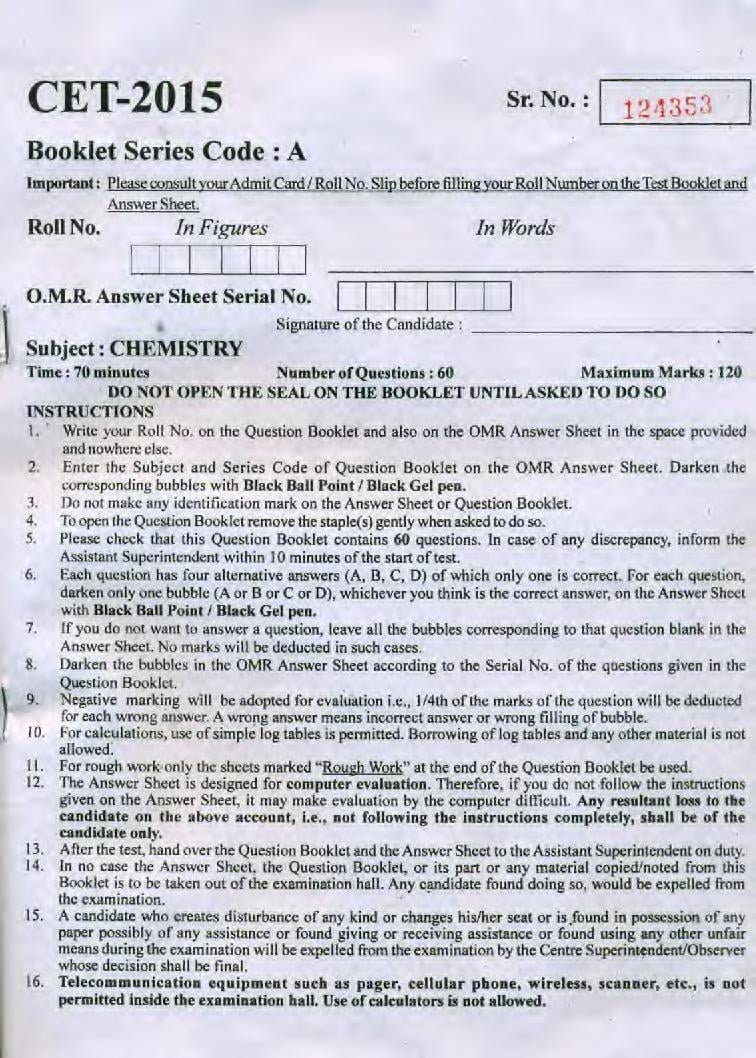
PU CET UG 2015 Question Paper Chemistry
Finished viewing? Save it for later —
Download PU CET UG 2015 Question Paper Chemistry (PDF · 12 pages)About PU CET UG 2015 Question Paper Chemistry
PU CET UG 2015 Question Paper Chemistry is available here for free download. Published by Punjab University for PUCET, this question paper can be viewed online or downloaded as a PDF (12 pages). Candidates preparing for PUCET can use PU CET UG 2015 Question Paper Chemistry to understand the exam pattern, the type of questions asked, and the overall difficulty level.
Frequently Asked Questions
How can I download PU CET UG 2015 Question Paper Chemistry?
Open this page and click the Download button to save PU CET UG 2015 Question Paper Chemistry as a PDF. It is completely free on AglaSem Docs.
Is PU CET UG 2015 Question Paper Chemistry free to download?
Yes. PU CET UG 2015 Question Paper Chemistry can be viewed online and downloaded as a PDF free of cost on AglaSem Docs.
How many pages does PU CET UG 2015 Question Paper Chemistry have?
PU CET UG 2015 Question Paper Chemistry contains 12 pages, which you can read online or download together as a single PDF.
Where can I find more PUCET study material?
You can find more PUCET question papers, sample papers, syllabus, and answer keys on AglaSem Docs.
PU CET UG 2015 Question Paper Chemistry – Text
Read the full text of this question paper below — useful to quickly search, copy and reference the content online without downloading the PDF.
📄 View text version (12 pages)
Page 1
~----------~
Booklet Series Code : A
Important: Please consult your Admit Card / Roll No. Slip before filling your Roll Number on the Test Booklet and
Answer Sheet.
Roll No. In Figures In Words
O.M.R. Answer Sheet Serial No.
, Signature of the Candidate:
Subject: CHEMISTRY
Time: 70 minutes Number of Questions: 60 Maximum Marks: 120
, DO NOT OPEN THE SEAL ON THE BOOKLET UNTIL ASKED TO DO SO
INSTRUCTIONS
1. Write your Roll No. on the Question Booklet and also on the OMR Answer Sheet in the space provided
t
and nowhere else.
2. Enter the Subject and Series Code of Question Booklet on the OMR Answer Sheet. Darken the
corresponding bubbles with Black Ball Point / Black Gel pen.
3; Do not make any identification mark on the Answer Sheet or Question Booklet.
4. To open the Question Booklet remove the staple(s) gently when asked to do so.
5. Please check that this Question Booklet contains 60 questions. In case of any discrepancy, inform the
Assistant Superintendent within 10 minutes of the start of test.
6. Each question has four alternative answers (A, B, C, D) of which only one is correct. For each question,
darken only one bubble (A or B or C or D), whichever you think is the correct answer, on the Answer Sheet
with Black Ball Point / Black Gel pen. ,
7. If you do not want to answer a question, leave all the bubbles corresponding to that question blank in the
Answer Sheet. No marks will be deducted in such cases.
8. Darken the bubbles in the OMR Answer Sheet according to the Serial No. of the qaestions given in the
Question Booklet. ,
9. Negative marking will be adopted for evaluation i.e., 1/4th of the marks of the question will be deducted
for each wrong answer. A wrong answer means incorrect answer or wrong filling of bubble.
10. For calculations, use of simple log tables is permitted. Borrowing of log tables and any other material is not
allowed:
11. For rough work-only the sheets marked "Rough Work" at the end of the Question Booklet be used.
,12. The Answer Sheet is designed for computer evaluation. Therefore, if you do not .follow the instructions
given on the Answer Sheet, it may make evaluation by the computer difficult. Any .resulrant loss to the
candidate on the above account, l.e., not following the instructions completely, shall be of the
candidate only.
13. After the test, hand over the Question Booklet and the Answer Sheet to the Assistant Superintendent on duty.
14. In no case the Answer Sheet, the Question Booklet, or its part or any material copied/noted from this
Booklet is to be taken out of the examination hall. Any candidate found doing so, would be expelled from
the examination. ./
15. A candidate who creates disturbance of any kind or changes his/her seat or is .found in possession of any
paper possibly of any assistance or found giving or receiving assistance or found using any other unfair
means during the examination will be expelled from the examination by the Centre Superintendent/Observer
whose decision shall be final. '
16. Telecommunication' equipment such as pager, cellular phone, wireless, scanner, etc., is not
permitted inside the examination hall. Use of calculators is not allowed. -
Page 2
1. At high pressure, van der waals equation becomes:
(A) PV=RT (B) PV= RT+ aN
(C) PV = RT -aN (D) PV= RT + Pb
2. Match the following
(X) Inversion Temperature (i) alRb
(Y) Boyle's Temperature (ii) 8a127Rb
(Z) Critical Temperature (Jiii) 2a1Rb
(A) X-i, Y-ii, ?-iii (B) X-iii, Y-ii,Z-i
(C) -X-iii, Y-i,Z-ii (D) X-i, Y-iii,Z-ii.
3. For an adiabatic process, which ofthe following relations is correct?
(A) ~E = 0 (B) P~V = 0
(C) q =0 (D) q =+w
4. The work done in ergs for a reversible expansion of one mole of an idea I gas from a volume of
10 litre to 20 litre at 25°C is:
(A) 2.303 x 8.31 x 107 x298log2 (B) 2.303 x 0.0821 x 298log2
(C) 2.303 x 0.0821 x 2981og0.5 (D) 2.303 x 2 x 298log2
5. The equilibrium constant for the reaction SOl (g) + Yz 01 (g) ~ S03 (g) is 5 X 10⁻¹atm-\
The equilibrium constant for the reaction: 2 S03 (g) ~ 2S01 (g) + 01 (g) would be :
(A) 100atm (B) 200atm .
(C) 4 x 10² atm (D) 6.25 xl O'ntm
ChemistryIBFH-30852-A 3 [Turn over
~
Page 3
the equilibrium constant would be :
(A) Unchanged (B) Increased
(C) Decreased (D) First increase then decrease
7. Two moles of PCl5 are heated in a closed vessel of 2 litre capacity. When the equilibrium is
attained .40% of it has been found to be dissociated. What is the value of K c in mol/dm' ?
(A) 0.532 (B) 0.266
(C) 0.133 (D) 0.174
8. The standard emf of a galvanic cell involving cell readion with n = 2 is found to be 0.295V
at 25°C. The equilibrium constant for the readion would be ( Given : F = 96500 Cmol ' ;
R = 8.314 JK-l mol+) :
(A) 2'x 1011 (B) 4 X 10¹²
(C) 1 X 10² (D) 1X 10¹⁰
9. The solubility of a gas in liquid increases with:
(A) Increase in temperature
(B) Reduction of gas pressure
(C) Decrease in temperature and Increase of gas pressure
(D) Amount ofliquid taken
10. If 0.1 M solution of glucose and 0.1 M urea solution are placed on two sides of a semipermeable
membrane to equal heights then it will be eorreet to say that:
,
(A) There will be no net movement across the membrane
(B) Glucose will flow towards urea solution
(C) Urea will flow towards glucose solution
(D) Water will flow from urea solution towards glucose solution
CkemisttyIBFH-30852-A
Page 4
equivalent conductance is :
(A) 14 (B) 140
(C) 1.4 (D) O.l4P
12. The oxidation potentials of Zn, Cu, Ag, H1 and Ni are 0.76, -0.34, -0.80, 0 and 0.25 volt
respectively. Which of the following reactions will provide maximum voltage?
(A) Zn + Cu2+~ Cu + Zn2+ (B) Zn + 2Ag+ ~ 2Ag + Zn2+
(C) H2 + Cu2+~ 2H+ + Cu (D) H2 + Ni2+~ 2H+ + Ni
13. The rate of Chemisorptions :
(A) Decreases with increase of pressure (B) Is independent of pressure
(C) Is maximum at one atmospheric pressure (D) Increases with increase of pressure
14. The migration of colloidal particles under the influence of an electric field is known as :
(A) Electro-osmosis (B) Brownian movement
. (C) Cataphoresis (D) Dialysis
15. The Crystalline structure ofNaCI is :
(A) Hexagonal close packed (B) Face centered cubic
(C) Square planar (D) Body-centered cubic
16.. The unit cell of AI (molar mass 27 g/mol-') has an edge length of 405 pm. Its density is
2.7 g/cmJ• The cubic unit cell is :
(A) Face-centered (B) Body-centered
(C) Edge-centered. . (D) Simple
ChemisttyIBFH-30852-A [Turn over
Page 5
passing through origin. This indicates that the reaction is of:
(A) Second order (B) First order
(C) Zero order (D) Fractional order
18. The reaction, X ~ Y (product) follows first order kinetics. In 40 minutes, the concentration of
X changes from 0.1 M to 0.025 M, then the rate of reaction when concentration of X is 0.01 M
is :
(A) 1.73 x 10⁻⁴Mzmin" (B) 3.47 x 10-s Mzmirr"
(C) 3.47 x 10⁻⁴Mzmirr! (D) 1.73 x 10-s Mzmin"
19. Colligative properties are applicable to :
(A) Ideal dilute solutions (B) Concentrated solutions
(C) .Non-ideal solutions (D) All of these
20. Which defect causes decrease in the density of a crystal ?..
(A) Frenkel defect (B) Schottky defect
(C) Interstitial defect (D) F-centre
21. IUPAC name for the compound given below is :
o
OH
(A) 3-Hydroxy- 5--{::hlor0--4-Pentanone (B) l-Chloro- 3-Hydroxy-2-Pentanone
(C) l--{::hloro-3-Ethyl- 3-Hydroxy-2-Propanone (D) l-Chloro-z-Oxo- 3-Hydroxypentane
22. The most stable carbocation in the following list is :
CHlCH/, C6HsCH/, (CH3)2 CH+, (C6HJ C+
(A) (C6Hs)3 C+ (B) C6HsCH2 +
(C) (CH3)2CH+ (D) CH3CH/
ChemistryIBFH-30852-A . 6
-¢-
Page 6
(A) Refonning (B) Sublimation
(C) Isomerisation (D) Cracking
24. Ozonolysis of2-methylpropene followed by reduction with ZnlCHlCOOH gives:
(A) -Propionaldehyde and formaldehyde (B) Acetaldehyde and acetone
(C) Acetone and formaldehyde (D) Acetaldehyde and water
25. Acetylenic hydrogen's ofalkynes can also be replaced with heavy metal Ag" by using:
(A) Fehling's reagent '(B) Tollen's reagent
(C) Hinsberg's'reagent (D) Fenton's reagent
26. Treatment of nitrobenzene with fuming HNOl in the presence of H2S04 at 373 K affords:
(A) Tn- Dinitrobenzene (B) p- Dinitrobenzene
(C) o-Dinitrobenzene (D) Benzene
27. Presence of Chlorofluorocarbons in atmosphere leads to:
(A) Global wanning (B) Greenhouse effect
(C) Smog (D) Depletion of ozone layer
28. Which of the following gases leads to aeid rain? .
(A) CO & NO (B) S02 & N02
(C) CO2 & S02 (D) CO & N02
29. When ethylbromide is treated with sodium acetylide the preductformed is :
(A) I-Butyne (B) 2-Butene
,(C) I-Butene (D) 2-Butyne
ChemistryIBFH-30852-A 7 [Turnover
-9-
Page 7
(A) Agricultural pesticide (B) Fireextinguisher
(C) Refrigerant and propellant (D) Dry cleaning agent
31. Reaction of Phenol with acetic anhydride in the presence of pyridine gives:
(A) Phenyl propionate (B) Phenyl benzoate
(C) Salicylic acid (D) Phenyl acetate
32. The products formed when C2H50C1H5 reacts with cone, ID( cold) :
(A) Ethyl iodide and water (B) Ethyl alcohol and ethyl iodide
(C) Ethyl alcohol and water (D) Ethyl iodide only
33. Predict the fmal product X in the following reaction:
0=0 NH2NH2I KOH
x
(A) Cyclohexane (B) Cyclohexene'
(C) Cyclohydrazone (D) Benzene
34. The conversion of propionic acid to a-bromopropionic
. ,
acid can be achieved with the help 0
following reagent :-
(A) Br/aq KOH (B) Br/CC14
. (C) Br/P (D) PBr3
l~. When ethylamine is warmed with chloroform and alcoholic potash, Y compound is formed whicl
gives very offensive smell. The compound Y is :
(A) Ethyl isocyanate (B) Naphthalene
(C) Ethylcyanide . (D) Ehtyl isocyanide
ChemistryIBFH-30852-A 8
~
Page 8
(A) Aliphatic amine with nitrous acid (B) Aliphatic amine with nitric acid
(C) Aromatic amine with nitrous acid (D) Aromatic amine with nitric acid
37. The structure of silk fibroin protein corresponds to :
(A) a-Helix (8) ~-J>leated Sheet
(C) y-Coiled (D) &-Planner
38. Deficiency of Vitamin D leads to:
(A) Rickets and osteomalacia (8). Night-blindness
(C) Scurvy (D) Sterility
39. Which of the following is not an example of condensation polymer?
(A) Nylon-66 (8) Terylene
(C) Buna--S (D) Bakelite
40. The colloidal solution of soaps in water removes the greasy matter by :
(A) Adsorption (8) Coagulation
(C) Absorption (D) Emulsification
41. The highest excited state that unexcited hydrogen atoms can reach when they are bombarded
with 12.2 eV electron is :
(A) n = 1 (B) n =2
(C) n=3 (D) n=4
42. The bond length in 0/.°1,°1-. and 0/-, follows the order:
2- > 0 - > 0 > 0 +
(A) 02222 + > 0 > 0 - > 0 2-
(B) 02222
> 0 - > 0 2- > 0 +
(C) 02222 - > 0 2- > 0 + > 0
(D) 02222
ChemistryIBFH-30852-A 9 [Turnover
-9-
Page 9
present in the container will be :
(A) 6.022 x 10²³ (B) J.2044 X 1023
(C) 2mole (D) 6.023 x 1024
44. Equivalent weight of FeC20 .•in the change: FeC20 .•---------Fel+ +C02is :
(A) Ml3 (B) Ml6
(C) MI2 (D) Mil
45. Poling process is used :
(A) For the removal ofAl203 from Al (B) For the removal of'Cu.O from Cu
(C) For the removal of'Znfr from Zn (D) For the removal ofFe203 from Fe
46. Heavy water is not used for drinking because:
(A) It is poisonous
(B) It is costly.
(C) Its physiological action is different from ordinary water
(D) Its chemical properties are different from ordinary water
47. AI20l formation involves large quantity of heat evolution which makes its use in :
(A) Deoxidiser (B) Confectionery
(C) Indoorphotography (D) Thermitewelding
48. The oxidation state ofMo in its oxo-complex species [Mo20 .•(C2"Jl'(H10)lJl-is:
(A) +2 • (B) +3
(C)+4 (D)+5
ChemistryIBFH-30852-A 10
-¢-
Page 10
(A) Pure iron with 0.1 to 0.2% C (8) PigIron
(C) An alloy of steel (D) Impure sulphide ore ofiron
50. For which one of the following ions, the colour is not due to a d-d transitions?
(A) Cr042- (8) Cu(NH3)/+
(C) TI(~O)63+ (D) CoF/+
51. Antichor is a compound:
(A) Which absorb chlorine
(8) Which removes Cl2 from amaterial
(C) Which liberates Cl2 from bleaching powder
(D) Which acts as a catalyst in the manufacture of'Cl,
52. HIS cannot be dried by passing over cone, "2S04 because:
(A) The acid oxidises it (8). The acid combines with H2S to form a salt
(C) Both form Complex (D) It dissolves in the acid
53. P4°10 has short and long P-O bonds. The number of short P-O bonds in this compound is :
(A) 1 (8) 2
(C) 3 (D) 4
54. CO2 and N2are non-supporter of combustion. However, for putting out fires CO2 is preferred
over NI and CO2 :
(A) Does not burn
. . .
'
(8) Forms non-combustible products with burning substances
(C) Is denser than nitrogen
(D) Is more reactive.
ChemistryIBFH~30852-A [Turn over
Page 11
formation of a :
(A) Green precipitate (8) Pink colouration
(C) Blue precipitate (D) Violetcolouration
56. The hydride which does not act as reducing agent is :
(A) NH3 (8) CaH2
(C) NaH (D) LiAlH4
57. Newly shaped glass articles when cooled suddenly become brittle, therefore these are cooled
slowly, this process is known as :
(A) Tempering (8) Annealing
(C) Quenching (D) Galvanising
58. Liquid ammonia bottles be opened after cooling them in ice for some time. It is because liquid
NUl:
(A) Brings tears to the eyes (8) Has a high Vapour pressure
(C) Is a corrosive liquid (D) Is a mild explosive
59. Starch paper moistened with Kl solution turns blue in ozone because of:
(A) Iodine liberation (8) Oxygen liberation
(C) Alkali formation (D) Ozone reacts with litmus paper
60. The compound which can remove both oxygen and nitrogen of the air when it is passed over it
at 1000°C:
(A) CaC2 (8) CaCl2
(C) CaCN2 (D) Ca(CN)2
ChemistryIBFH-30852-A 12
~
Page 12
CET(UG)-2015
FINAL ANSWERS / KEY
Subject: CHEMISTRY
Booklet Series Code: A
1 2 3 4 5 6 7 8 9 10
D C C A C A B D C A
11 12 13 14 15 16 17 18 19 20
B B D C B A C C A B
21 22 23 24 25 26 27 28 29 30
B A D C B A D B A C
31 32 33 34 35 36 37 38 39 40
D B A C D C B A C D
41 42 43 44 45 46 47 48 49 50
C A B A B C D B A A
51 52 53 54 55 56 57 58 59 60
B A D C A A B B A A
Note: An 'X' in the key indicates that either the question is ambiguous or it has
printing mistake. All candidates will be given credit for this question.
Document Details
| Board / Org | Panjab University |
| Exam | PUCET |
| Type | Question Paper |
| Pages | 12 |
| Updated | 22 Jul 2026 |