PU CET UG 2015 Question Paper Biotechnology
Finished viewing? Save it for later —
Download PU CET UG 2015 Question Paper Biotechnology (PDF · 12 pages)About PU CET UG 2015 Question Paper Biotechnology
PU CET UG 2015 Question Paper Biotechnology is available here for free download. Published by Punjab University for PUCET, this question paper can be viewed online or downloaded as a PDF (12 pages). Candidates preparing for PUCET can use PU CET UG 2015 Question Paper Biotechnology to understand the exam pattern, the type of questions asked, and the overall difficulty level.
Frequently Asked Questions
How can I download PU CET UG 2015 Question Paper Biotechnology?
Open this page and click the Download button to save PU CET UG 2015 Question Paper Biotechnology as a PDF. It is completely free on AglaSem Docs.
Is PU CET UG 2015 Question Paper Biotechnology free to download?
Yes. PU CET UG 2015 Question Paper Biotechnology can be viewed online and downloaded as a PDF free of cost on AglaSem Docs.
How many pages does PU CET UG 2015 Question Paper Biotechnology have?
PU CET UG 2015 Question Paper Biotechnology contains 12 pages, which you can read online or download together as a single PDF.
Where can I find more PUCET study material?
You can find more PUCET question papers, sample papers, syllabus, and answer keys on AglaSem Docs.
PU CET UG 2015 Question Paper Biotechnology – Text
Read the full text of this question paper below — useful to quickly search, copy and reference the content online without downloading the PDF.
📄 View text version (12 pages)
Page 1
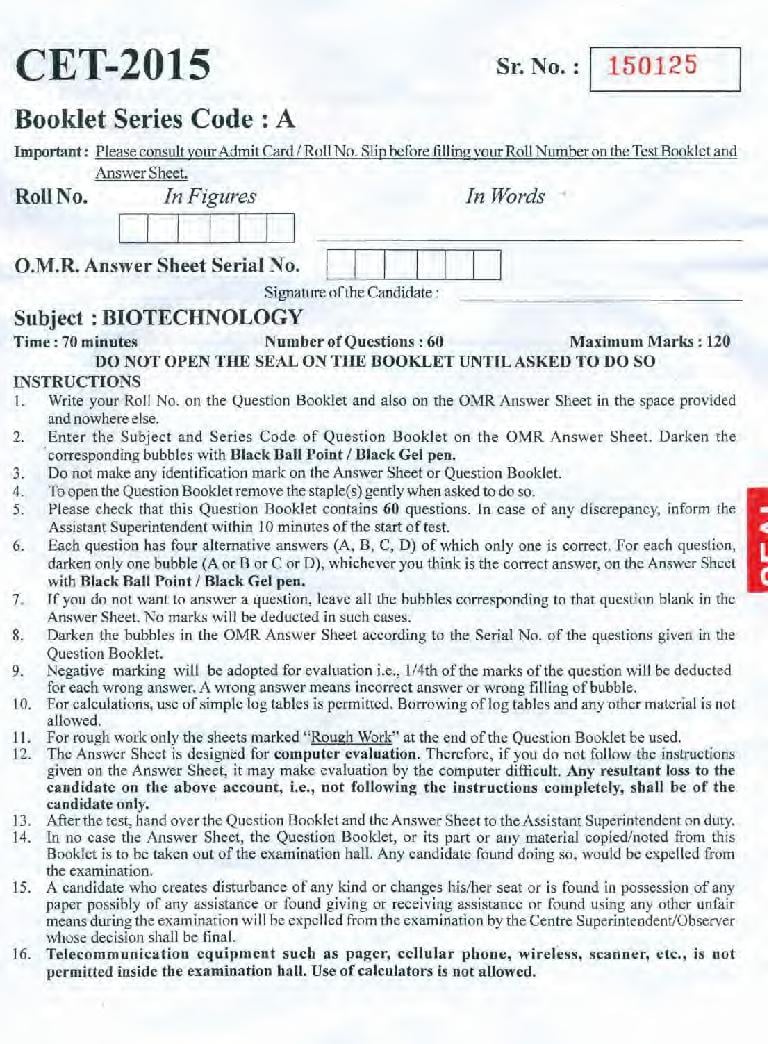
Booklet Series Code : A
Important: Please consult your Admit Card / Roll No. Slip before filling your Roll Number on the Test Booklet and
Answer Sheet.
Roll No. In Figures In Words
O.M.R. Answer Sheet Serial No.
Signature ofthe Candidate:
Subject : BIOTECHNOLOGY
Time: 70 minutes Number of Questions : 60 Maximum Marks: 120
DO NOT OPEN THE SEAL ON THE BOOKLET UNTIL ASKED TO DO SO
INSTRUCTIONS
1. Write your Roll No. on the Question Booklet and also on the OMR Answer Sheet in the space provided
and nowhere else.
2. Enter the Subject and Series Code of Question Booklet on the OMR Answer Sheet. Darken the
\corresponding bubbles with Black Ball Point / Black Gel pen. .
3. Do not make any identification mark on the Answer Sheer or Question Booklet.
4. To open the Question Booklet remove the staple( s) gently when asked to do so.
5. Please check that this Question Booklet contains 60 questions. In case of any discrepancy, inform the
Assistant Superintendent within 10 minutes of the start of test.
6. Each question has four alternative answers (A, B, C, D) of which only one is correct. For each question,
darken only one bubble (A or B or C or D), whichever you think is the correct answer, on the Answer Sheet
with Black Ball Point / Black Gel pen.
7. If you do not want to answer a question, leave all the bubbles corresponding to that question blank in the
Answer Sheet. No marks will be deducted in such cases.
8. Darken the bubbles in the OMR Answer Sheet according to the Serial No. of the questions given in the
Question Booklet.
9. Negative' marking will be adopted for evaluation i.e., 1/4th of the marks of the question will be deducted
for each wrong answer. A wrong answer means incorrect answer or wrong filling of bubble.
10. For calculations, use of simple log tables is permitted. Borrowing of log tables and any other material is not
allowed.
11. For rough work only the sheets marked "Rough Work" at the end of the Question Booklet be used.
12. The Answer Sheet is designed for computer evaluation. Therefore, if you do not follow the instructions
given on the Answer Sheet, it may make evaluation by the computer difficult. Any resultant loss to the
candidate on the above account, i.e., not following the instructions completely, shall be of the
candidate only.
13. After the test, hand over the Question Booklet and the Answer Sheet to the Assistant Superintendent on duty.
14. In no case the Answer Sheet, the Question Booklet, or its part or any material copied/noted from this
Booklet is to be taken out of the examination hall. Any candidate found doing so, would be expelled from
. the examination. '
15. A candidate who creates disturbance of any kind or changes his/her seat or is found in possession of any
. paper possibly of any assistarice or found giving or receiving assistance or found using any other unfair
means during the examination will be expelled from the examination by the Centre Superintendent/Observer
whose decision shall be final.
16. Telecommunication equipment such as pager, cellular phone, wireless, scanner, etc., is not
permitted inside the examination hall. Use of calculators is not allowed.
Page 2
Biotechnology/A
1. During bacterial conjugation, Fertility factor "F" is carried by :
(A) Male (B) Female
(C) Both by male and female (D) Neither by male nor by female
2. Chromatin consists of :
(A) histonesonly (B) DNAandhistonesonly.
(C) histones and other proteins only (D) DNA, histones, and other proteins.
3. A relationship among alleles where both alleles contribute to the phenotype ofthe heterozygote
is called:
(A) Dominance (B) Co-dominance
(C) Incomplete dominance (D) Pureline selection
4. When one gene influences multiple, seemingly unrelated phenotypic traits, it is known as :
(A) Pleiotropy (B) Epistasis
(C) Methylation (D) Epigenetics
5. Satellite DNA is typically found in :
(A) Centromeres (B) Heterochromatin
(C) Both centromeres and heterochromatin (D) Telomeres
6. Expression vector differs from normal cloning vector in having:
(A) An origin of replication (B) Suitable marker genes
(C) Unique restriction sites (D) Control elements
7. Which ofthe following molecules contains an anticodon ?
(A) rnRNA (B) tRNA
(C) rRNA (D) protein
BiotechnologyIBFH-30856-A 3 [Turnover
( +)
Page 3
(A) carbon dioxide (B) water
(C) glucose (D) (C~O)
9. Which pigment is present in all photosynthetic eukaryotes ?
(A) Chlorophyll a (B) Chlorophyll b
(C) Chlorophyll c (D) Bacteriochlorophyll
10. In pBR322, pBR stands for:
(A) Plasmid bacterial recombination (B) Plasmid bacterial replication
(C) Plasmid bolivar and rodriguez (D) Plasmid baltimore and rodriguez
11. results in the production ofRNA using a DNA template.
(A) Replication (B) Transcription
(C) Translation (D) Amplification
12. Which ofthe following does not follow base pairing rules?
(A) A:T (B) U:T
(C) G: C (D) U:A
13. Karyogamy is the:
(A) Fusion of protoplasts (B) Formation of a dikaryon
(C) Fusionofnuc1ei (D) Formationofrhizoids
14. All ofthe following are matched correctly except:
(A) Myosin: motor protein (B) Keratin: immune defense proteins
(C) Hemoglobin: transport protein (D) Collagen: structural protein
Biotechnoiogy/BFH-30856-A 4
C+)
Page 4
(A) Storage (B) Regulatory
(C) Protective (D) Transport
16. Alternative versions of the same single-copy gene are:
(A) Alleles (B) Mosaic genes
(C) Pseudogenes (D) Regulatory genes
17. The process of photosynthesis result in the formation of two substances essential to our
existence:
(A) Chlorophyll and water (B) Sugar and oxygen
(C) Sugar and water (D) Chlorophyll and oxygen
18. The most abundant organic molecule in nature are:
(A) Proteins (B) Carbohydrates
(C) Lipids (D) Nuc1eicacids
19. first concluded that all cells arise from preexisting cells.
(A) Theodor Schwarm (B) Robert Hooke
(C) Charles Darwin (D) RudolfVirchow
20. The Haber-Bosch process is important in the:
(A) Reduction of soil erosion
(B) Development of pesticides
(C) Manufacture of fertilizers
(D) Development of efficient irrigation systems
BiotechnologyIBFH-30856-A [Turnover
Page 5
21. Eukaryotic ceUs differ from prokaryotic cells in that eukaryotic cells have:
(A) Anuc1eus (B) A cytoplasm
(C) Aplasmamembrane CD) Genetic material
22. The nucleolus is the structure in which ---- are formed.
(A) Nuclear pores (B) Chromosomes
(C) Ribosomes CD) UnitesofER
23. Grana are stacks of within chloroplast.
(A) Prolamel1arbodies (B) Thylakoids
(C) Stroma (D) Etioplasts
24. In the cell cycle, interphase consists of:
(A) Mitosis and cytokinesis (B) Mitosis and the S phase
(C) The Gland G2 phase (D) The G 1, S and G2 phase
25. During the nuclear envelopes and nucleoli reforms.
(A) Anaphase (B) Metaphase
(C) Prophase (D) Telophase
26. The chief reservoir of nitrogen is :
(A) the ocean (B) livingorganisms
(C) dead organic material (D) the atmosphere
27. Nitrite is oxidized to nitrate by :
(A) Nitrosomonas (B) Nitrobacter
(C) ammonifying bacteria and fungi (D) d. denitrifying bacteria
BiotechnoiogyIBFH-30856-A 6
( +)
Page 6
(A) tendency of water to enter the cell (B) tendency of water to leave the cell
(C) kinetic energy of water (D) potential energy of water
29. Mutualism is an interaction between two species in which:
(A) one species benefits and the other is harmed
(B) both species benefit
(C) both species are harmed
(D) one species benefits and the other is neither hanned nor helped
30. If the concentration of K + is higher outside a plant cell than inside, K + will enter the
cell by:
(A) facilitated diffusion through channel proteins (B) facilitated diffusion via carrier proteins
(C) active transport through channel proteins (D) active transport via carrier proteins
31. Which of the following would NOT occur during signal recognition?
(A) The signal molecule binds to a specific receptor on the plasma membrane.
(B) The signal molecule is transported into the cell by endocytosis.
(C) The signal molecule is transported out of the cell by exocytosis.
(D) The signal molecule remains outside the celL
32. In biological reactions, when a molecule is oxidized it an electron and
a(n) _
(A) loses; proton (B) gains; proton
(C) loses; oxygen atom (D) gains; oxygen atom
BiotechnologyIBFH-30856-A 7 [Turnover
( +)
Page 7
(A) coenzyme (B) substrate
(C) active (D) polypeptide
34. Isozymes are:
(A) RNA molecules that catalyze metabolic reactions
(B) identical coenzymes that require different metal ions
(C) identical coenzymes located in different parts of the cell
(D) different enzymes that catalyze identical reactions
35. Which ofthe following statements concerning the effect of pH on enzyme activity is FALSE?
(A) The pH affects positively-charged amino acids
(B) The pH affects negatively-charged amino acids
(C) The binding capacity of an enzyme is affected by pH
(D) Enzymes are always present at their pH optimum
36. In an ATP molecule, phosphoanhydride bonds link:
(A) adenine to ribose (B) adenine to a phosphate group
(C) the phosphate groups together (D) ribose to a phosphate group
37. In feedback inhibition, the enzyme in a metabolic pathway is inhibited by
the -----
(A) last; end product (B) first; cofactor
(C) first; first substrate (D) first; end product
38. Formation of ATP from ADP and phosphate as a result of electron transport occurs in :
(A) the formation of acetyl CoA (B) fermentation
(C) glycolysis (D) oxidative phosphorylation
BiotechnologyIBFH-30856-A 8
( +)
Page 8
(A) stored in molecules ofADP (B) stored in molecules ofATP
(C) released in molecules of carbon dioxide (D) released as heat
40. For every molecule of glucose that begins glycolysis, how many ATP molecules are
consumed?
(A) 0 (B) 1
(C) 2 (D) 3
41. Under anaerobic conditions, yeasts and most plant cells convert pyruvate to:
(A) acetyl Co A (B) lactate
(C) ethanol and carbon dioxide (D) ArP
42. The pairing of homologous chromosomes is called:
(A) synapsis (B) chiasma
(C) crossing-over (D) recombination
43. Crossing-over occurs during:
(A) metaphase I (B) telophase I
(C) metaphase IT (D) prophase I
44. When a particular trait appears in the F2 generation but not in the Fl generation, it is
an indication that :
(A) a monohybrid cross is involved (B) a dihybrid cross is involved
(C) true-breeding plants are involved (D) the trait is recessive
45. Term of a patent is :
(A) 7 years and no renewal (B) 7 years with possibility of renewal
(C) 20 years and no renewable (0) 20 years with possibility of renewal
BiotechnologyIBFH-30856-A 9 [Turn ovr
( +)
Page 9
(A) are alleles of the same gene (B) occur on the same chromosome
(C) will segregate independently (D) will undergo independent assortment
47. Polyploidy refers to the:
(A) loss of part of a chromosome (B) gain of part of a chromosome
(C) gain or loss of some chromosomes (D) gain of a complete set of chromosomes
48. Cytoplasmic inheritance in plants involves genes present in the:
(A) plastids only (B) mitochondria only
(C) cytosol and plastids (D) mitochondria and plastids
49. Data obtained by Erwin Chargaffindicated that in DNA the ratio ofnuc1eotides containing
_____ to those containing is approximately 1: 1.
(A) adenine; cytosine (B) adenine; thymine
(C) guanine;thymine (D) thymine; cytosine
50. When scientists describe the genetic code as redundant, they mean that:
(A) it becomes disorganized over time
(B) many amino acids have more than one codon
(C) some codons specify stop signals
(D) it varies with cell type
51. Which ofthefollowing statements about promoters is FALSE?
(A) They are specific nucleotide sequences of DNA
(B) They consist of three nucleotides that bind to a codon
(C) They determine the position where RNA synthesis begins
(D) They determine which DNA strand is used as a template
BiotechnologyIBFH-30856-A 10
C+)
Page 10
(A) transcription is repressed (B) transcription is stimulated
(C) histonetailsbindDNA (D) histone tails are released from DNA
53. Interspersed repeated DNA units:
(A) tend to be smaller than 10 base pairs long
(B) constitute less than 10percent of the DNA of most multicellular organisms
(C) are identical to one another
(D) are believed to have originated from transposons
54. Suppose a plasmid containing a gene of interest plus the ampR gene is used to transform
E. coli cells. When these cells are placed on a medium containing ampicillin, what will
happen?
(A) Theywilldie (B) They will survive and grow
(C) They will form blue colonies (D) They will glow with a green color
55. When biologists speak of the "fitness" of an organism they are referring to :
(A) its beauty (B) its resistance to disease
(C) the size of its gene pool (D) the number of its surviving offspring
56. Deposition of microbes for the purpose of patenting is covered under:
(A) BudapestTreaty (B) PCT
(C) European Patent Convention (D) Strasbourg Convention
57. Technique used to separate charged molecules based on their mobility in an electric field
is known as:
(A) IonexchangeChromatography (B) Electrophoresis
(C) Isoelectro-focussing (D) Partition chromatography
BiotechnologyIBFH-30856-A [Turnover
Page 11
(A) Harsheyand Chase (B) Meselson and Stahl
(C) Johannson (D) Watson and Crick
59. In gas chromatography, the basis for separation of the components ofthe volatile material is
the difference in :
(A) Partition coefficients (B) Conductivity
(C) Molecularwt (D) Molarity
60. Ion exchange chromatography is based on the:
(A) Electrostatic attractions (B) Electrical mobility of ionic species
(C) Adsorption chromatography (D) Partition chromatography
BiotechnologyIBFH-30856-A 12
C+)
Page 12
CET(UG)-2015
FINAL ANSWERS / KEY
Subject: BIOTECHNOLOGY
Booklet Series Code: A
1 2 3 4 5 6 7 8 9 10
A D B A C D B B A C
11 12 13 14 15 16 17 18 19 20
B B C B B A B B D C
21 22 23 24 25 26 27 28 29 30
A C B D D D B D B A
31 32 33 34 35 36 37 38 39 40
C A C D D C D D D C
41 42 43 44 45 46 47 48 49 50
C A D D D B D D B B
51 52 53 54 55 56 57 58 59 60
B A D B D A B B A A
Note: An 'X' in the key indicates that either the question is ambiguous or it has
printing mistake. All candidates will be given credit for this question.
Document Details
| Board / Org | Panjab University |
| Exam | PUCET |
| Type | Question Paper |
| Pages | 12 |
| Language | english |
| Updated | 22 Jul 2026 |