Finished viewing? Save it for later —
Download ISC Class 12 Syllabus 2023 Physics (PDF · 25 pages)About ISC Class 12 Syllabus 2023 Physics
ISC Class 12 Syllabus 2023 Physics is available here for free download. Published by CISCE for Class 12, this syllabus can be viewed online or downloaded as a PDF (25 pages). Candidates preparing for Class 12 can use ISC Class 12 Syllabus 2023 Physics to understand the exam pattern, the type of questions asked, and the overall difficulty level.
Frequently Asked Questions
How can I download ISC Class 12 Syllabus 2023 Physics?
Open this page and click the Download button to save ISC Class 12 Syllabus 2023 Physics as a PDF. It is completely free on AglaSem Docs.
Is ISC Class 12 Syllabus 2023 Physics free to download?
Yes. ISC Class 12 Syllabus 2023 Physics can be viewed online and downloaded as a PDF free of cost on AglaSem Docs.
How many pages does ISC Class 12 Syllabus 2023 Physics have?
ISC Class 12 Syllabus 2023 Physics contains 25 pages, which you can read online or download together as a single PDF.
Where can I find more Class 12 study material?
You can find more Class 12 question papers, sample papers, syllabus, and answer keys on AglaSem Docs.
ISC Class 12 Syllabus 2023 Physics – Text
Read the full text of this syllabus below — useful to quickly search, copy and reference the content online without downloading the PDF.
📄 View text version (25 pages)
Page 1
Aims:
1. To enable candidates to acquire knowledge and to develop an understanding of the terms, facts, concepts,
definitions, and fundamental laws, principles and processes in the field of physics.
2. To develop the ability to apply the knowledge and understanding of physics to unfamiliar situations.
3. To develop a scientific attitude through the study of physical sciences.
4. To develop skills in -
(a) the practical aspects of handling apparatus, recording observations and
(b) Drawing diagrams, graphs, etc.
5. To develop an appreciation of the contribution of physics towards scientific and technological developments
and towards human happiness.
6. To develop an interest in the world of physical sciences.
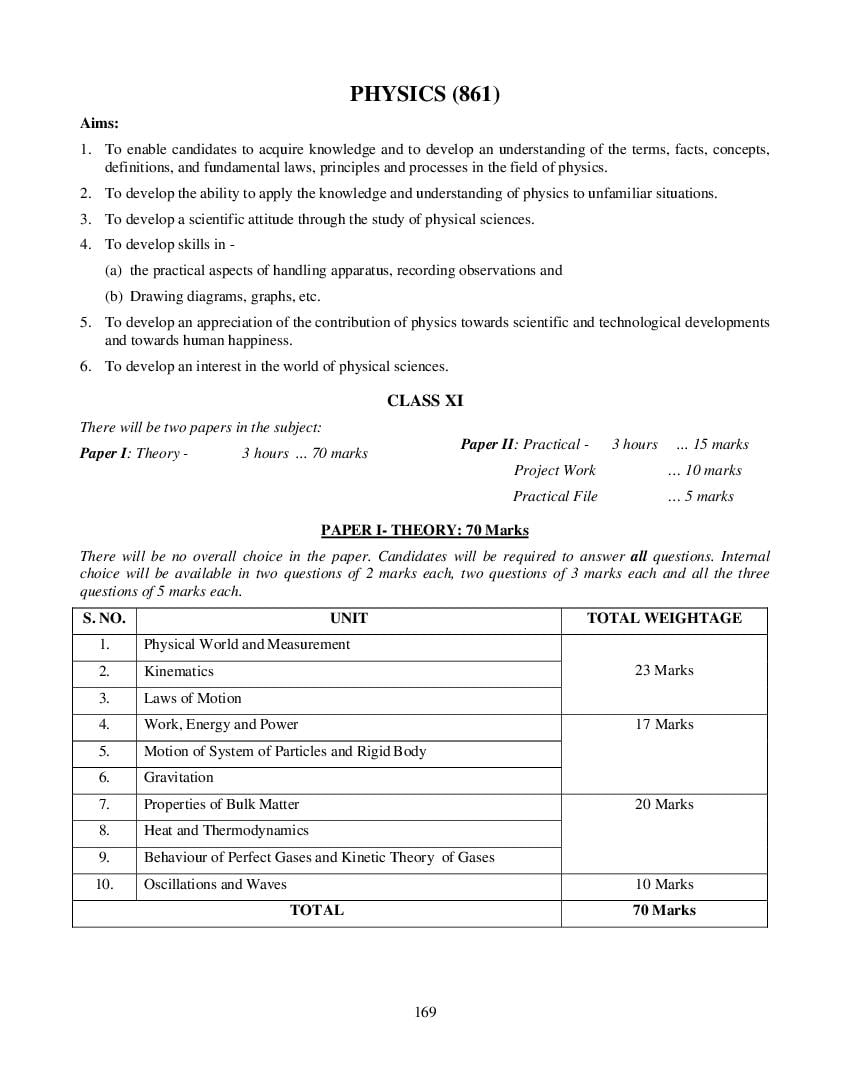
CLASS XI
There will be two papers in the subject:
Paper II: Practical - 3 hours ... 15 marks
Paper I: Theory - 3 hours ... 70 marks
Project Work … 10 marks
Practical File … 5 marks
PAPER I- THEORY: 70 Marks
There will be no overall choice in the paper. Candidates will be required to answer all questions. Internal
choice will be available in two questions of 2 marks each, two questions of 3 marks each and all the three
questions of 5 marks each.
S. NO. UNIT TOTAL WEIGHTAGE
1. Physical World and Measurement
2. Kinematics 23 Marks
3. Laws of Motion
4. Work, Energy and Power 17 Marks
5. Motion of System of Particles and Rigid Body
6. Gravitation
7. Properties of Bulk Matter 20 Marks
8. Heat and Thermodynamics
9. Behaviour of Perfect Gases and Kinetic Theory of Gases
10. Oscillations and Waves 10 Marks
TOTAL 70 Marks
169
Page 2
Note: (i) Unless otherwise specified, only S. I. Units fermi, angstrom (now outdated), light
are to be used while teaching and learning, as well as year, astronomical unit and parsec. A
for answering questions. new unit of mass used in atomic physics
is unified atomic mass unit with symbol u
(ii) All physical quantities to be defined as and when (not amu); rules for writing the names of
they are introduced along with their units and units and their symbols in SI (upper
dimensions. case/lower case.) Derived units (with
(iii) Numerical problems are included from all topics correct symbols); special names
except where they are specifically excluded or where wherever applicable; expression in terms
only qualitative treatment is required. of base units (e.g.: N= kg m/s2).
(b) Accuracy of measurement, errors in
1. Physical World and Measurement measurement: precision of measuring
(i) Physical World: instruments, instrumental errors,
systematic errors, random errors and
Scope of Physics and its application in
gross errors. Least count of an
everyday life. Nature of physical laws. instrument and its implication on errors
Physics and its branches (only basic in measurements; absolute error, relative
knowledge required); fundamental laws and error and percentage error; combination
fundamental forces in nature (gravitational of errors in (a) sum and difference, (b)
force, electro-magnetic force, strong and product and quotient and (c) power of a
weak nuclear forces; unification of forces). measured quantity.
Application of Physics in technology and (c) Significant figures; their significance;
society (major scientists, their discoveries, rules for counting the number of
inventions and laws/principles to be significant figures; rules for (a) addition
discussed briefly). and subtraction, (b) multiplication/
(ii) Units and Measurements division; ‘rounding off’ the uncertain
digits; order of magnitude as statement
Measurement: need for measurement; units
of magnitudes in powers of 10; examples
of measurement; systems of units:
from magnitudes of common physical
fundamental and derived units in SI;
quantities - size, mass, time, etc.
measurement of length, mass and time;
accuracy and precision of measuring (d) Dimensions of physical quantities;
instruments; errors in measurement; dimensional formula; express
significant figures. derived units in terms of base units
(N = kg.m s-2); use symbol […] for
Dimensional formulae of physical quantities
dimensions of or base unit of; e.g.:
and constants, dimensional analysis and its
dimensional formula of force in terms of
applications.
fundamental quantities written as
(a) Importance of measurement in scientific [F] = [MLT–2].Principle of homogeneity
studies; physics is a science of of dimensions. Expressions in terms of SI
measurement. Unit as a reference base units and dimensional formula may
standard of measurement; essential be obtained for all physical quantities as
properties. Systems of units; CGS, FPS,
and when new physical quantities are
MKS, MKSA, and SI; the seven base
units of SI selected by the General introduced.
Conference of Weights and Measures in (e) Use of dimensional analysis to (i) check
1971 and their definitions, list of the dimensional correctness of a
fundamental, supplementary and derived formula/ equation; (ii) to obtain the
physical quantities; their units and dimensional formula of any derived
symbols (strictly as per rule); subunits physical quantity including constants;
and multiple units using prefixes for (iii) to convert units from one system to
powers of 10 (from atto for 10-18 to tera another; limitations of dimensional
analysis.
170
Page 3
(i) Motion in a Straight Line dimensional), on a plane surface
(two dimensional) and in an open space
Frame of references, Motion in a straight line not confined to a line or a plane (three
(one dimension): Position-time graph, speed dimensional); symbol and
and velocity. representation; a scalar quantity, its
Elementary concepts of differentiation and representation and unit, equality of
integration for describing motion, uniform vectors. Unit vectors denoted
and non- uniform motion, average speed, by î , ĵ , k̂ orthogonal unit vectors along
velocity, average velocity, instantaneous
x, y and z axes respectively. Examples of
velocity and uniformly accelerated motion,
velocity - time and position - time graphs. one dimensional vector V 1 =a î or b ĵ or
Relations for uniformly accelerated motion
c k̂ where a, b, c are scalar quantities or
(graphical treatment).
Frame of reference, concept of point mass, numbers; V 2 = a î + b ĵ is a two
rest and motion; distance and displacement, dimensional or planar vector, V 3 = a î +
speed and velocity, average speed and
b ĵ + c k̂ is a three dimensional or space
average velocity, uniform velocity,
instantaneous speed and instantaneous vector. Concept of null vector and co-
velocity, acceleration, instantaneous planar vectors.
acceleration, s-t, v-t and a-t graphs for (b) Addition: use displacement as an
uniform acceleration and conclusions drawn example; obtain triangle law of addition;
from these graphs; kinematic equations of graphical and analytical treatment;
motion for objects in uniformly accelerated Discuss commutative and associative
rectilinear motion derived using graphical, properties of vector addition (Proof not
calculus or analytical method, motion of an required). Parallelogram Law; sum and
object under gravity, (one dimensional difference; derive expressions for
motion). magnitude and direction from
Differentiation as rate of change; examples parallelogram law; special cases;
from physics – speed, acceleration, velocity subtraction as special case of
gradient, etc. Formulae for differentiation of addition with direction reversed; use of
simple functions: xn, sinx, cosx, ex and ln x. Triangle Law for subtraction also; if
Simple ideas about integration – mainly.
a + b = c ; c - a = b ; In a parallelogram,
∫ x .dx. Both definite and indefinite integrals
n
if one diagonal is the sum, the other
to be mentioned (elementary calculus not to diagonal is the difference; addition and
be evaluated). subtraction with vectors expressed in
(ii) Motion in a Plane terms of unit vectors î , ĵ , k̂ ;
Scalar and Vector quantities with examples. multiplication of a vector by a real
Position and displacement vectors, number.
general vectors and their notations; (c) Use triangle law of addition to
equality of vectors, addition and subtraction express a vector in terms of its
of vectors, relative velocity, Unit vector;
components. If a + b = c is an
resolution of a vector in a plane,
rectangular components, Scalar and Vector addition fact, c = a + b is a resolution;
product of two vectors. Projectile motion a and b are components of c .
and uniform circular motion. Rectangular components, relation
(a) General Vectors and notation, position between components, resultant and
and displacement vector. Vectors angle between them. Dot (or scalar)
explained using displacement as a product of vectors a . b = abcosθ;
171
Page 4
example W = F . S = FS Cosθ . Special physics with v not large and mass m
case of θ = 0o, 90 o and 1800. Vector (or remaining constant, obtain F =m a .
For v→ c, m is not constant. Then
cross) product a × b = [absinθ] n̂ ;
m = mo
example: torque τ = r × F ; Special Note that F= ma is the
1 - v2 c2
cases using unit vectors iˆ , ĵ , k̂ for a . b
special case for classical mechanics. It is a
and a × b . vector equation. || . Also, this can be
(d) Concept of relative velocity, start from resolved into three scalar equations F x =ma x
simple examples on relative velocity of etc. Application to numerical problems;
one dimensional motion and then two introduce tension force, normal reaction
dimensional motion; consider force. If a = 0 (body in equilibrium), F= 0.
displacement first; relative displacement Statement, derivation and explanation of
(use Triangle Law or parallelogram principle of conservation of linear
Law). momentum. Impulse of a force: F∆t =∆p.
(e) Various terms related to projectile Newton's third law. Obtain it using Law of
motion; obtain equations of trajectory, Conservation of linear momentum. Proof of
time of flight, maximum height, Newton’s second law as real law. Systematic
horizontal range, instantaneous velocity, solution of problems in mechanics; isolate a
[projectile motion on an inclined plane part of a system, identify all forces acting on
not included]. Examples of projectile it; draw a free body diagram representing
motion. the part as a point and representing all
(f) Examples of uniform circular motion: forces by line segments, solve for resultant
details to be covered in unit 3 (d). force which is equal to m a . Simple problems
on “Connected bodies” (not involving two
3. Laws of Motion pulleys).
General concept of force, inertia, Newton's
(b) Force diagrams; resultant or net force from
first law of motion; momentum and
Triangle law of Forces, parallelogram law or
Newton's second law of motion; impulse;
Newton's third law of motion. resolution of forces. Apply net force ∑ F =
m a . Again for equilibrium a=0 and ∑F=0.
Law of conservation of linear momentum and its
Conditions of equilibrium of a rigid body
applications.
under three coplanar forces. Discuss ladder
Equilibrium of concurrent forces. Friction: problem.
Static and kinetic friction, laws of friction,
rolling friction, lubrication. (c) Friction; classical view and modern view of
friction, static friction a self-adjusting force;
Dynamics of uniform circular motion: limiting value; kinetic friction or sliding
Centripetal force, examples of circular motion friction; rolling friction, examples.
(vehicle on a level circular road, vehicle on a
banked road). Laws of friction: Two laws of static friction;
(similar) two laws of kinetic friction;
(a) Newton's first law: Statement and
explanation; concept of inertia, mass, force; coefficient of friction µ s = f s (max)/N and
law of inertia; mathematically, if ∑F=0, µ k = f k /N; graphs. Friction as a non-
a=0. conservative force; motion under friction, net
force in Newton’s 2nd law is calculated
including f k . Motion along a rough inclined
Newton's second law: p =m v ; F α ;
plane – both up and down. Pulling and
pushing of a roller. Angle of friction and
F =k . Define unit of force so that k=1;
angle of repose. Lubrication, use of bearings,
streamlining, etc.
F= ; a vector equation. For classical
172
Page 5
(ω), angular acceleration (α) and their Idea of centre of mass: centre of mass of a two-
relations. Concept of centripetal particle system, momentum conservation and
acceleration; obtain an expression for this centre of mass motion. Centre of mass of a rigid
acceleration using∆ v . Magnitude and body; centre of mass of a uniform rod.
direction of a same as that of ∆ v ; Moment of a force, torque, angular momentum,
Centripetal acceleration; the cause of this laws of conservation of angular momentum and
acceleration is a force - also called its applications.
centripetal force; the name only indicates its Equilibrium of rigid bodies, rigid body rotation
direction, it is not a new type of force, motion and equations of rotational motion, comparative
in a vertical circle; banking of road and study of linear and rotational motions.
railway track (conical pendulum is Moment of inertia, radius of gyration,
excluded). moments of inertia for simple geometrical
objects (no derivation). Statement of parallel
4. Work, Power and Energy and perpendicular axes theorems and their
applications.
Work done by a constant force and a
(i) Definition of centre of mass (cm), centre of
variable force; kinetic energy, work-energy
mass (cm) for a two particle system
theorem, power. m 1 x 1 +m 2 x 2 =Mx cm ; differentiating, get the
Potential energy, potential energy of a spring, equation for v cm and a cm ; general equation
conservative forces: conservation of mechanical for N particles- many particles system; [need
energy (kinetic and potential energies); not go into more details];centre of gravity,
Conservative and non-conservative forces. principle of moment, discuss ladder problem,
Concept of collision: elastic and inelastic concept of a rigid body; kinetic energy of a
collisions in one and two dimensions. rigid body rotating about a fixed axis in
terms of that of the particles of the body;
(i) Work done W= F . S =FScosθ. If F is hence, define moment of inertia and radius of
gyration; physical significance of moment of
variable dW= F . dS and W=∫dw= ∫ F . dS , inertia; unit and dimension; depends on
mass and axis of rotation; it is rotational
for F ║ dS F . dS =FdS therefore, W=∫FdS
inertia; equations of rotational motions.
is the area under the F-S graph or if F can be
Applications: only expression for the moment
expressed in terms of S, ∫FdS can be of inertia, I (about the symmetry axis) of: (i)
evaluated. Example, work done in stretching a ring; (ii) a solid and a hollow cylinder,
=
a spring W = ∫Fdx ∫=
kxdx 1 kx 2 . This
2
(iii) a thin rod (iv) a solid and a hollow
sphere, (v) a disc - only formulae (no
is also the potential energy stored in the derivations required).
stretched spring U=½ kx2 . (a) Statements of the parallel and
Kinetic energy and its expression, perpendicular axes theorems with
Work-Energy theorem E=W. Law of illustrations [derivation not required].
Conservation of Energy; oscillating spring. Simple examples with change of axis.
U+K = E = K max = U max (for U = 0 and K = (b) Definition of torque (vector); τ = r x
0 respectively); graph different forms of
F and angular momentum L = r x
energy and their transformations. E = mc2
p for a particle (no derivations);
(no derivation). Power P=W/t; P = F .v .
differentiate to obtain d L /dt= τ ;
(ii) Collision in one dimension; derivation of similar to Newton’s second law of
velocity equation for general case of m 1 ≠ m 2 motion (linear);hence τ =I α and
and u 1 ≠ u 2 =0; Special cases for m 1 =m 2 =m; L = Iω; (only scalar equation); Law of
m 1 >>m 2 or m 1 <<m 2 . Oblique collisions i.e. conservation of angular momentum;
collision in two dimensions. simple applications. Comparison of
linear and rotational motions.
173
Page 6
conditions for satellite to be geostationary;
Kepler's laws of planetary motion, universal law
parking orbit, calculation of its radius and
of gravitation. Acceleration due to gravity (g)
height; basic concept of polar satellites and
and its variation with altitude, latitude and
their uses.
depth.
(vi) Kepler's laws of planetary motion: explain
Gravitational potential and gravitational
the three laws using diagrams. Proof of third
potential energy, escape velocity, orbital
law (for circular orbits only).
velocity of a satellite, Geo-stationary satellites.
(i) Newton's law of universal gravitation; 7. Properties of Bulk Matter
Statement; unit and dimensional formula of
universal gravitational constant, G
(i) Mechanical Properties of Solids: Elastic
[Cavendish experiment not required]; behaviour of solids, Stress-strain
gravitational acceleration on surface of the relationship, Hooke's law, Young's modulus,
earth (g), weight of a body W= mg from bulk modulus, shear modulus of rigidity,
F=ma. Poisson's ratio; elastic energy.
(ii) Relation between g and G. Derive the Elasticity in solids, Hooke’s law, Young
expression for variation of g above and modulus and its determination, bulk
below the surface of the earth; graph; modulus and shear modulus of rigidity,
mention variation of g with latitude and work done in stretching a wire and strain
rotation, (without derivation). energy, Poisson’s ratio.
(iii) Gravitational field, intensity of gravitational (ii) Mechanical Properties of Fluids
field and potential at a point Pressure due to a fluid column; Pascal's
in earth’s gravitational field. V p = W αp /m. law and its applications (hydraulic lift and
Derive expression (by integration) for hydraulic brakes), effect of gravity on fluid
the gravitational potential difference pressure.
∆V = V B -V A = G.M(1/r A -1/r B ); here Viscosity, Stokes' law, terminal velocity,
V p = V(r) = -GM/r; negative sign for streamline and turbulent flow, critical
attractive force field; define gravitational velocity, Bernoulli's theorem and its
potential energy of a mass m in the earth's applications.
field; expression for gravitational potential
energy U(r) = W αp = m.V(r) = -G M m/r; Surface energy and surface tension, angle of
show that ∆U = mgh, for h << R. Relation contact, excess of pressure across a curved
between intensity and acceleration due to surface, application of surface tension ideas
gravity. to drops, bubbles and capillary rise.
(iv) Derive expression for the escape velocity of (a) Pressure in a fluid, Pascal’s Law and its
earth using energy consideration; v e depends applications, buoyancy (Archimedes
on mass of the earth; for moon v e is less as Principle).
mass of moon is less; consequence - no (b) General characteristics of fluid flow;
atmosphere on the moon. equation of continuity v 1 a 1 = v 2 a 2 ;
(v) Satellites (both natural (moon) and artificial) conditions; applications like use of
in uniform circular motion around the earth; nozzle at the end of a hose; Bernoulli’s
Derive the expression for orbital velocity and principle (theorem); assumptions -
time period; note the centripetal acceleration incompressible liquid, streamline
is caused (or centripetal force is provided) by (steady) flow, non-viscous and
the force of gravity exerted by the earth on irrotational liquid - ideal liquid;
the satellite; the acceleration of the satellite derivation of equation; applications of
is the acceleration due to gravity Bernoulli’s theorem atomizer, dynamic
[g’= g(R/R+h)2; F’ G = mg’]. uplift, Venturimeter, Magnus effect etc.
174
Page 7
examples; streamlines do not intersect specific latent heat capacity.
(like electric and magnetic lines of
Heat transfer-conduction, convection and
force); tubes of flow; number of
radiation, thermal conductivity, qualitative
streamlines per unit area α velocity of ideas of Blackbody radiation, Wein's
flow (from equation of continuity v 1 a 1 = displacement Law, Stefan's law, and
v 2 a 2 ); critical velocity; Reynold's Greenhouse effect.
number (significance only) Poiseuille’s
formula with numericals. (a) Temperature and Heat, measurement of
temperature (scales and inter
(d) Viscous drag; Newton's formula for conversion). Ideal gas equation and
viscosity, co-efficient of viscosity and its absolute temperature, thermal expansion
units. in solids, liquids and gases. Specific heat
Flow of fluids (liquids and gases), capacity, calorimetry, change of state,
laminar flow, internal friction between latent heat capacity, steady state and
layers of fluid, between fluid and the temperature gradient. Thermal
solid with which the fluid is in relative conductivity; co-efficient of thermal
motion; examples; viscous drag is a conductivity, Use of good and poor
force of friction; mobile and viscous conductors, Searle’s experiment, (Lee’s
liquids. Disc method is not required). Convection
with examples.
Velocity gradient dv/dx (space rate
of change of velocity); viscous drag (b) Black body is now called ideal or cavity
F = ηA dv/dx; coefficient of viscosity radiator and black body radiation is
η = F/A (dv/dx) depends on the nature of cavity radiation; Stefan’s law is now
the liquid and its temperature; units: known as Stefan Boltzmann law as
Ns/m2 and dyn.s/cm2= poise.1 poise=0.1 Boltzmann derived it theoretically. There
Ns/m2. is multiplicity of technical terms related
to thermal radiation - radiant intensity I
(e) Stoke's law, motion of a sphere falling (T) for total radiant power (energy
through a fluid, hollow rigid sphere radiated/second) per unit area of the
rising to the surface of a liquid, surface, in W/m2, I (T) =σ T4; dimension
parachute, obtain the expression of
and SI unit of σ. For practical radiators
terminal velocity; forces acting; viscous
I =∈. σ T4 where ∈ (dimension less) is
drag, a force proportional to velocity;
called emissivity of the surface
Stoke’s law; ν-t graph.
material; ∈=1 for ideal radiators. The
(f) Surface tension (molecular theory), α
Spectral radiancy R(λ). I (T)= ∫ R (λ)
drops and bubbles, angle of contact, 0
work done in stretching a surface and dλ.
surface energy, capillary rise,
measurement of surface tension by Graph of R(λ) vs λ for different
capillary (uniform bore) rise method. temperatures. Area under the graph is I
Excess pressure across a curved surface, (T). The λ corresponding to maximum
application of surface tension for drops value of R is called λ max ; decreases with
and bubbles. increase in temperature.
8. Heat and Thermodynamics Wien’s displacement law; Stefan’s law
and Newton’s law of cooling.
(i) Thermal Properties of Matter: Heat, [Deductions from Stefan’s law not
temperature, thermal expansion; thermal necessary]. Greenhouse effect – self-
expansion of solids, liquids and gases, explanatory.
anomalous expansion of water; specific heat
175
Page 8
Thermal equilibrium and definition of isothermal and adiabatic processes;
temperature (zeroth law of principal and molar heat capacities;
thermodynamics), heat, work and internal C p and C v ; relation between C p and
energy. First law of thermodynamics, C v (C p - C v = R). Work done as area
isothermal and adiabatic processes. bounded by PV graph.
Second law of thermodynamics: reversible (e) Second law of thermodynamics, Carnot's
and irreversible processes, Heat engine and cycle. Some practical applications.
refrigerator. Only one statement each in terms of
(a) Thermal equilibrium and zeroth law of Kelvin’s impossible steam engine and
Clausius’ impossible refrigerator. Brief
thermodynamics: Self explanatory
explanation of the law. Reversible and
(b) First law of thermodynamics. irreversible processes, Heat engine;
Concept of heat (Q) as the energy that is Carnot’s cycle - describe realisation
transferred (due to temperature from source and sink of infinite thermal
difference only) and not stored; the capacity, thermal insulation, etc. Explain
energy that is stored in a body or system using pV graph (isothermal process and
adiabatic process) expression and
as potential and kinetic energy is called
numericals (without derivation) for
internal energy (U). Internal energy is a
efficiency η=1-T 2 /T 1 ., Refrigerator and
state property (only elementary ideas) heat pumps.
whereas, heat is not; first law is a
statement of conservation of energy, 9. Behaviour of Perfect Gases and Kinetic
when, in general, heat (Q) is transferred Theory of Gases
to a body (system), internal energy (U) of (i) Kinetic Theory: Equation of state of a perfect
the system changes and some work W is gas, work done in compressing a gas. Kinetic
done by the system; then Q=∆U+W; also theory of gases - assumptions, concept of
W=∫pdV for working substance - an ideal pressure. Kinetic interpretation of
gas; explain the meaning of symbols temperature; rms speed of gas molecules;
(with examples) and sign convention degrees of freedom, law of equi-partition of
carefully (as used in physics: Q>0 when energy (statement only) and application to
added to a system, ∆U>0 when U specific heat capacities of gases; concept
increases or temperature rises, and W>0 of mean free path, Avogadro's number.
when work is done by the system). (a) Kinetic Theory of gases; derive p=1/3
Special cases for Q=0 (adiabatic), ∆U=0
ρ c from the assumptions and applying
2
(isothermal) and W=0 (isochoric).
Newton’s laws of motion. The average
(c) Isothermal and adiabatic changes in a thermal velocity (rms value) c rms =√3p/ρ;
perfect gas described in terms of PV calculations for air, hydrogen and their
graphs; PV = constant (Isothermal) and comparison with common speeds. Effect
PVγ = constant (adiabatic); joule and of temperature and pressure on rms
calorie relation (derivation of speed of gas molecules.
PVγ = constant not required).
[Note that pV=nRT the ideal gas
Note that 1 cal = 4⋅186 J exactly and J equation cannot be derived from kinetic
(so-called mechanical equivalent of heat) theory of ideal gas. Hence, neither can
should not be used in equations. In other gas laws; pV=nRT is an
equations, it is understood that each term experimental result. Comparing this
as well as the LHS and RHS are in the
same units; it could be all joules or all with p = ⅓ ρ c 2 , from kinetic theory of
calories. gases, a kinetic interpretation of
temperature can be obtained as
explained in the next subunit].
176
Page 9
ideal gas (obeying all the assumptions solution y=A sin (ωt+φ 0 ) where
especially no intermolecular attraction ω2 = k/m; obtain expressions for velocity,
and negligibly small size of molecules, acceleration, time period T and
we get p = (1/3)ρ c 2 or pV = (1/3)M c 2 . frequency f. Graphical representation of
(No further, as temperature is not a displacement, velocity and acceleration.
concept of kinetic theory). From Examples, simple pendulum, a mass m
experimentally obtained gas laws, we attached to a spring of spring constant k.
have the ideal gas equation (obeyed by Derivation of time period of simple
some gases at low pressure and high harmonic motion of a simple pendulum,
temperature) pV = RT for one mole. mass on a spring (horizontal and vertical
Combining these two results (assuming oscillations) Kinetic and potential
they can be combined), energy at a point in simple harmonic
motion. Total energy E = U+K (potential
RT=(1/3)M c 2 =(2/3).½M c 2 =(2/3)K; +kinetic) is conserved. Draw graphs of
Hence, kinetic energy of 1 mole of an U, K and E Verses y.
ideal gas K=(3/2)RT. Average K for 1
molecule = K/N = (3/2) RT/N = (3/2) kT (b) Free, forced and damped oscillations
where k is Boltzmann’s constant. So, (qualitative treatment only). Resonance.
temperature T can be interpreted as a Examples of damped oscillations (all
measure of the average kinetic energy of oscillations are damped); graph of
the molecules of a gas. amplitude vs time for undamped and
damped oscillations; damping force in
(c) Degrees of freedom and calculation of addition to restoring force (-ky); forced
specific heat capacities for all types of oscillations, examples; action of an
gases. Concept of the law of external periodic force, in addition to
equipartition of energy (derivation not restoring force. Time period is changed
required). Concept of mean free path to that of the external applied force,
and Avogadro’s number N A . amplitude (A) varies with frequency (f) of
10. Oscillations and Waves the applied force and it is maximum
when the frequency of the external
(i) Oscillations: Periodic motion, time period, applied force is equal to the natural
frequency, displacement as a function of time, frequency of the vibrating body. This is
periodic functions. Simple harmonic motion resonance; maximum energy transfer
(S.H.M) and its equation; phase; oscillations from one body to the other; bell graph of
of a spring, restoring force and force amplitude vs frequency of the applied
constant; energy in S.H.M., Kinetic and force. Examples from mechanics,
potential energies; simple pendulum and electricity and electronics (radio).
derivation of expression for its time period.
(ii) Waves: Wave motion, Transverse and
Free, forced and damped oscillations longitudinal waves, speed of wave motion,
(qualitative ideas only), resonance. displacement relation for a progressive wave,
(a) Simple harmonic motion. Periodic principle of superposition of waves,
motion, time period T and frequency f, reflection of waves, standing waves in strings
f=1/T; uniform circular motion and its and organ pipes, fundamental mode and
projection on a diameter defines SHM; harmonics, Beats, Doppler effect.
displacement, amplitude, phase and (a) Transverse and longitudinal waves;
epoch, velocity, acceleration, time characteristics of a harmonic wave;
period; characteristics of SHM; Relation graphical representation of a harmonic
between linear simple harmonic motion wave. Distinction between transverse
and uniform circular motion. Differential and longitudinal waves; examples;
equation of SHM, d2y/dt2+ω2y=0 from displacement, amplitude, time period,
177
Page 10
graph of displacement with time/position, expression for apparent frequency when
label time period/wavelength and both the source and listener are moving,
amplitude, equation of a progressive
v ± vL
harmonic (sinusoidal) wave, y = A sin given as f L = f r which can be
(kx±ωt) where k is a propagation factor v ± vr
and equivalent equations. reduced to any one of the four special
(b) Production and propagation of sound as cases, by using proper sign.
a wave motion; mechanical wave
requires a medium; general formula for PAPER II
speed of sound (no derivation).
Newton’s formula for speed of sound in PRACTICAL WORK- 15 Marks
air; experimental value; Laplace’s Given below is a list of required experiments.
correction; variation of speed v with Teachers may add to this list, keeping in mind the
changes in pressure, density, humidity general pattern of questions asked in the annual
and temperature. Speed of sound in examinations.
liquids and solids - brief introduction
only. Concept of supersonic and In each experiment, students are expected to record
ultrasonic waves. their observations in a tabular form with units at the
column head. Students should plot an appropriate
(c) Principle of superposition of waves; graph, work out the necessary calculations and arrive
interference (simple ideas only);
at the result.
dependence of combined wave form, on
the relative phase of the interfering Students are required to have completed all
waves; qualitative only - illustrate with experiments from the given list (excluding
wave representations. Beats (qualitative demonstration experiments):
explanation only); number of beats
produced per second = difference in the 1. To measure the diameter of a spherical body
frequencies of the interfering waves. using Vernier calipers. Calculate its volume with
Standing waves or stationary waves; appropriate significant figures. Also measure its
formation by two identical progressive volume using a graduated cylinder and compare
waves travelling in opposite directions the two.
(e.g., along a string, in an air column -
2. Find the diameter of a wire using a micrometer
incident and reflected waves); obtain
screw gauge and determine percentage error in
y= y 1 +y 2 = [2 y m sin (kx)] cos (ωt) using
equations of the travelling waves; cross sectional area.
variation of the amplitude A=2 y m sin (kx) 3. Determine radius of curvature of a spherical
with location (x) of the particle; nodes surface like watch glass by a spherometer.
and antinodes; compare standing waves
with progressive waves. 4. Equilibrium of three concurrent coplanar forces.
To verify the parallelogram law of forces and to
(d) Laws of vibrations of a stretched string.
determine weight of a body.
Obtain equation for fundamental
frequency f 0 =(½l) T/m ; sonometer. 5. (i) Inclined plane: To find the downward force
acting along the inclined plane on a roller due
(e) Modes of vibration of strings and air to gravitational pull of earth and to study its
columns (closed and open pipes); relationship with angle of inclination by
standing waves with nodes and antinodes; plotting graph between force and sin θ.
also in resonance with the periodic force
exerted usually by a tuning fork; sketches (ii) Friction: To find the force of limiting friction
of various modes of vibration; obtain for a wooden block placed on horizontal
expressions for fundamental frequency surface and to study its relationship with
and various harmonics and overtones; normal reaction. To determine the coefficient
mutual relations. of friction.
178
Page 11
measuring the variation in time period (T) with 15 Marks
effective length (L) of a simple pendulum; plot
Project Work – 10 Marks
graphs of T νs √L and T2 νs L. Determine
effective length of the seconds pendulum from T2 All candidates will be required to do one project
νs L graph. involving some Physics related topic/s, under the
guidance and regular supervision of the Physics
7. To find the force constant of a spring and to
teacher. Candidates are to prepare a technical report
study variation in time period of oscillation with
including an abstract, some theoretical discussion,
mass m of a body suspended by the spring. To
experimental setup, observations with tables of data
find acceleration due to gravity by plotting a
collected, analysis and discussion of results,
graph of T against √m. deductions, conclusion, etc. (after the draft has been
8. Boyle's Law: To study the variation in volume approved by the teacher). The report should be kept
with pressure for a sample of air at constant simple, but neat and elegant. Teachers may assign or
temperature by plotting graphs between p and students may choose any one project of their choice.
1 and between p and V.
V Suggested Evaluation criteria:
9. Cooling curve: To study the fall in temperature of Title and Abstract (summary)
a body (like hot water or liquid in calorimeter)
with time. Find the slope of the curve at four Introduction / purpose
different temperatures of the hot body and hence, Contents/Presentation
deduce Newton's law of cooling.
Analysis/ material aid (graph, data, structure,
10. To study the variation in frequency of air column pie charts, histograms, diagrams, etc.)
with length using resonance column apparatus or
a long cylindrical vessel and a set of tuning forks. Originality of work
Hence, determine velocity of sound in air at room Conclusion/comments
temperature.
11. To determine frequency of a tuning fork using a
sonometer. Practical File – 5 Marks
12. To determine specific heat capacity of a solid Teachers are required to assess students on the basis
using a calorimeter. of the Physics practical file maintained by them
Demonstration Experiments (The following during the academic year.
experiments are to be demonstrated by the teacher):
1. Searle's method to determine Young modulus of NOTE: For guidelines regarding Project Work,
elasticity. please refer to Class XII.
2. Capillary rise method to determine surface
tension of water.
3. Determination of coefficient of viscosity of a
given viscous liquid by terminal velocity method.
179
Page 12
There will be two papers in the subject:
Paper II: Practical - 3 hours ... 15 marks
Paper I: Theory - 3 hours ... 70 marks
Project Work ... 10 marks
Practical File ... 5 marks
PAPER I- THEORY: 70 Marks
There will be no overall choice in the paper. Candidates will be required to answer all questions. Internal
choice will be available in two questions of 2 marks each, two questions of 3 marks each and all the three
questions of 5 marks each.
S. NO. UNIT TOTAL WEIGHTAGE
1. Electrostatics 14 Marks
2. Current Electricity
3. Magnetic Effects of Current and Magnetism
16 Marks
4. Electromagnetic Induction and Alternating Currents
5. Electromagnetic Waves
6. Optics 18 Marks
7. Dual Nature of Radiation and Matter 12 Marks
8. Atoms and Nuclei
9. Electronic Devices 8 Marks
10. Communication Systems 2 Marks
TOTAL 70 Marks
180
Page 13
PAPER I -THEORY- 70 Marks field E experiences an electric
Note: (i) Unless otherwise specified, only S. I. Units force FE = qE . Intensity due to a
are to be used while teaching and learning, as well as
continuous distribution of charge i.e.
for answering questions.
linear, surface and volume.
(ii) All physical quantities to be defined as and when
(c) Electric lines of force: A convenient way
they are introduced along with their units and
to visualize the electric field; properties
dimensions.
of lines of force; examples of the lines of
(iii) Numerical problems are included from all topics force due to (i) an isolated point charge
except where they are specifically excluded or where (+ve and - ve); (ii) dipole, (iii) two
only qualitative treatment is required. similar charges at a small distance;(iv)
uniform field between two oppositely
1. Electrostatics charged parallel plates.
(i) Electric Charges and Fields (d) Electric dipole and dipole moment;
Electric charges; conservation and derivation of the E at a point, (1) on the
quantisation of charge, Coulomb's law; axis (end on position) (2) on the
superposition principle and continuous perpendicular bisector (equatorial i.e.
charge distribution. broad side on position) of a dipole, also
Electric field, electric field due to a point for r>> 2l (short dipole); dipole in a
charge, electric field lines, electric dipole, uniform electric field; net force zero,
electric field due to a dipole, torque on a torque on an electric dipole:
dipole in uniform electric field. τ= p × E and its derivation.
Electric flux, Gauss’s theorem in (e) Gauss’ theorem: the flux of a vector
Electrostatics and its applications to find
field due to infinitely long straight wire, field; Q=vA for velocity vector v A,
uniformly charged infinite plane sheet and
A is area vector. Similarly, for electric
uniformly charged thin spherical shell.
field E , electric flux φE = EA for E A
(a) Coulomb's law, S.I. unit of
charge; permittivity of free space and φE= E ⋅ A for uniform E . For non-
and of dielectric medium.
Frictional electricity, electric charges uniform field φE = ∫dφ =∫ E.dA . Special
(two types); repulsion and cases for θ = 00, 900 and 1800. Gauss’
attraction; simple atomic structure - theorem, statement: φE =q/∈0
electrons and ions; conductors or φE = where φE is for
and insulators; quantization and
conservation of electric charge; a closed surface; q is the net charge
Coulomb's law in vector form; (position enclosed, ∈o is the permittivity of free
coordinates r1, r2 not necessary). space. Essential properties of a Gaussian
Comparison with Newton’s law of surface.
gravitation; Superposition principle
Applications: Obtain expression for E
( =
F 1 )
F 12 + F 13 + F 14 + ⋅⋅⋅ . due to 1. an infinite line of charge, 2. a
(b) Concept of electric field and its intensity; uniformly charged infinite plane thin
examples of different fields; sheet, 3. a thin hollow spherical shell
gravitational, electric and magnetic; (inside, on the surface and outside).
Electric field due to a point charge Graphical variation of E vs r for a thin
spherical shell.
E = F / qo (q0 is a test charge); E for a
(ii) Electrostatic Potential, Potential Energy and
group of charges (superposition
Capacitance
principle); a point charge q in an electric
181
Page 14
electric potential due to a point charge, a expression for energy stored (U = CV
2
dipole and system of charges; equipotential
1 1 Q2
surfaces, electrical potential energy of a = QV = ) and energy density.
system of two point charges and of electric 2 2 C
dipole in an electrostatic field.
(c) Dielectric constant K = C'/C; this is also
Conductors and insulators, free charges and called relative permittivity K = ∈r = ∈/∈o;
bound charges inside a conductor. elementary ideas of polarization of matter
Dielectrics and electric polarisation, in a uniform electric field qualitative
capacitors and capacitance, combination discussion; induced surface charges
of capacitors in series and in parallel. weaken the original field; results in
Capacitance of a parallel plate capacitor,
reduction in E and hence, in pd, (V); for
energy stored in a capacitor. charge remaining the same Q = CV = C'
(a) Concept of potential, potential difference V' = K. CV'; V' = V/K; and E ′ = E ; if
and potential energy. Equipotential K
surface and its properties. Obtain an the Capacitor is kept connected with the
expression for electric potential at a source of emf, V is kept constant V = Q/C =
point due to a point charge; graphical Q'/C' ; Q'=C'V = K.
variation of E and V vs r, VP=W/q0; CV= K. Q increases; For a parallel plate
hence VA -VB = WBA/ q0 (taking q0 from B capacitor with a dielectric in between,
to A) = (q/4πε0)(1/rA - 1/rB); derive this C' = KC = K.∈o . A/d = ∈r .∈o .A/d.
equation; also VA = q/4πε0 .1/rA ; for ∈0 A
Then C ′ = ; for a capacitor
q>0, VA>0 and for q<0, VA < 0. For a d
∈
collection of charges V = algebraic sum r
of the potentials due to each charge; partially filled dielectric, capacitance,
potential due to a dipole on its axial line C' =∈oA/(d-t + t/∈r).
and equatorial line; also at any point for
r>>2l (short dipole). Potential energy of 2. Current Electricity
a point charge (q) in an electric field E ,
Mechanism of flow of current in conductors.
placed at a point P where potential is V,
Mobility, drift velocity and its relation with
is given by U =qV and ∆U =q (VA-VB) .
electric current; Ohm's law and its proof,
The electrostatic potential energy of a
resistance and resistivity and their relation to
system of two charges = work done
drift velocity of electrons; V-I characteristics
W21=W12 in assembling the system; U12
(linear and non-linear), electrical energy and
or U21 = (1/4πε0 ) q1q2/r12. For a system power, electrical resistivity and conductivity.
of 3 charges U123 = U12 + U13 + U23 Carbon resistors, colour code for carbon
1 qq qq q q resistors; series and parallel combinations of
= ( 1 2 + 1 3 + 2 3 ) . For a
4πε 0 r12 r13 r23 resistors; temperature dependence of resistance
dipole in a uniform electric field, derive and resistivity.
an expression of the electric potential Internal resistance of a cell, potential
energy UE = - p . E , special cases for φ difference and emf of a cell, combination of
=00, 900 and 1800. cells in series and in parallel, Kirchhoff's laws
and simple applications, Wheatstone bridge,
(b) Capacitance of a conductor C = Q/V; metre bridge. Potentiometer - principle and its
obtain the capacitance of a parallel-plate applications to measure potential difference, to
capacitor (C = ∈0A/d) and equivalent compare emf of two cells; to measure internal
capacitance for capacitors in series and resistance of a cell.
parallel combinations. Obtain an
182
Page 15
acceleration of free electrons, relaxation in potential across a resistor ∆V=IR<0 when
time τ ; electric current I = Q/t; concept of we go ‘down’ with the current (compare with
drift velocity and electron mobility. Ohm's flow of water down a river), and ∆V=IR>0 if
law, current density J = I/A; experimental we go up against the current across the
verification, graphs and slope, ohmic resistor. When we go through a cell, the -ve
and non-ohmic conductors; obtain the terminal is at a lower level and the +ve
relation I=vdenA. Derive σ = ne2τ/m and terminal at a higher level, so going from -ve
ρ = m/ne2 τ ; effect of temperature on to +ve through the cell, we are going up and
resistivity and resistance of conductors and ∆V=+ε and going from +ve to -ve terminal
semiconductors and graphs. Resistance R= through the cell, we are going down, so ∆V =
V/I; resistivity ρ, given by R = ρ.l/A; -ε. Application to simple circuits. Wheatstone
conductivity and conductance; Ohm’s law as bridge; right in the beginning take Ig=0 as we
J = σ E ; colour coding of resistance. consider a balanced bridge, derivation of
R1/R2 = R3/R4 [Kirchhoff’s law not
(b) Electrical energy consumed in time necessary]. Metre bridge is a modified form
t is E=Pt= VIt; using Ohm’s law of Wheatstone bridge, its use to measure
E = (V R ) t = I Rt. Potential difference
2
2 unknown resistance. Here R3 = l1ρ and
R4=l2ρ; R3/R4=l1/l2. Principle of
V = P/ I; P = V I; Electric power consumed Potentiometer: fall in potential ∆V α ∆l;
P = VI = V2 /R = I2 R; commercial units; auxiliary emf ε1 is balanced against the fall
electricity consumption and billing. in potential V1 across length l1. ε1 = V1 =Kl1 ;
Derivation of equivalent resistance for ε1/ε2 = l1/l2; potentiometer as a voltmeter.
combination of resistors in series and Potential gradient and sensitivity of
parallel; special case of n identical resistors; potentiometer. Use of potentiometer: to
Rs = nR and Rp = R/n. Calculation of compare emfs of two cells, to determine
equivalent resistance of mixed grouping of internal resistance of a cell.
resistors (circuits).
3. Magnetic Effects of Current and Magnetism
(c) The source of energy of a seat of emf (such
as a cell) may be electrical, mechanical, (i) Moving charges and magnetism
thermal or radiant energy. The emf of a Concept of magnetic field, Oersted's
source is defined as the work done per unit experiment. Biot - Savart law and its
charge to force them to go to the higher point application. Ampere's Circuital law and its
of potential (from -ve terminal to +ve applications to infinitely long straight wire,
terminal inside the cell) so, ε = dW /dq; but straight and toroidal solenoids (only
dq = Idt; dW = εdq = εIdt . Equating total qualitative treatment). Force on a moving
work done to the work done across the charge in uniform magnetic and electric
external resistor R plus the work done across fields, cyclotron. Force on a current-carrying
the internal resistance r; εIdt=I2R dt + I2rdt; conductor in a uniform magnetic field, force
ε =I (R + r); I=ε/( R + r ); also IR +Ir = ε between two parallel current-carrying
or V=ε- Ir where Ir is called the back emf as conductors-definition of ampere, torque
it acts against the emf ε; V is the terminal pd. experienced by a current loop in uniform
Derivation of formulae for combination for magnetic field; moving coil galvanometer -
identical cells in series, parallel and mixed its sensitivity. Conversion of galvanometer
grouping. Parallel combination of two cells into an ammeter and a voltmeter.
of unequal emf. Series combination of n cells
(ii) Magnetism and Matter:
of unequal emf.
A current loop as a magnetic dipole, its
(d) Statement and explanation of Kirchhoff's
magnetic dipole moment, magnetic dipole
laws with simple examples. The first is a
moment of a revolving electron, magnetic
conservation law for charge and the 2nd is
183
Page 16
magnet) on the axial line and equatorial line, electron in Bohr model of H atom.
torque on a magnetic dipole (bar magnet) in a Concept of radial magnetic field. Moving
uniform magnetic field; bar magnet as an coil galvanometer; construction,
equivalent solenoid, magnetic field lines; principle, working, theory I= k φ ,
earth's magnetic field and magnetic elements. current and voltage sensitivity. Shunt.
Diamagnetic, paramagnetic, and Conversion of galvanometer into
ferromagnetic substances, with examples. ammeter and voltmeter of given range.
Electromagnets and factors affecting their
strengths, permanent magnets. (d) Magnetic field represented by the symbol
B is now defined by the equation
(a) Only historical introduction through
F = qo ( v × B ) ; B is not to be defined in
Oersted’s experiment. [Ampere’s
swimming rule not included]. Biot-Savart terms of force acting on a unit pole, etc.;
law and its vector form; application; note the distinction of B from E is that
derive the expression for B (i) at the
B forms closed loops as there are no
centre of a circular loop carrying
current; (ii) at any point on its axis. magnetic monopoles, whereas E lines
Current carrying loop as a magnetic start from +ve charge and end on -ve
dipole. Ampere’s Circuital law: charge. Magnetic field lines due to a
statement and brief explanation. Apply it magnetic dipole (bar magnet). Magnetic
field in end-on and broadside-on
to obtain B near a long wire carrying
positions (No derivations). Magnetic flux
current and for a solenoid (straight as
φ = B . A = BA for B uniform and
well as torroidal). Only formula of B
due to a finitely long conductor. B A ; i.e. area held perpendicular to
(b) Force on a moving charged particle in For φ = BA( B A ), B=φ/A is the flux
magnetic field = ( )
FB q v × B ; special density [SI unit of flux is weber (Wb)];
but note that this is not correct as a
cases, modify this equation substituting
defining equation as B is vector and φ
dl / dt for v and I for q/dt to yield F =
and φ/A are scalars, unit of B is tesla (T)
I dl × B for the force acting on a current
equal to 10-4 gauss. For non-uniform B
carrying conductor placed in a magnetic
field. Derive the expression for force field, φ = ∫dφ=∫ B . dA . Earth's magnetic
between two long and parallel wires field B E is uniform over a limited area
carrying current, hence, define ampere like that of a lab; the component of this
(the base SI unit of current) and hence, field in the horizontal direction BH is the
coulomb; from Q = It. Lorentz force, one effectively acting on a magnet
Simple ideas about principle, working, suspended or pivoted horizontally.
and limitations of a cyclotron. Elements of earth’s magnetic field, i.e.
(c) Derive the expression for torque on a BH, δ and θ - their definitions and
current carrying loop placed in a relations.
uniform B , using F = I l × B and τ = (e) Properties of diamagnetic, paramagnetic
and ferromagnetic substances; their
r × F ; τ = NIAB sin φ for N turns τ
susceptibility and relative permeability.
= m × B , where the dipole moment m =
It is better to explain the main
NI A , unit: A.m2. A current carrying distinction, the cause of magnetization
loop is a magnetic dipole; directions of (M) is due to magnetic dipole moment
current and B and m using right hand (m) of atoms, ions or molecules being 0
rule only; no other rule necessary. for dia, >0 but very small for para and
184
Page 17
materials; few examples; placed in LCR series circuit, resonance; power in AC
external B , very small (induced) circuits, wattless current. AC generator.
magnetization in a direction opposite to (a) Electromagnetic induction, Magnetic
B in dia, small magnetization parallel to flux, change in flux, rate of change of
flux and induced emf; Faraday’s laws.
B for para, and large magnetization
Lenz's law, conservation of energy;
parallel to B for ferromagnetic
motional emf ε = Blv, and power P =
materials; this leads to lines of B (Blv)2/R; eddy currents (qualitative);
becoming less dense, more dense and
much more dense in dia, para and ferro, (b) Self-Induction, coefficient of self-
respectively; hence, a weak repulsion for inductance, φ = LI and L = ε ;
dia, weak attraction for para and strong dI dt
attraction for ferro magnetic material. henry = volt. Second/ampere, expression
Also, a small bar suspended in the for coefficient of self-inductance of a
horizontal plane becomes perpendicular µ0 N 2 A
=
solenoid L = µ0 n 2 A × l .
to the B field for dia and parallel to B l
for para and ferro. Defining equation H
Mutual induction and mutual inductance
= (B/µ0)-M; the magnetic properties,
(M), flux linked φ2 = MI1; induced emf
susceptibility χm = (M/H) < 0 for dia (as
dφ2 dI
M is opposite H) and >0 for para, both ε2 = =M 1 . Definition of M as
very small, but very large for ferro; dt dt
hence relative permeability µr =(1+ χm) ε2 φ2
< 1 for dia, > 1 for para and >>1 (very M = or M = . SI unit
dI 1 I1
large) for ferro; further, χm∝1/T (Curie’s
law) for para, independent of
dt
temperature (T) for dia and depends on henry. Expression for coefficient of
mutual inductance of two coaxial
T in a complicated manner for ferro; on
heating ferro becomes para at Curie solenoids.
µ0 N1 N 2 A
temperature. Electromagnet: its =M = µ0 n1 N 2 A Induced
definition, properties and factors l
affecting the strength of electromagnet; emf opposes changes, back emf is set up,
selection of magnetic material for eddy currents.
temporary and permanent magnets and
Transformer (ideal coupling): principle,
core of the transformer on the basis of
working and uses; step up and step
retentivity and coercive force (B-H loop
down; efficiency and applications
and its significance, retentivity and
including transmission of power, energy
coercive force not to be evaluated).
losses and their minimisation.
4. Electromagnetic Induction and Alternating
(c) Sinusoidal variation of V and I with time,
Currents
for the output from an ac
(i) Electromagnetic Induction generator; time period, frequency and
phase changes; obtain mean values of
Faraday's laws, induced emf and current;
current and voltage, obtain relation
Lenz's Law, eddy currents. Self-induction
between RMS value of V and I with peak
and mutual induction. Transformer.
values in sinusoidal cases only.
(ii) Alternating Current
(d) Variation of voltage and current in a.c.
Peak value, mean value and RMS value of circuits consisting of only a resistor, only
alternating current/voltage; their relation in an inductor and only a capacitor (phasor
sinusoidal case; reactance and impedance; representation), phase lag and phase
185
Page 18
obtain simple differential equation (SHM 1
type), V = Vo sin ωt, solution I = I0 sin f0 = .
2π LC
ωt, I0sin (ωt + π/2) and I0 sin (ωt - π/2)
for pure R, C and L circuits respectively. (g) Simple a.c. generators: Principle,
Draw phase (or phasor) diagrams description, theory, working and use.
showing voltage and current and phase Variation in current and voltage with
lag or lead, also showing resistance R, time for a.c. and d.c. Basic differences
inductive reactance XL; (XL=ωL) and between a.c. and d.c.
capacitive reactance XC, (XC = 1/ωC).
Graph of XL and XC vs f. 5. Electromagnetic Waves
(e) The LCR series circuit: Use phasor Basic idea of displacement current.
diagram method to obtain expression for Electromagnetic waves, their characteristics, their
I and V, the pd across R, L and C; and transverse nature (qualitative ideas only).
the net phase lag/lead; use the results of Complete electromagnetic spectrum starting from
4(e), V lags I by π/2 in a capacitor, V radio waves to gamma rays: elementary facts of
leads I by π/2 in an inductor, V and I are electromagnetic waves and their uses.
in phase in a resistor, I is the same in all Concept of displacement current, qualitative
three; hence draw phase diagram, descriptions only of electromagnetic spectrum;
combine VL and Vc (in opposite phase; common features of all regions of
phasors add like vectors) to electromagnetic spectrum including transverse
give V=VR+VL+VC (phasor addition) and nature ( and perpendicular to ); special
the max. values are related by features of the common classification (gamma
V2m=V2Rm+(VLm-VCm)2 when VL>VC rays, X rays, UV rays, visible light, IR,
Substituting pd=current x microwaves, radio and TV waves) in their
resistance or reactance, we get production (source), detection and other
Z2=R2+(XL-Xc)2 and properties; uses; approximate range of λ or f or
tanφ = (VL m -VCm)/VRm = (XL-Xc)/R at least proper order of increasing f or λ.
giving I = I m sin (wt-φ) where I m =Vm/Z
etc. Special cases for RL and RC circuits. 6. Optics
[May use Kirchoff’s law and obtain the
differential equation] Graph of Z vs f and (i) Ray Optics and Optical Instruments
I vs f. Ray Optics: Reflection of light by
(f) Power P associated with LCR circuit = spherical mirrors, mirror formula,
1
/2VoIo cosφ =VrmsIrms cosφ = Irms2 R; refraction of light at plane surfaces, total
power absorbed and power dissipated; internal reflection and its applications,
electrical resonance; bandwidth of optical fibres, refraction at spherical
signals and Q factor (no derivation); surfaces, lenses, thin lens formula, lens
oscillations in an LC circuit (ω0 = maker's formula, magnification, power of
a lens, combination of thin lenses in
1/ LC ). Average power consumed contact, combination of a lens and a mirror,
averaged over a full cycle P= refraction and dispersion of light through a
(1/2) VoIo cosφ, Power factor prism. Scattering of light.
cosφ = R/Z. Special case for pure R, L Optical instruments: Microscopes and
and C; choke coil (analytical only), XL astronomical telescopes (reflecting and
controls current but cosφ = 0, hence refracting) and their magnifying powers and
P =0, wattless current; LC circuit; at their resolving powers.
resonance with XL=Xc , Z=Zmin= R, power
delivered to circuit by the source is
186
Page 19
Mirror formula: its derivation; R=2f for magnifying power of a simple
spherical mirrors. Magnification. microscope with image at D (least
distance of distinct vision) and infinity;
(b) Refraction of light at a plane interface,
Ray diagram and derivation of
Snell's law; total internal reflection and
magnifying power of a compound
critical angle; total reflecting prisms and
microscope with image at D. Only
optical fibers. Total reflecting prisms:
expression for magnifying power of
application to triangular prisms with
compound microscope for final image at
angle of the prism 300, 450, 600 and 900
infinity.
respectively; ray diagrams for Refraction
through a combination of Ray diagrams of refracting telescope
media, 1 n2 × 2 n3 × 3 n1 =
1 , real depth with image at infinity as well as at D;
simple explanation; derivation of
and apparent depth. Simple applications. magnifying power; Ray diagram of
(c) Refraction through a prism, minimum reflecting telescope with image at
deviation and derivation of infinity. Advantages, disadvantages and
relation between n, A and δmin. Include uses. Resolving power of compound
explanation of i-δ graph, i1 = i2 = i (say) microscope and telescope.
for δm; from symmetry r1 = r2; refracted (ii) Wave Optics
ray inside the prism is parallel to the
Wave front and Huygen's principle. Proof
base of the equilateral prism. Thin prism.
of laws of reflection and refraction using
Dispersion; Angular dispersion;
dispersive power, rainbow - ray diagram Huygen's principle. Interference, Young's
(no derivation). Simple explanation. double slit experiment and expression for
Rayleigh’s theory of scattering of light: fringe width(β), coherent sources and
blue colour of sky and reddish sustained interference of light, Fraunhofer
appearance of the sun at sunrise and diffraction due to a single slit, width of
sunset clouds appear white. central maximum; polarisation, plane
polarised light, Brewster's law, uses of plane
(d) Refraction at a single spherical surface; polarised light and Polaroids.
detailed discussion of one case only -
convex towards rarer medium, for (a) Huygen’s principle: wavefronts - different
spherical surface and real image. Derive types/shapes of wavefronts; proof of laws
the relation between n1, n2, u, v and R. of reflection and refraction using
Huygen’s theory. [Refraction through a
Refraction through thin lenses: derive
prism and lens on the basis of Huygen’s
lens maker's formula and lens formula;
derivation of combined focal length of theory not required].
two thin lenses in contact. Combination (b) Interference of light, interference of
of lenses and mirrors (silvering of lens monochromatic light by double slit.
excluded) and magnification for lens, Phase of wave motion; superposition of
derivation for biconvex lens only; extend identical waves at a point, path
the results to biconcave lens, plano difference and phase difference; coherent
convex lens and lens immersed in a and incoherent sources; interference:
liquid; power of a lens P=1/f with SI constructive and destructive, conditions
unit dioptre. For lenses in contact 1/F= for sustained interference of light waves
1/f1+1/f2 and P=P1+P2. Lens formula, [mathematical deduction of interference
formation of image with combination of from the equations of two progressive
thin lenses and mirrors. waves with a phase difference is not
required]. Young's double slit
[Any one sign convention may be used in
experiment: set up, diagram, geometrical
solving numericals].
deduction of path difference ∆x = dsinθ,
between waves from the two slits; using
187
Page 20
for dark fringe and sin θ = tan θ =yn /D Wave particle duality; photoelectric effect,
as y and θ are small, obtain yn=(D/d)nλ Hertz and Lenard's observations; Einstein's
and fringe width β=(D/d)λ. Graph of photoelectric equation - particle nature of light.
distribution of intensity with angular Matter waves - wave nature of particles,
distance. de-Broglie relation; conclusion from
(c) Single slit Fraunhofer diffraction Davisson-Germer experiment. X-rays.
(elementary explanation only). (a) Photo electric effect, quantization of
Diffraction at a single slit: experimental radiation; Einstein's equation
setup, diagram, diffraction pattern, Emax = hυ - W0; threshold frequency; work
obtain expression for position of minima, function; experimental facts of Hertz and
a sinθn= nλ, where n = 1,2,3… and Lenard and their conclusions; Einstein used
conditions for secondary maxima, asinθn Planck’s ideas and extended it to apply for
=(n+½)λ.; distribution of intensity with radiation (light); photoelectric effect can be
angular distance; angular width of explained only assuming quantum (particle)
central bright fringe. nature of radiation. Determination of
(d) Polarisation of light, plane polarised Planck’s constant (from the graph of
electromagnetic wave (elementary idea stopping potential Vs versus frequency f of
only), methods of polarisation of light. the incident light). Momentum of photon
Brewster's law; polaroids. Description of p=E/c=hν/c=h/λ.
an electromagnetic wave as transmission (b) De Broglie hypothesis, phenomenon of
of energy by periodic changes in E and electron diffraction (qualitative only). Wave
nature of radiation is exhibited in
B along the path; transverse nature as
interference, diffraction and polarisation;
E and B are perpendicular to c . particle nature is exhibited in photoelectric
These three vectors form a right handed effect. Dual nature of matter: particle nature
system, so that E x B is along c , they common in that it possesses momentum p and
are mutually perpendicular to each kinetic energy KE. The wave nature of
matter was proposed by Louis de Broglie,
other. For ordinary light, E and B are
in all directions in a plane perpendicular λ=h/p= h/mv. Davisson and Germer
experiment; qualitative description of the
to the vector - unpolarised waves. If
experiment and conclusion.
E and (hence B also) is confined to a (c) A simple modern X-ray tube (Coolidge tube)
single plane only (⊥ c , we have linearly – main parts: hot cathode, heavy element
polarized light. The plane containing E anode (target) kept cool, all enclosed in a
(or B ) and c remains fixed. Hence, a vacuum tube; elementary theory of X-ray
linearly polarised light is also called production; effect of increasing filament
plane polarised light. Plane current- temperature increases rate of
emission of electrons (from the cathode), rate
of polarisation (contains );
of production of X rays and hence, intensity
polarisation by reflection; Brewster’s
of X rays increases (not its frequency);
law: tan ip=n; refracted ray is
increase in anode potential increases energy
perpendicular to reflected ray for i= ip;
of each electron, each X-ray photon and
ip+rp = 90° ; polaroids; use in the
hence, X-ray frequency (E=hν); maximum
production and detection/analysis of
polarised light, other uses. Law of frequency hνmax =eV; continuous spectrum
Malus. of X rays has minimum wavelength
λmin= c/νmax=hc/eV. Moseley’s law.
Characteristic and continuous X rays, their
origin. (This topic is not to be evaluated)
188
Page 21
BE/nucleon for light as well as heavy
(i) Atoms
elements. Middle order more stable [see
Alpha-particle scattering experiment; fission and fusion] Einstein’s equation
Rutherford's atomic model; Bohr’s atomic E=mc2. Calculations related to this
model, energy levels, hydrogen spectrum. equation; mass defect/binding energy,
Rutherford’s nuclear model of atom mutual annihilation and pair production
(mathematical theory of scattering excluded), as examples.
based on Geiger - Marsden experiment on (b) Radioactivity: discovery; spontaneous
α-scattering; nuclear radius r in terms of disintegration of an atomic nucleus with
closest approach of α particle to the nucleus, the emission of α or β particles and γ
obtained by equating ∆K=½ mv2 of the α radiation, unaffected by physical
particle to the change in electrostatic and chemical changes. Radioactive
potential energy ∆U of the system decay law; derivation of N = Noe-λt;
[ U = 2e × Ze r0∼10-15m = 1 fermi; atomic half-life period T; graph of N versus
4πε 0 r0 t, with T marked on the X axis. Relation
structure; only general qualitative ideas, between half-life (T) and disintegration
including atomic number Z, Neutron number constant (λ); mean life (τ) and its
N and mass number A. A brief account of relation with λ. Value of T of some
historical background leading to Bohr’s common radioactive elements. Examples
theory of hydrogen spectrum; formulae for of a few nuclear reactions with
wavelength in Lyman, Balmer, Paschen, conservation of mass number and
Brackett and Pfund series. Rydberg constant. charge, concept of a neutrino.
Bohr’s model of H atom, postulates (Z=1); Changes taking place within the nucleus
expressions for orbital velocity, kinetic included. [Mathematical theory of α and
energy, potential energy, radius of orbit and
β decay not included].
total energy of electron. Energy level
diagram, calculation of ∆E, frequency and (c) Nuclear Energy
wavelength of different lines of emission Theoretical (qualitative) prediction of
spectra; agreement with experimentally exothermic (with release of energy)
observed values. [Use nm and not Å for unit nuclear reaction, in fusing together two
ofλ]. light nuclei to form a heavier nucleus
(ii) Nuclei and in splitting heavy nucleus to form
middle order (lower mass number)
Composition and size of nucleus, nuclei, is evident from the shape of BE
Radioactivity, alpha, beta and gamma per nucleon versus mass number graph.
particles/rays and their properties; Also calculate the disintegration energy
radioactive decay law. Mass-energy Q for a heavy nucleus (A=240) with
relation, mass defect; binding energy per BE/A ∼ 7.6 MeV per nucleon split into
nucleon and its variation with mass
two equal halves with A=120 each and
number; Nuclear reactions, nuclear fission
BE/A ∼ 8.5 MeV/nucleon; Q ∼ 200 MeV.
and nuclear fusion.
Nuclear fission: Any one equation of
(a) Atomic masses and nuclear density; fission reaction. Chain reaction-
Isotopes, Isobars and Isotones – controlled and uncontrolled; nuclear
definitions with examples of each. reactor and nuclear bomb. Main parts of
Unified atomic mass unit, symbol u, a nuclear reactor including their
1u=1/12 of the mass of 12C atom = functions - fuel elements, moderator,
1.66x10⁻²⁷kg). Composition of nucleus; control rods, coolant, casing; criticality;
mass defect and binding energy, BE= utilization of energy output - all
(∆m) c2. Graph of BE/nucleon versus qualitative only. Fusion, simple example
189
Page 22
equation; requires very high temperature typical substances (carbon, Ge, Si); some
∼ 106 degrees; difficult to achieve; electrical properties of semiconductors.
hydrogen bomb; thermonuclear energy Majority and minority charge carriers -
production in the sun and stars. [Details electrons and holes; intrinsic and
of chain reaction not required]. extrinsic, doping, p-type, n-type; donor
and acceptor impurities.
9. Electronic Devices
(b) Junction diode and its symbol; depletion
(i) Semiconductor Electronics: Materials, region and potential barrier; forward
Devices and Simple Circuits. Energy bands in and reverse biasing, V-I characteristics
conductors, semiconductors and insulators and numericals; half wave and a full
(qualitative ideas only). Intrinsic and wave rectifier. Simple circuit diagrams
extrinsic semiconductors. and graphs, function of each component
(ii) Semiconductor diode: I-V characteristics in in the electric circuits, qualitative only.
forward and reverse bias, diode as a rectifier; [Bridge rectifier of 4 diodes not
Special types of junction diodes: LED, included]; elementary ideas on solar
photodiode, solar cell and Zener diode and its cell, photodiode and light emitting diode
characteristics, zener diode as a voltage (LED) as semi conducting diodes.
regulator. Importance of LED’s as they save energy
(iii) Junction transistor, npn and pnp transistor, without causing atmospheric pollution
transistor action, characteristics of a and global warming. Zener diode, V-I
transistor and transistor as an amplifier characteristics, circuit diagram and
(common emitter configuration). working of zener diode as a voltage
regulator.
(iv) Elementary idea of analogue and digital
signals, Logic gates (OR, AND, NOT, (c) Junction transistor; simple qualitative
NAND and NOR). Combination of gates. description of construction - emitter,
base and collector; npn and pnp type;
(a) Energy bands in solids; energy band symbols showing direction of current in
diagrams for distinction between emitter-base region (one arrow only)-
conductors, insulators and semi- base is narrow; current gains in a
conductors - intrinsic and extrinsic;
transistor, relation between α, β and
electrons and holes in semiconductors.
numericals related to current gain,
Elementary ideas about electrical voltage gain, power gain and
conduction in metals [crystal structure transconductance; common emitter
not included]. Energy levels (as for configuration only, characteristics; IB vs
hydrogen atom), 1s, 2s, 2p, 3s, etc. of an VBE and IC vs VCE with circuit diagram
isolated atom such as that of copper; and numericals; common emitter
these split, eventually forming ‘bands’ of transistor amplifier - circuit diagram;
energy levels, as we consider solid qualitative explanation including
copper made up of a large number of amplification, wave form and phase
isolated atoms, brought together to form reversal.
a lattice; definition of energy bands -
(d) Elementary idea of discreet and
groups of closely spaced energy levels
integrated circuits, analogue and digital
separated by band gaps called forbidden
signals. Logic gates as given; symbols,
bands. An idealized representation of the
input and output, Boolean equations
energy bands for a conductor,
(Y=A+B etc.), truth table, qualitative
insulator and semiconductor;
explanation. NOT, OR, AND, NOR,
characteristics, differences; distinction
NAND. Combination of gates
between conductors, insulators and
[Realization of gates not included].
semiconductors on the basis of energy
Advantages of Integrated Circuits.
bands, with examples; qualitative
190
Page 23
Elements of a communication system (block Students should learn to draw graphs correctly noting
diagram only); bandwidth of signals (speech, all important steps such as:
TV and digital data); bandwidth of transmission (i) Title
medium. Modes of propagation of
electromagnetic waves in the atmosphere (ii) Selection of origin (should be marked by two
t hr ough sky and space waves, satellite coordinates, example 0,0 or 5,0, or 0,10 or 30,5;
communication. Modulation, types (frequency Kink is not accepted).
and amplitude), n eed for modulation and (i) The axes should be labelled according to the
demodulation, advantages of frequency question
modulation over amplitude modulation. (ii) Uniform and convenient scale should be taken
Elementary ideas about internet, mobile and the units given along each axis (one small
network and global positioning system (GPS). division = 0.33, 0.67, 0.66, etc. should not to be
Self-explanatory- qualitative only. taken)
(iii) Maximum area of graph paper (at least 60% of
PAPER II the graph paper along both the axes) should
PRACTICAL WORK- 15 Marks be used.
The experiments for laboratory work and practical (iv) Points should be plotted with great care,
examinations are mostly from two groups: marking the points plotted with (should be a
(i) experiments based on ray optics and circle with a dot) or ⊗ . A blob ( ) is a
(ii) experiments based on current electricity. misplot.
The main skill required in group (i) is to remove (v) The best fit straight line should be drawn. The
parallax between a needle and the real image of best fit line does not necessarily have to pass
another needle. through all the plotted points and the origin.
In group (ii), understanding circuit diagram and While drawing the best fit line, all
making connections strictly following the given experimental points must be kept on the line
diagram is very important. Polarity of cells and or symmetrically placed on the left and right
meters, their range, zero error, least count, etc. should side of the line. The line should be continuous,
be taken care of. thin, uniform and extended beyond the extreme
A graph is a convenient and effective way of plots.
representing results of measurement. It is an (vi) The intercepts must be read carefully.
important part of the experiment. Y intercept i.e. y0 is that value of y when x = 0.
There will be one graph in the Practical question Similarly, X intercept i.e. x0 is that value of x
paper. when y=0. When x0 and y0 are to be read,
Candidates are advised to read the question paper origin should be at (0, 0).
carefully and do the work according to the
Deductions
instructions given in the question paper. Generally
they are not expected to write the procedure of the (i) The slope ‘S’ of the best fit line must be found
experiment, formulae, precautions, or draw the taking two distant points (using more than 50%
figures, circuit diagrams, etc. of the line drawn), which are not the plotted
Observations should be recorded in a tabular form. y − y1 ∆y
points, using S = 2 = . Slope S must
Record of observations x2 − x1 ∆x
be calculated upto proper decimal place or
• All observations recorded should be consistent
significant figures as specified in the question
with the least count of the instrument used (e.g.
paper.
focal length of the lens is 10.0 cm or 15.1cm but
10 cm is a wrong record.) (ii) All calculations should be rounded off upto
proper decimal place or significant figures, as
• All observations should be recorded with correct specified in the question papers.
units.
191
Page 24
resistance (a 60 cm constantan wire), plotting a
Short answer type questions may be set from each
graph of potential difference versus current. Also
experiment to test understanding of theory and logic
calculate the resistance per cm of the wire from
of steps involved.
the slope of the graph and the length of the wire.
Given below is a list of required experiments. 10. To compare emfs of two cells using a
Teachers may add to this list, keeping in mind the potentiometer.
general pattern of questions asked in the annual
examinations. 11. To determine the internal resistance of a cell by a
potentiometer.
Students are required to have completed all
12. From a potentiometer set up, measure the fall in
experiments from the given list (excluding
potential (i.e. pd) for increasing lengths of a
demonstration experiments):
constantan wire, through which a steady current
1. To find focal length of a convex lens by using u- is flowing; plot a graph of pd (V) versus length
v method (no parallax method) (l). Calculate the potential gradient of the wire
Using a convex lens, optical bench/metre scales and specific resistance of its material. Q (i) Why
and two pins, obtain the positions of the images is the current kept constant in this experiment?
for various positions of the object; f<u<2f, u~2f, Q (ii) How can you increase the sensitivity of the
potentiometer? Q (iii) How can you use the
and u>2f.
above results and measure the emf of a cell?
Draw the following set of graphs using data from 13. To verify the laws of combination of resistances
the experiments - (series and parallel) using metre bridge.
(i) ν against u. It will be a curve.
Demonstration Experiments (The following
v experiments are to be demonstrated by the teacher):
(ii) Magnification m = against ν which is a
u 1. To convert a given galvanometer into (a) an
straight line and to find focal length by ammeter of range, say 2A and (b) a voltmeter of
intercept. range 4V.
(iii) y = (100/v) against x = (100/u) which is a 2. To study I-V characteristics of a semi-conductor
straight line and find f by intercepts. diode in forward and reverse bias.
2. To find f of a convex lens by displacement 3. To study characteristics of a Zener diode and to
method. determine its reverse breakdown voltage.
3. To determine the focal length of a given convex 4. To study the characteristics of pnp/npn transistor
lens with the help of an auxiliary convex lens. in common emitter configuration.
5. To determine refractive index of a glass slab
4. To determine the focal length of a concave lens,
using a traveling microscope.
using an auxiliary convex lens, not in contact and
plotting appropriate graph. 6. To observe polarization of light using two
polaroids
5. To determine focal length of concave mirror by
using two pins (by u-v method). 7. Identification of diode, LED, transistor, IC,
resistor, capacitor from mixed collection of such
6. To determine the refractive index of a liquid by items.
using a convex lens and a plane mirror.
8. Use of multimeter to (i) identify base of
7. To determine the focal length of a convex mirror transistor, (ii) distinguish between npn and pnp
using convex lens. type transistors, (iii) see the unidirectional flow
of current in case of diode and an LED,
8. Using a metre bridge, determine the resistance of
about 100 cm of (constantan) wire. Measure its (iv) check whether a given electronic component
length and radius and hence, calculate the (e.g. diode, transistors, IC) is in working order.
specific resistance of the material. 9. Charging and discharging of a capacitor.
192
Page 25
Projects:
15 marks
Title of the Project
Project Work – 10 marks
Introduction
The Project work is to be assessed by a Visiting Contents
Examiner appointed locally and approved by the Analysis/ material aid (graph, data, structure,
Council. pie charts, histograms, diagrams, etc.)
All candidates will be required to do one project Originality of work (the work should be the
involving some physics related topic/s under the candidates’ original work,)
guidance and regular supervision of the Physics Conclusion/comments
teacher.
Suggested Evaluation Criteria for Model Based
Candidates should undertake any one of the Projects:
following types of projects: Title of the Project
• Theoretical project Model construction
Concise Project report
• Working Model
• Investigatory project (by performing an Suggested Evaluation Criteria for Investigative
Projects:
experiment under supervision of a teacher)
Title of the Project
Candidates are to prepare a technical report including
Theory/principle involved
title, abstract, some theoretical discussion,
experimental setup, observations with tables of data Experimental setup
collected, graph/chart (if any), analysis and Observations calculations/deduction and graph
discussion of results, deductions, conclusion, etc. The work
teacher should approve the draft, before it is Result/ Conclusions
finalised. The report should be kept simple, but neat Practical File – 5 marks
and elegant. Teachers may assign or students may
The Visiting Examiner is required to assess the
choose any one project of their choice.
candidates on the basis of the Physics practical file
maintained by them during the academic year.
193
Document Details
| Board / Org | CISCE |
| Exam | Class 12 |
| Type | Syllabus |
| Pages | 25 |
| Language | english |
| Updated | 09 Jun 2026 |