IPMAT 2027 Sample Paper IIM Indore
Finished viewing? Save it for later —
Download IPMAT 2027 Sample Paper IIM Indore (PDF · 15 pages)About IPMAT 2027 Sample Paper IIM Indore
IPMAT 2027 Sample Paper IIM Indore is available here for free download. Published by IIM for IPMAT, this sample paper can be viewed online or downloaded as a PDF (15 pages). Candidates preparing for IPMAT can use IPMAT 2027 Sample Paper IIM Indore to understand the exam pattern, the type of questions asked, and the overall difficulty level.
Frequently Asked Questions
How can I download IPMAT 2027 Sample Paper IIM Indore?
Open this page and click the Download button to save IPMAT 2027 Sample Paper IIM Indore as a PDF. It is completely free on AglaSem Docs.
Is IPMAT 2027 Sample Paper IIM Indore free to download?
Yes. IPMAT 2027 Sample Paper IIM Indore can be viewed online and downloaded as a PDF free of cost on AglaSem Docs.
How many pages does IPMAT 2027 Sample Paper IIM Indore have?
IPMAT 2027 Sample Paper IIM Indore contains 15 pages, which you can read online or download together as a single PDF.
Where can I find more IPMAT study material?
You can find more IPMAT question papers, sample papers, syllabus, and answer keys on AglaSem Docs.
IPMAT 2027 Sample Paper IIM Indore – Text
Read the full text of this sample paper below — useful to quickly search, copy and reference the content online without downloading the PDF.
📄 View text version (15 pages)
Page 1
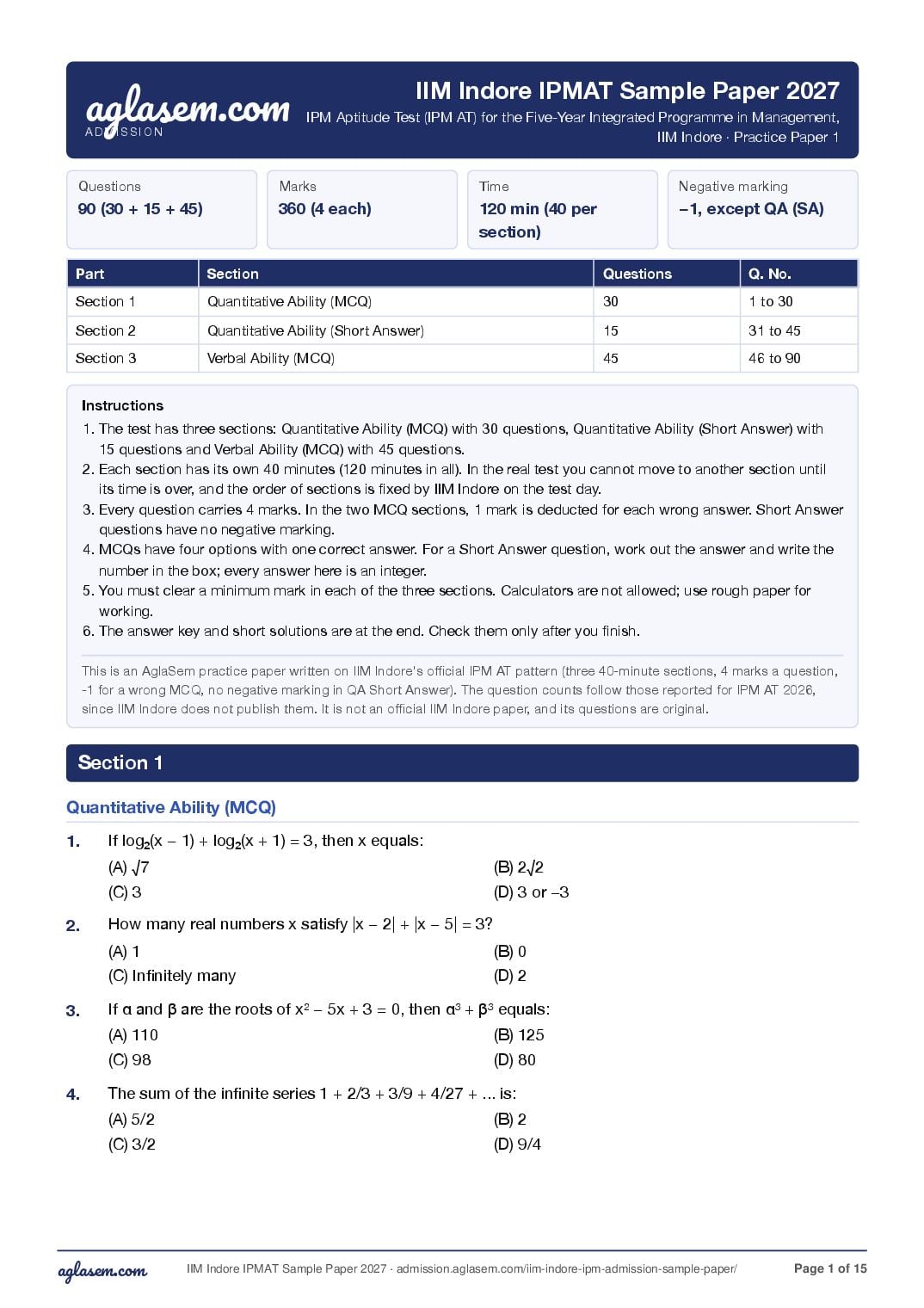
IPM Aptitude Test (IPM AT) for the Five-Year Integrated Programme in Management,
ADMISSION
IIM Indore · Practice Paper 1
Questions Marks Time Negative marking
90 (30 + 15 + 45) 360 (4 each) 120 min (40 per −1, except QA (SA)
section)
Part Section Questions Q. No.
Section 1 Quantitative Ability (MCQ) 30 1 to 30
Section 2 Quantitative Ability (Short Answer) 15 31 to 45
Section 3 Verbal Ability (MCQ) 45 46 to 90
Instructions
1. The test has three sections: Quantitative Ability (MCQ) with 30 questions, Quantitative Ability (Short Answer) with
15 questions and Verbal Ability (MCQ) with 45 questions.
2. Each section has its own 40 minutes (120 minutes in all). In the real test you cannot move to another section until
its time is over, and the order of sections is fixed by IIM Indore on the test day.
3. Every question carries 4 marks. In the two MCQ sections, 1 mark is deducted for each wrong answer. Short Answer
questions have no negative marking.
4. MCQs have four options with one correct answer. For a Short Answer question, work out the answer and write the
number in the box; every answer here is an integer.
5. You must clear a minimum mark in each of the three sections. Calculators are not allowed; use rough paper for
working.
6. The answer key and short solutions are at the end. Check them only after you finish.
This is an AglaSem practice paper written on IIM Indore's official IPM AT pattern (three 40-minute sections, 4 marks a question,
-1 for a wrong MCQ, no negative marking in QA Short Answer). The question counts follow those reported for IPM AT 2026,
since IIM Indore does not publish them. It is not an official IIM Indore paper, and its questions are original.
Section 1
Quantitative Ability (MCQ)
1. If log₂(x − 1) + log₂(x + 1) = 3, then x equals:
(A) √7 (B) 2√2
(C) 3 (D) 3 or −3
2. How many real numbers x satisfy |x − 2| + |x − 5| = 3?
(A) 1 (B) 0
(C) Infinitely many (D) 2
3. If α and β are the roots of x² − 5x + 3 = 0, then α³ + β³ equals:
(A) 110 (B) 125
(C) 98 (D) 80
4. The sum of the infinite series 1 + 2/3 + 3/9 + 4/27 + ... is:
(A) 5/2 (B) 2
(C) 3/2 (D) 9/4
IIM Indore IPMAT Sample Paper 2027 · admission./iim-indore-ipm-admission-sample-paper/ Page 1 of 15
Page 2
the number is divisible by 5?
(A) 120 (B) 96
(C) 108 (D) 60
6. In how many ways can the letters of the word ARRANGE be arranged?
(A) 1260 (B) 630
(C) 2520 (D) 5040
7. Two different numbers are chosen at random from {1, 2, 3, ..., 10}. What is the probability that their sum
is even?
(A) 2/5 (B) 4/9
(C) 1/2 (D) 5/9
8. A function f satisfies f(x) + 2f(1/x) = 3x for every x ≠ 0. What is f(2)?
(A) −1 (B) −2
(C) 2 (D) 1
9. The set of all real x for which (x − 1)(x − 4) < 0 and x² > 4 is:
(A) (1, 4) (B) (2, 4)
(C) (−2, 4) (D) (1, 2)
10. A point moves so that its distance from (3, 0) is always twice its distance from the origin. Its path is a
circle of radius:
(A) 2 (B) 1
(C) 3 (D) √3
11. The points (1, 1), (3, k) and (7, 9) lie on a straight line. What is k?
(A) 3 (B) 4
(C) 13/3 (D) 11/3
12. What is the length of the chord that the circle x² + y² − 8x − 6y + 7 = 0 cuts off on the x-axis?
(A) 6 (B) 8
(C) 2√7 (D) 4
13. If tan θ + cot θ = 4, then tan²θ + cot²θ equals:
(A) 16 (B) 18
(C) 12 (D) 14
14. For 0 < θ < π/2, the minimum value of 9 tan²θ + 4 cot²θ is:
(A) 6 (B) 36
(C) 12 (D) 13
15. A is the 2 × 2 matrix with first row (2, 1) and second row (3, 4). What is det(A²)?
(A) 25 (B) 10
(C) 125 (D) 5
16. If x and y are positive real numbers with x + y = 12, the greatest possible value of x²y is:
(A) 288 (B) 144
(C) 216 (D) 256
17. How many positive divisors does 720 have?
(A) 24 (B) 36
(C) 30 (D) 28
IIM Indore IPMAT Sample Paper 2027 · admission./iim-indore-ipm-admission-sample-paper/ Page 2 of 15
Page 3
(A) 43 (B) 07
(C) 49 (D) 01
19. What is the highest power of 2 that divides 50! exactly?
(A) 2⁴⁵ (B) 2⁴⁷
(C) 2⁴⁸ (D) 2²⁵
20. The 3rd and 8th terms of a geometric progression with real terms are 12 and 384. What is its 5th term?
(A) 48 (B) 24
(C) 96 (D) 64
21. Three numbers in geometric progression have a product of 216 and a sum of 19. The largest of them is:
(A) 6 (B) 9
(C) 8 (D) 12
22. Of 100 students, 50 take Maths, 40 take Physics and 30 take Chemistry. 15 take Maths and Physics, 10
take Physics and Chemistry, 12 take Maths and Chemistry, and 5 take all three. How many take none of
the three?
(A) 7 (B) 22
(C) 17 (D) 12
23. If f(x) = 2x + 3 and g(x) = x² − 1, what is f(g(2)) − g(f(1))?
(A) 9 (B) 15
(C) −15 (D) −9
24. A sum of money at compound interest (compounded yearly) amounts to ₹13,310 in 3 years and ₹14,641
in 4 years. What is the principal?
(A) ₹11,000 (B) ₹12,100
(C) ₹10,000 (D) ₹9,000
25. Two trains start at the same time from P and Q and run towards each other. After they meet, the first
takes 9 hours to reach Q and the second takes 4 hours to reach P. If the first train runs at 40 km/h, how
fast is the second?
(A) 50 km/h (B) 90 km/h
(C) 45 km/h (D) 60 km/h
26. A and B together can finish a job in 12 days, B and C in 15 days, and C and A in 20 days. How long will
A alone take?
(A) 60 days (B) 20 days
(C) 30 days (D) 40 days
27. The interior angles of a pentagon are in the ratio 2 : 3 : 4 : 5 : 6. What is the largest angle?
(A) 135° (B) 144°
(C) 162° (D) 150°
28. A cone and a hemisphere have equal bases and equal volumes. What is the ratio of the height of the
cone to its radius?
(A) 3 : 1 (B) 2 : 1
(C) 1 : 1 (D) 1 : 2
IIM Indore IPMAT Sample Paper 2027 · admission./iim-indore-ipm-admission-sample-paper/ Page 3 of 15
Page 4
5, the new mean and variance are:
(A) 40 and 36 (B) 45 and 18
(C) 45 and 36 (D) 45 and 23
30. Given log₁₀ 2 = 0.3010, how many digits does 2⁵⁰ have?
(A) 15 (B) 17
(C) 50 (D) 16
Section 2
Quantitative Ability (Short Answer)
31. How many integers x satisfy x² − 10x + 16 < 0?
32. Find the sum of all two-digit numbers that leave a remainder of 3 when divided by 7.
33. Find the coefficient of x³ in the expansion of (1 + 2x)⁶.
34. A committee of 5 is to be chosen from 6 men and 4 women so that it has at least 3 women. In how
many ways can this be done?
35. If x + y = 10 and xy = 21, find x³ + y³.
36. Find the value of log₃ 81 + log₂ 32 − log₅ 125.
37. A shopkeeper buys pens at 12 for ₹100 and sells them at 10 for ₹100. Find his profit percentage.
38. Find the sum of all integers from 1 to 100 that are NOT divisible by 3.
IIM Indore IPMAT Sample Paper 2027 · admission./iim-indore-ipm-admission-sample-paper/ Page 4 of 15
Page 5
40. A is the 2 × 2 matrix with first row (1, 2) and second row (3, 4). Find the sum of all the entries of A².
41. Find the least number that leaves a remainder of 7 when divided by 12, 15 or 20, and is divisible by 11.
42. Pipes A and B can fill a tank in 20 minutes and 30 minutes. Both are opened together on an empty tank,
A is closed after some time, and the tank is full 18 minutes after the start. After how many minutes was
A closed?
43. The radius of a circle is increased by 20%. By what percentage does its area increase?
44. Find the area of a triangle whose sides are 13, 14 and 15 units.
45. How many positive integers less than 100 are divisible by 3 or 5?
IIM Indore IPMAT Sample Paper 2027 · admission./iim-indore-ipm-admission-sample-paper/ Page 5 of 15
Page 6
Verbal Ability (MCQ)
Read the passage and answer the next five questions.
For most of history, people who kept bees assumed that a hive found its food by chance, each worker
wandering until it stumbled on a field of flowers. The truth, worked out by the Austrian zoologist Karl von
Frisch in the first half of the twentieth century, is far stranger. A forager that has found a rich source of
nectar returns to the hive and performs a dance on the vertical surface of the comb. It runs forward in a
straight line while waggling its body from side to side, loops back to its starting point, and repeats the run,
sometimes dozens of times.
The dance is a map. The angle of the straight run, measured from the vertical, matches the angle between
the direction of the food and the direction of the sun as seen from the hive. The length of the waggle run
tells the distance: the longer the run, the farther the flowers. Other workers crowd round the dancer, follow
its movements in the darkness of the hive, and then fly out to the spot it has described.
Von Frisch's claim was not accepted at once. Some researchers argued that recruits found the food
simply by smell, picking up the scent of flowers that clung to the dancer. The argument went on for years
and was largely settled only when later experiments, including some that tracked recruits by radar,
showed that bees fly out along the direction and distance coded in the dance. Von Frisch shared the
Nobel Prize in Physiology or Medicine in 1973.
What makes the discovery remarkable is not just that an insect can pass on abstract information, but that
it does so in a code that translates one frame of reference into another: a direction relative to the sun in
the open sky becomes a direction relative to gravity on a dark, vertical wall.
46. What is the primary purpose of the passage?
(A) To compare the dances of honeybees with those of other insects
(B) To explain how honeybees share the location of food and why this matters
(C) To describe the life and career of the zoologist Karl von Frisch
(D) To argue that bees find their food mainly by following the scent of the flowers
47. According to the passage, the length of the waggle run tells other bees:
(A) How many workers are needed (B) How far away the food is
(C) Where the sun is in the sky (D) How rich the nectar is
48. If a forager's straight run points straight up the comb, the food most likely lies:
(A) In the same direction as the sun
(B) In the direction opposite to the sun
(C) At right angles to the sun
(D) Inside or very close to the hive
49. The researchers who doubted von Frisch believed that recruits found the food by:
(A) Tracking other bees with their eyes
(B) Watching the position of the sun
(C) Smelling the flower scent carried on the dancer
(D) Following the dancer when it next flies out of the hive
50. The author finds the discovery remarkable mainly because the bees:
(A) Can repeat exactly the same dance many dozens of times in a row
(B) Turn a direction relative to the sun into one relative to gravity
(C) Were once thought to find food by chance
(D) Helped von Frisch to win a Nobel Prize
IIM Indore IPMAT Sample Paper 2027 · admission./iim-indore-ipm-admission-sample-paper/ Page 6 of 15
Page 7
Every translator knows the moment when a sentence refuses to cross over. A word in one language
carries a cluster of associations that no single word in another can hold. The Portuguese 'saudade', often
glossed as a longing for something absent, is a famous example, but the problem is everywhere, not only
in exotic words. Even a plain word such as 'home' gathers different shades in different tongues, and a
translator who renders it the same way every time may be accurate in the dictionary's sense and wrong in
every other.
Faced with this, translators have long argued between two ideals. One holds that a translation should stay
as close as possible to the original's words and structure, so that the reader feels the foreignness of the
text. The other holds that it should read as if it had been written in the new language, even if that means
changing images, idioms and the order of ideas. The first risks producing something stiff and puzzling; the
second risks producing something smooth but quietly different from what the author wrote.
Most good translators move between the two, choosing case by case. A joke usually has to be rebuilt
rather than copied, because a pun that works in one language is almost never a pun in another. A legal
clause, on the other hand, may need to be followed almost word for word, since a graceful paraphrase
could change who owes what to whom. Poetry asks for both at once: fidelity to sense and fidelity to
sound, which seldom point the same way.
Seen in this light, the old complaint that something is always 'lost in translation' is only half the story.
Something is also made. A translation is a reading of the original, and a strong reading can show the
reader things in a text that its first audience took for granted.
51. According to the passage, the two ideals of translation differ mainly in:
(A) How closely a translation should keep the original's words and form
(B) Whether translators should work from exotic languages
(C) How long a translation should take to complete
(D) Whether poetry and song can ever be properly translated at all
52. Why, according to the passage, must a joke usually be rebuilt rather than copied?
(A) Wordplay seldom survives a change of language
(B) Jokes are always too long to translate
(C) Jokes are less important than legal clauses
(D) Readers in other languages do not enjoy humour
53. The author mentions the word 'home' in order to show that:
(A) Dictionaries are always the translator's most reliable guide to meaning
(B) Even ordinary words carry meanings that differ across languages
(C) Exotic words such as 'saudade' cannot be translated
(D) Translators should always render a word the same way
54. The author's attitude to the saying that something is always 'lost in translation' is that it is:
(A) Incomplete, since translation can also reveal new things
(B) Relevant to legal texts but not to poetry
(C) A complaint made only by careless or poorly trained translators
(D) Entirely correct and impossible to dispute
55. Which of these would the author expect to need the closest, almost word-for-word translation?
(A) A song that is meant to be sung
(B) A clause in a commercial contract
(C) A rhyming poem for children
(D) A comic short story full of puns
IIM Indore IPMAT Sample Paper 2027 · admission./iim-indore-ipm-admission-sample-paper/ Page 7 of 15
Page 8
In most large Indian cities, a great deal of daily shopping happens not in shops but on pavements.
Vegetable sellers, tea stalls, cobblers and fruit carts serve millions of customers, often at prices that
formal retail cannot match, because the vendor pays no rent for a showroom and carries little stock. For
the vendor, the street offers a living that needs almost no capital: a cart, a few days' stock and the
knowledge of where customers pass.
Yet the same features that make street trade cheap also make it fragile. A vendor without a fixed,
recognised place can be moved on at any time, and a single eviction can wipe out the small savings of
years. Because much of the trade is in cash and goes unrecorded, vendors also find it hard to borrow
from banks, and turn instead to moneylenders who charge far higher interest.
City planners have often treated vendors as an obstruction to be cleared for the sake of traffic and tidy
streets. A different view sees them as part of the city's infrastructure, much like bus stops or public toilets,
which need space set aside and rules that are fair and predictable. India's Street Vendors Act of 2014
leans towards this second view: it provides for surveys of vendors, certificates of vending and town
vending committees that include vendors' representatives.
Whether such laws work depends less on their wording than on how they are applied. A vending zone
placed far from where customers actually walk is a zone in name only, and a certificate is of little use if it
can be ignored by the official on the spot.
56. According to the passage, street vendors can often sell more cheaply than shops because they:
(A) Pay lower taxes than formal retailers
(B) Pay no showroom rent and keep little stock
(C) Buy their goods directly from the government
(D) Sell only goods of lower quality
57. Why do vendors, according to the passage, often borrow from moneylenders?
(A) Vendors prefer not to deal with the government
(B) Moneylenders charge less interest than banks
(C) Banks are not allowed by law to lend money to small traders
(D) Their mostly cash trade leaves little record for banks
58. The 'second view' described in the passage treats street vendors as:
(A) A temporary problem that will disappear with growth
(B) An obstruction to be cleared for the sake of smooth traffic
(C) A source of tax revenue for city governments
(D) A part of city infrastructure that needs planned space
59. Which statement is best supported by the last paragraph?
(A) Vending zones should be placed away from busy streets
(B) Officials on the spot should be given more power over vendors
(C) A well-worded law can still fail if it is badly applied
(D) The Street Vendors Act of 2014 has failed completely
IIM Indore IPMAT Sample Paper 2027 · admission./iim-indore-ipm-admission-sample-paper/ Page 8 of 15
Page 9
We tend to think of forgetting as a failure, a leak in a vessel that ought to hold everything poured into it.
Yet a memory that kept every detail would be a burden rather than a gift. To recognise a friend's face, the
mind must ignore the differences between the way that face looked on a dozen occasions: in harsh light
and soft, smiling and tired. Generalising requires letting go of particulars.
Psychologists have also found that forgetting can help us learn. When we return to a topic after we have
partly forgotten it, the effort of recalling it seems to fix it more firmly than an easy review would. This is one
reason why practice spread over several days usually beats the same amount of practice crammed into
one evening, even though cramming feels more productive at the time.
None of this means that all forgetting is good. Losing the name of a colleague or the date of an
examination is simply inconvenient, and diseases that destroy memory are tragic. The point is narrower: a
mind built to forget most of what it meets is not badly designed. It is designed to keep what is used and
to let the rest fade, which is, on the whole, a sensible way to manage a limited store.
60. Which of the following best expresses the main point of the passage?
(A) All forgetting is a sign of a healthy and well-designed mind
(B) Cramming is the best way to prepare for tests
(C) Memory should store every detail it meets
(D) Forgetting, within limits, serves useful purposes
61. The example of recognising a friend's face is used to show that:
(A) Friends' faces change more than other faces
(B) Faces are harder to remember than names
(C) Changes in lighting alter the way memories are stored
(D) Recognition depends on ignoring small differences
62. According to the passage, practice spread over several days works better than cramming because:
(A) Spread-out practice always involves many more total hours of study
(B) Cramming leaves the learner too tired to remember anything
(C) Effortful recall after some forgetting fixes memory more firmly
(D) Learners forget less when they study in the evening
63. The sentence 'The point is narrower' signals that the author is:
(A) Limiting the claim rather than praising all forgetting
(B) Changing the subject to diseases of memory
(C) Moving on to give practical study advice
(D) Admitting that the whole argument so far has been mistaken
64. Fill in the blank: The committee's report was so ___ that it took the members an entire weekend to read
it.
(A) terse (B) voluminous
(C) succinct (D) abbreviated
65. Fill in the blank: Far from being ___, the new manager listened carefully to every complaint before
acting.
(A) attentive (B) considerate
(C) dismissive (D) patient
66. Fill in the blank: The minister's speech was full of ___ promises that no one expected him to keep.
(A) sincere (B) binding
(C) hollow (D) solemn
IIM Indore IPMAT Sample Paper 2027 · admission./iim-indore-ipm-admission-sample-paper/ Page 9 of 15
Page 10
(A) perseverance (B) apathy
(C) procrastination (D) indolence
68. Fill in the blank: The two accounts of the accident were so ___ that the investigators could not tell which
was true.
(A) consistent (B) contradictory
(C) identical (D) complementary
69. Fill in the blanks: The scientist was ___ about the results, insisting that more trials were needed before
any ___ could be drawn.
(A) careless ... inference (B) cautious ... conclusion
(C) triumphant ... comparison (D) certain ... deduction
70. Find the part of the sentence that has an error: Who's laptop / is lying / on the conference table?
(A) Who's laptop (B) is lying
(C) on the conference table? (D) No error
71. Find the part of the sentence that has an error: The population of Mumbai / is larger than / any other city
in India.
(A) The population of Mumbai (B) is larger than
(C) any other city in India. (D) No error
72. Find the part of the sentence that has an error: The coach, as well as the players, / was delighted / with
the result.
(A) The coach, as well as the players,
(B) was delighted
(C) with the result.
(D) No error
73. Choose the grammatically correct sentence.
(A) Had she left earlier, she would have caught the train.
(B) If she had left earlier, she would catch the train yesterday.
(C) If she would have left earlier, she would have caught the train.
(D) Had she left earlier, she will have caught the train.
74. Choose the grammatically correct sentence.
(A) Scarcely had the meeting begun when the power failed.
(B) Scarcely the meeting had begun when the power failed.
(C) Scarcely had the meeting begun than the power failed.
(D) Scarcely had the meeting began when the power failed.
75. Arrange the sentences in the most logical order:
A. Within a few years, the same phones were being used to pay for groceries and send money home.
B. When mobile phones first spread across India, most people used them only to make calls.
C. Today, many small shops accept digital payments more readily than they accept large notes.
D. Cheap data plans then turned the phone into a device for browsing and messaging.
(A) BADC (B) BDAC
(C) BDCA (D) DBAC
IIM Indore IPMAT Sample Paper 2027 · admission./iim-indore-ipm-admission-sample-paper/ Page 10 of 15
Page 11
A. The settlers cleared the land and built houses of the timber they had cut.
B. A town grew up around the market, and the market drew still more settlers.
C. As the farms prospered, the settlers began to sell their surplus at a weekly market.
D. The valley was covered with thick forest when the first settlers arrived.
(A) DCAB (B) DABC
(C) ADCB (D) DACB
77. Arrange the sentences in the most logical order:
A. Most passers-by only stared at the damage.
B. The driver did not stop, but Ritu's notes helped the police trace him the next day.
C. Ritu was walking home when a car sped past and hit a parked scooter.
D. She, however, took out a notebook and wrote down the number plate.
(A) CDAB (B) CADB
(C) CABD (D) ACDB
78. Arrange the sentences in the most logical order:
A. However, a single bad review can travel faster than a hundred good ones.
B. A satisfied customer may tell a few friends about a good meal.
C. Many owners therefore reply to online complaints quickly and politely.
D. Small restaurants depend heavily on word of mouth.
(A) BDAC (B) DBAC
(C) DBCA (D) DACB
Each of the next two questions gives four sentences. Three of them form a coherent paragraph;
choose the sentence that does NOT belong.
79. Choose the sentence that does not belong to the paragraph.
(A) Coral reefs, by contrast, are built by tiny animals in warm seas.
(B) They also provide sheltered nurseries for many kinds of fish and crabs.
(C) Their tangled roots slow the waves and protect the shore from erosion.
(D) Mangroves grow along tropical coasts, where the land meets the sea.
80. Choose the sentence that does not belong to the paragraph.
(A) Regular exercise strengthens the heart and improves blood circulation.
(B) Even a brisk thirty-minute walk on most days brings real benefits.
(C) It also helps to control weight and lowers the risk of diabetes.
(D) Many gyms now offer membership plans paid by the month.
81. Choose the word most similar in meaning to CIRCUMSPECT.
(A) Talkative (B) Reckless
(C) Cautious (D) Doubtful
82. Choose the word most similar in meaning to INNOCUOUS.
(A) Infectious (B) Offensive
(C) Harmless (D) Poisonous
83. Choose the word most similar in meaning to OBDURATE.
(A) Obedient (B) Anxious
(C) Stubborn (D) Lenient
IIM Indore IPMAT Sample Paper 2027 · admission./iim-indore-ipm-admission-sample-paper/ Page 11 of 15
Page 12
(A) Unsociable (B) Friendly
(C) Outgoing (D) Affectionate
85. Choose the word most nearly OPPOSITE in meaning to MAGNANIMOUS.
(A) Petty (B) Noble
(C) Forgiving (D) Generous
86. In which sentence is the word 'affect' used correctly?
(A) The cold weather may affect this year's harvest.
(B) Her speech had a strong affect on the voters in the hall.
(C) The medicine had no affect on his fever.
(D) The new rule will take affect next month.
87. In which sentence is the word 'principle' used correctly?
(A) He repaid the principle along with the interest.
(B) Delhi is one of the principle cities of India.
(C) She refused the bribe as a matter of principle.
(D) The principle of the school addressed the students.
88. Choose the meaning of the idiom: to steal the show
(A) To arrive late at an important event
(B) To attract the most attention and praise
(C) To take something without permission
(D) To cancel a performance at the last minute
89. Choose the meaning of the idiom: to be on the same page
(A) To be equally skilled at the same task or subject
(B) To work in the same office as someone
(C) To read the same book at the same time
(D) To agree or share the same understanding
90. Choose the meaning of the idiom: to put the cart before the horse
(A) To do things in the wrong order
(B) To hand over a job to someone else
(C) To take an unnecessary risk with money
(D) To work very hard without any rest
IIM Indore IPMAT Sample Paper 2027 · admission./iim-indore-ipm-admission-sample-paper/ Page 12 of 15
Page 13
1 C 2 C 3 D 4 D 5 C 6 A 7 B 8 A 9 B 10 A
11 D 12 A 13 D 14 C 15 A 16 D 17 C 18 D 19 B 20 A
21 B 22 D 23 C 24 C 25 D 26 C 27 C 28 B 29 C 30 D
31 5 32 676 33 160 34 66 35 370 36 6 37 20 38 3367 39 31 40 54
41 187 42 8 43 44 44 84 45 46 46 B 47 B 48 A 49 C 50 B
51 A 52 A 53 B 54 A 55 B 56 B 57 D 58 D 59 C 60 D
61 D 62 C 63 A 64 B 65 C 66 C 67 A 68 B 69 B 70 A
71 C 72 D 73 A 74 A 75 B 76 D 77 B 78 B 79 A 80 D
81 C 82 C 83 C 84 A 85 A 86 A 87 C 88 B 89 D 90 A
Solutions
Quantitative Ability (MCQ)
1. (C) log₂[(x − 1)(x + 1)] = 3 gives x² − 1 = 8, so x = ±3. The logs need x > 1, so x = 3 only.
2. (C) For every x between 2 and 5 the sum of the distances from 2 and 5 is exactly 3. Outside that interval it is more
than 3. So every x in [2, 5] works.
3. (D) α + β = 5, αβ = 3. α³ + β³ = (α + β)³ − 3αβ(α + β) = 125 − 45 = 80.
4. (D) S = Σ n·xⁿ⁻¹ with x = 1/3, which equals 1/(1 − x)² = 1/(2/3)² = 9/4.
5. (C) Ending in 0: 5 × 4 × 3 = 60. Ending in 5: first digit from {1, 2, 3, 4} (4 ways), then 4 × 3 = 48. Total 108.
6. (A) 7 letters with A twice and R twice: 7!/(2! × 2!) = 5040/4 = 1260.
7. (B) An even sum needs both odd or both even: C(5, 2) + C(5, 2) = 20 of the C(10, 2) = 45 pairs, so 20/45 = 4/9.
8. (A) Put x = 2: f(2) + 2f(1/2) = 6. Put x = 1/2: f(1/2) + 2f(2) = 3/2. From the first, f(1/2) = (6 − f(2))/2; substituting, (6 −
f(2))/2 + 2f(2) = 3/2, so 3f(2)/2 = −3/2 and f(2) = −1.
9. (B) The first holds for 1 < x < 4; the second for x > 2 or x < −2. Together: 2 < x < 4.
10. (A) (x − 3)² + y² = 4(x² + y²) simplifies to x² + y² + 2x − 3 = 0, that is (x + 1)² + y² = 4: a circle with centre (−1, 0) and
radius 2.
11. (D) Slope from (1, 1) to (7, 9) is 8/6 = 4/3. So (k − 1)/(3 − 1) = 4/3 and k = 1 + 8/3 = 11/3.
12. (A) Put y = 0: x² − 8x + 7 = 0, so x = 1 or x = 7. The chord runs from (1, 0) to (7, 0) and has length 6.
13. (D) Square both sides: tan²θ + cot²θ + 2 = 16, since tan θ · cot θ = 1. So the value is 14.
14. (C) By AM ≥ GM, 9 tan²θ + 4 cot²θ ≥ 2√(9 × 4) = 12, with equality when tan²θ = 2/3.
15. (A) det A = 2 × 4 − 1 × 3 = 5, and det(A²) = (det A)² = 25.
16. (D) Write x + y = x/2 + x/2 + y = 12. By AM ≥ GM, (x/2)(x/2)y ≤ 4³ = 64, so x²y ≤ 256, reached at x = 8, y = 4.
17. (C) 720 = 2⁴ × 3² × 5, so the number of divisors is (4 + 1)(2 + 1)(1 + 1) = 30.
18. (D) 7⁴ = 2401 ends in 01, so 7¹⁰⁰ = (7⁴)²⁵ also ends in 01.
19. (B) ⌊50/2⌋ + ⌊50/4⌋ + ⌊50/8⌋ + ⌊50/16⌋ + ⌊50/32⌋ = 25 + 12 + 6 + 3 + 1 = 47.
20. (A) r⁵ = 384/12 = 32, so r = 2. The 5th term = 12 × 2² = 48.
21. (B) Let them be a/r, a, ar. a³ = 216 gives a = 6. 6/r + 6 + 6r = 19 gives 6r² − 13r + 6 = 0, so r = 3/2 or 2/3. The
numbers are 4, 6, 9.
22. (D) At least one = 50 + 40 + 30 − 15 − 10 − 12 + 5 = 88. None = 100 − 88 = 12.
23. (C) g(2) = 3 and f(3) = 9. f(1) = 5 and g(5) = 24. 9 − 24 = −15.
24. (C) Rate = 14,641/13,310 − 1 = 10%. Principal = 13,310/1.1³ = 13,310/1.331 = ₹10,000.
IIM Indore IPMAT Sample Paper 2027 · admission./iim-indore-ipm-admission-sample-paper/ Page 13 of 15
Page 14
time of first) = √(4/9) = 2/3. So the second runs at 40 × 3/2 = 60 km/h.
26. (C) 2(A + B + C) = 1/12 + 1/15 + 1/20 = 12/60, so A + B + C = 1/10 per day. A = 1/10 − 1/15 = 1/30, i.e. 30 days.
27. (C) The angles of a pentagon add to 540°. 540/20 = 27, so the largest is 6 × 27 = 162°.
28. (B) (1/3)πr²h = (2/3)πr³ gives h = 2r.
29. (C) Mean becomes 2 × 20 + 5 = 45. Adding a constant does not change variance; multiplying by 2 multiplies it by
4: 36.
30. (D) log₁₀ 2⁵⁰ = 50 × 0.3010 = 15.05, so 2⁵⁰ lies between 10¹⁵ and 10¹⁶ and has 16 digits.
Quantitative Ability (Short Answer)
31. (5) Answer: 5. x² − 10x + 16 = (x − 2)(x − 8) < 0 for 2 < x < 8, so x = 3, 4, 5, 6, 7.
32. (676) Answer: 676. The numbers are 10, 17, ..., 94: an AP with 13 terms. Sum = 13 × (10 + 94)/2 = 676.
33. (160) Answer: 160. The term is C(6, 3)(2x)³ = 20 × 8x³ = 160x³.
34. (66) Answer: 66. 3 women and 2 men: C(4, 3) × C(6, 2) = 4 × 15 = 60. 4 women and 1 man: 1 × 6 = 6. Total 66.
35. (370) Answer: 370. x³ + y³ = (x + y)³ − 3xy(x + y) = 1000 − 630 = 370.
36. (6) Answer: 6. 4 + 5 − 3 = 6.
37. (20) Answer: 20. Cost per pen = ₹100/12, selling price = ₹10. Profit = (10 − 25/3)/(25/3) = (5/3)/(25/3) = 1/5 = 20%.
38. (3367) Answer: 3367. Sum of 1 to 100 = 5050. Multiples of 3 up to 99: 3 × (1 + 2 + ... + 33) = 3 × 561 = 1683. 5050
− 1683 = 3367.
39. (31) Answer: 31. Count factors of 5: ⌊125/5⌋ + ⌊125/25⌋ + ⌊125/125⌋ = 25 + 5 + 1 = 31.
40. (54) Answer: 54. A² has rows (1 + 6, 2 + 8) = (7, 10) and (3 + 12, 6 + 16) = (15, 22). Sum = 7 + 10 + 15 + 22 = 54.
41. (187) Answer: 187. The number is 60k + 7. 60k + 7 ≡ 5k + 7 (mod 11) must be 0, so 5k ≡ 4 (mod 11), giving k = 3 as
the least value. 60 × 3 + 7 = 187 = 11 × 17.
42. (8) Answer: 8. B runs all 18 minutes and fills 18/30 = 3/5. A fills the other 2/5, which takes 2/5 × 20 = 8 minutes.
43. (44) Answer: 44. Area scales with r²: 1.2² = 1.44, an increase of 44%.
44. (84) Answer: 84. s = 21. By Heron's formula, area = √(21 × 8 × 7 × 6) = √7056 = 84.
45. (46) Answer: 46. Multiples of 3: 33; of 5: 19; of 15: 6. 33 + 19 − 6 = 46.
Verbal Ability (MCQ)
46. (B) The passage explains the waggle dance, the debate about it and why the discovery is remarkable. It does not
argue for the smell theory or compare insects.
47. (B) Paragraph 2: 'The length of the waggle run tells the distance.'
48. (A) The angle from the vertical equals the angle between the food and the sun. An angle of zero means the food is
in the sun's direction.
49. (C) Paragraph 3: they argued that recruits found the food 'simply by smell'.
50. (B) The last paragraph: the dance translates one frame of reference (the sun) into another (gravity on a vertical
wall).
51. (A) One ideal stays close to the original's words and structure; the other aims to read as if written in the new
language.
52. (A) Paragraph 3: a pun that works in one language is almost never a pun in another.
53. (B) The author says the problem is 'everywhere, not only in exotic words', and gives 'home' as a plain word with
different shades.
54. (A) The last paragraph calls it 'only half the story': 'Something is also made', and a strong reading can show new
things.
55. (B) Paragraph 3: a legal clause may need to be followed almost word for word, since paraphrase could change
obligations.
56. (B) Paragraph 1: the vendor pays no rent for a showroom and carries little stock.
IIM Indore IPMAT Sample Paper 2027 · admission./iim-indore-ipm-admission-sample-paper/ Page 14 of 15
Page 15
Moneylenders charge far higher interest.
58. (D) Paragraph 3: the different view sees vendors as part of the city's infrastructure, like bus stops, needing space
and fair rules.
59. (C) The last paragraph says success depends less on wording than on application, and gives examples of poor
application.
60. (D) The author argues that a mind built to forget is 'not badly designed', while noting that some forgetting is
inconvenient or tragic.
61. (D) To recognise a face, the mind must ignore how it differed on different occasions: 'Generalising requires letting
go of particulars.'
62. (C) Paragraph 2: returning after partial forgetting makes recall effortful, which fixes it more firmly than easy review.
63. (A) After granting that some forgetting is bad, the author narrows the claim: forgetting most things is a sensible
design.
64. (B) A report that takes a whole weekend to read is voluminous (very long). The other words mean brief.
65. (C) 'Far from being' introduces the opposite of what follows. Listening carefully is the opposite of being dismissive.
66. (C) Promises no one expects to be kept are hollow (empty).
67. (A) Continuing despite repeated failure is perseverance. Indolence is laziness and diffidence is lack of confidence.
68. (B) If investigators could not tell which was true, the accounts must have conflicted.
69. (B) Insisting on more trials shows caution, and one 'draws' a conclusion.
70. (A) 'Who's' means 'who is'. The possessive form is 'Whose laptop'.
71. (C) A population must be compared with a population: 'larger than that of any other city in India'.
72. (D) With 'as well as', the verb agrees with the first subject, 'the coach', so 'was' is correct.
73. (A) A past unreal condition takes 'had + past participle' (or the inverted 'Had she left') with 'would have + past
participle'.
74. (A) 'Scarcely' at the start takes inversion ('had the meeting begun'), pairs with 'when' (not 'than'), and needs the
participle 'begun'.
75. (B) B (first, calls) → D ('then', data) → A ('within a few years', payments) → C ('today').
76. (D) D (forest on arrival) → A (clearing and building) → C (farms prosper, market) → B (town grows around the
market).
77. (B) C sets the scene; A (others only stared) contrasts with D ('She, however'); B gives the outcome.
78. (B) D states the idea, B gives the positive case, A ('however') the negative case, and C ('therefore') the owners'
response to it.
79. (A) Three sentences describe mangroves and their roles; the coral reef sentence changes the subject.
80. (D) The paragraph is about the health benefits of exercise; gym payment plans are off the point.
81. (C) Circumspect means careful to consider all risks before acting.
82. (C) Innocuous means not harmful or offensive, as in 'an innocuous remark'.
83. (C) Obdurate means stubbornly refusing to change one's opinion or course.
84. (A) Gregarious means fond of company; its opposite is unsociable.
85. (A) Magnanimous means generous and forgiving; petty (small-minded) is the opposite.
86. (A) 'Affect' is the verb (to influence). The other three need the noun 'effect'.
87. (C) A principle is a basic rule or belief. The head of a school, the sum lent and 'main' are all 'principal'.
88. (B) To steal the show is to be the most impressive or talked-about part of an event.
89. (D) People on the same page understand a matter in the same way and agree about it.
90. (A) Putting the cart before the horse means doing first what should come later.
IIM Indore IPMAT Sample Paper 2027 · admission./iim-indore-ipm-admission-sample-paper/ Page 15 of 15
Document Details
| Board / Org | IIM |
| Exam | IPMAT |
| Type | Sample Paper |
| Pages | 15 |
| Language | english |
| Updated | 27 Oct 2026 |