CBSE Class 12 Question Paper 2022 Sociology (Solved)
Finished viewing? Save it for later —
Download CBSE Class 12 Question Paper 2022 Sociology (Solved) (PDF · 7 pages)About CBSE Class 12 Question Paper 2022 Sociology (Solved)
CBSE Class 12 Question Paper 2022 Sociology (Solved) is available here for free download. Published by CBSE for Class 12, this question paper can be viewed online or downloaded as a PDF (7 pages). Candidates preparing for Class 12 can use CBSE Class 12 Question Paper 2022 Sociology (Solved) to understand the exam pattern, the type of questions asked, and the overall difficulty level.
Frequently Asked Questions
How can I download CBSE Class 12 Question Paper 2022 Sociology (Solved)?
Open this page and click the Download button to save CBSE Class 12 Question Paper 2022 Sociology (Solved) as a PDF. It is completely free on AglaSem Docs.
Is CBSE Class 12 Question Paper 2022 Sociology (Solved) free to download?
Yes. CBSE Class 12 Question Paper 2022 Sociology (Solved) can be viewed online and downloaded as a PDF free of cost on AglaSem Docs.
How many pages does CBSE Class 12 Question Paper 2022 Sociology (Solved) have?
CBSE Class 12 Question Paper 2022 Sociology (Solved) contains 7 pages, which you can read online or download together as a single PDF.
Where can I find more Class 12 study material?
You can find more Class 12 question papers, sample papers, syllabus, and answer keys on AglaSem Docs.
CBSE Class 12 Question Paper 2022 Sociology (Solved) – Text
Read the full text of this question paper below — useful to quickly search, copy and reference the content online without downloading the PDF.
📄 View text version (7 pages)
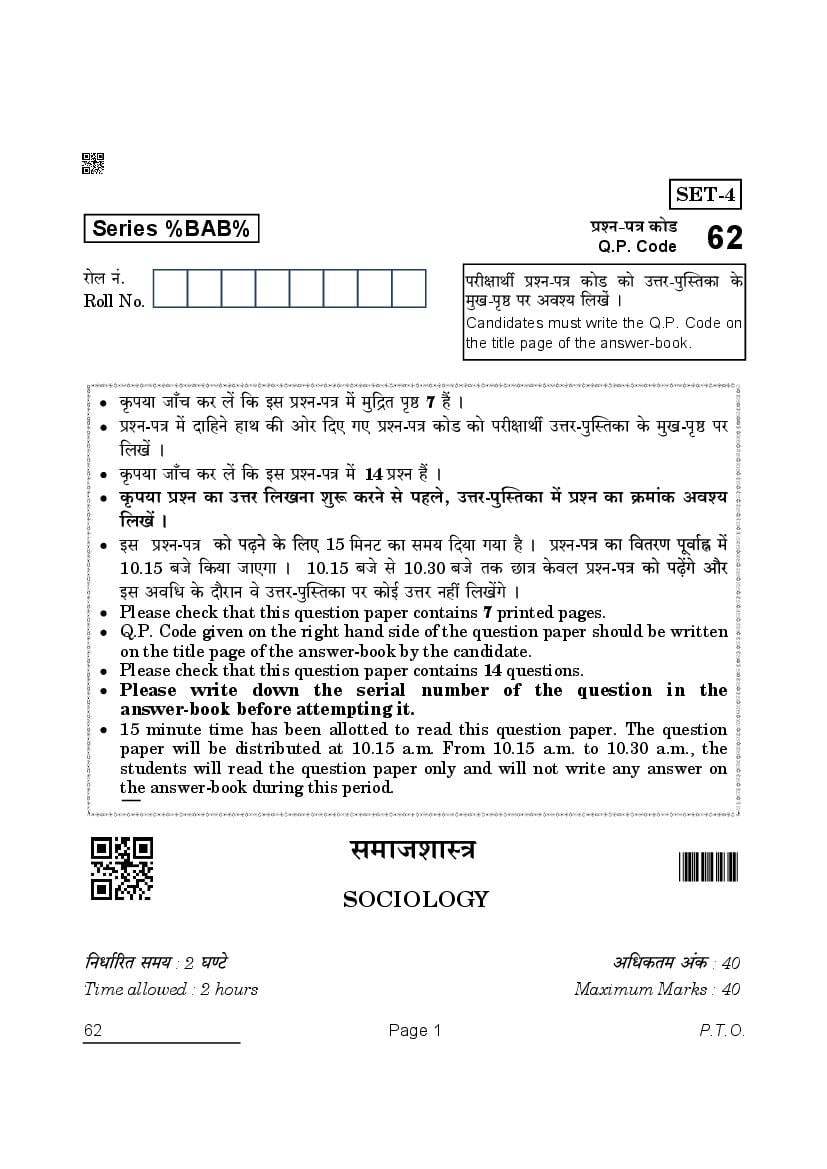
Page 1
Series %BAB% àíZ-nÌ H$moS>
Q.P. Code 62
amob Z§. narjmWu àíZ-nÌ H$moS> H$mo CÎma-nwpñVH$m Ho$
Roll No. _wI-n¥ð >na Adí` {bIo§ &
Candidates must write the Q.P. Code on
the title page of the answer-book.
H¥$n`m Om±M H$a b| {H$ Bg àíZ-nÌ _o§ _w{ÐV n¥ð> 7 h¢ &
àíZ-nÌ _| Xm{hZo hmW H$s Amoa {XE JE àíZ-nÌ H$moS H$mo narjmWu CÎma-nwpñVH$m Ho$ _wI-n¥>ð> na
{bI| &
H¥$n`m Om±M H$a b| {H$ Bg àíZ-nÌ _| >14 àíZ h¢ &
H¥$n`m àíZ H$m CÎma {bIZm ewê$ H$aZo go nhbo, CÎma-nwpñVH$m _| àíZ H$m H«$_m§H$ Adí`
{bI| &
Bg àíZ-nÌ 15 {_ZQ >H$m g_` {X`m J`m h¡ & àíZ-
10.15 ~Oo {H$`m OmEJm & 10.15 ~Oo go 10.30 ~Oo VH$ N>mÌ Ho$db àíZ-
Bg Ad{Y Ho$ Xm¡amZ do CÎma-nwpñVH$m na H$moB© CÎma Zht {bI|Jo &
Please check that this question paper contains 7 printed pages.
Q.P. Code given on the right hand side of the question paper should be written
on the title page of the answer-book by the candidate.
Please check that this question paper contains 14 questions.
Please write down the serial number of the question in the
answer-book before attempting it.
15 minute time has been allotted to read this question paper. The question
paper will be distributed at 10.15 a.m. From 10.15 a.m. to 10.30 a.m., the
students will read the question paper only and will not write any answer on
the answer-book during this period.
g_mOemñÌ
SOCIOLOGY
:2 : 40
Time allowed : 2 hours Maximum Marks : 40
62 Page 1 P.T.O.
Page 2
(i) 14
(ii)
(iii) 1 2 1
10 15
(iv) 3 9, 2
30
(v) 10 12, 4
80
(vi) 13 14, 6
200
IÊS>> H$
1. òmoV :
ZJam| _| pñWV CËnmXH$m| Ho$ Ûmam ~ZmE JE {dbm{gVm Ho$ gm_mZm|, T>mH$m `m _weuXm~mX H$s
-H$mo{Q> H$s aoe_ H$s _m±J _| Xa~mam| Ho$ {dKQ>Z Ho$ ~mX ^mar H$_r hmo JB© & `o CËnmX {OZ
~mø ~mµOmam| na {Z^©a Wo CZH$m ^r H$_mo~oe gµ\$m`m hmo J`m Wm & Xÿa-XamO Ho$ joÌm| Ho$ J«m_,
{eën {deofV: nydu ^maV Ho$ CZ joÌm| Ho$ A{V[aº$ Ohm± A§J«oµOm| H$m àdoe OëXr Am¡a gKZ
Wm, A{YH$ g_` VH$ pñWa aho, O~ VH$ {H$ aobdo Ho$ {dñVma Zo CÝh| J§^ra ê$n go à^m{dV
Zht {H$`m &
: 1983 : 29
O~ A§J«oµOm| Zo ^maV Ho$ amÁ`m| Am¡a H$ñ~m| na A{YH$ma H$a {b`m, Vmo BZ amOg^mAm| Ho$
g§ajU _| H$m`©aV H$marJa, H$bmH$ma Am¡a Hw$brZ bmoJm| H$m ^r nVZ hþAm & BgH$m H$moB© EH$
H$maU Xr{OE & 1
2. :
..... Om°Z ñQw>AQ>© {_b H$m boI àH$meZ Ho$ Vwa§V ~mX hr, ^maVr`
_hm{dÚmb`m| _| Bgo EH$ ñdrH¥$V gm{hË` _mZ {b`m J`m & Bg boI go ^maVr`m| Zo _¡ ½Zm
H$mQ>m© Ho$ ~mao _| OmZm, Am¡a ñdV§ÌVm Am¡a g_mZVm Ho$ {bE `yamon Am¡a A_o[aH$m Ho$ hþE g§Kf©
Am{X H$s OmZH$mar ^r hþB© &
{XE JE òmoV _| {H$g àH$ma Ho$ ? 1
62 Page 2
Page 3
(i) The question paper contains 14 questions.
(ii) All questions are compulsory.
(iii) Section A Question number 1 and 2 are 1 mark source based questions.
Answer to these questions must not exceed 10 15 words.
(iv) Section B Question number 3 to 9 are 2 marks questions. These are very
short-answer type questions. Answer to these questions should not exceed
30 words.
(v) Section C Question number 10 to 12 are 4 marks questions. These are
short-answer type question. Answer to these questions should not exceed
80 words.
(vi) Section D Question number 13 and 14 are 6 marks questions. These are
long-answer type questions. Answer to these questions should not exceed
200 words.
SECTION A
1. Read the source and answer the question :
Urban luxury manufactures like the high quality silks and cottons of
Dacca or Murshidabad must have been hit first by the almost
simultaneous collapse of indigeneous court demand and the external
market on which these had largely depended. Village crafts in the
interior and particularly, in regions other than eastern India where
British penetration was earliest and deepest, probably survived much
longer, coming to be seriously affected only with the spread of railways.
(Sarkar : 1983 : 29)
When British took over states and towns of India, some of them lost their
courts, artisans and court gentry. Give any one reason. 1
2. Read the source and answer the question :
Ways of thinking
..... John Stuart Mi nL soon after its publication became
a text in Indian colleges. Indians came to know about Magna Carta, and
the struggle for liberty and equality in Europe and America.
Mention the kind of Westernization being referred to in the given source. 1
62 Page 3 P.T.O.
Page 4
3. h_mar ~hþV-gr gm§ñH¥${VH$ añ_m| Am¡a CZHo$ àH$mam| _| H¥${f H$s n¥ð>^y{_ hmoVr h¡ &
g§aMZmË_H$ Am¡a gm§ñH¥${VH$ n[adV©Z K{Zð> ê$n _| EH$-
{d{^Þ joÌm| _| Zd-df© Ho$ Ë`mohma _w»` ê$n go µ\$gb H$mQ>Zo Ho$ g_` _ZmE OmVo h¢ &
(a) H¥${f Ed§ g§ñH¥${V Ho$ ~rM EH$ K{Zð> g§~§Y h¡ & {XE JE H$WZ Ho$ g_W©Z _| EH$
H$maU Xr{OE & 1
(b) {H$Ýht Xmo H¥${f g§~§{YV Ë`mohmam| Ho$ Zm_ {b{IE & 1
4. gm_m{OH$ Am§XmobZ _| EH$ b§~o g_` VH$ {Za§Va gm_y{hH$ J{V{d{Y`m| H$s Amdí`H$Vm hmoVr
h¡ & Eogr J{V{d{Y`m± àm`: amÁ` Ho$ {déÕ hmoVr h¢ VWm amÁ` H$s Zr{V VWm ì`dhma _|
n[adV©Z H$s _m±J H$aVr h¢ & ñdV:ñ\y$V© VWm Ag§J{R>V {damoY H$mo gm_m{OH$ Am§XmobZ Zht
H$h gH$Vo &
(a) gm_m{OH$ Am§XmobZ Ho$ H$moB© Xmo bjU {b{IE & 1
(b) {H$gr EH$ X{bV Am§XmobZ H$m CXmhaU Xr{OE & 1
5. nyO
± rdmX Ho$ AmZo go nhbo Ho$ gm_«mÁ` Am¡a nyO
± rdmXr Xm¡a Ho$ emgZ _| JwUmË_H$ A§Va h¡ &
A§Va ~VmBE & 2
6. g§ñH¥${VH$aU H$s AdYmaUm EH$ Eogo àmê$n H$mo ghr R>hamVr h¡ Omo XaAgb Ag_mZVm
Am¡a AndO©Z na AmYm[aV h¡ & Bg H$WZ Ho$ g_W©Z _| Xmo H$maU Xr{OE & 2
7. {d{^Þ àH$ma Ho$ g_mO gwYmaH$ Am§XmobZm| _| Hw$N> {df`JV g_mZVmE± Wt & na§Vw gmW hr
AZoH$ _hÎdnyU© Agh_{V`m± ^r Wt & H$moB© Xmo Agh_{V`m± ~VmBE & 2
8. (H$) à{VXmZmË_H$ AWdm ê$nm§VaUH$mar gm_m{OH$ Am§XmobZ {H$go H$hVo h¢ ? EH$ CXmhaU
Xr{OE & 1+1
AWdm
(I) gwYmadmXr gm_m{OH$ Am§XmobZm| ? EH$ CXmhaU Xr{OE & 1+1
9. ^maVr` amï´>dm{X`m| Ho$ {bE Am¡n{Zdo{eH$ emgZ Ho$ Xm¡amZ hþAm Am{W©H$ emofU EH$ H|$Ðr`
_wÔm Wm &
ñdV§ÌVm Ho$ àma§{^H$ dfm] _| ^maVr` ? 2
62 Page 4
Page 5
3. Many of our cultural practices and patterns can be traced to our agrarian
backgrounds. Structural and cultural changes are closely inter-related.
Most of the New Year festivals in different regions of India celebrate the
main harvest season.
(a) There is a close relationship between agriculture and culture.
Give one reason to support the given statement. 1
(b) Name any two agriculture related festivals. 1
4. A social movement requires sustained collective action over time. Such
action is often directed against the state and takes the form of demanding
changes in state policy or practice. Spontaneous and disorganised protest
cannot be called a social movement.
(a) Write any two features of a social movement. 1
(b) Give an example of a Dalit Movement. 1
5. -capitalist
2
6. Sanskritisation seems to justify a model that rests on inequality and
exclusion. Give two reasons to support this statement. 2
7. The varied social reform movements did have common themes. Yet there
were also significant differences. State any two differences. 2
8. (a) What are Redemptive or Transformatory social movements ? Give
one example. 1+1
OR
(b) What is meant by Reformist social movements ? Give one example. 1+1
9. , the issue of economic exploitation under colonial
rule was a central issue.
How did Indian nationalists promote industrialisation in the early years
of independence ? 2
62 Page 5 P.T.O.
Page 6
10. H¥${f Ho$ ì`mdgm`rH$aU go _µOXÿam| H$m g§Mma (gHw©$boeZ) H¡$go hþAm ? 4
11. (H$) EH$ \ Ho$ H$m_Jmam| H$mo amoµOJma XoZo H$m VarH$m {^Þ hmoVm h¡ & Bg VarHo$ H$s
ì`m»`m H$s{OE & 4
AWdm
(I) d¡km{ZH$ à~§YZ ì`dñWm H$s ì`m»`m H$s{OE & 1980 Ho$ XeH$ _| d¡km{ZH$ à~§YZ
Ho$ ñWmZ na H$m¡Z-gr ì`dñWm H$m BñVo_mb {H$`m J`m Wm ? 4
12. g§{dXm IoVr nÕ{V Ho$ gH$mamË_H$ VWm ZH$mamË_H$ nhbwAm| I H$s{OE & 2+2
IÊS>> K
13. (H$) ? 1982 m| H$s à{gÕ
2+4
AWdm
(I) Kam| na {H$`m OmZo dmbm H$m_ AW©ì`dñWm/Am{W©H$s H$m _hÎdnyU© {hñgm h¡ &
CXmhaU XoVo hþE g_PmBE & 6
14. nm[apñW{VH$s` Am§XmobZ ZE gm_m{OH$ Am§XmobZ H$m CXmhaU h¢ `m nwamZo gm_m{OH$
Am§XmobZ H$m ? {MnH$mo Am§XmobZ H$m CXmhaU XoVo hþE Cn`w©º$ H$s ì`m»`m H$s{OE & 1+5
62 Page 6
Page 7
10. How did commercialisation of agriculture lead to circulation of labour ? 4
11. (a) Job recruitment as a factory worker takes a different pattern.
Explain this pattern. 4
OR
(b) nt system. What shift from Scientific
Management took place in the 1980s ? 4
12. Mention the positive and negative aspects of contract farming 2+2
SECTION D
13. (a) What is the difference between a strike and a lockout ? Discuss the
famous strike of Bombay Textile Mills of 1982. 2+4
OR
(b) Home based work is an important part of the economy. Explain by
giving an example. 6
14. Are ecological movements new or old social movements ? Explain the
above using the Chipko Movement as an example. 1+5
62 Page 7 P.T.O.
Document Details
| Board / Org | CBSE |
| Exam | Class 12 |
| Type | Question Paper |
| Pages | 7 |
| Updated | 30 Apr 2026 |