Karnataka SSLC Question Paper April 2019 Elements of Mechanical and Electrical Engineering 2 – Text
Read the full text of this question paper below — useful to quickly search, copy and reference the content online without downloading the PDF.
📄 View text version (4 pages)
Page 1
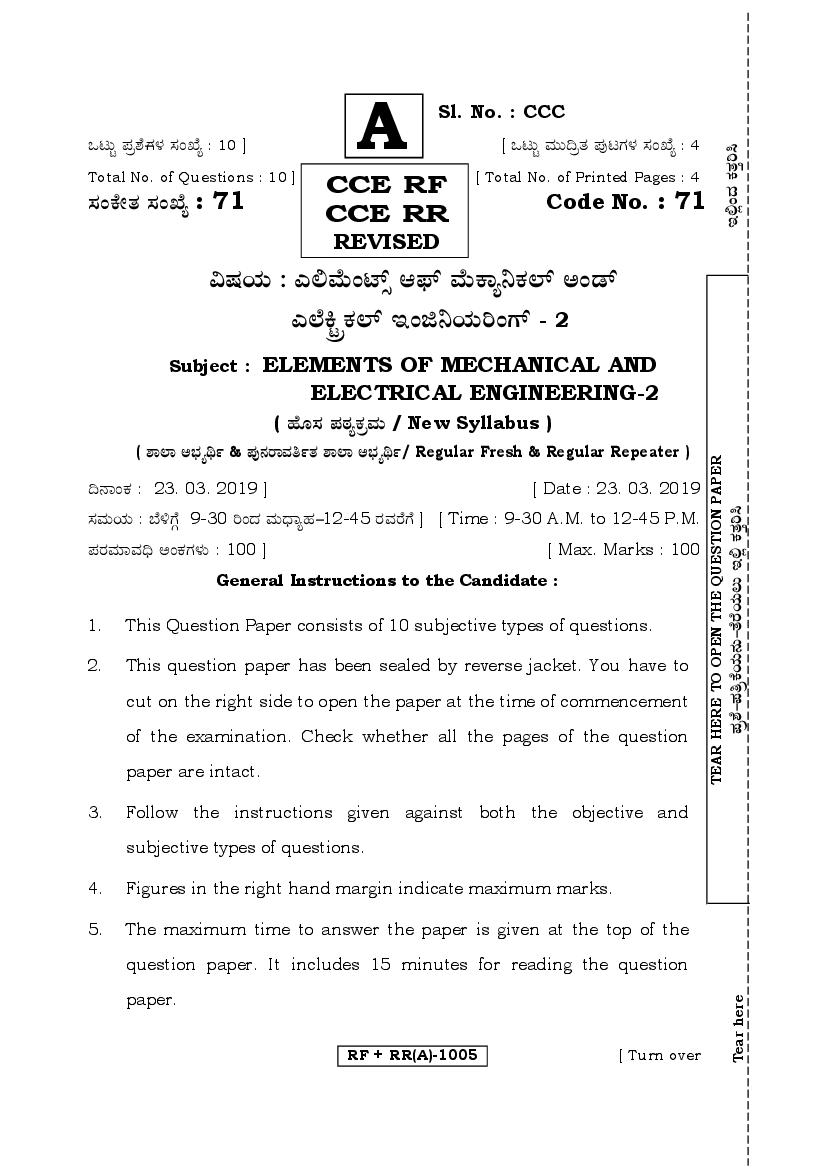
Jlflo Æ⁄√ÀÊ-V⁄◊⁄ —⁄MSÊ¿ : 10 ] A Sl. No. : CCC
[ Jlflo »⁄flfl¶√}⁄ Æ⁄‚¥lV⁄◊⁄ —⁄MSÊ¿ : 4
BΔ«M•⁄ O⁄}⁄°¬“
Total No. of Questions : 10 ] [ Total No. of Printed Pages : 4
CCE RF
—⁄MOÊfi}⁄ —⁄MSÊ¿ : 71 CCE RR
Code No. : 71
REVISED
…Œ⁄æ⁄fl : GΔ»ÊflMmÈ” A±È »ÊflO¤¿¨O⁄≈È @MsÈ
G≈ÊPoÒO⁄≈È BMf¨æ⁄fl¬MVÈ - 2
Subject : ELEMENTS OF MECHANICAL AND
ELECTRICAL ENGINEERING-2
( ‘ʇ—⁄ Æ⁄p⁄¿O⁄√»⁄fl / New Syllabus )
( À¤≈¤ @∫⁄¥¿£% & Æ⁄‚¥´⁄¡¤»⁄~%}⁄ À¤≈¤ @∫⁄¥¿£%/ Regular Fresh & Regular Repeater )
TEAR HERE TO OPEN THE QUESTION PAPER
¶´¤MO⁄ : 23. 03. 2019 ] [ Date : 23. 03. 2019
Æ⁄√ÀÊ-Æ⁄~√OÊæ⁄fl´⁄fl-}Ê¡Êæ⁄flƒfl BΔ« O⁄}⁄°¬“
—⁄»⁄flæ⁄fl : ∑ÊÿVÊX 9-30 ¬M•⁄ »⁄fl®¤¿‘⁄-12-45 ¡⁄»⁄¡ÊVÊ ] [ Time : 9-30 A.M. to 12-45 P.M.
Æ⁄¡⁄»⁄·¤»⁄© @MO⁄V⁄◊⁄fl : 100 ] [ Max. Marks : 100
General Instructions to the Candidate :
1. This Question Paper consists of 10 subjective types of questions.
2. This question paper has been sealed by reverse jacket. You have to
cut on the right side to open the paper at the time of commencement
of the examination. Check whether all the pages of the question
paper are intact.
3. Follow the instructions given against both the objective and
subjective types of questions.
4. Figures in the right hand margin indicate maximum marks.
5. The maximum time to answer the paper is given at the top of the
question paper. It includes 15 minutes for reading the question
paper.
Tear here
RF + RR(A)-1005 [ Turn over
Page 2
71 2 CCE RF + RR
Note : Answer questions from Sections A & B as per the instructions
given under them.
SECTION – A
Note : Answer all the questions.
1. a) List the advantages of I.C. engines. 2
b) Write the classification of I.C. engines according to the type of fuel
used. 3
c) How are the petrol engines different from diesel engines ? 5
2. a) Define air compressor. 2
b) Explain the applications of air compressor. 3
c) Draw a neat sketch of single stage reciprocating air compressor and
label the parts. 5
3. a) Name the different types of refrigerants. 2
b) Why do we need refrigeration ? Give reasons. 3
c) Draw a neat sketch of refrigeration system and label the parts. 5
4. a) Mention the types of lathes. 2
b) Differentiate between three jaw chuck and four jaw chuck. 3
c) With a line diagram show the important parts of an engine lathe or
centre lathe. 5
OR
a) Name the types of drilling machine. 2
b) Explain the following drilling machine operations : 3
i) drilling
ii) reaming.
c) With a neat sketch explain slot milling. 5
5. a) What is welding ? 2
b) Explain the applications of welding. 3
c) Draw a neat sketch of carburizing flame and explain briefly. 5
SECTION – B
Note : Answer all the questions.
6. a) What is self induced emf ? 2
b) Differentiate between Fleming's left hand rule and right hand rule. 3
c) Draw a neat sketch of mutually induced emf and explain it briefly. 5
Page 3
CCE RF + RR 3 71
7. a) Define average value. 2
b) Explain the following : 3
i) rms value
ii) Instantaneous value.
c) Draw a neat diagram of sine wave curve and mark the following on it :
5
i) Amplitude
ii) Cycle
iii) Time period.
8. a) Define step-up transformer. 2
b) Explain the working principle of dc generator. 3
c) Draw a neat sketch of dc series motor and explain briefly. 5
OR
a) What is an alternator ? 2
b) Explain the applications of transformer. 3
c) Draw a neat sketch of an alternator and label the parts. 5
9. a) Name the types of electric iron. 2
b) Describe the working of an electric stove. 3
c) Draw a neat sketch of electric iron and label the parts. 5
10. a) What is transistor ? 2
b) Explain the applications of transistor. 3
c) The incomplete n-p-n transistor is given in figure. What do x, y, z
indicate ? Mark the arrow which indicates the direction of flow of
charge and functions of regions. 5
RF + RR(A)-1005 [ Turn over