PSEB Syllabus 2020-21 for Class 10 Social Science
Finished viewing? Save it for later —
Download PSEB Syllabus 2020-21 for Class 10 Social Science (PDF · 4 pages)About PSEB Syllabus 2020-21 for Class 10 Social Science
PSEB Syllabus 2020-21 for Class 10 Social Science is available here for free download. Published by Punjab Board for Class 10, this syllabus can be viewed online or downloaded as a PDF (4 pages). Candidates preparing for Class 10 can use PSEB Syllabus 2020-21 for Class 10 Social Science to understand the exam pattern, the type of questions asked, and the overall difficulty level.
Frequently Asked Questions
How can I download PSEB Syllabus 2020-21 for Class 10 Social Science?
Open this page and click the Download button to save PSEB Syllabus 2020-21 for Class 10 Social Science as a PDF. It is completely free on AglaSem Docs.
Is PSEB Syllabus 2020-21 for Class 10 Social Science free to download?
Yes. PSEB Syllabus 2020-21 for Class 10 Social Science can be viewed online and downloaded as a PDF free of cost on AglaSem Docs.
How many pages does PSEB Syllabus 2020-21 for Class 10 Social Science have?
PSEB Syllabus 2020-21 for Class 10 Social Science contains 4 pages, which you can read online or download together as a single PDF.
Where can I find more Class 10 study material?
You can find more Class 10 question papers, sample papers, syllabus, and answer keys on AglaSem Docs.
PSEB Syllabus 2020-21 for Class 10 Social Science – Text
Read the full text of this syllabus below — useful to quickly search, copy and reference the content online without downloading the PDF.
📄 View text version (4 pages)
Page 1
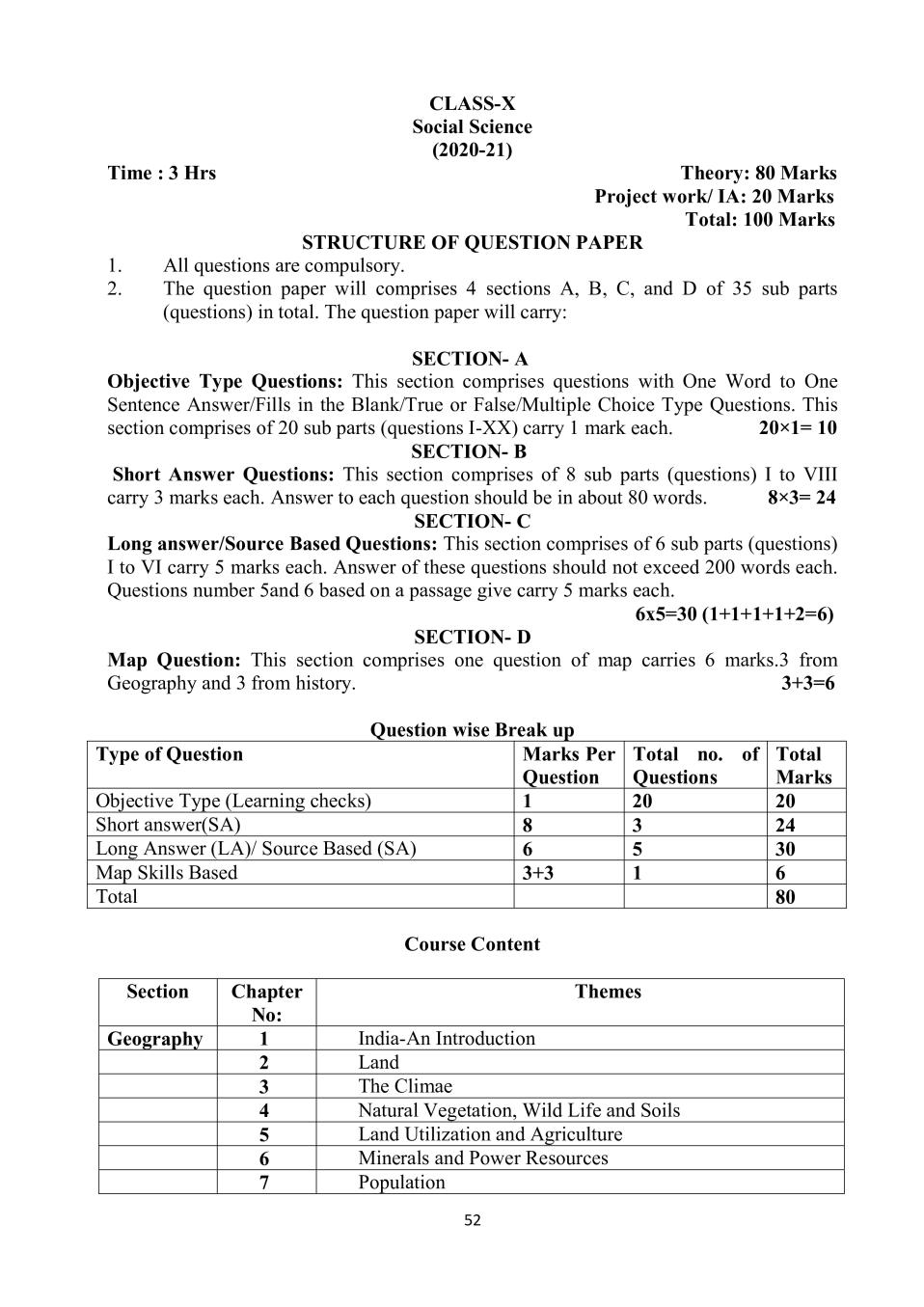
Social Science
(2020-21)
Time : 3 Hrs Theory: 80 Marks
Project work/ IA: 20 Marks
Total: 100 Marks
STRUCTURE OF QUESTION PAPER
1. All questions are compulsory.
2. The question paper will comprises 4 sections A, B, C, and D of 35 sub parts
(questions) in total. The question paper will carry:
SECTION- A
Objective Type Questions: This section comprises questions with One Word to One
Sentence Answer/Fills in the Blank/True or False/Multiple Choice Type Questions. This
section comprises of 20 sub parts (questions I-XX) carry 1 mark each. 20×1= 10
SECTION- B
Short Answer Questions: This section comprises of 8 sub parts (questions) I to VIII
carry 3 marks each. Answer to each question should be in about 80 words. 8×3= 24
SECTION- C
Long answer/Source Based Questions: This section comprises of 6 sub parts (questions)
I to VI carry 5 marks each. Answer of these questions should not exceed 200 words each.
Questions number 5and 6 based on a passage give carry 5 marks each.
6x5=30 (1+1+1+1+2=6)
SECTION- D
Map Question: This section comprises one question of map carries 6 marks.3 from
Geography and 3 from history. 3+3=6
Question wise Break up
Type of Question Marks Per Total no. of Total
Question Questions Marks
Objective Type (Learning checks) 1 20 20
Short answer(SA) 8 3 24
Long Answer (LA)/ Source Based (SA) 6 5 30
Map Skills Based 3+3 1 6
Total 80
Course Content
Section Chapter Themes
No:
Geography 1 India-An Introduction
2 Land
3 The Climae
4 Natural Vegetation, Wild Life and Soils
5 Land Utilization and Agriculture
6 Minerals and Power Resources
7 Population
52
Page 2
2 Infrastructure of the Indian Economy
3 Agriculure Development in India
4 Industrial Development in India
History 1 Physical features of the Punjab and their influence on it’s
History
2 Political and Social conditions of Punjab before Guru
Nanak Dev ji
3 Guru Nanak Dev ji and his Teachings
4 Contribution of Sikh Guru’s from Guru Angad Dev ji to
Guru Tegh Bahadur J
5 Guru Gobind Singh Ji’s Life, Creation of Khalsa and his
personality
6 Banda Singh Bahadur and The Sikh Misals
7 Ranjit Singh:Early life Achievements and Anglo-Sikh
Relations
8 The Anglo –Sikh Wars and Annexation of the Punjab
9 Punjab’s Contribution towards struggle for freedom
Pol. Sci. 1 Features of the Indian Constitution
2 The central Government
3 The State Government
4 Indian Democracy at Work
5 Indian Foreign Policy and United Nations
List of Map Items
(Geography)
1. All the 28 states of India, Capitals of the states
All the 9 union territories, capitals of the U.T.s
2. Himalaya Mountains, Northern plains, Southern plateau, Coastal Plains.
3. Mawsynram (Cherrapunji), Jaisalmer, Allahabad, Channai,
4. Production regions for Wheat, Rice, Sugarcane, Pulses.
5. Production regions for Iron and Coal.
(History)
1. In the map of Punjab, Show Nandaun, Basoli, Shahi Tibbi, Chamkaur Sahib,
Nirmoh and Sri Muktsar sahib where battles were fought by Guru Gobind Singh Ji.
2. Show the towns of Mudki, Ferozshah, Baddowal, Aliwal and Sabhraon on the map
of Punjab (First Anglo Sikh War)
3. In the Map of Punjab (before 1947) show places of Sonipat, Ghuraam, Samana,
Sirhind and Sadhaura.
4. Show the important Historical Places of Shri Amritsar Sahib, Kapurthla, Sri
Anandpur Sahib, Sri Mukatsar Sahib and Kartarpur.
5. Show the towns of Mudki ,Ram Nagar, Chillianwala , Multan and Gujarat on the
map of Punjab (second Anglo Sikh War)
53
Page 3
At the end of the stipulated term, each learner will present the research work in the
Project File to the External and Internal examiner. The questions should be asked
from the Research Work/ Project File of the learner. The Internal Examiner
should ensure that the study submitted by the learner is his/her own original
work. In case of any doubt, authenticity should be checked and verified.
INTERNAL ASSESSMENT Allocation of Marks (20)
The marks will be allocated under the following heads:
1. Preodic assessment map, peer assessment, gallery walks, Role play,Group
discussion, Quiz
2. Portfolio Class work
Work done(Activities, Assessment)
Achievements of student throughout the year in the
subject
3 Subject Enrichment Every student has to compulsorily undertake any one
activities project on the following topics:
Consumer Awareness
Social Issues
Sustainable Development
Historical
Political
Objectives
The overall objective of the project work is to help
students gain an insight and pragmatic
understanding of the theme.
It should also help in enhancing the life skills of the
students.
Students are expected to apply the social science
concepts that they have learnt over the years.
Students may go out for collecting data and used
different primary and secondary resources to prepare
the project.
If possible, various forms of art may be integrated in
the project work
Sr. Aspects marks
No.
a. Content accuracy, originality and 2
analysis
b. Presentation and creativity 2
54
Page 4
students themselves.
Projects and Models should be made from eco-friendly
products without incurring too much expenditure.
3. Map skill 2 marks
4 Book Bank 2 marks
Total 4+4+4+4+2+2 20 marks
Theory Paper + Project Work
Time: 3 Hrs Max. Marks :80 + 20=100
1 Geography (Section- A) 24 Marks
2 Economics (Section- B) 16 Marks
3 History (Section - C) 24 Marks
4 Pol.Science (Section-D) 16 Marks
5 Project Work (each component A,B.C 20 Marks
and D will comprises 4marks.)
Total 100 Marks
Weightage of Marks Section wise
O TQ 1 SA 3 Long Map Total
Marks Marks Answer/ Questions
Source 5 Marks
Based 5
Marks
Section A(Geo) 1(5) 3(2) 5(2) 3(1) 24 Marks
Section B(Eco) 1(5) 3(2) 5(1) 16 Marks
Section C(His) 1(5) 3(2) 5(2) 3(1) 24 Marks
Section D(Pol.Sci) 1(5) 3(2) 5(1) 16 Marks
Section E (Map Work)Geo, His 1(3+3) 6 Marks
Project Work 20 Marks
1x20=20 3x8=24 5x6=15 (3+3)x1=6 80+20=100
Weightage of difficulty Level
Estimated Difficulty Level Percentage
(i) Easy (E) 30%
(ii) Average (AV) 50%
(iii) Difficult (D) 20%
55
Document Details
| Board / Org | Punjab Board |
| Exam | Class 10 |
| Type | Syllabus |
| Pages | 4 |
| Updated | 22 Jul 2026 |