Karnataka 1st PUC Question Bank for Chemistry
Finished viewing? Save it for later —
Download Karnataka 1st PUC Question Bank for Chemistry (PDF · 56 pages)About Karnataka 1st PUC Question Bank for Chemistry
Karnataka 1st PUC Question Bank for Chemistry is available here for free download. Published by Karnataka Board for Class 11, this question bank can be viewed online or downloaded as a PDF (56 pages). Candidates preparing for Class 11 can use Karnataka 1st PUC Question Bank for Chemistry to understand the exam pattern, the type of questions asked, and the overall difficulty level.
Frequently Asked Questions
How can I download Karnataka 1st PUC Question Bank for Chemistry?
Open this page and click the Download button to save Karnataka 1st PUC Question Bank for Chemistry as a PDF. It is completely free on AglaSem Docs.
Is Karnataka 1st PUC Question Bank for Chemistry free to download?
Yes. Karnataka 1st PUC Question Bank for Chemistry can be viewed online and downloaded as a PDF free of cost on AglaSem Docs.
How many pages does Karnataka 1st PUC Question Bank for Chemistry have?
Karnataka 1st PUC Question Bank for Chemistry contains 56 pages, which you can read online or download together as a single PDF.
Where can I find more Class 11 study material?
You can find more Class 11 question papers, sample papers, syllabus, and answer keys on AglaSem Docs.
Karnataka 1st PUC Question Bank for Chemistry – Text
Read the full text of this question bank below — useful to quickly search, copy and reference the content online without downloading the PDF.
📄 View text version (56 pages)
Page 1
Department of School Education
(Pre-University)
QUESTION BANK
Page 2
Multiple Choice Questions (MCQs)
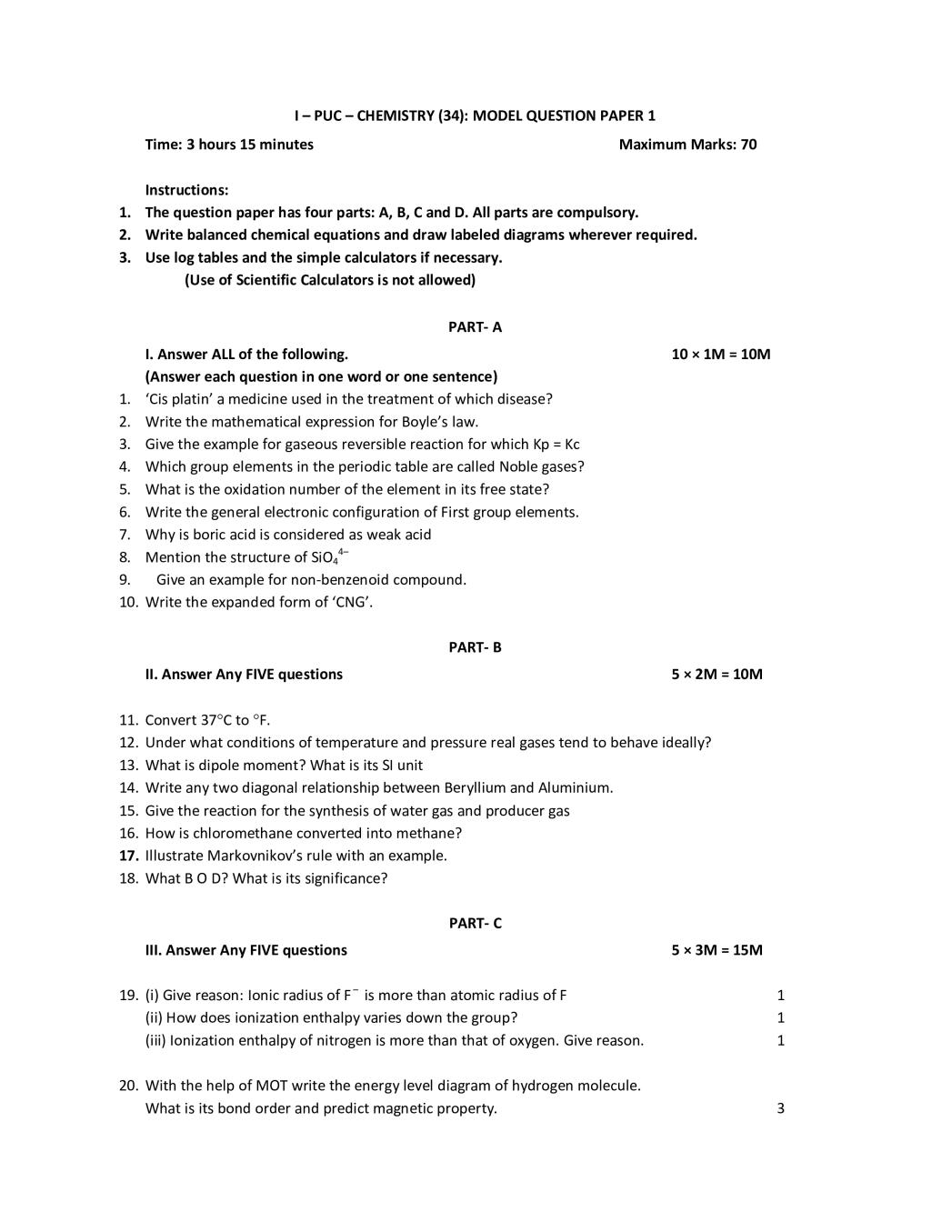
1. Patients suffering from AIDS can be helped using which of the following drugs?
a) Cis platin b) AZT (Azidothymidine)
c) Taxol d) Codeine
2. What are the basic constituents of matter?
a) Atoms & Molecules b) Atoms & Moles
c) Molecules & Ions d) Nuclei & Ions
3. The substances whose compositions are not uniform and different components are mixed are called
_______
a) Homogenous substances b) Heterogeneous substances
c) Pure substances d) Elements
4. A ________ is made up of two or more pure substances which may be in any ratio.
a) Mixture b) Element
c) Molecule d) Atom
5. Which of the following is not a pure substance?
a) Copper b) Gold
c) Sugar solution d) Water
6. When two or more atoms of different elements combine with each other in a fixed ratio, the molecule of a
____ is obtained.
a) Compound b) Element
c) Atom d) Ion
7. Which among the three states of matter has a definite shape and size?
a) Solids b) Liquids
c) Gases d) Vapor
8. Water is a _______
a) Element b) Compound
c) Homogeneous mixture d) Heterogeneous mixture
9. Which of the following may not be a physical property?
a) Odor b) Color
c) Density d) Composition
10. Candela is the S.I. unit of _____
a) Luminous intensity b) Thermodynamic temperature
c) Amount of substance d) Electric current
11. How many scientific fundamental quantities are given S.I. units?
a) 5 b) 7
c) 3 d) 9
Question Bank I PUC Chemistry
Page 3
12. What is the symbol of the amount of substance’s S.I. unit?
a) K b) s
c) mol d) kg
3
13. 1Litre = _______ m
a) 1000 b) 0.001
c) 1 d) 10
14. _________ is referred to as the closeness of different measurements for the same quantity.
a) Accuracy b) Precision
c) Analysis d) Dimension
15. How many significant figures does 0.057 have?
a) 2 b) 4
c) 3 d) 0
16. What did Dalton propose?
a) Law of Multiple Proportions b) Avogadro’s Law
c) Law of Definite Composition d) Law of Conservation of Mass
17. Law of Definite Composition is also known as ________
a) Law of Multiple Proportions b) Avogadro’s Law
c) Law of Definite Proportion d) Law of Conservation of Mass
18. What did Dalton’s Theory couldn’t explain?
a) gaseous volumes b) conservation of mass
c) chemical philosophy d) indivisible atoms
19. According to Dalton’s Atomic Theory, matter consists of indivisible _______
a) Molecules b) Atoms
c) Ions d) Mixtures
20. Which of the following may not be explained by Dalton’s atomic theory?
a) reason for combining atoms b) conservation of mass
c) chemical philosophy d) indivisible atoms
21. What is the abbreviation of amu?
a) Atomic matter unit b) Atomic mass unified
c) Atomic mass unit d) At mass unity
22. All atoms of a given element have identical __________ including identical _________.
a) Properties, mass b) Weight, volume
c) Volume, properties d) Temperature, pressure
23. What’s the molecular mass of carbon dioxide?
a) 43 b) 28
c) 44 d) 40
24. According to S.I. the system, ______ was used to measure the amount of substance.
a) mole b) weight machine
c) weight d) mass
Question Bank I PUC Chemistry
Page 4
25. A mole of any substance contains _______
a) 6.022 × 1026 particles b) 6.022 × 10²² particles
c) 6.022 × 10²³ particles d) 3.022 × 10²² particles
26. A _______ formula represents a whole number ratio to the simplest form.
a) Molecular b) Empirical
c) Simpler d) Shorter
27. __________ formula can be calculated if the molar mass is known after having an empirical formula.
a) Molecular b) Empirical
c) Simpler d) Shorter
28. In a particular reaction, one of the reactants limits the number of products formed. That is called as
_______.
a) Limiting reagent b) Limiting product
c) Excessive reagent d) Excessive reactant
29. Which of the following is not true regarding balanced chemical equations?
a) They contain the same number of atoms on each side
b) Electrons are also balanced
c) An equal number of molecules on both the side
d) Follows the law of conservation of mass
30. Which of the following is true regarding molecular formula?
a) actual whole numbered ratio b) rational numbered ratio
c) simplest possible whole numbered ratio d) the same as the empirical ratio
Fill in the blanks by choosing the appropriate word from those given in the brackets:
SET-1
(kg m-3, Avogadro constant, coordination entities, weight, compound, pure substance)
1. When all constituent particles of a substance are same in chemical nature, it is said to be _______.
2. When two or more atoms of different elements combine together in a definite ratio, gives _______.
3. The force exerted by gravity on an object is called _______.
4. The SI unit of density is___________.
5. This number of entities in one mol is __________.
SET-2
(molarity, yotta, yocto, molality, Azidothymidine, molar mass)
1. The mass of one mole of a substance in grams is called _________.
2. The number of moles of the solute in 1 litre of the solution is called _________.
3. The number of moles of solute present in 1 kg of solvent is called __________.
4. The prefix for 10-24 is __________.
5. The drug used for helping AIDS patients is ________.
Question Bank I PUC Chemistry
Page 5
SET-3
(its volume, mole, femto, 1.6 × 10⁻⁴, candela, matter)
1. Anything which has mass and occupies space is called ________.
2. The SI unit of amount of substance is ______.
3. The prefix for 10-15 is_________.
4. The amount of space occupied by a substance is _______.
5. The scientific notation for 0.00016 can be written as __________.
SET-4
(three, two, Dalton, atomic mass unit, limiting reagent, dimensional analysis)
1. The significant numbers in 285 is ________.
2. The method to convert units from one system to another is __________.
3. ________ law could not provide reason for combining of atoms.
4. Mass exactly equal to one-twelfth of the mass of one carbon–12 atom is called__________.
5. The reactant, which gets consumed first, limits the amount of product formed and is called the _______.
SET-5
( 98.6, molarity, Amphere, ppm, unity, 37 )
1. The temperature of human body in Fahreneit scale is _______.
2. The temperature dependent concentration term is_________.
3. The sum of mole fraction of components in solution is _________.
4. The concentration term used measure very low concentration is _________.
5. The SI unit of current is_________.
Two-mark questions
1. Write the drugs used to treatment of cancer and AIDS.
2. What is homogeneous mixture. Give an example.
3. What is heterogeneous mixture. Give an example.
4. What are pure substances? Give an example.
5. Write any two differences between physical and chemical properties.
6. Expand SI. How many base units in SI system?
7. Mention the prefix for 106 and 10–6.
8. Write any two differences between mass and weight.
9. Give the scientific notation for 232.508 and 0.00016.
10. What is meant by precision and accuracy?
11. What is dimensional analysis? Illustrate it with an example.
12. State law of conservation of mass and Law of Definite Proportions.
13. What is meant by atomic mass and molecular mass?
14. What is molar mass? Write the formula mass of sodium chloride.
15. What is Avogadro constant? How do you denote Avogadro number?
Question Bank I PUC Chemistry
Page 6
16. What is an empirical and molecular formula?
17. Define stoichiometry and limiting reagent.
18. What is the empirical formula for the following?
i) Fructose (C6H12O6) found in honey
ii) Caffeine (C8H10N4O2) a substance found in tea and coffee.
19. Define molarity. Write its mathematical expression.
20. Define molality. Write its mathematical expression.
Three-mark questions
1. Write any three differences between solids and liquids.
2. Mention the SI units for electric current, thermodynamic temperature and amount of substance.
3. What is density? Write its mathematical expression and SI unit.
4. Write any three common scales to measure temperature.
5. State law of multiple proportions. Explain it with an example.
6. State Gay lussac’s law of Gaseous volumes. Explain it with an example.
7. Write any three postulates of Dalton’s atomic theory.
8. Mention the three isotopes of carbon.
9. Write any three ways to express the amount of substance present in the solution.
10. What is mole fraction? Write its mathematical expression for a substance ‘A’ dissolves in substance ‘B’ and
their number of moles are nA and nB , respectively.
Problems
1. A compound contains 4.07% hydrogen, 24.27% carbon and 71.65% chlorine. Its molar mass is 98.96 g.
What are its empirical and molecular formulas?
2. Calculate the amount of water(g) produced by the combustion of 16 g of methane.
3. 50.0 kg of N2(g) and 10.0 kg of H2(g) are mixed to produce NH3(g). Calculate the amount of NH3(g)
formed. Identify the limiting reagent in the production of NH3 in this situation.
4. A solution is prepared by adding 2 g of a substance A to 18 g of water. Calculate the mass per cent of the
solute.
5. Calculate the molarity of NaOH in the solution prepared by dissolving its 4 g in enough water to form 250
mL of the solution.
6. The density of 3 M solution of NaCl is 1.25 g mL–1. Calculate the molality of the solution.
7. The density of 3 molal solution of NaOH is 1.110 g mL–1. Calculate the molarity of the solution.
8. If 4 g of NaOH dissolves in 36 g of H2O, calculate the mole fraction of each component in the solution.
Also, determine the molarity of solution (specific gravity of solution is 1g mL–1).
9. A measured temperature on Fahrenheit scale is 200°F. What will this reading be on Celsius scale?
10. What will be the molarity of a solution, which contains 5.85 g of NaCl(s) per 500 mL?
11. If 500 mL of a 5 M solution is diluted to 1500 mL, what will be the molarity of the solution obtained?
12. The empirical formula and molecular mass of a compound are CH2O and 180g respectively. What will be
the molecular formula of the compound?
Question Bank I PUC Chemistry
Page 7
Multiple Choice Questions (MCQs)
1. The phosphorescent material coated behind anode is
a) Zinc sulphate b) zinc sulphite
c) zinc thiosulphate d) zinc sulphide.
2. Identify the incorrect statement
a) The cathode rays start from cathode and move towards the anode.
b) In the absence of electrical or magnetic field, cathode rays travel in straight lines.
c) The cathode rays consist of negatively charged particles, called electrons.
d) The characteristics of cathode rays depend upon materials of electrodes gas present in the tube.
3. Which of the following is correct arguments of Thomson?
a) The amount of deviation of the particles from their path in the presence of electrical or magnetic
field is independent on magnitude of charge.
b) The amount of deviation of the particles from their path in the presence of electrical or magnetic
field is depends on mass of the particle.
c) The amount of deviation of the particles from their path in the presence of electrical or magnetic
field is independent on mass of the particle.
d) The amount of deviation of the particles from their path in the presence of electrical or magnetic
field is independent on strength of the electrical or magnetic field.
4. The value of e/m for electron is
a) 1.758820 × 10¹¹ C kg–1 b) 9.1094×10⁻³¹ kg
c) 1.602176 × 10⁻¹⁹ C d) 6.023 × 10²³
5. The thickness of gold foil used in Rutherford alpha particle scattering experiment is nearly
a) 1nm b) 10 nm
c) 100nm d) 0.1nm
6. Select the incorrect statement regarding conclusions of α-particle experiment.
a) Most of the space in the atom is empty.
b) The positive charge has to be concentrated in a very small volume.
c) The positive charge is distributed uniformly in the atom.
d) The volume occupied by the nucleus is negligibly small as compared to the total volume of the atom
7. The properties of atom explained by Thomson model is/are
a) Position of electrons, neutrons and protons
b) Size of atom
c) Stability of atom
d) Orbitals in atom.
Question Bank I PUC Chemistry
Page 8
8. e/m ratio is highest for
a) proton b) electron
c) neutron d) gama rays.
9. In Rutherford α- ray scattering experiment, the role of helium is
a) Provide inert atmosphere b) less heavier provide no obstacle to α-ray
c) Act as source of α-ray d) Helps in recording response of α-ray scattering.
10. According to calculations made by Rutherford, the radius of the atom and nucleus respectively are
a) 10–10 m and 10–15 m b) 10–15 m and 10–10 m
c) 10–12 m and 10–18 m d) 10–9 m and 10–12 m
40
11. K19 and 40Ca20 are examples of
a) Isotopes b) isoelectronic
c) isodiapheres d) isobars
12. Select the incorrect about isotopes:
a) Isotopes are atoms of same elements b) Isotopes are element of different elements
c) Isotopes have different number of neutrons.d) Isotopes have same chemical behaviours.
80
13. The number of protons, neutrons and electrons in Br35respectively are
a) 35, 45 and 35 b) 45, 35 and 45
c) 45, 35 and 35 d) 35, 35 and 45
14. The chemical properties of atoms are controlled by the number of
a) Neutrons b) electrons
c) isotopes d) isobars
40
15. Which of the following does not contain number of neutrons equal to that of 18 Ar ?
41 43
a) 19 K b) 21 Sc
40 42
c) 21 Sc d) 20 Ca
16. According to Bohr's theory, the angular momentum of an electron in 5th orbit is
a) 10 h / b) 2.5 h /
c) 25 h / d) 1.0 h /
17. Which one of the following sets of ions represents the collection of isoelectronic species?
a) K+, Cl–, Mg2+, Sc3+ b) Na+, Ca2+, Sc3+, F–
c) K+, Ca2+, Sc3+, Cl– d) Na+, Mg2+, Al3+, Cl–
(Atomic numbers: F = 9, Cl = 17, Na = 11, Mg = 12, Al = 13, K = 19, Ca = 20, Sc = 21)
18. The incorrect statement about Rutherford model is/are
a) The most of the mass of the atom was concentrated in extremely small region (nucleus).
b) The nucleus is surrounded by electrons that move around the nucleus with a very high speed in
circular paths called orbits.
c) Rutherford’s model of atom resembles the solar system in which the nucleus plays the role of sun
and the electrons that of revolving planets.
d) Electrons and the nucleus are held together by gravitational forces of attraction.
Question Bank I PUC Chemistry
Page 9
19. The theory that disprove Rutherford atomic model is
a) Kinetic theory of gases b) Maxwell electromagnetic theory
c) De brogle’s theory d) Einstein’s theory
20. The incorrect statement about Bohr’s atomic model is/are:
a) Angular moment of electron is quantised
b) Energy of the electrons in the orbit is quantised.
c) The position and velocity cannot be estimated simultaneously
d) Electrons present near to nucleus has less energy.
21. The series of hydrogen spectrum obtained in visible region is
a) Lyman b) Paschen
c) P-fund d) Balmer
22. The theory/principles that rules out the definite path of electron around the nucleus is
a) Maxwell electromagnetic theory b) Heisen berg’s uncertainty principle
c) Daltons’ theory d) Aufbau principle.
23. The frequency below which photoelectric effect is not observed is called
a) Photoelectric frequency b) Minimum frequency
c) Threshold frequency d) Bohr frequency
24. The radius of first stationary state is called
a) Bohr orbit. b) Rydberg orbit.
c) Bohr radius. d) Rydberg radius.
25. Bohr’s theory is not applicable for
a) He+ b) H+
c) Li2+ d) Be+3
26. The splitting of spectral lines in the presence of magnetic field is called
a) Zeeman effect b) photoelectric effect
c) Stark effect d) Raman effect
27. The maximum number of electrons that accommodate in principal quantum number n=4 is
a) 2 b) 6
c) 18 d) 32
28. The principal quantum number signifies
a) Size of the orbit b) Shape of the orbit
c) Orientation of orbitals d) direction of spin of electron.
29. The incorrect set of quantum numbers is
a) n=4, l=3, m=0 b) n=4, l=2, m=1
c) n=4, l=4, m=0 d) n=4, l=1, m=0
30. Schrödinger equation is applicable for system
a) Whose energy does not change in time.
b) Whose energy change in time.
c) Whose kinetic energies of subatomic particles are equal.
d) Whose kinetic energies of subatomic particles are zero.
Question Bank I PUC Chemistry
Page 10
Fill in the blanks by choosing the appropriate word from those given in the brackets:
SET-1
2
(UV, dumbbell, 2n , electrons, orientation of orbitals, size)
1. The fundamental particle with highest e/m ratio is ______.
2. The shape of orbital having l= 1 is _________.
3. Lyman series is observed in _________ region.
4. Total number of electrons in a shell having principal quantum number ‘n’ is _______.
5. The magnetic quantum number informs about_________
SET-2
(nodes, ‘n’, increases, ‘n-1’, atomic orbital, ‘n-l-1’)
1. The region in which there is a maximum probability of finding an electron is ______.
2. The region where the electron probability density function reduces to zero is called _____.
3. Number of nodes increases with principal quantum number n_______.
4. Total number of nodes is given by_____.
5. Number of angular nodes is given by ____________
SET-3
(isotopes, 18, principal quantum number, 52.9 pm, 20, isobars)
1. Atoms with same mass number but different atomic numbers are called________.
2. Atoms with same atomic number but different mass numbers are called________.
3. The size of the orbital is determined by _______.
4. Number of electrons in dipositive Calcium ion ( 42
20 Ca ) is ______.
5. The value of Bohr orbit is ____
SET-4
(J.Chadwick, one, two, nine, Goldstein, J.J.Thomson)
1. Total number of orbitals associated with third shell is ____ .
2. Electron was discovered by __________.
3. Proton was discovered by ___________.
4. Neutron was discovered by________.
5. Bohr atomic model was applicable only for system having _________ electron.
SET-5
-18
(2.18 x 10 , zero, infinity, Deuterium, tritium, quantum, )
1. When the electron is free from the influence of nucleus, the energy is taken as ______.
2. Ionized hydrogen atom in stationary state has principal quantum n equal to
3. The value of Rydberg constant in joules is ______.
Question Bank I PUC Chemistry
Page 11
4. The smallest quantity of energy that can be emitted or absorbed in the form of electromagnetic radiation is
called ___________.
5. The isotopes of hydrogen having 2 neutrons ________
2 marks questions:
1. Name any two fundamental particles of an atom.
2. Who discovered i) neutron ii) electrons
3. Calculate the number of electrons and neutrons in 40Ca20
4. State Heisenberg’s principle. Write its mathematical equation.
5. What is photoelectric effect? Write its mathematical equation
6. What are isotopes? Give example.
7. What are isobars? Give example.
8. What are isotones? Give example.
9. Write any two drawbacks of Rutherford atomic model.
10. Write De Broglie equation and explain its terms.
11. Write Rydberg equation and explain its terms.
12. Define Wavelength and frequency.
13. Illustrates Aufbau principle with an example.
14. Illustrates Pauli’s exclusion principle with an example.
15. Illustrates Hunds rule of principle with an example.
16. write the possible value for a) n=3, l=2. b) a) n=4, l=0
17. Write the significance of a) Principal quantum number b) azimuthal quantum number.
18. What is meant by a) Stark effect b) Zeeman effect
19. Write any two drawbacks of Bohr atomic model.
20. What is threshold frequency? Write equation to relate threshold frequency and kinetic energy.
3 marks question:
1. Write any three observations of Rutherford alpha ray scattering experiment.
2. Write any three properties of cathode ray.
3. Write any three properties of anode ray.
4. Mention any three drawbacks of Rutherford atomic models.
5. Write any three postulates of Rutherford atomic models.
6. Explain hydrogen emission spectra?
7. Write any three postulates of Bohr’s atomic models.
8. Write any three drawback of Bohr’s atomic models.
9. What are the significances of the following
i) Principal quantum number ii) Azimuthal quantum number iii) magnetic quantum number.
10. What is electromagnetic spectrum? Represent electromagnetic spectra with respect to frequency and
wavelength.
Question Bank I PUC Chemistry
Page 12
Problems:
1. The Vividh Bharati station of All India Radio, Delhi, broadcasts on a frequency of 1,400 kHz (kilo hertz).
Calculate the wavelength of the electromagnetic radiation emitted by transmitter. Which part of the
electromagnetic spectrum does it belong to?
2. The wavelength range of the visible spectrum extends from violet (400 nm) tored (750 nm). Express these
wavelengths in frequencies (Hz). (1nm = 10–9 m).
3. Calculate (a) wave number and (b) frequency of yellow radiation having wavelength 5800 Å.
4. Calculate energy of one mole of photons of radiation whose frequency is 5 ×10¹⁴Hz.
5. A 100watt bulb emits monochromatic light of wavelength 400 nm. Calculate the number of photons
emitted per second by the bulb.
6. When electromagnetic radiation of wavelength 300 nm falls on the surface of sodium, electrons are emitted
with a kinetic energy of 1.68 ×10⁵ J mol–1. What is the minimum energy needed to remove an electron from
sodium?
7. When electromagnetic radiation of wavelength 300 nm falls on the surface of sodium, electrons are emitted
with a kinetic energy of 1.68 ×10⁵ J mol–1. What is the maximum wavelength that will cause a
photoelectron to be emitted?
8. The threshold frequency ν0 for a metal is 7.0 ×10¹⁴ s–1. Calculate the kinetic energy of an electron emitted
when radiation of frequency ν =1.0 ×10¹⁵ s–1 hits the metal.
9. What is the frequency of a photon emitted during a transition from n = 5 state to the n = 2 state in the
hydrogen atom?
10. What is the wavelength of a photon emitted during a transition from n = 5 state to the n = 2 state in the
hydrogen atom?
11. Calculate the energy associated with the first orbit of He+. What is the radius of this orbit?
12. What will be the wavelength of a ball of mass 0.1 kg moving with a velocity of10 m s–1 ?
13. The mass of an electron is 9.1×10⁻³¹ kg. If its K.E. is 3.0×10⁻²⁵ J, calculate its wavelength.
14. Calculate the mass of a photon with wavelength 3.6 Å.
15. A microscope using suitable photons is employed to locate an electron in an atom within a distance of 0.1
Å. What is the uncertainty involved in the measurement of its velocity?
16. A golf ball has a mass of 40g, and a speed of 45 m/s. If the speed can be measured within accuracy of 2%,
calculate the uncertainty in the position.
Question Bank I PUC Chemistry
Page 13
Multiple Choice Questions (MCQs)
1. Which of the following doesn’t follow “Law of triads”?
a) Li, Na, K b) Ca, Sr, Ba
c) P,C,N d) Cl, Br, I
2. The statement that is not correct for the Mendeleev’s periodic classification of element is
a) The properties of the elements are periodic function of their atomic number
b) He left several gaps for undiscovered elements called these elements as Eka aluminium and
Eka silicon
c) He placed Tellurium before Iodine thinking atomic weights might be incorrect
d) He arranged elements in horizontal rows and columns
3. The period number in the long form of the periodic table is equal to :
a) magnetic quantum number of any element of the period.
b) atomic number of any element of the period.
c) maximum Principal quantum number of any element of the period.
d) maximum Azimuthal quantum number of any element of the period.
4. Which one of the following statements related to the modern periodic table is incorrect :
a) The p-block has 6 columns, because a maximum of 6 electrons can occupy all the orbital’s in a
p-subshell.
b) The d-block has 8 columns, because a maximum of 8 electrons can occupy all the orbital’s
in a d-subshell.
c) Each block contains a number of columns equal to the number of electrons that can occupy
that subshell.
d) The block indicates value of Azimuthal quantum number () for the last subshell that
received electrons in building up the electronic configuration.
5. The position of an element with atomic number 114 is
a) Period 6 group 14 b) Period 6 group 16
c) Period 5 group 18 d) Period 7 group 14
6. In modern periodic table, the element with atomic number Z = 118 will be :
a) Uuo; Ununoctium; alkaline earth metal b) Uno; Unniloctium; transition metal
c) Uno; Unniloctium; alkali metal d) Uuo; Ununoctium; noble gas
th th
7. An element X belongs to group 16 & 5 period. Its atomic number is
a) 34 b) 50
c) 52 d) 85
8. Which is false statement?
a) s and p block elements are called as Representative elements
b) iso electronic species: Na+, O2-, F—, Mg2+, Cl—
Question Bank I PUC Chemistry
Page 14
c) metallic character: P < Si <Be < Mg < Na
d) Radius: vander waals radius > metallic radius > covalent radius
9. Anything that influences the valence electrons will affect the chemistry of the element. Which one of the
following factors does not affect the valence shell?
a) Valence principal quantum number (n) b) Nuclear charge (Z )
c) Nuclear mass d) Number of core electrons
10. The correct order of radii is
a) Mg2+ > Mg >Al 3+ b) F— < O2- <N3-
c) Cs < Rb <K d) Si < P < C
11. Which of the following refers to the ionization enthalpy
a) X(s) X+(g) + e b) X(s) + aq X+(aq) + e
c) X(g) X+(g) + e d) X(g) + e X-(g)
12. Which of the following affect the ionization enthalpy of the atom?
a) Nuclear charge b) Electron neutrality with proton
c) Penetration effect d) Atomic size
13. The correct order of IE1 of
a) B < Be < O < N < F < Ne. b) B < Be < N < O < F < Ne
c) Be < B < O < N < F < Ne d) B < F < O < N < Be < Ne
14. Which electronic configuration of neutral atoms will have the highest first ionisation energy ?
a) 1s2 2s2 2p4 b) 1s2 2s2 2p3
c) 1s2 2s2 2p2 d) 1s2 2s2 2p1
15. The first (IE1) and second (IE2) ionization energies (kJ/mol) of a few elements designated by Roman
numerals are given below. Which of these would be an alkali metal ?
IE1 IE2
a) I 2372 5251
b) II 520 7300
c) III 900 1760
d) IV 680 7800
16. Which is a true statement ?
a) Larger is the value of ionisation energy easier is the formation of cation.
b) Ionisation enthalpy is always positive
c) Larger is the value of ionisation energy as well as electron affinity the smaller is the electronegativity
of atom.
d) Larger is the Zeff larger is the size of atom
17. The formation of the oxide ion, O2-(g), from oxygen atom requires first an exothermic and then an
O (g); H 141 kJ mol1 ,
endothermic step as shown O(g) e
O (g) e
; H 780 kJ mol1 . Thus process of formation of O2– is isoelectronic with neon.
It is due to the fact that
a) oxygen is more electronegative
Question Bank I PUC Chemistry
Page 15
b) Addition of electron in oxygen results in larger size of the ion
c) Electron repulsion outweighs the stability gained by achieving noble gas
d) O– ion has comparatively smaller than oxygen
18. The correct order of electron gain enthalpy with –ve sign of F, Cl, Br, I having atomic number 8, 17, 35, 53
respectively is
a) I > Br > Cl > F b) F > Cl > Br > I
c) Cl > F > Br > I d) Br > Cl > I > F
19. Electron gain enthalpy (Electron affinity) is a :
a) Relative strength to attract the shared electron pair
b) Necessary energy required to remove the electron from the outermost orbit
c) Energy released when an electron is added to the outermost shell
d) Energy released when an electron is added to the inner shell
20. Which of the following will have the most negative electron gain enthalpy and which the least negative ?
F, P, S, Cl.
a) P, Cl b) Cl, F
c) Cl, S d) Cl, P
21. Second electron affinity of an element is :
a) Always exothermic b) Endothermic for few elements
c) Exothermic for few elements d) Always endothermic
22. The set representing the Incorrect order for electron gain enthalpy
a) O<S b) Ar = Kr
c) Ne < He d) Cl < F
23. The first (∆iH1) and the second (∆iH2) ionization enthalpies (in kJ molñ1) and the (∆egH) electron gain
enthalpy (in kJ mol–1) of a few elements are given below:
Elements ∆H1 ∆H2 ∆egH
I 520 7300 – 60
II 419 3051 – 48
III 2372 5251 + 48
IV 738 1451 – 40
Which of the above elements is least reactive non metal?
a) I b) II
c) III d) IV
24. Using above data Qn-23, which element can form stable binary halide of the formula MX2?
a) I b) II
c) III d) IV
25. Electronegativity is
a) is directly related to effective nuclear charge
b) is directly related to non-metallic property
c) Is inversely related to metallic property
d) all of these
Question Bank I PUC Chemistry
Page 16
26. Arrange F, C, N, O in the decreasing order of electronegativity :
a) O>F>N>C b) F>N>C>O
c) C>F>N>O d) F>O>N>C
27. The outer most electronic configuration of the most electronegative atom is :
a) ns2 np5 b) ns2np6
c) ns2np4 d) ns2np3
28. Paulings electronegativity values for elements are useful in predicting
a) Polarity of bonds in molecules b) Position of elements in electromotive series
c) Co-ordination number d) Dipole moment of various molecules
29. Which of the following elements can show covalency greater than 4?
a) Be b) P
c) S d) Al
30. Which is false statement?
a) An element belongs to 3rd period and group-13 of the periodic table are solid, metallic and good
conductor of electricity
b) As2O3 is amphoteric oxide, CO is neutral oxide, Na2O is acidic oxide
c) Oxidation and covalency of Al in [AlCl(H2O)5]2+ are same
d) Be is diagonally related Al
Fill in the blanks by choosing the appropriate word from those given in the brackets:
SET-1
(caesium, Magnesium, Helium, Germanium, Argon, Beryllium)
1. The least electronegative element in the periodic table_______.
2. The element which is diagonally related to Lithium is _______.
3. The least electron gain enthalpy noble gas is _______.
4. Eka Silicon is also known as ________.
5. The iso electronic species of K+ is _____.
SET-2
(positive, negative, zero, seven, thirty two, eighteen)
1. Ionisation enthalpy is always ______.
2. The enthalpy change for adding a 1st electron is always _____.
3. The value of ‘l’ for 3s orbital is _______.
4. The number of families in Modern periodic table is _______.
5. The number of elements in 6th period of modern periodic table is ______.
SET-3
(increases, series, groups, chalcogens, alkali metals, decreases)
1. The horizontal rows in a Mendeleev periodic table are called _____.
2. On going down a group in the periodic table, the metallic character of elements _____.
Question Bank I PUC Chemistry
Page 17
3. Group -16 are also called as ______.
4. Group-1 elements are called as _____.
5. On going down a group Ionisation enthalpy _____.
SET-4
(metals, atomic number, atomic weight, metalloids, Noble gases, main group element)
1. Dobereiner law of triads is based on _______.
2. The elements Si & Ge are _____.
3. The modern periodic table was prepared by ____.
4. Group-18 elements are called ______.
5. s and p-block elements are also called as ______.
SET-5
(Electronegativity, fluorine, Moseley, decreases, actinoid, Rutherford)
1. Most electronegative element in periodic table is ____.
2. Pauling scale is used to measure _____.
3. ____ scientist prepared modern periodic table.
4. On going down a group in the periodic table, the metallic character of elements____.
5. 5f series elements known as _____series.
2 marks questions:
1. What is the significance of atomic number in the modern periodic table?
2. What are the four blocks of the modern periodic table ? Name one element from each block.
3. Write any two limitations of Mendeleev’s periodic table.
4. What are metalloids? Give an example.
5. What would be the IUPAC name and symbol for the element with atomic number 115?
6. X,Y and Z are the elements of a Dobereiner’s triad . If the atomic mas of X is 7 and that of Z is 39, what
should be the atomic mass of Y ?
7. What are Transuranium Elements ? give an example.
8. What are actinoids? Write its general electronic configuration.
9. Arrange the following elements in the increasing order of metallic character. Si, Be, Mg, Na and P.
10. Explain why cations are smaller radii than their parent atoms.
11. State Modern periodic law. Mention the longest period in Modern periodic table.
12. Which family of the element exhibit low reactivity? Justify your answer.
13. Identify the period and group of the element with atomic number 37.
14. What are isoelectronic species? give two examples.
15. Mention any two factors that affect Ionisation enthalpy.
16. Name two elements that have two electrons in their outermost shells.
17. Name the most electronegative and least electronegative element.
18. What are Amphoteric oxides? Give an example.
Question Bank I PUC Chemistry
Page 18
19. Predict the formula of stable binary compound of the element X belongs to alkali metal and Y belongs to
halogen family.
20. Assign the position of the element having outer electronic configuration
1) ns2 np4 for n=3 2) (n-1)d2 ns2 for n=4
3 marks question:
1. a) State Mendeleev’s periodic law.
b) What were the two criteria used by Mendeleev to classify the elements in his periodic table?
2. a) Define Ionization enthalpy,
b) How does it vary across the period? Give reason.
3. What factors affect the atomic radius of an element? Explain with examples.
4. Explain the trend in electron gain enthalpy across a period in the periodic table. Give examples to each to
illustrate your answer.
5. Discuss the importance of electro negativity in predicting the polarity of bonds and the reactivity of
elements. Illustrate with example.
6. Define Electro negativity. How does Electro negativity related to metallic and non-metallic property?
7. Give reasons :
a) IE1 of Na is less than IE1 of Mg
b) Electro negativity decreases down the group.
8. A metal X is in the first group of the periodic table .
a) What will be the formula of its oxide?
b) What will the formula of its chloride?
c) What is the valency of X?
9. What is a group in the periodic table? In which part of a group would you separately expect the elements
to have i) the greatest metallic character ii) the largest atomic size.
10. Give one example for each of the following:
a) Basic oxide
b) Acidic oxide
c) Neutral oxide.
Question Bank I PUC Chemistry
Page 19
Multiple Choice Questions (MCQs)
1. According to Lewis, compounds are said to be stable when number of electrons on each atom is
a) 0 b) 10
c) 8 d) 18
2. Find out the correct Lewis symbol for the atom carbon among the following options.
a) .C: b) :C.
c) :C: d) .C.
3. In Lewis symbol, the number of dots around the symbol represents the
a) Total number of electrons. b) number of valence electrons.
c) number of lone pair electrons. d) number of unpair electrons.
4. Sharing or transfer of electrons from one atom to the other to attain stable octet configuration follows
_______
a) Duet rule b) Triplet rule
c) Octet rule d) Septet rule
5. Which of the following molecule doesn’t involve covalent bond?
a) H2O b) CCl4
c) NaCl d) O2
6. A chemical bond formation that involves the complete transfer of electrons between atoms is _______
a) ionic bond b) covalent bond
c) metallic bond d) partial covalent bond
7. Formation of a compound through ionic bond ______ the ionization energy of the metal ion.
a) does not depends on b) depend on
c) is independent regarding d) may or may not depend on
8. Electron gain enthalpy may be ________
a) exothermic b) both exothermic and endothermic
c) endothermic d) always zero
9. What is the energy that is released upon the formation of an ionic compound known as?
a) Ionization energy b) Lattice energy
c) Electron gain enthalpy d) Electropositivity
10. What are the units of measuring the bond angle?
a) meters b) kilograms
c) degree d) mole
11. All the __________ species (molecules and ions) have the same bond order.
a) isotopic b) isoelectronic
c) isobaric d) isoneutronic
Question Bank I PUC Chemistry
Page 20
12. Which of the following molecules may have a dipole moment?
a) N2 b) CH4
c) BeF2 d) H2O
13. The shape of the molecule depends on the _______
a) adjacent atom b) valence electrons
c) core electrons d) atmosphere
14. The shape of the molecule NH3 is?
a) Square pyramidal b) V-shape
c) Trigonal pyramidal d) Tetrahedral
3
15. How many orbitals are included in sp d hybridization?
a) 5 b) 4
c) 3 d) 6
16. A double bond is made up of __________
a) Two sigma bonds b) Two pi bonds
c) One sigma and one pi bond d) Two sigma and one pi bond
17. The shape of water is ?
a) Trigonal b) Trigonal bipyramidal
c) Bent d) Square planar
18. Which of the following molecules geometry is true?
a) BrF5 – Trigonal pyramidal b) ClF3 – T-shape
c) PCl5 – See-saw d) SF4 – Trigonal bipyramidal
19. The angle between two bonds in a linear molecule is _______
a) 108° b) 180°
c) 74.5° d) 90°
20. The strength of covalent bond __________extent of overlapping of orbitals.
a) may be or may not be related b) is independent on
c) is dependent on d) is not related to
21. Which type of bond is present between hydrogens in hydrogen molecule?
a) Sigma bond b) Pi bond
c) Ionic bond d) Metallic bond
22. The pi-bond involves __________
a) axial overlapping b) side-wise overlapping
c) end to end type of overlapping d) head-on overlapping
23. Which of the following is not a homonuclear diatomic molecule?
a) H2 b) N2
c) O2 d) HCl
24. The phenomenon of forming completely new atomic orbitals by intermixing them is known as
___________
a) Allocation b) Hybridization
c) Chemical bond formation d) Electron configuration
Question Bank I PUC Chemistry
Page 21
25. The orbitals that are resulted from sp hybridization have _______% s-character and ________%
p-character.
a) 25, 75 b) 75, 25
c) 20, 80 d) 50, 50
26. The type of hybridization does a BCl3 molecule undergo?
a) sp b) sp2
c) sp3 d) sp3d
27. Combination of two atomic orbitals results in the formation of two molecular orbitals namely _________
a) one bonding and one non-bonding orbital b) two bonding orbitals
c) two non-bonding orbitals d) two bonding and non-bonding orbitals
28. Mention the types of orbitals that undergo hybridization in order to get octahedral geometry?
a) s-orbital only b) s-orbital and p-orbital
c) s-orbital, p-orbital, and d-orbital d) d-orbital and p-orbital
29. What’s the bond order of Oxygen?
a) 0 b) 1
c) 2 d) 3
30. A molecule named o-nitrophenol consists of ______________hydrogen bond/s.
a) intermolecular b) intramolecular
c) both intermolecular and intramolecular d) neither intermolecular nor intramolecular
31. In the case of sodium and chlorine, chemical bond happens by
a) the transfer of an electron from sodium to chlorine.
b) the transfer of an electron from chlorine to sodium.
c) the sharing of electron between sodium and chlorine.
d) the transfer of a charge from chlorine to sodium.
32. The bond formed, as a result of the electrostatic attraction between the positive and negative ions was
termed as
a) Electrovalent bond b) Covalent bond
c) Dative bond d) Hydrogen bond
Fill in the blanks by choosing the appropriate word from those given in the brackets:
SET-1
(CO2, PCl5, BeF2, He2, O2, H2O)
1. A molecule having zero bond order is _____.
2. The molecule with zero dipole moment is ________
3. The molecule that doesn’t follow octet rule is_______
4. The compound containing non-polar covalent bond in which the shared pair of electrons is equally attracted
by the two atoms is _________
5. The molecule having three canonical forms is
Question Bank I PUC Chemistry
Page 22
SET-2
(p-block, square planar, electron pair repulsion, Pi electrons, bond order, trigonal bipyamidal)
1. The shape of PCl5 is _______
2. Isoelectronic molecules and ions have identical __________.
3. VSEPR theory predicts the geometry of large number of compounds of ________ elements.
4. The theoretical basis of VSEPR theory is effects of _______ on molecular shape.
5. The shape of AB4E2 type molecule having four bond pair and two lone pair is _________.
SET-3
(minimum energy, sp , potential energy, sp2overlapping, bent)
3
1. The shape of SO2 is _______.
2. Valence band theory is based on knowledge of ___________of atomic orbitals.
3. When two atoms approach each other ___________decreases.
4. When the net force of attraction balances the force of repulsion, system acquires __________.
5. The hybridisation of H2O is ________
SET-4
(pairing, sigma, hybridisation, Pi, stronger, Bond energy)
1. The minima in the curve of potential energy v/s internuclear distance is ___________
2. Partial merging of atomic orbitals results in the _______of electrons.
3. Greater the extent of overlap _______the covalent bond
4. Head on overlap is also called _______ bond.
5. The process of intermixing of the orbitals of slightly different energies is called ______.
SET-5
(104.5, wave functions, constructive interference, Molecular orbital, lower, 109.5)
1. The bond angle between sp3 hybrid orbital of H2O is ___.
2. The bonding molecular orbital has _______ energy
3. According to wave mechanics, the atomic orbitals can be expressed by wave functions_______
4. Linear combination of atomic orbital method was adopted in _______ theory.
5. Bonding atoms reinforce each other due to ___________
Two-mark questions
1. Write the Lewis Dot structure of a) H2O b) CO2
2. Illustrate octet rule with an example.
3. Give any two examples for compounds containing incomplete octet electron on central atom.
4. Give any two examples for compounds containing expanded octet electron on central atom.
5. What is electrovalent bond? give one example for compound containing electrovalent bond.
6. Define the following a) lattice enthalpy b) bond length
7. Define bond enthalpy. What is the unit of bond enthalpy?
Question Bank I PUC Chemistry
Page 23
8. Write the resonance structure of Ozone molecule.
9. NH3 and NF3 both have pyramidal shape with one lone pair of electrons, but NH3 is more polar than NF3.
Give reason.
10. Give any 2 rules of Fajans to decide the covalent character of an ionic bond.
11. What are the molecular geometries of BF3 and CCl4
12. Plot the potential energy curve for the formation of H2 molecule as a function of internuclear distance.
13. Write any two differences between sigma (Ꝺ) and pi bond (∏).
14. Identify the type of hybridisations of PCl5 and H2O
15. With the help of Molecular orbital theory write the electronic configuration of Li2 and calculate its bond
order.
16. Define hydrogen bond. Mention the types of Hydrogen bond.
17. Explain the electrovalence bond taking CaF2 as example.
18. How the values of ionization enthalpy and electron gain enthalpy effects formation of ionic bonds.
19. Which two noble gas elements violates octet rule.
20. Write the expression that relates dipole moment and distance between charges. What is the SI unit of dipole
moment.
Three-mark questions
1. Give any three drawback of octet rule.
2. Calculate formal charge of oxygen atoms in Ozone.
3. Write any three misconceptions associated with resonance.
4. Write any three postulates of VSEPR theory.
5. What are salient features of hybridisation?
6. What are important conditions for hybridisation?
7. Explain hybridisation in PCl5
8. According to Molecular orbital theory, what are the conditions for the combination ofatomic orbitals?
9. With the help of Molecular orbital theory show that He2 doesn’t exists.
10. With the help of Molecular orbital theory show that O2is paramagnetic in nature.
Question Bank I PUC Chemistry
Page 24
Multiple Choice Questions (MCQs)
1. A system that can transfer neither matter nor energy to and from its surroundings is called
a) a closed system b) an isolated system
c) an open system d) a homogeneous system
2. Thermodynamics is applicable to
a) microscopic systems only b) macroscopic systems only
c) homogeneous systems only d) heterogeneous systems only
3. An intensive property does not depend upon
a) nature of the substance b) quantity of matter
c) external temperature d) atmospheric pressure
4. Which is the correct unit for entropy?
a) kJ mol b) JK–1 mol
c) JK–1 mol–1 d) kJ mol
5. A property that depends upon the quantity of matter is called an extensive property. Which of the following
is not an extensive property?
a) mass b) volume
c) density d) internal energy
6. Which is true for an isobaric process?
a) dp> 0 b) dp< 0
c) dp = α d) dp = 0
7. For a cyclic process, the change in internal energy of the system is
a) always positive b) always negative
c) equal to zero d) equal to infinity
9. The work done in the reversible expansion of a gas from the initial state A to final state B is
a) maximum b) minimum
c) equal to zero d) equal to infinity
8. The first law of thermodynamics is
a) the total energy of an isolated system remains constant though it may change from one form to
another
b) total energy of a system and surroundings remains constant
c) whenever energy of one type disappears, equivalent amount of another type is produced
d) all of the above
9. The change in internal energy for an isobaric process is given by
a) ΔU = q + p Δv b) ΔU = q – p Δv
c) ΔU = q d) ΔU = p Δv
Question Bank I PUC-Chemistry
Page 25
10. The molar heat capacity at constant pressure is related to heat capacity at constant volume by the relation
a) CP – R = CV b) CV – R = CP
c) CP – CP = R d) R – CP = CV
11. The molar heat capacity at constant volume is the change in
a) internal energy with temperature at constant volume
b) internal energy with temperature at constant pressure
c) enthalpy with temperature at constant volume
d) enthalpy with temperature at constant pressure
12. Which of the following is not correct?
a) H = E + P V b) H–E= PV
c) H – E – P V = 0 d) H = E – PV
13. For the reaction H2 + I2 → 2HI, ΔH is equal to
a) ΔU + 2 R T b) ΔU– 2 R T
c) ΔU d) ΔU + R T
14. A system absorbs 100 kJ heat and performs 50 kJ work on the surroundings. The increase in internal energy
of the system is
a) 50 kJ b) 100 kJ
c) 150 kJ d) 5000 kJ
15. When the total energy change in an isothermal cycle is zero, it represents
a) a reversible cycle b) an adiabatic change
c) a thermodynamic equilibrium d) an irreversible cycle
16. In an endothermic reaction
a) ER> EP b) ER < EP
c) ER = EP d) all of these
17. For the reaction N2 + 3H2→ 2NH3, the change in enthalpy is given by
a) ∆H = ∆U – 2 R T b) ∆H = ∆U + 2 R T
c) ∆H = ∆U + 3 R T d) ∆H = ∆U + R T
18. The change in enthalpy that takes place when one mole of the compound is formed form its elements is
called
a) heat of formation of compound b) heat of synthesis
c) heat of combustion d) standard heat of formation
19. Which of the following always has a negative value?
a) heat of formation b) heat of reaction
c) heat of combustion d) heat of solution
20. The heat of neutralization of a strong acid and a strong base is always
a) zero b) constant
c) positive d) changing
Question Bank I PUC Chemistry
Page 26
21. The average amount of energy required to break all bonds of a particular type in one mole of the substance
is called
a) heat of reaction b) bond energy
c) heat of transition d) heat of bond formation
22. The heat of neutralization of an acid A with a base B is 13.7 kcal. Which of the following is true
a) A is weak and B is also weak b) A is strong and B is weak
c) A is weak and B is strong d) A is strong and B is also strong
23. The apparatus used to measure heat changes during chemical reactions is called
a) polarimeter b) colorimeter
c) calorimeter d) Hygrometer
24. Hess’s law is used to determine
a) heat of formation of substances which are otherwise difficult to measure
b) heat of transition
c) heats of various other reactions like dimerization
d) all of the above
25. The second law of thermodynamics states that
a) whenever a spontaneous process occurs, it is accompanied by an increase in the total energy of the
universe
b) the entropy of the system is constantly increasing
c) neither of the above
d) both (a) and (b)
26. The entropy of a pure crystal is zero at absolute zero. This is statement of
a) first law of thermodynamics b) second law of thermodynamics
c) third law of thermodynamics d) Hess’s law.
27. The entropy of the system increases in the order
a) gas < liquid < solid b) solid < liquid < gas
c) gas < solid < liquid d) none of these
28. The free energy function (G) is defined as
a) G = H + T S b) G=H–TS
c) G = T S – H d) none of these.
29. A spontaneous reaction is not possible if
a) ΔH and T ΔS are both negative b) ΔH and T ΔS are both positive
c) ΔH is +ve and T ΔS is –ve d) ΔH is –ve and T Δ S is +ve
30. The enthalpies of all the elements in their standard state are:
a) unity b) zero
c) <0 d) different for each element.
Question Bank I PUC-Chemistry
Page 27
Fill in the blanks by choosing the appropriate word from those given in the brackets:
SET-1
(melting point, lower than, order, spontaneous, disorderness, non-spontaneous)
1. In an exothermic reaction, the internal energy of the products is _______ internal energy of the reactants
2. The enthalpy changes when one mole of a solid substance is converted into the liquid state at it’s_______ is
called heat of fusion.
3. Entropy is a measure of _______ of the molecules of the system.
4. The entropy of any pure crystalline substance approaches zero because there is perfect _____ in a crystal at
absolute zero.
5. If ΔH is negative and ΔS is positive for a reaction, then the reaction is said to be ______ reaction.
SET-2
(Gibbs free energy, calorific value, Exothermic, greater, decreases, lesser)
1. When water is cooled to ice, its entropy_________
2. A process is in the equilibrium state when _______ becomes zero.
3. A reaction was non-spontaneous at high temperature but become spontaneous at low temperature the
reaction is ________
4. The heat produced from the complete combustion of 1 g of fuel or food is called its ________
5. For an endothermic reaction to be spontaneous, the factor TΔS should be______than ΔH in magnitude.
SET-3
(adiabatic, open, state function, non-spontaneous, path function, closed, )
1. A system which can exchange energy with the surroundings but not the matter is called __________ system
2. A process in which heat can’t flow from system to surroundings or vice-versa is called _________ process.
3. The sum of heat and work is a ______.
4. Animals and plants are __________ systems from thermodynamical view.
5. A process which can neither take place by itself nor by initiation is called _________ process.
SET-4
(enthalpy of hydration, enthalpy of atomization, ΔH, ΔU, ΔG, enthalpy of vaporization)
1. The enthalpy of sublimation is the sum of enthalpy of fusion and _______
2. The enthalpy of solution is the sum of lattice enthalpy and __________
3. Calorimeter at constant pressure is used to determine the value of _________
4. Calorimeter at constant volume is used to determine the value of__________
5. The change in enthalpy on breaking one mole of bonds completely to obtain atoms in the gas phase is
called_______
SET-5
(ΔU=q+w, q= -w, CP-CV=R, ΔU=w, ΔG = ΔH- TΔS, ΔG = 0)
1. Gibb’s equation is _______.
2. ___________ is the mathematical statement of first law of thermodynamics.
Question Bank I PUC Chemistry
Page 28
3. The relation ship between heat capacity at constant volume and heat capacity at constant pressure is
_________
4. For a cyclic process involving isothermal expansion of an ideal gas the first law of thermodynamics can be
represented as __________
5. For aadiabatic process there is no heat change gain or lost, the first law of thermodynamics can be
represented as __________
SET-6
(Temperature, zero, nP-nR=0, intensive, -ΔG0/2.303RT, Extensive)
1. ____________is an intensive property.
2. Pressure is __________ property in thermodynamics.
3. A process is taking place at constant temperature and pressure then Gibbs free energy will be _______
4. Standard free energy change (ΔG0) of a reaction is related to its equilibrium constant as K=10x where x is
_____
5. The condition at which the change in enthalpy becomes equal to change in internal energy is _________
Two Marks Questions
1. Describe open, closed and isolated systems.
2. Define Isothermal and adiabatic process.
3. Distinguish between Reversible and irreversible process.
4. Distinguish between State function and path function. Give example each.
5. What do you understand by the terms: Extensive properties and Intensive properties. Give two examples of
each category.
6. Give the sign conventions for heat and work.
7. Give reasons:
a) When an ideal gas expands into vacuum, there is neither absorption nor evolution of heat. Why?
b) Many thermodynamically feasible reactions do not occur under ordinary conditions.
8. State the first law of thermodynamics. Obtain the mathematical expression for the law.
9. Explain the term enthalpy. How its related to the internal energy of the system.
10. Define entropy. Explain the effect of increased temperature on the entropy of the substance.
11. State and explain second law of thermodynamics.
12. Explain spontaneous and non-spontaneous reactions.
13. What is bond energy? Why it is called enthalpy of atomization.
14. What is Gibbs free energy? Give Gibbs-Helmholtz equation.
15. Define third law of thermodynamics. When is the entropy of a perfectly crystalline solid zero?
16. Mention any two factors that affects enthalpy of reaction.
17. Define the following terms: a) Specific heat, b) Molar heat capacity.
18. Justify the following statements:
a) Reactions with ΔG0< 0 always have an equilibrium constant greater than one.
b) At low temperatures, enthalpy change dominates the ΔG expression and at high temperatures, it is the
entropy which dominates the value of ΔG.
Question Bank I PUC-Chemistry
Page 29
19. a) An endothermic reaction A→B proceeds to completion. Predict the sign of ΔS.
b) What will be the sign of ΔS for the reaction: N2(g)+ O2(g)→ 2NO(g)
20. For a hypothetical process, A→B, predict whether the process is spontaneous or not when
a) ΔH is +, TΔS is + andTΔS is greater than ΔH.
b) ΔH is – , TΔS is – and TΔS is greater than ΔH.
Three Marks Questions:
1. Write the relationship betweenΔH and ΔU for the following reactions
a) N2(g)+ 3H2(g) →2NH3(g)
b) CO2(g)+ C(s) →2CO(g)
c) PCl5(g)→PCl3(g)+ Cl2(g)
2. Derive the expression for maximum work done when n moles of an ideal gas are expanded isothermally
and reversibly from V1 to V2 volume.
3. Define following terms :
(a) Thermochemistry (b) Enthalpy of a reaction (c) Standard heat of reaction
4. Define following terms :
(a) Heat of reaction (b) Heat of formation (h) Standard heat of formation
5. Define following terms:
(a) Enthalpy of combustion (b) Enthalpy of solution (c) Enthalpy of neutralisation
6. Define following terms :
(a) Enthalpy of vaporization (b) Enthalpy of sublimation (c) Enthalpy of transition.
7. Explain the terms : heat of reaction at constant pressure (CP) and heat of reaction at constant volume(CV).
How are they related?
8. Describe the measurement of ΔU by bomb calorimeter.
9. State Hess’ Law of constant heat summation and explain some of its important applications.
10. Predict the feasibility of a reaction when
(i) both ΔH and ΔS increases
ii) both ΔH and ΔS decreases and
(iii) When ΔH increase and ΔS decreases.
Problems (3Marks)
1. Calculate the pressure-volume work done when a system containing a gas expands from 1.0 litre to 2.0
litres against a constant external pressure of 10 atmospheres. Express the answer in calories and joules.
2. One mole of an ideal gas at 25ºC is allowed to expand reversibly at constant temperature from a volume of
10 litres to 20 litres. Calculate the work done by the gas in joules and calories.
3. Find the work done when one mole of the gas is expanded reversibly and isothermally from 5 atm to 1 atm
at 25ºC.
4. Find ΔE, q and w if 2 moles of hydrogen at 3 atm pressure expand isothermally at 50ºC and reversibly to a
pressure of 1 atm.
Question Bank I PUC Chemistry
Page 30
5. A gas contained in a cylinder fitted with a frictionless piston expands against a constant external pressure of
1 atm from a volume of 5 litres to a volume of 10 litres. In doing so it absorbs 400 J thermal energy from
its surroundings. Determine ΔE for the process.
6. Calculate the maximum work done when pressure on 10 g of hydrogen is reduced from 20 to one
atmosphere at a constant temperature of 273 K. The gas behaves ideally. Will there be any change in
internal energy ? Also calculate ‘q’.
7. One mole of an ideal gas expands isothermally and reversibly from 1 litre to 100 litres at 27°C. Calculate
w, q, ΔE.
8. The heat of combustion of carbon monoxide at constant volume and at 17ºC is –283.3 kJ. Calculate its heat
of combustion at constant pressure.
9. The heat of formation of methane at 298 K at constant pressure is –17.890 kcal. Calculate its heat of
formation at constant volume.
10. The bond dissociation energies of gaseous H2, Cl2 and HCl are 104, 58 and 103 kcal mol–1 respectively.
Calculate the enthalpy of formation of HCl.
11. The standard heats of formation of C2H5OH(l), CO2(g) and H2O(l) are –277.0, –393.5 and –285.5 kJ mol–1
respectively. Calculate the standard heat change for the reaction.
12. Calculate the standard heat of formation of propane (C3H8) if its heat of combustion is –2220.2 kJ mol–1.
The heats of formation of CO2(g) and H2O(l) are – 393.5 and –285.8 kJ mol–1 respectively.
13. Calculate the entropy change when 1 mole of ethanol is evaporated at 351 K. The molar heat of
vaporization of ethanol is 39.84 kJ mol–1.
14. The heat of combustion of methane is –890.65 kJ mol–1 and heats of formation of CO2 and H2O are
–393.5 and –286.0 kJ mol–1 respectively. Calculate the heat of formation of methane.
15. Equilibrium constant of a reaction is 0.008. Calculate the free energy change at 298 K( R=8.314JK–1mol–1).
Question Bank I PUC-Chemistry
Page 31
Multiple Choice Questions (MCQs)
1. A chemical system is at equilibrium
a) when the rate of the forward reaction becomes zero
b) when the rates of the forward reaction and the reverse reaction are equal
c) when all the reactants have been used up
d) when the rates of the forward reaction and the reverse reaction are both zero
2. What effect does a catalyst have on the equilibrium position of a reaction?
a) a catalyst favors the formation of products
b) a catalyst favors the formation of reactants
c) a catalyst does not change the equilibrium position of a reaction
d) a catalyst may favor reactants or product formation, depending upon the direction in which the
reaction is written
3. Which one of the following statements is incorrect?
a) adding products shifts the equilibrium to the left
b) adding reactants shifts the equilibrium to the right
c) exothermic reactions shift the equilibrium to the left with increasing temperature
d) adding a catalyst shifts the equilibrium to the right
4. In which of the following reactions is Keq independent of the pressure?
a) CaCO3(s) →CaO(s) + CO2(g) b) 2CO(g) + O2(g) → 2CO2(g)
c) N2(g) + 3H2(g) → 2NH3(g) d) none of these
5. Which of the following conditions will favour maximum formation of the product in the reaction
A2(g) + B2(g)⇌ X2(g) ΔrH = –X kJ ?
a) low temperature and high pressure b) low temperature and low pressure
c) high temperature and high pressure d) high temperature and low pressure
6. Consider the reaction below: 2SO3(g) ⇌2SO2(g) + O2(g) ΔH° = +198 kJ. All of the following changes
would shift the equilibrium to the left except one. Which one would not cause the equilibrium to shift to the
left?
a) removing some SO3
b) adding some SO2
c) decreasing the temperature
d) adding a catalyst that speeds up the decomposition of SO3
7. To an equilibrium mixture of 2SO2(g) + O2(g) ⇌ 2SO3(g), some helium, an inert gas, is added at constant
volume. The addition of helium causes the total pressure to double. Which of the following is true?
a) The concentrations of all three gases are unchanged
b) [SO3] increases
c) The number of moles of SO3 increases
d) [SO2] increases
Question Bank I PUC Chemistry
Page 32
8. The equilibrium expression, k = [Ag+] [Cl–] describes the reaction :
a) AgCl → Ag+ + Cl– b) Ag+ + Cl– → AgCl
c) Ag+ + Cl– → Ag + Cl d) Ag + Cl → Ag+ + Cl–
9. For the reaction of hydrogen cyanide with water to form hydrogen ions and cyanide ions, the equilibrium
constant at 25°C is 5 × 10⁻¹⁰. What does this tell you about the position of the equilibrium and the rate of
reaching equilibrium?
a) the equilibrium lies toward reactants and the rate is slow
b) the equilibrium lies toward products, and you can tell nothing about the rate
c) the equilibrium lies toward products and the rate is fast
d) the equilibrium lies toward reactants, and you can tell nothing about the rate
10. Which of the following reactions goes essentially to completion at equilibrium?
a) Br2(g) + Cl2(g) ⇌ 2BrCl(g) Kc = 7.0 b) C(graphite) + O2(g)⇌CO2(g) Kc = 1.3 × 1069
c) 2CH4(g)⇌C2H2(g) + 3H2(g) Kc = 0.154 d) Br2(g)⇌ 2Br(g) Kc = 4 × 10–18
11. Conjugate base for Bronsted acid H2O and HF is
a) H3O+ and H2F+, respectively b) OH– and H2F+, respectively
c) H3O+ and F-, respectively d) OH– and F–, respectively
12. Of the following equilibria, which one will shift to the left in response to a decrease in volume?
a) CO2(g) + H2O(l)⇌H2CO3(aq) b) H2(g) + Cl2(g)⇌ 2HCl(g)
c) N2(g) + 3H2(g)⇌ 2NH3(g) d) 2SO3(g)⇌ 2SO2(g) + O2(g)
13. If a mixture where Q = K is combined, what happens?
a) nothing appears to happen, but forward and reverse reactions are continuing at the same rate
b) the reaction shifts toward products
c) the reaction shifts toward reactants
d) nothing happens
14. Which of the following fluoro-compounds is most likely to behave as a Lewis base?
a) BF3 b) PF3
c) CF4 d) SiF4
15. If the equilibrium constant K for the reaction N2 +3H2 ⇌ 2NH3 is 16. What would be the value of the
equilibrium constant K for the reaction NH3⇌1/2 N2 + 3/2H2.
a) 0.25 b) 0.4
c) 2 d) 0.625
16. For which one of the following equilibrium equations will Kp equal to Kc?
a) PCl5⇌ PCl3 + Cl2 b) COCl2⇌ CO + Cl2
c) H2 + I2 ⇌2HI d) 3H2 + N2 ⇌ 2NH3
17. If the equilibrium constant for N2 + O2⇌ 2NO is K, the equilibrium constant for
½ N2 + ½ O2⇌ NO(g) will be
a) ½K b) K
c) K2 d) K1/2
Question Bank I PUC Chemistry
Page 33
18. If the value of equilibrium constant for a particular reaction is 1.6 × 10¹² then at equilibrium the system will
contain
a) mostly products b) similar amounts of reactants and products
c) all reactants d) mostly reactants
19. Which of the following statements is correct for a reversible process in a state of equilibrium?
a) ΔG0 = –2.30 RT log K b) ΔG0 = 2.30 RT log K
c) ΔG = –2.30 RT log K d) ΔG = –2.30RT log K
20. For the reversible reaction,N2(g) + 3H2(g)⇌ 2 NH3(g) + heatthe equilibrium shifts in forward direction
a) by increasing the concentration of NH3(g)
b) by decreasing the pressure
c) by decreasing the concentration of N2(g) and H2(g)
d) by increasing pressure and decreasing temperature
21. KMnO4 can be prepared from K2MnO4 as per the reaction,
3MnO42– + 2H2O ⇌ 2 MnO4– + MnO2 + 4OH– the reaction can go to completion by removing OH– ions by
adding
a) CO2 b) SO2
c) HCl d) KOH
22. Aqueous solution of which of the following compounds is the best conductor of electric current
a) hydrochloric acid, HCl b) ammonia, NH3
c) Fructose, C6H12O6 d) acetic acid, C2H4O2
23. Which of these is least likely to act as a Lewis base?
a) BF3 b) PF3
c) CF4 d) SiF4
24. Which of the following salts will give highest pH in water?
a) KCl b) NaCl
c) Na2CO3 d) CuSO4
25. Which one of the following pairs of solutions is not an acidic buffer?
a) CH3COOH and CH3COONa b) H2CO3 and Na2CO3
c) H3PO4 and Na3PO4 d) HClO4 and NaClO4
26. Identify the correct order of solubility in aqueous medium
a) Na2S > CuS > ZnS b) Na2S > ZnS > CuS
c) CuS > ZnS > Na2S d) ZnS > Na2S > CuS
27. H2S gas when passed through a solution of cations containing HCl precipitates the cations of second group
of qualitative analysis but not those belonging to the 4th group it is because
a) presence of HCl decreases the sulphide ion concentration
b) solubility product of group 2 sulphides is more than that of Group 4 sulphides
c) presence of HCl increases the sulphide ion concentration
d) sulphides of Group 4 cations are unstable in HCl.
Question Bank I PUC Chemistry
Page 34
28. The pH value of blood does not appreciably change by a small addition of an acid or a base, because the
blood
a) can be easily coagulated b) contains iron as a part of the molecule
c) is a body fluid d) contains serum protein which acts as buffer
29. Buffer solutions have constant acidity and alkalinity because
a) these give unionised acid or base on reaction with added acid or alkali
b) acids and alkalies in these solutions are shielded from attack by other ions
c) they have large access of H+ or OH– ions
d) they have fixed value of pH
30. Repeated use of which one of the following fertilizers would increase the acidity of the soil
a) Ammonium sulphate b) Superphosphate of lime
c) Urea d) Potassium nitrate
Fill in the blanks by choosing the appropriate word from those given in the brackets:
SET-1
(increases, low, forward, backward, decreases, remains unchanged)
1. On adding a catalyst to a reaction, the equilibrium constant______
2. The equilibrium constant of an endothermic reaction_______ with increase of temperature.
3. Exothermic reactions are favored by ________ temperatures.
4. If concentration quotient of reaction is less than its equilibrium constant, then the reaction will proceed in
the ______ direction.
5. For an exothermic reaction, equilibrium constant ________ with increase in temperature.
SET-2
(Reactants, reversible, forward, high, low, products)
1. If the value of an equilibrium constant for a particular reaction is 1.6 × 10¹² , then at equilibrium the system
will contain mostly _________
2. According to law of mass action rate of a chemical reaction is proportional to molar concentration of
________
3. The dissociation of a weak electrolyte is a ________ reaction.
4. An equilibrium constant of 10–4 for a reaction means, the equilibrium is largely towards __________
direction.
5. An ionizing solvent has ______ value of dielectric constant.
SET-3
(hydrogen ion, ammonia, BF3 water, lone pair of electrons, CN–)
1. According to Lewis concept, an acid is a substance which accepts_______
2. According to Bronsted-Lowry concept , an acid is a substance that is capable of donating a ________
3. The conjugate acid of a Bronsted bases NH2– is __________
4. ___________ is a conjugate base of an acid H3O+.
5. _______does not have a proton but still acts as an acid.
Question Bank I PUC Chemistry
Page 35
SET-4
(weak acid, pH , pOH, strong acids, weak base, pKw)
1. A buffer CH3COONH4 is a salt from weak acid and _________
2. Sodium acetate is a salt made up of strong base and _________
3. The solutions which resist change in _______on dilution are called Buffer solutions.
4. __________of 0.01 M sodium hydroxide is 2.
5. In general, _______ are strong electrolytes.
SET-5
(polyprotic, Aprotic, trigonal pyramidal, ammonia, sulphuric acid, Square planar)
1. The solvent which neither accepts proton nor donates proton is called _________ solvent.
2. phosphoric acid is an example for _________ acid.
3. The shape of hydronium ion which is a conjugate acid of H2O is ________
4. Contact process involves the manufacture of _______.
5. Haber’s process involves the manufacture of _______ by using Fe around 500°C and 200 atm.
Two marks questions:
1. Define following terms: (a) Law of Chemical equilibrium (b) Law of mass action.
2. Give one example of each of the following physical equilibria:
a) Solid-liquid equilibrium
b) Gas-solution equilibrium
c) Liquid-gas equilibrium
d) Solid -solution equilibrium
3. Explain the following terms (a) Homogeneous equilibria (b) Heterogeneous equilibria.
4. State law of Mass Action. Does equilibrium reaction stop at equilibrium?
5. Mention any two applications of equilibrium constant.
6. Name the factors that influence the equilibrium state.
7. Explain the effect of the following on the equilibrium constant
a) Catalyst is added to the reaction
b) Concentrations of the reactants are doubled
8. a) Why does ice melt slowly at higher altitudes?
b) Why gas fizzes out when soda water bottle is opened?
9. Consider the reaction: PCl5(g)⇌PCl3(g) + Cl2(g) How would the equilibrium be affected by (i) the addition of
Cl2 (ii) decrease in the volume of the container?
10. Give the equilibrium constant expression for the reaction N2(g) +3H2(g)⇌ 2NH3(g). If helium gas is injected
into the vessel without disturbing the overall pressure of the system. What will be the effect on the
equilibrium? Explain.
11. Compare the Arrenhius theory of acids and bases with the Bronsted-Lowry concept.
12. Define following terms a) Degree of dissociation b) Common ion effect.
13. Explain any two applications of common ion effect.
Question Bank I PUC Chemistry
Page 36
14. (a) Differentiate the rate constant from equilibrium constant.
(b) In what direction the following equilibrium will be shifted if some chlorine gas is introduced into the
system at equilibrium? COCl2(g)⇌CO(g) + Cl2(g).
15. Derive the ionic product of water and give its value at 250C.
16. Define Lewis acids and Lewis bases. Give one example of each.
17. Explain: a) NH3 is a Lewis base b) BCl3 is a Lewis acid.
18. Write the relation ship between solubility and solubility product of AB and AB2 type of salt.
19. Give one example each of acid buffer and basic buffer solution.
20. Give reason:
a) An aqueous solution of sodium acetate has pH greater than 7.
b) Decreasing order of the basic strength is RO− > OH− > CH3COO− > Cl−
Three marks questions:
1. Give any three characteristics of an equilibrium constant.
2. State and explain the law of mass action. Derive a relationship between Kp and Kc for the reaction:
3. Explain how equilibrium constant Kc helps to predict the direction of the reaction with respect to reaction
quotient (Qc).
4. Write the relationship between Kp and Kc for:
i) 2HI(g)⇌ H2(g) + I2(g)
ii) N2(g) +3H2(g)⇌ 2NH3(g)
iii) PCl5(g)⇌ PCl3(g) + Cl2(g)
5. State Le Chatelier’s principle. What is the effect of temperature and pressure on equilibrium.
6. Describe the effect of
a) Addition of H2
b) Addition of CH3OH
c) Removal of CO
d) Removal of CH3OH on the equilibrium of the reaction 2H2(g) +CO(g)⇌CH3OH(g)
7. What is meant by conjugate acid-base pair? Identify a conjugate acid-base pair in the following:
HCl + H2O ⇌ Cl– +H3O+
8. What is a Buffer solution? How is their buffer capacity measured? Give examples.
9. Derive Henderson’s equation to calculate the pH of an acidic buffer solution.
10. Define the terms ‘Solubility’ and ‘Solubility product’. Explain the use of solubility product in qualitative
analysis.
Problems:
1. At 500°C, the reaction between N2 and H2 to form ammonia has Kc = 6.0 × 10⁻². What is the numerical
value of Kp for the reaction?
2. At equilibrium for the reaction 2SO2(g) + O2(g)⇌ 2SO3(g) the concentrations of reactants and products at
727°C were found to be : SO2 = 0.27 mol L–1; O2 = 0.40 mol L–1; and SO3 = 0.33 mol L–1. What is the value
of the equilibrium constant, Kc, at this temperature?
Question Bank I PUC Chemistry
Page 37
3. Calculate the equilibrium constant at 25°C for the reaction 2NOCl(g)⇌ 2NO(g) + Cl2(g) In an experiment,
2.00 moles of NOCl were placed in a one-liter flask and the concentration of NO after equilibrium achieved
was 0.66 mole/liter.
4. The standard free energy change for the reaction N2(g) + O2(g)⇌2NO(g) is +173.1 kJ. Calculate Kp for the
reaction at 25°C.
5. Calculate ΔG° and Kp for the following reaction at 298 K, CO(g) + H2O(g) → CO2(g) + H2(g) Given that ΔG°
for CO(g), CO2(g) and H2O(g) are –32.807, –97.26 and –54.64 Calmol–1 respectively.
6. The value of Kc for the reaction 2A ⇌ B + C is 2 × 10⁻³. At a given time, the composition of reaction
mixture is [A] = [B] = [C] = 3 × 10⁻⁴ M. In which direction the reaction will proceed?
7. The pH of sample of milk is 6.4. Calculate [H+].
8. If a solution has a pH of 5.50 at 25°C, calculate its [OH–].
9. Calculate the pH of 0.001M NaOH assuming complete dissociation of base.
10. Calculate the ionization constant of 0.05 M weak acid if its degree of dissociation is 0.018. The dissociation
constants of formic acid and acetic acid are 21.4 × 10⁻⁵ and 1.81 × 10– 5 respectively. Find the relative
strengths of the acids.
11. The solubility of BaSO4 is 2.33×10⁴ g/ml at 20°C. Calculate the solubility product of BaSO4 assuming that
the salt is completely ionized.
12. Calculate the solubility of NiCO3 in moles per liter and grams per liter. The value of Ksp for
NiCO3=1.4×10⁻⁷.
13. Find the pH of a buffer solution containing 0.20 mole per liter CH3COONa and 0.15 mole per liter
CH3COOH. Ka for acetic acid is 1.8×10⁻⁵.
14. A buffer solution contains 0.015 mole of ammonium hydroxide and 0.025 mole of ammonium chloride.
Calculate the pH value of the solution. Dissociation constant of NH4OH at the room temperature is
1.80×10⁻⁵.
15. The pKa of acetic acid and pKb of ammonium hydroxide are 4.76 and 4.75 respectively. Calculate the pH of
ammonium acetate.
Question Bank I PUC Chemistry
Page 38
Multiple Choice Questions (MCQs)
1. Oxidation involves
a) Loss of electrons b) Gain of electrons
c) Increase in valency of negative part d) All the above
2. Two oxidation states for chlorine are found in the compound:
a) CaOCl2 b) KCl
c) KClO3 d) C2O7
3. Which of the following is redox reactions
a) Evaporation of water b) both oxidation and reduction
c) H2SO4 with NaOH d) In atmosphere O3 from O2 by lightning
4. Oxidation state of oxygen in hydrogen peroxide is
a) –1 b) +1
c) 0 d) 2
5. Without losing its concentration ZnCl2 solution cannot be kept in contact with
a) Pb b) Al
c) Au d) Ag
6. When H2 reacts with Na, it acts as:
a) Oxidizing agent b) Reducing agent
c) Both d) Chelating agent.
7. Which statement is wrong:
a) Oxidation number of oxygen is +1 in peroxides
b) Oxidation number of oxygen is +2 in oxygen difluoride
c) Oxidation number of oxygen is -1/2 in superoxide
d) Oxidation number of oxygen is -2 in most of its compounds.
8. Phosphorous has the oxidation state of +3 in
a) Orthophosphoric acid b) Phosphorous acid
c) Meta phosphoric acid d) Pyrophosphoric acid.
9. Which of the following is not true for reduction?
a) addition of hydrogen b) addition of electropositive element
c) removal of oxygen d) removal of electropositive element
10. The oxidation state of Mn in potassium permanganate is
a) +2 b) +4
c) +7 d) +6
Question Bank I PUC Chemistry
Page 39
11. Which of the following reactions is the metal displacement reaction choose the right option
a) 2Pb(NO3)2→ 2PbO + 4NO2 + O2↑ b) 2KClO3 2KCl + 3O2
c) Cr2O3 +2Al Al2O3 + 2 Cr d) Fe + 2HCl → FeCl2 +H2 ↑
12. What is the change in oxidation number of carbon in the following reaction?
CH4(g) + 4 Cl2(g) →CCl4(l) + 4HCl(g)
a) +4 to +4 b) 0 to +4
c) –4 to +4 d) 0 to –4
13. Hot concentrated sulphuric acid is a moderately strong oxidizing agent.Which of the following reactions
doesn't show oxidizing behaviour?
a) Cu + 2H2SO4 → CuSO4 + SO2 + 2H2O b) S + 2H2SO4 → 3 SO2 + 2H2O
c) C + 2H2SO4 → CO2 + 2SO2 + 2H2O d) CaF2 + H2SO4 → CaSO4 + 2HF
14. The correct structure of tribromooctaoxide is
a) b)
c) d)
15. Which of the following reactions are disproportionation reactions?
(i) 2 Cu+ → Cu2+ + Cu
(ii) 3MnO42– + 4H+ → 2 MnO4– + MnO2 + 2 H2O
(iii) 2 KMnO4 K2MnO4 + MnO2 + O2
(iv) 2 MnO4– + 3 Mn2+ + 2H2O → 5MnO2 + 4 H+
Select the correct option from the following.
a) (i) and (iv) only b) (i) and (ii) only
c) (i), (ii) and (iii) d) (i), (iii) and (iv)
16. The oxidation state of Cr in CrO5 is
a) –6 b) +12
c) +6 d) +4
17. The correct order of N-compounds in its decreasing order of oxidation states is,
a) HNO3, NO, N2, NH4Cl b) HNO3, NO, NH4Cl, N2
c) HNO3, NH4Cl, NO, N2 d) NH4Cl, N2, NO, HNO3
Question Bank I PUC Chemistry
Page 40
18. For the redox reactions,
MnO4-+ C2O42- + H+→ Mn2+ + CO2 + H2O
The correct coefficients of the reactants for the balanced equation are
MnO4- C2O42- H+
a) 16 5 2
b) 2 5 16
c) 2 16 5
d) 5 16 2
19. (I) H2O2 + O3 → H2O + 2O2
(II) H2O2 + Ag2O → 2Ag + H2O + O2
Role of hydrogen peroxide in the above reactions is respectively
a) Oxidizing in (I) and reducing in (II) b) Reducing in (I) and oxidizing in (II)
c) Reducing in (I) and (II) d) Oxidizing in (I) and (II)
20. The pair of compounds that can exist together is
a) FeCl3, SnCl2 b) HgCl2, SnCl2
c) FeCl2, SnCl2 d) FeCl3, KI
21. A mixture of potassium chlorate, oxalic acid and sulphuric acid is heated. During the reaction which
element undergoes maximum change in the oxidation number?
a) S b) H
c) Cl d) C
3–
22. Oxidation numbers of P in PO4 , of S in SO42– and that of Cr in Cr2O72– are respectively
a) +3, +6 and +5 b) +5, +3 and +6
c) –3, +6 and +6 d) +5, +6 and +6
23. Number of moles of MnO4– required to oxidize one mole of ferrous oxalate completely in acidic medium
will be
a) 7.5 moles b) 0.2 moles
c) 0.6 moles d) 0.4 moles
24. Which of the best description of the behaviour of bromine in the reaction given below?
H2O + Br2 → HOBr + HBr
a) Proton acceptor only b) Both oxidised and reduced
c) Oxidised only d) Reduced only
25. Oxidation states of sulphur in the anions SO32–, S2O42– and S2O62– follow the order
a) S2O42– < SO32– < S2O62– b) SO32– < S2O42– < S2O62–
c) S2O42– < S2O62– < SO32– d) S2O62– < S2O42– < SO32–
26. Oxidation state of Fe in Fe3O4 is
a) 5/4 b) 4/5
c) 3/2 d) 8/3
27. Reaction of sodium thiosulphate with iodine gives
a) tetrathionate ion b) sulphide ion
c) sulphate ion d) sulphite ion
Question Bank I PUC Chemistry
Page 41
28. The oxide, which cannot act as a reducing agent is
a) CO2 b) ClO2
c) NO2 d) SO2
29. Which substance is serving as a reducing agent in the following reaction?
14H+ + Cr2O72– +3Ni → 7 H2O + 2 Cr3+ + 3Ni2+
a) H+ b) Cr2O72–
c) H2O d) Ni
30. The oxidation state of I in H4IO6– is
a) +1 b) –1
c) +7 d) +5
Fill in the blanks by choosing the appropriate word from those given in the brackets:
SET-1
(-1, -2, 0, +1, +2, +3 )
1. In Elements, in the free or the uncombined state each atom bears an oxidation number of _________
2. In the compound dioxygen difluoride, the oxygen is assigned an oxidation number of________
3. The oxidation number of hydrogen when it is bonded to metals in binary compounds is_________
4. The oxidation number of all the alkali metals in their compounds is of_________
5. In polyatomic ion CO3-2, the algebraic sum of all the oxidation number of atoms of the ion must equal to
__________
SET-2
(Reducing agent, reduction, oxidizing agent, oxidation, Stock notation, redox reactions)
1. An increase in the oxidation number of the element in the given substanceis________
2. A decrease in the oxidation number of the element in the given substance is_________
3. A reagent which can increase the oxidation number of an element in each substance is called__________
4. A reagent which lowers the oxidation number of an element in each substance it's called__________
5. The reactions which involve change in oxidation number of the interacting species is called_______
SET-3
(Decomposition, combination, non-metal displacement, metal displacement, disproportionation,
elimination )
1. Either one of the reactants must be in the elemental form in a __________ reactions.
2. ____________ reaction involves breakdown of the compound into two or more components at least one of
which must be in the elemental state.
3. Alkali metals displace hydrogen from cold water is an example of _________ reactions.
4. In a __________ reaction an element in one oxidation state is simultaneously oxidized and reduced.
5. _________ reactions are used to extract pure metals from their ores.
Question Bank I PUC Chemistry
Page 42
SET-4
(Zinc, reducing agent, oxidizing agent, copper, ammonium nitrate, acetic acid)
1. A negative E0 value refers to a substance which is a stronger __________
2. A positive E0 value refers to a substance which is a stronger ___________
3. In a Daniel cell oxidation occurs at __________ electrode.
4. A salt bridge contains a solution of _________ generally solidified by boiling with agar agar and later
cooling to a jellylike substance.
5. In a Daniel cell substance that get deposited at cathode is _________
SET-5
(lead, lead dioxide, Hydrochloric acid, Chlorine, Oxygen, water )
For a chemical reaction PbO2 + 4HCl → PbCl2 + Cl2+ 2H20
1. An element which shows decrease in oxidation number is ______
2. An element which shows increase in oxidation number is_______
3. A species which acts as an oxidizing agent is _______
4. A species which acts as a reducing agent is _______
5. An element which does not show any change in oxidation number at all is ______
SET-6
(Cl2, Zn, Cu, H2, Steam, N2)
1. Metals like_________ do not evolve hydrogen gas from dilute acids.
2. Metals like_________can evolve hydrogen gas from dilute acids.
3. ___________ is a stronger oxidant than Br2 and I2.
4. Metals like Agand Au which lie below the hydrogenin electrochemical series are less reactive and do not
evolve________ from water.
5. Metals like Fe, Pb and Ni which lie below the hydrogenin electrochemical series reacts with________and
evolve Hydrogen.
Two Marks Questions:
1. Define the concept of oxidation and reduction in terms of electron transfer reactions.
2. Define the concept of oxidation and reduction in terms of oxidation number.
3. In terms of electron transfer reactions, define reducing agents and oxidizing agents.
4. Define reducing agents and oxidizing agents by the concept of oxidation number.
5. What are combination and decomposition reactions give example each.
6. Explain disproportionation reactions? ClO4– does not show disproportionation reaction why?
7. Give reason:
a) SO2 and H2O2can act as oxidizing agent as well as reducing agent in their reactions, ozone and nitric
acid act only as oxidants.
b) Fluorine is the best oxidant among hydrohalic compounds.
Question Bank I PUC Chemistry
Page 43
8. Find out the oxidation number of the highlighted element in each of the following
a) KI3 b) H2S4O6 c)K2Cr2O7 d) H4P2O7
9. Consider the elements: Cs, Ne, I and F.
a. Identify the element that exhibits only negative oxidation state
b. Identify the element that exhibits only positive oxidation state
c. Identify the element that exhibits both negative and positive oxidation state.
d. Identify the element that neither exhibits negative nor positive oxidation state.
10. Arrange the following metals in the order in which they displace each other from the solution of their salts.
Al, Cu, Fe, Mg and Zn.
11. Represent the following redox reaction in the oxidation and reduction half reaction
Co(s) + Ni2+(aq) → Co2+(aq) + Ni
12. Using the stock notation represent the following compounds.
HAuCl4, CuI, Fe2O3, MnO2
13. Match the following:
(a) N2(g) + O2(g) → 2NO (g) i) Disproportionation reaction
(b) 2Pb(NO3)2(s)→ 2PbO(s) + 4NO2(g) + O2(g) ii) Combination reaction
(c) NaH(s) + H2O(l)→NaOH(aq) + H2(g) iii) Decomposition reaction
– – –
(d) 2NO2(g) + 2OH (aq)→ NO2 (aq) + NO3 (aq)+H2O(l) iv) Displacement reaction
14. Justify: Among halogens, fluorine is the best oxidizing agent and among hydrogen halides hydroiodic acid
is the best reducing agent.
15. Define electrochemical series. Arrange Zn, Au and Ag in the increasing order of their reactivity.
16. Given E0Zn= -0.76V, E0Cu = +0.34V. Which metal can displace hydrogen from dilute acid? Mention the
standard electrode potential of hydrogen.
17. In a reaction 2H2O2→2H2O +O2, Identify the species in which oxygen exhibits -1 oxidation state and give
the type of reaction involved.
18. Given the standard electrode potentials, K+/K = –2.93V, Ag+ /Ag = 0.80V, Hg2+/Hg =0.79V,
Mg2+/Mg = –2.37V. Cr3+/Cr = –0.74V arrange these metals in their increasing order of reducing power.
19. Give reason:
i) The displacement reactions of Cl, Br, I using fluorine are not generally carried out in an aqueous
solution.
ii) All decomposition reactions are not redox reactions.
20. An electrochemical cell is constituted by combining Al electrode E0Al= -1.66Vand copper electrode
E0Cu = +0.34V and Cu electrode. Which of these electrodes will work as a cathode and why?
Three Marks Questions:
1. What are displacement reactions? Mention the types of displacement reactions and give example each.
2. 2Cu2O(S) + Cu2S (s) → 6Cu (s) + SO2 (g) is a redox reaction. Identify the species oxidized, and reduced,
which acts as an oxidizing agent, and which acts as a reducing agent.
3. Balance the following redox reaction by oxidation number method
Cr2O72–(aq) + SO32–(aq)→ Cr3+(aq)+ SO32–(aq)( acidic medium)
Question Bank I PUC Chemistry
Page 44
4. Balance the following redox reaction by oxidation number method
MnO4–(aq) + Br–(aq)→ MnO2(s)+BrO3–(aq)( basic medium)
5. Balance the following redox reaction by half reaction method
MnO4–(aq) + I–(aq)→ MnO2(s) + I2(s)( basic medium)
6. Balance the following redox reaction by half reaction method
Fe2+(aq) + Cr2O72–(aq)→ Fe3+(aq) +Cr3+(aq) ( acidic medium)
7. Balance the following redox reaction by oxidation number method
MnO2(s)+ Br–(aq)→ Mn2+(aq)+Br2(l) (acidic medium)
8. Consider the galvanic cell in which the reaction Zn(s) + Cu2+(aq) →Zn2+(aq)+ Cu(s)takes place, Further
show:
a) Which of the electrode is negatively charged?
b) Write the individual reactions at each electrode.
9. Name the indicator used in the following reactions.
a) MnO4– v/s Fe2+
b) I2 v/s S2O32–
c) Cr2O72– v/s Fe2+
10. Based on standard electrode potential valueswhich of the following reactions would take place? Explain.
[Cu+2/ Cu = +0.34 V, Zn+2/Zn = –0.76 V, Mg+2/ Mg = –2.36 V, Fe+2/Fe = –0.44 V, Cd+2/ Cd = –0.74 V]
i) Cu(s) + Zn2+(aq) → Cu2+(aq) + Zn(s)
ii) Mg(s) + Fe2+(aq) → Mg2+(aq) + Fe(s)
iii) Fe(s) + Cd2+(aq) → Fe2+(aq) + Cd(s)
Question Bank I PUC Chemistry
Page 45
Multiple Choice Questions (MCQs)
1. What is the valency of carbon?
a) Pentavalent b) Divalent
c) Trivalent d) Tetravalent
2. Identify the condensed formula of ethane from the following.
a) CH3 – CH3 b) HC – H2 – C – H3
c) CH2 = CH2 d) CH3CH3
3. Which is not a heteroatom?
a) Oxygen b) Nitrogen
c) Carbon d) Sulfur
4. What is the other name for acyclic compounds?
a) Aliphatic b) Aromatic
c) Heterocyclic d) Alicyclic
5. The successive members of a homologous series differ by an unit of which of the following?
a) – CH3 b) – CH
c) – CH2 d) – CH2CH3
6. Which of these is not an aliphatic compound?
a) Acetic acid b) Acetaldehyde
c) Ethane d) Tetrahydrofuran
7. Pick out the option that is not a functional group from the following.
a) Hydroxyl group b) Benzene group
c) Aldehyde group d) Carboxylic acid group
8. 2-chloropropane and 1-chloropropane exhibit ____________isomerism.
a) chain b) position
c) functional d) metamerism
9. Which of the following is not a type of structural isomerism?
a) geometric isomerism b) chain isomerism
c) metamerism d) tautomerism
10. Optical isomerism is a type of ____________
a) metamerism b) stereoisomerism
c) geometrical isomerism d) tautomerism
11. Acetaldehyde and ethenol show ____________
a) stereoisomerism b) metamerism
c) positional isomerism d) tautomerism
Question Bank I PU Chemistry
Page 46
12. A compound with the same molecular formula exists in two forms one is alcohol and the other is Ether,
what type of isomerism does it show?
a) positional isomerism b) metamerism
c) functional isomerism d) chain isomerism
13. Nucleophilic reagents behave as ______________
a) water b) lewis base
c) lewis acid d) salt
14. Carbocations bear a ______________ charge.
a) no b) negative
c) positive d) 0
15. Which of the following is false regarding inductive effect?
a) temporary effect
b) propagates through a carbon chain
c) permanent effect
d) groups having high electron affinity than hydrogen show the negative inductive effect
16. In a molecule, when displacement of electron pair is away from the group it is ______________
electromeric effect.
a) zero b) negative
c) positive d) no
17. Resonating structures are also known as ______________ forms.
a) canonical b) inductor
c) electromeric d) nucleophilic
18. What is obtained by thermolysis of haloalkane?
a) free radicals b) carbocation
c) arene d) nitrene
19. The purification method where solid substances change from solid to vapor state without passing through
the liquid state is called as which of the following?
a) Sublimation b) Crystallization
c) Distillation d) Differential extraction
20. In crystallization, the compound dissolved in a solvent is more soluble in what temperature?
a) Room temperature b) Lower temperature
c) Higher temperature d) Very low temperature
21. What is the basis for the process of distillation?
a) Difference in melting point b) Difference in temperature
c) Difference in pressure d) Difference in boiling point
22. Identify the example of compounds separated by steam distillation method.
a) Glycerol-spent lye mixture in soap industry
b) Aniline-water mixture
c) Chloroform and aniline mixture
d) Different fractions of crude oil in petroleum industry
Question Bank I PU Chemistry
Page 47
23. Which of the following is the apparatus for differential extraction?
a) Separatory funnel b) Porous sheet
c) Packed column d) Electric motor
24. Which is not used as an absorbent in adsorption chromatography?
a) Silica gel b) Alumina
c) Potassium permanganate d) Starch
25. In column chromatography, identify the mobile and stationary phase from the following.
a) Solid, Liquid b) Liquid, Solid
c) Gas, Liquid d) Solid, Solid
26. Paper chromatography is a type of which chromatography?
a) Column chromatography b) Thin layer chromatography
c) Adsorption chromatography d) Partition chromatography
27. The mobile phase in chromatography can comprise of which of the following?
a) Gas or liquid b) Liquid or solid
c) Solid or gas d) Liquid only
28. Carbon and hydrogen are detected by heating the compound with which of the following?
a) Copper (II)oxide b) Iron(II)oxide
c) Iron(III)oxide d) Copper(I)oxide
29. Identify the element that cannot be detected by Lassaigne’s test.
a) Nitrogen b) Fluorine
c) Sulfur d) Phosphorous
30. The amounts of water can be detected by the increase in the mass of __________ during quantitative
analysis of hydrogen.
a) potassium hydroxide b) sodium hydroxide
c) sodium chloride d) calcium chloride
Fill in the blanks by choosing the appropriate word from those given in the brackets:
SET-1
(electronegativity, same plane, towards, sp3, sp2, urea)
1. F. Wohler synthesised an organic compound, _________ from an inorganic compound, ammonium cyanate.
2. The hybridisation of carbon in methane is _________ .
3. The greater the s character of the hybrid orbitals, the greater is the ___________.
4. In ethene molecule all the atoms must be in the ___________.
5. In three-dimensional representation of organic molecules, solid-wedge is used to indicate a bond projecting
out of the plane of paper, ________ the observer.
SET-2
(Alicyclic, Tropone, functional group, aliphatic, away, towards)
1. In three-dimensional representation of organic molecules, dashed-wedge is used to indicate a bond
projecting out of the plane of paper, ________ from the observer.
Question Bank I PU Chemistry
Page 48
2. The acycliccompounds are also called as ________.
3. ________ compounds contain carbon atoms joined in the form of a ring.
4. ________ is the example of non-benzenoid compound.
5. The ________ is an atom or a group of atoms joined to the carbon chain which is responsible for the
characteristic chemical properties of the organic compounds.
SET-3
(homologues, chain isomers, position isomers, isomerism, –CH2, homologous series)
1. A group or a series of organic compounds each containing a characteristic functional group forms a
________.
2. The members of homologous series are called _________ .
3. The members of a homologous series can be represented by general molecular formula and the successive
members differ from each other in molecular formula by a _______ unit.
4. The phenomenon of existence of two or more compounds possessing the same molecular formula but
different properties is known as ____________.
5. Pentane and Isopentanes are _________.
SET-4
(carbocation, Carbanions, stereoisomers, homolytic cleavage, heterolytic cleavage, substrate)
1. The compounds that have the same constitution and sequence of covalent bonds but differ in relative
positions of their atoms or groups in space are called __________ .
2. In _________ the bond breaks in such a fashion that the shared pair of electrons remains with one of the
fragments.
3. A species having a carbon atom possessing sextext of electrons and a positive charge is called a _______.
4. In ________one of the electrons of the shared pair in a covalent bond goes with each of the bonded atoms.
5. In an organic reaction, the organic molecule is also referred as a ________.
SET-5
(nucleophile, free radical, lassaigne’s test, sublimation, crystallization, electrophile)
1. Organic reactions, which proceed by homolytic fission are called _________ reactions.
2. A reagent that brings an electron pair to the reactive site is called a ___________.
3. A reagent that takes away an electron pair from reactive site is called _________.
4. Nitrogen, sulphur, halogens and phosphorus present in an organic compound are detected by ________.
5. Conversion of a substance from the solid to the gaseous state without its becoming liquid is called _____.
Two-mark questions:
1. Write the structures of the following compounds.
(i) Cyclopropane (ii) chlorocyclohexane
2. Represent the methane in Three-Dimensional structure.
3. Give one example for each benzenoid aromatic compounds and non-benzenoid compounds.
4. What are acyclic compounds? Give an example.
Question Bank I PU Chemistry
Page 49
5. What is functional group? Write the functional group for ketone.
6. Write a short note on homologous series.
7. Expand IUPAC. Before the IUPAC system of nomenclature, how organic compounds were assigned
names?
8. Write the structures of isopropyl and neopentyl groups.
9. Write the IUPAC names for HOCH2(CH2)3CH2COCH3 and BrCH2CH=CH2.
10. Write the IUPAC names for toluene and anisole.
11. Write the structures of 1-Chloro-2,4-dinitrobenzene and 2-Chloro-1-methyl-4-nitrobenzene.
12. Explain structural isomerism with suitable example.
13. Illustrate the position isomerism taking appropriate example.
14. Explain functional group isomerism with suitable example.
15. Write a short note on metamerism.
16. Write any two differences between heterolytic bond cleavage and homolytic bond cleavage.
17. What are nucleophiles? Give an example.
18. What are electrophiles? Give an example.
19. Explain hyperconjugation effect with suitable example.
20. Write a short note on sublimation.
Three-mark questions:
1. Mention any three types of organic reactions.
2. Mention any three types of separating techniques.
3. Write any three differences between inductive effect and electromeric effect.
4. Give the brief classification of organic compounds.
5. Give the general formula for the following classes of organic compounds (a) Aliphatic monohydric alcohol
(b) Aliphatic ketones. (c) Aliphatic amines.
6. Write the molecular formula of the first three members of homologous series of alcohols.
7. Define Rf value. Write a short note on paper chromatography.
8. How will you prepare Lassaigne’s extract? How will you detect presence of halogen atom in a organic
compound?
9. Explain the principle and calculations involved in the estimation of carbon in the organic compound.
10. How is the nitrogen determined quantitatively by Kjeldahl’s method?
11. How is the nitrogen determined quantitatively by Dumas method?
12. How is the halogen determined quantitatively by Carius method?
13. During estimation of nitrogen present in an organic compound by Kjeldahl’s method, the ammonia evolved
from 0.5 g of the compound in Kjeldahl’s estimation of nitrogen, neutralized 10 mL of 1 M H2SO4. Find
out the percentage of nitrogen in the compound.
14. In Carius method of estimation of halogen, 0.15 g of an organic compound gave 0.12 g of AgBr. Find out
the percentage of bromine in the compound.
15. In Dumas’ method for estimation of nitrogen, 0.3g of an organic compound gave 50mL of nitrogen
collected at 300K temperature and 715mm pressure. Calculate the percentage composition of nitrogen in
the compound. (Aqueous tension at 300K=15 mm)
Question Bank I PU Chemistry
Page 50
16. 0.26 g of an organic compound gave 0.039 g of water and 0.245 g of carbondioxide on combustion.
Calculate percentage of Carbon and Hydrogen.
Question Bank I PU Chemistry
Page 51
Select the correct option from the given choices.
1. Alkanes are also known as __________
a) alkenes b) paraffin
c) aromatic d) alicyclic
2. How many carbons are there in the product of a decarboxylation reaction when compared with the
reactant?
a) two carbons more b) one carbon more
(c) one carbon less d) an equal number of carbons
3. Which of the following reaction is used to increase the length of the carbon chain?
a) Wolff Kishnn’s reaction b) Clemmensen reduction
c) Kolbe’s electrolysis d) Wurtz reaction
4. Alkynes are __________ in nature and first four members are __________ gases.
a) polar, white b) nonpolar, colourless
c) polar, colourless d) nonpolar, white
5. Which of the following is not a process of halogenation of alkanes?
a) acylation b) chlorination
c) bromination d) iodination
6. In the combustion reaction of alkanes if Ethane is used how many moles of oxygen are required?
a) 3 b) 4
c) 7 d) 3.5
7. Which of the following is true regarding the boiling point?
a) cannot say b) n-Octane is greater than isooctane
c) n-Octane is less than isooctane d) n-Octane is equal to isooctane
8. Ethene is prepared from chloroethane this is an example of a reaction __________
a) from alkynes b) removal of vicinal dihalides
c) acidic dehydrogenation d) dehydrohalogenation
9. Alkene __________ in the physical properties of alkanes.
a) there is no comparison b) differ completely
c) differ in a few aspects d) same as
10. Alkenes show __________ isomerism.
a) only structural b) only geometrical
c) both geometrical and structural d) neither geometrical nor structural
11. Addition reaction of hydrogen Bromide to the unsymmetrical alkene follows __________
a) anti markovnikov’s rule b) markovnikov’s rule
c) kharish effect d) peroxide effect
Question Bank I PUC Chemistry
Page 52
12. What is kharash effect?
a) Dehydrogenation b) Peroxide effect
c) Markovnikov’s rule d) Addition of hydrogen
13. Which of the following compound is more acidic?
a) Alkane b) Alkene
c) Alkyne d) All of them are equally acidic
14. What is the intermediate conformation between eclipsed and staggered?
a) Staggered b) Eclipse
c) Skew d) Newman
15. What is a general formula of alkynes?
a) CnH2n-2 b) CnHn-2
c) CnH2n d) CnH2n+2
16. Are alkynes more reactive than alkenes?
a) Yes b) No
c) Cannot say d) Maybe
17. Alkynes are ____________ in water and the melting point ___________ with increase in molar mass.
a) soluble, decrease b) insoluble, increase
c) insoluble, decrease d) soluble, increase
18. Alkynes show ________________ reactions.
a) neither electrophilic nor nucleophilic addition
b) nucleophilic addition only
c) electrophilic only
d) both electrophilic and nucleophilic addition
19. Ethyne on oxidation with alcoholic KMnO4 forms ________________
a) hydrochloric acid b) oxalic acid
c) acetic acid d) formic acid
20. At which temperature, does cyclic polymerization of an alkyne occur?
a) 871 Kelvin b) 872 Kelvin
c) 873 Kelvin d) 874 Kelvin
21. When ethyne is subjected to ozonolysis, what is the end product?
a) formic acid b) acetic acid
c) oxalic acid d) glucose
22. Which of the following hydrocarbon is formed, when benzene reacts with three chlorine molecules under
UV condition?
a) Hexachlorobenzene b) Benzene hexachloride
c) Chlorobenzene d) Chlorohexane
Question Bank I PUC Chemistry
Page 53
23. Alkylbenzene is formed when benzene is treated with an alkyl halide in the presence of anhydrous
aluminum chloride. Identify the type of reaction.
a) Halogenation b) Friedel-Crafts acylation reaction
c) Friedel-Crafts alkylation reaction d) Sulphonation
24. Which of the following is an example of meta directing group?
a) –CHO b) –NH2
c) –OCH3 d) –NHR
25. Calculate the number of sigma(σ) and pi(π) bonds present in benzene (C6H6).
a) 6 σ and 3 π b) 3 σ and 6 π
c) 3 σ and 12 π d) 12 σ and 3 π
26. Which of the following is used to reduce phenol vapors to benzene?
a) Hydrogen gas b) Oleum
c) Zinc dust d) Anhydrous AlCl3
27. Benzene on treatment with excess of chlorine in the presence of anhydrous AlCl3 , under dark and cold
condition yield ‘X’. Identify X.
a) Chlorobenzene b) Hexachlorobenzene
c) Benzene Hexachloride d) Acetophenone
28. Identify the conditions under which hydrogenation of benzene produces cyclohexane.
a) High temperature, High pressure, Nickel catalyst
b) Low temperature, Low pressure, Ziegler catalyst
c) High temperature, Low pressure, Anhydrous AlCl3
d) Low temperature, Low Pressure, Anhydrous AlCl3
29. Which of the following is an example of ortho and para directing group?
a) –SO3H b) –COOR
c) –OCH3 d) –CN
30. Which among the following is not a carcinogen?
a) 1,2-Benzpyrene b) Ethyl Alcohol
c) 3-Methylcholanthrene d) 1,2-Benzanthracene
Fill in the blanks by choosing the appropriate word from those given in the brackets:
SET-1
(cyclic, tetravalent, cycloalkanes, multiple, single, double)
1. Saturated hydrocarbons contain carbon-carbon and carbon-hydrogen ________ bonds.
2. If carbon atoms form a closed chain or a ring, they are termed as _________.
3. Unsaturated hydrocarbons contain carbon-carbon ________ bonds.
4. Aromatic hydrocarbons are a special type of _______ compounds.
5. Carbon is ________ .
Question Bank I PUC Chemistry
Page 54
SET-2
(primary, secondary, Tertiary, Methane, Alkanes, Alkenes)
1. ________ are saturated open chain hydrocarbons containing carbon - carbon single bonds.
2. _______ is the first member of alkanes family.
3. Terminal carbon atoms are always ________.
4. Carbon atom attached to two carbon atoms is known as ________.
5. ________ carbon is attached to three carbon atoms.
SET-3
(hydrogenation, non-polar, polar, soda lime, alkanes, four)
1. Quaternary carbon is attached to ______ carbon atoms.
2. Petroleum and natural gas are the main sources of _______.
3. Dihydrogen gas adds to alkenes and alkynes in the presence of finely divided catalysts like platinum,
palladium or nickel to form alkanes. This process is called ___________.
4. Sodium salts of carboxylic acids on heating with _______ give alkanes containing one carbon atom less
than the carboxylic acid.
5. Alkanes are almost ___________ molecules.
SET-4
(Petrol, free radical, alkanes, alkynes, decarboxylation, Soda lime)
1. _________ is a mixture of sodium hydroxide and calcium oxide.
2. This process of elimination of carbon dioxide from a carboxylic acid is known as ________.
3. _______ is a mixture of hydrocarbons.
4. Lower ________ do not undergo nitration and sulphonation reactions.
5. Pyrolysis of alkanes is believed to be a _______ reaction.
SET-5
(Lindlar’s, Benzene, Ethyne, acetic acid, monomers, Alkenes)
1. _______ are unsaturated hydrocarbons containing at least one double bond.
2. Partially deactivated palladised charcoal is known as ________ catalyst.
3. The simple compounds from which polymers are made are called ________.
4. on passing through red hot iron tube at 873K undergoes cyclic polymerization.
5. _______ was considered as parent ‘aromatic’ compound.
Two-mark questions:
1. Explain hydrogenation with suitable example.
2. Illustrate the conversion of propyne to propane with chemical equation.
3. Write structural formulas of the following compounds:
(i) 3,4,4,5–Tetramethylheptane (ii) 2,5-Dimethyhexane
4. Explain Wurtz reaction with an example.
Question Bank I PUC Chemistry
Page 55
5. Explain decarboxylationwith an example.
6. Explain combustion with an example.
7. What is pyrolysis? Write the chemical equation for supporting it.
8. Explain the aromatization of n-hexane with chemical equation.
9. Write the Sawhorse projections of ethane.
10. Write the Newman’s projections of ethane.
11. What are cis and trans isomers?
12. Write the cis and trans isomers of but-2-ene.
13. Explain the β-elimination reaction with suitable chemical equation.
14. State Markovnikov rule. Mention the major product obtained when H-Br added to propene.
15. Explain the Kharash effect with suitable example.
16. How do you prepare ethyne from calcium carbide? Write the chemical equation.
17. Explain the decarboxylation of sodium salt of benzoic acid with chemical equation.
18. Explain the sulphonation of benzene with suitable example.
19. Explain the Friedel-Crafts acylation of benzene with chemical equation.
20. What are ortho and para directing groups? Give an example.
Three-mark questions
1. Explain the preparation of alkanes by Kolbe’s electrolytic method.
2. Explain the mechanism of chlorination of methane.
3. Write the structures of chain isomers for pentane.
4. Write the mechanism for addition of H-Br to propene.
5. Write the mechanism for addition of H-Br to propene in thepresence of peroxide.
6. Explain the ozonolysis of propene.
7. Give the three characteristicspossessed by an aromatic compound.
8. Write the steps involved in the mechanism of nitration of benzene.
9. Write the steps involved in the mechanism of chlorination of benzene.
10. Write the steps involved in the mechanism of Friedel-Crafts methylation of benzene.
11. Write the steps involved in the mechanism of Friedel-Crafts acylation of benzene.
Question Bank I PUC Chemistry
Page 56
Notes
Model Papers Class 6 Notes
Sample Papers Class 7 Notes
Half Yearly Sample Papers Class 8 Notes
Class 9 Notes
Important Resources
Class 10 Notes
Periodic Table
Class 11 Notes
Writing Skills / Formats
Maps of India / World Class 12 Notes
Books and Solutions
NCERT Books
NCERT Book Solutions
HC Verma Chapter Wise Solutions
RD Sharma Solutions
CGBSE Solutions
Document Details
| Board / Org | Karnataka Board |
| Exam | Class 11 |
| Type | Question Bank |
| Pages | 56 |
| Updated | 29 Aug 2026 |