IIFT 2022 Question Paper Set 2
Finished viewing? Save it for later —
Download IIFT 2022 Question Paper Set 2 (PDF · 28 pages)About IIFT 2022 Question Paper Set 2
IIFT 2022 Question Paper Set 2 is available here for free download. Published by NTA for Indian Institute of Foreign Trade MBA Entrance Exam, this question paper can be viewed online or downloaded as a PDF (28 pages). Candidates preparing for Indian Institute of Foreign Trade MBA Entrance Exam can use IIFT 2022 Question Paper Set 2 to understand the exam pattern, the type of questions asked, and the overall difficulty level.
Frequently Asked Questions
How can I download IIFT 2022 Question Paper Set 2?
Open this page and click the Download button to save IIFT 2022 Question Paper Set 2 as a PDF. It is completely free on AglaSem Docs.
Is IIFT 2022 Question Paper Set 2 free to download?
Yes. IIFT 2022 Question Paper Set 2 can be viewed online and downloaded as a PDF free of cost on AglaSem Docs.
How many pages does IIFT 2022 Question Paper Set 2 have?
IIFT 2022 Question Paper Set 2 contains 28 pages, which you can read online or download together as a single PDF.
Where can I find more Indian Institute of Foreign Trade MBA Entrance Exam study material?
You can find more Indian Institute of Foreign Trade MBA Entrance Exam question papers, sample papers, syllabus, and answer keys on AglaSem Docs.
IIFT 2022 Question Paper Set 2 – Text
Read the full text of this question paper below — useful to quickly search, copy and reference the content online without downloading the PDF.
📄 View text version (28 pages)
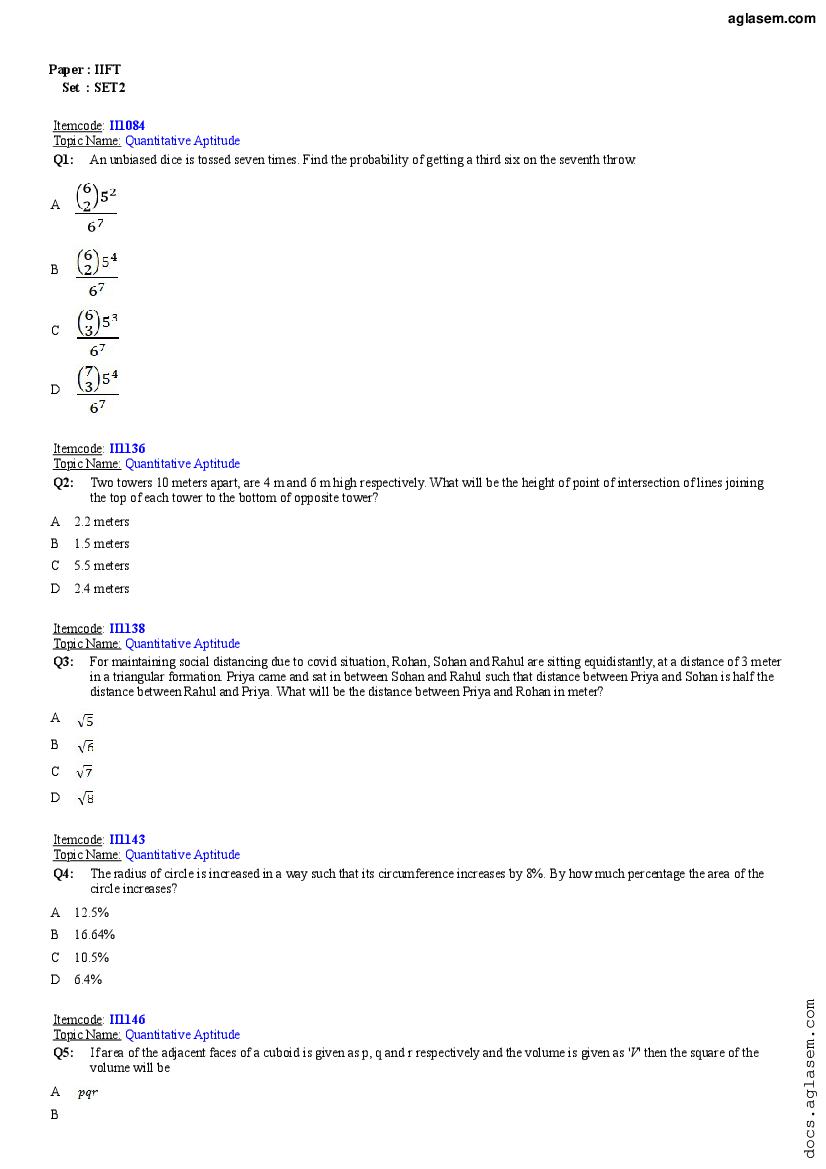
Page 1
Set : SET2
Itemcode: II1084
Topic Name: Quantitative Aptitude
Q1: An unbiased dice is tossed seven times. Find the probability of getting a third six on the seventh throw.
A
B
C
D
Itemcode: II1136
Topic Name: Quantitative Aptitude
Q2: Two towers 10 meters apart, are 4 m and 6 m high respectively. What will be the height of point of intersection of lines joining
the top of each tower to the bottom of opposite tower?
A 2.2 meters
B 1.5 meters
C 5.5 meters
D 2.4 meters
Itemcode: II1138
Topic Name: Quantitative Aptitude
Q3: For maintaining social distancing due to covid situation, Rohan, Sohan and Rahul are sitting equidistantly, at a distance of 3 meter
in a triangular formation. Priya came and sat in between Sohan and Rahul such that distance between Priya and Sohan is half the
distance between Rahul and Priya. What will be the distance between Priya and Rohan in meter?
A
B
C
D
Itemcode: II1143
Topic Name: Quantitative Aptitude
Q4: The radius of circle is increased in a way such that its circumference increases by 8%. By how much percentage the area of the
circle increases?
A 12.5%
B 16.64%
C 10.5%
D 6.4%
Itemcode: II1146
Topic Name: Quantitative Aptitude
Q5: If area of the adjacent faces of a cuboid is given as p, q and r respectively and the volume is given as 'V' then the square of the
volume will be
A
B
Page 2
D
Itemcode: II1147
Topic Name: Quantitative Aptitude
Q6: During a marriage ceremony in Panipat, two shots from the air rifle are fired from the same place at an interval of 10 minutes 42
seconds. A man sitting in the train which is approaching the place where the ceremony is being held, hears the second sound after
10 minutes of hearing the first one. Assuming speed of light to be 330 m/s, what could be the speed of the train?
A 20.1 m/s
B 12.4 m/s
C 23.1 m/s
D 30.1 m/s
Itemcode: II1148
Topic Name: Quantitative Aptitude
Q7: Rahul takes 4 days to finish one third of a job, Sohan takes 3 days to finish one sixth of the same work and Ram takes 5 days to
finish half the job. All 3 of them together work for 3 days after which Rahul and Ram leave the job. How long will it take for
Sohan to complete the remaining work?
A 6 days
B 8.1 days
C 5.1 days
D 7 days
Itemcode: II1149
Topic Name: Quantitative Aptitude
Q8: f(x) = , where y = f(x). Find the ratio of x to f(y).
A
B
C 1:2
D 1:1
Itemcode: II1150
Topic Name: Quantitative Aptitude
Q9: The rate at which coal is consumed by a RORO train, which is operated by Konkan Railways, fluctuates as the square of the
speed. It is given that coal consumption of this train is 1200 kg/hour when the speed is 40 km/hour. Konkan Railway bears the
cost of coal at the rate Rs. 16/100kg and all other expenses of running the RORO train costs Konkan Railways Rs. 13/hour. Find
the total cost in paise/km, for operating the RORO train when it is running at the speed of km/hour.
A
B
C
D
Itemcode: II1151
Topic Name: Quantitative Aptitude
Q10:
A
B
C
Page 3
Itemcode: II1152
Topic Name: Quantitative Aptitude
Q11: A shopkeeper marks up the price of the Toor dal by 20% and gives a discount of 10% to the customer. Besides, he also tricks 100
grams to his dealer and his customer respectively while buying or selling 1 kilogram of Toor dal. Find the profit percentage of the
shopkeeper.
A 22%
B 20%
C 32%
D 27%
Itemcode: II1153
Topic Name: Quantitative Aptitude
Q12: Same item is sold for Rs. 600 and Rs. 175, respectively. The profit earned on the first sale is 20 times the loss incurred on the
second sale. To make an overall profit of 30% in the whole transaction, at what price the second sale should happen:
A Rs. 310 approx
B Rs. 238 approx
C Rs. 254 approx
D Rs. 357 approx
Itemcode: II1154
Topic Name: Quantitative Aptitude
Q13: In a group of students, number of students drink only Fruit Juice, number of students drink only Coke. students drink
both Fruit Juice and Coke and the students who drink neither Fruit Juice nor Coke are . The number of students who drink
Coke may be
A 41 and 39
B 39 and 54
C 59 and 54
D 41 and 59
Itemcode: II1155
Topic Name: Quantitative Aptitude
Q14: A group of 78 people watch NDTV, Times Now and Republic. Out of these news channels, 36 watch NDTV, 48 watch Times
Now and 32 watches Republic. 14 people watch both NDTV and Times Now, 20 people watch both Times Now and Republic,
and 12 people watch both Republic and NDTV. Find the ratio of the number of people who watch only Times Now to the number
of people who watch only Republic.
A 9:4
B 13 : 21
C 11 : 4
D 17 : 4
Itemcode: II1156
Topic Name: Quantitative Aptitude
Q15: Find the set S that denotes the set of all values of " " for which the roots of the equation is greater
than 2.
A
B
C
D
Itemcode: II1157
Page 4
Q16: In the galaxy “Andromeda”, a planet named “Exo” has a city called “Azith”. The city has an alphabet system that consists of 48
letters and an octo-decimal number system (base -18). The registration number on the number plate of a vehicle in the city has
two parts. The first part is the alphabet part that consists of three letters and the second part is the number part that consists of 3
digits. The city administration issues all kinds of registration numbers with following restrictions:
a. The letters in the alphabet part are in ascending order and all letters must be distinct.
b. In the number part, the first digit is three more than the third digit.
Find the number of possible registration numbers available in the Azith city.
A 3353270
B 2557830
C 5339840
D 4669920
Itemcode: II1158
Topic Name: Quantitative Aptitude
Q17: There are 12 points in a two-dimensional plane with following coordinates: Points A, B, C, D, E, F, G have coordinates (1, 0), (2,
0), (3, 0), (4, 0), (5, 0), (6, 0) and (7, 0) respectively. Points H, I, J have coordinates (1, 1), (2, 2) and (3, 3) respectively. Points K,
L have coordinates (4, -2) and (5, -3) respectively. The number of circles possible with these points are?
A 179
B 158
C 168
D 147
Itemcode: II1159
Topic Name: Quantitative Aptitude
Q18:
The value of which satisfy is
A 2
B
C 4
D 8
Itemcode: II1160
Topic Name: Quantitative Aptitude
Q19:
A 61
B 71
C 81
D 91
Itemcode: II1161
Topic Name: Quantitative Aptitude
Q20:
A 1
B 1/2
C 1/3
D 2
Page 5
Topic Name: Quantitative Aptitude
Q21: A can was full of olive oil. Lata draws each time 20% of the volume from the can and replaces with groundnut oil. Usha draws
10% of the volume and replaces with mustard oil. Starting with Lata, both repeats the procedure alternatively two times each.
What is the ratio of olive oil, groundnut oil and mustard oil in the end?
A 7200 : 1800 : 1000
B 5184 : 3096 : 1720
C 5760 : 3440 : 800
D 5436 : 3284 : 1280
Itemcode: II1163
Topic Name: Quantitative Aptitude
Q22: “xyz” and “zyx” are three digit numbers where x, y, z are distinct digits from 0 to 9. Difference of xyz and zyx has a factor of 7.
What is the maximum possible value of the LCM of x, y and z?
A 126
B 72
C 90
D 56
Itemcode: II1164
Topic Name: Quantitative Aptitude
Q23:
A 4:1
B 2:1
C 3:1
D 5:1
Itemcode: II1165
Topic Name: Quantitative Aptitude
Q24:
A
B
C
D
Page 6
Topic Name: Quantitative Aptitude
Q25: Ishika speaks truth in 60% of cases and Mishika in 85% of cases. Ishika and Mishika agree in a statement. Find the probability
that the statement is true.
A 49/57
B 51/100
C 57/100
D 51/57
Itemcode: II1203
Topic Name: Reading Comprehension And Verbal Ability
Q26: Directions. From the sentences below, identify where comma(s) is/are missing and/or inappropriately used grammatically:
A. Don’t guess. Use a timer or watch.
B. Don’t guess, use a timer or watch.
C. The driver managed to escape from the vehicle before it sank and swam to the river-bank.
D. The driver managed to escape from the vehicle before it sank, and swam to the river-bank.
A B, C are incorrect
B B, D are incorrect
C A, C are incorrect
D Only B is incorrect
Itemcode: II1204
Topic Name: Reading Comprehension And Verbal Ability
Q27: Directions. From the sentences below, identify where comma(s) is/are missing and/or inappropriately used grammatically:
A. The convict said the judge “is mad”.
B. The convict, said the judge, is mad.
C. Leonara walked on her head, a little higher than usual.
D. Leonara walked on, her head a little higher than usual.
A B, D are incorrect
B A, C are incorrect
C A, D are incorrect
D Only A is incorrect
Itemcode: II1205
Topic Name: Reading Comprehension And Verbal Ability
Q28: Directions: Identify the option with the Incorrect usage of an apostrophe:
A It's got very cold outside
B Who's book is this?
C Jesus' disciples
D It needn't be a pane
Itemcode: II1206
Topic Name: Reading Comprehension And Verbal Ability
Q29: Directions. There are four sentences A, B, C, D where the underlined word is used either correctly or incorrectly. Choose the
option which lists all the sentences where the underlined word is used correctly in a sentence.
A. This person needs the counsel of a psychiatrist.
B. I'm a scientist and if I don't know an answer, I seek counsel from sharper brains.
C. Each of the brothers on the counsel was gifted in some way.
D. A similar counsel of moderation was given to the Canadian press in connexion with the Manitoba school question in
December 1897.
A Only A and C are correct
B A, B and D are correct
C Only C and D are correct
D Only B and D are correct
Itemcode: II1207
Page 7
Q30: Directions. There are four sentences A, B, C, D where the underlined word is used either correctly or incorrectly. Choose the
option which lists all the sentences where the underlined word is used correctly in a sentence.
A. Cassie drew her brows down to feign a stern expression.
B. Her heartbeat was feign and slow.
C. I wish you wouldn't feign illness on every first day of school.
D. My cousin would always feign excitement when we came to visit, but I knew she really didn't like sharing her room.
A Only B and D are correct
B Only A and D are correct
C Only C and D are correct
D A, C and D are correct
Itemcode: II1208
Topic Name: Reading Comprehension And Verbal Ability
Q31:
A H-I, F-II, B-III, C-IV
B C-II, F-III, A-IV, D-V
C B-III, A-IV, E-V, C-VI
D G-I, C-II, F-III, E-IV
Itemcode: II1209
Topic Name: Reading Comprehension And Verbal Ability
Q32:
A I-V, B-VI, H-VII, C-VIII
B E-VI, H-VII, D-VIII, B-IX
C I-V, H-VII, E-VIII, F-IX
D H-VI, E-VII, I-VIII, B-IX
Page 8
Topic Name: Reading Comprehension And Verbal Ability
Q33:
A A - II, B - III, C - I, D - IV
B A - III, B - IV, C - II, D - I
C A - I, B - II, C - III, D - IV
D A - II, B - IV, C - I, D - III
Itemcode: II1211
Topic Name: Reading Comprehension And Verbal Ability
Q34: Directions: From the options given below, identify best SYNONYMN for the word underlined:
According to Douglas Brinkley's Wheels for the World, Henry authorized $1.5 million in company funds for an inquiry of Lee's
professional and private life in 1975 to discredit him.
A Calumniate
B Ameliorate
C Castigate
D Delineate
Itemcode: II1212
Topic Name: Reading Comprehension And Verbal Ability
Q35: Direction: From the options given below, identify best SYNONYMN for the word underlined:
While automatic enrollment or "quick" enrollment makes the process of joining a retirement plan less daunting, expanding the
number of funds available to participants can have the opposite effect.
A Trivial
B Inviting
C Heartening
D Consternate
Itemcode: II1213
Topic Name: Reading Comprehension And Verbal Ability
Q36: Directions: Select the option with the incorrect spelling:
A Caboose
B Mercenary
C Lugbrious
D Puritanical
Itemcode: II1214
Topic Name: Reading Comprehension And Verbal Ability
Q37: Directions. Select the option with the incorrect spelling:
A Chicanery
B Modicum
C Exculpate
D Faxcile
Itemcode: II1215
Topic Name: Reading Comprehension And Verbal Ability
Page 9
A Insuinuate
B Sombre
C Interloper
D Gaffe
Itemcode: II1216
Topic Name: Reading Comprehension And Verbal Ability
Q39: Directions: Fill in the blank with appropriate preposition:
The birds alight ____ the roof of a temple.
A with
B for
C at
D on
Itemcode: II1217
Topic Name: Reading Comprehension And Verbal Ability
Q40: Directions: Fill in the blank with appropriate preposition:
The short story has great affinity _____ the novel.
A with
B between
C over
D on
Itemcode: II1218
Topic Name: Reading Comprehension And Verbal Ability
Q41: Directions: Fill in the blank with appropriate preposition:
I have a great antipathy ____ meat.
A against
B to
C on
D over
Itemcode: II1219
Topic Name: Reading Comprehension And Verbal Ability
Q42: Directions: A little change or alteration in usage of the article/helping verb may change meaning of a sentence. Below given are
the sentences along with their meanings; identify the expressions with the correct meaning and choose the right option:
I. Go to sea - become a sailor
II. Go to the sea - go on a voyage
III. Go to bed - go to the place where the bed is
IV. Go to the bed - go to sleep
A Only I and III are correct
B Only II and IV are correct
C Only I and II are correct
D Only II and III are correct
Itemcode: II1220
Topic Name: Reading Comprehension And Verbal Ability
Q43: Directions: A little change or alteration in usage of the article/helping verb may change meaning of a sentence. Below given are
the sentences along with their meanings; identify the expressions with the correct meaning and choose the right option:
I. Little hope of success – no hope
II. A little hope of success – some hope at least
III. A neighbor to one – living near one
IV. Neighbor to one – kind to one
A Only I and II are correct
B Only III and IV are correct
Page 10
D All I, II, III and IV are correct
Itemcode: II1221
Topic Name: Reading Comprehension And Verbal Ability
Q44: Directions: A little change or alteration in usage of the article/helping verb may change meaning of a sentence. Below given are
the sentences along with their meanings; identify the expressions with the correct meaning and choose the right option:
I. The jury was – the members of the jury taken individually
II. The jury were – the members of the jury taken as a whole
III. Dead in sin – great sinner
IV. Dead to sin – free from sin
A Only I and II are correct
B Only II and III are correct
C Only I and IV are correct
D Only III and IV are correct
Passage:
Passage I
Qualitative research methods are often mischaracterized by advocates, users, and critics alike because too often the reflexive, iterative,
and flexible methods are misunderstood as 'just making do.' There is a good pragmatic tradition of "making do," from Dewey to the
present, that describes the necessities as well as virtues of using what situations provide in their immediacy as the grounds of social
action. While qualitative research certainly shares some of this pragmatic bricolage, good research, qualitative as well as quantitative, is
designed as well as improvised. One of the merits of qualitative research is its particular openness to serendipitous invention; one of its
failures, however, has been an unwillingness, or inability, on the part of its practitioners, until recently, to specify how that openness to
'what situations make available' can be both systematic and creative.
Over the years I have probably reviewed hundreds of research proposals; too large a number of these claimed that because the
researcher was doing a qualitative study, the kinds of data and forms of collection could not be specified in advance. I was always a bit
embarrassed by this, feeling let down by my side. It sometimes seemed as if our teaching of qualitative research was creating a mystical
religion, a set of our own unexamined fetishes just at the moment we set about to identify others' taken for granted assumptions and
social meanings. In this vein, some years ago I heard a colleague advise a student going out to do field work for the first time "to be like
a blank slate," "just tell me everything you see and hear, write it all down." The student was completely baffled and clearly at a loss
about what to do, to do first, or second, or how to begin. What would constitute telling me all you see and hear. Importantly, the student
had read a lot of sociology, and knew a lot about signs and signifiers, latent as well as manifest patterns in social relations. She knew
that competent social actors are not blank slates. She felt incompetent but not entirely blank. She had a project, after all.
It seemed from the proposals I read and the conversations I observed that we, qualitative sociologists, believed that we could not specify
what we were going to do (i.e. lay out a design and plan of the research), because that would mean that we would have -- by that naming
-- necessarily circumscribed what we would do. Having supposedly controlled a priori what we would do, we would be unable to do
something else along the way, as the situations and insights invited. We would have lost the distinctive virtues of qualitative research.
Somehow, in this mysticism about qualitative methods, research designs seemed to be understood as enforceable contracts or sets of
machine instructions; any deviation from the design was understood to be either impossible, a failure, or a mistake. Qualitative research
was celebrated for its flexibility, the temporal coincidence of collection and analysis and thus prior design was, by definition, a threat to
qualitative research.
Of course, I have overstated the issue but we were asked to provide fodder for discussion. And, to some extent, this overstatement puts
the issue in a bold form. Why should qualitative research be any less well designed (or specified) than quantitative research? When I
think about the steps in different methods, it occurs to me that most of what gets put into a research design, let us say for a survey
project or quantitative research, could also be put in the design for an ethnography or a project of in-depth-interviewing and narrative
analysis. The major differences lie in the fact that qualitative projects (1) will not rely on statistical analyses and therefore do not need to
produce probability samples and standardized collection instruments at the same temporal pace and placement in the research process.
As a consequence of temporal pace and sequencing, qualitative projects (2) will be able to adjust the forms of data, modes and cites of
collection in response to the ongoing processes of analysis and interpretation. This is certainly so. I suspect, however, that the resistance
to detailed research qualitative research designs derives less, however, from emphasis on these key differences than from an overly
idealized or reified view of how other forms of research proceed, whether quantitative sociology or chemistry or biology. That is, all
research develops (is in the making and rethinking) throughout the stages of design, collection, and analysis. Almost all research
produces much that was unanticipated and therefore had to be responded to with adjustments along the way. The central difference lies
in the explicit weight of recognition of and preparation for this process of adjustment in most qualitative projects. Nothing precludes a
preliminary design that sets the researcher on a path that is understood as a first approximation of the work process.
I should say before going much further that there are varieties of qualitative research and my remarks will not appropriately characterize
all. For the moment, I am referring primarily to ethnographic fieldwork (i.e. research study looking at the social interaction of users in a
given environment), participant observation, in-depth open ended interviewing, and other work involving interpretative qualitative
analysis of documents of various sorts. Thus, the mode of analysis rather than the type of data more appropriately describes work as
qualitative. (The content of documents and interviews can be analysed quantitatively or qualitatively. Observations can be systematically
structured and quantified but much observation is not, nor would be productive.)
The goal of research is to produce results that can be falsifiable and in some way affirmable by rational processes of actors other than
the author. Most important is that the researcher provide an account of how the conclusions were reached, why the reader should believe
the claims and how one might go about trying to produce a similar account. What makes science morally, and rationally, compelling is
that it is a public enterprise. I am not referring to the funding or organizational supports. Rather, science is distinguished by the claim to
produce shared understanding/knowledge through modes that can be rationally and collectively apprehended. In short, we have an
obligation not to "hide the ball." To the extent that we do "hide the ball," we transform our science into rhetorical performance.
Page 11
Topic Name: Reading Comprehension And Verbal Ability
Q45: Which of the following is incorrect:
Participant observation and in-depth open ended interviewing can be analysed both qualitatively and quantitatively but analysing
A
observations using quantitative techniques wouldn't be as much productive.
The varieties of research that require interpretative qualitative analysis of data is what qualifies the work to be classified as
B
qualitative.
C Due to their reflexive, iterative, and flexible nature, the qualitative research methods should not be specified in advance.
Controlling a priori what the researcher would do does not cause the distinctive virtues associated with qualitative research to be
D
lost.
Itemcode: II1167
Topic Name: Reading Comprehension And Verbal Ability
Q46: According to the passage, which of the following is incorrect about qualitative research design:
The only difference between qualitative and quantitative research is that the latter relies on statistical analyses and therefore needs
A
to produce probability samples and standardized collection instruments.
Because qualitative analysis does not rely on statistical analyses, it does not need to produce probability samples and standardized
B
collection instruments at the same temporal pace and placement in the research process as quantitative research.
All research, including quantitative sociology or chemistry or biology develops throughout the stages of design, collection, and
C analysis and produces much that was unanticipated and therefore has to be responded to with adjustments along the way, however,
qualitative research requires explicit weight of recognition of and preparation for this process of adjustment.
While qualitative projects require a preliminary design similar to the other forms of research, however, the former requires an
D
explicit weight of recognition of and preparation for this process of adjustment.
Itemcode: II1168
Topic Name: Reading Comprehension And Verbal Ability
Q47: "The goal of research is ...... other than the author" (last para) from the passage can be best explained as:
A The goal of research is to produce results that are able to be proved to be false.
The goal of research is to produce outcomes that are able to be contradicted by evidence, and that it is there for others to approve
B
or disapprove that researcher's conclusions follow from the collected/empirical data/observations.
Researchers should produce results that can be contradicted if the experimental observations come to light that disprove the
C
outcomes.
The goal of research is to arrive at the conclusions and make claims to knowledge through the application of science, i.e. the
D
collection of facts.
Itemcode: II1169
Topic Name: Reading Comprehension And Verbal Ability
Q48: Which of the following can be inferred from the passage:
Qualitative research that specifies a priori the design and plan of research can be both systematic and creative and requires
A
application of science for producing a shared understanding.
B Kinds of data and forms of collection for qualitative research could be very much specified in advance.
Deviations from the design already laid out for qualitative research would be considered either impossible, or a failure, or mistake
C
because research designs once specified are understood as enforceable contracts.
D Scientific qualitative research should make visible to others how researcher knows what he or she is claiming to know.
Itemcode: II1170
Topic Name: Reading Comprehension And Verbal Ability
Q49: Match List I with List II
Choose the correct answer from the options given below:
A A - iv, B - iii, C - i, D - ii
Page 12
C A - ii, B - i, C - iii, D - iv
D A - i, B - iv, C - ii, D - iii
Passage:
Passage II
Sociologist Matthews writes that Let's say someone writes an academic paper quoting fifty people who have worked on the subject and
provided background materials for his study; assume, for the sake of simplicity, that all fifty are of equal merit. Another researcher
working on the exact same subject will randomly cite three of those fifty in his bibliography. Merton showed that many academics cite
references without having read the original work; rather, they'll read a paper and draw their own citations from among its sources. So a
third researcher reading the second article selects three of the previously referenced authors for his citations. These three authors will
receive cumulatively more and more attention as their names become associated more tightly with the subject at hand. The difference
between the winning three and the other members of the original cohort is mostly luck: they were initially chosen not for their greater
skill, but simply for the way their names appeared in the prior bibliography. Thanks to their reputations, these successful academics will
go on writing papers and their work will be easily accepted for publication. It is easier for the rich to get richer, for the famous to
become more famous. This theory can easily apply to companies, businessmen, actors, writers, and anyone else who benefits from past
success.
During the 1940s, a Harvard linguist, George Zipf, examined the properties of language and came up with an empirical regularity now
known as Zipf's law, which, of course, is not a law (and if it were, it would not be Zipf's). It is just another way to think about the
process of inequality. The mechanisms he described were as follows: the more you use a word, the less effortful you will find it to use
that word again, so you borrow words from your private dictionary in proportion to their past use. This explains why out of the sixty
thousand main words in English, only a few hundred constitute the bulk of what is used in writings, and even fewer appear regularly in
conversation. Likewise, the more people aggregate in a particular city, the more likely a stranger will be to pick that city as his
destination. The big get bigger and the small stay small, or get relatively smaller. A great illustration of preferential attachment can be
seen in the mushrooming use of English as a lingua franca—though not for its intrinsic qualities, but because people need to use one
single language, or stick to one as much as possible, when they are having a conversation. So whatever language appears to have the
upper hand will suddenly draw people in droves; its usage will spread like an epidemic, and other languages will be rapidly dislodged. I
am often amazed to listen to conversations between people from two neighboring countries, say, between a Turk and an Iranian, or a
Lebanese and a Cypriot, communicating in bad English, moving their hands for emphasis, searching for these words that come out of
their throats at the cost of great physical effort. Even members of the Swiss Army use English (not French) as a lingua franca (it would
be fun to listen). Consider that a very small minority of Americans of northern European descent is from England; traditionally the
preponderant ethnic groups are of German, Irish, Dutch, French, and other northern European extraction. Yet because all these groups
now use English as their main tongue, they have to study the roots of their adoptive tongue and develop a cultural association with parts
of a particular wet island, along with its history, its traditions, and its customs!
Itemcode: II1171
Topic Name: Reading Comprehension And Verbal Ability
Q50: What is the appropriate meaning of 'lingua franca'?
A Foreign language unable to dislodge other languages.
B Common language among people of diverse speech.
C Language used in scientific writings.
D Language spoken in France.
Itemcode: II1172
Topic Name: Reading Comprehension And Verbal Ability
Q51: Which of the following statement is TRUE?
A Matthews talked about randomness but Zipf talked about careful choice.
B Zipf had presented Matthews' work parsimoniously.
C Both Matthews and Zipf have discussed about ubiquitous application of scientific language.
D Both Matthews and Zipf have discussed about preferential attachment.
Itemcode: II1173
Topic Name: Reading Comprehension And Verbal Ability
Q52: Which of the following statement is CORRECT?
A The passage deals with mnemonics.
B The passage deals with contradiction in ideas suggested by the two linguists.
C The passage illustrates how initial advantage follows throughout the life.
D The passage establishes the idea of supremacy of English over other languages.
Passage:
Page 13
How is it that people come to use certain nonverbal behaviours in specific settings, or associate a particular behaviour (e.g., smiling)
with a particular meaning (e.g., happiness)? A sociocultural approach to answering these questions focuses on the ways in which
behaviours and their meanings are prescribed at social or cultural levels and on the ways in which people come to acquire them.
Encompassing a number of models and theories, the sociocultural paradigm emphasizes the influence of human interaction in creating
and transmitting understanding; thus, it highlights the effects of culture, class, religion, sexuality, power, or other socially maintained
factors on the enactment and meaning of behaviour.
The fundamental assumption underlying the sociocultural paradigm is that interpersonal behaviour and its meanings are learned through
the diffusion of social or cultural knowledge and are, therefore, malleable. Because interpersonal behaviours are learned rather than
innate, both behaviours and their meanings can be altered by changing the knowledge that is conveyed. This can explain, for instance,
not only why cultures vary one from another in both their behaviours and the meanings of those behaviours, but also why, without
access to another culture’s knowledge, people often find cross-cultural communication so challenging.
Central to the sociocultural paradigm, then, are two ideas: i) Most nonverbal communication is learned, rather than innate, and, ii) Most
non-verbal behaviours do not have inherent meanings, but rather, their meanings are products of social consensus. These principles have
found widespread acceptance within the field of human communication, perhaps, in part, because of their considerable intuitive appeal.
It is easy to identify examples of behavioural learning simply by considering the apparent influence of parents, teachers, gender roles,
cultural norms, and the media on children’s behaviours. Consequently, the paradigm seems to have face validity as an approach that is
isomorphic with people’s everyday experiences.
A related strength of the sociocultural paradigm is found in the magnitude of the empirical evidence that has been marshalled in support
of it. Perhaps as a result of its intuitive appeal, many researchers have applied the tenets of the paradigm to their own work and have
found support for the influence of learning, or for the social embeddedness of meaning, across a wide range of topics, ranging from
personality development and child discipline, to gender role acquisition, doctor–patient communication, and the relational messages of
nonverbal behaviours.
One potential criticism of the sociocultural paradigm is that its emphasis on the social influences on learning behaviour and creating
meaning obscures what may be substantial non-social influences on the same outcomes, including the influence of genetics. Certainly,
any paradigm will lead its proponents to attend to particular variables more than others; the problem lies in the potential to misinterpret
genetic effects, for instance, as the effects of learning or socialization. An important example derives from the study of parental
influence on child personality development. As Harris (1998) noted in her detailed review, there is no shortage of social science research
showing that children are more likely than not to grow up with personalities similar to those of their parents. That is, pleasant,
affectionate parents tend to rear pleasant, affectionate children, whereas aggressive, violent parents tend to rear children who are
likewise aggressive and violent. Working from the framework of the sociocultural paradigm, one would find little difficulty explaining
these robust patterns as products of socialization: children observe their parents behaving in a pleasant, affectionate manner and come to
adopt the same disposition themselves. However, as Harris (1995) pointed out, much of the research examining parental-offspring
congruence in disposition has failed to control for an important alternative hypothesis: children are similar to their parents because of
their genetic relatedness to the parents, not because of how they were socialized. To the extent that researchers in this area have failed to
entertain (and, consequently, to control for) such an alternative, therefore, they may run the risk of misattributing—or at least,
overattributing—the observed similarity between parents and children to a social influence, when a non-social influence is also
operative.
Itemcode: II1174
Topic Name: Reading Comprehension And Verbal Ability
Q53: Find out the incorrect statement:
A Human interaction is responsible for the enactment and meaning of behaviour through creating and transmitting understanding.
B Culture, class, religion, sexuality, power, or other socially maintained factors influence human interactions.
C Nonverbal behaviours do not have inherent meanings but, instead, acquire their meanings through social consensus.
Because nonverbal communication is learned rather than innate, both behaviours and their meanings can be altered by changing
D
the knowledge that is conveyed.
Itemcode: II1175
Topic Name: Reading Comprehension And Verbal Ability
Q54: Which of the following cannot be implied from "This can explain, for instance, not only ...... people often find cross-cultural
communication so challenging" (2nd para) in the passage:
A The same behaviour can vary in meaning from one social or cultural group to another.
B There are consensually recognized meanings for nonverbal behaviour within a given cultural community.
All receivers and observers of a specified behaviour within a community attribute fairly consistent meanings to that behaviour
C
making cross-cultural communication challenging.
Meanings of behaviours are located within the particular individuals and interactions from whence they originate, making the
D
cross cultural communication challenging.
Itemcode: II1176
Topic Name: Reading Comprehension And Verbal Ability
Q55: Which of the following is not true about the criticisms of sociocultural paradigm explained in passage:
A Learning behaviour and creating meaning can be attributed to certain variables other than the social influences.
B The research examining parental-offspring congruence in dispositions overattributes the similarity to social influences.
Page 14
may run the risk of misattributing-or at least, overattributing-the observed similarity between parents and children to a social
influence.
Rather than the social influences, non-social influences such as genetics can also help explain why children are more likely to
D
grow up with personalities similar to those of their parents.
Itemcode: II1177
Topic Name: Reading Comprehension And Verbal Ability
Q56: Identify the most suitable title for this passage:
A The Sociocultural Paradigm, Genetics and the Non-verbal Behaviours
B The Sociocultural Paradigm: A Summary
C The Sociocultural Paradigm and Non-social Influences
D The Sociocultural Paradigm: An Explanation and Critique
Passage:
Read the following passage:
The ùber philosopher Bertrand Russell presents a particularly toxic variant of my surprise jolt in his illustration of what people in his
line of business call the Problem of Induction or Problem of Inductive Knowledge—certainly the mother of all problems in life.
Consider a turkey that is fed every day. Every single feeding will firm up the bird's belief that it is the general rule of life to be fed every
day by friendly members of the human race "looking out for its best interests," as a politician would say. On the afternoon of the
Wednesday before Thanksgiving, something unexpected will happen to the turkey. It will incur a revision of belief.
What can a turkey learn about what is in store for it tomorrow from the events of yesterday? A lot, perhaps, but certainly a little less
than it thinks, and it is just that "little less" that may make all the difference. The turkey problem can be generalized to any situation
where the same hand that feeds you can be the one that wrings your neck.
Let us go one step further and consider induction's most worrisome aspect: learning backward. Consider that the turkey's experience
may have, rather than no value, a negative value. It learned from observation, as we are all advised to do (hey, after all, this is what is
believed to be the scientific method). Its confidence increased as the number of friendly feedings grew, and it felt increasingly safe even
though the slaughter was more and more imminent. Consider that the feeling of safety reached its maximum when the risk was at the
highest! But the problem is even more general than that; it strikes at the nature of empirical knowledge itself. Something has worked in
the past, until—well, it unexpectedly no longer does, and what we have learned from the past turns out to be at best irrelevant or false, at
worst viciously misleading.
FIGURE 1: ONE THOUSAND AND ONE DAYS OF HISTORY
A turkey before and after Thanksgiving.
It would appear to a quoting dilettante—i.e., one of those writers and scholars who fill up their texts with phrases from some dead
authority—that, as phrased by Hobbes, "from like antecedents flow like consequents." Those who believe in the unconditional benefits
of past experience should consider this pearl of wisdom allegedly voiced by a famous ship's captain:
But in all my experience, I have never been in any accident. . . of any sort worth speaking about. I have seen but one vessel in distress in
all my years at sea. I never saw a wreck and never have been wrecked nor was I ever in any predicament that threatened to end in
disaster of any sort.
E. J . Smith, 1907, Captain, RMS Titanic
Captain Smith's ship sank in 1912 in what became the most talked-about shipwreck in history.
Itemcode: II1178
Page 15
Q57: What is the central idea of the passage?
A Foible scientific ideas / frameworks must be discarded in case of human/animal behavior.
B Unpredictability is embedded in human nature.
C Cognitive dissonance makes us blind towards objective reality.
D A big change takes place that is completely unprepared for by the past.
Itemcode: II1179
Topic Name: Reading Comprehension And Verbal Ability
Q58: What does the figure convey?
A
B
C
D
Itemcode: II1180
Topic Name: Reading Comprehension And Verbal Ability
Q59: Identify the INCORRECT idiom:
A Like a dying turkey in a thunderstorm.
B Go cold turkey.
C Talk turkey.
D Like turkey's voting for Christmas.
Itemcode: II1181
Topic Name: Reading Comprehension And Verbal Ability
Q60: Which of the following is a CORRET statement?
A The passage deals with the issue of trust in politics.
B The passage deals with the importance of counterintuitive evidence.
C The passage deals with the issues of animal psychology.
D The passage deals with popcorning issues at animal farm.
Itemcode: II1078
Topic Name: Data Interpretation And Logical Reasoning
Q61: A word arrangement, when rearranged by given input follow a particular rule/logic in each step. Following is an example of input
and rearrangement. Study that rule/logic and apply on given problem.
INPUT: man’s mood varies with time and environment
Steps/Results:
I. Varies with man’s mood environment and time
II. And time environment mood man’s varies with
III. Environment time and varies with mood man’s
IV. And varies environment time man’s mood with
If Step IV reads, 'everyone was aware about their beautiful friendship', what will be the three middle words of Step II?
A their beautiful aware
B aware beautiful their
C everyone were friendship
D aware were beautiful
Itemcode: II1082
Topic Name: Data Interpretation And Logical Reasoning
Q62: Complete the following sequence:
Page 16
A 12772
B 21264
C 21512
D 18876
Passage:
Read the following passage:
Directions: The Table gives the data for the Currency exchange rates and Stock market Indexes. Any person in any country can invest in
any market or currency. For investing in a country one has to use home currency of that country. One can either invest or withdraw on
1st of each month only.
Note: The closing price of currency and Index of a month is same as opening price of the first day of the next month
Itemcode: II1011
Topic Name: Data Interpretation And Logical Reasoning
Q63: If an Indian has invested Rs.93, 000 in UK Stock Market in January 2019 then in which month his/her portfolio has declined by
maximum percentage in rupee terms?
A April 2019
B May 2019
C June 2019
D July 2019
Itemcode: II1017
Topic Name: Data Interpretation And Logical Reasoning
Q64: If an Indian has invested Rs. 100,000 in 1st January 2019 till 1st January 2020, then which option is best for her?
A Depositing in an Indian bank at 9% per annum
B Investment in Indian Stock Market
C Investment in USA Stock Market
D Investment in UK Stock Market
Itemcode: II1018
Topic Name: Data Interpretation And Logical Reasoning
Q65: If a person from USA Invest $1500 in Indian stock market in 1st February then, on which of the following date investment
reaches a maximum value in Dollar terms?
A 1st May 2019
B 1st June 2019
C 1st October 2019
D 1st December 2019
Itemcode: II1021
Topic Name: Data Interpretation And Logical Reasoning
Q66: If a person from India Invest Rs. 108,000 in US stock market in the month of January 2019 then, on which one of the following
dates the investment reaches minimum value in rupee terms?
Page 17
B 1st June 2019
C 1st October 2019
D 1st November 2019
Passage:
Read the following passage:
Below tables give production and sales data for 4 different categories of vehicles, in last 6 years. In any category, if the production is
less than domestic sales and exports then they are imported. If the production is in excess of domestic sales and exports then they are
stocked up (inventory is created) to be used in the subsequent years. There was no inventory at the beginning of year 2014-15.
Itemcode: II1024
Topic Name: Data Interpretation And Logical Reasoning
Q67: How many vehicles were imported in year 2017-18?
A 76
B 59
C 0
D 64
Itemcode: II1028
Topic Name: Data Interpretation And Logical Reasoning
Q68: How many two wheelers were in Inventory by the end of 2019 -20?
A 98
B 0
C 198
D 281
Itemcode: II1030
Topic Name: Data Interpretation And Logical Reasoning
Q69: In which year import of number of vehicles is highest?
A 2015-16
B 2016-17
C 2017-18
D 2018-19
Itemcode: II1032
Topic Name: Data Interpretation And Logical Reasoning
Q70: In which of the following year inventory has maximum number of different categories?
A 2014-15
B 2015-16
C 2016-17
D 2018-19
Page 18
Read the following passage:
ABC Ltd is a beverages company which markets and sells six products (Product 1 to Product 6) in Tier-I cities of India. The sales are
managed by a team of five sales managers (Raj, Roy, Ravi, James and Rishab) who report to Assistant Vice President of Sales. Each
sales manager manages a separate territory. They are given half yearly product-wise target and rewarded with gold points for good
performance or penalized with red points for underperformance. They are assessed for each product separately. They earn one gold point
if performance for a product is equal to or more than 100% but less than 150%. They earn one more gold point if performance is equal
to or more than 150%. These points are considered for promotion. If they earn gold points in two or more products, they get one extra
bonus gold point. In case they underperform in a product (i.e. less than 100%), one gold point is deducted provided they have earned
through performance in any other product/products but in case they have not earned any gold point they are given a red point. Hence, at
the end of assessment, each sales manager can have either gold points or red points, depending on their performance and penalties in six
products.
Performance of Manager for a Product (%) = X 100
Revenue targets and achievements for the period January – June 2020 are given below.
Itemcode: II1033
Topic Name: Data Interpretation And Logical Reasoning
Q71: For which of the following manager –product combination, the performance is closest to 100% ?
A Raj-Product3
B Raj – Product 4
C Ravi- Product 1
D Rishab- Product 2
Itemcode: II1039
Topic Name: Data Interpretation And Logical Reasoning
Q72: Who among the following managers has overall average performance closest to 100%?
A Raj
B Roy
C James
D Rishab
Itemcode: II1041
Topic Name: Data Interpretation And Logical Reasoning
Q73: How many managers have performance greater than 150 percent in one or more products?
A 2
B 3
C 4
D 6
Itemcode: II1043
Topic Name: Data Interpretation And Logical Reasoning
Page 19
A 1
B 2
C 3
D 4
Passage:
Read the following passage:
DTechno, a small firm, has eight employees (Employee IDs 1001 to 1008) working in three departments (Department A, Department B
and Department C) who are involved in various planning and execution processes of the firm. Department C has more employees than
other two departments. Most of these employees are involved in both, planning and execution processes, whereas remaining employees
are involved in either planning or execution processes only. Employees are rated for their performance using six Key Performance
Indicators (KPI), three indicators for performance in three planning processes (Planning KPI1 to Planning KPI3) and three indicators for
performance in execution processes (ExecutionKPI1 to ExecutionKPI3). Rating varies from zero to ten where ten indicates best
performance (Fig A and Fig B). Planning Average Rating is derived as average of all three Planning KPI Ratings and Execution Average
Rating is average of all three Execution KPI Ratings (Fig C). Final Weighted Rating is weighted sum of Planning Average Rating and
Execution Average Rating. Each department uses its own weightages for planning and execution KPIs to calculate Final Weighted
Rating . One of the departments gives 40% weightage to Planning Average Rating & 60% to Execution Average Rating, second
department gives 30% & 70% and third department gives 80% & 20%. Final Weighted Rating of all employees is shown in Fig.D
Page 20
Topic Name: Data Interpretation And Logical Reasoning
Q75: How many employees have got zero rating in any of their six KPI Ratings?
A 1
B 3
C 4
D 6
Page 21
Topic Name: Data Interpretation And Logical Reasoning
Q76: Who among the following employees is working in Department C?
A 1001
B 1003
C 1004
D 1005
Itemcode: II1050
Topic Name: Data Interpretation And Logical Reasoning
Q77: How many employees are managing all the six process (three processes of Planning and three processes of Execution)? Hence,
they have been rated for all six process KPIs.
A 2
B 3
C 4
D 5
Itemcode: II1051
Topic Name: Data Interpretation And Logical Reasoning
Q78: Who among the following are working in same department?
A 1001 and 1007
B 1002 and 1008
C 1006 and 1008
D 1004 and 1005
Passage:
Based on the information answer the questions which follow.
In a toy shop, there are 5 toys, Doll, Teddy Bear, Remote Car, Board Game and an Airplane. The cost price and selling price are among
₹ 950, ₹ 1000, ₹ 1050, ₹1150 and ₹ 1200. The selling prices are different for all toys, and cost prices are different for all toys. The cost
price of Remote Car is equal to the selling price of Airplane and on the sale of both the shop incurred a loss. On selling Teddy Bear the
shop earned a profit. The profit earned by selling any article is more than ₹ 50 and the profit is not same for any product. Similarly, the
loss incurred for any two products are not same. The toy shop earned a profit on only 2 products. It is also known that the Cost Price of
the Board Game is lowest while the selling price of Teddy Bear is ₹1150. The Profit/Loss made on selling Doll and Teddy Bear are
equal in absolute terms.
Itemcode: II1053
Topic Name: Data Interpretation And Logical Reasoning
Q79: What is the selling price of Remote Car?
A 1150
B 950
C 1200
D 1000
Itemcode: II1060
Topic Name: Data Interpretation And Logical Reasoning
Q80: What is the difference between the cost price and selling price of Board Game?
A 250
B 200
C 100
D 150
Itemcode: II1061
Topic Name: Data Interpretation And Logical Reasoning
Q81: Which article has a selling price of ₹1050?
A Teddy Bear
Page 22
C Airplane
D Board Game
Itemcode: II1062
Topic Name: Data Interpretation And Logical Reasoning
Q82: Which statement is true?
A Selling Price of Board Game is ₹1050
B Profit made by selling a doll is ₹100
C The cost price of Airplane is equal to selling price of Board Game
D The profit made by selling Board Game is equal to loss made by selling Airplane.
Passage:
Read the following passage:
In a B-school admission, a candidate is selected based on an entrance exam score and weightage to graduation stream and gender.
Selection is also based on interview. There are 6 graduation streams namely, MBBS, Law, Economics, Fashion Technology, CA and
Engineering, which are given different weights with a difference of 5 each by the B-school. Silos were created for 10 candidates P, Q, R
,S, T, U, V, W, X and Y to assess their scores and out of 10 candidates, 7 were selected for admission. In a silo not more than 2
candidates are from the same stream. No candidate was selected from Law stream and the final score of each candidate is same as the
weightage for the graduation stream. Some more details provided are as follows:
(i). In the silo there are 6 females and 4 males, out of which 4 females and 3 males were selected. One female and one male from the
lowest weightage stream were selected with a score of 60.
(ii). Fashion Technology is the stream with highest weightage with only one candidate who is also selected from this stream. R is a male,
the only candidate from MBBS and not from the lowest scoring stream, while Q a female is from engineering and is selected.
(iii). CA has a score of 70 in which 2 candidates appeared but only one female was selected.
(iv). T is from Fashion Technology while P is an engineer. V is an unselected male while U scored 65 and is from Economics. 2
candidates from Economics were selected.
(v). W is a selected CA and X and Y are not from the same stream. Y scores 80 while S scores 65.
Itemcode: II1064
Topic Name: Data Interpretation And Logical Reasoning
Q83: In how many streams were both the appearing candidates selected?
A 1
B 2
C 3
D 4
Itemcode: II1067
Topic Name: Data Interpretation And Logical Reasoning
Q84: Which statement is always true?
A S is a selected female
B U is a male candidate from Economics
C X is an unselected female candidate from CA stream
D P is a selected female with score 60
Itemcode: II1068
Topic Name: Data Interpretation And Logical Reasoning
Q85: What is the maximum possible difference in the scores of the highest scoring selected female candidate and lowest scoring
male candidate?
A 30
B 20
C 25
D 35
Itemcode: II1069
Topic Name: Data Interpretation And Logical Reasoning
Q86: If out of 3 selected males, the highest scoring male withdraws admission, then a male from the waiting list is selected. In the
Page 23
A Law
B CA
C Engineering
D MBBS
Passage:
Read the following passage:
Four colleagues A,B,C and D during lunch time which is from 1:00 – 1:30 pm on a given day go for a walk through 2 different routes
i.e. they exit from one gate and enter from the other one. A straight path, within the office, connects Gates 1 and 2. A and B exit from
Gate 1 and enter from Gate 2, and again move towards Gate 1 using the straight path; while C and D exit from Gate 2 and enter from
Gate 1, and again move towards Gate 2 using the straight path. The routes are in clockwise direction i.e. Gate1 to Gate 2 a person can
only walk in clockwise direction and similarly from Gate 2 to Gate 1. It takes 4 minutes to walk from Gate 1 exit to Gate 2 entrance and
6 minutes to walk from Gate 2 exit to Gate 1 entrance. The time taken to walk from Gate 1 to Gate 2 and vice versa within the office is 1
minute. Initially, the colleagues leave at a gap of 2 minutes each in the order of B, A, C and D during lunch time. Each person starts the
next round of walk immediately after completing the first round.
Itemcode: II1071
Topic Name: Data Interpretation And Logical Reasoning
Q87: If A leaves from Gate 1 at 1:02 pm, when will A leave for his third round?
A 1:16 pm
B 1:12 pm
C 1:18 pm
D 1:24 pm
Itemcode: II1075
Topic Name: Data Interpretation And Logical Reasoning
Q88: If D leaves Gate 2 at 1:15 pm, following the same sequence as stated in the passage, then which of the two colleagues will meet
at Gate 2 before 1:30 pm?
A A and B
B C and A
C D and A
D B and D
Passage:
Read the following passage:
On a picnic trip of a company, 3 hotels Trident, Hilton and Park were booked for 90 employees. 6 of the employees were willing to stay
at any hotel. 12 wanted to stay in only Trident. 18 wanted to stay in only Park. Only Hilton had two times the employees as there were
in Trident and Park only. Only Hilton and Park had three less than only Trident and Hilton. Also not more than 7 employees can stay in
only Trident and Hilton.
Itemcode: II1079
Topic Name: Data Interpretation And Logical Reasoning
Q89: How many employees can stay in Hilton?
A 47
B 44
C 45
D 46
Itemcode: II1081
Topic Name: Data Interpretation And Logical Reasoning
Q90: How many employees can stay in Trident and Hilton only?
A 4
B 6
C 7
D 5
Page 24
Topic Name: General Awareness
Q91: Identify the correct statement:
I. Barcelona, Spain is scheduled to host next summer Olympics in 2022.
II. Byjus has acquired Great Learning.
III. Mr Ajay Tyagi is the Chairman of SEBI.
IV. Mirabai Chanu won a Bronze Medal in Weightlifting at Tokyo Olympics.
A Only II & III are correct
B Only IV is correct
C Only I is correct
D Only I & III are correct
Itemcode: II1183
Topic Name: General Awareness
Q92: Which court is the oldest high court in India?
A Calcutta High Court
B Madras High Court
C Bombay High Court
D Delhi High Court
Itemcode: II1184
Topic Name: General Awareness
Q93: What is the name of India’s operation of evacuating its citizens from war-torn Afghanistan?
A Operation Safed Sagar
B Operation Raahat
C Operation Surya Hope
D Operation Devi Shakti
Itemcode: II1185
Topic Name: General Awareness
Q94: The Kashi-Vishwanath corridor will connect:
A Man Mandir and Darbhanga Ghat to Ramnagar Fort
B Dashashwamedh and Kedar Ghat to the Sita Samahit Sthal
C Panchganga and Scindia Ghat to Dhamekh Stupa
D Manikarnika and Lalita Ghat to Kashi Vishwanath Jyotirlinga Temple
Itemcode: II1186
Topic Name: General Awareness
Q95: "Self-made", a limited series on Netflix is inspired by the life of:
A Nina Simone
B Betty White
C Madam C J Walker
D Dolly Parton
Itemcode: II1187
Topic Name: General Awareness
Q96:
Page 25
B A -II, B -III , C -V , D -I , E- IV
C A - V, B - I, C - IV, D - II, E- III
D A - II, B - I, C - IV, D - V, E- III
Itemcode: II1188
Topic Name: General Awareness
Q97: Match the novels/books with their corresponding author:
Choose the correct answer from the options given below
A A - iv , B - iii , C - ii , D - i, E - v
B A - ii , B - iv , C - iii , D - v, E - i
C A - v , B - ii , C - i, D - iv, E - iii
D A - iii, B - i, C - v, D - iv, E - ii
Itemcode: II1189
Topic Name: General Awareness
Q98: According to the Economist Intelligence Unit (EIU), World Wide Cost of Living survey, 2021, _________ is the most expensive
city in the world to live in.
A Tel Aviv, Israel
B Zurich, Switzerland
C New York, USA
D Paris, France
Itemcode: II1190
Topic Name: General Awareness
Q99: Match List I with List II
Choose the correct answer from the options given below:
Page 26
B A - iii , B - i , C - iv, D - ii
C A - i , B - iii, C - iv, D - ii
D A - iii , B - i , C - ii , D - iv
Itemcode: II1191
Topic Name: General Awareness
Q100: Identify the nick names associated with the given players:
Choose the correct answer from the options given below:
A A - ii, B - iii, C - i, D - iv
B A - iii, B - iv, C - ii, D - i
C A - i, B - ii, C - iii, D - iv
D A - ii, B - iv, C - i, D - iii
Itemcode: II1192
Topic Name: General Awareness
Q101: Match List I with List II
Choose the correct answer from the options given below:
A A - IV, B - II, C - I, D - III
B A - III, B - I, C - II, D - IV
C A - I, B - II, C - III, D - IV
D A - II, B - IV, C - I, D - III
Itemcode: II1193
Topic Name: General Awareness
Q102: Given below are four statements about FELUDA:
Statement I: This is Jagdish Chandra Bose’s fictional character.
Statement II: A Covid test developed by CSIR
Statement III: A fictional private investigator.
Statement IV: A short form for FnCas9 elementary linked useful detecting assistant
In light of the above statements, choose the correct answer from the options given below
A Statement I, II and IV are correct
B Statement I, II and III are correct
C Only Statement II and IV are correct
D Only Statement II and III are correct
Itemcode: II1194
Topic Name: General Awareness
Q103: ‘Lithium Triangle’ countries are:
A New Zealand, Australia and Solomon Islands
B US, Canada, Mexico
C Norway, Sweden, Finland
D Chile, Bolivia and Argentina
Page 27
Topic Name: General Awareness
Q104: 'Glow and Lovely' is a product of:
A Nestle
B Procter & Gamble Company
C Hindustan Unilever Ltd.
D Marico Limited
Itemcode: II1196
Topic Name: General Awareness
Q105: Which of the following countries unveiled a new commemorative coin to mark Diwali, 2021, celebrating the life and legacy of
Indian independence leader Mahatma Gandhi?
A Sri Lanka
B South Africa
C United Kingdom
D USA
Itemcode: II1197
Topic Name: General Awareness
Q106: _______________ won the 2021 Nobel Prize in Physiology or Medicine for their discoveries of receptors for temperature and
touch.
A David Julius and Ardem Patapoutian
B Harvey J. Alter, Michael Houghton and Charles M. Rice
C William G. Kaelin Jr, Sir Peter J. Ratcliffe and Gregg L. Semenza
D James P. Allison and Tasuku Honjo
Itemcode: II1198
Topic Name: General Awareness
Q107: Where is North Atlantic Treaty Organization's (NATO) headquarters located?
A France
B Russia
C USA
D Belgium
Itemcode: II1199
Topic Name: General Awareness
Q108: Which of the following is correct regarding eNAM?
A eNAM is a direct benefit transfer schene for farmers
B eNAM is an electronic trading portal for farmers
C eNAM is a fertilizer distribution App
D eNAM is a mobile app to link one’s AADHAAR with Voter ID card
Itemcode: II1200
Topic Name: General Awareness
Q109: Which country holds the presidency of G20 in 2021?
A Indonesia
B Japan
C Thailand
D Italy
Itemcode: II1201
Topic Name: General Awareness
Q110:
Page 28
B A - II, B - IV, C - I, D - V, E - III
C A - III, B - V, C - IV, D - I, E - II
D A - I, B - III, C - II, D - IV, E - V
AglaSem Earn while Learn Program. Send your papers and get paid.
Contact: support@
Document Details
| Board / Org | NTA |
| Exam | Indian Institute of Foreign Trade MBA Entrance Exam |
| Type | Question Paper |
| Pages | 28 |
| Language | english |
| Updated | 09 Jun 2026 |