IIFT 2022 Question Paper Set 1
Finished viewing? Save it for later —
Download IIFT 2022 Question Paper Set 1 (PDF · 41 pages)About IIFT 2022 Question Paper Set 1
IIFT 2022 Question Paper Set 1 is available here for free download. Published by NTA for Indian Institute of Foreign Trade MBA Entrance Exam, this question paper can be viewed online or downloaded as a PDF (41 pages). Candidates preparing for Indian Institute of Foreign Trade MBA Entrance Exam can use IIFT 2022 Question Paper Set 1 to understand the exam pattern, the type of questions asked, and the overall difficulty level.
Frequently Asked Questions
How can I download IIFT 2022 Question Paper Set 1?
Open this page and click the Download button to save IIFT 2022 Question Paper Set 1 as a PDF. It is completely free on AglaSem Docs.
Is IIFT 2022 Question Paper Set 1 free to download?
Yes. IIFT 2022 Question Paper Set 1 can be viewed online and downloaded as a PDF free of cost on AglaSem Docs.
How many pages does IIFT 2022 Question Paper Set 1 have?
IIFT 2022 Question Paper Set 1 contains 41 pages, which you can read online or download together as a single PDF.
Where can I find more Indian Institute of Foreign Trade MBA Entrance Exam study material?
You can find more Indian Institute of Foreign Trade MBA Entrance Exam question papers, sample papers, syllabus, and answer keys on AglaSem Docs.
IIFT 2022 Question Paper Set 1 – Text
Read the full text of this question paper below — useful to quickly search, copy and reference the content online without downloading the PDF.
📄 View text version (41 pages)
Page 1
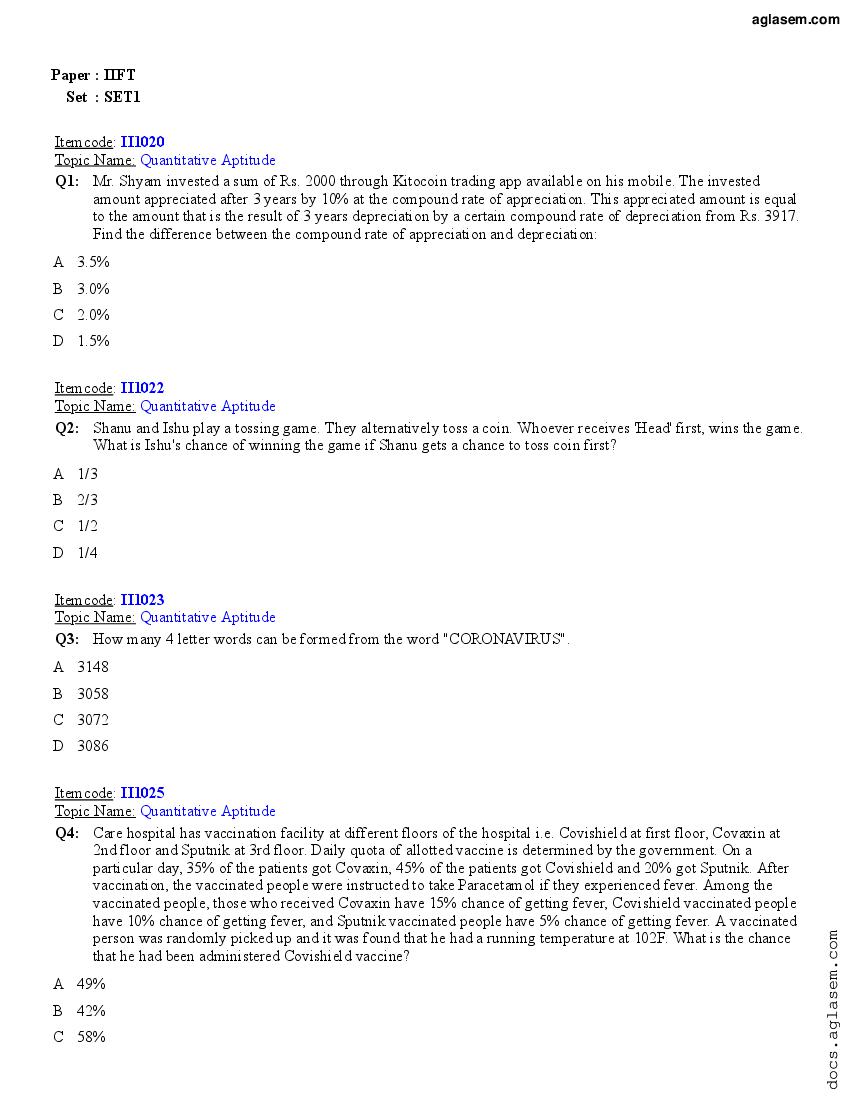
Set : SET1
Itemcode: II1020
Topic Name: Quantitative Aptitude
Q1: Mr. Shyam invested a sum of Rs. 2000 through Kitocoin trading app available on his mobile. The invested
amount appreciated after 3 years by 10% at the compound rate of appreciation. This appreciated amount is equal
to the amount that is the result of 3 years depreciation by a certain compound rate of depreciation from Rs. 3917.
Find the difference between the compound rate of appreciation and depreciation:
A 3.5%
B 3.0%
C 2.0%
D 1.5%
Itemcode: II1022
Topic Name: Quantitative Aptitude
Q2: Shanu and Ishu play a tossing game. They alternatively toss a coin. Whoever receives 'Head' first, wins the game.
What is Ishu's chance of winning the game if Shanu gets a chance to toss coin first?
A 1/3
B 2/3
C 1/2
D 1/4
Itemcode: II1023
Topic Name: Quantitative Aptitude
Q3: How many 4 letter words can be formed from the word "CORONAVIRUS".
A 3148
B 3058
C 3072
D 3086
Itemcode: II1025
Topic Name: Quantitative Aptitude
Q4: Care hospital has vaccination facility at different floors of the hospital i.e. Covishield at first floor, Covaxin at
2nd floor and Sputnik at 3rd floor. Daily quota of allotted vaccine is determined by the government. On a
particular day, 35% of the patients got Covaxin, 45% of the patients got Covishield and 20% got Sputnik. After
vaccination, the vaccinated people were instructed to take Paracetamol if they experienced fever. Among the
vaccinated people, those who received Covaxin have 15% chance of getting fever, Covishield vaccinated people
have 10% chance of getting fever, and Sputnik vaccinated people have 5% chance of getting fever. A vaccinated
person was randomly picked up and it was found that he had a running temperature at 102F. What is the chance
that he had been administered Covishield vaccine?
A 49%
B 42%
C 58%
Page 2
Itemcode: II1026
Topic Name: Quantitative Aptitude
Q5: In a figure, ABC is a right angled triangle at C, semicircles are drawn on AC, BC and AB's diameter. Find the
area of the shaded region.
Note: Figure not as per scale
A 336
B 676
C 196
D 556
Itemcode: II1027
Topic Name: Quantitative Aptitude
Q6:
A 26
B -24
C 24
D -26
Itemcode: II1029
Topic Name: Quantitative Aptitude
Q7: A triangular park named ABC, is required to be protected by green fencing. The length of the side BC is 293. If
the length of side AB is a perfect square, the length of the side AC is a power of two (2), and the length of side
AC is twice the length of side AB. Determine how much fencing is required to cover the triangular park.
A 1079
B 1024
C 1096
D 1061
Itemcode: II1031
Topic Name: Quantitative Aptitude
Q8:
Page 3
B
C
D
Itemcode: II1034
Topic Name: Quantitative Aptitude
Q9: The goods train between Bhilai to Lucknow without rakes can go upto the speed of 72km/hour, and the speed
gets diminished by the quantity that varies as the square root of the number of wagons attached. If it is known
that with 4 wagons the speed is 56 km/hour, the greatest number of wagons with which the engine can just move
is:
A 84
B 144
C 56
D 80
Itemcode: II1035
Topic Name: Quantitative Aptitude
Q10: Find the sum of following series:
A 180/342
B 182/342
C 180/343
D 182/343
Itemcode: II1036
Topic Name: Quantitative Aptitude
Q11: A mining work can be undertaken only between 9 AM to 6 PM. If A and B work entirely during these hours,
they can complete the work alone in 18 days and 22 days respectively. If A and B both start together on 25th Nov
at 12 noon, when should B stop doing the work so that the work will be completed exactly on 09th Dec at 12
noon?
A 30th Nov 12 Noon
B 01st Dec 12 Noon
C 30th Nov 11 AM
D 01st Dec 1 PM
Itemcode: II1037
Topic Name: Quantitative Aptitude
Q12: ABCD is a rectangle in the clockwise direction. The coordinates of A are (1, 3) and the coordinates of C are
Page 4
point of BC.
A (5/2, 7/2)
B (9/2, 5/2)
C (9/5, 7/2)
D (3, 2)
Itemcode: II1038
Topic Name: Quantitative Aptitude
Q13: One can use three different modes of transportation to reach from Dwarka to Ghaziabad. These mode of
transportation have varying speeds 20 km/hour, 30 km/hour, and 50 km/hour respectively. To reach Ghaziabad
from Dwarka, Samiksha took each mode of transportation 1/5th, 2/5th and 2/5th times of her total journey time,
while Shrestha took each mode of transportation 1/6th, 1/6th, and 4/6th of the total distance. The percentage by
which Samiksha's travel time exceeds Shrestha travel time is nearest to:
A 1%
B 2%
C 5%
D 7%
Itemcode: II1040
Topic Name: Quantitative Aptitude
Q14: The mean of the 29 observations is 337. If the first term is increased by 1, second term by 2 and so on. The new
mean will be:
A 364
B 435
C 352
D 772
Itemcode: II1042
Topic Name: Quantitative Aptitude
Q15: In the figure (not drawn to scale) given below, if AD=CD=BC and angle BCE =81o, how much is the value of
angle DBC?
Page 5
B 33o
C 54o
D 66o
Itemcode: II1045
Topic Name: Quantitative Aptitude
Q16:
A 726
B 762
C 526
D 584
Itemcode: II1046
Topic Name: Quantitative Aptitude
Q17:
A 144
B 324
C 484
Page 6
Itemcode: II1048
Topic Name: Quantitative Aptitude
Q18: A granite stone has been purchased to build the kitchen platform and dining area of Mr. Kumar's bungalow. The
cost of the stone varies directly with square of its weight. The stone broke into four parts whose weights are in
the ratio of 2:4:7:11. If the granite stone had broken into four equal parts of weight then it would have led to a
loss of Rs. 73600. What is the actual cost of the original granite stone (unbroken)?
A 5,18,400
B 2,30,400
C 9,21,600
D 4,66,560
Itemcode: II1049
Topic Name: Quantitative Aptitude
Q19: Find the value of following expression
LogSin40o LogSin41o---- LogSin99o LogSin100o
A
B 0
C 1
D 2
Itemcode: II1052
Topic Name: Quantitative Aptitude
Q20: Sui-Dhaga Company has to prepare two special designer dresses for Garba event. Their unique dress designs are
always in demand by the young couples who participate in Garba event competitions. The profit contribution of
male dress is $75 per unit and the profit contribution of female dress is $80 per unit. Total 7 hours are required to
stitch a male-dress and 3 hours are required to stitch a female-dress. Silk required to prepare a male dress and a
female dress is 4 meters and 5 meters respectively. To produce the dresses, total available labour hours are 59 and
total availability of silk is 60 meters. They would like to produce male and female dresses as per the available
resources in such a way so that the total profit gets maximized for the company. What will be total maximum
profit earned by the Sui-Dhaga Company?
A 775
B 900
C 1015
D 1240
Itemcode: II1054
Topic Name: Quantitative Aptitude
Q21: The angle of elevation of a glider from the deck of ship 25 meters above the sea surface is 30o and the angle of
depression of the reflection of glider in the sea is 75o. Find the approximate height of the glider from the sea
surface.
A 46
Page 7
C 29
D 52
Itemcode: II1055
Topic Name: Quantitative Aptitude
Q22: There is a shooting event organised by the SBT youth Club to select the best candidate who will qualify to
participate in Eklavya championship. The shooting board is designed by using 4 concentric circles of radii 2
inch, 3 inch, 5 inch and 9 inch. What is the probability that the participant will shoot only in the second ring to
qualify for Eklavya championship.
A 16/25
B 20/81
C 20/56
D 16/81
Itemcode: II1056
Topic Name: Quantitative Aptitude
Q23: The Star TV agency has conducted a survey in Green view residency to see how many people like these three
serials: "Anupama" "Kalayani", and "Imlie" which hold first three positions of TRP. In a group of 150 people 90,
70, and 50 people like "Kalayani", "Imlie" and "Anupama" respectively. The number of people who like all the
three serials is half the number of people who like exactly two serials. The number of people who like exactly
any two out of the three serials is the same as those who like exactly any other two of the three serials. The
number of people who like all the three serials are:
A 12
B 13
C 14
D 15
Itemcode: II1057
Topic Name: Quantitative Aptitude
Q24: Determine the number of positive integer 'n' where 1 n 100 and 'n' is not divisible by 2, 3 or 5.
A 23
B 25
C 26
D 29
Itemcode: II1058
Topic Name: Quantitative Aptitude
Q25:
A
B
Page 8
D
Itemcode: II1087
Topic Name: Reading Comprehension And Verbal Ability
Q26: Directions.
There are four sentences A, B, C, D where the underlined word is used either correctly or incorrectly. Choose the
option which lists all the sentences where the underlined word is used correctly in a sentence.
A. He did not waver in unbelief about the promise of God but was strengthened in faith, giving glory to God.
B. Harry signed an insurance waver before surgery.
C. All these legends waver between the theory of creation, or rather of manufacture, and the theory of evolution.
D. Will this constitute a waver of such right?
A B, D
B A, C, D
C A, C
D A, B
Itemcode: II1088
Topic Name: Reading Comprehension And Verbal Ability
Q27: Directions.
There are four sentences A, B, C, D where the underlined word is used either correctly or incorrectly. Choose the
option which lists all the sentences where the underlined word is used correctly in a sentence.
A. A woman could not forbear declaring openly that her faith had saved her.
B. Forbear to say more on a subject which is forbidden.
C. Forbear to judge, for we are sinners all.
D. He was a delicate child, in direct contrast to a strong race of forbears, and inherited from his mother a refined,
retiring disposition and a love for books.
A A, B, C
B C, D
C B, C, D
D A, B
Itemcode: II1089
Topic Name: Reading Comprehension And Verbal Ability
Q28: Directions.
There are four sentences A, B, C, D where the underlined word is used either correctly or incorrectly. Choose the
option which lists all the sentences where the underlined word is used correctly in a sentence.
A. The teacher asked the students to not elude to any online sources in their research papers.
B. Reyna used a tricky turnaround move to elude the only defender before firing from 8 yards into the empty
goal.
C. Nick tried to elude the security men by sneaking through a back door.
D. The mafia boss ordered his men to not elude to any criminal activity during their telephone conversations.
A A, D
B C, D
C B, C
Page 9
Itemcode: II1090
Topic Name: Reading Comprehension And Verbal Ability
Q29: Directions:
In the sentences below are certain nouns/collective nouns that are used incorrectly as singular when they should
be used as plural and vice-versa. Identify the correct sentence from the following:
A Whose are these cattles?
B The sceneries of Kashmir are very charming.
C No news is good news.
D He loves either your son or my.
Itemcode: II1091
Topic Name: Reading Comprehension And Verbal Ability
Q30: Directions: In the sentences below are certain nouns/collective nouns that are used incorrectly as singular when
they should be used as plural and vice-versa. Identify the correct sentence from the following:
A There is colony of mouses in my house.
B He gave me ten five rupees note.
C These five children are her offsprings.
D There are no gentry in this town.
Itemcode: II1092
Topic Name: Reading Comprehension And Verbal Ability
Q31: Directions:
Identify the options with all correct spellings:
A Assiduous, Aquaintance, Allegiance, Exaneration
B Adolesence, Annihilation, Cassette, Octenial
C Aquiantance, Adherent, Ignominous, Movabillity
D Garrulous, Notoriety, Centenarian, Ignominious
Itemcode: II1093
Topic Name: Reading Comprehension And Verbal Ability
Q32: Directions:
Find the most appropriate word from the given options, which best describes the meaning provided in the
question.
Meaning: The study of inscriptions
A Cacography
B Calligraphy
C Epigraphy
D Pantography
Itemcode: II1094
Topic Name: Reading Comprehension And Verbal Ability
Q33: Directions:
Find the most appropriate word from the given options, which best describes the meaning provided in the
Page 10
Meaning: The study of reptiles
A Ecology
B Zoology
C Amphibology
D Herpetology
Itemcode: II1095
Topic Name: Reading Comprehension And Verbal Ability
Q34: Directions:
Identify the appropriate meaning for the given root word:
Root word: Quin (as in quintessence/ quintet)
A Summary
B Cone
C Fifth
D Easy to understand
Itemcode: II1096
Topic Name: Reading Comprehension And Verbal Ability
Q35: Directions:
Identify the appropriate meaning for the given root word:
Root word: Rhin/o (as in Rhinoceros)
A Huge
B Fire
C Wisdom
D Nose
Itemcode: II1097
Topic Name: Reading Comprehension And Verbal Ability
Q36: Directions:
From the options given below, identify correct antonym for the word given in CAPS:
ARMISTICE
A Truce
B Concord
C Skirmish
D Peace
Itemcode: II1098
Topic Name: Reading Comprehension And Verbal Ability
Q37: Directions:
For each of the sentences given below, identify which of the two underlined words/phrases is correct:
Page 11
B I - A, II - D, III - F, IV - G
C I - B, II - C, III - F, IV - H
D I - A, II - C, III - E, IV - H
Itemcode: II1099
Topic Name: Reading Comprehension And Verbal Ability
Q38: Directions:
For each of the sentences given below, identify which of the two underlined words/phrases is correct:
A I - A, II - C, III - F, IV - G
B I - B, II - D, III - E, IV - H
C I - A, II - D, III - E, IV - H
D I - B, II - C, III - F, IV - G
Itemcode: II1100
Topic Name: Reading Comprehension And Verbal Ability
Q39: Directions:
Each of the sentence below is written twice using an inappropriate and an appropriate word highlighted in black
and italicized. For each pair of sentences, identify the sentence with the appropriate word usage from the options
given below:
I. Temperatures this week are expected to be seasonal.
II. Temperatures this week are expected to be seasonable
III. The only route was along a narrow tortuous road.
IV. The only route was along a narrow torturous road.
V. The idea was greeted with strong censor.
VI. The idea was greeted with strong censure.
A The sentences with appropriate word usage are I, III, V
B The sentences with appropriate words usage are II, IV, VI
C The sentences with appropriate words usage are I, IV, V
Page 12
Itemcode: II1101
Topic Name: Reading Comprehension And Verbal Ability
Q40: Directions:
Each of the sentence below is written twice using an inappropriate and an appropriate word highlighted in black
and italicized. For each pair of sentences, identify the sentence with the appropriate word usage from the options
given below:
I. There was concern that his legal victory could set a dangerous precedence.
II. There was concern that his legal victory could set a dangerous precedent.
III. Her ideas were light-years ahead of her time.
IV. Her ideas were many years ahead of her time.
V. The screaming kids and blaring radio made for a noisy evening.
VI. The screaming kids and blaring radio made for a noisome evening.
A The sentences with appropriate word usage are I, III, VI
B The sentences with appropriate word usage are II, IV, V
C The sentences with appropriate word usage are II, III, VI
D The sentences with appropriate word usage are I, IV, V
Itemcode: II1102
Topic Name: Reading Comprehension And Verbal Ability
Q41: Directions:
From the options given below, identify the sentences with correct usage of verbs underlined:
A. Drinking and driving is a crime.
B. One or the other of you have to compromise.
C. Neither the gloves nor the scarf need washing.
D. Each invoice and purchase order has to be approved by the manager.
A A, B are correct
B C, D are correct
C A, D are correct
D B, C are correct
Itemcode: II1103
Topic Name: Reading Comprehension And Verbal Ability
Q42: Directions:
Certain foreign words are frequently used in English language. Identify the origin of the given words:
I. coup d'etat
II. fait accompli
III. tete-e-tete
IV. elite
A All are Spanish
B All are French
C All are Latin
D All are Anglo-Indian
Page 13
Topic Name: Reading Comprehension And Verbal Ability
Q43: Directions:
Certain foreign words are frequently used in English language. Identify the origin of the given words:
I. faux pas
II. en masse
III. bandolero
IV. versus
A Only I and IV are French
B Only II and III are Spanish
C Only IV is Latin
D Only I and II are Latin
Itemcode: II1105
Topic Name: Reading Comprehension And Verbal Ability
Q44: Complete the following Idioms by matching List I with List II
Choose the correct answer from the options given below:
A A - III, B - I, C - II, D - IV
B A - IV, B - III, C - II, D - I
C A - III, B - II, C - I, D - IV
D A - III, B - II, C - IV, D - I
Passage:
Passage I
I am occasionally troubled by the disparate rumblings of dissatisfaction about the role of theory in management. As a
profession, we seem to experience recurring bouts of doubt about what theory is, and is not, and whether we should
have a single unifying theory or many.
While we agonize over the degree of theoretical abstraction needed to produce knowledge, arguing occasionally for a
step back from highly abstract theorization to “middle-range” theories or the much less ambitious notion of
“mechanisms”, it is apparent that, as a community of scholars, we are deeply engaged with and passionate about the
role of theory in our profession. There is, perhaps surprisingly, considerable consensus on what theory is: theory is
simply a way of imposing conceptual order on the empirical complexity of the phenomenal world. As Bacharach
(1989) astutely observed, theory offers “a statement of relations between concepts within a set of boundary
assumptions and constraints”. Ultimately, theories reflect, in highly abstract terms, the organization of a discipline’s
knowledge base.
However, theory does much more than simply abstract and organize knowledge. It also signals the values upon which
that knowledge is built. And it is in this somewhat shadowy connection between and among theory, knowledge, and
values that cracks in our consensus about theory begin to appear. Although we might agree, broadly, about the
substantive elements that constitute theory, we appear to disagree as a profession about why we need theory and what
role it should play in creating, maintaining, and shaping what type of knowledge we value in the field. Fundamentally,
we disagree about the value of theory.
Some see theory as a means of knowledge accumulation. These are the empiricists, who clearly constitute the
dominant contemporary view. Informed by positivism, empiricists view management as a science and theory as the
Page 14
summarize the phenomenal world. They have a Darwinian understanding of the relationship between theories, seeing
an implicit competition between theories in their ability to capture reality. Over time, as theory progresses in its ability
to proximate and predict reality, a single unified theory should emerge. When a single theory fails to emerge (as is
inevitable), empiricists tend to reject the value of theory entirely and focus energy exclusively on the collection of data.
Declaring a moratorium on theory—Alfred North Whitehead’s “dustbowl empiricism”—is a recurring phenomenon in
the history of social science. Dustbowl empiricism is characterized by what Feyerabend (1975) described as the
rhetorical bullying that is implicit in appeals to rationality and evidence.
Dustbowl empiricism is, of course, doomed to fail. Knowledge accumulation simply cannot occur without a
conceptual framework. When explicit frameworks are pushed into the background, theory becomes implicit. Implicit
theories are inherently dangerous because they discourage researchers from asking fundamental questions about the
assumptions that underpin knowledge and the methods used to acquire knowledge. The random accumulation of
evidence is also doomed because of the inherent tendency of humans to theorize. Theorization is an essential element
of how we make sense of the world, and randomly accumulated data are, as Coase (1988) critically observed, nothing
but “a mass of descriptive material, waiting for a theory, or a fire.”
Management researchers constituting an alternative subgroup value theory as a means of knowledge abstraction. These
are the rationalists, and they serve as a useful and important counterbalance to the empiricists. Instead of seeing theory
as the summation of empirical observation, rationalists see theory as occurring prior to empirical observation. That is,
theory offers a perceptual lens that structures sensory experience. Without theoretically derived categories, rationalists
argue, humans would be unable to cognitively organize or even recognize sensory experience.
Rationalists value theory for its logic. Because they favor deduction over induction, rationalists often prefer theories
that offer internal coherence or elegant explanations of the world. For these scholars new theory is more likely to come
from the interpretation of past masters, through parsing canonical texts (i.e., literature reviews), than from empirical
observation.
The ultimate danger of an overemphasis on rationalism is theoretical “fetishism,” where theory becomes an exercise in
writing and interpretation but is detached from the empirical world. Taken to its extreme, rational theories tend to
become self-absorbed—more attentive to naval-gazing efforts of deconstructing prior theory than to challenges from
contradictory phenomena. Elsewhere I have written about the emergent fetishism in theory and the concomitant danger
of increasing scientism in management theory. However, rationalists offer a critically important counterbalance to
empiricists, and it is the effective union of induction and deduction, or empiricism and rationalism, that tends to
produce new knowledge.
A growing number of management scholars see a powerful normative value in theory. The highest and best use of
theory, for this constituency, is not to represent the phenomenal world as it is but, rather, to fashion theoretical lenses
that allow us to see the world as it might be. In contrast to both empiricists and rationalists, who see virtue in assuming
an objective distance between research and practice and who believe that their research is largely free of political and
moral assumptions, normative theorists embrace the notion that no theory is value free. They adopt McKenzie’s (2006)
argument that management theories are less a camera that captures reality and more an engine that produces it.
Normative scholars, thus, value theory for its ability to create new reality. They construct theories that contradict the
(often dismal) view of the world given to us by both empiricists and rationalists and, instead, articulate new
possibilities for organizational behavior and managerial action. Rather than attending to the deconstruction of the
causes of action, normative theorists tend to focus on the motives and ethics of actors and the process by which they
make choices for action.
The question “why theory?” thus has several potential answers. In fact it is the tension between these different value
propositions for theory that generates a series of observable and somewhat predictable dynamics in management
scholarship.
Itemcode: II1106
Topic Name: Reading Comprehension And Verbal Ability
Q45: Based on the passage, which of the following provides gist of the 'theory':
Theory is all about setting boundary conditions & assumptions within which relations among concepts may be
A
studied.
B Abstraction and knowledge mainly constitute the substantive elements of theory.
C Theory represents a broad range of value propositions and which is what derives much of rumblings and
Page 15
To make sense, theory should include empirical adequacy, offer elegant explanations of the world using a
D
deductive logic and be able to create a new reality.
Itemcode: II1107
Topic Name: Reading Comprehension And Verbal Ability
Q46: Based on the passage, which of the following HOLDS TRUE about 'empiricists/empiricism':
A Empiricists aim to produce and capture literally true stories about the phenomenal world.
Knowledge accumulation is an empirical activity rather than a cognitive activity or a sensory experience that
B
aims to proximate and predict reality.
C For empiricists, knowledge accumulation happens through collection of data in the real world.
Just because it is never possible to come up with a single unified theory, empiricists tend to reject the value of
D
theory and focus energy exclusively on collection of data.
Itemcode: II1108
Topic Name: Reading Comprehension And Verbal Ability
Q47: Which of the following is NOT TRUE about 'dustbowl empiricism' as explained in the passage:
Implicit theories are arrived at by the researchers through random accumulation of evidence that lacks asking
A fundamental questions about the assumptions that underpin knowledge and the methods used to acquire
knowledge, and hence, are dangerous
Dustbowl empiricism is doomed to fail since knowledge accumulation is aimed at through using implicit theories
B
in contrast to using conceptual frameworks that are pushed into the background.
It is an approach to social sciences that focuses on accumulating knowledge through empirical observation and
C
collecting data without any conceptual framework
While knowledge accumulation through focusing exclusively on collection of data is suggested to appeal in its
D rationality and evidence and it appears to have a persuasive effect but such knowledge accumulation often lacks
in sincerity or meaningfulness.
Itemcode: II1109
Topic Name: Reading Comprehension And Verbal Ability
Q48: Which of the following is NOT associated with rationalism or theoretical "fetishism" as described in the
passage:
A Excessive belief in the power of scientific knowledge and techniques in management theory is dangerous.
When rationalists indulge into excessive contemplation of deconstruction of a prior theory even at the expense of
B
a wider view that might emerge from an opposed or conflicting phenomena, it is theoretical fetishism.
Rationalists view theory as a source of knowledge abstraction and suggest that elegant explanations of the world
C require interpretation of past masters through parsing canonical texts to cognitively organize or even recognize
sensory experience using a deductive logic.
Theory occurs prior to empirical observation since without theoretically derived categories, humans would be
D
unable to cognitively organize or even recognize sensory experience.
Itemcode: II1110
Topic Name: Reading Comprehension And Verbal Ability
Q49: Based on the passage, which of the following about normative theory/theorists is TRUE:
A Normative value in theory is the best for articulating organizational behaviour and managerial action.
B Theories given by empiricists and rationalists cannot be used for articulating new possibilities for organizational
Page 16
While rationalists and empiricists aim to represent the phenomenal world as it is, normative scholars fashion
C
theoretical lenses in a way that allows to see the world as it might be.
Normative theorists do not assume distance between research and practice and tend to believe that their research
D
is not free of political and moral assumptions.
Passage:
The contrasting styles of communication represented by the managers from Spain and say Japan are often referred to
as low-context and high-context, respectively.
In order to understand the implications, suppose you are having a discussion with Sally, a business colleague, and you
both come from a culture that prefers low-context communication. People from such cultures are conditioned from
childhood to assume a low level of shared context—that is, few shared reference points and comparatively little
implicit knowledge linking speaker and listener.
Under these circumstances, it’s highly likely that, while speaking with Sally, you will explicitly spell out your ideas,
providing all the background knowledge and details necessary to understand your message. The United States is the
lowest-context culture in the world, followed by Canada and Australia, the Netherlands and Germany, and the United
Kingdom.
Though cultural norms are transmitted from one generation to the next through means that are generally indirect and
subliminal, you may remember receiving some deliberate lessons concerning appropriate ways to communicate. I
certainly received such lessons as a child growing up in the United States. My third-grade teacher, Mary Jane, a tall,
thin woman with tightly curled hair, used to coach us during our Monday morning circle meetings using the motto,
“Say what you mean and mean what you say.” When I was sixteen, I took an elective class at Minneapolis South High
School on giving effective presentations. This is where I learned the traditional American rule for successfully
transferring a powerful message to an audience: “Tell them what you are going to tell them, then tell them, then tell
them what you’ve told them.” This is the philosophy of low-context communication in a nutshell. The communication
technique is designed to help people quickly identify and correct misunderstandings, thereby reducing (if not
eliminating) one common cause of needless, pointless debate.
Childhood lessons like these imbued me with the assumption that being explicit is simply good communication. But,
as Takaki explained, good communication in a high-context culture like Japan is very different. In Japan as in India,
China, and many other countries, people learn a very different style of communication as children—one that depends
on unconscious assumptions about common reference points and shared knowledge.
For example, let’s say that you and a business colleague named Maryam both come from a high-context culture like
Iran. Imagine that Maryam has travelled to your home for a visit and arrived via a late-evening train at 10:00 p.m. If
you ask Maryam whether she would like to eat something before going to bed, when Maryam responds with a polite
“No, thank you,” your response will be to ask her two more times. Only if she responds “No, thank you” three times
will you accept “No” as her real answer.
In a high-context culture like Iran, it’s not necessary—indeed, it’s often inappropriate—to spell out certain messages
too explicitly. If Maryam replied to your first offer of food, “Yes, please serve me a big portion of whatever you have,
because I am dying of hunger!” this response would be considered inelegant and perhaps quite rude. Fortunately,
shared assumptions learned from childhood make such bluntness unnecessary. You and Maryam both know that “No,
thank you” likely means, “Please ask me again because I am famished.”
If you’re from a low-context culture, you may perceive a high-context communicator as secretive, lacking
transparency, or unable to communicate effectively. On the other hand, if you’re from a high-context culture, you
might perceive a low-context communicator as inappropriately stating the obvious, or even as condescending and
patronizing.
When I had first arrived at my hotel in New Delhi, I was hot and, more important, hungry. Although I would have
spent that week conducting classes for a group of Indian executives at the swank five-star Oberoi hotel, the Indian
business school hosting me put me up in a more modest and much smaller residence several miles away. Staying in a
simple hotel just steps from the bustle of workaday New Delhi, I thought, would make it that much easier for me to get
Page 17
Lunch was at the top of my agenda. The very friendly young man behind the concierge desk jumped to attention when
he saw me approaching. I asked about a good place to eat. “There is a great restaurant just to the left of the hotel. I
recommend it highly,” he told me. “It is called Swagat. You can’t miss it.”
It sounded perfect. I walked out to the road and looked to the left. The street was a whirlwind of colors, smells, and
activities. I saw a grocery store, a cloth vendor, a family of five all piled onto one motor scooter, and a bunch of
brown- speckled chickens pecking in the dust next to the sidewalk. No restaurant.
“You didn’t find it?” the kind concierge asked in a puzzled tone as I re-entered the hotel. This time the young man
explained, “Just walk out of the hotel, cross the street, and the restaurant will be on your left. It’s next to the market.
There is a sign. You can’t miss it,” he said again.
Remembering my confusing encounter with the concierge in New Delhi, if I had been an Indian from Delhi with the
shared cultural understanding of how to interpret implicit messages, I would have been better able to interpret the
concierge’s directions. Lacking those assumptions left me bewildered and unable to find my way to the restaurant.
Itemcode: II1111
Topic Name: Reading Comprehension And Verbal Ability
Q50: According to the author, low-context communication cultures:
A Can be characterised as indirect in nature
B Can be characterized as not speaking to the point
C Are characterised by the use of overt messages
D Are characterised by the use of covert messages
Itemcode: II1112
Topic Name: Reading Comprehension And Verbal Ability
Q51: Which of the following can be inferred from passage:
Low-context communication is based on as much shared knowledge/assumption as the High-context
A
communication.
Low-context communication is not based on as much shared knowledge/assumption as the High-context
B
communication
High-context communication is not based on as much shared knowledge/assumption as the Low-context
C
communication
D Neither Low-context, nor High-context communication is based on shared knowledge/assumption.
Itemcode: II1113
Topic Name: Reading Comprehension And Verbal Ability
Q52: Which of the following best explains 'you might perceive a low-context communicator as inappropriately
"stating the obvious" '(8th para) from the passage:
A You didn't have to say it! We all understood!
B You should not be talking to us like that!
C You talk to us like we're children!
D You kindly speak to us as clearly as you can!
Passage:
Read the follwing passage:
Page 18
believe in a god that gave some very concrete laws to humans, or else morality will disappear and society will collapse
into primeval chaos.
It is certainly true that belief in gods was vital for various social orders, and that it sometimes had positive
consequences. Indeed, the very same religions that inspire hate and bigotry in some people inspire love and
compassion in others.
Yet though gods can inspire us to act compassionately, religious faith is not a necessary condition for moral behaviour.
The idea that we need a supernatural being to make us act morally assumes that there is something unnatural about
morality. But why? Morality of some kind is natural. All social mammals from chimpanzees to rats have ethical codes
that limit things such as theft and murder.
Among humans, morality is present in all societies, even though not all of them believe in the same god, or in any god.
Christians act with charity even without believing in the Hindu pantheon, Muslims value honesty despite rejecting the
divinity of Christ, and secular countries such as Denmark and the Czech Republic aren’t more violent than some
devout countries.
Morality doesn’t mean ‘following divine commands’. It means ‘reducing suffering’. You just need to develop a deep
appreciation of suffering. If you really understand how an action causes unnecessary suffering to yourself or to others,
you will naturally abstain from it. People nevertheless murder, rape and steal because they have only a superficial
appreciation of the misery this causes. They are fixated on satisfying their immediate lust or greed, without concern for
the impact on others – or even for the long-term impact on themselves. Even inquisitors who deliberately inflict as
much pain as possible on their victim, usually use various desensitising and dehumanising techniques in order to
distance themselves from what they are doing.
Many thinkers have constructed elaborate social theories, explaining why in the long run such behaviour is
counterproductive. You would not like to live in a society where strangers are routinely robbed and murdered. Not only
would you be in constant danger, but you would lack the benefit of things like commerce, which depends on trust
between strangers. Merchants don’t usually visit dens of thieves. That’s how secular theoreticians from ancient China
to modern Europe have justified the golden rule of ‘don’t do to others what you would not like them to do to you’.
Yet we do not really need such complex long-term theories to find a natural basis for universal compassion. Forget
about commerce for a moment. On a much more immediate level, hurting others always hurts me too. Every violent
act in the world begins with a violent desire in somebody’s mind, which disturbs that person’s own peace and
happiness before it disturbs the peace and happiness of anyone else. Thus people seldom steal unless they first develop
a lot of greed and envy in their minds. People don’t usually murder unless they first generate anger and hatred.
Emotions such as greed, envy, anger and hatred are very unpleasant. You cannot experience joy and harmony when
you are boiling with anger or envy. Hence long before you murder anyone, your anger has already killed your own
peace of mind.
For some people, a strong belief in a compassionate god that commands us to turn the other cheek may help in curbing
anger. That’s been an enormous contribution of religious belief to the peace and harmony of the world.
Unfortunately, for other people religious belief actually stokes and justifies their anger, especially if someone dares to
insult their god or ignore his wishes. So the value of the lawgiver god ultimately depends on the behaviour of his
devotees. If they act well, they can believe anything they like. Similarly, the value of religious rites and sacred places
depends on the type of feelings and behaviours they inspire. If visiting a temple makes people experience peace and
harmony – that’s wonderful. But if a particular sacred place causes violence and conflicts, what do we need it for? It is
clearly dysfunctional. Not visiting any place of worship and not believing in any god is also a viable option. As the last
few centuries have proved, we don’t need to invoke God’s name in order to live a moral life. Secularism can provide
us with all the values we need.
Itemcode: II1114
Topic Name: Reading Comprehension And Verbal Ability
Q53: Which of the following is correct:
A Moral behaviour naturally follows the religious teachings
Page 19
C In order to act morally, you don't need to believe in any myth or story
D People follow societal order because they alienate themselves from their doings
Itemcode: II1115
Topic Name: Reading Comprehension And Verbal Ability
Q54: Which of the following is an incorrect statement:
A Religion is not a pre-condition for moral behaviour
B Having a violent desire in mind is the source of all the violence
C Morality always starts with having faith in God
D Trade and business depends on trust
Itemcode: II1116
Topic Name: Reading Comprehension And Verbal Ability
Q55: Which of the following is the correct central theme of the passage?
A Believing in God prevents the society from collapsing into the primeval chaos
B Morality is a supernatural phenomenon
C Emotions like anger, envy or happiness determine morality
D Morality may or may not be associated with religion
Passage:
Read the following passage:
I teach undergraduate psychology courses at the University of Maryland, and my classes draw students with diverse
interests. But every one of them perks up when I pose this question: Do you want two extra-credit points on your term
paper, or six points?
I tell my students that the extra-credit offer is part of an exercise illustrating the interconnectedness of choices
individuals make in communities. I explain that the exercise was inspired by an ecologist named Garrett Hardin and an
address that he delivered 50 years ago this summer, describing what he called “the tragedy of the commons.” Hardin
said that when many individuals act in their own self-interest without regard for society, the effects can be catastrophic.
Hardin used the 19th-century convention of “the commons”—a cattle-grazing pasture that villagers shared—to warn
against the overexploitation of communal resources.
I’m hoping that my students will grasp the connections between the classroom exercise, Hardin’s ideas, and our
planet’s most pressing problems (including climate change). I allow them to choose between two points or six points of
extra credit—but there’s a catch. I stipulate that if more than 10 percent of the class members choose six points, no one
gets any points. The extra-credit points are analogous to water, fuel, grazing pasture (from Hardin’s analysis), or any
natural resource.
According to some free market economic theories, if everyone strives for maximum personal benefit, then societies
will thrive. By this logic the student’s rational choice would be to pick six points, just as the shepherd’s rational choice
would be to use as much grazing pasture as possible. And those who maximize personal consumption aren’t greedy—
they’re strategic.
But when everyone chooses this path, the common resource is overtaxed, and societies end up with overharvesting,
water shortages, or climate change. A possible solution seems simple: If everyone just moderated their consumption,
we’d have sustainability. As many of my students say, “If everyone chooses two points, we’ll all get the points.” And
yet, for the first eight years I used this exercise, only one class—of the dozens I taught—stayed under the 10 percent
threshold. All the other classes failed.
This exercise was developed more than 25 years ago. Professor Steve Drigotas of Johns Hopkins University had been
Page 20
chosen two points, was incredibly frustrated with my peers who had chosen six.
In 2015 one of my students tweeted about the exercise—“WHAT KIND OF PROFESSOR DOES THIS”—and his
lament went viral. People around the globe weighed in: Does so many people choosing six points mean it’s human
nature to be greedy and selfish?
Actually most people aren’t. But it’s very tricky to get people to cooperate, especially in large groups of complete
strangers. After all, if someone else is taking more for themselves (running more water or choosing six points), why
shouldn’t I? But if we all think this way, eventually we’ll all lose.
Hardin suggested that education might make a difference—that if we teach people about the consequences of taking
too much, they might not. I’ve been skeptical about this idea. When my student’s tweet went viral, some colleagues
said that I wouldn’t be able to use the exercise again (because students would already know how it works). I laughed.
If it were only that easy! My suspicion was justified. Even after the exercise got wide exposure, my students still failed
the challenge to get the extra-credit points.
Despite this I remain optimistic. After all, most of my students, about 80 percent, choose two points—just as most
people choose to cooperate in real-world situations. Most of us want to do what’s right. But that alone won’t solve our
problems, so we need to think creatively and use behavioral science to find solutions.
In 2016 I decided to change things up. In hopes of finding a way to increase cooperation, I drew from the scientific
literature on social groups and introduced a third option: Students could choose two points, six points—or zero points.
That’s right. Zero. Why would anyone do that? Well, for each student who chose zero points, one of the six-point
choosers (selected randomly) would lose everything, reducing the total number of six-point choosers by one.
The zero-point option is self-sacrificial; students forgo points for themselves in order to help the group by restraining
those who take too much. In behavioral experiments this type of action is called altruistic punishment, a term coined
by economists Ernst Fehr and Simon Gächter. Their research documented people willingly giving up some of their
own resources in order to punish those who behave selfishly in a group context—and doing so in the belief that every
individual profits from increased cooperation.
Usually a few of my students each semester choose the zero-point option, and sometimes that’s all it takes. Just a
handful of people can make a huge difference—that is, a few self-sacrificing students can bring down the total number
of six-point choosers to below the 10 percent threshold. This additional element has dramatically increased
cooperation in my courses. Now roughly half my classes receive the extra-credit points. In my opinion this is a
remarkable turnaround. And some of my classes have done this without anyone actually choosing the zero-point
option; simply knowing it was available was enough to increase cooperation.
Though this type of solution may work on the small scale of a classroom, won’t we need much larger action to curb
global problems like climate change? Yes, but the principle is the same–it’s about collective action and reducing
overconsumption. For example, recently I started volunteering with Citizens’ Climate Lobby (CCL), an organization
that advocates for a policy known as carbon fee and dividend. This plan would put a steadily rising fee on fossil fuels
and distribute the money raised back to American households (to protect families against rising costs). Ultimately this
would reduce fossil fuel consumption by making this type of energy more expensive to use—so reducing consumption
would be better for both our wallets and the environment. At CCL, volunteers meet with lawmakers and conduct
outreach to the community. Through our efforts—again, collective action—we gain allies in Congress and the public.
By early this year the House’s bipartisan Climate Solutions Caucus had 70 members (half Democrats and half
Republicans) from states across the country.
The challenge that Garrett Hardin described 50 years ago remains today: Our survival depends on each of us and all of
us conserving the commons. I choose to remind myself of that with these wise and hopeful lines from the Beatles: “All
the world is birthday cake / so take a piece / but not too much.”
Itemcode: II1117
Topic Name: Reading Comprehension And Verbal Ability
Q56: Central theme of the passage is about:
A Free market economic theories are antithetical to the idea of societal harmony.
Page 21
C Viewing our neighbors as equal partners in classroom behavior.
D Exploring ways to build common ground between greedy and selfless people.
Itemcode: II1118
Topic Name: Reading Comprehension And Verbal Ability
Q57: Identify the CORRECT statement:
A Professor Garrett Hardin conducted the experiment on author to demonstrate about the tragedy of the commons
B Author undoubtedly believed that educating people to cooperate will generate positive result.
C Author was optimistic that by adding six-points, his students will pass the test
D Taking only 2 or even lesser bonus points is the option suggested for sustainability.
Itemcode: II1119
Topic Name: Reading Comprehension And Verbal Ability
Q58: Identify the INCORRECT statement:
A Our survival depends on the choices that each one of us makes.
B Beatles seem to be suggesting that "the world has enough for everyone's needs, but not everyone's greed."
C Almost half of the students failed in the tests that were conducted by author in his classes.
When the tweet became viral, author's colleagues were convinced that the exercise will still generate the same
D
result because its human nature to be greedy and selfish.
Itemcode: II1120
Topic Name: Reading Comprehension And Verbal Ability
Q59: Which of the following can be inferred from the passage?
A A few people who recycle or compost can have an inverse effect on others' lifestyles.
B A few students can help an entire class gain a leg up in the course.
C Each one's individual choice is vital for determining the end result.
D Even with the sacrifice of few, society will not gain much.
Itemcode: II1121
Topic Name: Reading Comprehension And Verbal Ability
Q60: "But every one of them perks up when I pose this question". The appropriate meaning of this sentence would
be:
A Students are baffled
B Students are cheerful.
C Students fret upon hearing this.
D Students become inquisitive.
Itemcode: II1085
Topic Name: Data Interpretation And Logical Reasoning
Q61: Based on the statement given below, identify which of the assumption/s is/are implicit:
Vikas says to Harry, "Refer to the Cambridge dictionary instead of Oxford dictionary to be good at English."
Page 22
I. Harry wants to be good at English.
II. Vikas is a good advisor.
A Only assumption I is implicit
B Only assumption II is implicit
C Both assumption I and II are implicit
D Neither assumption I nor II is implicit
Itemcode: II1086
Topic Name: Data Interpretation And Logical Reasoning
Q62: In a certain language, "ba tu qui zu" implies "zomato provides food delivery". In the same language "ra ni ma tu"
implies "i love good food"; "ba te ma so" implies "love the delivery fresh"; and "so zu tu qui ba" implies "zomato
delivery provides fresh food".
What would be the code of "love the fresh" in this code language:
A qu ra ni
B te so ma
C zu so ba
D tu te qui
Passage:
Directions : The pie charts given below depict the percentage production breakup of 4 crops viz maize, corn, soyabean
and wheat in the world and USA respectively. Assume that the total world production of these crops in a given year is
160 million tonnes.
Page 23
Itemcode: II1001
Topic Name: Data Interpretation And Logical Reasoning
Q63: Given that USA accounts for 20 percent of the total production of soyabean in the world then what percentage
of the total food crops production of the world is accounted by USA?
A 12 percent
B 24 percent
C 28 percent
D 30 percent
Itemcode: II1002
Topic Name: Data Interpretation And Logical Reasoning
Page 24
(approximately) of the total production of food crops in the world accounted by USA?
A 3.55 percent
B 4.68 percent
C 5.75 percent
D 7.82 percent
Itemcode: II1003
Topic Name: Data Interpretation And Logical Reasoning
Q65: If the ratio of production of wheat in USA and ROW is 1:6, then (approximately) what percentage of total food
crop production of the ROW is accounted by wheat?
A 5 percent
B 8 percent
C 12 percent
D 15 percent
Itemcode: II1004
Topic Name: Data Interpretation And Logical Reasoning
Q66: If USA produces 20 percent lesser corn than ROW, find the production of soyabean in USA?
A 14.35 million tonnes
B 8.75 million tonnes
C 12.25 million tonnes
D 17.75 million tonnes
Passage:
Directions: Refer to the following line charts and solve the questions based on them. The line charts given below give
the expenditure and income of ABC Ltd. which produces and sells only two variants of its rice - Basmati rice and
Parmal rice.
Page 25
Page 26
Q67: The total profit of ABC Ltd. is highest in which of the following years?
A 2007
B 2009
C 2012
D 2004
Itemcode: II1006
Topic Name: Data Interpretation And Logical Reasoning
Q68: Calculate the number of years during 2005 to 2013 for atleast one of the two rice when income and
expenditure did not follow the same trend (i.e both income and expenditure did not increase or decrease
simultaneously compared to the previous year)?
A 5
B 6
C 8
D 9
Itemcode: II1007
Topic Name: Data Interpretation And Logical Reasoning
Q69: The percentage annual increase in the income of Basmati rice is highest in which of the following years?
A 2005
B 2007
C 2009
D 2012
Itemcode: II1008
Topic Name: Data Interpretation And Logical Reasoning
Q70: In which year the annual percentage decrease in the profit of parmal rice is maximum as compared to that of
the previous year?
A 2009
B 2010
C 2011
D 2013
Passage:
Directions: The graph below depicts the crime cases registered against foreigners in different countries in a given year.
The crime cases are classified into three categories: Murder cases, theft cases and other cases. The data for nine
countries are shown in the figure below. These nine countries belong to the top ten countries in terms of the total
number of cases registered. The tenth country is Malaysia, where only 523 theft cases were registered.
Page 27
categories of crimes. If two countries are assigned rank 2nd, then for any given crime, 3rd rank cannot be assigned to
any country.
Itemcode: II1009
Topic Name: Data Interpretation And Logical Reasoning
Q71: The rank of China in the murder cases category is?
A 2nd
B 5th
C 7th
D 8th
Itemcode: II1010
Page 28
Q72: In the top two countries on the basis of total registered cases, the approximate ratio of total number of murder
cases to total number of theft cases is
A 1:6
B 1:7
C 1:9
D 1:4
Itemcode: II1012
Topic Name: Data Interpretation And Logical Reasoning
Q73: Which of the following is correct about the ranks of countries in the other crimes category?
i) USA: 7
ii) Russia: 3
A Only (i) is correct
B Only (ii) is correct
C Both (i) and (ii) are correct
D Both (i) and (ii) are incorrect
Itemcode: II1013
Topic Name: Data Interpretation And Logical Reasoning
Q74: The sum of the ranks of Pakistan in the three categories of crimes is?
A 4
B 7
C 5
D 10
Passage:
Directions: The following graph provides data about the refrigerators and television sets manufactured by XYZ
company in 8 days - day1 to day8. However, on each day after quality check (QC) some products were found to be
defective. The attached bar chart provides data about aggregate number of refrigerators and televisions manufactured
by the company and the number of refrigerators found defective after QC on each day of the given eight days.
All the televisions and refrigerators which cleared the QC were packed for selling.
Page 29
number of televisions which cleared the QC.
Itemcode: II1014
Topic Name: Data Interpretation And Logical Reasoning
Q75: If the number of televisions which cleared the quality check (QC) on each of the given eight days is same, then
at least how many refrigerators cleared the QC on day 3?
A 20
B 30
C 25
D 40
Itemcode: II1015
Topic Name: Data Interpretation And Logical Reasoning
Q76: On how many of the given 8 days the number of refrigerators which cleared the quality check can be zero?
A 1
Page 30
C 3
D 5
Itemcode: II1016
Topic Name: Data Interpretation And Logical Reasoning
Q77: Which of the following can be the ratio of number of televisions and refrigerators which cleared the quality
check on day1?
A 1:4
B 1:5
C 1:6
D 1:7
Itemcode: II1019
Topic Name: Data Interpretation And Logical Reasoning
Q78: Given that the number of televisions which cleared the quality check on each of the eight days is equal to 'X',
then how many distinct values of X are possible?
A 2
B 3
C 4
D 5
Passage:
Read the following passage:
Ten teams have submitted their nominations for a reputed Hackathon. They were first divided in two groups of 5 teams
each: Ghost Riders to The Capitalists (group 1); and Team Intelligence to Dr Bigbull (group 2). In the competition,
each team from one group had to pitch their idea against the each team from another group. For example Ghost Riders
will have to pitch their idea against each team in group 2. The following table gives partial information about the final
scoresheet at the end of the competition:
Note: * To be read as “Tech Pirates” lost the idea presentation round against “Evil Masterminds”.
For group 1 - The total points earned by each teams have been given in the last column e.g. Ghost Rider has scored 7
points overall.
For group 2 - The total points earned by each teams have been given in the last row e.g. Team Intelligence has scored
Page 31
In addition to this, the golden Hawks did not lose the presentation round against The Think Tank.
Point rule:
(i) If a team Wins, the winning team will get 5 points;
(ii) If there is a tie, both teams will get 2 points each; and
(iii) If a team lost the match, the losing team will get 0 points.
Itemcode: II1059
Topic Name: Data Interpretation And Logical Reasoning
Q79: What was the result of presentation round between The Think Tank and Evil Masterminds?
A The Think Tank Lost
B Evil Masterminds Lost
C A tie
D Insufficient information provided
Itemcode: II1063
Topic Name: Data Interpretation And Logical Reasoning
Q80: Tech Pirates had a tie against which of the following team(s)?
I. Team Intelligence
II. Screaming Eagles
III. Dr Bigbull
IV. Golden Hawks
Choose the correct option?
A Only I
B Both II and III
C Only III
D Both III and IV
Itemcode: II1065
Topic Name: Data Interpretation And Logical Reasoning
Q81: Following are four statements:
I. Golden Hawks won the presentation round against Super Sellers.
II. Evil Masterminds won the presentation round against Ghost Riders.
III. Screaming Eagles won the presentation round against The Think Tank.
IV. The presentation round between The Capitalist and Team Intelligence resulted in a tie.
Choose the correct option:
A Statement I is true, and Statement II is false.
B Both statement II and Statement IV are true.
Page 32
D Only statement III is false.
Passage:
Read the following passage:
In 2021, IIFT has announced the “Student of the year” competition which has two steps: – the preliminary stage and
the final stage. The preliminary stage comprised of overall academic excellence in the five trimesters of the
coursework. When the results of the preliminary stage were announced, it was found that only five students - Aavanya,
Aarav, Saanvi, Vagisha, and Raghav qualified to compete in the final stage of “Student of the year 2021” competition.
In the final stage there were five rounds of extra-curricular activities wherein the students could score from 1 to 10
points in each round. These five extra-curricular activity rounds were Debate, Extempore, Business quiz, B-plan
competition, and Case Study analysis. The student with maximum points across these five rounds would be considered
as winner and would take the prestigious trophy of “Student of the year 2021”.
So at the end of these five rounds of competitions, when the Jury asked for the scorecard to find out the final winner,
the scorer informed them that due to some technical glitches several entries have been deleted and jury was presented
with following table:
However, the scorer has made the following observations too:
(i) No two students have scored equal points in the same round.
(ii) Vagisha has scored an odd number point in case study analysis round.
(iii) Aarav’s total score point was in the multiple of 8, and it was the least among all.
(iv) There was no tie between any two students in the overall/total points.
(v) Vagisha has scored same points in the following rounds: Debate round, and Extempore round.
(vi) None of the missing scores were less than 4 in any round.
(vii) Aavanya won the competition and won the prestigious trophy of “Student of the year 2021”.
Itemcode: II1066
Topic Name: Data Interpretation And Logical Reasoning
Q82: Choose the correct pair of possibilities:
Possibility I: Raghav scored 8 points in debate round.
Possibility II: Vagisha's score in extempore round is twice of Aarav in the same round.
Possibility III: Vagisha scored 6 points in the debate round.
Page 33
A Possibility I and possibility II are true.
B Possibility II and possibility III are true.
C Possibility III and possibility IV are true.
D Possibility I and possibility IV are true.
Itemcode: II1070
Topic Name: Data Interpretation And Logical Reasoning
Q83: If Aavanya scores 5 points in the B-plan competition round, and sum of two of the three missing values for
Raghav is a prime number, then which possibility is correct?
Possibility I: Raghav has scored 5 points in Case-study analysis round.
Possibility II: Raghav has scored 5 points in Debate round.
Possibility III: Raghav has scored 4 points in Debate round.
A Possibility I alone is definitely false.
B Possibility II alone is definitely true
C Possibility III alone is definitely true.
D All possibilities are true.
Itemcode: II1072
Topic Name: Data Interpretation And Logical Reasoning
Q84: Suppose, if Saanvi scores 5 points in Debate round, still wins the "Student of the Year" trophy by scoring one
more point than "Aavanya" in total score; and Raghav has been given opportunity to re-appear for any two
rounds, how many combinations Raghav can choose to win prestigious "Student of the Year" trophy:
A 3
B 4
C 5
D 6
Passage:
Read the following passage:
In an intra B-school competition, five students have participated. To facilitate a fair and blind evaluation, each student
has been assigned a secret project name (i.e., Red wings, Green forest, Purple umbrella, Blue ocean, and Orange
candy) randomly; and were given two awards: one for being the best in the particular management discipline (i.e.,
Marketing, Finance, Operations, Human Resources, and Information Technology); and one for being ranked from 1st
to 5th. Only one student can be declared as winner under each category. The secret project name, management
discipline, and ranking information provided above need not to be in the same order. Determine who has been assigned
which secret project name, and which two awards, they received. Following set of information are also available:
(i) The winner under marketing category was ranked just above Babita’s project (which was not Purple umbrella).
(ii) The project coded as Blue Ocean was ranked just above Babita’s project (which was not winner under information
technology discipline).
Page 34
Chandan’s project.
(iv) The Red wings project was placed just higher than the winner of Information Technology discipline, and just
below the Amar’s project.
(v) The Orange candy project ranked just above Dolly’s (which wasn’t the Purple umbrella) and just below the winner
of project under Finance discipline.
(vi) The winner under information technology was neither coded as Green forest, nor was it won by Eshan.
Itemcode: II1073
Topic Name: Data Interpretation And Logical Reasoning
Q85: Dolly won the best project under which category?
A Operations
B Information Technology
C Human Resource
D Marketing
Itemcode: II1074
Topic Name: Data Interpretation And Logical Reasoning
Q86: Who among the following got the award of the best project under Information Technology discipline?
A Eshan
B Dolly
C Babita
D Chandan
Itemcode: II1076
Topic Name: Data Interpretation And Logical Reasoning
Q87: Which of the following is the secret project name of the Eshan?
A Blue ocean
B Red wings
C Orange candy
D Purple umbrella
Itemcode: II1077
Topic Name: Data Interpretation And Logical Reasoning
Q88: Which of the following are correctly matched?
Page 35
B Only II and V
C Only IV and V
D Only I and II
Passage:
Read the following passage:
William and his wife Olivia have a family of three generations comprising of thirteen members. Some of Olivia’s
children are married, but none of her grandchildren is married.
I. Olivia has a daughter-in-law named Victoria and two son-in-laws, one being Jack.
II. James brother is Michael.
III. Michael has two nephews and two nieces, one being Luna.
IV. Victoria, who is sister-in-law to Michael, has four nephew and nieces. Victoria has no children.
V. Parker, who is married to Charlotte in the family has a daughter Violet and a son.
VI. John has a sister and two cousins, Dylan and Violet.
Answer the following based on above informations:
Itemcode: II1080
Topic Name: Data Interpretation And Logical Reasoning
Q89: Who is Charlottes son?
A John
B Dylan
C James
D Michael
Itemcode: II1083
Topic Name: Data Interpretation And Logical Reasoning
Q90: Who is Jack's daughter?
A Charlotte
B Victoria
C Luna
D Violet
Itemcode: II1122
Topic Name: General Awareness
Q91: Which of the following is not within the scope of privatization of General Insurance Business Amendment Bill,
2021:
A National Insurance Company Ltd
B New India Assurance Company Ltd
Page 36
D Life Insurance Corporation of India
Itemcode: II1123
Topic Name: General Awareness
Q92: Which amongst the following is the country's cleanest city as per Swachh Sarvekshan 2021?
A Surat
B Navi Mumbai
C Indore
D Ambikapur
Itemcode: II1124
Topic Name: General Awareness
Q93: Which among the following is not an indicator of Human Development Index?
A Life expectancy
B Years of schooling
C Per capita income
D National Income
Itemcode: II1125
Topic Name: General Awareness
Q94: Which one of the following countries hosted the 13th BRICS summit in 2021?
A China
B Russia
C India
D Brazil
Itemcode: II1126
Topic Name: General Awareness
Q95: Which of the following agencies/bodies helps to solve the balance of payment problems of member countries?
A World Economic Forum
B Asian Development Bank
C International Monetary Fund
D World Bank
Itemcode: II1127
Topic Name: General Awareness
Q96: Which of the following ministries of Govt. of India has developed the "SACRED portal";
A Ministry of Tribal Affairs
B Ministry of Women and Child Development
C Ministry of Social Justice and Empowerment
D Ministry of Skill Development and Entrepreneurship
Page 37
Topic Name: General Awareness
Q97: What is the name given to India's first ever satellite and nuclear missile tracking ship?
A INS Tez
B INS Parvat
C INS Dhruv
D INS Eklavya
Itemcode: II1129
Topic Name: General Awareness
Q98: Which continent has highest number of countries in the world?
A Europe
B Asia
C Africa
D North America
Itemcode: II1130
Topic Name: General Awareness
Q99: Which country was officially admitted as the 9th full member of Shanghai Cooperation Organization (SCO) in
2021?
A Iraq
B Iran
C Germany
D China
Itemcode: II1131
Topic Name: General Awareness
Q100: Which country announced the information technology (Intermediary Guidelines and Digital Media Ethics Code)
Rules, 2021?
A France
B China
C India
D Australia
Itemcode: II1132
Topic Name: General Awareness
Q101: Shehroze Kashif, who has become the youngest person to reach the summit of K2 in 2021, belongs to which
country?
A India
B Pakistan
C Bangladesh
D Indonesia
Page 38
Topic Name: General Awareness
Q102: Indian Institute of Heritage has been proposed to be set up in 2021 in which city by the Minister of Culture,
Government of India?
A Noida
B Varanasi
C Ahmedabad
D Gandhi Nagar
Itemcode: II1134
Topic Name: General Awareness
Q103: Who directed the famous Italian comedy-drama movie "Life is Beautiful"?
A Steven Spielberg
B Martin Scorsese
C Roberto Benigni
D Peter Jackson
Itemcode: II1135
Topic Name: General Awareness
Q104: ________ is a car named after free-roaming horse breed of the American West that is also referred to as wild
horses.
A Impala
B Stingray
C Mustang
D Barracuda
Itemcode: II1137
Topic Name: General Awareness
Q105: Match the logo with the corresponding airline:
Page 39
A A - ii, B - iii, C - i, D - iv, E - v
B A - iii, B - v, C - iv, D - ii, E - i
C A - v, B - i, C - ii, D - iii, E - iv
D A - iv, B - ii, C - iii, D - i, E - v
Itemcode: II1139
Topic Name: General Awareness
Q106: Who sworn in as the 71st U.S. Secretary of the State on January 26, 2021:
A Antony J. Blinken
B Rex Wayne Tillerson
C John Kerry
D Michael R. Pompeo
Page 40
Topic Name: General Awareness
Q107: ___________ , a Central Sector Scheme of Ministry of Panchayati Raj, is a reformative step towards
establishment of clear ownership of property in rural inhabited (Abadi) areas, by mapping of land parcels using
drone technology and providing 'Record of Rights' to village household owners with issuance of legal
ownership cards to the property owners.
A HRIDAY Scheme
B Swamitva Scheme
C Pradhan Mantri Awas Yojna
D AMRUT
Itemcode: II1141
Topic Name: General Awareness
Q108: Which of the following straits connect the Atlantic Ocean with the Mediterranean Sea?
A Strait of Gibraltar
B Strait of Makkassar
C Strait of Tatar
D Strait of Bosporous
Itemcode: II1142
Topic Name: General Awareness
Q109: Which force has commissioned its first two women officers in combat for the first time in India?
A CISF
B CRPF
C ITBP
D BSF
Itemcode: II1144
Topic Name: General Awareness
Q110: Match the player with his/her respective sport
Choose the correct answer from the options given below:
A A - v, B - iv, C - i, D - ii, E - iii
B A - v, B - i, C - iv, D - iii, E - ii
Page 41
D A - iv, B - i, C - v, D - iii, E - ii
AglaSem Earn while Learn Program. Send your papers and get paid.
Contact: support@
Document Details
| Board / Org | NTA |
| Exam | Indian Institute of Foreign Trade MBA Entrance Exam |
| Type | Question Paper |
| Pages | 41 |
| Language | english |
| Updated | 09 Jun 2026 |