CBSE Class 10 Question Paper 2025 Solution English Language and Literature
Finished viewing? Save it for later —
Download CBSE Class 10 Question Paper 2025 Solution English Language and Literature (PDF · 10 pages)About CBSE Class 10 Question Paper 2025 Solution English Language and Literature
CBSE Class 10 Question Paper 2025 Solution English Language and Literature is available here for free download. Published by CBSE for Class 10, this solution can be viewed online or downloaded as a PDF (10 pages). Candidates preparing for Class 10 can use CBSE Class 10 Question Paper 2025 Solution English Language and Literature to understand the exam pattern, the type of questions asked, and the overall difficulty level.
Frequently Asked Questions
How can I download CBSE Class 10 Question Paper 2025 Solution English Language and Literature?
Open this page and click the Download button to save CBSE Class 10 Question Paper 2025 Solution English Language and Literature as a PDF. It is completely free on AglaSem Docs.
Is CBSE Class 10 Question Paper 2025 Solution English Language and Literature free to download?
Yes. CBSE Class 10 Question Paper 2025 Solution English Language and Literature can be viewed online and downloaded as a PDF free of cost on AglaSem Docs.
How many pages does CBSE Class 10 Question Paper 2025 Solution English Language and Literature have?
CBSE Class 10 Question Paper 2025 Solution English Language and Literature contains 10 pages, which you can read online or download together as a single PDF.
Where can I find more Class 10 study material?
You can find more Class 10 question papers, sample papers, syllabus, and answer keys on AglaSem Docs.
CBSE Class 10 Question Paper 2025 Solution English Language and Literature – Text
Read the full text of this solution below — useful to quickly search, copy and reference the content online without downloading the PDF.
📄 View text version (10 pages)
Page 1
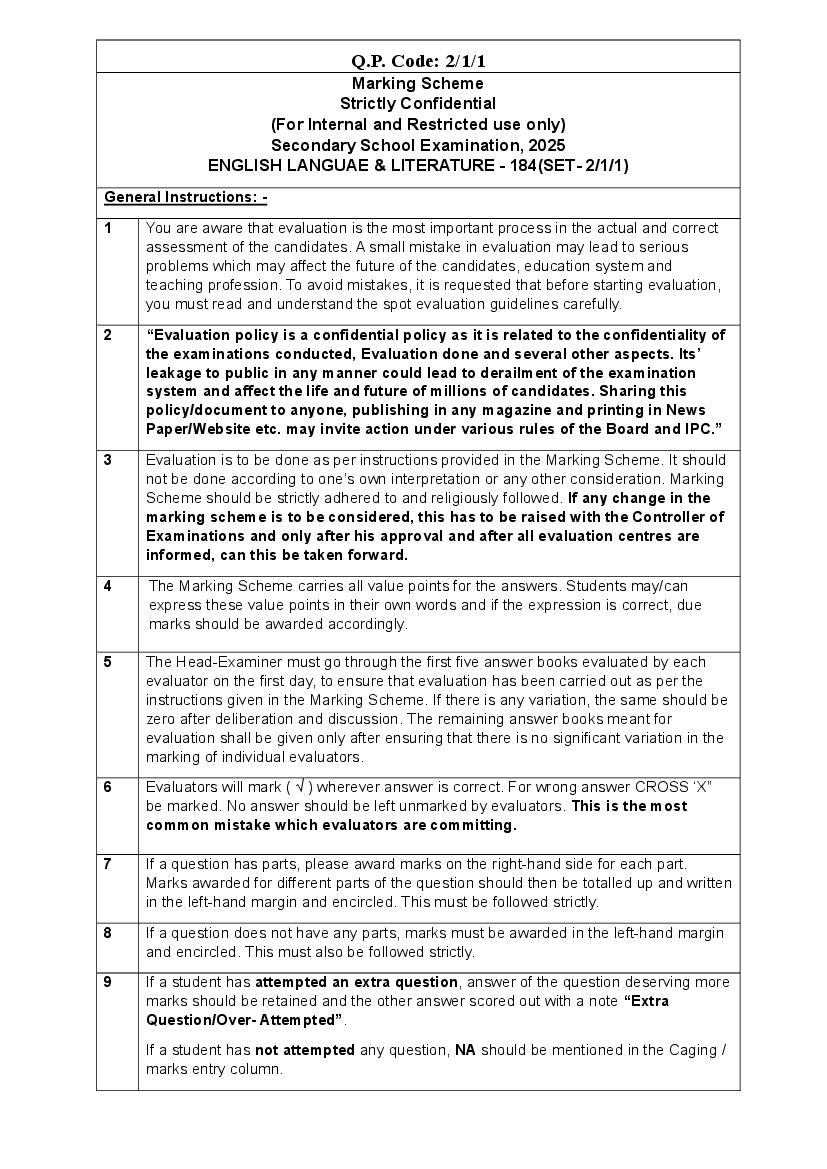
Strictly Confidential
(For Internal and Restricted use only)
Secondary School Examination, 2025
ENGLISH LANGUAE & LITERATURE - 184(SET- 2/1/1)
General Instructions: -
1 You are aware that evaluation is the most important process in the actual and correct
assessment of the candidates. A small mistake in evaluation may lead to serious
problems which may affect the future of the candidates, education system and
teaching profession. To avoid mistakes, it is requested that before starting evaluation,
you must read and understand the spot evaluation guidelines carefully.
2 “Evaluation policy is a confidential policy as it is related to the confidentiality of
the examinations conducted, Evaluation done and several other aspects. Its’
leakage to public in any manner could lead to derailment of the examination
system and affect the life and future of millions of candidates. Sharing this
policy/document to anyone, publishing in any magazine and printing in News
Paper/Website etc. may invite action under various rules of the Board and IPC.”
3 Evaluation is to be done as per instructions provided in the Marking Scheme. It should
not be done according to one’s own interpretation or any other consideration. Marking
Scheme should be strictly adhered to and religiously followed. If any change in the
marking scheme is to be considered, this has to be raised with the Controller of
Examinations and only after his approval and after all evaluation centres are
informed, can this be taken forward.
4 The Marking Scheme carries all value points for the answers. Students may/can
express these value points in their own words and if the expression is correct, due
marks should be awarded accordingly.
5 The Head-Examiner must go through the first five answer books evaluated by each
evaluator on the first day, to ensure that evaluation has been carried out as per the
instructions given in the Marking Scheme. If there is any variation, the same should be
zero after deliberation and discussion. The remaining answer books meant for
evaluation shall be given only after ensuring that there is no significant variation in the
marking of individual evaluators.
6 Evaluators will mark ( √ ) wherever answer is correct. For wrong answer CROSS ‘X”
be marked. No answer should be left unmarked by evaluators. This is the most
common mistake which evaluators are committing.
7 If a question has parts, please award marks on the right-hand side for each part.
Marks awarded for different parts of the question should then be totalled up and written
in the left-hand margin and encircled. This must be followed strictly.
8 If a question does not have any parts, marks must be awarded in the left-hand margin
and encircled. This must also be followed strictly.
9 If a student has attempted an extra question, answer of the question deserving more
marks should be retained and the other answer scored out with a note “Extra
Question/Over- Attempted”.
If a student has not attempted any question, NA should be mentioned in the Caging /
marks entry column.
Page 2
only once.
11 A full scale of marks __________(example 0 to 80/70/60/50/40/30 marks as given in
Question Paper) has to be used. Please do not hesitate to award full marks if the
answer deserves it.
12 Every examiner has to necessarily do evaluation work for full working hours i.e., 8
hours every day and evaluate 20 answer books per day in main subjects and 25
answer books per day in other subjects (Details are given in Spot Guidelines).
13 Ensure that you do not make the following common types of errors committed by the
Examiner in the past:-
● Leaving answer or part thereof unassessed in an answer booklet.
● Giving more marks for an answer than assigned to it.
● Wrong totalling of marks awarded on an answer.
● Wrong transfer of marks from the inside pages of the answer booklet to the title
page.
● Wrong question wise totalling on the title page.
● Wrong totalling of marks of the two columns on the title page.
● Wrong grand total.
● Marks in words and figures not tallying/not same.
● Wrong transfer of marks from the answer book to online award list.
● Answers marked as correct, but marks not awarded. (Ensure that the right tick mark
is correctly and clearly indicated. It should merely be a line. Same is with the X for
incorrect answer.)
● Half or a part of answer marked correct and the rest as wrong, but no marks
awarded.
14 While evaluating the answer books if the answer is found to be totally incorrect, it
should be marked as cross (X) and awarded zero (0)Marks.
15 Any unassessed portion, non-carrying over of marks to the title page, or totalling error
detected by the candidate shall damage the prestige of all the personnel engaged in
the evaluation work as also of the Board. Hence, in order to uphold the prestige of all
concerned, it is again reiterated that the instructions be followed meticulously and
judiciously.
16 The Examiners should acquaint themselves with the guidelines given in the
“Guidelines for Spot Evaluation” before starting the actual evaluation.
17 Every Examiner shall also ensure that all the answers are evaluated, marks carried
over to the title page, correctly totalled and written in figures and words.
18 It may be noted that the candidates are entitled to obtain photocopy of the Answer
Book on request on payment of the prescribed processing fee. All
Examiners/Additional Head Examiners/Head Examiners are once again reminded that
they must ensure that evaluation is carried out strictly as per value points for each
answer as given in the Marking Scheme.
Page 3
QP CODE-2/1/1
$
MARKING SCHEME
English Language and Literature (Code No. 184)
CLASS-X (2024-25)
SECTION A- 20 marks
Reading
QNO. MARKS
1. Passage 1 10 Marks
i. Tone – Informative / objective / formal / appreciative ½ +½
Rationalization - Writer - presented factual information about the
historical use of Saffron - its medicinal properties, without any
particular emotional or subjective bias.
ii.
(C) Saffron is considered to be the most valuable spice, similar to how gold is 1
valued among metals.
iii. (Any Two Value Points)
Being used since ages in various foods made for the royals and
elites/ Forms the backbone of several iconic dishes from around the
world
Contains medicinal properties. 1+1
Has strong aroma and unique flavour.
Has high retail value because of labour-intensive harvesting methods.
iv.
(B) widely recognised 1
v. (Any Two Value Points) 1+1
hand-picking / drying over charcoal fires/spread on trays/ forty
hours of labour
vi. 1
True
vii.
(C) Due to its labour - intensive cultivation process and its relatively low yield 1
per plant.
viii. (Any Two Value Points)
Beetroot and pomegranate are used as adulterants to enhance red colour
of Saffron ½+½
because of its high price, adulteration is quite common
silk fibres, oil or wax – used to add bulk
Powdered saffron can be adulterated with turmeric and paprika
2. Passage 2 10 Marks
i. (Any Two Value Points)
Soft and smooth texture 1+1
Feels comfortable on skin
Page 4
ii.
(A) Both the assertion and reason are true, and the reason is the correct 1
explanation of the assertion
iii. (Any One Value Point)
Labour-intensive cultivation. 1
Limited production due to natural factors.
Specialized knowledge, expertise required.
Careful selection for superior quality.
iv.
China and India ½+½
v. This makes the production limited/cost high/ (any other correct 1
response to be accepted )
vi. (Any One Value Point)
easily damaged as it loses 20% strength when wet 1
moderate to poor elasticity
weakened when exposed to sunlight
if dirty – attacked by insects
vii. Karnataka produced the most amount ½+½
Uttar Pradesh produced the least amount.
viii. …production of 1 kg of silk 1
ix. It requires specialized knowledge / expertise by skilled artisans and
craftsmanship. 1
SECTION B – 20 marks
Grammar and Creative Writing Skills
GRAMMAR 10 Marks
3. Any ten out of twelve questions to be attempted/marked. 10 x 1 =
(Full credit 1 mark for correct answers) 10
(No partial credit )
i. Considering 1
ii. trapping – trapped 1
iii. Yukti asked Sanjay if/whether that restaurant served good South Indian food 1
iv. (B) If she was sure she could manage. 1
v. Migrate 1
vi. ERROR – Much 1
CORRECTION – More/ Something
vii. (C) between – among 1
viii. (C ) enjoyed 1
ix. She had finished the project the day before/ the previous day 1
x. (B) will be held 1
xi. (B) ensure 1
xii. ERROR – upto 1
CORRECTION - into
Page 5
4. Formal Letter Writing - Any one from (a) and (b) to be attempted 5
a. Format – 1 mark (no mark for format alone if content is irrelevant 1+1+1+2
or missing, full credit of 1 mark if all aspects are mentioned.
Partial credit of ½ mark if one or two aspects are missing
No credit if more than two aspects are missing
Organisation of ideas – 1 mark (effective style, orderly sequence,
paragraphed structure and formal tone and vocabulary)
Accuracy – 1 mark (spelling, punctuation and grammar)
Content – 2 marks (Any two value points)
Topic Introduction / Problem: inadequate healthcare
infrastructure
Reasons – Lack of resources, population explosion, apathy of
authorities
Suggestive measures – Creating more wellness centers, opening
specialized hospitals for children and women.
(Any other relevant point to be accepted)
OR
b. Format – 1 mark (no mark for format alone if content is irrelevant 1+1+1+2
or missing, full credit of 1 mark if all aspects are mentioned.
Partial credit of ½ mark if one or two aspects are missing
No credit if more than two aspects are missing
Organisation of ideas – 1 mark (effective style, orderly sequence,
paragraphed structure and formal tone and vocabulary)
Accuracy – 1 mark (spelling, punctuation and grammar)
Content – 2 marks (Any two value points)
Introduction of Topic - Importance of physical education - Health
is Wealth, Physical fitness –most important, makes mind fresh and
active
Problem - Youth’s increasing tendency towards video games
Lack of open space
Suggestive Measures – Creating more open spaces, dedicated
sports universities, open gyms/ yoga centres ; encouraging physical
sports in schools and communities
(Any other relevant point to be accepted)
5. Analytical Paragraph Writing - Any one from (a) and (b) to be 5
attempted.
a. Organisation of ideas – 2 (effective style, orderly sequence, single 2+1+2
paragraph structure, formal tone and functional vocabulary,
Linking words and phrases like: however, in addition to, in
contrast to, therefore etc. should be included)
Accuracy – 1 (spelling, punctuation and grammar)
Content – 2 marks
Full credit of 2 marks for all value points given in the question
Partial credit of 1 mark if only two value points are given
At least any two value points from those given below to be
included –
Page 6
no travel cost, saves time
VS
Classroom Learning – same place, same time ; caters to the needs
of the class ; transportation cost and time consuming
OR
b. Organisation of ideas – 2 (effective style, orderly sequence, single 2+1+2
paragraph structure, formal tone and functional vocabulary,
Linking words and phrases like: however, in addition to, in
contrast to, therefore etc. should be included)
Accuracy – 1 (spelling, punctuation and grammar)
Content – 2 marks
Full credit of 2 marks for all value points given in the question
Partial credit of 1 mark if only two value points are given
At least any two value points from those given below to be
included –
Electronic device that can store and process information
makes life easy and simple
physical description – monitor, keyboard, CPU and mouse
computer technology used in all fields – education, medicine,
commerce and entertainment
SECTION C 40 Marks
Literature Textbook and Supplementary Reading Text
6. Answer the questions for any one from the given two extracts (a) and (b). 5
a.
i. (C) There was a hailstorm 1
ii. Devastated 1
iii. (Any Two Value Points) 1+1
All his effort put in the field had gone in vain.
The storm had destroyed his cornfields.
He will not be able to earn any money as the crops were destroyed.
iv. A few leaves would have been left 1
OR
b.
i. (Any One Value Point) 1
Anil was careless/casual/generous about his money.
Anil did not seem to bother about little profit made by Hari Singh.
Anil was being helpful by not disclosing the fact that he knew about the
profit being made by Hari Singh
ii. (C) That he would be able to accomplish a lot if he gets educated. 1
iii. Anil promised to teach him how to cook, write his name, whole
sentences and add numbers.
1 +1
The narrator felt grateful for the opportunity to learn, believing that once
he could write like an educated man, there would be no limit to what he
could achieve
Page 7
7. Answer the questions for any one from the given two extracts (a) and (b). 5
a.
i. (Any One Value Point) 1
It is a term of endearment or affection.
It suggests a close relationship or familiarity between the speaker and the
person they are addressing
ii. (Any Two Value Points) 1+1
The “yellow hair” mentioned in the poem is likely symbolic of physical
beauty or attractiveness
The religions man suggests it not to be the basis of God’s love.
Youth considers it to be a reason for loving someone
iii. Selfless 1
iv. 1 mark to be awarded to all students who attempt this question as the options 1
given do not contain the correct answer.
OR
b.
i. Oxymoron – In his quiet rage 1+1
Metaphor – pads of velvet quiet
Repetition – quiet
Alliteration – stress, should, stripes, shadow
Imagery – lurking, sliding
Personification
1 mark for identification and 1 mark for naming the figure of speech
ii. Soft, restless, restrained, smooth, stealthily (Any One Value Point) 1
iii. (B) both subdued and angry. 1
iv. (B) Along the sand, the people 1
All turn and look one way
They turn back on the sand
They look at the sea all day
8. Answer any Four of the following five questions in 40- 50 words. 4 X 3 = 12
Content – 2 Marks
Expression – 1 Mark (Effective style, coherence/cohesion)
i. (Any Two Value Point) 2 +1
Mandela talks about decades of oppression and brutality faced by
Black people of South Africa.
The structure created by white people was hurtful - formed the
basis of one of the harshest, most inhumane societies the world has
ever known.
The prejudice, discrimination created by the Whites – developed a
sense of inferiority in the blacks
The trauma/ atmosphere of fear for the Blacks
(Any other relevant point to be accepted)
ii. (1 mark for nature + 1 mark for simplicity) 2 +1
Nature – Hemlock tree, snow, crow, simple acts of nature can bring a
change/ healing effect
Page 8
scenario
iii. (1 mark for Rajvir’s excitement + 1 mark for Pranjol’s lack of 2 +1
enthusiasm)
Rajvir was excited about the magnificent view because he saw it
for the first time.
Pranjol was a youngster from Assam only and was born and
brought up on a plantation. That’s why he was not excited.
iv. (Any Two Value Points) 2 +1
The poem humorously provides guidelines for identifying various wild
animals encountered in the jungle.
Through witty descriptions and clever rhymes, Wells presents distinct
characteristics of different animals.
By employing a light hearted approach, Wells effectively conveys
information about wildlife in a memorable and engaging manner.
The underlying themes of human-animal interactions and the importance
of keen observation in understanding nature are subtly woven into the
humorous narrative
(Any other relevant point to be accepted)
v. (Any Two Value Points) 2 +1
Mijbil was packed into a box not more than 18 inches square – felt
uncomfortable/injured, to be carried on the floor at the author’s feet in
the airplane
When the author got back after the meal, Mijbil had torn the lining of the
box to shreds.
In the aircraft, Mijbil was out of the box in a flash. He disappeared
at a high speed down the aircraft. There were squawks and shrieks.
It was an eventful journey for the author – could not take a direct
flight because pets were not allowed
(Any other relevant point to be accepted)
9. Answer any Four of the following five questions in 40- 50 words. 2X3=6
Content – 2 Marks
Expression – 1 Mark (Effective style, coherence/cohesion)
i. (Any Two Value Points) 2 +1
Mrs. Pumphrey’s overindulgence – over pampering, overfeeding
Reluctance to impose discipline on Tricki reflects a common
tendency among pet owners to spoil their animals without
considering the consequences.
The absence of adequate exercise for Tricki emphasizes the
importance of regular exercise for pets and the impact of external
factors on their well being.
It offers a critical examination of human behaviour towards animals and
the need for responsible pet ownership
(Any other relevant point to be accepted)
ii. (Any Two Value Points) 2 +1
Page 9
pivotal role in saving the earth from destruction.
Martian invasion was prevented because of the book
The book, discovered by the inhabitants of a faraway planet,
contains nursery rhymes from Earth’s literature, which the aliens
misinterpret as factual accounts of historical events.
The misunderstanding arises when the aliens lacking knowledge of
Earth’s culture and language, mistake the nursery rhymes for an
accurate depiction of human history.
(Any other relevant point to be accepted)
iii. (Any Two Value Points) 2 +1
Griffin undergoes significant character development. Once a figure
consumed by his desire for power and dominance through
invisibility, Griffin, later, grappled with the consequences of his
actions.
He navigates a world where his once extraordinary abilities
became a burden, leading him to confront the moral implications of
his scientific pursuits.
Examples from text how he indulges in many harmful activities.
(Any other relevant point to be accepted)
10. Answer any One of the following two questions in 100- 120 words. 1 X 6 =6
Content – 3 Marks
Expression – 2 Marks (Effective style, coherence/cohesion)
Accuracy – 1 Mark (Grammar, spellings and punctuation)
a. (Any Three Value Points – At least one value point for each text) 3 + 2 +1
Amanda-
Amanda represents the longing for freedom – felt dominated, while her
mother/parent/guardian, represents instructional control over freedom,
this highlights the contrast.
The poem conveys the moral that children need to be allowed more
freedom. Excessive nagging may make them annoyed and disobedient
and hence they may develop a type of dislike for real life.
Madam rides the bus-
On the other hand, Valli - eight years old – has no friends – wanted to
explore the world - mesmerized by the bus journey between her village
and the city - started saving money for the bus fare.
Planned her journey meticulously.
(Any other relevant point to be accepted)
OR
b. (At least 1 value point from each text + 1 mark for conclusion) 3 + 2 +1
The ball poem- Berryman - beautifully describes a boy who has
lost his ball - gave a lesson full a wisdom - everyone must learn to
Page 10
bearing those losses - both material and human.
‘A Long Walk to Freedom’ by Nelson Mandela is about the
struggle of freedom of South Africa. Mandela recalls the reason for
this movement - black-skinned people exploited by the whites.
While taking vow as the first black President, Mandela established
democracy in the country - said there would be no discrimination
henceforth.
Conclusion - While the Ball Poem teaches us to accept loss and that
suffering is a part of life, A Long Walk to Freedom, teaches us to fight
for loss of freedom and suffering as a human right.
(Any other relevant point to be accepted)
11. Answer any One of the following two questions in 100- 120 words. 1X6=6
Content – 3 Marks
Expression – 2 Marks (Effective style, coherence/cohesion)
Accuracy – 1 Mark (Grammar, spellings and punctuation)
a. (Any Three Value Points) 3 + 2 +1
Horace had gone to steal from the safe
Was befooled by the lady in red
Believed her to be the mistress/owner, as claimed by her
Opened the safe for her without taking any precautions e.g. gloves – left
fingerprints everywhere
Was imprisoned
Meticulously planned robbery came to a naught as not familiar with the
owner
Regretted – duped by the lady, ran away with the money
Realizes that one should never trust anyone blindly
(Any other relevant point to be accepted)
OR
b. (Any Three Value Points) 3 + 2 +1
Matilda - pretty, young lady - wanted to lead a luxurious life - born in a
humble family - married an ordinary man/clerk
Wanted to pretend to be a rich woman at the Ball
lacked wisdom and prudence.
Just to show off at the ball - borrowed necklace from a friend – lost it -
led to enormous sufferings for her and her husband for many years.
After the loss - became mature, humble and grateful.
Earlier, did not understand the importance of living within one’s means -
later on realized her mistake.
(Any other relevant point to be accepted)
Document Details
| Board / Org | CBSE |
| Exam | Class 10 |
| Type | Solution |
| Pages | 10 |
| Updated | 24 Sep 2026 |