CBSE Class 10 Question Paper 2025 Solution Food Producation
Finished viewing? Save it for later —
Download CBSE Class 10 Question Paper 2025 Solution Food Producation (PDF · 9 pages)About CBSE Class 10 Question Paper 2025 Solution Food Producation
CBSE Class 10 Question Paper 2025 Solution Food Producation is available here for free download. Published by CBSE for Class 10, this solution can be viewed online or downloaded as a PDF (9 pages). Candidates preparing for Class 10 can use CBSE Class 10 Question Paper 2025 Solution Food Producation to understand the exam pattern, the type of questions asked, and the overall difficulty level.
Frequently Asked Questions
How can I download CBSE Class 10 Question Paper 2025 Solution Food Producation?
Open this page and click the Download button to save CBSE Class 10 Question Paper 2025 Solution Food Producation as a PDF. It is completely free on AglaSem Docs.
Is CBSE Class 10 Question Paper 2025 Solution Food Producation free to download?
Yes. CBSE Class 10 Question Paper 2025 Solution Food Producation can be viewed online and downloaded as a PDF free of cost on AglaSem Docs.
How many pages does CBSE Class 10 Question Paper 2025 Solution Food Producation have?
CBSE Class 10 Question Paper 2025 Solution Food Producation contains 9 pages, which you can read online or download together as a single PDF.
Where can I find more Class 10 study material?
You can find more Class 10 question papers, sample papers, syllabus, and answer keys on AglaSem Docs.
CBSE Class 10 Question Paper 2025 Solution Food Producation – Text
Read the full text of this solution below — useful to quickly search, copy and reference the content online without downloading the PDF.
📄 View text version (9 pages)
Page 1
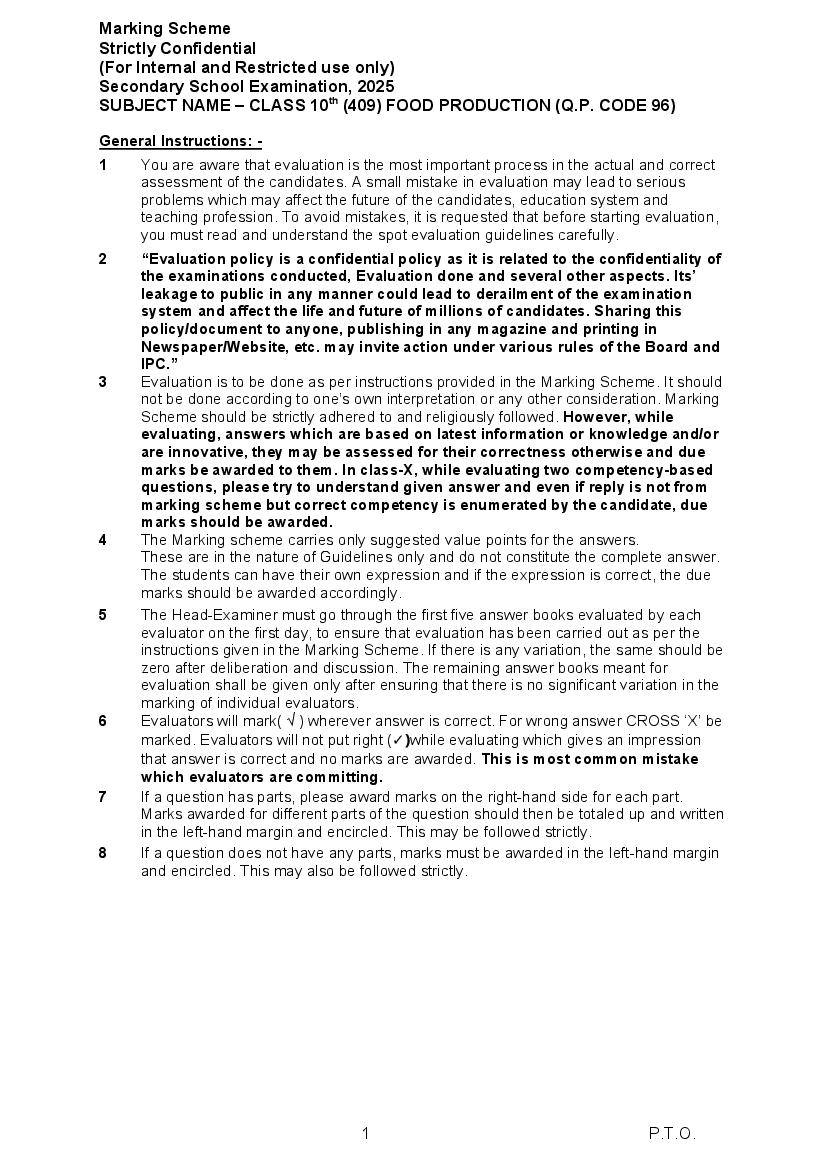
Strictly Confidential
(For Internal and Restricted use only)
Secondary School Examination, 2025
SUBJECT NAME – CLASS 10th (409) FOOD PRODUCTION (Q.P. CODE 96)
General Instructions: -
1 You are aware that evaluation is the most important process in the actual and correct
assessment of the candidates. A small mistake in evaluation may lead to serious
problems which may affect the future of the candidates, education system and
teaching profession. To avoid mistakes, it is requested that before starting evaluation,
you must read and understand the spot evaluation guidelines carefully.
2 “Evaluation policy is a confidential policy as it is related to the confidentiality of
the examinations conducted, Evaluation done and several other aspects. Its’
leakage to public in any manner could lead to derailment of the examination
system and affect the life and future of millions of candidates. Sharing this
policy/document to anyone, publishing in any magazine and printing in
Newspaper/Website, etc. may invite action under various rules of the Board and
IPC.”
3 Evaluation is to be done as per instructions provided in the Marking Scheme. It should
not be done according to one’s own interpretation or any other consideration. Marking
Scheme should be strictly adhered to and religiously followed. However, while
evaluating, answers which are based on latest information or knowledge and/or
are innovative, they may be assessed for their correctness otherwise and due
marks be awarded to them. In class-X, while evaluating two competency-based
questions, please try to understand given answer and even if reply is not from
marking scheme but correct competency is enumerated by the candidate, due
marks should be awarded.
4 The Marking scheme carries only suggested value points for the answers.
These are in the nature of Guidelines only and do not constitute the complete answer.
The students can have their own expression and if the expression is correct, the due
marks should be awarded accordingly.
5 The Head-Examiner must go through the first five answer books evaluated by each
evaluator on the first day, to ensure that evaluation has been carried out as per the
instructions given in the Marking Scheme. If there is any variation, the same should be
zero after deliberation and discussion. The remaining answer books meant for
evaluation shall be given only after ensuring that there is no significant variation in the
marking of individual evaluators.
6 Evaluators will mark( √ ) wherever answer is correct. For wrong answer CROSS ‘X’ be
marked. Evaluators will not put right (✓)while evaluating which gives an impression
that answer is correct and no marks are awarded. This is most common mistake
which evaluators are committing.
7 If a question has parts, please award marks on the right-hand side for each part.
Marks awarded for different parts of the question should then be totaled up and written
in the left-hand margin and encircled. This may be followed strictly.
8 If a question does not have any parts, marks must be awarded in the left-hand margin
and encircled. This may also be followed strictly.
1 P.T.O.
Page 2
marks should be retained and the other answer scored out with a note “Extra
Question”.
10 No marks to be deducted for the cumulative effect of an error. It should be penalized
only once.
11 A full scale of marks __________(example 0 to 80/70/60/50/40/30 marks as given in
Question Paper) has to be used. Please do not hesitate to award full marks if the
answer deserves it.
12 Every examiner has to necessarily do evaluation work for full working hours i.e., 8
hours every day and evaluate 20 answer books per day in main subjects and 25
answer books per day in other subjects (Details are given in Spot Guidelines).This is in
view of the reduced syllabus and number of questions in question paper.
13 Ensure that you do not make the following common types of errors committed by the
Examiner in the past:-
● Leaving answer or part thereof unassessed in an answer book.
● Giving more marks for an answer than assigned to it.
● Wrong totaling of marks awarded on an answer.
● Wrong transfer of marks from the inside pages of the answer book to the title
page.
● Wrong question wise totaling on the title page.
● Wrong totaling of marks of the two columns on the title page.
● Wrong grand total.
● Marks in words and figures not tallying/not same.
● Wrong transfer of marks from the answer book to online award list.
● Answers marked as correct, but marks not awarded. (Ensure that the right tick
mark is correctly and clearly indicated. It should merely be a line. Same is with the
X for incorrect answer.)
● Half or a part of answer marked correct and the rest as wrong, but no marks
awarded.
14 While evaluating the answer books if the answer is found to be totally incorrect, it
should be marked as cross (X) and awarded zero (0)Marks.
15 Any unassessed portion, non-carrying over of marks to the title page, or totaling error
detected by the candidate shall damage the prestige of all the personnel engaged in
the evaluation work as also of the Board. Hence, in order to uphold the prestige of all
concerned, it is again reiterated that the instructions be followed meticulously and
judiciously.
16 The Examiners should acquaint themselves with the guidelines given in the
“Guidelines for Spot Evaluation” before starting the actual evaluation.
17 Every Examiner shall also ensure that all the answers are evaluated, marks carried
over to the title page, correctly totaled and written in figures and words.
18 The candidates are entitled to obtain photocopy of the Answer Book on request on
payment of the prescribed processing fee. All Examiners/Additional Head
Examiners/Head Examiners are once again reminded that they must ensure that
evaluation is carried out strictly as per value points for each answer as given in the
Marking Scheme.
2 P.T.O.
Page 3
MARKING SCHEME CLASS 10th
FOOD PRODUCTION (409)
Q.N SECTION A MARKS
O (Objective Type Questions )
1 Answer any 4 out of the given 6 questions on 4 1 = 4
Employability Skills.
(i) (C) Feedback 1
(ii) (C) Self-aware 1
(iii) (D)Ignoring available resources 1
(iv) (C) Operating System 1
(v) (B) A self employed person running a business 1
(vi) (C) Population 1
2. Answer any 5 out of the given 6 questions. 5 1 = 5
(i) (D) Fruits 1
(ii) (A) Water 1
(iii) (C) Tiny turnips 1
(iv) (A) Lentil soup 1
(v) (A) Moisten the salad 1
(vi) (C) French loaf 1
3. Answer any 5 out of given 6 questions. 5x1=5
(i) (B) Carbohydrates 1
(ii) (A) Conduction 1
(iii) (C) Chlorophyll 1
(iv) (A) velouté 1
3 P.T.O.
Page 4
(C) Tossed salad
Any one
(vi) (A) Sandwich 1
4. Answer any 5 out of given 6 questions. 5x1=5
(i) (A) Proteins 1
(ii) (B) Flow of thermal energy from high-temperature reservoir to 1
low temperature reservoir.
(iii) (A) Chiffonade 1
MARKS TO BE AWARDED FOR ANY OPTION IF
ATTEMPTED
(iv) (D) Roux 1
MARKS TO BE AWARDED FOR ANY OPTION IF
ATTEMPTED
(v) (D) Bread 1
(vi) (C) Mayonnaise 1
5. Answer any 5 out of the given 6 questions. 5x1=5
(i) (C) To increase the palatability of food. 1
(ii) (B) Porcelain 1
(iii) (C) Nutrients are preserved 1
(D) Food is cooked fast
Any one
(iv) (C) India 1
(v) (A) Vegetable based salad 1
(vi) (C) 3 1
SECTION B
(Subjective Type Questions)
6. Non -verbal communication is the expression or exchange of 1+1=2
information or messages without using any spoken or written
word. with the help of facial expressions, hand gestures, eye
4 P.T.O.
Page 5
example 1 Raising a hand to greet
2 Pointing finger at some one
3 Sad face, smile, standing straight, showing interest
4 Any other
(Any one example)
7. Personality management refers to the process of developing, 2
maintaining and improving an individual’s characteristics, and
behaviors to achieve personal and professional goals.
It also involves identifying one’s strength and weakness to deal
in adverse situations.
By managing the personality effectively individuals can
improve their overall well being, achieve goals and develop a
positive impact on those around them.
(Any other)
8. Points to be considered for taking care of Desktop of 1x2=2
computer.
Protecting with cover
unplug to avoid overcharging
update operating system
use antivirus scan
clean keyboard
Proper ventilation and temperature
Check cable and connection
Handle with care
Any other
(Any two)
Ways in which an Entrepreneur affects a society.
9. 1x2=2
Creates job/Provides job opportunity
uses local resources
provides products and services
solves problem
5 P.T.O.
Page 6
creates competitive market
Any other
(Any two)
10. Issues that can arise due to exploitation of 1x2=2
environment.
Global warming,
soil erosion
floods
depletion of fossil fuel
Pollution-Air, water and land
Deforestation
Any other
(Any two)
11. Four objectives of cooking food 1/2x4=2
Helps in digestion
Kills bacteria, keep the food sterile
Nutritional adequacy
Increases shelf life
Enhances palatability
Increases eye appeal
Easy to chew and digest
Brings variety in flavor, texture and aroma
(Any four)
12. Conduction-process of using metal like pan and utensils for 2
transferring the heat to object.
In deep fat frying, food is submerged in hot oil, and the heat is
transferred directly from the oil to the food through
conduction.
Example- using stainless steel vessels
Convection-Movement of heated particles of gases or liquid.
6 P.T.O.
Page 7
the cooler particles take their place .
Example- oven
(Marks to be awarded if any one or both methods are
explained)
13. Vitamin-A 1X2=2
Vitamin-B
Vitamin-C
Vitamin-E
Vitamin-K
(Any two)
14. Two examples of cream soup are:- 1x2=2
Cream of tomatoes
Cream of peas
Cream of mushroom
Cream of chicken
Cream of cauliflower
Cream of Broccoli
Cream of Pumpkin and lentil
(Any two)
15. A salad can be defined as dish prepared of various mixtures of 2
raw or cooked vegetables and other food items, usually
seasoned with oil, vinegar or other dressing and sometimes
accompanied by paneer, egg, meat, fish or other ingredients.
It can be served as side dish , a light meal or even as a main
course
16. Grilled Sandwich-A grilled sandwich is a sandwich made by 2
cooking bread with a filling between the slices.
The filling can be cheese, paneer, vegetables, chicken or meat
Example-grilled paneer sandwich, grilled cheese
sandwich, grilled chicken sandwich.
7 P.T.O.
Page 8
Moist cooking method
Liquid in small quantity
Liquid is not actually bubbling
Temperature-71℃-82℃ or (160℉-180℉)
Preserves Nutrients, flavor and texture
(Any Four)
Example-Poaching of vegetables, fruits, chicken, egg
and fish
18. Guidelines to minimize nutrient losses during food 1/2x8=4
preparation.
Short cooking time
Cut bigger pieces/Do not over chop or puree
Minimum liquid amount to be used
Cover vessel while cooking
Cook food on low flame
Avoid overcooking
Do not overstore cooked food
Wash whole fruits and vegetables
Do not wash after cutting vegetables
Use stir frying and steaming method
Any other
(Any eight)
19. Four types of thick soup:- 1x4=4
1.Cream soup- made up of chicken, meat or any vegetable
and are known by the same name. example cream of chicken,
cream of cauliflower, cream of peas etc.
Thus soup takes the colour and taste of main ingredient even
though there might be other ingredients in small quantities.
Milk or cream is always added.
8 P.T.O.
Page 9
fresh starchy vegetables. Hence once cooked and pureed, the
starch form main ingredient itself thickens the soup. They may
or may not contain little cream. example. Puree of potatoes,
Puree of lentils, puree of pumpkin.
3.Bisque Soup- These soups are made with shell fish and are
usually thickened with rice.
4.Veloute Soup- These are made with meat or vegetable stock
thickened with flour cooked to a light brown color. A mixture of
egg yolk and cream is added to it. example Chicken velouté,
Cream of leek and potato velouté and Cream of carrot and
ginger velouté.
5.Chowders- Chowder is a seafood or vegetable stew , often
served with milk or cream mostly eaten with saltine crackers.
(Any four)
20. four keys to a quality salad 1x4=4
Fresh ingredients
Variety of ingredients
Balance of flavor
Eye appealing- good base and garnish
Properly seasoned
Adequate dressing providing moistness and flavour
Crunchy, crispy and soft texture
(Any four)
21. Open Sandwich-An open sandwich can be made from a 2+2=4
single slice of bread which can be applied with the dressing
and then topped with topping or filling on it.
Example. roast beef sandwich, garlic bread, pizza open
sandwich, cheese toasties, bruschetta
9 P.T.O.
Document Details
| Board / Org | CBSE |
| Exam | Class 10 |
| Type | Solution |
| Pages | 9 |
| Updated | 24 Sep 2026 |