Karnataka 2nd PUC Model Question Paper 2027 for Biology (Paper 2)
Finished viewing? Save it for later —
Download Karnataka 2nd PUC Model Question Paper 2027 for Biology (Paper 2) (PDF · 4 pages)About Karnataka 2nd PUC Model Question Paper 2027 for Biology (Paper 2)
Karnataka 2nd PUC Model Question Paper 2027 for Biology (Paper 2) is available here for free download. Published by Karnataka Board for Class 12, this sample paper can be viewed online or downloaded as a PDF (4 pages). Candidates preparing for Class 12 can use Karnataka 2nd PUC Model Question Paper 2027 for Biology (Paper 2) to understand the exam pattern, the type of questions asked, and the overall difficulty level.
Frequently Asked Questions
How can I download Karnataka 2nd PUC Model Question Paper 2027 for Biology (Paper 2)?
Open this page and click the Download button to save Karnataka 2nd PUC Model Question Paper 2027 for Biology (Paper 2) as a PDF. It is completely free on AglaSem Docs.
Is Karnataka 2nd PUC Model Question Paper 2027 for Biology (Paper 2) free to download?
Yes. Karnataka 2nd PUC Model Question Paper 2027 for Biology (Paper 2) can be viewed online and downloaded as a PDF free of cost on AglaSem Docs.
How many pages does Karnataka 2nd PUC Model Question Paper 2027 for Biology (Paper 2) have?
Karnataka 2nd PUC Model Question Paper 2027 for Biology (Paper 2) contains 4 pages, which you can read online or download together as a single PDF.
Where can I find more Class 12 study material?
You can find more Class 12 question papers, sample papers, syllabus, and answer keys on AglaSem Docs.
Karnataka 2nd PUC Model Question Paper 2027 for Biology (Paper 2) – Text
Read the full text of this sample paper below — useful to quickly search, copy and reference the content online without downloading the PDF.
📄 View text version (5 pages)
Page 1
Karnataka 2nd PUC
Model Question Paper
2027 for Biology (Paper
2)
EXAM YEAR TYPE SUBJECT
Karnataka Class 12 2027 Sample Paper Biology
Notes · Sample Papers · Previous Year Papers · Mock Tests
Page 2
. s e
em l a
as a g
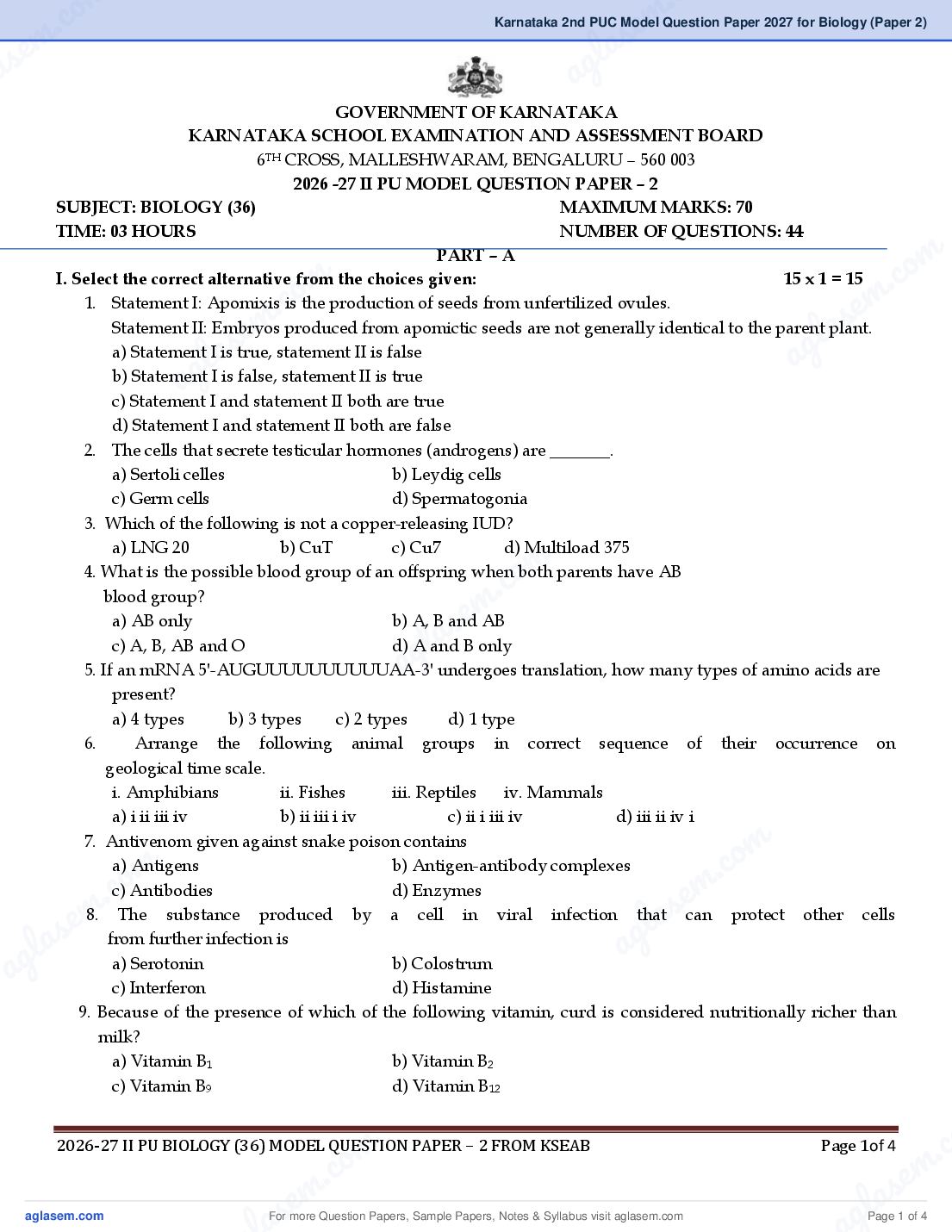
GOVERNMENT OF KARNATAKA
KARNATAKA SCHOOL EXAMINATION AND ASSESSMENT BOARD
6TH CROSS, MALLESHWARAM, BENGALURU – 560 003
2026 -27 II PU MODEL QUESTION PAPER – 2
SUBJECT: BIOLOGY (36) MAXIMUM MARKS: 70
m
TIME: 03 HOURS NUMBER OF QUESTIONS: 44
om . co
PART – A
.c m
I. Select the correct alternative from the choices given: 15 x 1 = 15
m se
a
1. Statement I: Apomixis is the production of seeds from unfertilized ovules.
s e g l
a
Statement II: Embryos produced from apomictic seeds are not generally identical to the parent plant.
l a
ag
a) Statement I is true, statement II is false
b) Statement I is false, statement II is true
c) Statement I and statement II both are true
d) Statement I and statement II both are false
2. The cells that secrete testicular hormones (androgens) are _______.
a) Sertoli celles b) Leydig cells
c) Germ cells d) Spermatogonia
3. Which of the following is not a copper-releasing IUD?
m
co
a) LNG 20 b) CuT c) Cu7 d) Multiload 375
.
4. What is the possible blood group of an offspring when both parents have AB
s em
blood group?
l a
a) AB only b) A, B and AB
c) A, B, AB and O
a g
d) A and B only
5. If an mRNA 5'-AUGUUUUUUUUUUAA-3' undergoes translation, how many types of amino acids are
present?
a) 4 types b) 3 types c) 2 types d) 1 type
6. Arrange the following animal groups in correct sequence of their occurrence on
geological time scale.
i. Amphibians ii. Fishes iii. Reptiles iv. Mammals
a) i ii iii iv b) ii iii i iv c) ii i iii iv d) iii ii iv i
m
c. o
7. Antivenom given against snake poison contains
m
c. o m
a) Antigens b) Antigen-antibody complexes
s e
em la
c) Antibodies d) Enzymes
las ag
8. The substance produced by a cell in viral infection that can protect other cells
g
from further infection is
a a) Serotonin
c) Interferon
b) Colostrum
d) Histamine
9. Because of the presence of which of the following vitamin, curd is considered nutritionally richer than
milk?
a) Vitamin B1 b) Vitamin B2
c) Vitamin B9 d) Vitamin B12
om . c
c m
2026-27 II PU BIOLOGY (36) MODEL QUESTION PAPER – 2 FROM KSEAB Page 1of 4
m . s e
se
For more Question Papers, Sample Papers, Notes & Syllabus visit
g l a
Page 1 of 4
Page 3
plant.
a) Nitrogen b) Phosphorus
c) Potassium d) Magnesium
11. In the given diagram of pBR322 vector, identify the restriction sites A, B, C
and D.
a) A- tetR, B- Hind III, C- Ori, D- ampR
b) A- Ori, B- ampR, C- tetR, D- Hind III
c) A- Hind III, B- tetR, C- ampR, D- Ori
d) A- ampR, B- tetR, C- Hind III, D- Ori
12. The plants developed by the fusion of protoplasts of two different plants are
called
a) Somaclones b) Somatic hybrids
c) Transgenic plants d) GM plants
13. In a pond if there were 20 lotus plants last year and through reproduction 16 are added. Calculate the
birth rate.
a) 0.8 offspring per lotus per year b) 0.4 offspring per lotus per year
c) 0.8 offspring per year d) 1.25 offspring per year
14. The correct sequence of steps in the process of decomposition is
a) Fragmentation → leaching → catabolism → humification → mineralization
b) Leaching → fragmentation → catabolism → humification → mineralization
c) Humification → fragmentation → leaching → catabolism → mineralization
d) Catabolism → fragmentation → leaching → humification → mineralization
15. The following are the in-situ conservation approaches except
a) National parks b) Wildlife sanctuaries
c) Biosphere reserves d) Botanical gardens
II. Fill in the blanks by choosing the appropriate word/words from those given in the bracket. 5 x 1 = 5
(Morphine, Endometrium, Reserpine, Fossils, Vector, Myometrium)
16. The glandular layer of uterus that undergoes cyclic changes during menstrual cycle is _________.
17. The paleontological evidence for evolution is obtained from __________.
18. ______ is a very effective sedative and painkiller.
19. The plasmid DNA act as ________ to transfer the piece of DNA attached to it.
20. The genetic diversity shown by Rauwolfia vomitoria growing in Himalayan ranges produces an active
chemical called_________.
2026-27 II PU BIOLOGY (36) MODEL QUESTION PAPER – 2 FROM KSEAB Page 2of 4
For more Question Papers, Sample Papers, Notes & Syllabus visit Page 2 of 4
Page 4
. s e
em l a
as PART – B
a g
III. Answer any FIVE of the following questions in 3-5 sentences each, wherever applicable:
5 x 2 = 10
21. Write the significance of sporopollenin.
22. Mention the reasons for infertility in humans
23. Differentiate between linkage and recombination.
24. Draw a diagram of nucleosome and label two parts.
m
co
25. Comment on the similarity between the thorn of Bougainvillea and tendril of Cucurbita with reference to
om .
evolution.
.c
26. What are flocs? Write their significance in sewage treatment.
e m
e m l a s
s
27. Mention “The Evil Quartet” of biodiversity losses in a given habitat.
l a ag
ag PART – C
IV. Answer any FIVE of the following questions in 40-80 words each, wherever applicable: 5 x 3 =15
28. Draw a diagram of mature embryo sac and label three parts.
29. What is placenta? List its functions.
30. Define venereal diseases or sexually transmitted infections (STIs). Mention the modes of transmission
of STIs.
m
31. Draw a labelled diagram of Miller’s experimental set-up.
. co
32. Mention the causative organisms for the following diseases:
em
a) Ascariasis b) Typhoid c) Filariasis
a s
33. Name the microbes that help in the production of the following bioactive agents.
l
a g
a) Cyclosporin A b) Streptokinase c) Statins
34. Schematically represent pyramid of energy with appropriate units.
PART- D
V. Answer any FOUR of the following questions in 200-250 words each, wherever applicable: 4 x 5 = 20
35. Explain the different outbreeding devices developed by flowering plants.
36. Draw diagram of the sectional view of mammary gland and label five parts.
37. Schematically represent incomplete dominance by taking inheritance of flower colour in the
m
c. o
snapdragon as an example.
m
c. o
38. Explain Griffith’s ‘transforming principle’ experiment.
e m
em s
39. What are the functions of
s la
ag
a) i gene b) lac z gene c) lac y gene d) lac a gene e) inducer.
gla
40. Briefly explain the uses of transgenic animals.
a 41. What is mutualism? Explain any four examples of mutualism.
VI. Answer any ONE of the following questions in 200-250 words each, wherever applicable: 1 x 5 = 5
42. Identify the genetic disorders given below:
a) Sex-linked recessive disorder occurring in about 8% of males and only about 0.4% of females leading
to defect in cone of eye. (1M)
b) Sex-linked recessive disorder affecting a single protein involved in the clotting of blood. (1M)
om . c
c m
2026-27 II PU BIOLOGY (36) MODEL QUESTION PAPER – 2 FROM KSEAB Page 3of 4
m . s e
se
For more Question Papers, Sample Papers, Notes & Syllabus visit
g l a
Page 3 of 4
Page 5
d) Autosome linked recessive blood disease, substitution of amino acid in beta globin chain of
hemoglobin. (1M)
e) Autosome linked recessive blood disease, reduced rate of synthesis of globin chains of haemoglobin.
(1M)
43. The flowchart shows replication of the retrovirus in the host. Answer the questions given below:
a) Fill in the missing data in boxes labeled 1 & 2 (2M)
b) Give an example for retrovirus. (1M)
c) Name the disease caused by this retrovirus. (1M)
d) Name the diagnostic test for this disease. (1M)
44. Give reasons for the following:
a) Restriction enzymes are called ‘molecular scissors.
b) DNA ligase is used in genetic engineering.
c) Chilled ethanol is used in DNA isolation.
d) Smaller DNA fragments move farther in a gel slab.
e) Thermostable DNA polymerase is used in polymerase chain reaction.
*********************************
2026-27 II PU BIOLOGY (36) MODEL QUESTION PAPER – 2 FROM KSEAB Page 4of 4
For more Question Papers, Sample Papers, Notes & Syllabus visit Page 4 of 4
Document Details
| Board / Org | Karnataka Board |
| Exam | Class 12 |
| Type | Sample Paper |
| Pages | 4 |
| Language | english |
| Updated | 03 Nov 2026 |