Class 11 Sample Paper 2022 History Term 1
Finished viewing? Save it for later —
Download Class 11 Sample Paper 2022 History Term 1 (PDF)About Class 11 Sample Paper 2022 History Term 1
Class 11 Sample Paper 2022 History Term 1 is available here for free download. Published by AglaSem for Class 11, this sample paper can be viewed online or downloaded as a PDF. Candidates preparing for Class 11 can use Class 11 Sample Paper 2022 History Term 1 to understand the exam pattern, the type of questions asked, and the overall difficulty level.
Frequently Asked Questions
How can I download Class 11 Sample Paper 2022 History Term 1?
Open this page and click the Download button to save Class 11 Sample Paper 2022 History Term 1 as a PDF. It is completely free on AglaSem Docs.
Is Class 11 Sample Paper 2022 History Term 1 free to download?
Yes. Class 11 Sample Paper 2022 History Term 1 can be viewed online and downloaded as a PDF free of cost on AglaSem Docs.
Where can I find more Class 11 study material?
You can find more Class 11 question papers, sample papers, syllabus, and answer keys on AglaSem Docs.
Class 11 Sample Paper 2022 History Term 1 – Text
Read the full text of this sample paper below — useful to quickly search, copy and reference the content online without downloading the PDF.
📄 View text version (18 pages)
Page 1
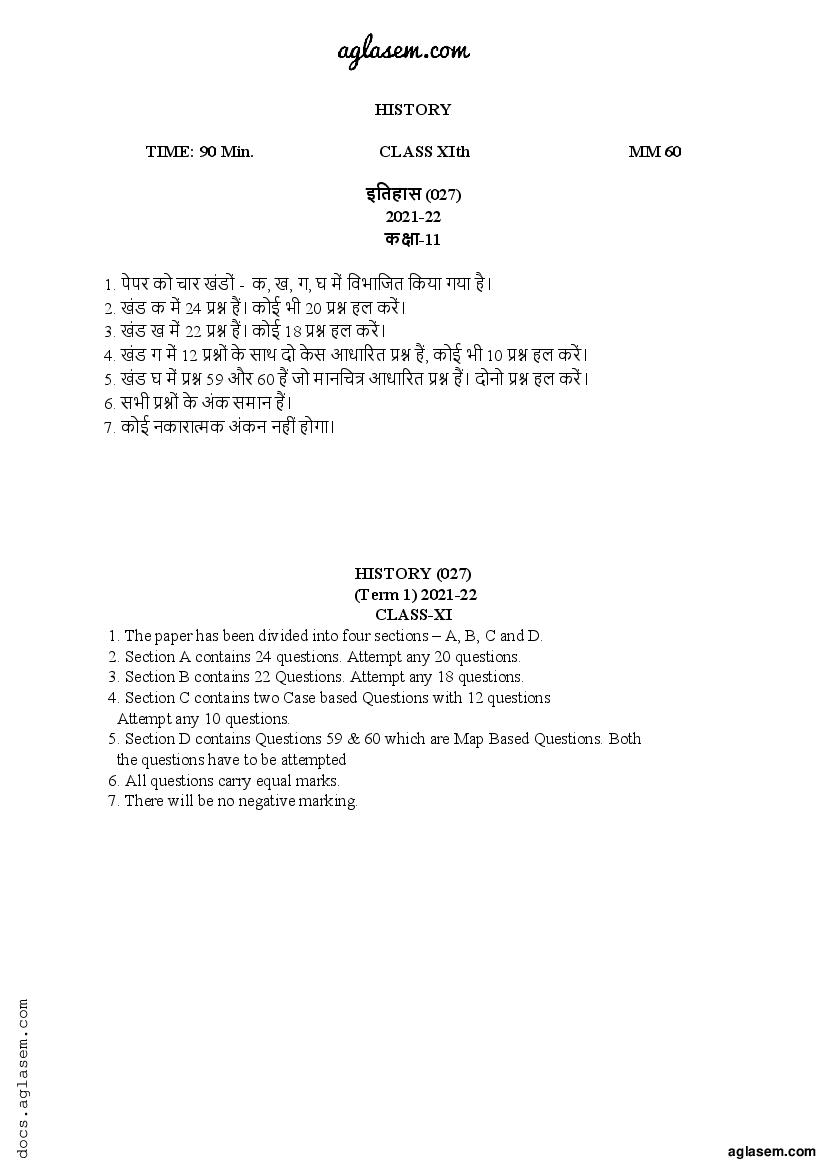
TIME: 90 Min. CLASS XIth MM 60
इितहास (027)
2021-22
क(ा-11
1. पेपर को चार खंडों - क, ख, ग, घ म. िवभािजत िकया गया है ।
2. खंड क म. 24 89 ह: । कोई भी 20 89 हल कर. ।
3. खंड ख म. 22 89 ह: । कोई 18 89 हल कर. ।
4. खंड ग म. 12 89ों के साथ दो केस आधाCरत 89 ह: , कोई भी 10 89 हल कर. ।
5. खंड घ म. 89 59 और 60 ह: जो मानिचF आधाCरत 89 ह: । दोनो 89 हल कर. ।
6. सभी 89ों के अंक समान ह: ।
7. कोई नकाराHक अंकन नहीं होगा।
HISTORY (027)
(Term 1) 2021-22
CLASS-XI
1. The paper has been divided into four sections – A, B, C and D.
2. Section A contains 24 questions. Attempt any 20 questions.
3. Section B contains 22 Questions. Attempt any 18 questions.
4. Section C contains two Case based Questions with 12 questions
Attempt any 10 questions.
5. Section D contains Questions 59 & 60 which are Map Based Questions. Both
the questions have to be attempted
6. All questions carry equal marks.
7. There will be no negative marking.
Page 2
1. मेसोपोटािमया के हिथयार मुK Lप से िकससे बने थे?
(ए) कां O (बी) तां बा (सी) पPर (डी) लोहा
1. Mesopotamian weapons were prominently made of
(a) bronze (b) copper (c) stone (d) iron.
2. उRक शहर की शहरी अथTUवVथा Wारा हािसल िकया गया तकनीकी मील का पPर था
(ए) कां O उपकरण। (बी) ईंट Yंभों का िनमाT ण।
(सी) कुZार का पिहया। (डी) तेल िनकालने की तकनीक।
2. The technological landmark witnessed by the urban economy of the city of Uruk was
(a) bronze tools. (b) construction of brick columns.
(c) potter’s wheel. (d) oil pressing technique.
3. 2000 ईसा पूवT म., मेसोपोटािमया की शाही राजधानी के Lप म. फला-फूला शहर था
(क) उर (बी) मारी (सी) मोहनजोदड़ो (डी) कालीबंगा
3. In the 2000 BCE, the city that flourished as the royal capital of Mesopotamia was
(a) Ur (b) Mari (c) Mohenjodaro (d) Kalibangan.
4. मेसोपोटािमया का शासक जो 2370 ई.पू. म. अ^ड का राजा बना, वह था
(a) एनमेरकर (बी) िगलगमेश (सी) हमुराबी (डी) सरगोन
4. The Mesopotamian ruler who became the king of Akkad, in 2370 BCE, was (a) Enmerkar
(b) Gilgamesh (c) Hamurabi (d) Sargon
5. इ`ा ........ की दे वी थी
(ए) चंaमा (बी) bार और युc (सी) हवा। (डी) आग
5. Inanna was the Goddess of
(a) the Moon (b) love and War (c) wind. (d) fire
6. दिdणी मेसोपोटािमया म. सबसे पुराने मंिदरों का िनमाT ण म. िकया गया था
(ए) 4000 ईसा पूवT (बी) 5000 ईसा पूवT (सी) 6000 ईसा पूवT (डी) 7000 ईसा पूवT
6. The earliest temples in Southern Mesopotamia were built in
(a) c.4000 BCE (b) c.5000 BCE. (c) c.6000 BCE (d) c.7000 BCE
7. मेसोपोटािमया के शुRआती शहरों के लोगों Wारा िनिमTत मुK मंिदर िनeिलfखत थे।
I. ना`े II.अनु III.एनकी IV.इन`ा
Page 3
B. I, II, III
C. I, II
D. III, IV
7. Main temples constructed by the people of early cities of Mesopotamia were the following.
I.Nanne II.Anu III.Enki IV.Inanna
A.I, II, III, IV B. I, II,III
C. I, II D III , IV
8. मेसोपोटािमया की सgता की िवशेषता iा नहीं है -
• नगरों का िनमाT ण पूवT िनयोिजत रणनीित के अनुसार िकया गया था।
• िनमाT ण के िलए िमjी की ईंटों का इYेमाल िकया गया था।
• अिधकां श घर एक मंिजला के थे िजनम. एक आं गन था।
ए 1,2
बी 1,3
सी केवल 2
डी केवल 1
8. What is NOT a characteristic of Mesopotamian civilization-
• Towns were constructed according to pre-planned strategy.
• Mud bricks were used for construction.
• Most of the houses were of single story having a courtyard.
A. 1,2
B. 1,3
C. Only 2
D. Only 1
9. मेसोपोटािमया िलिप की िवशेषताएं थीं:
I.यह िमjी की पjी पर िलखा गया था।
िWतीय। यह बाएं से दाएं िलखा गया था।
A. I
B. केवल II
C. I और II दोनों
D. केवल उनम. से कोई नहीं
9. Features of Mesopotamian script were:
I.It was written on clay tablets.
Ii. It was written from left to right.
A. I
B. Only II
C. I and II both
D. Only None of them
10.. िनeिलfखत भाषा को पहचान.:
यह िहkू और अरबी पCरवार या भाषाओं के समूह की भाषा थी। यह भाषा अशोक के Ymों पर दे खी
जा सकती है ।
A फ़ारसी B. अरबी C. अरामाईक D. तुरानी
Page 4
It was a language of Hebrew and Arabic family or group of languages. This language can be
seen on the Ashokan pillars.
A Persian B. Arabic C. Aramaic D. Turani
11. मठवाद के मूp और उqे r के बारे म. अिनिsतता बढ़ रही थी..
A. 13वीं सदी B. 14वीं सदी C. 15वीं सदी D. 16वीं सदी.
11. There was a growing uncertainty about the value and purpose of monasticism by the
A. 13th century B. 14th century C. 15th century D. 16th century.
12. एक िगu (vेणी) िकसका संघ था?
A. िभdु B. िकसान C. िशw और उxोग D. लॉड्T स
12. A guild was an association of
A . monks. B. farmers C. craft and industry D. lords
13. 8िसc पुYक {ूडल सोसाइटी, जो |ां सीसी समाज से संबंिधत थी, िकसके Wारा िलखी गई थी:
A. जॉन किनंघम B. अले}.डर किनंघम
C. जे~ कैमरन D. माकT •ॉक
13. The famous book Feudal Society, which dealt with the French society, was written by:
A. John Cunningham B. Alexander Cunningham
C. James Cameron D. Marc Bloch
14. यूरोप ने भूिम उपयोग म. पCरवतTन "दो-dेF से तीन-dेF 8णाली म. f€च" के दौरान दे खा
A. 10वीं सदी B. 11वीं सदी C. 12वीं सदी D. 13वीं सदी
14. Europe witnessed change in land use "switch from a two-field to a three-field system"
during tithe
A. 10th century B. 11th century C. 12th century D. 13th century
15. लौडT Wारा नाईट को दी गई भूिम को कहा जाता था:
A. िफ़फ़ B. ‚यूड C. िसƒूर D. मेनोर
15. The land granted by the lord to the knights was called:
A. Fief B. Feud C. Seigneur D. Manor
16. िभdु जो एक Vथान से दू सरे Vथान पर जाते थे, लोगों को उपदे श दे ते थे और दान पर रहते थे। इन
िभdुओं को िकस नाम से जाना जाता था?
A. मेनोर B. |ायसT C. दशमां श D. स„T
16. Monks who moved from one place to another, preaching to the people and living on
charity. These monks were known as
A. Manor B. Friars C. Tithe D. Serfs
17. उस िवWान का नाम बताइए िजसने यह तकT िदया िक इितहास केवल राजनीितक इितहास के बारे
म. नहीं है बf… इसम. अंतराT †‡ीय संबंध और महान लोगों के जीवन भी शािमल ह: ।
A. जे~ किनंघम B. अले}.डर किनंघम
C. जे~ •ॉक D. माकT •ॉक
Page 5
includes international relations and lives of great people.
A. James Cunningham B. Alexander Cunningham
C. James Bloch D. Marc Bloch
18. कैथेड‡ल शहर के िनमाT ण का vेय िकसको जाता है
A. कृिष उ‰ादन म. अिधक उपज
B. Uापार और उxोग को बढ़ावा दे ना
C. धमT की आड़ म. Uापार को बढ़ावा दे ने का अिभयान
D. िशwकारों, कारीगरों, UापाCरयों और आम लोगों Wारा योगदान और सदOता।
18. Construction of Cathedral town attributed to
A. Higher yield in agricultural production
B. Promotion of trade and industry
C. Business promotion drive under the shade of religion
D. The contribution and subscription by craftsmen, artisans, merchants and common people.
19. नई कृिष 8ौxोिगकी म. शािमल था
A. भूिम का पुनŠTहण
B. भारी लोहे के िटप वाले हलों का उपयोग
C. बैल का कंधा हान‹स
D. ये सब।
19. New agricultural technology was consisting of
A. reclamation of land
B. use of heavy iron tippedploughs
C. shoulder harness of bullock
D. all of them.
20. ____ ने कŒों और गां वों म. रहने वाले पादCरयों के िवपरीत अलग-थलग रहने का िवकw चुना।
A. िभdु B. िकसान C. िशw और उxोग D. €ामी
20. ____opted to live isolated in contrast to the clergy who lived in towns and villages.
A. monks B. farmers C. craft and industry D. lords
21.िनeिलfखत गxां श को पढ़. और पहचान.: ये वे सावTजिनक Vथान या dेF थे जहां 8िशिdत लोग
(•ेिडयेटसT) जंगली जानवरों से लड़ते ह: और अंत म. उŽ. मार िगराते ह: । उनके Wारा िवकिसत उ•ृ†
बा•बल और कौशल भी, िवशेष अवसरों पर वहां एकिFत लोगों Wारा दे खा गया और इस 8कार, उŽोंने
मनोरं जन िकया।
ए टै िसटस बी कालीज़ीयम
C. डोमस ऑग“ाना D. माकTस ऑरे िलयस का Yंभ
21.Read the following passage and recognize: These were the public places or areas where
the trained people (gladiators) fight wild beasts and finally, knock them down. The excellent
muscle power developed by them and the skill as well, was observed by the populace
gathered there, on special occasions and thus, they entertained.
A. Tacitus B. Colosseums
C. Domus Augustana D. Column of Marcus Aurelius
Page 6
I. ”ेन के िविसगो•स
II. गॉल के |:क,
III. इटली म. लो–ाड्T स
ए I, II, III
बी II, III
सी I, III
डी I, II
22.Who was destroyed by the Arabs between the period around 511 to 774 C.E.?
I. Visigoths of Spain
II. Franks of Gaul,
III. Lombards in Italy
A. I, II, III
B. II, III
C. I, III
D. I, II
23. कां “.टाइन के बारे म. iा सही नहीं है ?
I.उŽोंने सॉिलडस (सोने का िस^ा) पेश िकया जो रोमन सा—ा˜ को ही खH कर िदया।
II. उसके शासन म. तेल 8ेस और कां च के िचF (प.च 8ेस और पानी की िमल) Uापक Lप से Vथािपत
िकए गए थे।
III.उŽोंने गां वों म. भारी उxोगों को बढ़ावा दे ने म. अिधक िनवेश िकया।
ए I, II, III
बी I, II
सी. II, III
डी I, III
23.What is not correct about Constantine ?
I. He introduced solidus (the gold coin) which outlasted the Roman empire itself.
II. Oil presses and glass pictures (screw presses and watermills) were established amply
under his rule.
III. He Invested more in the promotion of heavy industries in villages.
A. I, II, III
B. I, II
C. II, III
D. I , III
24. िकन निदयों ने उ™र की ओर से रोमन सा—ा˜ की सीमाएँ बनाईं?
I. राइन II फरात
III. डे ›ूब IV नील
ए I, II
बी I, III
सी. II, III
डी I, IV
Page 7
I. Rhine II. Euphrates
III. Danube. IV. Nile
A. I , II
B. I, III
C. II, III
D. I, IV
25. रोम के 8ारं िभक सा—ा˜ के पूवT और पिsम म. उœ वग• म. कौन सी भाषाएँ बोली जाती थीं?
A. पूवT के उœ वगT Šीक म. बोलते और िलखते थे, पूवT के लोग लैिटन म. बोलते और िलखते थे।
B.पिsम के उœ वगT Šीक म. बोलते और िलखते थे, पिsम के लोग लैिटन म. बोलते और िलखते थे।
C.पूवT के उœ वगT Šीक म. बोलते और िलखते थे, पिsम के लोग लैिटन म. बोलते और िलखते थे।
D.पूवT के उœ वगT लैिटन म. बोलते और िलखते थे, पिsम के लोग Šीक म. बोलते और िलखते थे।
25.Which languages were spoken in upper classes in east and west of the early empire of
Rome?
A. The upper classes of the east spoke and wrote in Greek, those of the East in Latin.
B.The upper classes of the West spoke and wrote in Greek, those of the west in Latin.
C.The upper classes of the east spoke and wrote in Greek, those of the west in Latin.
D.The upper classes of the east spoke and wrote in Latin, those of the west in Greek.
26.तीसरी शताžी के मŸ का ”ेिनश जैतून का तेल मुK Lप से एक कंटे नर म. ले जाया जाता था
िजसे…… कहा जाता था
A.अ फोरा B.ड‡ेसल 20
C. अ फोरा D. इनम. से कोई नहीं।
26.The Spanish olive oil of the middle of the third century was mainly carried in a container
that was called
A. Amphora B. Dressel 20
C. Amphora D. None of them.
27.स.ट ऑग“ाइन उ™री अ|ीकी शहर के िबशप थे
ए अ`ाबा बी अ¡ीCरया
सी. िह¢ो डी. ›ूिमिडया
27.Saint Augustine was bishop of the North African city of
A. Annaba B. Algeria
C. Hippo D. Numidia
28. रोमन सा—ा˜ म. ईसाई धमT को आिधकाCरक धमT बनाने वाला स—ाट था
A. अले}.डर B. ऑग“स
C. कॉ£. टाइन D.नीरो
28. The emperor who made Christianity the official religion in the Roman Empire was
A. Alexander B. Augustus
C. Constantine D.Nero
Page 8
ए। उŽ. उनके कौंसल पद से बाहर कर िदया गया था
B. वह ऑ¤े िवयन की सेनाओं से परािजत •आ था
C. वह उसकी ह¥ा कर दी गई थी
D. रोमन इितहास के सबसे महान शासक के Lप म. मृ¥ु •ई
29. What happened to Julius Caesar?
A. He was voted out of his consul position
B. He was defeated by the forces of Octavian
C. He He was assassinated
D. died as the greatest ruler in Roman History
30.---------- का एक कानू न vिमकों को kां डेड होने के िलए सं दिभT त करता है तािक उŽ. पहचाना
जा सके िक वे कब भागते ह: और िछपने की कोिशश करते ह: ।
A. 498
B. 298
C. 398
D. 198
30.A law of ---------- referred to workers being branded so they could be recognized if and
when they run away and try to hide.
E. 498
F. 298
G. 398
H. 198
31. चार खलीफाओं को §म से UवfVथत कर. -
I. उमरी
II. अली
III.अबू बकरी
IV.उथमान
A I, II, III, IV
B III, I, IV, II
C III, IV, I, II
D IV, III, II, I
31. Arrange the four Caliphs in sequence-
I. Umar
II. Ali
III.Abu Bakr
IV.Uthman
A. I, II, III, IV
B. III. I,IV, II
C. III, IV,I, II
Page 9
32. िनeिलfखत म. से सबसे Lिढ़वादी इ¨ामी कानून का _________ ©ूल था।
A. मिलिकस
B हनफ़ी
C. शफी
D. हनबली
32. The most conservative among thethe following was the____________School of Islamic
Law.
A. Maliki
B. Hanafi
C. Shafii
D. Hanbali
33. िनeिलfखत म. से कौन इ¨ामी जगत की सािहf¥क कृित नहीं है :
A. िकताब उल-बुखारा
B. अल-क़ानून-िफल-ित«ो
C. शाहनामा
D. किलला वा िडमना
33. Which one of the following is NOT a literary works of Islamic world :
A. Kitabal-Bukhara
B. Al-Qanun-fil-Tibb
C. Shahnama
D. Kalila Wa Dimna
34. िनeिलfखत छिव को पहचान.-
ए. म^ा
बी मदीना
सी. काबा
डी दिम¬
34. Recognize the following image-
Page 10
B. Medina
C. Kaba
D. Damascus
35. इ¨ामी इितहास dेF म. अधT-ऐितहािसक कायT-
ए. जीवनी
बी §ॉिनक®
सी. 8¥dदश¯ CरपोटT
डी िशलालेख
35. The semi-historical works in the Islamic history area-
A. biographies
B. chronicles
C. eyewitness reports
D Inscriptions
36. खलीफा मुआिवया ने अपनी राजधानी को Vथानां तCरत िकया
A रोम
B मदीना
C. म^ा
D दिम¬
36. Caliph Muawiya shifted his capital to
A. Rome
B. Medina
C. Mecca
D. Damascus
37. मिहला-संत सूफी, िजŽोंने अपनी किवताओं म., ई°र के साथ एकजुट होकर ई°र के 8ित ती± 8ेम
का उपदे श िदया था
ए. रािबया
बी. आयशा
सी. फाितमा
डी खदीजा
37. The woman-saint sufi who, in her poems, preached intense love for God by uniting with
God was
Page 11
B. Aisha
C. Fatima
D. Khadija
38. क.aीय इ¨ामी भूिम म. पCरचािलत तां बे के िस^े को कहा जाता था
A.डे नाCरयस
B. फुलुस
C. िदरहम
D. aचाम
38.Copper coin circulated in the central Islamic Lands was called
A.denarius
B.Fulus
C. dirham
D. drachm
39. पहलवी थी
A. 8ाचीन रोम की भाषा
B.8ाचीन ईरान की पिवF पुYकों की भाषा
C. मुf¨म समुदाय का एक अनु²ान
D. एक अ”ताल का नाम।
39. Pahlavi was
A. language of ancient Rome
B. language of sacred books of ancient Iran
C. A ritual of Muslim Community
D. Name of a hospital.
40. बेअत-अल-िकमा था…।
ए. एक सभागार
बी एक आराधनालय
C. एक मf³द
D. एक पुYकालय सह िव´ान संVथान।
40. Bayt-al-Kima was….
A. An auditorium
B. A Synagogue
C. A mosque
D. A Library cum Institute of Science.
41. िनeिलfखत को सुमेिलत कीिजए-
A एं ग® और सैµन I. नाइट् स
B िफ़फ़ II. क.aीय की एक जनजाित
यूरोप इं •:ड म. बस गया
C गॉल III जमीन का टु कड़ा।
Page 12
A. A-II, B-I, C- IV, D-III
B. A-I, B- II, C- IV, D-III
C. A- III, B-I, C- II, D-IV
D. A-I, B- II, C-III, D- IV
41. Match the following-
A. Angles I. Knights
And Saxons
B. Fief II. a tribe of central
Europe settled in England
C. Gaul III. a piece of land.
D. Feud IV. France
A. A-II, B-I, C- IV, D-III
B. A -I, B-lI, C- IV, D-III
C. A- III, B-I, C- II, D –IV
D. A-I, B- II, C-III, D- IV
42. बुबोिनक ¶ेग के Lप म. तबाही के iा पCरणाम नहीं दे खे गए?
A. कई लोगों को िवVथािपत कर िदया गया था,
B. जनसंKा म. वृfc के पCरणाम€Lप vिमकों की भारी कमी हो गई
C. कृिष और िनमाT ण के बीच िनिमTत असंतुलन,
D.खाxा`ों सिहत कृिष उ‰ादों के िलए कीमत. िगर गईं।
42. What consequences was not seen of the catastrophe in the form of bubonic plague?
A. A number of people were dislocated,
B. Increase in population resulted in a major shortage of labour
C. imbalances created between agriculture and manufacture,
D.prices plummeted for agricultural products including food grains.
43. कथन (ए) यूरोपीय लोग मेसोपोटािमया को खाते म. मह·पूणT मानते थे
कारण (आर) पुराने िनयम म., इसके बारे म. संदभT ह: , जो 'िशमर' का उ¸ेख करते ह: , िजसका अथT है
सुमेर।
(A) दोनों (ए) और (आर) सही ह: और (आर) (ए) की सही UाKा है ।
(B) दोनों (ए) और (आर) सही ह: और (आर) (ए) का सही ”†ीकरण नहीं है ।
(C) (ए) सही है लेिकन (आर) सही नहीं है ।
(D) (आर) सही है लेिकन (ए) सही नहीं है ।
Page 13
Reasons(R)In Old Testament, there are references about it, which refer to ‘Shimar’, meaning
the Sumer.
(a) Both (A) and (R) are correct and (R) is the correct explanation of (A).
(b) Both (A) and (R) are correct and (R) is not the correct explanation of (A).
(c) (A) is correct but (R) is not correct.
(d) (R) is correct but (A) is not correct.
44. ŠेगोCरयन ईसाई (सी) वष• की तुलना म. िहजरी की गणना सूF iा है ?
A. (H × 32/33) + 622 = C – Christian(C – 622) × 33/32 = H – Hijri
B. (H × 33/33) + 622 = C – Christian(C – 622) × 33/32 = H – Hijri
C. (H × 32/33) + 621 = C – Christian(C – 622) × 33/32 = H – Hijri
D. (H × 32/33) + 622 = C – Christian(C – 621) × 33/32 = H – Hijri
44. What is the calculation formula of Hijri vis-a-vis Gregorian Christian (C) years?
A.It is – (H × 32/33) + 622 = C – Christian(C – 622) × 33/32 = H – Hijri
B.It is – (H × 33/33) + 622 = C – Christian(C – 622) × 33/32 = H – Hijri
C.It is – (H × 32/33) + 621 = C – Christian(C – 622) × 33/32 = H – Hijri
D.It is – (H × 32/33) + 622 = C – Christian(C – 621) × 33/32 = H – Hijri
45. िनeिलfखत म. से कौन अž अल-मिलक के िस^े की िवशेषता नहीं है ?
A.उŽोंने अरबी को 8शासन की भाषा के Lप म. अपनाया और इ¨ामी िस^ा 8साCरत िकया।
B.इसे चां दी म. दीनार और सोने म. िदरहम कहा जाता था।
C. आकृित, 8तीक और िशलालेख बीजाf¹न िस^े (डे नCरयस) से कॉपी िकए गए थे
और ईरानी िस^ा (drachm) लेिकन अरबी सं©रण म.।
D.सभी गलत ह: ।
45. Which one of the following is NOT a feature of Abd al-Malik‘s coin?
A. He adopted Arabic as the language of administration and circulated Islamic coinage.
B. It was called dinar in silver and dirham in gold.
C. The shape, symbol, and inscriptions were copied from Byzantine coin (denarius).
and Iranian coin (drachm) but in the Arabic version.
D. All are incorrect.
46.िनeिलfखत को UवfVथत कर. :
I सीनेटर
II. गुलाम
III. घुड़सवार
IV आदरणीय लोग।
A I, III, IV, II
B I, II, III, IV
C II, III, IV, I
D III, II, IV, I,
46.Arrange the following:
I. Senator
Page 14
III. Equestrian
IV. Respectable section.
A I,III,IV,II
B.I,II,III,IV
C, II,III,IV,I
D III,II,IV,I,
SECTION 3
47- मेसोपोटािमया के समाज म. िकस 8कार के पCरवार आम थे?
(ए) संयुº पCरवार (बी) संयुº पCरवार
(सी) एकल पCरवार (डी) इनम. से कोई नहीं
48- पCरवार का मुfखया कौन था ?
(ए) िपता (बी) मां (सी) बड़ा बेटा (डी) ये सभी
49- एकल पCरवार का iा अथT है ?
(ए) सभी Cर»ेदारों के साथ एक पCरवार।
(बी) म. एक आदमी, उसकी प¼ी और बœे शािमल ह: ।
(सी) एक आदमी, उसकी प¼ी, उसके बœे और उनके बœे शािमल ह:
(डी) इनम. से कोई नहीं
50 - दीनार iा था?
Page 15
(सी) एक चां दी का िस^ा (डी) एक लाल हीरा
51. िववाह के समय िकसका आदान-8दान •आ?
(ए) उपहार (बी) मंF
(सी) िवरासत (डी) कानूनी पाठ
52. घर और गाय-बैल का वाCरस कौन करता था?
ए) िपता (बी) मां (सी) बड़ा बेटा (डी) दु ½न
We know from the legal texts that in Mesopotamian society the nuclear family was the norm
although a married son and his family often resided with his parents. The father was the head
of the family. We know a little about the procedure for marriage. When a declaration was
made about the willingness to marry, the bride’s parents gave their consent to the marriage.
Then a gift was given to the groom‘s people to the bride‘s people. When the wedding took
place, gifts were exchanged by both parties, who ate together and made offerings in a temple.
When her mother -in-law came to fetch her, the bride was given her share of the inheritance
by her father, the father‘s house, herds and fields etc. were inherited by the sons.
47- What types of families were common in the Mesopotamian society?
(A) Compound families (B) Combine families (C) Nuclear families
(D) None of these
48- Who was the head of the family?
(A) Father (B) Mother (C) Elder Son (D) All of these
49- What is the meaning of a nuclear family?
(A) A family with all relatives.
(B) Comprises of a Man, his Wife and Children.
(C) Comprises of a Man, his Wife, his Children and their Children
(D) None of these
50 - What was denarius?
(A) A Gold coin (B) A Ruby stone
(C) A Silver coin (D) A Red diamond
51. what was exchanged at the time of marriage?
(A) gifts (B) chants
(C) inheritance (D) legal text
52. who used to inherit the house and herds?
A) Father (B) Mother (C) Elder Son (D) bride groom
Page 16
(i) हर कोई पुजारी बन सकता है ।
(ii) मिहलाएं पुजारी नहीं बन सकतीं।
(iii) पुजारी िववाह कर सकते थे।
(iv) इनम. से कोई नहीं।
54. धािमTक कुिलन िकसे माना जाता था?
(i) िभdु (ii) तप€ी (iii) िबशप (iv) नन
55. िनeिलfखत म. से कौन िबशप के बारे म. सही नहीं है ?
(i) वे साधारण घरों म. रहते थे।
(ii) उनके पास िवशाल भूिम स¾दा थी।
(iii) उŽ. धािमTक बड़¢न माना जाता था।
(iv) इनम. से कोई नहीं
56. चचT को दशमां श के Lप म. उपज का िकतना िह¿ा िदया गया था?
(i) 1/2 (ii) 1/3 (iii) 1/4 (iv) 1/10
57. िकसके िलए अमीर लोग पैराŠाफ के अनुसार पैसे दान करते थे?
(i) अपने कpाण के िलए (ii) गरीब लोगों के िलए (iii) रा˜ के िलए (iv) नन
58. िदए गए अंश के अनुसार मŸकालीन यूरोप की धािमTक UवVथा कैसी थी?
(i) 8गितशील। (ii) Lिढ़वादी।
(iii) कठोर। (iv) इनम. से कोई नहीं
Page 17
Everyone could not become a priest. Serfs were banned, as were the physically challenged.
Women could not become priests. Men who became priests could not marry. Bishops were
the religious nobility. Like lords who owned vast landed estates, the bishops also had the use
of vast estates, and lived in grand palaces. The Church was entitled to a tenth share of
whatever the peasants produced from their land over the course of the year, called a ̳tithe‘.
Money also came in the form of endowments made by the rich for their own welfare and the
welfare of their deceased relatives in the afterlife.
53. Which of the following statement is correct?
(i) Everyone could become a priest.
(ii) Women could not become priests.
(iii) Priests could marry.
(iv) None of these.
54. Who were considered religious nobility?
(i) Monks (ii) Friars (iii) Bishops (iv) Nuns
55. Which of the following is not correct about Bishop?
(i) They used to live in simple houses.
(ii) They owned vast landed estates.
(iii) They were considered religious nobility.
(iv) None of these
56. How much share of the produce was paid to the Church as Tithe?
(i) 1/2 (ii) 1/3 (iii) 1/4 (iv) 1/10
57. for whom rich people used to donate money according to paragraph?
(i) for their own welfare (ii) for poor people (iii) for the state (iv) Nuns
58. How was the religious system of medieval Europe according to the given excerpt?
(i) Progressive. (ii) orthodox.
(iii) Rigid. (iv) None of these
Read the map carefully and answer the following questions:.
Page 18
a)UR
b) Uruk
c) Mari
d) Babylon
60 .B in this place systematic excavation started in twentieth century.
a) Damascus
b) Macedonia
c) Ur
d) Constantinople
Document Details
| Board / Org | Aglasem |
| Exam | Class 11 |
| Type | Sample Paper |
| Updated | 22 Jul 2026 |