RTU 2016 Question Paper Semester IV Automobile Engineering Fluid Machanics
Finished viewing? Save it for later —
Download RTU 2016 Question Paper Semester IV Automobile Engineering Fluid Machanics (PDF · 4 pages)About RTU 2016 Question Paper Semester IV Automobile Engineering Fluid Machanics
RTU 2016 Question Paper Semester IV Automobile Engineering Fluid Machanics is available here for free download. Published by Default for Semester Exams, this question paper can be viewed online or downloaded as a PDF (4 pages). Candidates preparing for Semester Exams can use RTU 2016 Question Paper Semester IV Automobile Engineering Fluid Machanics to understand the exam pattern, the type of questions asked, and the overall difficulty level.
Frequently Asked Questions
How can I download RTU 2016 Question Paper Semester IV Automobile Engineering Fluid Machanics?
Open this page and click the Download button to save RTU 2016 Question Paper Semester IV Automobile Engineering Fluid Machanics as a PDF. It is completely free on AglaSem Docs.
Is RTU 2016 Question Paper Semester IV Automobile Engineering Fluid Machanics free to download?
Yes. RTU 2016 Question Paper Semester IV Automobile Engineering Fluid Machanics can be viewed online and downloaded as a PDF free of cost on AglaSem Docs.
How many pages does RTU 2016 Question Paper Semester IV Automobile Engineering Fluid Machanics have?
RTU 2016 Question Paper Semester IV Automobile Engineering Fluid Machanics contains 4 pages, which you can read online or download together as a single PDF.
Where can I find more Semester Exams study material?
You can find more Semester Exams question papers, sample papers, syllabus, and answer keys on AglaSem Docs.
RTU 2016 Question Paper Semester IV Automobile Engineering Fluid Machanics – Text
Read the full text of this question paper below — useful to quickly search, copy and reference the content online without downloading the PDF.
📄 View text version (4 pages)
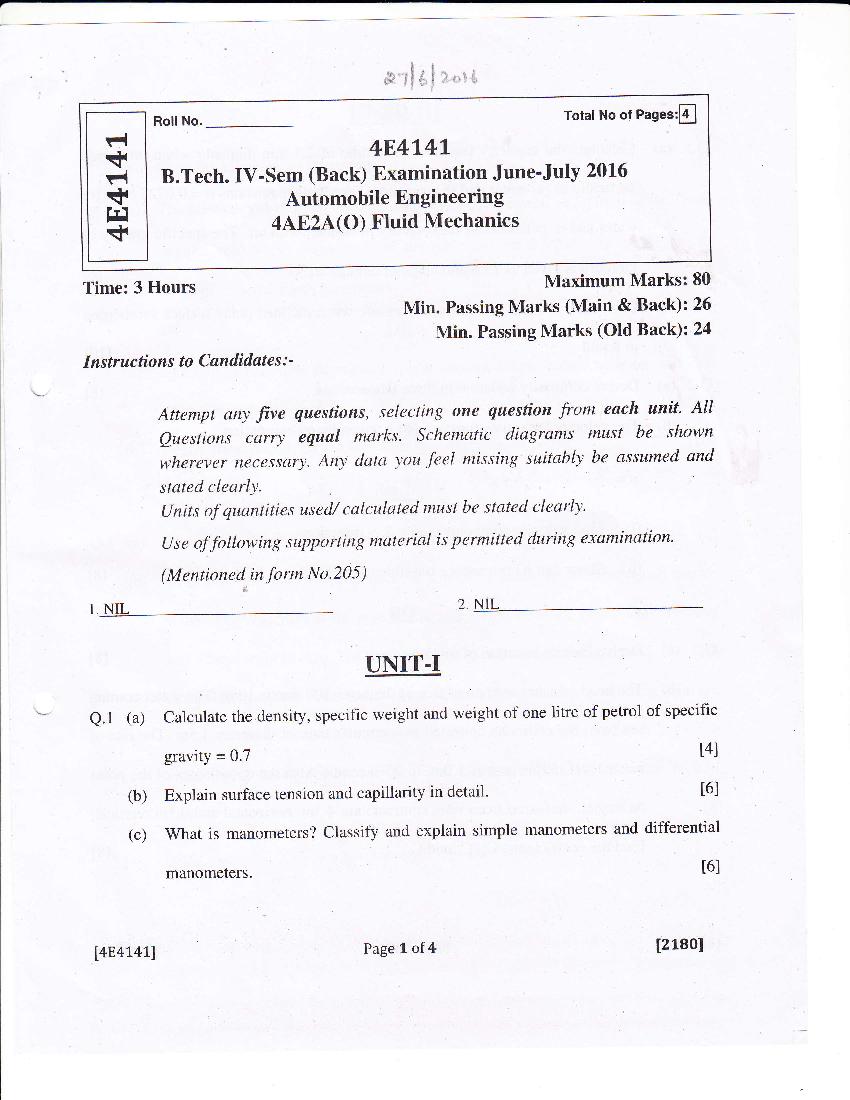
Page 1
RollNo. TotalNo ot Pages:[l
F{ 4E4L4L
+
F{ B.Tech. IV-Sem (Back) Examination June-July 2016
+
frl
Automobile Engineering
s 4 LF;2 A(O) Ftuid Mechanics
Time: 3 Hours Maximum Marks: 80
Min. Passing Marks (Main & Back): 26
Min. Passing Marks (Old Back): 24
Instructions to Candidate s : -
Attempt any five questions, sele_cting one question from each unil' All
Questions carry equal marks. Schematic diagrams
must be shown
wherever necessary. Any data you feel missing suitably be assumed and
stated clearly.
Llnits of quantities used/ calculated must be stated clearly.
use of following supporting material is permitted during examination'
(Mentioned in form No.205)
1 NIIT
1. NIL
UNIT.I
Q.1 (a) Calculate the density, speciflc weight and weight of one litre of petrol of specific
gravity = 0.7 t4l
(b) Explain surface tension and capillarity in detail' t6l
(c) What is manometers? Classify and explain simple manometers and differential
manometers. t6l
Page 1 of4 [21801
l4E4L4L)
Page 2
Q.l (a) Calculate the capillary
rise in a glass tube
of 2.5 mm diameter
vertica'y in (a) water when immersed
and (b) mercury.
Take surface tensions
o = 0.0725N/m
water and o for
= 0.52N/m for mercury
in contact with air.
The specific gravity
mercury is given of
as 13.6 and angle
of contact
=130o
(b) formula for centre
of pressure when
incrined prane surface
il;r,|" ,uo.".rll
Q.2 (a) Derive continuig 11o1
equation in three
Djmensions.
(b) The verocity potentiars l8l
function (Q) is given
by an expression.
, XY' x-+---{+yr
,^- , x3vJ )
3 -v-r"
(i) Fjnd velocity components
in x & y direcfions.
(ii) Show that
Q represents a possible
case of flow.
t8l
q
Q Z (a) Derive Euler,s
equation of motjon.
(b) The head of warer t8l
over an orifice
of diameter r 00
mm is I0 m. The
out from the orifice water coming
,
is collected in a
circurar tank of
diameter I.5m.
water rever in this The rise of
tank is I'0m. in
25seconds. Arso
the coordinates
on the jet, measured of the point
from ven a contracta
are 4.3n r. horizontal
and 0.5m. vertical.
Find the coefficients,
Ca, C, and C..
t8l
[4E4141]
Page 2 of 4
Page 3
(b) The efficiency n of a fan depends on density p, Dynamic viscosity p of the fluid,
angular velocity w, diameter D of the rotor and the discharge Q. Express 11 in
terms of dimensionless parameters. tt2)
OR
a..3 (a) Define dimensionless numbers. Explain various dimensionless numbers and also
write their significance 12+41
(b) Derive the equation for laminar flow between parallel plates. t10l
UNIT-IV
Q.4 (a) Describe in detail Prandtl mixing length theory for turbulent shear stress. t6l
(b) Determine the wall shearing stress in a pipe of diameter 100mm, which carries
water. The velocities at the pipe centre and 30mm from the pipe center are ZrnJs
and 1.5m/s respectively. The flow in pipe is given as turbulent. t6l
(c) A pipeline carrying water has average height of irregularities projecting from the
surface of the boundary of the pipe as 0,15mm. What type of boundary is it? The
shear stress developed is 4.9N/m2' The kinematic viscosity of water is 0.01
stokes. l4l
l4E4t47l Page 3 of4 [2180]
Page 4
Q"a (a) Find the head lost due to friction in a pipe
of diameter 300 mm and length 50 m,
through which water is flowing at a verociry
of 3m/s using.
(i) Dalcy formula
(ii) Chezy's formula for which c = 60
I8l
(b) At a sudden enlargement of water main from 240mmto
4g0mm diameter. the
hydraulic gradient raises by lOmm. Estimate
the rate of flow.
t8l
UNIT.V
Q'5 (a) Derive the'formula for the drag force on a flat plate due to
boundary layer. tgl
(b) Describe in detail _
(i) Laminar boundary layer
(ii) Turbulent boundary layer
[5+3]
OR
Q.5 (a) Derive the expression for drag and lift.
t8l
(b) Write short nores on lAny Two)
(i) Drag on sphere and cylinder
(ii) Development of lift on circular cylinder
(ii) Development of lift on an airfoil
[4x2=31
14847471 Page 4 of 4
Document Details
| Board / Org | Default |
| Exam | Semester Exams |
| Type | Question Paper |
| Pages | 4 |
| Updated | 30 Apr 2026 |