TN TRB Polytechnic Lecturer 2019-2020 Syllabus for Production Engineering
Finished viewing? Save it for later —
Download TN TRB Polytechnic Lecturer 2019-2020 Syllabus for Production Engineering (PDF · 3 pages)About TN TRB Polytechnic Lecturer 2019-2020 Syllabus for Production Engineering
TN TRB Polytechnic Lecturer 2019-2020 Syllabus for Production Engineering is available here for free download. Published by Default for Govt Jobs Exams, this syllabus can be viewed online or downloaded as a PDF (3 pages). Candidates preparing for Govt Jobs Exams can use TN TRB Polytechnic Lecturer 2019-2020 Syllabus for Production Engineering to understand the exam pattern, the type of questions asked, and the overall difficulty level.
Frequently Asked Questions
How can I download TN TRB Polytechnic Lecturer 2019-2020 Syllabus for Production Engineering?
Open this page and click the Download button to save TN TRB Polytechnic Lecturer 2019-2020 Syllabus for Production Engineering as a PDF. It is completely free on AglaSem Docs.
Is TN TRB Polytechnic Lecturer 2019-2020 Syllabus for Production Engineering free to download?
Yes. TN TRB Polytechnic Lecturer 2019-2020 Syllabus for Production Engineering can be viewed online and downloaded as a PDF free of cost on AglaSem Docs.
How many pages does TN TRB Polytechnic Lecturer 2019-2020 Syllabus for Production Engineering have?
TN TRB Polytechnic Lecturer 2019-2020 Syllabus for Production Engineering contains 3 pages, which you can read online or download together as a single PDF.
Where can I find more Govt Jobs Exams study material?
You can find more Govt Jobs Exams question papers, sample papers, syllabus, and answer keys on AglaSem Docs.
TN TRB Polytechnic Lecturer 2019-2020 Syllabus for Production Engineering – Text
Read the full text of this syllabus below — useful to quickly search, copy and reference the content online without downloading the PDF.
📄 View text version (3 pages)
Page 1
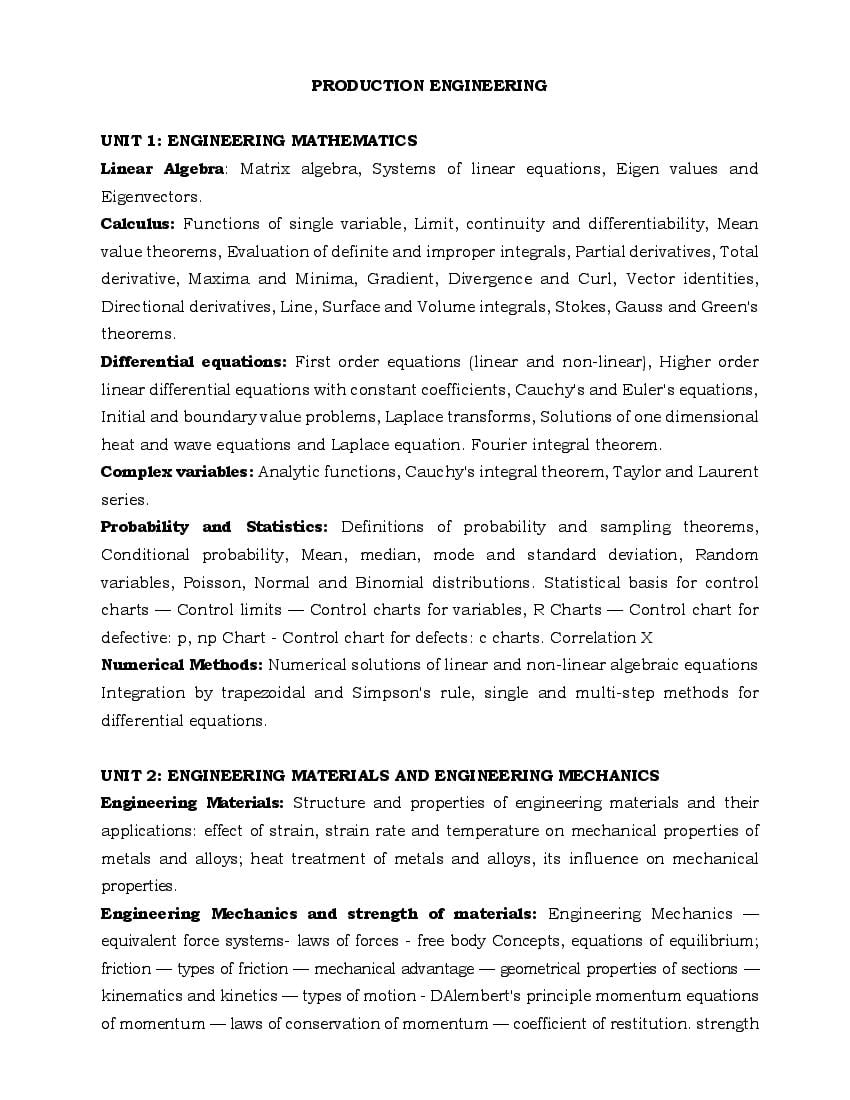
UNIT 1: ENGINEERING MATHEMATICS
Linear Algebra: Matrix algebra, Systems of linear equations, Eigen values and
Eigenvectors.
Calculus: Functions of single variable, Limit, continuity and differentiability, Mean
value theorems, Evaluation of definite and improper integrals, Partial derivatives, Total
derivative, Maxima and Minima, Gradient, Divergence and Curl, Vector identities,
Directional derivatives, Line, Surface and Volume integrals, Stokes, Gauss and Green's
theorems.
Differential equations: First order equations (linear and non-linear), Higher order
linear differential equations with constant coefficients, Cauchy's and Euler's equations,
Initial and boundary value problems, Laplace transforms, Solutions of one dimensional
heat and wave equations and Laplace equation. Fourier integral theorem.
Complex variables: Analytic functions, Cauchy's integral theorem, Taylor and Laurent
series.
Probability and Statistics: Definitions of probability and sampling theorems,
Conditional probability, Mean, median, mode and standard deviation, Random
variables, Poisson, Normal and Binomial distributions. Statistical basis for control
charts — Control limits — Control charts for variables, R Charts — Control chart for
defective: p, np Chart - Control chart for defects: c charts. Correlation X
Numerical Methods: Numerical solutions of linear and non-linear algebraic equations
Integration by trapezoidal and Simpson's rule, single and multi-step methods for
differential equations.
UNIT 2: ENGINEERING MATERIALS AND ENGINEERING MECHANICS
Engineering Materials: Structure and properties of engineering materials and their
applications: effect of strain, strain rate and temperature on mechanical properties of
metals and alloys; heat treatment of metals and alloys, its influence on mechanical
properties.
Engineering Mechanics and strength of materials: Engineering Mechanics —
equivalent force systems- laws of forces - free body Concepts, equations of equilibrium;
friction — types of friction — mechanical advantage — geometrical properties of sections —
kinematics and kinetics — types of motion - DAlembert's principle momentum equations
of momentum — laws of conservation of momentum — coefficient of restitution. strength
Page 2
bending and shear stress, Euler's theory of columns, Theory of torsion.
UNIT 3: THEORY OF MACHINES AND DESIGN
Analysis of planar mechanisms, cams and followers; governers and fly wheels; design of
elements — failure theories; design of bolted, riveted and welded joints; design of shafts,
keys, spur gears, belt drives, brakes and clutches.
UNIT 4: FLUID MECHANICS AND THERMAL ENGINEERING
Fluid Mechanics — fluid statics, Bernoulli's equation, flow through pipes, equations of
continuity and momentum; thermodynamics — zeroth, first and second law of
thermodynamics, thermodynamic system and processes, calculation of work and heat
for systems and control volumes; air standard cycles; basics of internal combustion
engines and steam turbines; heat transfer — fundamentals of conduction, convection and
radiation, heat exchangers.
UNIT 5: METAL CASTING AND FORMINGYLLABUSFOR COMPETITIVE EXAMINATION
Casting Processes — types and applications; patterns — types and materials;
allowances; moulds and cores — materials, making, and testing; casting techniques of
cast iron, steels and nonferrous metals and alloys; solidification; design of casting, gating
and risering; casting inspection, defects and remedies.
Metal Forming — Stress-strain relations in elastic and plastic deformation; concept of flow
stress, deformation mechanisms; hot and cold working — forging, rolling, extrusion, wire
and tube drawing; sheet metal working processes such as blanking, piercing, blending,
deep drawing, coining and embossing; analysis of rolling, forging, extrusion and wire/rod
drawing; metal working defects.
UNIT 6: METAL JOINING PROCESSES
Welding Processes — manual metal arc, MIG, TIG, plasma arc, submerged arc, electroslag,
thermit, resistance, forge, friction, and explosive Welding; other joining processes —
soldering, brazing, braze welding; inspection of welded joints, defects and remedies;
introduction to advanced welding processes — ultrasonic, electron beam, laser beam;
thermal cutting.
Page 3
Basic Machine tools; machining processes-turning, drilling, boring, milling, shaping,
planning, gear cutting, thread production, broaching, grinding, lapping, honing, super
finishing; mechanics of machining — geometry of cutting tools, chip formation, cutting
forces and power requirements, Merchant's analysis; selection of machining parameters;
tool materials, tool wear and tool life, economics of machining, thermal aspects of
machining, cutting fluids, machinability; principles and applications of nontraditional
machining processes — USM, AJM, WJM, EDM and Wire cut EDM, LBM, EBM, PAM, CHM,
ECM.
Tool Engineering: Jigs and fixtures — principles, applications, and design; press tools —
configuration, design of die and punch; principles of forging die design.
UNIT 8: METROLOGY AND INSPECTION
Limits, fits, and tolerances, interchangeability, selective assembly; linear and
angular measurements by mechanical and optical methods, comparators; design of
limit gauges; interferometry; measurement of straightness, flatness, roundness,
squareness and symmetry; surface finish measurement; inspection of screw
threads and gears; alignment testing of machine tools.
UNIT 9: POWDER METALLURGY AND NEWER PRODUCTION PROCESSES
Production of metal powders, compaction and sintering. Unconventional
Machining Processes - electrodischarge machining — Laser beam machining — Ion
beam machining — Plasma beam machining — Ultrasonic machining — Abrasive
jet machining — Electrochemical and chemical machining — abrasive flow finishing
— Page 20
UNIT 10: QUALITY CONTROL, PROCESS ANALYSIS AND MODERN
MANUFACTURING SYSTEMS
Quality objectives - Quality control - Quality Assurance - Quality system -
Sources of errors in manufacturing; process capability; tolerance analysis in
manufacturing and assembly; process planning; parameter selection and
comparison of production alternatives; time and cost analysis; manufacturing
technologies — strategies and selection. Computer Integrated Manufacturing:
Basic concepts of CAD, CAM, CAPP, cellular manufacturing, NC, CNC, DNC,
Robotics, FMS and CIM
Document Details
| Board / Org | Default |
| Exam | Govt Jobs Exams |
| Type | Syllabus |
| Pages | 3 |
| Updated | 15 Jul 2026 |