Rajasthan Board Class 12 Question Paper 2019 English
Finished viewing? Save it for later —
Download Rajasthan Board Class 12 Question Paper 2019 English (PDF · 8 pages)About Rajasthan Board Class 12 Question Paper 2019 English
Rajasthan Board Class 12 Question Paper 2019 English is available here for free download. Published by Rajasthan Board for Class 12, this question paper can be viewed online or downloaded as a PDF (8 pages). Candidates preparing for Class 12 can use Rajasthan Board Class 12 Question Paper 2019 English to understand the exam pattern, the type of questions asked, and the overall difficulty level.
Frequently Asked Questions
How can I download Rajasthan Board Class 12 Question Paper 2019 English?
Open this page and click the Download button to save Rajasthan Board Class 12 Question Paper 2019 English as a PDF. It is completely free on AglaSem Docs.
Is Rajasthan Board Class 12 Question Paper 2019 English free to download?
Yes. Rajasthan Board Class 12 Question Paper 2019 English can be viewed online and downloaded as a PDF free of cost on AglaSem Docs.
How many pages does Rajasthan Board Class 12 Question Paper 2019 English have?
Rajasthan Board Class 12 Question Paper 2019 English contains 8 pages, which you can read online or download together as a single PDF.
Where can I find more Class 12 study material?
You can find more Class 12 question papers, sample papers, syllabus, and answer keys on AglaSem Docs.
Rajasthan Board Class 12 Question Paper 2019 English – Text
Read the full text of this question paper below — useful to quickly search, copy and reference the content online without downloading the PDF.
📄 View text version (8 pages)
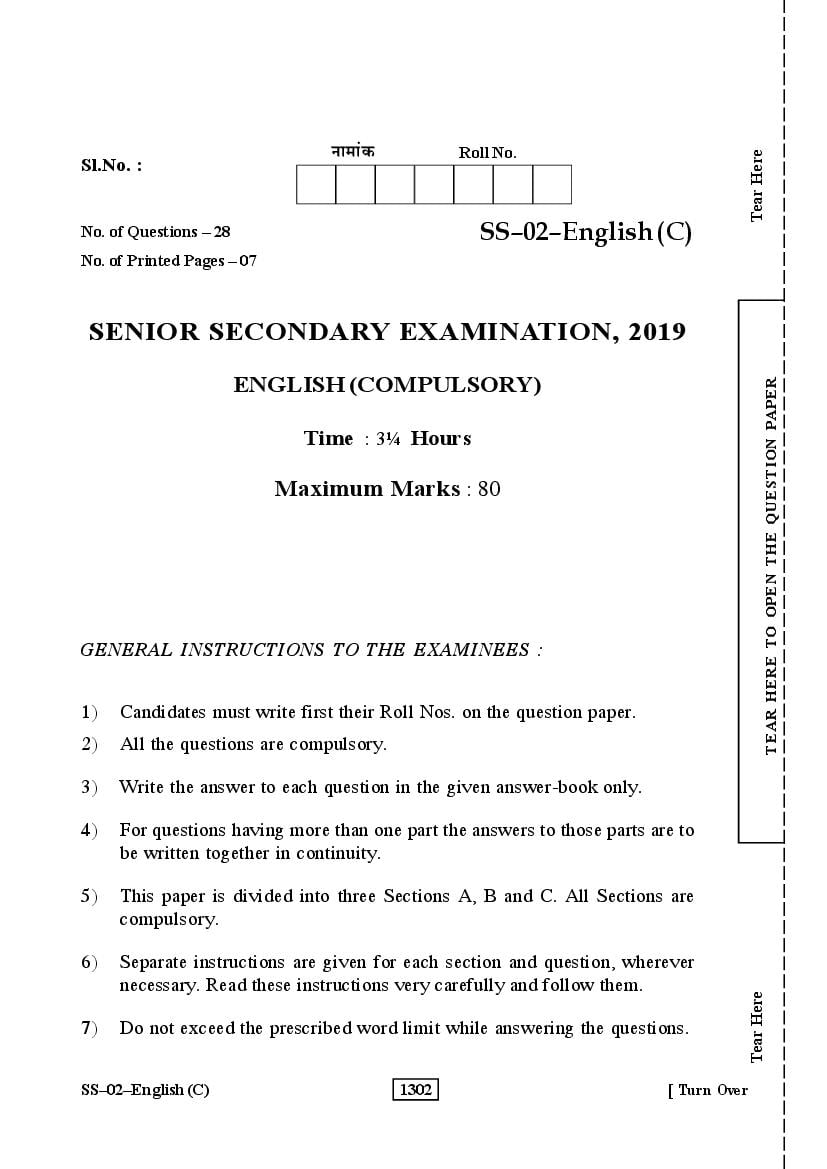
Page 1
Tear Here
Sl.No. :
No. of Questions – 28 SS–02–English (C)
No. of Printed Pages – 07
SENIOR SECONDARY EXAMINATION, 2019
ENGLISH (COMPULSORY)
TEAR HERE TO OPEN THE QUESTION PAPER
Time : 3¼ Hours
Maximum Marks : 80
GENERAL INSTRUCTIONS TO THE EXAMINEES :
1) Candidates must write first their Roll Nos. on the question paper.
2) All the questions are compulsory.
3) Write the answer to each question in the given answer-book only.
4) For questions having more than one part the answers to those parts are to
be written together in continuity.
5) This paper is divided into three Sections A, B and C. All Sections are
compulsory.
6) Separate instructions are given for each section and question, wherever
necessary. Read these instructions very carefully and follow them.
Tear Here
7) Do not exceed the prescribed word limit while answering the questions.
SS–02–English (C) 1302 [ Turn Over
Page 2
SECTION - A
(READING)
1-9 Read the passage given below and answer the questions that follow:
Rabindranath Thakur was born in Calcutta on May 7, 1861. His father
Devendranath Thakur, was a well-known social and religious leader and was
called Maharshi Devendranath. Though a religious leader, Devendranath was
very broad-minded and he encouraged his son to think independently.
In school, Rabindranath found the teaching too elementary. It did not take
his teacher long to recognise his high intelligence. He was given 'Macbeth' to
translate and to everyone's surprise Rabindranath made a very good translation
into Bengali. However, his limitless curiosity to know more and newer things
could not be satisfied in school. It was, therefore, decided to withdraw him from
there. For four years, from the age of thirteen to seventeen, he studied a wide
variety of subjects at home. About the same time he was drawn to Nature and
Arts. For hours he would go swimming in the Ganga and watch the changing
moods of that mighty river. He also started composing verses and learning music.
From 1881 onwards his talent as a writer expressed itself in the form of
countless compositions in poetry, drama, prose, music, fiction, philosophy and
painting. He wrote nearly 50 plays, 100 books of verse and 40 volumes of
fiction and philosophical writings.
Rabindranath was also a great educationist. In 1901, he founded a school at
Shantiniketan near Bolpur in Bengal. Situated in the midst of natural
surroundings, it soon started attracting students from all over the country and
even from outside India. In 1922 it was changed into an international university
called Vishva-Bharati, the name it continues to have to this day.
The work which brought him universal recognition was a collection of
poems named 'Gitanjali'. Originally written in Bengali, it was translated into
English by Rabindranath himself. This won him in 1913 the Nobel Prize in
Literature and made him internationally famous.
Rabindranath was a great nationalist and patriot. He felt so bitter about the
Jallianwala Bagh tragedy in 1919 that as a protest, he gave up Knighthood
which the British had awarded him earlier. But his nationalism was not based on
any narrow loyalties. It was a part of his wider vision of internationalism and
world brotherhood.
SS–02–English (C) 1302
Page 3
He died on August 07, 1941, four years before the founding of the U.N.O.
and six years before the coming of Indian independence. Though he is no more,
his message of universal peace and love among mankind will continue to inspire
many generations to come.
1) Why did Rabindranath give up the title of Knighthood? [1]
2) When and where was he born? [1]
3) Which book of him won him the Nobel prize in Literature? [1]
4) Who was famous as 'Maharshi'? [1]
5) How does Rabindranath still inspire the generations to come? [1]
6) Why was Rabindranath not educated at school? [1]
Find out words from the passage which mean -
7) Freedom. [1]
8) Easy, not complicated. [1]
9) A piece of poetry. [1]
10-11 Read the passage given below and answer the questions that follow :
How often one hears children wishing they were grown up and old people
wishing they were young again. Each age has its pleasures and pains and the
happiest person is the one who enjoys what each age gives him without wasting
his time in useless regrets.
Childhood is a time when there are few responsibilities to make life difficult.
If a child has good parents, he is fed, looked after and loved, whatever he may
do.
Life is always presenting new things to the child-things that have lost their
interest for older people because they are too well-learned. A child finds pleasure
in playing in the rain or in snow. His first visit to the seaside is a marvellous
adventure. But a child has his pains : he is not so free to do as he wishes as he
thinks older people are : he is continually being told not to do things, or being
punished for what he has done wrong. His life is therefore not perfectly happy.
SS–02–English (C) 1302 [ Turn Over
Page 4
When the young man starts to earn his own living, he becomes free - from
the discipline of school and parents; but at the time he is forced to accept
responsibilities. He can no longer expect others to pay for his food, his clothes and
his room, but has to work if he wants to live comfortably. If he spends most of his
time playing about in the way that he used to as a child, he will go hungry. And if
he breaks the laws of society as he used to break the laws of his parents, he may go
to prison. If, however, he works hard, keeps out of trouble and has good health,
he can have the great happiness of seeing himself make steady progress in his job
and of building up for himself his own position in society.
Old age has always been thought of as the worst age to be, but it is not necessary
for the old to be unhappy. With old age should come wisdom and ability to help
others with advice wisely. The old can have the joy of seeing their children making
progress in life, they can watch their grand children growing up around them and
perhaps best of all, they can, if their life has been a useful one, feel the happiness of
having come through the battle of life safely and of having reached a time when
they can lie back and rest, leaving others to continue the fight.
10) On the basis of your reading of the above passage make notes on it using
headings and sub-headings. [4]
11) Write a summary of the passage and suggest a suitable title. [2]
SECTION - B
(WRITING)
12) Draft a poster to make the masses aware against the misuse of water and to
inspire them to save water. (Word limit - 50 words) [4]
OR
You have been transferred to Jaipur from Mumbai. You want to sell your house
in Mumbai along with furniture. Prepare an advertisement for it for a classified
column in not more than 50 words. [4]
SS–02–English (C) 1302
Page 5
13) A heavy flood takes seven lives in your neighbouring village. Write a report on
it with the help of given outline in about 100 words.
(Continuous rain - dam - broke - people - homeless - houses - collapsed - electricity -
failed - cattle - drowned - relief work - ambulance - rescue team) [7]
OR
Your school celebrated a two days 'Van-Mahotsav' programme last week. Write
a report on it in about 100 words. [7]
14) You are Rashmi or Rajkumar living in Ajmer. Write a letter to the Municipal
Commissioner of your city complaining him or her against the insanitary
conditions of your locality. [7]
OR
You are Amita or Amit living in Dungarpur. Write a letter to Om Book Depot,
Bada Bazar, Indore placing an order to supply books for school library. [7]
15) You have been asked to deliver a speech on Clean India Mission in your school
prayer assembly. Write a speech in about 100 words on the topic. [7]
OR
Write an article in about 100 words on the topic, "Pollution - causes and
remedies". [7]
SECTION - C
(TEXTUAL QUESTIONS)
16-17 Read the extract given below and answer the questions that follow:
"It is not growing like a tree
In bulk, doth make man better be
Or standing long an oak, three hundred year,
To fall at last, dry, bald and sere."
16) What is the quality of an oak? [2]
17) How does an oak fall at last? [2]
OR
SS–02–English (C) 1302 [ Turn Over
Page 6
"And I can not find the place
Where his paw is in the share;
Little one! Oh, little one!
I am searching everywhere."
16) What does the line, "Little one! Oh, little one!" suggest you? [2]
17) "And I can not find the place." Which place is the poet unable to find? [2]
18) Answer any three of the following questions in 30-40 words :
a) What is the theme of the poem, "A Boy's Song?" [2]
(A Boy's Song)
b) What does hope mean to the poet? (The Hope) [2]
c) How does a man act in the second stage of life? [2]
(The Seven Ages of Man)
d) How can human life be perfect, according to the poet? [2]
(The Noble Nature)
19-22 Answer the following questions in 30-40 words each:
19) Where does Saheb work and how much money is he paid there? [2]
(Lost Spring)
20) Why did William Douglas decide to join the YMCA pool? [2]
(Deep Water)
21) Who were the assailants, according to the wounded man? [2]
(A Walk Through The Fire)
22) How much profit did the narrator achieve by selling the drawing? [2]
(Third Thought)
SS–02–English (C) 1302
Page 7
23) Answer the following question in about 125 words:
Mention the benefits of Yoga as discussed in the lesson. (How Yoga Heels) [7]
OR
Draw a character-sketch of Mr. Lamb. (On the Face of It) [7]
24) Answer the following question in about 125 words:
Draw a character-sketch of Michael Obi. (Dead Men's Path) [7]
OR
What were the similarities and differences between Sophie and Jansie? Explain.
(Growing Up Pains) [7]
25-28 Answer the following questions in about 30-40 words each:
25) What was the right answer according to the girl? (The Guitar Player) [2]
26) What was the name of Fatimah's father and what was he?
(Love Across The Salt Desert) [2]
27) Why did Franz start for school very late that morning?
(The Last Lesson) [2]
28) Who was little Derek? What did he say about Sophie?
(Going Places) [2]
SS–02–English (C) 1302
Page 8
NO
T
W
RI
TE
AN
YT
H
IN
G
H
ER
E
Document Details
| Board / Org | Rajasthan Board |
| Exam | Class 12 |
| Type | Question Paper |
| Pages | 8 |
| Updated | 22 Jul 2026 |