RTU 2016 Question Paper Semester IV Automobile Engineering Kinematics of Machines
Finished viewing? Save it for later —
Download RTU 2016 Question Paper Semester IV Automobile Engineering Kinematics of Machines (PDF · 4 pages)About RTU 2016 Question Paper Semester IV Automobile Engineering Kinematics of Machines
RTU 2016 Question Paper Semester IV Automobile Engineering Kinematics of Machines is available here for free download. Published by Default for Semester Exams, this question paper can be viewed online or downloaded as a PDF (4 pages). Candidates preparing for Semester Exams can use RTU 2016 Question Paper Semester IV Automobile Engineering Kinematics of Machines to understand the exam pattern, the type of questions asked, and the overall difficulty level.
Frequently Asked Questions
How can I download RTU 2016 Question Paper Semester IV Automobile Engineering Kinematics of Machines?
Open this page and click the Download button to save RTU 2016 Question Paper Semester IV Automobile Engineering Kinematics of Machines as a PDF. It is completely free on AglaSem Docs.
Is RTU 2016 Question Paper Semester IV Automobile Engineering Kinematics of Machines free to download?
Yes. RTU 2016 Question Paper Semester IV Automobile Engineering Kinematics of Machines can be viewed online and downloaded as a PDF free of cost on AglaSem Docs.
How many pages does RTU 2016 Question Paper Semester IV Automobile Engineering Kinematics of Machines have?
RTU 2016 Question Paper Semester IV Automobile Engineering Kinematics of Machines contains 4 pages, which you can read online or download together as a single PDF.
Where can I find more Semester Exams study material?
You can find more Semester Exams question papers, sample papers, syllabus, and answer keys on AglaSem Docs.
RTU 2016 Question Paper Semester IV Automobile Engineering Kinematics of Machines – Text
Read the full text of this question paper below — useful to quickly search, copy and reference the content online without downloading the PDF.
📄 View text version (4 pages)
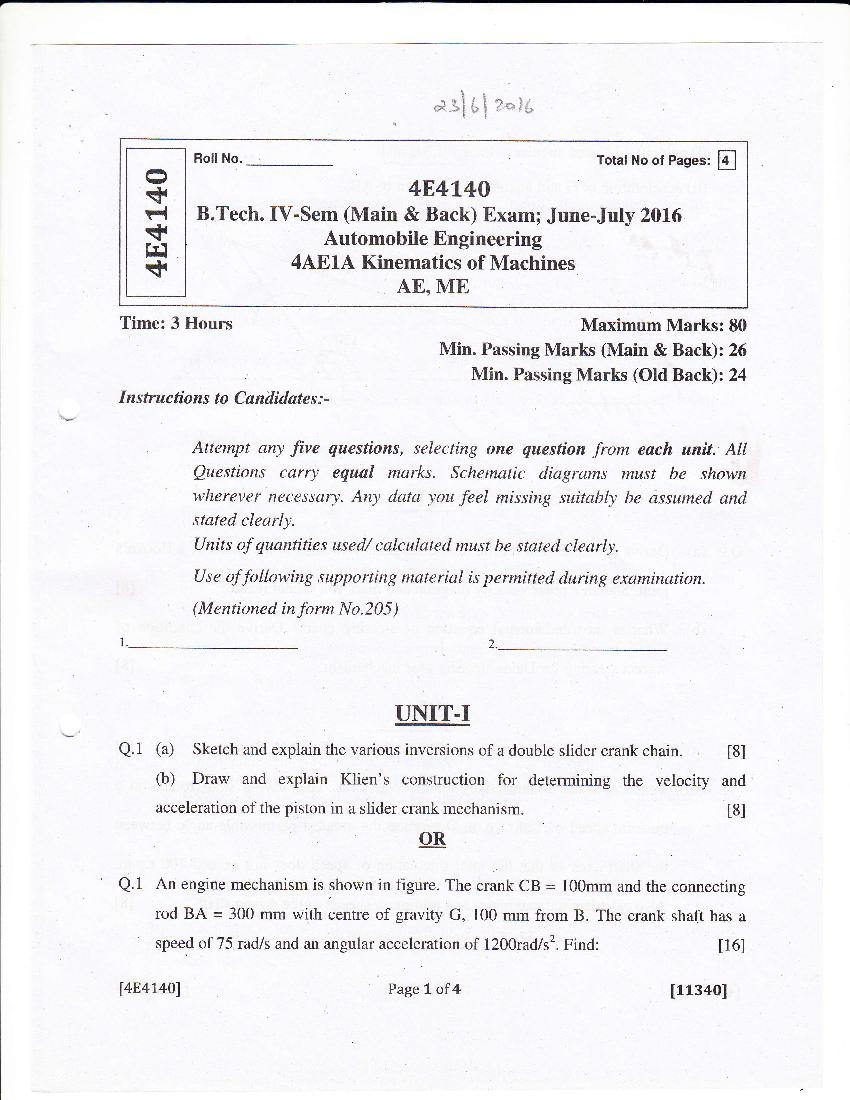
Page 1
:' 1/ r'.j'
(}{ ->t r,;'
I
RollNo. Total No of Pages: []
(D
sil 4E4140
t,{ B.Tech. IV-Sem (Main & Back) Examl June-July 2016
!t Automobile Engineering
rfl
\t 4AE1A Kinematics of Machines
AEO ME
Time: 3 Hours Maximum Marks: 80
Min. Passing Marks (Main & Back): 26
Min. Passing Marks (OId Back): 24
Instructions to Canili.date s : -
Attempt any ftve questions, selecting one question from each unit. All
Questions carry equal marks. Schematic diagrams must be shown
wherever necessat)). Ary data you feel missing suitably be assumed and
stated clearly.
Units of quantities used/ calculated must be stated clearly.
use of following supporting material is permitted during examination.
(M entioned in form No.205 )
UNIT-I
Q.1 (a) Sketch and explain the various inversions of a double slider crank chain. t8l
(b) Draw and explain Klien's construction for determining the velocity and
acceleration of the piston in a slider crank mechanism. t8l
OR
Q.l An engine mechanism is shown in figure. The crank cB = 100mm and the connecting
rod BA = 300 mm with centre of gravity G, 100 mm from B. The crank shaft has a
speed of75 rad/s and an angular acceleration of 1200rad/s2. Find: l16l
l4E414o) Page 1 of4 [113401
Page 2
(ii) acceleration of G and angular acceleration of AB.
Q.2 (a) Derive an expression for the ratio of angular velocities of the shafts of a Hooke's
joint. Sketch a polar velocity diagram and mark it's salient feature. t8l
(b) What is the fundamental equation of steering gears? Derive the condition of
correct steering for Davis steering gear mechanism. t8l
OR
Q.2 (a) Draw and explain an overhead value mechanism of an LC. Engine. t8I
(b) Two shafts are connected by a universal joint. The driving shaft rotates at a
uniform speed of 1200 r,p.m. Determine the greatest permissible angle between
the shaft axes so that the total fluctuation of speed does not exceed 100 r.p.m.
Also calculate the maximum and minimum speeds of the driven qhaft. t8I
l4E4t40l Page? of4 [113401
Page 3
s3 <-..\ N\a- ---- \s\<<>\\1\==---sa- ass s<ss-s-$E--\ !\-sireE-i. -DES\EE Ex},rS,SDlDIf I{)I lTfg
friction torque considering both the theories for a flat collar.
t8l
(b) A load of 15kN is raised by means of a screw jack. The mean diameter of the
square threaded screw is 42mm and the pitch is l0mm. A force of 120
N is
applied at the end of a lever to raise the load. Determine
the length of the lever
to be used and the mechanical advantage obtained. Is the
screw self-locking?
Take pr = 0.t2. tgl
OR
Q'3 (a) Derive the condition for maximum power transmission by a belt drive
considering the effect of centrifugal tension.
tSl
(b) Determine the maximum power transmited by a v-belt drive having
the included
v - groove angle of 35". The belt used is l8mm deep with.lgmm maximum
width and weighs 300 gm. per metre length. The angle of
lap is 145o and the
maximum permissible stress is 1.5N/mm2 .Take
V = 0.2 t8l
UNIT-IV
Q'4 (a) A single plate clutch transmits 25kw at 900 r.p.m. The maximum pressure intensity
between the plates is 85 kN/m2. The.outer diameter
of the plate is 360 mm. Both
the sides of the plate are effective and the coefficient of
friction is 0.25.
Determine the (i) inner diameter of the plate (ii)
axial force to engage the
clutch.
i8l
(b) What is a Clutch? Make a sketch of a single plate clutch and
describe its
working.
t8l
14841401 Fage 3 of4
[113401
Page 4
Q.4 (a) Show that in a band block brake, the ratio of the maximum and minimum
tensions in the brake straPs is :
To I t* ptanof'
Tn ll - Ptan9 )
-l
Where To = Maximum tension, Tn = Minimum tension 20 = angle subtended by
each block at the centre of the drum. t8l
(b) What is the different between absorption and transmission dynamometers?
Describe the construction and operation of a prony brake dynamometer' t8]
UNIT-V
Q.5 (a) How are the cams classified? Describe in detail' t8l
(b) Deduce expression for the velocity and acceleration of the follower when it
moves with simple harmonic motion' t8l
OR
e.5 Draw the profit of a cam operating a knife -edge follower having a lift of 30mm.
The
cam raises the follower with SHM for 150o of the rotation followed t'Y a Period
of
dwe1l for 60o. The follower descends for the next 100o rotation of the cam
with
uniform velocity, again followed by a dwell period. The cam rotates at a uniform
velocity of 120 r.p.m, and has a least radius of 20mm. What will be the maximum
velocity and acceleration of the follower during the lift and the return' t16l
Page 4 of4 [113401
1484L401
Document Details
| Board / Org | Default |
| Exam | Semester Exams |
| Type | Question Paper |
| Pages | 4 |
| Updated | 30 Apr 2026 |