PUMDET 2023 Question Paper Chemistry
Finished viewing? Save it for later —
Download PUMDET 2023 Question Paper Chemistry (PDF · 16 pages)About PUMDET 2023 Question Paper Chemistry
PUMDET 2023 Question Paper Chemistry is available here for free download. Published by WBJEEB for PUMDET, this question paper can be viewed online or downloaded as a PDF (16 pages). Candidates preparing for PUMDET can use PUMDET 2023 Question Paper Chemistry to understand the exam pattern, the type of questions asked, and the overall difficulty level.
Frequently Asked Questions
How can I download PUMDET 2023 Question Paper Chemistry?
Open this page and click the Download button to save PUMDET 2023 Question Paper Chemistry as a PDF. It is completely free on AglaSem Docs.
Is PUMDET 2023 Question Paper Chemistry free to download?
Yes. PUMDET 2023 Question Paper Chemistry can be viewed online and downloaded as a PDF free of cost on AglaSem Docs.
How many pages does PUMDET 2023 Question Paper Chemistry have?
PUMDET 2023 Question Paper Chemistry contains 16 pages, which you can read online or download together as a single PDF.
Where can I find more PUMDET study material?
You can find more PUMDET question papers, sample papers, syllabus, and answer keys on AglaSem Docs.
PUMDET 2023 Question Paper Chemistry – Text
Read the full text of this question paper below — useful to quickly search, copy and reference the content online without downloading the PDF.
📄 View text version (16 pages)
Page 1
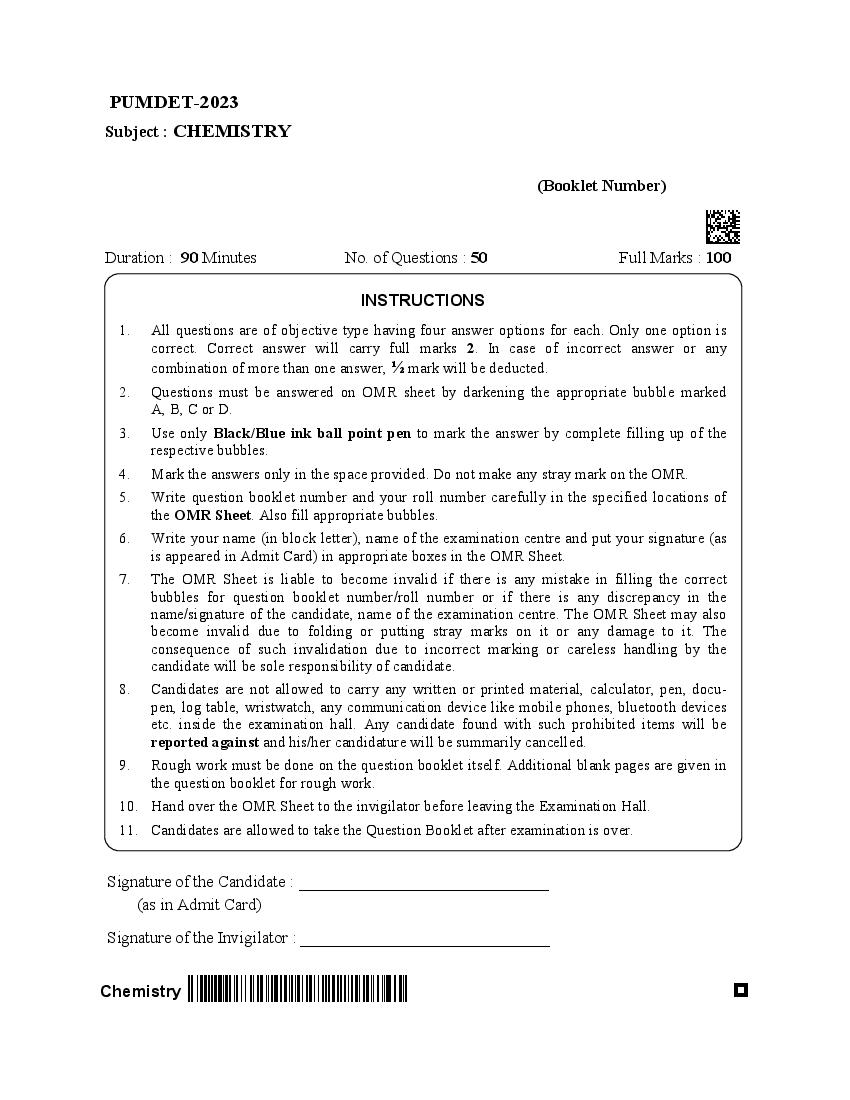
(Booklet Number)
Duration : 90 Minutes No. of Questions : 50 Full Marks : 100
INSTRUCTIONS
1. All questions are of objective type having four answer options for each. Only one option is
correct. Correct answer will carry full marks 2. In case of incorrect answer or any
combination of more than one answer, ½ mark will be deducted.
2. Questions must be answered on OMR sheet by darkening the appropriate bubble marked
A, B, C or D.
3. Use only Black/Blue ink ball point pen to mark the answer by complete filling up of the
respective bubbles.
4. Mark the answers only in the space provided. Do not make any stray mark on the OMR.
5. Write question booklet number and your roll number carefully in the specified locations of
the OMR Sheet. Also fill appropriate bubbles.
6. Write your name (in block letter), name of the examination centre and put your signature (as
is appeared in Admit Card) in appropriate boxes in the OMR Sheet.
7. The OMR Sheet is liable to become invalid if there is any mistake in filling the correct
bubbles for question booklet number/roll number or if there is any discrepancy in the
name/signature of the candidate, name of the examination centre. The OMR Sheet may also
become invalid due to folding or putting stray marks on it or any damage to it. The
consequence of such invalidation due to incorrect marking or careless handling by the
candidate will be sole responsibility of candidate.
8. Candidates are not allowed to carry any written or printed material, calculator, pen, docu-
pen, log table, wristwatch, any communication device like mobile phones, bluetooth devices
etc. inside the examination hall. Any candidate found with such prohibited items will be
reported against and his/her candidature will be summarily cancelled.
9. Rough work must be done on the question booklet itself. Additional blank pages are given in
the question booklet for rough work.
10. Hand over the OMR Sheet to the invigilator before leaving the Examination Hall.
11. Candidates are allowed to take the Question Booklet after examination is over.
Signature of the Candidate : ______________________________
(as in Admit Card)
Signature of the Invigilator : ______________________________
Chemistry
Page 2
Chemistry 2
Page 3
1. By how much will the potential of half-cell Cu2+ | Cu change if the solution is diluted to
100 times at 298 K ?
(A) Increases by 59 mV (B) Decreases by 59 mV
(C) Increases by 29.5 mV (D) Decreases by 29.5 mV
2. In an irreversible process taking place at constant T and P in which P-V work is being
done, the change in Gibbs free energy (dG) and change in internal energy (dU) satisfies
the criteria.
(A) dGT, P < 0, dUS, V < 0 (B) dGT, P < 0, dUS, V > 0
(C) dGT, P < 0, dUS, T < 0 (D) dGT, P < 0, dUS, P < 0
3. The value of rG – rG0 of the reaction
N2 (g, 0.2 bar) + 2O2(g, 0.2 bar) 2NO2 (g, 0.2 bar)
at 300 K is (given log 0.2 = –0.699)
(A) 4015.2 J mol–1 (B) – 6030.2 J mol–1
(C) 8030.4 J mol–1 (D) – 2015.1 J mol–1
4. Under the same reaction condition of A B, initial concentration of 1.386 mol dm–3 of
a substance becomes half in 40 seconds and 20 seconds through first order and zero order
kinetics respectively. Ratio k1/k0 of the rate constants for first order (k1) and zero order
(k0) of the reaction is
(A) 0.5 mol–1 dm3 (B) 1.0 mol–1 dm3
(C) 1.5 mol–1 dm3 (D) 2.0 mol–1 dm3
Chemistry 3
Page 4
in a 1 cm. cell at 250 nm. The molar absorptivity in L mol –1 cm–1 is
(A) 2020 (B) 3100
(C) 3010 (D) 6990
6. Given that, E0Fe2+/Fe = –0.44 V and E0Fe3+/Fe2+ = 0.77 V at 298 K. E0Fe3+/Fe is
(A) − 0.036 V (B) 0.036 V
(C) 0.33 V (D) 1.21 V
7. For the equilibrium NH2COONH4(s) 2NH3(g) + CO2(g)
pCO = 1 bar at 100 ℃. Hence equilibrium constant (Kp) is
2
(Assume the reaction vessel initially was evacuated)
(A) 1 (B) 2
(C) 3 (D) 4
8. For an enzyme catalysed reaction obeying Michaelis-Menton equation, the slope and
1 1
intercept of the plot of against are 3.5 102 s and 5 104 mol–1 L s respectively,
r0 [s]0
where r0 and [s]0 are the initial rate and initial substrate concentration. The Michaelis
constant (KM) is
(A) 142.8 m mol L–1 (B) 17.5 m mol L–1
(C) 7.0 m mol L–1 (D) 3.5 m mol L–1
Chemistry 4
Page 5
versus concentration of reactant is 2.0 (where concentration is expressed in mol L –1 and
time in second). The numerical values of rate constant and order of the reaction are
(A) 4.0 and 2 (B) √2 and 0
1
(C) 2 and 1 (D) 2 and
2
10. A system at 300 K consists of 1024 atoms. Assuming that there is no interatomic energy
in the system, its total internal energy will be
(A) 3.10 kJ (B) 4.56 kJ
(C) 6.21 kJ (D) 9.36 kJ
11. For an adiabatic reversible expansion of an ideal gas, it appears that P T3. The ratio
CP/CV (i.e. ) for the gas is
(A) 3/2 (B) 5/3
(C) 7/5 (D) 9/7
12. The dimension of A that appears in Maxwell’s speed distribution equation
mc2
P(c) = Ac2 exp – is
2k T
B
(A) ML–1T–1 (B) ML2T–2
(C) M0L–3T3 (D) M0L–2T2
x2
13. For = A exp – 2 , (– x ) the expectation value of px is
a
(A) –a (B) +a
(C) 0 (D) undefined
Chemistry 5
Page 6
at 300 K are 260, 308, 150, 426 and 105 S cm2 mol–1 respectively. Hence Λ 0m for formic
acid in the same unit and at the same temperature is
(A) 381 (B) 405
(C) 429 (D) 531
15. The crystal CaxTiyOz, has Ca at the corners, Ti at the body centres and O at the face
centres of a cubic unit cell. Find x, y, z and the number of atoms contributed by a
200-plane placed within the crystal.
(A) 1, 1, 3 and 3 (B) 1, 1, 3 and 1
(C) 4, 1, 6 and 1 (D) 2, 1, 3 and 1.5
16. Which two quantities are same ?
(A) The transport no. of H+ in 0.1 N HCl and HNO3
(B) The transport no. of H+ in infinitely dilute HCl and HNO3
(C) The mobility of H+ in 0.1 N HCl and HNO3
(D) The mobility of H+ in infinitely dilute HCl and HNO3
17. A sparingly soluble salt M2X ionizes as M2X 2M+ + X2–, then Ka (activity solubility
product)
(A) Ka = S22 (B) Ka = 4S33
(C) Ka = 4S32 (D) Ka = S33
Chemistry 6
Page 7
(A) 1 (B) 2
(C) 6 (D) 7
19. Which one of the following electronic transitions corresponds to the lowest energy band
in the absorption spectrum of Ni(en)32+ ?
2g 1g
(A) 3T 3A (B) 3T 3A
2g 2g
1g
(C) 4T 4A (D) 4A 4T
2g 2g 2g
20. For which of the following molecules, the IR active stretching vibrations will be Raman
active ?
(A) cis-N2F2 (B) trans-N2F2
(C) H2O (D) Pyridine N-oxide
21. Which of the following is expected to be inert among the following ?
(A) Cu(H2O)62+ (B) Ni(H2O)62+
(C) Co(NH3)63+ (D) CoF63–
22. The self-indicating silica gel (impregnated with cobalt chloride) turns pink on absorbing
moisture and becomes blue on heating. The pink and blue colours are respectively due to
(A) Co(H2O)62+ and CoCl42– (B) Co(H2O)62+ and Co2O3
(C) Co(H2O)62+ and Co(H2O)63+ (D) Co(H2O)63+ and CoCl42–
Chemistry 7
Page 8
Product of Fe(OH)3 is 10–38.
(A) 3 (B) 11
(C) 5 (D) 9
24. The correct order of the spectrochemical series of the species NO 2–, NH3, en, F–
(en = ethylenediamine) is
(A) NO2– > NH3 > en > F– (B) en > NO2– > NH3 > F–
(C) en > NH3 > NO2– > F– (D) NO2– > en > NH3 > F–
25. The complex that undergoes oxidative addition reaction in presence of H 2 is
(A) [Ru(bipy)2 (CO) (H2O)]2+ (B) [Mn(CO)5 (CH3)]
(C) [Ir (CO) Cl (PPh3)2] (D) [Cr(CO)4 (PPh3)(PBu3)]
26. Number of d-d transitions observed in the visible region in Cu(H 2O)62+ ion is
(A) 2 (B) 3
(C) 1 (D) 4
27. The total number of the microstates of the term symbol, 3F is
(A) 3 (B) 21
(C) 9 (D) 6
28. The ground spin state (s) of C22– ion is
1
(A) 1 (B)
2
(C) 0 (D) 2
Chemistry 8
Page 9
incorrect ?
(A) The active sites of both Hb4 and Mb contain the heme group in which FeII is
equatorially coordinated by four pyrrole nitrogen atoms of porphyrin.
(B) FeII in deoxy-Hb4 and deoxy-Mb is present in low spin configuration.
(C) Oxygenation of Hb4 is autocatalytic due to cooperative interaction but such effects
are absent in Mb due to its monomeric nature.
(D) The successive oxygen binding constants of Hb4 gradually increases.
30. On the basis of 18 electron rule, identify the first-row transition metal for
[(4 – C8H8)M(CO)3] and [M(CO)3 PPh3]–
(A) Mn and Fe (B) Mn and Co
(C) Fe and Co (D) Fe and Ni
31. The elements A, B, C and D have electronegativities 3.8, 3.3, 2.8 and 1.3 respectively.
The correct order of increasing covalent character for the compounds AB, AD, BD and
AC will be
(A) AC < AB < BD < AD (B) AD < BD < AC < AB
(C) AB < AC < BD < AD (D) BD < AD < AC < AB
32. Total number of isomers for Ma2b2cd(a, b, c, d represents monodentate ligands) are
(A) 10 (B) 6
(C) 8 (D) 4
33. The number of unpaired electron(s) present in [CoF6]3– is
(A) zero (B) two
(C) four (D) one
Chemistry 9
Page 10
HA
HB
HD
HC
(A) HA (B) HB
(C) HC (D) HD
35. Correct order of stability of the following carbocations is
CH2 CH2 CH2 CH2
OMe OCOMe NMe2 CO2Me
I II III IV
(A) I > II > III > IV (B) I > III > II > IV
(C) III > I > II > IV (D) III > I > IV > II
36. Among the following molecules, the molecule which does not exist in different
conformations is
(A) ammonia (B) hydrogen peroxide
(C) hydroxylamine (D) methanol
37. Which of the following statements is NOT CORRECT ?
(A) A molecule with D2 point group is chiral.
(B) All epimers are diastereomers.
(C) A molecule cannot have both enantiotopic and diastereotopic ligands.
(D) A molecule may be optically inactive although it contains chirality centres.
Chemistry 10
Page 11
1, 3-ditert-butylcyclohexane are respectively
(A) Twist – boat; chair (B) Chair; twist – boat
(C) Chair for both (D) Twist – boat for both
39. The number of different types (non-equivalent) of hydrogen atoms in cis-1, 2 – dimethyl
cyclopropane is
(A) six (B) four
(C) three (D) two
40. Among the following molecules, the molecule that records two doublets with coupling
constant of about 16 Hz in the 1H – NMR spectrum is
(A) (Z) – 1, 2 – dichloroethene (B) (E) – 1, 2 – dibromoethene
(C) (E) – 1- bromo - 2 – chloroethene (D) (Z) – 1- bromo - 2 – chloroethene
41. The correct order of C – H stretching frequency in IR spectroscopy
H
C C H
H C C H
C C O
i ii iii
i ii iii iv
(A) iv < i < ii < iii (B) i < ii < iv < iii
(C) i < iv < ii < iii (D) i < ii < iii < iv
42. The final product(s) in the following sequence of reactions is (are)
(i) H2/Lindlar’s catalyst
2 – Butyne Product(s)
(ii) Br2/CCl4
(A) racemic – 2, 3 – dibromobutane
(B) meso – 2, 3 – dibromobutane
(C) racemic – and meso – 2, 3 – dibromobutane
(D) 2, 2, 3, 3 - tetrabromobutane
Chemistry 11
Page 12
CH3
(i) B2H6
D
(ii) H2O2, NaOH
H3C H H3C H
OH OH
(A) (B)
D D
H3C H3 C
OH OH
(C) (D) H
H
D D
44. The major product of the following reaction is
Cl dilute
Et2N aqueous solution of NaOH
Me
OH NEt2
Et2N
(A) (B) HO
Me Me
NEt2
OH
Et2N
(C) (D) HO
Me Me
Chemistry 12
Page 13
forms benzoic acid on strong oxidation is
H3C
(A) H3C COCH3 (B) CH(OH)CH3
(C) CH(OH)CH2CH3 (D) CH2CH(OH)CH3
O*
(i) CF3CO3H
46. Ph X+Y
CH3 (ii) Aq. NaOH, reflux
CH3 (iii) H3O
Structure of X and Y are –
* O
(A) Ph OH
and
H3C OH
CH3
O*
Ph OH
and
(B) H3C OH
CH3
O*
Ph
OH and CH3OH
(C)
CH3
*
O
Ph OH
(D)
and H3C OH
CH3
Chemistry 13
Page 14
OMe Me
?
+
CO2Me
D
OMe OMe
CO2Me CO2Me
(A) (B)
Me Me
D D
OMe OMe
Me Me
(C) (D)
CO2Me CO2Me
D D
48. An electric current is passed through an aqueous solution (buffered at pH 6.0) of alanine,
glutamic acid and arginine. The isoelectric points of alanine, glutamic acid and arginine
are 6.0, 3.2 and 10.7 respectively. The correct statement among the following is
(A) Glutamic acid is present as an anion in this solution.
(B) Arginine is present as an anion in this solution.
(C) Alanine is present as an anion in this solution.
(D) Alanine migrates to cathode in this solution.
Chemistry 14
Page 15
OH
OH
O OH O OH
(A) (B)
HO OH OH
HO
OH OH
OH OH
O OH O OH
(C) (D)
HO OH HO OH
OH OH
50. Which of the following statement(s) is/are CORRECT ?
(I) Sucrose exhibits mutarotation.
(II) Naturally occurring cysteine has S configuration.
(III) Thymine is not an RNA base.
(IV) D-Glucose and D-galactose yield the same osazone.
(A) (I) only (B) (III) only
(C) (II) and (III) (D) (II) and (IV)
_____________
Chemistry 15
Page 16
Chemistry 16
Document Details
| Board / Org | WBJEEB |
| Exam | PUMDET |
| Type | Question Paper |
| Pages | 16 |
| Updated | 22 Jul 2026 |