CBSE Class 10 Question Paper 2025 Solution Hindustani Music
Finished viewing? Save it for later —
Download CBSE Class 10 Question Paper 2025 Solution Hindustani Music (PDF · 14 pages)About CBSE Class 10 Question Paper 2025 Solution Hindustani Music
CBSE Class 10 Question Paper 2025 Solution Hindustani Music is available here for free download. Published by CBSE for Class 10, this solution can be viewed online or downloaded as a PDF (14 pages). Candidates preparing for Class 10 can use CBSE Class 10 Question Paper 2025 Solution Hindustani Music to understand the exam pattern, the type of questions asked, and the overall difficulty level.
Frequently Asked Questions
How can I download CBSE Class 10 Question Paper 2025 Solution Hindustani Music?
Open this page and click the Download button to save CBSE Class 10 Question Paper 2025 Solution Hindustani Music as a PDF. It is completely free on AglaSem Docs.
Is CBSE Class 10 Question Paper 2025 Solution Hindustani Music free to download?
Yes. CBSE Class 10 Question Paper 2025 Solution Hindustani Music can be viewed online and downloaded as a PDF free of cost on AglaSem Docs.
How many pages does CBSE Class 10 Question Paper 2025 Solution Hindustani Music have?
CBSE Class 10 Question Paper 2025 Solution Hindustani Music contains 14 pages, which you can read online or download together as a single PDF.
Where can I find more Class 10 study material?
You can find more Class 10 question papers, sample papers, syllabus, and answer keys on AglaSem Docs.
CBSE Class 10 Question Paper 2025 Solution Hindustani Music – Text
Read the full text of this solution below — useful to quickly search, copy and reference the content online without downloading the PDF.
📄 View text version (14 pages)
Page 1
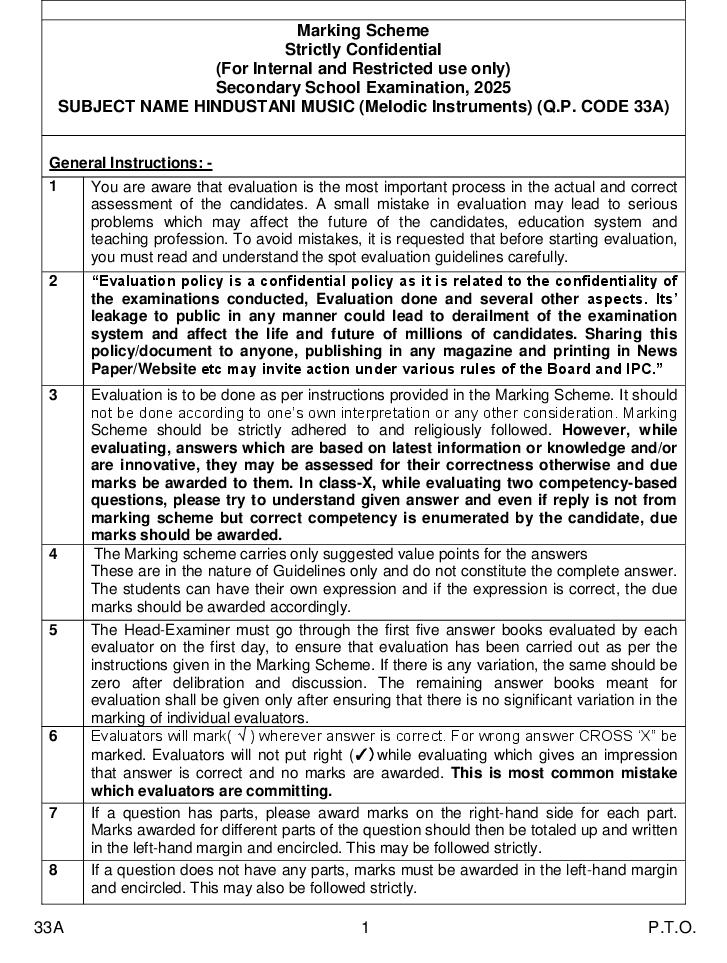
Strictly Confidential
(For Internal and Restricted use only)
Secondary School Examination, 2025
SUBJECT NAME HINDUSTANI MUSIC (Melodic Instruments) (Q.P. CODE 33A)
General Instructions: -
1 You are aware that evaluation is the most important process in the actual and correct
assessment of the candidates. A small mistake in evaluation may lead to serious
problems which may affect the future of the candidates, education system and
teaching profession. To avoid mistakes, it is requested that before starting evaluation,
you must read and understand the spot evaluation guidelines carefully.
2 “Evaluation policy is a confidential policy as it is related to the confidentiality of
the examinations conducted, Evaluation done and several other aspects. Its’
leakage to public in any manner could lead to derailment of the examination
system and affect the life and future of millions of candidates. Sharing this
policy/document to anyone, publishing in any magazine and printing in News
Paper/Website etc may invite action under various rules of the Board and IPC.”
3 Evaluation is to be done as per instructions provided in the Marking Scheme. It should
not be done according to one’s own interpretation or any other consideration. Marking
Scheme should be strictly adhered to and religiously followed. However, while
evaluating, answers which are based on latest information or knowledge and/or
are innovative, they may be assessed for their correctness otherwise and due
marks be awarded to them. In class-X, while evaluating two competency-based
questions, please try to understand given answer and even if reply is not from
marking scheme but correct competency is enumerated by the candidate, due
marks should be awarded.
4 The Marking scheme carries only suggested value points for the answers
These are in the nature of Guidelines only and do not constitute the complete answer.
The students can have their own expression and if the expression is correct, the due
marks should be awarded accordingly.
5 The Head-Examiner must go through the first five answer books evaluated by each
evaluator on the first day, to ensure that evaluation has been carried out as per the
instructions given in the Marking Scheme. If there is any variation, the same should be
zero after delibration and discussion. The remaining answer books meant for
evaluation shall be given only after ensuring that there is no significant variation in the
marking of individual evaluators.
6 Evaluators will mark( √ ) wherever answer is correct. For wrong answer CROSS ‘X” be
marked. Evaluators will not put right (✓)while evaluating which gives an impression
that answer is correct and no marks are awarded. This is most common mistake
which evaluators are committing.
7 If a question has parts, please award marks on the right-hand side for each part.
Marks awarded for different parts of the question should then be totaled up and written
in the left-hand margin and encircled. This may be followed strictly.
8 If a question does not have any parts, marks must be awarded in the left-hand margin
and encircled. This may also be followed strictly.
33A 1 P.T.O.
Page 2
marks should be retained and the other answer scored out with a note “Extra
Question”.
10 No marks to be deducted for the cumulative effect of an error. It should be penalized
only once.
11 A full scale of marks __________(example 0 to 80/70/60/50/40/30 marks as given in
Question Paper) has to be used. Please do not hesitate to award full marks if the
answer deserves it.
12 Every examiner has to necessarily do evaluation work for full working hours i.e., 8
hours every day and evaluate 20 answer books per day in main subjects and 25
answer books per day in other subjects (Details are given in Spot Guidelines).This is in
view of the reduced syllabus and number of questions in question paper.
13 Ensure that you do not make the following common types of errors committed by the
Examiner in the past:-
● Leaving answer or part thereof unassessed in an answer book.
● Giving more marks for an answer than assigned to it.
● Wrong totaling of marks awarded on an answer.
● Wrong transfer of marks from the inside pages of the answer book to the title
page.
● Wrong question wise totaling on the title page.
● Wrong totaling of marks of the two columns on the title page.
● Wrong grand total.
● Marks in words and figures not tallying/not same.
● Wrong transfer of marks from the answer book to online award list.
● Answers marked as correct, but marks not awarded. (Ensure that the right tick
mark is correctly and clearly indicated. It should merely be a line. Same is with the
X for incorrect answer.)
● Half or a part of answer marked correct and the rest as wrong, but no marks
awarded.
14 While evaluating the answer books if the answer is found to be totally incorrect, it
should be marked as cross (X) and awarded zero (0)Marks.
15 Any un assessed portion, non-carrying over of marks to the title page, or totaling error
detected by the candidate shall damage the prestige of all the personnel engaged in
the evaluation work as also of the Board. Hence, in order to uphold the prestige of all
concerned, it is again reiterated that the instructions be followed meticulously and
judiciously.
16 The Examiners should acquaint themselves with the guidelines given in the
“Guidelines for spot Evaluation” before starting the actual evaluation.
17 Every Examiner shall also ensure that all the answers are evaluated, marks carried
over to the title page, correctly totaled and written in figures and words.
18 The candidates are entitled to obtain photocopy of the Answer Book on request on
payment of the prescribed processing fee. All Examiners/Additional Head
Examiners/Head Examiners are once again reminded that they must ensure that
evaluation is carried out strictly as per value points for each answer as given in the
Marking Scheme.
33A 2
Page 3
$
MARKING SCHEME
HINDUSTANI MUSIC (Melodic Instruments)
SECTION – A
1. (C) Khamaj
1
2. (D) Rupak
1
3. (D)3 – 1
1
4. (C)I – IV
1
5. (D)I, II, IV
1
6. (A)(a)-ii, (b)-iv, (c)-iii, (d)-i
1
7. (D)Statement I is true and II is false.
1
8. (A)Statement I and II both are true.
1
SECTION – B
9. (a)Describing of Tala Rupak – Matra, Vibhag Tali, Khali and any
other special feature writing the Bol of Tala Rupak in Tigun with signs
of Tali Khali and Matra – Vibhag in Notation. (1+1)=2
OR
(b) Describe Tana – its meaning and few varieties. 1
Describing the meaning of Meend and its varieties. 1
10. (a)Describing Thata, Ashrya Raga, Nature of swara, Number of varjit
swara in ascent descent 1
Vadi, Samvadi, Aroha – Avroh, Pakad and Time of Performance.
1
OR
33A 3 P.T.O.
Page 4
training. 1
His contribution in Music as a performance, teacher, composer and
scholar. 1
11. (a)Identifying the Raga Vrindabani Sarang from the phrase.
1
Elaborating the Swaras (upto 40) according to the Vrindabani Sarang’s
characteristics. 1
OR
(b) Describe Matra, Vibhag ,Tali -Khali and with which musical form
performed 1
Writing of Bol of Tiwada Tala in Dugun in Tala Notaion with Matra and
signs of tali khali 1
12. (a)Life sketch of Inayat Khan, birth, death, place, family, training.
1
His contribution in music, style, as performer, teacher and scholar.
1
OR
(b) Definition of Dhrupad 1
Its specialities & Banis 1
13. (a)Definition of Aalap and its features
1
Definition of Kan and its Varieties
1
OR
(b) Life sketch of Omkar Nath Thakur, birth, training, occupation death 1
Contribution as teacher, Author, Composer 1
SECTION – C
14. (a)Writing of Sthai and Antara with strokes, of the Raga chosen for
Maseetkhani Gat in the notation, that is, Matra, Vibhag, Tali-Khali
signs. 3
Writing of Two Todas in Notation of Raga.
1 1
1 +1 =3
2 2
OR
(b) Writing the sthai and Antara of Raga Khamaj or Bhupali with in Matra,
Vibhag, Tali-Khali signs in Notation system. 3
1 1
Writing of two Tanas in the same raga in Notation. 1 +1 =3
2 2
33A 4
Page 5
candidate has opted for 1
His teaching-learning and gharana
1
His style of performance, Laya, strokes techniques used.
4
OR
(b) Describing the various parts of the instrument that student has opted
for 3
Describing the tuning of the instruments string – which string is tuned
in which swara and tuning of Tarabs. 3
33A 5 P.T.O.
Page 6
Strictly Confidential
(For Internal and Restricted use only)
Secondary School Examination, 2025
SUBJECT NAME: HINDUSTANI MUSIC VOCAL /SUBJECT CODE -034)
QP CODE-33 TOTAL MARKS : 30
General Instructions: -
1 You are aware that evaluation is the most important process in the actual and correct
assessment of the candidates. A small mistake in evaluation may lead to serious
problems which may affect the future of the candidates, education system and
teaching profession. To avoid mistakes, it is requested that before starting evaluation,
you must read and understand the spot evaluation guidelines carefully.
2 “Evaluation policy is a confidential policy as it is related to the confidentiality of
the examinations conducted, Evaluation done and several other aspects. Its’
leakage to public in any manner could lead to derailment of the examination
system and affect the life and future of millions of candidates. Sharing this
policy/document to anyone, publishing in any magazine and printing in News
Paper/Website etc may invite action under various rules of the Board and IPC.”
3 Evaluation is to be done as per instructions provided in the Marking Scheme. It should
not be done according to one’s own interpretation or any other consideration. Marking
Scheme should be strictly adhered to and religiously followed. However, while
evaluating, answers which are based on latest information or knowledge and/or
are innovative, they may be assessed for their correctness otherwise and due
marks be awarded to them. In class-X, while evaluating two competency-based
questions, please try to understand given answer and even if reply is not from
marking scheme but correct competency is enumerated by the candidate, due
marks should be awarded.
4 The Marking scheme carries only suggested value points for the answers
These are in the nature of Guidelines only and do not constitute the complete answer.
The students can have their own expression and if the expression is correct, the due
marks should be awarded accordingly.
5 The Head-Examiner must go through the first five answer books evaluated by each
evaluator on the first day, to ensure that evaluation has been carried out as per the
instructions given in the Marking Scheme. If there is any variation, the same should be
zero after delibration and discussion. The remaining answer books meant for
evaluation shall be given only after ensuring that there is no significant variation in the
marking of individual evaluators.
6 Evaluators will mark( √ ) wherever answer is correct. For wrong answer CROSS ‘X” be
marked. Evaluators will not put right (✓)while evaluating which gives an impression
that answer is correct and no marks are awarded. This is most common mistake
which evaluators are committing.
7 If a question has parts, please award marks on the right-hand side for each part.
Marks awarded for different parts of the question should then be totaled up and written
in the left-hand margin and encircled. This may be followed strictly.
33 1 P.T.O.
Page 7
8 If a question does not have any parts, marks must be awarded in the left-hand margin
and encircled. This may also be followed strictly.
9 If a student has attempted an extra question, answer of the question deserving more
marks should be retained and the other answer scored out with a note “Extra
Question”.
10 No marks to be deducted for the cumulative effect of an error. It should be penalized
only once.
11 A full scale of marks ____30___(example 0 to 80/70/60/50/40/30 marks as given in
Question Paper) has to be used. Please do not hesitate to award full marks if the
answer deserves it.
12 Every examiner has to necessarily do evaluation work for full working hours i.e., 8
hours every day and evaluate 20 answer books per day in main subjects and 25
answer books per day in other subjects (Details are given in Spot Guidelines).This is in
view of the reduced syllabus and number of questions in question paper.
13 Ensure that you do not make the following common types of errors committed by the
Examiner in the past:-
● Leaving answer or part thereof unassessed in an answer book.
● Giving more marks for an answer than assigned to it.
● Wrong totaling of marks awarded on an answer.
● Wrong transfer of marks from the inside pages of the answer book to the title
page.
● Wrong question wise totaling on the title page.
● Wrong totaling of marks of the two columns on the title page.
● Wrong grand total.
● Marks in words and figures not tallying/not same.
● Wrong transfer of marks from the answer book to online award list.
● Answers marked as correct, but marks not awarded. (Ensure that the right tick
mark is correctly and clearly indicated. It should merely be a line. Same is with the
X for incorrect answer.)
● Half or a part of answer marked correct and the rest as wrong, but no marks
awarded.
14 While evaluating the answer books if the answer is found to be totally incorrect, it
should be marked as cross (X) and awarded zero (0)Marks.
15 Any un assessed portion, non-carrying over of marks to the title page, or totaling error
detected by the candidate shall damage the prestige of all the personnel engaged in
the evaluation work as also of the Board. Hence, in order to uphold the prestige of all
concerned, it is again reiterated that the instructions be followed meticulously and
judiciously.
16 The Examiners should acquaint themselves with the guidelines given in the
“Guidelines for spot Evaluation” before starting the actual evaluation.
17 Every Examiner shall also ensure that all the answers are evaluated, marks carried
over to the title page, correctly totaled and written in figures and words.
18 The candidates are entitled to obtain photocopy of the Answer Book on request on
payment of the prescribed processing fee. All Examiners/Additional Head
Examiners/Head Examiners are once again reminded that they must ensure that
evaluation is carried out strictly as per value points for each answer as given in the
Marking Scheme.
33 2
Page 8
QP CODE-33 SUBJECT CODE-034 TOTAL MARKS: 30
MARKING SCHEME
HINDUSTANI MUSIC VOCAL
SECTION – A
खण्ड – अ
1 (D) 1
.
2 (C) 1
.
3 (D) 1
.
4 (D) 1
.
5 (B) 1
.
6 (B) 1
.
7 (C) 1
.
8 (A) 1
.
33 3 P.T.O.
Page 9
खण्ड – ब
9 (a) Introduction to Aalap (1 mark) - It is a free-flowing, 2
unaccompanied melodic improvisation.
Types of Aalap (1 mark): examples- Nom-tom, Bol
alaap, Sargam alaap,Akaar alaap.
MARKS DISTRIBUTION- 2 Marks .Award marks
based on the clarity of explanation and examples
provided for both the concept and its types. 2
Marks: Both Introduction and Types are correct
and clearly articulated.1 Mark: Only one is correct,
and the other is either incorrect or missing.0 Marks:
Both are incorrect and absent.
OR
(b) Introduction (1 mark): Dhamar gayan is a traditional 2
form of Indian classical music, primarily associated
with the Holi festival and the devotional practices
of Lord Krishna. Dhamar gayan is in Dhamar taal of
14 beats.
Key Features (1 mark): List at least 2 salient
features of Dhamar .For example Historical
Significance, Traditional and cultural significance,
Language, Style of singing.
MARKS DISTRIBUTION- 2 Marks: 2 marks If Both
Introduction and salient features are correct.1 Mark:
Only one is correct, and the other is either
incorrect or missing.0 Marks: Both are incorrect and
absent.
10 (a) Structure of Tanpura (1 Mark): Parts of Tanpura - 2
Clear mention of the key components Tumba, Tabli,
Bridge Manka, Soot-Dhaga,Daand,Gulu,Khunti,Taar,
Atti.
Method of Tuning (1 Mark): Correct description of
33 4
Page 10
The Tanpura is tuned by adjusting the tension of its
four strings on notes P S S S .
MARKS DISTRIBUTION- 2 Marks: If Parts of Tanpura
and Method of Tuning are correct.1 Mark: If Only one
is correct, and the other is either incorrect or
missing.
0 Marks: Both are incorrect and absent.
OR
(b) Kan: (1 mark) : Where the note is played with a slight 2
oscillation or grace to add beauty to the melody.
Two types-Poorvlagan Kan and Anulagan Kan.
Tarana: (1 mark) : A type of Gayan Style like Chota
khyaal in Indian classical music, typically in the
form of a fast-paced rhythmic pattern or syllables
(like "ta-na-dim-dir-dani"),
Meend: (1 mark): Continuous glide or slide between
two notes, commonly used in Indian classical music.
It connects two distinct notes smoothly, without a
break, creating a fluid, seamless transition.
MARKS DISTRIBUTION- 2 Marks: If Both definitions
are correct and clearly articulated.1 Mark: Only one
definition is correct, and the other is either
incorrect or missing.0 Marks: Both definitions are
incorrect or absent.
11 (a) Contribution to Indian Music (2 mark)- Pt. Omkar 2
Nath Thakur made significant contributions to
Indian classical music, especially in the realm of
Dhrupad singing and Music education. His writings
and books helped preserve and transmit his deep
knowledge of classical music specific compositions
or innovations, Books like"Sangeet Ka Itihas"Raga
and Taal":"Sangeet Shastra" and Sangeetanjali
(6parts)
MARKS DISTRIBUTION- 2 Marks-1 mark for
describing the major contributions of Pt. Omkar
33 5 P.T.O.
Page 11
on specific achievements, impact on the music
community, or his innovations. 0.5 marks for partial
or incomplete descriptions of his contributions.0
marks for incorrect or vague answer.
OR
(b) Introduction to Life Sketch (1 mark): Briefly describe 2
Ust. Faiyaz Khan's background, birthplace, and
important life events.
Contribution to Music (1 mark): Mention his
significant role or contributions to classical music,
such as innovations, performances, or teaching.
MARKS DISTRIBUTION - 2 Marks- The answer
should be concise, covering both the life sketch and
the contribution in a summarized form. If the
student mentions both his life and a key
contribution correctly, student will earn full marks.
12 (a) Raga Identification Explanation (1 mark): The given 2
swara phrase ‘Ga Re Sa Dha Sa Re Ga’ suggests a
characteristic pattern found in Raga “Bhupali”.
Elaboration of the Raga (1 mark): The student should
write out the swara alaap of raag Bhupali in 50
symmetric or melodic swara combination.
MARKS DISTRIBUTION-2 Marks: 1 marks for Correct
identification of the raga and a proper elaboration
(up to 50 swaras). 1 Mark: Either identification of the
raga is correct but elaboration is incomplete or
incorrect OR the identification is incorrect, but the
elaboration is somewhat related to the raga.
0 Marks: Incorrect identification of the raga and
incorrect or incomplete elaboration.
OR
(b) Salient Features of Dhrupad: Ancient Tradition, 2
Dhrupad is one of the oldest forms of Hindustani
classical music, dating back to the 15th century.
Inventor is Raja Maan Singh Tomar.Focuses on Raga
and Taal and layakaris , Accompanied by
33 6
Page 12
Chautal,Brahmatal etc.
MARKS DISTRIBUTION- 2 Marks- 1 mark for
correctly describing the key characteristics of
Dhrupad Gayan.1 mark- for providing details on its
history, structure, and style of presentation.
0.5 marks for partially correct or incomplete
descriptions. 0 marks if the answer is incorrect or
misses essential characteristics.
13 (a) Description of Tala Chautala (1 Mark): Tala Chautala 2
is an Indian classical tala.It consists of 12 matras ,
divided into 6 equal parts, each containing 2 matras.
Thah and Dugun in Tala Notation (1 Mark): The
student should write out the bol of taal in single
speed and double speed with correct notation and
signs of taal.
MARKS DISTRIBUTION – (2 Marks): 2 Marks for
Correct Description and Thah-Dugun in Tala
Notation.
1 Mark: Either Description of the tala is correct but
Tala Notation is incomplete or incorrect OR the
Description is incorrect, but the Tala Notation
somewhat related to the tala.
0 Marks: Incorrect identification of the raga and
incorrect or incomplete elaboration.
OR
(b) 2
Description Tala Tilwada : (1 mark) : Tilwada is a Tala
in Hindustani classical music.It consists of 16 beats,
divided into 4 Vibhag,of 4 beats each.
Tigun in Tala Notation (1 Mark): The student should
write out the Tigun speed with correct notation and
signs of taal.
MARKS DISTRIBUTION- (2 Marks): 1 mark for
correctly describing Tala Tilwada and its features.
1 mark for providing the correct Tigun (tripartite
division) in Tala Notation. 0.5 marks for incomplete
33 7 P.T.O.
Page 13
Tigun.0 marks for incorrect or unclear answers.
SECTION – C
खण्ड – स
14 (a) Features of the Raga: 2 marks -Correct description 6
of the raga's classification, Thaat-Kaafi,Vadi-
Samvadi –MA-SA,Time-Afternoon ,Jaati-Audav-
Audav etc.
Aroh- SA RE MA PA NI SA
Avroh- SA NI PA MA RE SA
Pakad : N S R, M R, S, R M P, M R M P NI P
Notation of Drut Khayal : 3 marks -Providing a clear
and accurate notation of Drut Khayal (Sthayi &
Antara) with all correct signs.
Tan (1 mark)-: 1 mark for Two Tanas in Raag
Vrindavani Sarang.
MARKS DISTRIBUTION-(6 Marks)-If the students
mentions both Features of the Raga and Notation of
Drut Khayal and Tanas, they will earn full marks.(3
Marks) - Either Features of the Raga is correct but
Raga Notation is incomplete or incorrect. OR the
Description is incorrect, but the Notation is correct.
Tan (1 mark) : for correctly notated Two Tanas.
(0 marks) for incorrect or unclear answers.
OR
(b) Correctness of Raga (1 Mark) – If a specific raga is 6
mentioned, it should be correct. For example, Raga
Bhupali etc.
Notation of Vilambit Khayal (3 Marks) -Accurate
notation of the Vilambit Khayal (Sthayi & Antara),
including the swaras and signs. Proper
representation of the lyrics including the taal.
Notation of Two Tanas (2 Marks) - Two Tanas
33 8
Page 14
rhythmic and melodic structure of raga.
If the student mentions all Features of Notation of
Vilambit Khayal and Tanas, they will earn full marks.
15 (a) 6
Name and Explanation of each Tana (6 marks):
Student will describe six different types of
Tanas,for example like -Shudh taan ,Koot taan,Akaar
Taan,Sapaat Taan ,Bol Taan,Alankar Taan,Mishr Taan
etc.
1 mark for each example. If the student mentioned
six different types of Tanas. They will earn full
marks.
OR
(b) Writing about the merits of an Indian Classical 6
Vocalist in own language.Name of the selected
artist ,Gharana, style, singing techniques, disciples
etc. of any present time vocalist. Introduction and
Artist Selection, Vocal Technique and Range.
Interpretation and Emotion, Originality and
Influence.
If the student mentioned above few points, they will
earn full marks.
33 9 P.T.O.
Document Details
| Board / Org | CBSE |
| Exam | Class 10 |
| Type | Solution |
| Pages | 14 |
| Updated | 24 Sep 2026 |