HBSE Class 12 Sample Paper 2027 Chemistry
Finished viewing? Save it for later —
Download HBSE Class 12 Sample Paper 2027 Chemistry (PDF · 20 pages)About HBSE Class 12 Sample Paper 2027 Chemistry
HBSE Class 12 Sample Paper 2027 Chemistry is available here for free download. Published by Haryana Board for Class 12, this sample paper can be viewed online or downloaded as a PDF (20 pages). Candidates preparing for Class 12 can use HBSE Class 12 Sample Paper 2027 Chemistry to understand the exam pattern, the type of questions asked, and the overall difficulty level.
Frequently Asked Questions
How can I download HBSE Class 12 Sample Paper 2027 Chemistry?
Open this page and click the Download button to save HBSE Class 12 Sample Paper 2027 Chemistry as a PDF. It is completely free on AglaSem Docs.
Is HBSE Class 12 Sample Paper 2027 Chemistry free to download?
Yes. HBSE Class 12 Sample Paper 2027 Chemistry can be viewed online and downloaded as a PDF free of cost on AglaSem Docs.
How many pages does HBSE Class 12 Sample Paper 2027 Chemistry have?
HBSE Class 12 Sample Paper 2027 Chemistry contains 20 pages, which you can read online or download together as a single PDF.
Where can I find more Class 12 study material?
You can find more Class 12 question papers, sample papers, syllabus, and answer keys on AglaSem Docs.
HBSE Class 12 Sample Paper 2027 Chemistry – Text
Read the full text of this sample paper below — useful to quickly search, copy and reference the content online without downloading the PDF.
📄 View text version (21 pages)
Page 1
HBSE Class 12 Sample
Paper 2027 Chemistry
EXAM YEAR TYPE SUBJECT
Haryana Class 12 2027 Sample Paper Chemistry
Notes · Sample Papers · Previous Year Papers · Mock Tests
Page 2
m .co
m .co s e m
se g l a
a
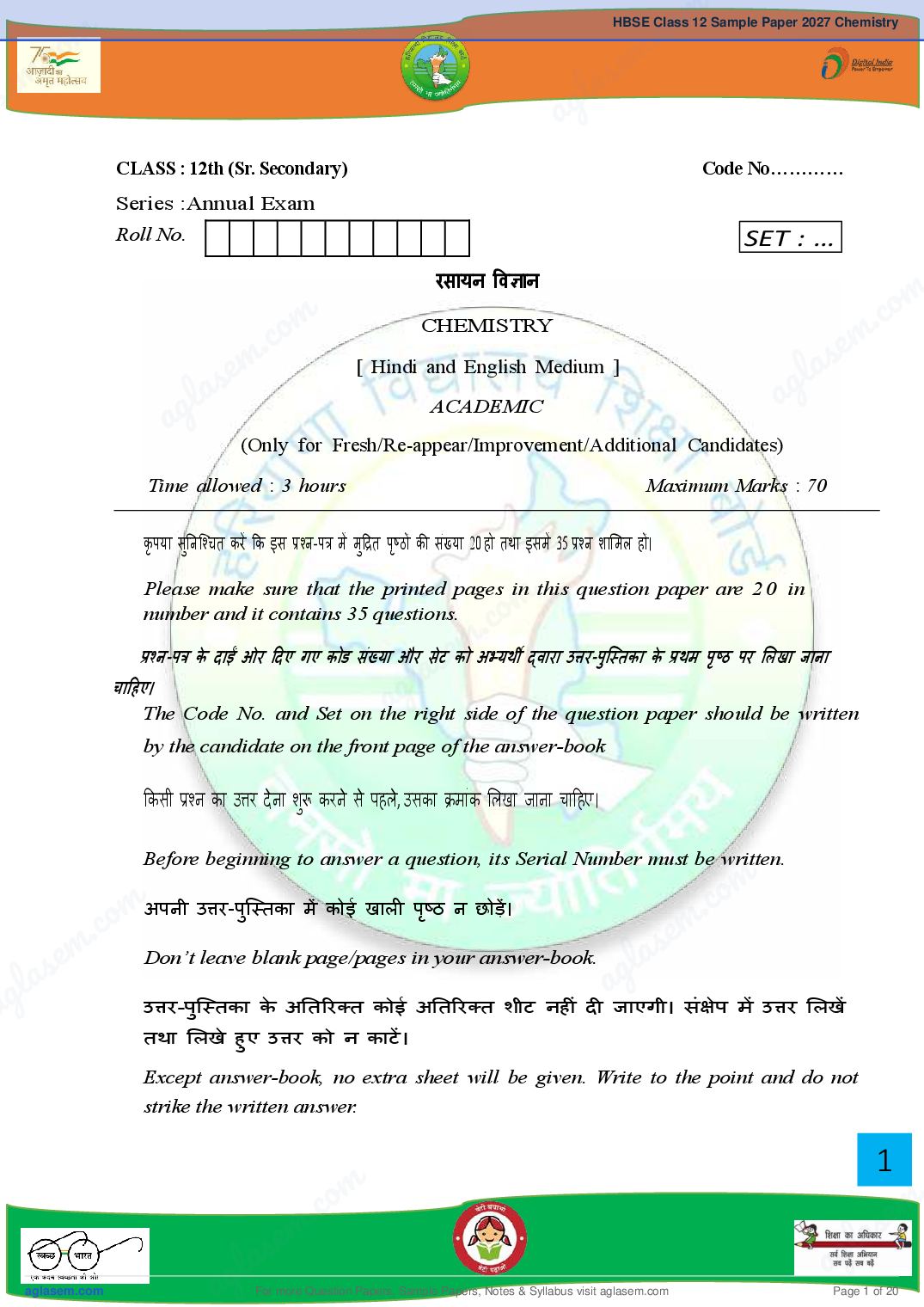
CLASS : 12th (Sr. Secondary) Code No…………
Series :Annual Exam
Roll No. A
SET : …
रसायन वि्ሺान
m
m .co
.co
CHEMISTRY
e m
e m l as
l as [ Hindi and English Medium ]
ag
ag ACADEMIC
(Only for Fresh/Re-appear/Improvement/Additional Candidates)
Time allowed : 3 hours Maximum Marks : 70
कृपया सुनिश्चित करें कक इस ्ቚचि-प्ቔ में मु्शित पष्ृ ठों की संख्या 20 हो तथा इसमें 35 ्ቚचि शाममल हों।
Please make sure that the printed pages in this question paper are 2 0 in
m
number and it contains 35 questions.
.co
em
्ቚचि-प्ቔ के दाईं ओर ्शदए गए कोड संख्या और सेट को अभ्यथी द्वारा उ्ቈर-पुश्ततका के ्ቚथम पृष्ठ पर मलखा जािा
s
िा्शहए। g la
a right side of the question paper should be written
The Code No. and Set on the
by the candidate on the front page of the answer-book
ककसी ्ቚचि का उ्ቈर दे िा शरूु करिे से पहले, उसका ्ቅमांक मलखा जािा िा्शहए।
Before beginning to answer a question, its Serial Number must be written.
m
mअपिी उ्ቈर-पुश्ततका में कोई खाली पष्ृ ठ ि छोडें। .co
m .co s e m
s e Don’t leave blank page/pages in your answer-book.
g l a
g la a
a उ्ቈर-पुश्ततका के अनतररक्त कोई अनतररक्त शीट िहीं दी जाएगी। सं्षेप में उ्ቈर मलखें
तथा मलखे हुए उ्ቈर को ि काटें ।
Except answer-book, no extra sheet will be given. Write to the point and do not
strike the written answer.
1
m .
.co s e m
s em l a
g la ag
a For more Question Papers, Sample Papers, Notes & Syllabus visit Page 1 of 20
Page 3
्ቚचि-प्ቔ पर कुछ भी ि मलखें तथा वततुनिष्ठ ्ቚकार के ्ቚचिों के उ्ቈरों पर कोई निशाि ि
लगाएँ।
Candidates must write their Roll No. on the question paper. Except Roll No. do not
write anything on question paper and don't make any mark on answers of objective
type questions.
्ቚचिों के उ्ቈर दे िे से पहले सनु िश्चित कर लें कक आपको सही एवं पूर्ि ्ቚचि-प्ቔ ्ቚाप्त हुआ है ।
परी्षा के बाद इस संबंध में कोई दावा तवीकार िहीं ककया जाएगा।
Before answering the questions, ensure that you have been supplied the correct
and complete question paper, no claim in this regard, will be entertained after
examination.
सामान्य निदे श :
(i) कुल 35 ्ቚचि हैं।
(ii) सभी ्ቚचि अनिवायि हैं।
(iii) यह ्ቚचि-प्ቔ पाँि खंडों : A, B, C, D और E में ववभाश्जत है ।
(iv) खंड-A में अठारह (1-18) वततुनिष्ठ ्ቚकार के ्ቚचि हैं, ्ቚत्येक 1 अंक का है ।
(v) खंड-B में सात (19-25) अनत लघु उ्ቈरीय ्ቚकार के ्ቚचि हैं, ्ቚत्येक 2 अंकों का है ।
(vi) खंड-C में पाँि (26-30) लघु उ्ቈरीय ्ቚकार के ्ቚचि हैं, ्ቚत्येक 3 अंकों का है ।
(vii) खंड-D में दो (31 एवं 32) केस तटडी ्ቚकार के ्ቚचि हैं, ्ቚत्येक 4 अंकों का है ।
(viii) खंड-E में तीि (33-35) दीघि उ्ቈरीय ्ቚकार के ्ቚचि हैं, ्ቚत्येक 5 अंकों का है ।
(ix) कोई सम्ቇ ववकल्प िहीं है । तथावप, खंड-B में तीि ्ቚचिों, खंड-C में दो ्ቚचिों,
खंड-D में दोिों ्ቚचिों के एक-एक भाग तथा खंड-E में सभी तीि ्ቚचिों में आंतररक
ववकल्प ्ቚदाि ककया गया है । ऐसे ्ቚचिों में आपको ्शदए गए ववकल्पों में से केवल
एक का ही उ्ቈर दे िा है ।
(x) कैलकुलेटर का उपयोग अिुमत िहीं है ।
2
For more Question Papers, Sample Papers, Notes & Syllabus visit Page 2 of 20
Page 4
m .co
m .co s e m
se g l a
a
General Instructions :
(i) There are 35 questions in all.
m
c o m
(ii) All questions are compulsory.
m .co
. s e
s em
(iii) This question paper is divided into five Sections : A, B, C, D and E.
g l a
g l a
(iv) Section-A consist of eighteen (1-18) Objective type questions, aeach of
a
1 mark.
(v) Section-B consist of seven (19-25) Very short answer type questions, each of
2 marks.
(vi) Section-C consist of five (26-30) Short answer type questions, each of
3 marks.
m
.co
(vii) Section-D consist of two (31 & 32) Case study type questions, each of
4 marks.
s em
g
(viii) Section-E consist of three la(33-35) Long answer type questions, each of
5 marks. a
(ix) There is no overall choice. However an internal choice has been provided in
Section-B three questions, Section-C two questions, Section-D one part of both
the questions and Section-E all three questions. You have to attempt only one
of the given choices in such questions.
(x) Use of calculator is not permitted.
m
m .co
m .co खंड – A
s e m
s e g l a
g la SECTION – A a
a [ वततुनिष्ठ ्ቚकार के ्ቚचि ]
[ Objective Type Questions ]
निम्िमलखखत बहुववकल्पीय ्ቚचिों (1-9) के सही ववकल्प का ियि कीश्जए :
3
m .
.co s e m
s em l a
g la ag
a For more Question Papers, Sample Papers, Notes & Syllabus visit Page 3 of 20
Page 5
्ቚ.1- निम्िमलखखत में से कौि-सा एक सहलग्ि (Colligative) गुर् िहीं है ? 1
(A) वाष्प दाब में सापे्ष कमी (B) क्वथिांक में वद्
ृ र्ध
(C) ्शहमांक में कमी (D) क्वथिांक में कमी
Q.1-Which of the following is not a colligative property ? 1
(A) relative lowering of vapour pressure (B) elevation in boiling point
(C) depression in freezing point (D) depression in boiling point
्ቚ. 2- ्ቚोटीि α-अमीिो अम्लों के बहुलक (पॉमलमर) होते हैं, जो एक-दस
ू रे से निम्ि
द्वारा जड
ु े होते हैं: 1
(A) सहसंयोजक बंध (B) ग्लाइकोमसडडक बंध
(C) पेप्टाइड बंध (D) समन्वय बंध (कोऑडडििेट बंध)
Q. 2- Proteins are polymers of a-amino acids which are joined to each other by: 1
(A) Covalent Bond (B) Glycosidic Bond
(C) Peptide Bond (D) Coordinate Bond
्ቚ. 3- वह बेस जो DNA में पाया जाता है लेककि RNA में िहीं पाया जाता, वह है : 1
(A) ग्वानिि (Guanine) (B) साइटोमसि (Cytosine)
(C) थाइममि (Thymine) (D) एडेनिि (Adenine)
Q.3-The base which is present in DNA but not in RNA is: 1
(A) Guanine (B) Cytosine
(C) Thymine (D) Adenine
्ቚ. 4- मलर्थयम एल्युममनियम हाइ्ቑाइड द्वारा एथेििाइ्ाइल के अपियि से बििे वाले
यौर्गक की पहिाि कीश्जए: 1
(A) एथाइलऐमीि (B) एथेिाल
(C) ्ቚोपाइलऐमीि (D) ममथाइलऐमीि
Q. 4- Identify the compound produced by the reduction of Ethanenitrile with
Lithium aluminium hydride: 1
4
For more Question Papers, Sample Papers, Notes & Syllabus visit Page 4 of 20
Page 6
m .co
m .co s e m
se g l a
(A) Ethylamine (B) Ethanal
a
(C) Propylamine (D) Methylamine
्ቚ. 5- ्शदए गए यौर्गकों के क्वथिांकों (boiling points) के सही बढ़ते ्ቅम की पहिाि कीश्जए: 1
(A) ्ቚोपाि-1-ओल < ब्यट
ू ाि-1-ओल < ब्यूटाि-2-ओल < पें टाि-1-ओल
(B) पें टाि-1-ओल < ब्यूटाि-1-ओल < ब्यूटाि-2-ओल < ्ቚोपाि-1-ओल
m
(C) ्ቚोपाि-1-ओल < ब्यट m
ू ाि-2-ओल < ब्यट
ू ाि-1-ओल < पें टाि-1-ओल .co
(D) ब्यट .co
ू ाि-1-ओल < ब्यट
ू ाि-2-ओल < ्ቚोपाि-1-ओल < पें टाि-1-ओल
s e m
s em l a
Q. 5- Identifyathe correct increasing order of boiling points of the given compounds:
g l ag 1
a
(A) Propan-1-ol <butan-1-ol <butan-2-ol < pentan-1-ol
(B) Pentan-1-ol <butan-1-ol <butan-2-ol <Propan-1-ol
(C) Propan-1-ol <butan-2-ol <butan-1-ol < pentan-1-ol
(D) Butan-1-ol < Butan-2-ol <Propan-1-ol <Pentan-1-ol
्ቚ. 6- निम्िमलखखत में से कौि-सा अर्ु ्ቚकृनत में र्िरल (chiral) है ? 1
(A) ्ቚोपाि-2-ऑल (B) ब्यूटाि-2-ऑल
m
(C) 1-्ቜोमोब्यूटेि
.co
(D) 2-्ቜोमो्ቚोपेि
s em
Q. 6- Which of the following molecules is chiral in nature? 1
g a
lButan-2-ol
(A) Propan-2-ol a
(B)
(C) 1-Bromobutane D) 2-Bromopropane
्ቚ. 7- निम्िमलखखत में से कौि-सा हे टरोलेश्प्टक कॉम्प्लेक्स है ? 1
(A) [Co (NH3) 6]3+ (B) [Cr (NH3) 6]3+
m
.co
(C) [Ni (H2O) 6]2+ (D) [Co (NH3) 4 Cl 2] +
m
c. oQ. 7- Which of the following is heteroleptic complex? s e m 1
e m l a
las (A) [Co (NH3) 6]3+ (B) [Cr (NH3) 6]3+
ag
ag (C) [Ni (H2O) 6]2+ (D) [Co (NH3) 4 Cl 2] +
्ቚ. 8- समम्ቦ [Pt (NH3)2 Cl2] का सही IUPAC िाम क्या है ? 1
(A) डायमीिडाइक्लोररडोप्लै्शटिम (IV) (B) डायमीिडाइक्लोररडोप्लै्शटिम (II)
5
m .
.co s e m
s em l a
g la ag
a For more Question Papers, Sample Papers, Notes & Syllabus visit Page 5 of 20
Page 7
Q. 8- The correct IUPAC name of the complex [Pt (NH3)2 Cl2] is: 1
(A) diamminedichloridoplatinum (IV) (B) diamminedichloridoplatinum (II)
(C) dichloridodiammineplatinum (IV) (D) dichloridodiammineplatinum (II)
्ቚ.9- ्ቅोममयम का इलेक््ॉनिक ववन्यास है : 1
(A) [Ar] 3d⁴ 4s¹ (B) [Ar] 3d⁴ 4s²
(C) [Ar] 3d⁵ 4s¹ (D) [Ar] 3d⁵ 4s²
Q.9- Electronic configuration of chromium is: 1
(A) [Ar] 3d 4 4s1 (B) [Ar] 3d 4 4s2
(C) [Ar] 3d 5 4s1 (D) [Ar] 3d 5 4s2
निम्िमलखखत ्ቚचिों (10-12) में ररक्त तथाि भररए :
Fill in the blanks in following questions (10-12) :
्ቚ. 10- है लोएरीि, बेंजीि वलय की सामान्य ……………………… अमभक्ቅयाएँ करते हैं। 1
Q. 10- Haloarenes undergo the usual ……………………… reactions of the benzene ring. 1
्ቚ. 11- α-अमीिो अम्ल एक-दस
ू रे से …………………. बंध / मलंकेज द्वारा जड
ु े होते हैं। 1
Q. 11- α-amino acids are connected to each other by …………………. bond / linkage. 1
्ቚ. 12- एमसल क्लोराइड (अम्ल क्लोराइड) का हाइ्ቑोजिीकरर् उत््ቚेरक, बेररयम सल्फेट पर
पैलेडडयम की उपश्तथनत में ककया जाता है ।इस अमभक्ቅया को ……… अपियि कहा जाता है । 1
Q. 12- Acyl chloride (acid chloride) is hydrogenated over catalyst, palladium on barium sulphate.
6
For more Question Papers, Sample Papers, Notes & Syllabus visit Page 6 of 20
Page 8
m .co
m .co s e m
se g l a
This reaction is called ……………………..reduction.
a 1
निम्िमलखखत ्ቚचिों (13-15) के उ्ቈर एक शब्द/वाक्य में दीश्जए:
m
m .co
m .co
Answer the following questions (13-15) in one word/sentence:
s e m
s e g l a
l a
्ቚ. 13- रासायनिक अमभक्ቅया मलखखए: जब र््ቇग्िाडि अमभकमिक शुष्क बफि (ठोस CO₂) के a
साथ
अमभक्ቅयाagकरता है। 1
Q. 13- Write a chemical reaction : when Grignard Reagent react with dry ice (solid CO2) 1
्ቚ. 14- ्ቚथम को्शट की अमभक्ቅया के मलए दर श्तथरांक k की इकाई मलखखए। 1
Q.14- Write the unit of rate constant k for the first order reaction. ` 1
्ቚचि 15- ववमशष्ट िालकता (specific conductance) को पररभावित कीश्जए तथा इसकी SI इकाई
m
मलखखए।
m .co
s e
g la
Q. 15- Define conductivity (specific conductance), write its SI unit . 1
a
्ቚचि संख्या 16 से 18 के मलए, दो कथि ्शदए गए हैं, श्जिमें एक को अमभकथि (A) तथा दस
ू रे को
कारर् (R) के रूप में अंककत ककया गया है । िीिे ्शदए गए कूट (A), (B), (C) और (D) में से सही उ्ቈर
िुनिए:
(A) - अमभकथि (A) और कारर् (R) दोिों सत्य हैं तथा कारर् (R), अमभकथि (A) की सही व्याख्या
करता है ।
(B) - अमभकथि (A) और कारर् (R) दोिों सत्य हैं, लेककि कारर् (R), अमभकथि (A) की सही व्याख्या m
m करता है।
िहीं
c. o(C) - अमभकथि (A) सत्य है, लेककि कारर् (R) असत्य है। m.co
m (D) - अमभकथि (A) असत्य है, लेककि कारर् (R) सत्य है। s e
s e g l a
g la a
a For question number 16 to 18, two statements are given one labelled as Assertion (A) and the other
labelled as Reason (R). Select the correct answer to these questions from the codes (A), (B), (C) and
(D) as given below:
(A) - Both Assertion (A) and Reason (R) are true and Reason (K) is the correct explanation of the
Assertion (A).
7
m .
.co s e m
s em l a
g la ag
a For more Question Papers, Sample Papers, Notes & Syllabus visit Page 7 of 20
Page 9
Assertion (A).
(C)- Assertion (A) is true, but Reason (R) is false.
(D) Assertion (A) is false, but Reason (R) is true.
्ቚचि 16- अमभकथि (A): एरोमै्शटक ्ቚाथममक अमीिों को गै़््ቜयल ़ቸथैमलमाइड संचलेिर् द्वारा तैयार
ककया जा सकता है ।
कारर् (R): एररल है लाइड, ़ቸथैमलमाइड द्वारा निममित ऐनियि के साथ न्यूश्क्लयोकफमलक ्ቚनततथापि
अमभक्ቅया िहीं करते हैं। 1
Q.16- Assertion (A): Aromatic primary amines can be prepared by Gabriel Phthalimide synthesis.
Reason (R): Aryl halides do not undergo nucleophilic substitution with the anion formed by
phthalimide. 1
्ቚ.17- कथि (A): जतता (श् क
ं ), कैडममयम और पारा को सं्ቅमर् तत्व (Transition Elements) िहीं
मािा जाता है ।
कारर् (R): इि तत्वों की आधार अवतथा (Ground State) तथा उिकी सामान्य ऑक्सीकरर् अवतथाओं
में क्ቌ्षकाएँ (Orbitals) पर्
ू ति ः भरी हुई होती हैं। 1
Q.17- Assertion (A): Zinc, cadmium and mercury are not considered as transition elements.
Reason (R): These elements have completely filled orbitals in their ground state as well as in their
common oxidation states. 1
्ቚ.18- कथि (A): दी गई अमभक्ቅया की आश्ववकता 2 है । 1
2HI → H₂ + I₂
कारर् (R): अमभकारकों के दो अर्ु उिके बीि होिे वाली एक साथ टक्कर में शाममल होते हैं।
Q.18- Assertion (A): The molecularity of the given reaction is 2 . 1
2HI→ H₂ + I2
Reason (R): Two molecules of the reactants are involved in simultaneous collision between them.
खंड – B
SECTION – B
्ቚ. 19- निम्िमलखखत समन्वय यौर्गकों के IUPAC िाम मलखखए : 1+1
8
For more Question Papers, Sample Papers, Notes & Syllabus visit Page 8 of 20
Page 10
m .co
m .co s e m
se g l a
(i) [Co(NH₃)₅CO₃]Cl
a
(ii) K₃[Fe(C₂O₄)₃]
m
.co
Q. 19- Write the IUPAC name of the following coordination compounds : 1+1
m
(i) .co
[Co(NH3 )5CO3]Cl
m s e m
s e l a
(ii) a
g l K 3[Fe(C2O4)3] ag
a
्ቚ.20 - क्या होता है , जब : 1+1
(क) मेर्थल ्ቜोमाइड का शुष्क ईथर की उपश्तथनत में सोडडयम के साथ उपिार ककया जाता है ?
(ख) एर्थल क्लोराइड का जलीय KOH के साथ उपिार ककया जाता है ?
m
.co
Q.20 - What happens, when : 1+1
(a)
s em
Methyl bromide is treated with sodium in the presence of dry ether ?
a aqueous KOH ?
(b) Ethyl chloride is treated lwith
g
a
्ቚ.21- फेरे डे के संदभि में ककतिी ववद्युत की आवचयकता होगी उत्पन्ि करिे के मलए? 1+1
(i) वपघले हुए CaCl₂ से 20.0 ्ቇाम Ca
(ii) वपघले हुए Al₂O₃ से 27.0 ्ቇाम Al
अथवा m
m उस सेल का निरूपर् कीश्जए श्जसमें निम्िमलखखत अमभक्ቅया होती है: m .co
m .co s e 1+1
s e g l a
l a Mg(s) + 2Ag⁺(0.0001M) ---------→ Mg²⁺(0.130M) + 2Ag(s)
a
ag य्शद E°cell = 3.17 V हो, तो उसका E(cell) ्ञात कीश्जए।
Q.21- How much electricity in term of Faraday is required to produce? 1+1
(i) 20.0 gram of Ca from molten CaCl2
9
m .
.co s e m
s em l a
g la ag
a For more Question Papers, Sample Papers, Notes & Syllabus visit Page 9 of 20
Page 11
OR
Represent the cell in which the following reaction takes place
Mg(s) + 2Ag+(0.0001M) -----------→ Mg2+(0.130M) + 2Ag(s)
Calculate its E (cell) if E0 cell = 3.17 V.
्ቚ.22 - निम्िमलखखत िाममत अमभक्ቅयाओं के मलए समीकरर् मलखखए : 1+1
(i) कैनि ारो अमभक्ቅया (Cannizzaro’s reaction)
(ii) हे ल-वोल्हाडि- ेमलंतकी अमभक्ቅया (Hell-Volhard-Zelinsky Reaction)
Q.22 - Write equations for the following name reactions : 1+1
(i) Cannizzaro’s reaction
(ii) Hell-Volhard-Zelinsky reaction
्ቚ. 23- (A) एक ्ቚथम को्शट अमभक्ቅया में अमभकारक की सांिता 5 ममिट में 0.6 mol L⁻¹
से घटकर 0.2 mol L⁻¹ हो जाती है । अमभक्ቅया का दर श्तथरांक ्ञात कीश्जए। 2
(log 3 = 0.48)
अथवा
(B) ्ቚथम को्शट अमभक्ቅया के मलए दर श्तथरांक k = 2.54 × 10⁻³ s⁻¹ है । अमभकारक के 2
तीि-िौथाई भाग के अपघटि के मलए आवचयक समय की गर्िा कीश्जए। (log 4 = 0.60)
Q,23- (A) The concentration of the reactant is reduced from 0.6 mol L-¹ to 0.2 mol L-¹ in 2
5 minutes in a first order reaction. Calculate rate constant of the reaction. (log 3 = 0.48)
OR
(B) Rate constant k for the first order reaction is 2.54 × 10-³ s-¹. Calculate the time required
for three-fourth of the reactant to decompose. (log 4 = 0.60) 2
्ቚ. 24- (a) ्शदए गए यौर्गक की संरििा बिाइए: 1+1
4-्ቜोमो-3-मेथाइलपें ट-2-ईि
10
For more Question Papers, Sample Papers, Notes & Syllabus visit Page 10 of 20
Page 12
m .co
m .co s e m
se g l a
a
(b)जब क्लोरोएथेि का जलीय पोटै मशयम हाइ्ቑॉक्साइड के साथ उपिार ककया जाता है ,
तो क्या होता है ?
Q. 24- (a) Draw the structure of the given compound: 1+1
4-Bromo-3-methylpent-2-ene
m
m .co
.co
(b)What happens when chloroethane is treated with aqueous potassium hydroxide ?
e m
्ቚ.25- निम्िमलखखत em अमभक्ቅयाओं से अपे्ቌ्षत उत्पादों की संरििाएँ तथा IUPAC िाम मलखखए:
l as1+1
a
(a)lब्य
sूटािल का उत््ቚेरक अपियि। a g
a(b)g तिु सल््यूररक अम्ल की उपश्तथनत में ्ቚोपीि का जलयोजि।
अथवा
निम्िमलखखत यौर्गकों के समह
ू ों को उिके बढ़ते हुए क्वथिांकों (boiling points) के ्ቅम में
व्यवश्तथत कीश्जए: 1+1
(a) पें टाि-1-ऑल, ब्यट
ू ाि-1-ऑल, ब्यट
ू ाि-2-ऑल, एथेिॉल, ्ቚोपाि-1-ऑल, मेथेिॉल।
(b) पें टाि-1-ऑल, n-ब्यट
ू े ि, पें टािल, एथॉक्सीएथेि।
m
.co
Q.25- Give the structures and IUPAC names of the products expected from
em
the following reactions: 1+1
la s
g
(a) Catalytic reduction of butanal.
a
(b) Hydration of propene in the presence of dilute sulphuric acid.
OR
Arrange the following sets of compounds in order of their increasing boiling points: 1+1
(a) Pentan-1-ol, butan-1-ol, butan-2-ol, ethanol, propan-1-ol, methanol.
(b) Pentan-1-ol, n-butane, pentanal, ethoxyethane.
m
m .co
m .co खंड – C
s e m
s e g l a
g la SECTION – C a
a [ Short Answer Type Questions ]
्ቚ. 26- ्शदए गए रूपांतरर्ों में ्ቚयुक्त अमभकमिकों (reagents) के िाम मलखखए: 1+1+1
(i) कफिॉल से 2, 4, 6-्ाइ्ቜोमोकफिॉल
11
m .
.co s e m
s em l a
g la ag
a For more Question Papers, Sample Papers, Notes & Syllabus visit Page 11 of 20
Page 13
(iii) ब्यूटैि-2-ओि से ब्यूटैि-2-ऑल
अथवा
(i) संबर्ं धत ऐल्कोहॉल के निमािर् हे तु ऐल्कीि के अम्ल-उत््ቚेररत जलयोजि (acid catalyzed
hydration) की क्ቅयाववर्ध (mechanism) समझाइए। 2
(ii) निम्िमलखखत अमभक्ቅया को पूर्ि कीश्जए: 1
(i)LiAlH4
RCOOH
(ii) H2 O
Q. 26- Write the reagents which are used in the given conversions: 1+1+1
(i) Phenol to 2, 4, 6 tribromophenol
(ii) Propene to propan-1-ol
(iii) Butan-2-one to butan-2-ol
OR
(i) Explain the mechanism of acid catalyzed hydration of alkene to form corresponding
alcohol. 2
(ii) Complete the following reaction : 1
(i)LiAlH4
RCOOH
(ii) H2 O
्ቚ. 27- 45 g एर्थलीि ग्लाइकोल (C2H6O2) को 600 g पािी में ममलाया जाता है । गर्िा कीश्जए
(a) ्शहमांक में अविमि (freezing point depression) तथा 2+1
(b) (b) ववलयि का ्शहमांक (freezing point)
Q. 27- 45 g of ethylene glycol (C2H6O2) is mixed with 600 g of water. Calculate 2+1
(a) the freezing point depression and (b) the freezing point of the solution.
्ቚ. 28- संयोजकता बंध मसद्धांत के आधार पर समझाइए कक वगि समतलीय संरििा वाला
12
For more Question Papers, Sample Papers, Notes & Syllabus visit Page 12 of 20
Page 14
m .co
m .co s em
se g la
[Ni(CN)4]²⁻ आयि ्ቚनतिंब
a
ु कीय (diamagnetic) होता है , जबकक ितष्ु फलकीय ज्याममनत वाला [NiCl4]²⁻
आयि अिि
ु ब
ंु कीय (paramagnetic) होता है । 1½ + 1½
Q. 28- Explain on the basis of valence bond theory that [Ni(CN )4]2- ion with square
planar structure is diamagnetic and [NiCl4]2-ion with tetrahedral geometry is
paramagnetic. 1½ + 1½
m
c o m
्ቚ. 29- (a) निम्ि के जलअपघटि (हाइ्ቑोमलमसस) के उत्पाद क्या हैं ?
m
1+1+1 .co
(i) स्ቅ .
ु ोज तथा (ii) लैक्टोज s e
s em g l a
l a a
a(b)g ववटाममि C हमारे शरीर में सं्ቇ्शहत (तटोर) क्यों िहीं ककया जा सकता?
Q. 29- (a) What are the hydrolysis products of 1+1+1
(i) sucrose and (ii) lactose ?
(b) Why cannot vitamin C be stored in our body?
्ቚ.30-एक ्ቚथम को्शट अमभक्ቅया का दर नियतांक 1.15 × 10⁻³ s-1 है । इस अमभकारक के 5 g को
m
3 g तक घटिे में ककतिा समय लगेगा? .co 3
s em अथवा
g la होिे में 40 ममिट लगते हैं। t₁/₂ की गर्िा कीश्जए 3
एक ्ቚथम को्शट अमभक्ቅया में 30% अपघटि
a
Q.30-A first order reaction has a rate constant 1.15 × 10⁻³ s-1. How long will 5 g
of this reactant take to reduce to 3 g? 3
OR
A first order reaction takes 40 min for 30% decomposition. Calculate t1/2. 3
m
.co
SECTION-D
m
c. oनिम्िमलखखत ्ቚचि (31 और 32) केस-आधाररत ्ቚचि हैं, श्जिमें ्ቚत्येक के s4 eअंmक हैं। गद्यांश को
[ Case Study Based Questions ]
s em g l a
la ध्यािपूवक
ि पढ़ें और उसके बाद ्शदए गए ्ቚचिों के उ्ቈर दें : a
ag The following questions (31 and 32) are case based questions, carries 4 marks each. Read the passage
carefully and answer the questions that follow:
्ቚ.31. NH₃ की तरह अमीि में िाइ्ोजि परमार्ु ़््ቔसंयोजी (trivalent) होता है और उसके पास एक
13
m .
.co s e m
s em l a
g la ag
a For more Question Papers, Sample Papers, Notes & Syllabus visit Page 13 of 20
Page 15
संकरखर्त (hybridised) होती हैं और अमीिों की ज्याममनत वपराममडीय (pyramidal) होती है । निम्ि
ऐमलफै्शटक अमीि जल के अर्ओ
ु ं के साथ हाइ्ቑोजि बंध बिाकर पािी में घल
ु िशील होते हैं। अमीिों
का मोलर िव्यमाि बढ़िे पर उिके हाइ्ቑोफो़्बक भाग का आकार बढ़ जाता है , श्जससे उिकी
घुलिशीलता कम हो जाती है । उच्ि अमीि पािी में अघुलिशील होते हैं।
हालाँकक, अमीि अल्कोहलों की तुलिा में पािी में कम घुलिशील होते हैं क्योंकक ऑक्सीजि की
तुलिा में िाइ्ोजि की ववद्युतऋर्ात्मकता (electronegativity) कम होती है । समावयवी (isomeric)
अमीिों के क्वथिांक का ्ቅम 1° > 2° > 3° होता है । इसका कारर् यह है कक अमीि हाइ्ቑोजि बंधि
के कारर् एक-दस
ू रे से जड
ु े रहते हैं। ्ቚाथममक अमीिों में हाइ्ቑोजि बंधि की मा्ቔा द्ववतीयक अमीिों
की अपे्षा अर्धक होती है क्योंकक उिमें हाइ्ቑोजि बंध बिािे के मलए दो हाइ्ቑोजि परमार्ु उपलब्ध
होते हैं। तत
ृ ीयक अमीि हाइ्ቑोजि बंधि िहीं ्शदखाते क्योंकक िाइ्ोजि से जड
ु ा कोई हाइ्ቑोजि
परमार्ु उपश्तथत िहीं होता। अमीिों का निमािर् िाइ्ो यौर्गकों, िाइ्ाइलों, अमाइडों आ्शद से ककया
जा सकता है ।
(a) निम्िमलखखत समीकरर्ों को पूरा कीश्जए: 1+1
(i) LiAlH₄ (ii) H₂O
(i) CH₃CONH₂ -----------------------→
(ii) Fe + HCl
---------------→
(b) ्ቚाथममक अमीिों का क्वथिांक तत
ृ ीयक अमीिों की तुलिा में अर्धक क्यों होता है ? 1
(c) निम्िमलखखत अमीिों को ्ቚाथममक, द्ववतीयक या तत
ृ ीयक के रूप में वगीकृत कीश्जए। 1
C₂H₅NHCH₃ , CH₃NH₂ , (CH₃)₂NC₂H₅
अथवा
(C), ब्यूटेि-1-अमीि और ब्यूटेि-1-ऑल में से कौि जल में अर्धक ववलेय है ? 1
Q.31. Like NH3 nitrogen atom of amine is trivalent and carries an unshared pair of electrons.
Nitrogen orbitals in amines are therefore sp³ hybridised and the geometry of amines is pyramidal.
Lower aliphatic amines are soluble in water due to the formation of hydrogen bond with water
molecules. The solubility decreases as the molar mass of amines increases due to increase in size of
hydrophobic part. Higher amines are insoluble in water. However amines are less soluble in water
than alcohols because of low electronegativity of nitrogen as compared to oxygen. Boiling points of
isomeric amines follow the order 10 > 2 0 > 30 It is due to the fact the amines are held together due to
14
For more Question Papers, Sample Papers, Notes & Syllabus visit Page 14 of 20
Page 16
m .co
m .co s em
se g la
a
hydrogen bonding. Extent of hydrogen bonding is more in primary amines than in secondary amines
as two hydrogen atoms are available for hydrogen bond formation. Tertiary amines do not show
hydrogen bonding because of the absence of hydrogen atom attached to nitrogen. Amines can be
prepared from, nitro compounds, nitriles, amides etc.
(a) Complete the following equations: 1+1
m
.co
(i)LiAlH4 (ii) H2O
m
.co m
(i) CH3 CONH2 -----------------------→
s e
s em l a
ag
(ii) Fe + HCl
g l a ---------------→
aprimary amines have higher boiling points than tertiary amines?
(b)Why 1
(c) Classify the following amines as primary , secondary or tertiary . 1
C2H5 NHCH3 , CH3NH2 , (CH3)2N C2H5
OR
(C), Out of Butane-1-amine and Butane-1-ol , which is more soluble in water? 1
्ቚ. 32- परासरर् (Osmosis) एक ऐसी ्ቚक्ቅया है श्जसके द्वारा ववलायक (solvent) के अर्ु अधि-
m
पारगम्य खझल्ली (semi-permeable membrane) के माध्यम से कम ववलेय सांिता वाले ववलयि से
o
c
अर्धक ववलेय सांिता वाले ववलयि की ओर जाते .हैं। परासरर् दाब (Osmotic pressure) एक
m
eककसी
समश्ष्टगत गर्
ु (colligative property) है । a
l s
जब ववलयि पर लगाया गया दाब उसके परासरर्
agपरासरर् (reverse osmosis) होता है। जब दो ववलयि अधि-
दाब से अर्धक हो जाता है , तो ्ቚनतलोम
पारगम्य खझल्ली द्वारा अलग ककए जाते हैं और उिका परासरर् दाब समाि होता है , तो उन्हें
समपरासरी (isotonic) कहा जाता है । अधि-पारगम्य खझल्ली द्वारा अलग ककए गए दो ववलयिों में से
य्शद एक का परासरर् दाब कम हो, तो उसे दस
ू रे ववलयि के सापे्ष अल्पपरासरी (hypotonic) कहा
जाता है । य्शद उसका परासरर् दाब दस
ू रे ववलयि से अर्धक हो, तो उसे दस
ू रे ववलयि के सापे्ष
अनतपरासरी (hypertonic) कहा जाता है । रक्त कोमशका के भीतर के िव से संबंर्धत परासरर् दाब
m
0.9% (िव्यमाि/आयति) सोडडयम क्लोराइड ववलयि के बराबर होता है , श्जसे सामान्य लवर्ीय
o
c
m (normal saline solution) कहा जाता है और इसे अंतःमशरा (intravenously)
. इंजेक्शि के रूप में
c. oदेववलयि m
e ूर्ि है। यह यह
e m िा सरु ्ቌ्षत होता है। परासरर् दाब दैनिक जीवि और ्ቚकृनत में अत्यंlaतsमहत्वप
l as समझािे में सहायता करता है कक IV िवों का परासरर् दाब रक्त aकेgपरासरर् दाब के समाि क्यों
ag रखा जाता है , तथा यही मसद्धांत िमक या िीिी का उपयोग करके खाद्य संर्षर् के पीछे भी कायि
करता है ।
Q. 32- Osmosis is a process by which the molecules of a solvent pass from a solution of low solute
concentration to a solution of high solute concentration through a semi-permeable membrane.
15
m .
.co s e m
s em l a
g la ag
a For more Question Papers, Sample Papers, Notes & Syllabus visit Page 15 of 20
Page 17
osmotic pressure, reverse osmosis occurs. When two solutions are separated by a semipermeable
membrane and they have same osmotic pressure they are said to be isotonic. Of the two solutions
separated by a semipermeable membrane, if one is a lower osmotic pressure, it is said to be hypotonic
relative to the second solution. If it has a higher osmotic pressure, than the second solution, it is said
to be hypertonic relative to the second solution. The osmotic pressure associated with the fluid inside
the blood cell is equivalent to that of 0.9% (mass/volume) sodium chloride solution called normal
saline solution and it is safe to inject intravenously. Osmotic pressure is vital in daily life and nature.
It helps in explain, why IV fluids match blood's osmotic pressure, its also the principle behind food
preservation using salt or sugar.
(a) 2.46 लीटर पािी में घुले CaCl₂ (i = 2.59) की मा्ቔा की गर्िा कीश्जए ताकक 27°C पर उसका
परासरर् दाब 0.70 atm हो। 2
[्शदया गया: R = 0.082 L atm K⁻¹ mol⁻¹, CaCl₂ का मोलर िव्यमाि = 111 g mol⁻¹]
(a) Calculate the amount of CaCl₂ (i = 2.59) dissolved in 2.46 litre of water such that its osmotic
pressure is 0.70 atm at 27°C. 2
[Given: R = 0.082 L atm K-¹ mol-¹, molar mass of CaCl₂ = 111 g mol-¹]
(b) जब ककशममश को पािी में रखा जाता है , तो वे फूल जाती हैं। इस ्ቚक्ቅया में शाममल पररघटिा
का िाम बताइए। 1
(b) When raisins are kept in water, they get swollen. Name the phenomenon involved in this process.
अथवा
b) परासरर् दाब (Osmotic Pressure) अन्य साम्शू हक गर्
ु ों (Colligative Properties) की तल
ु िा में
अर्धक लाभदायक क्यों है ? 1
(b) Why osmotic pressure is more advantageous than other colligative properties? 1
(c) समि
ु ी जल के ववलवर्ीकरर् (Desalination) के मलए कौि-सी पररघटिा उ्ቈरदायी है ? 1
c) Which phenomenon is responsible for desalination of sea water? 1
16
For more Question Papers, Sample Papers, Notes & Syllabus visit Page 16 of 20
Page 18
m .co
m .co s e m
se g l a
SECTION – E
a
[ दीघि उ्ቈरीय ्ቚचि ]
[ Long Answer Type Questions ]
्ቚ. 33- (a) निम्िमलखखत का रूपांतरर् कैसे करें गे: 3+2
m
m .co
(i) ्ቚोपेिोि से ्ቚोपीि
.co s e m
s em l a
ag
(ii) बेंजोइक अम्ल से बें ाश्ल्डहाइड
g la
a से m-िाइ्ोएसीटोकफिोि
(iii) बें ीि
(b) (i) निम्िमलखखत यौर्गकों को HCN के ्ቚनत उिकी अमभक्ቅयाशीलता के बढ़ते ्ቅम में व्यवश्तथत
कीश्जए:
CH3 CO CH3 , (CH3)3 C- CO-C-(CH3)3 , CH3 CHO
(ii) उि यौर्गकों की पहिाि कीश्जए, जो एल्डोल संघिि करें गे:
m
HCHO, C6H5CHO , CH3CHO
m .co
s e
Q. 33- (a) How will you convert the following:
g la 3+2
(i) Propanone to Propene
a
(ii) Benzoic acid to Benzaldehyde
(iii) Benzene to m-Nitroacetophenone
(b) (i) Arrange the following compounds in increasing order of their reactivity towards HCN:
m
m CH CO CH , (CH ) C- CO-C-(CH ) , CH CHO
c. o(ii) Identify m .co
the compounds, which would undergo Aldol condensation: se
3 3 3 3 3 3 3
s em g l a
la a
ag
HCHO, C H CHO , CH CHO
6 5 3
अथवा / OR
17
m .
.co s e m
s em l a
g la ag
a For more Question Papers, Sample Papers, Notes & Syllabus visit Page 17 of 20
Page 19
(i) एसीटोकफिोि और बेंजोकफिोि
(ii) ्ቚोपेिल और ्ቚोपेिोि
(iii) पें टाि-2-ओि और पें टाि-3-ओि
(b) (i) निम्िमलखखत अम्लों में से कौि-सा अर्धक ्ቚबल है और क्यों?
CH₂FCOOH , CH₃COOH
(ii) निम्िमलखखत यौर्गकों को उिके क्वथिांक के बढ़ते ्ቅम में व्यवश्तथत कीश्जए:
CH₃COCH₃ , CH₃CH₂CH₃ , CH₃CH₂OH , CH₃CHOOR
OR
(a) Give chemical tests to distinguish between the following pairs of compounds: 3+2
(i) Acetophenone and Benzophenone
(ii) Propanal and Propanone
(iii) Pentan-2-one and Pentan-3-one
(b) (i) Which of the following acids is stronger and why?
CH2FCOOH , CH3COOH
(ii)Arrange the following compounds in the increasing order of their boiling points:
CH3 CO CH3 , CH3 CH2 CH3 , CH3 CH2OH , CH3 CHO
्ቚ. 34 - (a) 0.1 mol L⁻¹ NaCl ववलयि की िालकता 1.06 × 10⁻² S cm⁻¹ है । 3+2
उसकी मोलर िालकता तथा ववयोजि की डड्ቇी की गर्िा कीश्जए। ्शदया गया है :
λ₀ Na⁺ = 50.1 S cm² mol⁻¹
λ₀ Cl⁻ = 76.5 S cm² mol⁻¹
18
For more Question Papers, Sample Papers, Notes & Syllabus visit Page 18 of 20
Page 20
m .co
m .co s em
se g la
a
(b) (i) एक गैल्वैनिक सेल में निम्िमलखखत सेल अमभक्ቅया होती है :
2 Ag⁺ (aq) + Zn (s) -------------→ 2 Ag (s) + Zn²⁺ (aq) E₀(cell) = +1.56 V
धारा के ्ቚवाह की ्शदशा का पूवाििुमाि कीश्जए।
m
.co
(ii) ्ቚाथममक बैटरी तथा द्ववतीयक बैटरी के बीि अंतर तपष्ट कीश्जए।
o m m
c
. of 0.1 mol L solution of NaCl is 1.06 X 10 S cm s e
m
e its molar conductivity and degree of dissociation. Given that :
Q. 34 - (a) The conductivity -1 -2 -1
3+2
l a
as
Calculate
l = 50.1 S cm mol ag
λgNa+
a -
0 2 -1
λ0 Cl = 76.5 S cm2 mol-1
(b) (i) Following cell reaction occurs in a galvanic cell:
2 Ag+ (aq) +Zn (s) -------------→ 2Ag (s) + Zn2+ (aq) E0(cell) =+1.56 V
m
.co
Predict the direction of flow of current.
(iii)
e m
Differentiate between a primary battery and a secondary battery.
las
ag
अथवा
(क) 0.1 M KCl ववलयि से भरी हुई एक िालकता सेल का ्ቚनतरोध 100 Ω है । य्शद उसी सेल का
्ቚनतरोध 0.01 mol L⁻¹ KCl ववलयि से भरिे पर 300 Ω हो जाता है , तो 0.01 mol L⁻¹ KCl ववलयि
की िालकता (conductivity) तथा मोलर िालकता (molar conductivity) की गर्िा कीश्जए। 0.1 M
KCl ववलयि की िालकता 1.29 × 10⁻² S cm⁻¹ है ।
(ख) (i) H₂–O₂ ईंधि सेल के कोई दो लाभ मलखखए। 3+2
m
m (ii) मरकरी सेल का सेल ववभव (cell potential) उसके पूरे जीविकाल में श्तथर क्यों बिा रहता है ?
.co
m .co s e m
s e OR
g l a
g la a
(a) Resistance of a conductivity cell filled with 0.1 M KCI solution is 100 Ω. If the resistance of
the same cell when filled with 0.01 mol L -1 KCl solution is 300 Ω, calculate the conductivity and
a molar conductivity of 0.01 mol L-1 KCI solution. The conductivity of 0.1 M KCl solution is
1.29 X 10⁻² S cm-1 3+2
(b) (i) Write any two advantages of H2 – O2 fuel cell.
ii) Why does the cell potential of mercury cell remain constant throughout the life?
19
m .
.co s e m
s em l a
g la ag
a For more Question Papers, Sample Papers, Notes & Syllabus visit Page 19 of 20
Page 21
ु ाइट अयतक से KMnO₄ के निमािर् के िरर्ों को बताइए। 3+2
(ii) अम्लीकृत पोटै मशयम परमैंगिेट ववलयि निम्िमलखखत के साथ कैसे अमभक्ቅया करता है ?
अमभक्ቅयाओं के मलए आयनिक समीकरर् मलखखए :
(a) ऑक्सालेट आयि (b) आयोडाइड आयि।
Q. 35- (i) Indicate the steps in the preparation of KMnO4 from Pyrolusite ore. 3+2
(ii)How does acidified potassium permanganate solution react with the
following ? Write ionic equations for the reactions :
(a) Oxalate ion (b) Iodide ion
अथवा
(i) कारर् स्शहत समझाइए : 3+2
(क) सं्ቅमर् धातुएँ (Transition Metals) संकुल यौर्गक (Complex Compounds) बिाती हैं।
(ख) Zn²⁺ के लवर् रं गहीि होते हैं जबकक Ni²⁺ के लवर् रं गीि होते हैं।
(ग) Cr²⁺ एक ्ቚबल अपिायक (Strong Reducing Agent) है ।
(ii) आंतररक सं्ቅमर् तत्व (Inner Transition Elements) क्या होते हैं? उिका सामान्य इलेक््ॉनिक
ववन्यास (General Electronic Configuration) मलखखए।
OR
(i) Explain giving reason : 3+2
(a) Transition metals form complex compounds.
(b) Zn2+ salts are colourless while Ni2+salts are coloured.
(c) Cr2+ is a strong reducing agent.
(ii) What are inner transition elements? Write their general electronic
configuration
………………………………………………………………………
20
For more Question Papers, Sample Papers, Notes & Syllabus visit Page 20 of 20
Document Details
| Board / Org | Haryana Board |
| Exam | Class 12 |
| Type | Sample Paper |
| Pages | 20 |
| Updated | 03 Nov 2026 |