CBSE Class 10 Question Paper 2025 Solution Home Science
Finished viewing? Save it for later —
Download CBSE Class 10 Question Paper 2025 Solution Home Science (PDF · 13 pages)About CBSE Class 10 Question Paper 2025 Solution Home Science
CBSE Class 10 Question Paper 2025 Solution Home Science is available here for free download. Published by CBSE for Class 10, this solution can be viewed online or downloaded as a PDF (13 pages). Candidates preparing for Class 10 can use CBSE Class 10 Question Paper 2025 Solution Home Science to understand the exam pattern, the type of questions asked, and the overall difficulty level.
Frequently Asked Questions
How can I download CBSE Class 10 Question Paper 2025 Solution Home Science?
Open this page and click the Download button to save CBSE Class 10 Question Paper 2025 Solution Home Science as a PDF. It is completely free on AglaSem Docs.
Is CBSE Class 10 Question Paper 2025 Solution Home Science free to download?
Yes. CBSE Class 10 Question Paper 2025 Solution Home Science can be viewed online and downloaded as a PDF free of cost on AglaSem Docs.
How many pages does CBSE Class 10 Question Paper 2025 Solution Home Science have?
CBSE Class 10 Question Paper 2025 Solution Home Science contains 13 pages, which you can read online or download together as a single PDF.
Where can I find more Class 10 study material?
You can find more Class 10 question papers, sample papers, syllabus, and answer keys on AglaSem Docs.
CBSE Class 10 Question Paper 2025 Solution Home Science – Text
Read the full text of this solution below — useful to quickly search, copy and reference the content online without downloading the PDF.
📄 View text version (13 pages)
Page 1
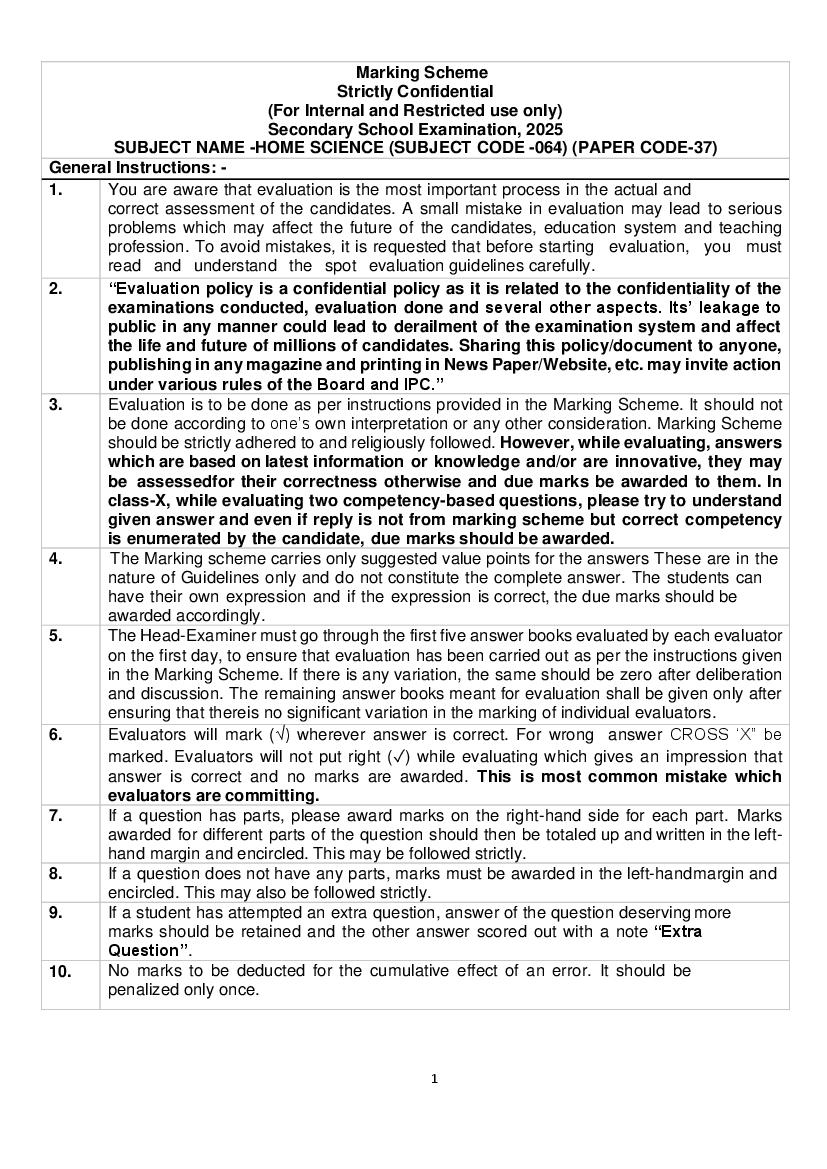
Strictly Confidential
(For Internal and Restricted use only)
Secondary School Examination, 2025
SUBJECT NAME -HOME SCIENCE (SUBJECT CODE -064) (PAPER CODE-37)
General Instructions: -
1. You are aware that evaluation is the most important process in the actual and
correct assessment of the candidates. A small mistake in evaluation may lead to serious
problems which may affect the future of the candidates, education system and teaching
profession. To avoid mistakes, it is requested that before starting evaluation, you must
read and understand the spot evaluation guidelines carefully.
2. “Evaluation policy is a confidential policy as it is related to the confidentiality of the
examinations conducted, evaluation done and several other aspects. Its’ leakage to
public in any manner could lead to derailment of the examination system and affect
the life and future of millions of candidates. Sharing this policy/document to anyone,
publishing in any magazine and printing in News Paper/Website, etc. may invite action
under various rules of the Board and IPC.”
3. Evaluation is to be done as per instructions provided in the Marking Scheme. It should not
be done according to one’s own interpretation or any other consideration. Marking Scheme
should be strictly adhered to and religiously followed. However, while evaluating, answers
which are based on latest information or knowledge and/or are innovative, they may
be assessedfor their correctness otherwise and due marks be awarded to them. In
class-X, while evaluating two competency-based questions, please try to understand
given answer and even if reply is not from marking scheme but correct competency
is enumerated by the candidate, due marks should be awarded.
4. The Marking scheme carries only suggested value points for the answers These are in the
nature of Guidelines only and do not constitute the complete answer. The students can
have their own expression and if the expression is correct, the due marks should be
awarded accordingly.
5. The Head-Examiner must go through the first five answer books evaluated by each evaluator
on the first day, to ensure that evaluation has been carried out as per the instructions given
in the Marking Scheme. If there is any variation, the same should be zero after deliberation
and discussion. The remaining answer books meant for evaluation shall be given only after
ensuring that thereis no significant variation in the marking of individual evaluators.
6. Evaluators will mark (√) wherever answer is correct. For wrong answer CROSS ‘X” be
marked. Evaluators will not put right (✓) while evaluating which gives an impression that
answer is correct and no marks are awarded. This is most common mistake which
evaluators are committing.
7. If a question has parts, please award marks on the right-hand side for each part. Marks
awarded for different parts of the question should then be totaled up and written in the left-
hand margin and encircled. This may be followed strictly.
8. If a question does not have any parts, marks must be awarded in the left-hand margin and
encircled. This may also be followed strictly.
9. If a student has attempted an extra question, answer of the question deserving more
marks should be retained and the other answer scored out with a note “Extra
Question”.
10. No marks to be deducted for the cumulative effect of an error. It should be
penalized only once.
1
Page 2
Paper) has to be used. Please do not hesitate to award full marks if the answer deserves
it.
12. Every examiner has to necessarily do evaluation work for full working hours i.e., 8 hours
every day and evaluate 20 answer books per day in main subjects and 25 answer books per
day in other subjects (Details are given in Spot Guidelines). This is in view of the reduced
syllabus and number of questions in question paper.
13. Ensure that you do not make the following common types of errors committed by the
Examiner in the past: -
● Leaving answer or part there of unassessed in an answer book.
● Giving more marks for an answer than assigned to it.
● Wrong totaling of marks awarded on an answer.
● Wrong transfer of marks from the inside pages of the answer book to the title page.
● Wrong question wise totaling on the title page.
● Wrong totaling of marks of the two columns on the title page.
● Wrong grand total.
● Marks in words and figures not tallying/not same.
● Wrong transfer of marks from the answer book to online award list.
● Answers marked as correct, but marks not awarded. (Ensure that the right tick mark is
correctly and clearly indicated. It should merely be a line.Same is with the X for
incorrect answer.)
● Half or a part of answer marked correct and the rest as wrong, but no marks awarded.
14. While evaluating the answer books if the answer is found to be totally incorrect,
it should be marked as cross (X) and awarded zero (0) Marks.
15. Any un assessed portion, non-carrying over of marks to the title page, or totaling error
detected by the candidate shall damage the prestige of all the personnel engaged in the
evaluation work as also of the Board. Hence, in orderto uphold the prestige of all concerned,
it is again reiterated that the instructions be followed meticulously and judiciously.
16. The Examiners should acquaint themselves with the guidelines given in the
“Guidelines for spot Evaluation” before starting the actual evaluation.
17. Every Examiner shall also ensure that all the answers are evaluated, marks
carried over to the title page, correctly totaled and written in figures and words.
18. The candidates are entitled to obtain photocopy of the Answer Book on request on payment
of the prescribed processing fee. All Examiners/Additional Head Examiners/Head Examiners
are once again reminded that they must ensure that evaluation is carried out strictly as per
value points for each answer as given in the Marking Scheme.
2
Page 3
MARKING SCHEME
Q. No. EXPECTED ANSWER / VALUE POINTS Marks
SECTION A (Objective Type Questions)
1. (D) 20 seconds 1
2. Gum / Gum Arabic / Gum Acacia 1
3. Example of exploratory play for a 3 – 5-year-old child- 1
1.Breaks / opens / dismantles toys
2.Treasure hunt
3.Exploring nature / surroundings
4.Engaging in sensory play / exploring various materials like sand, water, clay
etc.
Any other, Any one
4. (A) Animal – Oil 1
5. (D) Dovetailing 1
6. Clothes should not be stored in moist conditions- 1
To avoid the following-
1.mildew / fungal growth
2.gradual discoloration of clothes
3.off -odour
Any other, Any one
7. Endomorphic body type in children- 1
1.Rounded and heavier physique / build
2.Higher percentage of body fat
3.Wider waist and large bone structure
4.Fat storage on lower abdomen, hips and thighs
5.Slower Metabolism
6.Can gain muscles easily
7.Difficulty in losing weight
8.Not necessarily overweight
9.BMI is high
Any other, Any one
8. (B) 1-(iv), 2-(i), 3-(ii), 4-(iii) 1
9. (A) 1-(ii), 2-(iv), 3-(i), 4-(iii) 1
10. (B) 5 – 6 years 1
11. (A) (ii) and (iv) 1
12. What is Argemone? Give two of its harmful effects on human health.
3
Page 4
1.an adulterant
2.a weed that grows along with mustard crop
3.used to adulterate mustard- oil / seeds / paste
Any other, Any one
Harmful effects on human health - ½
1.Dropsy
2.Oedema / Water retention
3.Swelling
4.Glaucoma / Blindness
5.Gastro-intestinal disturbances / Nausea / Vomiting / Diarrhoea
6.Enlargement of liver
7.Rashes on exposed body parts
8.Kidney failure
9.Heart related issues
10.Cancer
13. (A) Both Assertion (A) and Reason (R) are true and Reason (R) is the 1
correct explanation of Assertion (A).
14. Example of misleading information on packaged food products- 1
1.Exaggerated / Misleading claims on any packaged food products
2.Imitation / Packaging similar to those of popular brands
3.Incomplete / False labels
4.Small / Blurred / Difficult to read print
5.Imitation / Duplication of standardized marks
Any other, Any one suitable example
Case Study-Based Questions
15. (C) Posture while sweeping the floor 1
16. (D) 1-(iv), 2-(i), 3-(ii), 4-(iii) 1
17. Note - All the options are correct. One mark should be awarded for 1
attempting the question.
18. (A) Allocating money for various tasks 1
SECTION B (Short Answer Questions)
19. What are fine motor skills? Give two example of fine motor skills
developed in early childhood years among 3 – 5-year-old children.
Fine motor skills refer to the development of skills involving fine / small muscles 1
Any other
4
Page 5
3- 5-year-old children-
1.Can open large buttons / snap buttons
2.Fold / Tear paper
3.Draw simple pictures / tadpole pictures
4.Draw shapes / Paints
5.Use scissors / Can cut along a line
6.Pour liquids in containers
7.Can string beads
8.Write crude alphabets
9.Tying shoe laces
10.Walking tip toe
11.Can eat by themselves
20. What kind of clothing should be worn by a food handler?
A food handler should wear- 1X2=2
1.Neat and clean clothes
2.Cotton clothes
3.Light coloured clothes
4.Clothes that are easy to wash and maintain
5.Apron, gloves, head gear, safety shoes etc.
21. Define food safety and mention two ways by which FSSAI ensures safety
of food.
Food safety –
1
1.An assurance that food is acceptable for human consumption
2.Food will not cause any harm to the consumer when it is prepared or eaten
Any one
Ways by which FSSAI ensures safety of food- ½X2=1
1.Assures safe / reliable / healthy / quality food
2.Lays standards and guidelines for food products
3.Issues licenses to food service operators and registers small vendors
4.Gives guidelines to other bodies like BIS, Agmark for certification
5.Specifies food labeling standards
6.Provides training and promotes awareness about food safety
7.Collects samples and get them tested for adulteration / malpractices
8.Conducts regular inspections
9.Imposes penalties in case of violation
5
Page 6
Syndets are better than soaps as- 1X2=2
They -
1.can be used with hard water
2.can be used on delicate fabrics
3.are required in less amount
4.are mild on hands / skin
5.require less water for rinsing
6.do not clog drains
7.dissolve easily in both hot and cold water
8.are more effective
9.have fragrance
10.reduce surface tension of water
11.keep the dirt particles suspended in water
12.help to fight tough stains
23. What are the factors that you will keep in mind for sorting out of clothes
before washing?
Factors to be kept in mind for sorting out of clothes before washing are- 1X2=2
1.Type of fibre
2.Type of weave / fabric construction
3.Design (heavy / delicate clothes should be washed separately)
4.Colour (whites should be washed separately from coloured ones)
5.Colour fastness (clothes which bleed should be washed separately)
6.Level of dirt on fabric (very dirty articles should be washed separately)
24. Mention two points to be kept in mind while storing leftover food.
Points to be kept in mind while storing leftover food are- 1x2=2
1.Should be cooled, packed, labelled and dated
2.Transfer to clean and small containers
3.Store in airtight containers or wrap them tightly
4.Refrigerate as soon as possible
5.Ensure refrigerator is set at appropriate temperature
6.Keep leftovers away from strong smelling foods in the refrigerator
7.Cooked left overs should be stored separately from the raw foods
6
Page 7
Consumer education helps consumers in the following ways- ½X4=2
To-
1.tackle consumer problems
2.educate them as to what / when / how / from where to buy / how to pay
3.become aware of rights and responsibilities
4.develop the ability to decide and choose things intelligently
5.be well informed, alert and vigilant against malpractices
6.demand safe, reliable and good quality products at a reasonable price
7.file complaints and seek redressal against malpractices
Any other, Any four
26. Discuss any three factors that affect meal planning.
Factors affecting meal planning are- 1X3=3
1.Age
2.Gender / Sex
3.Climate
4.Seasonal availability of food items
5.Occupation
6.Cost of food items / Economic conditions / Budget
7.Number of family members
8.Occasion
9.Availability of food
10.Family traditions
11.Personal preferences / Likes and dislikes of family members
12.Physiological needs (Pregnancy / Lactation / Adolescence)
13.Availability of resources such as time, fuel, skill, equipment etc.
Any other, Any three factors discussed in 1-2 lines
27. (a) Maya has a 6-month-old baby boy.
(i) Tell her how play stimulates mental development.
Play stimulates mental development- 1X2=2
1.Learn about a new object / environment by seeing, touching, tasting etc.
2.Beginning of understanding ‘cause - effect relationship’ by throwing toys /
objects repeatedly
3.Stimulates curiosity / exploration
4.Understand and remember the actions of self and others
5.Exercise their abilities to think and solve problems
7
Page 8
Toys for a 6-month-old child- ½X2=1
1.Wind chimes
2.Balloons
3.Rattles
4.Colourful mobiles
5.Squeaky rubber toys
6.Teethers
OR OR
(b) State three differences between active and passive play.
Active Play Passive Play 1X3=3
1.Involves active participation of 1.Plays alone with toys / Non-
children interactive
2.Involves a lot of movement and 2.Does not involve movement and
physical activity physical activity
3.Involves more of physical and 3.Involves more of cognitive skills
motor skills
4.Promotes social skills 4.May or may not promote social
skills
5.Example- Riding bicycle, swinging, 5.Example- Watching television,
playing football, swimming etc. listening to music, playing video
games, reading etc.
Any other, Any three
28. Discuss three advantages of preparing a time plan using example.
Advantages of preparing a time plan- 1X3=3
1.Saves time
2.Conserves / Saves energy
3.Better management of resources
4.Time for recreation / other activities / hobbies
5.Avoids last minute stress / anxiety / tension
6.Helps in advance planning / Can plan ahead
7.Can think of various solutions to the problems / situations
8.Helps to handle emergency situations
9.Increases productivity
10.Enhances efficiency
11.Timely achievement of goals
12.Timely completion of tasks
Any other, Any three using example
8
Page 9
shopkeepers.
Methods of faulty weights and measures adopted by the shopkeepers- ½X6=3
1.Use of stones instead of actual weights
2.Use of magnets to alter weighing machines
3.Non standardized weights and measures
4.Hollow weights
5.Missing pointers
6.Magnets placed under the pan of the scale
7.Iron rings hung on one side of the balance
8.Narrow bottles with thick glass
9.Beams of scales are placed on an uneven sloping surface
10.Using short or dented measuring rod
11.Not measuring liquids up to the brim
12.Not emptying the entire contents while measuring liquids
13.Scales not starting from zero
Any other, Any six
SECTION C (Long Answer Questions)
30. Rohit attended the office party and found a stain on his shirt when he
returned home. He kept wondering what stain it was?
(i) Tell him about the various types of stains.
Types of stains – 1X2=2
1.Animal stains
2.Grease / Oil stains
3.Dye stains
4.Mineral stains
5.Vegetable stains
6.Miscellaneous stains
Any two
(ii) Tell him how to identify the stains.
Identification of stains- 1X2=2
1.Feel / Touch
2.Colour / Appearance
3.Smell
Any two
31. Mohan was having difficulty in walking. He consulted a doctor. The doctor
suggested it must be due to consumption of adulterated chana dal.
9
Page 10
Kesari dal / Metanil yellow 1
Any one
(ii) Write two symptoms of consumption of adulterated dal.
Symptoms of consumption of adulterated dal- 1X2=2
1.Lathyrism
2.Paralysis
3.Crippling of lower limbs
4.Pain in lower limbs
5.Mental retardation
6.Degenerative reproductive organs
7.Cancer
8.Gastro-intestinal disturbances / Nausea / Vomiting / Diarrhoea
(iii) Write one responsibility of Mohan with respect to misleading
information.
Responsibility of Mohan with respect to misleading information- 1
1.Be alert / updated
2.Survey the market and compare information
3.Read booklets / leaflets provided with products
4.Do not get swayed by sales
5.Buy seal packed items
6.Check the standardized mark
7.Buy good quality products of reputed brands
8.Buy from reliable shops
9.Report to the concerned authorities
10.Ask for the bill / receipt
Any other, Any one
32. (a) Mention the social characteristics of adolescents.
Social characteristics of adolescents- 1X4=4
1.Change in relationship with parents / family
2.Give more importance to friends
3.Peer Influence (positive / negative)
4.Crushes / Feeling of love
5.Age-appropriate social values
6.Sharing / Cooperating
7.Develop leadership qualities
8.Take responsibilities
9.Develop empathy
10.Live in virtual world
11.Seek independence
10
Page 11
13.Form social groups
14.Rebellious and casual attitude
15.Develop sense of identity / self-awareness
16.Get influenced by role model
17.Feel that everyone is watching them
Any other, Any four
OR OR
(b) Explain deductive reasoning and abstract thinking among
adolescents.
Deductive reasoning / Hypothetical Deductive reasoning- 1X2=2
1.Capable of imagining all the possible alternatives for solving a given problem
2.Shift of emphasis in thoughts from real to possible
3.Consider all the abstract hypothesis before coming to a conclusion
4.Able to consider possible outcomes and consequences of actions
5.Engages with the question – ‘What would happen if?’
6.Any example
Abstract thinking – 1X2=2
1.Reason about imaginary situations
2.Can solve unreal problems
3.Examine the situation logically
4.Develop mature and systematic thinking
5.Perceives differently
6.Any example
33. Sheela finds ironing of clothes very tiring.
(i) Which type of fatigue is she experiencing while ironing clothes?
Physiological / Psychological fatigue 1
Any one
(ii) Write six possible reasons for the type of fatigue that she is
experiencing.
Reasons for fatigue- ½X6=3
1.Heavy physical work
2.Long period of physical and stressful work
3.Working in wrong posture
4.Working in same posture for a long time
5.Uncomfortable working conditions
11
Page 12
7.Repetitive, boring and monotonous work
8.Personal dislike for any particular activity
9.Lack of appreciation / recognition
10.Low motivation / Low incentives
11.Unfamiliar work / Inability to do work
12.Unable to attain the desired results
13.Unclear instructions / Lack of planning and guidance
14.Failure to satisfy demands of others
15.Interference
Any other, Any six
34. Rita’s daughter will start going to school soon. Her daughter is a very
bubbly and happy child.
(i) Guide Rita which specific points she should keep in mind while
packing her daughter’s lunch box.
Points to be kept in mind while packing her daughter’s lunch box- 1X4=4
1.Nutritious
2.Balanced
3.Provides satiety
4.Attractive and colorful
5.Easy to prepare
6.Easy to eat / carry / not messy / Finger foods
7.Provides variety
8.According to likes and dislikes of the child
9.Freshly prepared
10.Include seasonal foods
11.Avoid strongly flavoured / spicy / fried foods
12.Select appropriate packaging material
Any other, Any four
(ii) Define meal planning.
Meal planning is making a plan of meals with adequate nutrition for every member 1
of the family within the available resources
Any other
35. Discuss the principles of hygienic handling and serving of food in detail
with examples.
Principles of hygienic handling and serving of food- 1X5=5
To ensure hygienic food handling and serving of food, principles of cleanliness,
segregation, cooking and storing may be followed, which includes the following-
12
Page 13
2.Use separate chopping boards and knives for raw meats, fish and other foods
to avoid cross contamination
3.Clean all utensils, chopping boards, knives etc. before and after using them
4.Cooked food should be kept covered in clean containers
5.Cooked hot foods should be held above 60°C and cold foods should be held
below 5°C.
6.Servers should wear clean clothes, disposable gloves, head gear etc.
7.Tongs and ladles should be used to serve food
8.Servers should not dip their fingers in glasses
9.Hold plates from the base
10.Nails should be unpainted and trimmed
11.Rings / jewellery / watches should not be worn
12.Wash hands before beginning the kitchen work and after using washroom,
handling raw meat, vegetables etc.
13.Taste the food with spoon / Do not lick fingers
14.Cuts / wounds must be covered with water proof dressing
Any other, Any five
13
Document Details
| Board / Org | CBSE |
| Exam | Class 10 |
| Type | Solution |
| Pages | 13 |
| Updated | 24 Sep 2026 |