CBSE Class 10 Question Paper 2025 Solution Introducation to Tourism
Finished viewing? Save it for later —
Download CBSE Class 10 Question Paper 2025 Solution Introducation to Tourism (PDF · 12 pages)About CBSE Class 10 Question Paper 2025 Solution Introducation to Tourism
CBSE Class 10 Question Paper 2025 Solution Introducation to Tourism is available here for free download. Published by CBSE for Class 10, this solution can be viewed online or downloaded as a PDF (12 pages). Candidates preparing for Class 10 can use CBSE Class 10 Question Paper 2025 Solution Introducation to Tourism to understand the exam pattern, the type of questions asked, and the overall difficulty level.
Frequently Asked Questions
How can I download CBSE Class 10 Question Paper 2025 Solution Introducation to Tourism?
Open this page and click the Download button to save CBSE Class 10 Question Paper 2025 Solution Introducation to Tourism as a PDF. It is completely free on AglaSem Docs.
Is CBSE Class 10 Question Paper 2025 Solution Introducation to Tourism free to download?
Yes. CBSE Class 10 Question Paper 2025 Solution Introducation to Tourism can be viewed online and downloaded as a PDF free of cost on AglaSem Docs.
How many pages does CBSE Class 10 Question Paper 2025 Solution Introducation to Tourism have?
CBSE Class 10 Question Paper 2025 Solution Introducation to Tourism contains 12 pages, which you can read online or download together as a single PDF.
Where can I find more Class 10 study material?
You can find more Class 10 question papers, sample papers, syllabus, and answer keys on AglaSem Docs.
CBSE Class 10 Question Paper 2025 Solution Introducation to Tourism – Text
Read the full text of this solution below — useful to quickly search, copy and reference the content online without downloading the PDF.
📄 View text version (12 pages)
Page 1
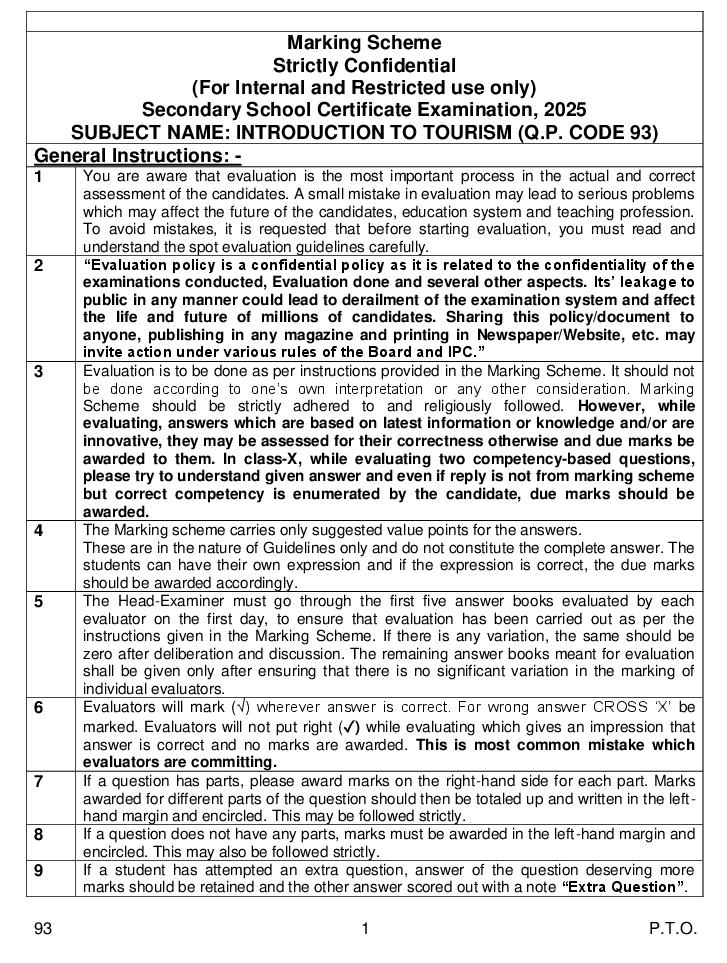
Strictly Confidential
(For Internal and Restricted use only)
Secondary School Certificate Examination, 2025
SUBJECT NAME: INTRODUCTION TO TOURISM (Q.P. CODE 93)
General Instructions: -
1 You are aware that evaluation is the most important process in the actual and correct
assessment of the candidates. A small mistake in evaluation may lead to serious problems
which may affect the future of the candidates, education system and teaching profession.
To avoid mistakes, it is requested that before starting evaluation, you must read and
understand the spot evaluation guidelines carefully.
2 “Evaluation policy is a confidential policy as it is related to the confidentiality of the
examinations conducted, Evaluation done and several other aspects. Its’ leakage to
public in any manner could lead to derailment of the examination system and affect
the life and future of millions of candidates. Sharing this policy/document to
anyone, publishing in any magazine and printing in Newspaper/Website, etc. may
invite action under various rules of the Board and IPC.”
3 Evaluation is to be done as per instructions provided in the Marking Scheme. It should not
be done according to one’s own interpretation or any other consideration. Marking
Scheme should be strictly adhered to and religiously followed. However, while
evaluating, answers which are based on latest information or knowledge and/or are
innovative, they may be assessed for their correctness otherwise and due marks be
awarded to them. In class-X, while evaluating two competency-based questions,
please try to understand given answer and even if reply is not from marking scheme
but correct competency is enumerated by the candidate, due marks should be
awarded.
4 The Marking scheme carries only suggested value points for the answers.
These are in the nature of Guidelines only and do not constitute the complete answer. The
students can have their own expression and if the expression is correct, the due marks
should be awarded accordingly.
5 The Head-Examiner must go through the first five answer books evaluated by each
evaluator on the first day, to ensure that evaluation has been carried out as per the
instructions given in the Marking Scheme. If there is any variation, the same should be
zero after deliberation and discussion. The remaining answer books meant for evaluation
shall be given only after ensuring that there is no significant variation in the marking of
individual evaluators.
6 Evaluators will mark (√) wherever answer is correct. For wrong answer CROSS ‘X’ be
marked. Evaluators will not put right (✓) while evaluating which gives an impression that
answer is correct and no marks are awarded. This is most common mistake which
evaluators are committing.
7 If a question has parts, please award marks on the right-hand side for each part. Marks
awarded for different parts of the question should then be totaled up and written in the left-
hand margin and encircled. This may be followed strictly.
8 If a question does not have any parts, marks must be awarded in the left-hand margin and
encircled. This may also be followed strictly.
9 If a student has attempted an extra question, answer of the question deserving more
marks should be retained and the other answer scored out with a note “Extra Question”.
93 1 P.T.O.
Page 2
once.
11 A full scale of marks __________(example 0 to 80/70/60/50/40/30 marks as given in
Question Paper) has to be used. Please do not hesitate to award full marks if the answer
deserves it.
12 Every examiner has to necessarily do evaluation work for full working hours i.e., 8 hours
every day and evaluate 20 answer books per day in main subjects and 25 answer books
per day in other subjects (Details are given in Spot Guidelines).This is in view of the
reduced syllabus and number of questions in question paper.
13 Ensure that you do not make the following common types of errors committed by the
Examiner in the past:-
● Leaving answer or part thereof unassessed in an answer book.
● Giving more marks for an answer than assigned to it.
● Wrong totaling of marks awarded on an answer.
● Wrong transfer of marks from the inside pages of the answer book to the title page.
● Wrong question wise totaling on the title page.
● Wrong totaling of marks of the two columns on the title page.
● Wrong grand total.
● Marks in words and figures not tallying/not same.
● Wrong transfer of marks from the answer book to online award list.
● Answers marked as correct, but marks not awarded. (Ensure that the right tick mark
is correctly and clearly indicated. It should merely be a line. Same is with the X for
incorrect answer.)
● Half or a part of answer marked correct and the rest as wrong, but no marks awarded.
14 While evaluating the answer books if the answer is found to be totally incorrect, it should
be marked as cross (X) and awarded zero (0)Marks.
15 Any unassessed portion, non-carrying over of marks to the title page, or totaling error
detected by the candidate shall damage the prestige of all the personnel engaged in the
evaluation work as also of the Board. Hence, in order to uphold the prestige of all
concerned, it is again reiterated that the instructions be followed meticulously and
judiciously.
16 The Examiners should acquaint themselves with the guidelines given in the “Guidelines
for Spot Evaluation” before starting the actual evaluation.
17 Every Examiner shall also ensure that all the answers are evaluated, marks carried over to
the title page, correctly totaled and written in figures and words.
18 The candidates are entitled to obtain photocopy of the Answer Book on request on
payment of the prescribed processing fee. All Examiners/Additional Head Examiners/Head
Examiners are once again reminded that they must ensure that evaluation is carried out
strictly as per value points for each answer as given in the Marking Scheme.
93 2
Page 3
MARKING SCHEME
INTRODUCTION TO TOURISM (406)
Class X
SECTION A: OBJECTIVE-TYPE QUESTIONS
Q. Question Source Material Unit/ Page
No. (NCERT/ Chap. No. of Mar
PSSCIVE/ CBSE No. Source ks
E study) Mat.
Q.1 Answer any 4 out of the given 6 questions on Employability Skills (14=4)
i. (B) Receiver NCERT Text Book Unit 1 17 1
ii. (B) Focused NCERT Text Book Unit 2 52 1
iii. (C) Communication NCERT Text Book Unit 2 60 1
iv. (A) INSERT NCERT Text Book Unit 3 67 1
v. (D) Good looking NCERT Text Book Unit 4 89 & 90 1
vi (A) Sustainable Cities and NCERT Text Book Unit 5 111 1
Communities
Q.2 Answer any 5 out of the given 6 questions (15=5)
i. (C) Mask CBSE Study Unit 1 2 1
Material
ii. (D) Political background CBSE Study Unit 1 3 1
Material
iii. (C) Turn unexpected changes CBSE Study Unit 1 9 & 10 1
into opportunity Material
iv. (C) To promote a positive and CBSE Study Unit 1 15 1
professional image Material
93 3 P.T.O.
Page 4
clean and tidy appearance. Material
It includes neatness and
cleanliness of body and hair.
vi. (B) Confidence level and respect CBSE Study Unit 1 20 & 21 1
of the tourism professional Material
towards guests.
OR
(C) Understanding of the interest
of the guest.
(Either of the Two Options)
Q. 3 Answer any 5 out of the given 6 questions (15=5)
i. (A) Courteous and well-groomed CBSE Study Unit 2 24 1
staff at the airport Material
ii. (B) Foreign exchange CBSE Study Unit 2 24 & 29 1
Material
iii. (B) Outbound tourism CBSE Study Unit 2 25 1
Material
iv. (B) Responsible tourism CBSE Study Unit 2 25 1
Material
v. (C) Timatic CBSE Study Unit 2 34 1
Material
vi. (B) Andhra Pradesh Tourism CBSE Study Unit 2 37 1
Development Corporation Material
Q.4 Answer any 5 out of the given 6 questions (15=5)
i. (A) IBT CBSE Study Unit 3 44 1
Material
ii. (B) Penthouse CBSE Study Unit 3 43 1
Material
iii. (B) A room with two single beds CBSE Study Unit 3 42 1
Material
iv. (D) Passengers CBSE Study Unit 3 42 1
Material
v. (C) VISA CBSE Study Unit 3 48 1
Material
vi. (B) It is a form of business travel CBSE Study Unit 3 46 1
Material
93 4
Page 5
i. (D) Munnar CBSE Study Unit 4 58 1
Material
ii. (B) Blue pottery CBSE Study Unit 4 59 1
Material
iii. (B) Kaziranga National Park CBSE Study Unit 4 62 1
Material
iv. (A) 1972 CBSE Study Unit 4 61 1
Material
v. (D) Rashtrapati Bhavan CBSE Study Unit 4 61& 62 1
Material
vi. (B) Madhya Pradesh CBSE Study Unit 4 62 1
Material
SECTION B: SUBJECTIVE-TYPE QUESTIONS
Answer any 3 out of the given 5 questions on Employability Skills in 20-30 words (23=6)
Q.6 Verbal communication includes sounds, NCERT Unit 1 7 1+1=2
words, language and speech. Speaking is Text Book
one of the most effective and commonly
used ways of communicating. It helps in
expressing our emotions in words. By
improving your verbal communication
skills, you will build rapport, and have a
better connect.
Types – Interpersonal communication,
Written communication, small group
communication, public communication.
Q.7 Managing stress is about making a plan to NCERT Unit 2 41 2
be able to cope effectively with daily
Text Book
pressures. The ultimate goal is to strike a
balance between life, work, relationships,
relaxation and fun. By doing this, you are
able to deal with daily stress triggers and
meet these challenges
head on.
Always keep in mind the ABC of stress
management.
A: Adversity or the stressful event.
B: Beliefs or the way you respond to the
event.
C: Consequences or actions and outcomes
93 5 P.T.O.
Page 6
(Any other relevant point)
Q.8 Monthly Maintenance: NCERT Unit 3 76 1+1=2
Transfer photographs to computer Text Book
and delete from drive.
Organise photos into folders or
albums.
Clean up ‘Download’ folder.
Uninstall unused programs and
apps.
Run disk-cleaner software.
Run full system virus scan.
(Any Two Points)
Q.9 Functions of an Entrepreneur NCERT Unit 4 93 1+1=2
MAKING DECISIONS: An Text Book
entrepreneur makes decisions
everyday. This includes what to
produce or sell, how much and
where to sell.
MANAGING THE BUSINESS: An
entrepreneur plans the future of his
or her business. He/she arranges
for raw material, hires people for
work and tells everyone what to do.
They also check if the plan is being
followed.
DIVIDE INCOME: The entrepreneur
divides the business money to many
groups. He/she spends money to
buy material, pays rent of the
building and salaries to people.
TAKING RISK: Risk is the chance of
something going wrong. An
entrepreneur takes risks against
fires, lost items and theft.
CREATE A NEW METHOD, IDEA
OR PRODUCT: An entrepreneur is
always trying new things. He/she
does this to increase their
importance and income.
(Any Two Points)
93 6
Page 7
be helpful to one another, Text book
be friendly with everyone,
include everyone while working or
playing,
help others by including everyone,
whether they are small or big, girl or
boy, belong to any class or caste
(Any other relevant point)
Answer any 4 out of the given 6 questions in 20-30 words (24=8)
Q.11 The unwritten rules of business, which a CBSE Unit 1 17 1+1=2
professional should Study
follow. Material
The Boss is the Boss: Right or
wrong, the boss always has the last
word.
Keep the boss informed. Good or
bad, you don’t want the boss to
listen to information mentioned from
an inappropriate source.
Never go over the boss’ head
without telling him or her first.
Make your boss look good.
Promotion and opportunities arise
when you help the organization
reach its goals.
(Any Two points)
Q.12 The physical environmental benefits of CBSE Unit 2 30 1+1=2
tourism. Study
Parks and nature reserves may be Material
created and ecological preservation
supported as a necessity for nature-
based tourism.
Improved waste management can
be achieved. Increased awareness
and concern for the environment
can result from nature-based
tourism activities and development.
(Any other relevant point)
93 7 P.T.O.
Page 8
Tourism can enhance local cultural Study
awareness. Material
Tourism can generate revenue to
help pay for the preservation of
archaeological sites, historic
buildings and districts.
Despite criticism about the alteration
of cultures to unacceptable levels,
the sharing of cultural knowledge
and experience can be beneficial for
hosts and guests at tourism
destinations and can result in the
revival of local traditions and crafts.
(Any other relevant point)
Q.14 Suite – A Suite is a set of at least two CBSE Unit 3 43 2
rooms consisting of bedrooms and living Study
area. Material
Usually, suites are known by their decor –
Presidential suite, Mughal suite and others.
Q.15 Continental Breakfast – No cooked food CBSE Unit 3 44 2
is served. Study
Juice followed by different types of bread Material
slices and preserves such as jelly, jam,
butter and marmalade along with tea or
coffee.
Q.16 Activities for tourists in the mountains: CBSE Unit 4 58 1/24=2
Adventure Sports – skiing, mountaineering, Study
trekking, hiking photography, camping, Material
horse riding, enjoying beautiful natural
scenery and snow-clad mountains.
Experiencing sunset and sunrise, nature
walk.
(Any four)
93 8
Page 9
Q.17 Personality: CBSE Unit 1 3 1+3=4
Oxford Dictionary defines personality as a Study
combination of characteristics or qualities Material
that form an individual’s distinctive
character.
OR
Personality in general terms means the
unique set of qualities (i.e. physical, mental
and emotional attitudes, values, interests)
that make you different from others.
Personality is actually how you present
yourself to others and how people define
you. Your personality is everything about
you.
Heredity:
Oxford dictionary describes heredity as the
passing on of physical or mental
characteristics genetically from one
generation to another. We inherit certain
traits, such as the colour of our eyes, the
shape of our face and body from our
father, grandfather and great grandfather.
Mainly we inherit these four aspects of
personality i.e., body build, physical
attractiveness, physical defects and health
conditions from our ancestors. Most people
are born with a mixture of traits. Heredity
forms your basic personality.
Q.18 The main objectives of the STDC are to: CBSE Unit 2 37 14=4
Establish, develop, promote, Study
execute, operate and otherwise Material
carry on projects, schemes and
other activities including running and
maintenance of tourist vehicles to
facilitate or accelerate the
development of tourism.
Construct, run and maintain tourist
Information Bureaux and Centres in
and outside the State within the
93 9 P.T.O.
Page 10
Publish and sell different types of
material for the purpose of giving
publicity to tourism.
Construct, lease out, take on lease,
run and maintain tourist bungalows,
tourist inns, youth hostels, hotels
and cafeterias.
Q.19 International Tourist: When a citizen of a CBSE Unit 3 47 1+
country crosses the boundary of his/her Study 1.5+1.5
country legally to visit another country, Material =4
then he/she is an international tourist.
International tourists are further divided
into the following two categories:
Inbound Tourists: When tourists
from other countries visit a said
country, then they are the inbound
tourists for the said country. In other
words, non-residents or foreigners
visiting a given country are known
as Inbound. Tourists. This is also
known as “Incoming Tourism”.
For example, a group of Europeans
visiting India are the inbound
tourists for India. In this process a
country earns foreign exchange
from the visitors visiting.
Outbound Tourists: When the
citizen of a country visits a foreign
nation then they are called outbound
tourists of the country. This is also
called “outgoing tourism”.
For example, an Indian visits U.S.A.
for a holiday, he is an outbound
tourist for India.
Q.20 The two functions of a travel agent CBSE Unit 3 45 2+2=4
(1) Information Provider: Travel Study
agency acts a source of information Material
for the tourists. The information can
be regarding a destination to aid the
customer in choosing a tour or
93 10
Page 11
flight of convenience. They suggest
to customers the activities that they
can indulge in at the destination, the
accommodation and transportation
facilities, etc. keeping in mind the
budget, age group and interest of
the customer. All in all they help
them to make up their mind on a
destination of their choice by giving
them information through brochures,
pamphlets or by showing them
visuals of a place. They also help
the customers with special requests
such as information regarding
weather or if the customer has other
preferences such as twin room
instead of double room, and so on.
This is the most important aspect of
a travel agent’s job as correct
information will ease the customers
and help him/her in taking a
decision; thus ensuring business
and revenue generation for the
travel agency.
(Any other relevant point)
(2) Ticketing: Ticketing is one of the
primary activities of the travel
agency. Ticketing refers to both
airline and railway ticketing. Air
tickets, both domestic and
international, are provided by travel
agencies and the travel agent will
also give choices to the customer by
suggesting them different airfares
and services provided by different
airlines, e.g. a low-cost airline like
Indigo will offer cheap priced tickets
but does not provide meals,
entertainment inclusive of airfare
and also offers less baggage facility.
Railway tickets are also provided for
both domestic and international
93 11 P.T.O.
Page 12
travelling to Europe might request
for tickets or passes for the Euro
Rail (Eurail), the agent will
coordinate with partners abroad for
providing the same to the customer.
(Any other relevant point)
Q.21 Tourism product: Focuses on facilities CBSE Unit 4 51 1+3=4
and services designed to meet the needs Study
of the tourist. It can be seen as a Material
composite product, as the sum total of a
country’s tourist attractions, transport,
accommodation and entertainment which
results in tourist satisfaction.
Classification of Tourism Products:
Tourism products are essential pull factors
for the tourist destination. The diversity in
tourism products attracts large number of
tourists to the destination. The compilation
of tourism products inventory is a
fundamental step in promoting them to the
right tourist. Tourism products can be
grouped on the basis of relevant
similarities. The following figure gives the
classification of tourism products on the
basis of similarities.
(Explain any 3 in detail)
93 12
Document Details
| Board / Org | CBSE |
| Exam | Class 10 |
| Type | Solution |
| Pages | 12 |
| Updated | 24 Sep 2026 |