NCERT Book Class 9 Social Science (Geography) Chapter 2 Physical Features of India
Finished viewing? Save it for later —
Download NCERT Book Class 9 Social Science (Geography) Chapter 2 Physical Features of India (PDF · 10 pages)About NCERT Book Class 9 Social Science (Geography) Chapter 2 Physical Features of India
NCERT Book Class 9 Social Science (Geography) Chapter 2 Physical Features of India is available here for free download. Published by NCERT for Class 9, this books can be viewed online or downloaded as a PDF (10 pages). Candidates preparing for Class 9 can use NCERT Book Class 9 Social Science (Geography) Chapter 2 Physical Features of India to understand the exam pattern, the type of questions asked, and the overall difficulty level.
Frequently Asked Questions
How can I download NCERT Book Class 9 Social Science (Geography) Chapter 2 Physical Features of India?
Open this page and click the Download button to save NCERT Book Class 9 Social Science (Geography) Chapter 2 Physical Features of India as a PDF. It is completely free on AglaSem Docs.
Is NCERT Book Class 9 Social Science (Geography) Chapter 2 Physical Features of India free to download?
Yes. NCERT Book Class 9 Social Science (Geography) Chapter 2 Physical Features of India can be viewed online and downloaded as a PDF free of cost on AglaSem Docs.
How many pages does NCERT Book Class 9 Social Science (Geography) Chapter 2 Physical Features of India have?
NCERT Book Class 9 Social Science (Geography) Chapter 2 Physical Features of India contains 10 pages, which you can read online or download together as a single PDF.
Where can I find more Class 9 study material?
You can find more Class 9 question papers, sample papers, syllabus, and answer keys on AglaSem Docs.
NCERT Book Class 9 Social Science (Geography) Chapter 2 Physical Features of India – Text
Read the full text of this books below — useful to quickly search, copy and reference the content online without downloading the PDF.
📄 View text version (1 page)
Page 1
2
Y
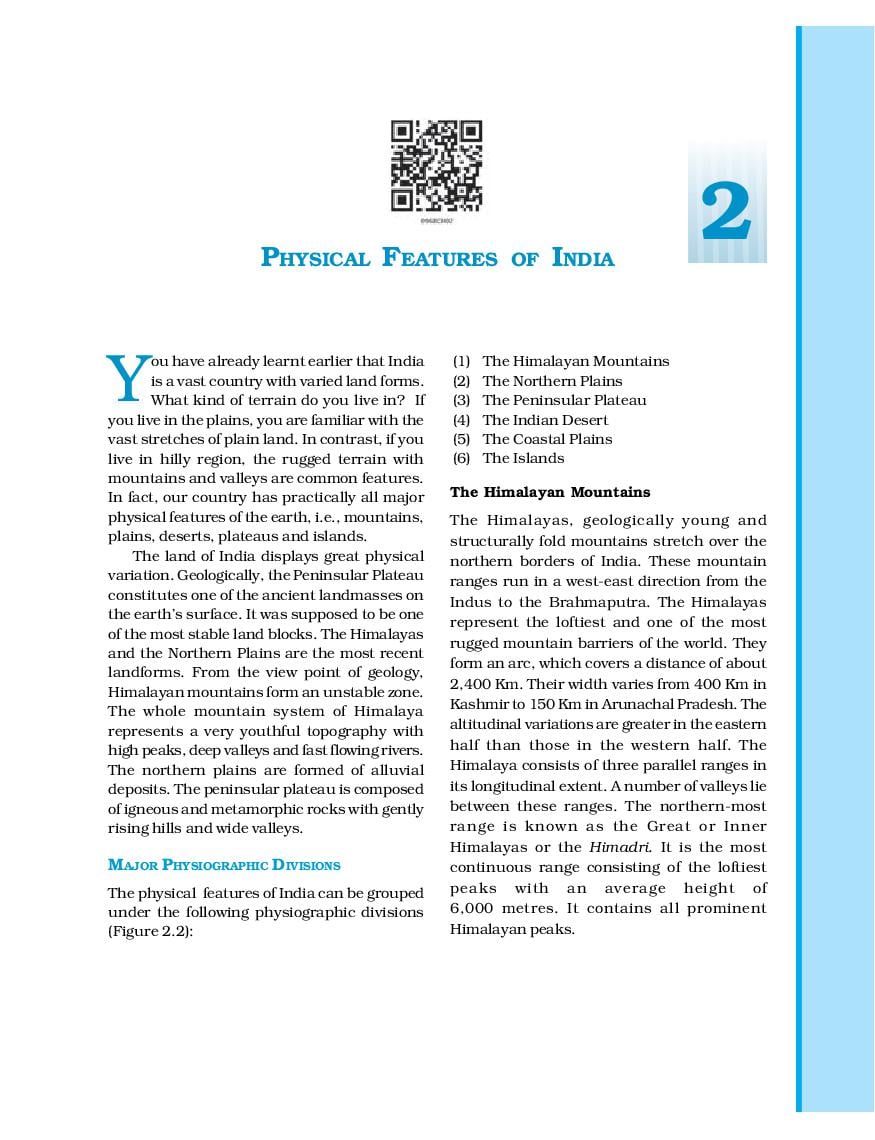
ou have already learnt earlier that India (1) The Himalayan Mountains
is a vast country with varied land forms. (2) The Northern Plains
What kind of terrain do you live in? If (3) The Peninsular Plateau
you live in the plains, you are familiar with the (4) The Indian Desert
vast stretches of plain land. In contrast, if you (5) The Coastal Plains
live in hilly region, the rugged terrain with (6) The Islands
mountains and valleys are common features.
In fact, our country has practically all major The Himalayan Mountains
physical features of the earth, i.e., mountains, The Himalayas, geologically young and
plains, deserts, plateaus and islands. structurally fold mountains stretch over the
The land of India displays great physical northern borders of India. These mountain
variation. Geologically, the Peninsular Plateau ranges run in a west-east direction from the
constitutes one of the ancient landmasses on
Indus to the Brahmaputra. The Himalayas
the earth’s surface. It was supposed to be one
represent the loftiest and one of the most
of the most stable land blocks. The Himalayas
rugged mountain barriers of the world. They
and the Northern Plains are the most recent
form an arc, which covers a distance of about
landforms. From the view point of geology,
2,400 Km. Their width varies from 400 Km in
Himalayan mountains form an unstable zone.
Kashmir to 150 Km in Arunachal Pradesh. The
The whole mountain system of Himalaya
represents a very youthful topography with altitudinal variations are greater in the eastern
high peaks, deep valleys and fast flowing rivers. half than those in the western half. The
The northern plains are formed of alluvial Himalaya consists of three parallel ranges in
deposits. The peninsular plateau is composed its longitudinal extent. A number of valleys lie
of igneous and metamorphic rocks with gently between these ranges. The northern-most
rising hills and wide valleys. range is known as the Great or Inner
Himalayas or the Himadri. It is the most
MAJOR PHYSIOGRAPHIC DIVISIONS continuous range consisting of the loftiest
The physical features of India can be grouped peaks with an average height of
under the following physiographic divisions 6,000 metres. It contains all prominent
(Figure 2.2): Himalayan peaks.
Showing the first page only. Download the PDF above for the complete document.
Document Details
| Board / Org | NCERT |
| Exam | Class 9 |
| Type | Books |
| Pages | 10 |
| Updated | 30 Apr 2026 |