HBSE Class 11 Syllabus 2023 Chemistry
Finished viewing? Save it for later —
Download HBSE Class 11 Syllabus 2023 Chemistry (PDF · 9 pages)About HBSE Class 11 Syllabus 2023 Chemistry
HBSE Class 11 Syllabus 2023 Chemistry is available here for free download. Published by Haryana Board for Class 11, this syllabus can be viewed online or downloaded as a PDF (9 pages). Candidates preparing for Class 11 can use HBSE Class 11 Syllabus 2023 Chemistry to understand the exam pattern, the type of questions asked, and the overall difficulty level.
Frequently Asked Questions
How can I download HBSE Class 11 Syllabus 2023 Chemistry?
Open this page and click the Download button to save HBSE Class 11 Syllabus 2023 Chemistry as a PDF. It is completely free on AglaSem Docs.
Is HBSE Class 11 Syllabus 2023 Chemistry free to download?
Yes. HBSE Class 11 Syllabus 2023 Chemistry can be viewed online and downloaded as a PDF free of cost on AglaSem Docs.
How many pages does HBSE Class 11 Syllabus 2023 Chemistry have?
HBSE Class 11 Syllabus 2023 Chemistry contains 9 pages, which you can read online or download together as a single PDF.
Where can I find more Class 11 study material?
You can find more Class 11 question papers, sample papers, syllabus, and answer keys on AglaSem Docs.
HBSE Class 11 Syllabus 2023 Chemistry – Text
Read the full text of this syllabus below — useful to quickly search, copy and reference the content online without downloading the PDF.
📄 View text version (9 pages)
Page 1
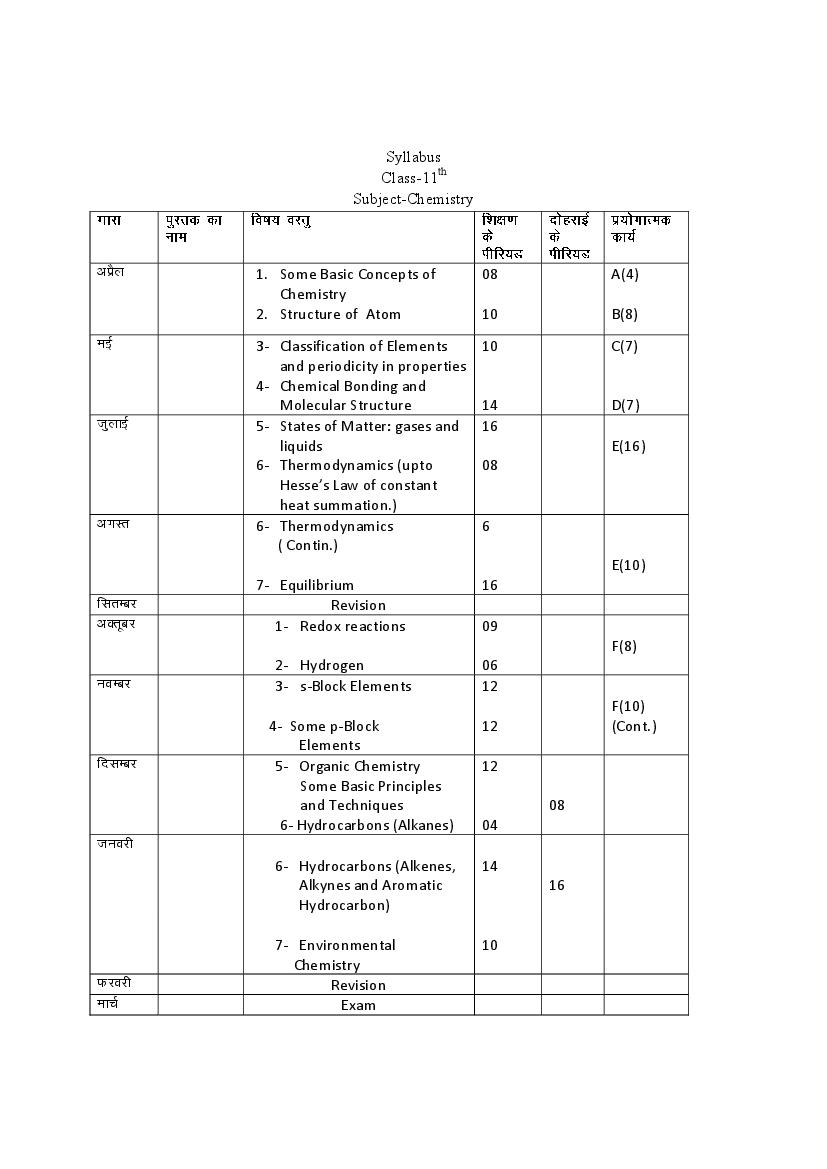
Class-11th
Subject-Chemistry
vizSy 1. Some Basic Concepts of 08 A(4)
Chemistry
2. Structure of Atom 10 B(8)
ebZ 3- Classification of Elements 10 C(7)
and periodicity in properties
4- Chemical Bonding and
Molecular Structure 14 D(7)
tqykbZ 5- States of Matter: gases and 16
liquids E(16)
6- Thermodynamics (upto 08
Hesse’s Law of constant
heat summation.)
vxLr 6- Thermodynamics 6
( Contin.)
E(10)
7- Equilibrium 16
flrEcj Revision
vDrwcj 1- Redox reactions 09
F(8)
2- Hydrogen 06
uoEcj 3- s-Block Elements 12
F(10)
4- Some p-Block 12 (Cont.)
Elements
fnlEcj 5- Organic Chemistry 12
Some Basic Principles
and Techniques 08
6- Hydrocarbons (Alkanes) 04
tuojh
6- Hydrocarbons (Alkenes, 14
Alkynes and Aromatic 16
Hydrocarbon)
7- Environmental 10
Chemistry
Qjojh Revision
ekpZ Exam
Page 2
Unit Ist: Some Basic Concepts of Chemistry:
(i) Importance of Chemistry.
(ii) Nature of matter: - classification of matter.
(iii) Properties of matter and their measurement: - Physical and
chemical properties, SI units, mass and weight, volume, density, temperature.
(iv) Uncertainty in measurement: - Scientific notation, multiplication and division,
addition and subtraction, significant figures, precision and accuracy, dimensional
analysis.
(v) Laws of Chemical combinations: - Law of conservation of mass, law of definite
proportions, law of multiple proportions, Gay Lussac’s law of gaseous volumes,
Avogadro’s law.
(vi) Dalton’s atomic theory.
(vii) Atomic and molecular Masses: - atomic mass, average atomic mass, molecular
mass, formula mass.
(viii) Mole concept and molar masses.
(ix) Percentage Composition: - empirical Formula and molecular formula.
(x) Stoichiometry and calculations: - Balancing of chemical equations, limiting
reagent, mass percentage, mole fraction, molarity, molality.
Unit 2nd :- Structure of Atom:
(i) Sub. atomic particles: - Discovery of electrons, charge to mass ratio of electron,
charge on the electron. discovery of protons and neutrons.
(ii) Atomic Models: - Thomson’s model of atom and its limitations, Rutherford’s nuclear
model of atom and its limitations, atomic number and mass number, isobars and
isotopes, Drawbacks of Rutherford’s model.
(iii) Developments leading to the Bohr’s model of atom: - Wave nature of
electromagnetic radiations, electromagnetic spectrum, particle nature of electromagnetic
radiation, Planck’s quantum theory, photo electric effects. Dual behavior of
electromagnetic radiations, atomic spectra, emission and absorption spectrum.
(iv) Bohr’s Model for Hydrogen atom: - Explaination of line spectrum of hydrogen
Limitations of Bohr’s Model.
(v) Quantum mechanical model of the atom: - Dual nature of matters and light,
Heisenberg’s uncertainty principle, it’s significance de-Broglie’s relationship, failure of
Bohr’s model, hydrogen atom and the Schrodinger equation.
(vi) Orbital and quantum numbers: - Shapes of atomic s,p,d and f orbitals energies of
orbitals rules for filling of electrons in orbitals Aufbau principle pauli exclusion principle
and Hund’s rule, electronic configuration. of atoms, stability of half filled and full filled
orbitals.
Page 3
(i) Need of Classification of elements, basis of periodic Classification, Newlands law
of Octaves, mendeleve’s periodic Law and its periodic table.
(ii) Modern periodic law and long form of periodic table
Nomenclature of elements with atomic number>100, electronic configuration of
elements and the periodic table. Group wise electronic configuration.
(iii) Electronic configurations and types of elements: -
s, p, d, f – Blocks, metals, non metals and metalloids.
(iv) Periodic trends in properties of elements: -
Trends in physical properties, atomic radii, Ionic radii, ionization enthalpy, electron gain
enthalpy, electro negativity,
(v) Periodic trends in chemical properties: - Periodicity of valence or oxidations
states, anamolous properties of second period elements. Periodic trends and chemical
reactivity.
Unit 4th :- Chemical Bonding and Molecular structure:
(i) Kossel-Lewis Approach to chemical bonding:
Octet rule
Covalent Bond
Lewis representation of simple molecules (Lewis structure)
Formal Charge
Limitation of the octet rule
(ii) Ionic OR Electrovalent Bond: -
Lattice enthalpy
(iii) Bond Parameters: - Bond length, bond angle, bond enthalpy, bond-order,
resonance structures, polarity of bonds, dipole moment.
(iv) The Valence Shell Electron Pair Repulsion (VSEPR) Theory (v) Valence Bond
Theory: - Orbital overlap concept, directional properties of bonds, overlapping of
atomic orbitals, types of overlapping and nature of covalent bond, sigma (σ) bond and pi
(π) bond.
(vi) Hybridisation: - Types of hybridsation and shapes of molecules
(vii) Molecular orbital theory:- Formation of molecular orbitals Linear combination of
atomic orbital (LCAO), conditions for the combination of atomic orbital, types of
molecular orbitals, energy level diagram for molecular orbitals, electronic configuration
and molecular behaviour. Bonding in some homo nuclear diatomic molecules.
(qualitative idea only)
(viii) Hydrogen Bonding: - Cause of formation of hydrogen bond types of hydrogen
bond.
th
Unit 5 :- States of Matter: Gases and liquids
Page 4
dipole forces, hydrogen bond.
(ii) Thermal energy.
(iii) Inter molecular forces Vs thermal interactions.
(iv) The Gaseous state: - The Gas Laws- Boyle’s law, Charle’s law, Gay lussac’s law,
Avogadro’s law.
(v) Ideal gas equation:- density and molar mass of gas, Dalton law of partial pressure,
partial pressures, in terms of mole fraction.
(vi) Kinetic molecular theory of gases.
(vii) Deviation from ideal gas behaviour.
(viii) Liquification of gases.
(ix) Liquid state:- Vapour pressure, surface tension, viscosity.(Qualitative idea no
mathematical derivation)
th
Unit 6 :- Thermodynamics:
(i) Thermodynamic state: - system and surroundings, types of systems, open, closed
and isolated system, state function and path functions. Internal energy as a state function,
work, heat, isothermal and free expansion of an ideal gas.
(ii) Enthalpy, extensive and intensive properties, heat capacity, relationship between
Cp and Cv for Ideal gas.
(iii) Calorimetry:- Measurement of ∆U and ∆H, bomb calorimeter.
(iv) Enthalpy Change- reaction enthalpy, standard enthalpy of reactions, enthalpy
changes during phase trans formations, standard enthalpy of formation Hess’s law of
constant heat summation.
(v) Enthalpies for different types of reactions:- Standard enthalpy of combustion,
enthalpy of atomization, bond enthalpy, enthalpy of solution, lattice enthalpy.
(vi) Spontaneity – Factors governing spontaneity of process, Change in enthalpy and
change in entropy, Gibb’s free energy, effect of temp on spontaneity of process, Gibb’s
free energy change and equilibrium.
Unit-7 Equilibrium: (i) Equilibrium in physical process Solid- equilibrium, equilibrium involving
dissolution of solid or gases in liquids, general characteristics of equilibrium involving
physical processes.
(ii) Equilibrium in chemical processes- dynamic equilibrium.
(iii) Law of Chemical equilibrium and equilibrium constant – relation between equilibrium
constant for a general reaction and its multiple.
(iv) Homogeneous equilibrium:- relationship between equilibrium constant in terms of
pressure(Kp) and equilibrium constant in terms concentration(Kc).
(v) Heterogeneous equilibrium
(vi) Application of equilibrium constant, predicting the extent of a reaction, predicting the
direction of the reaction, calculating equilibrium concentration.
Page 5
(G).
(viii) Factors affecting equilibrium:- Le- Chatelier’s principle, effect of changing
Concentration, effect of pressure change, effect of temp change, effect of inert Gas
addition, effect of catalyst.
(ix) Ionic equilibrium in solutions- acids, bases and salts, Arrhenius concept of acids and
bases, Bronsted- Lowry acids and bases ,Lewis acids and bases.
(x) Ionization of acids and bases.
(xi) Ionization constant of water and its ionic product:- pH Scale, ionization of weak acids,
ionization of weak bases, relation ship between Ka and Kb, di and ply basic acids &
strength, Common ion effect, hydrolysis of salts and pH of their solution.
(xii) Buffer solutions
(xiii) Solubility equilibrium of sparingly soluble salts, solubility product common ion effect on
solubility of ionic salts.
Unit-8: Redox Reactions(i) Oxidation and reduction reactions.
(ii) Redox reactions in terms of electron transfer reactions.
(iii) Oxidation reactions by oxidactin number method and half reaction method, redox
reactions as the basis for titractions.
(iv) Redox reactions and electode processes: standard electrode potential
Unit-9 HYDROGEN
(i) Position of hydrogen in the periodic Table.
(ii) Dihydrogen:- Occurence, isotopes if hydrogen.
(iii) Preparation of dihydrogen;
(iv) Properties of hihydrogen; uses of dihydrogen
(v) Hydrides: Ionic, covalent, Metallic hydndes.
(vi) Water: Physical Properties, Structure of water, Structure of ic, Chemical properties of
water, Hard and Soft water, Methods for softening of water.
(vii) Hydrogen peroxide:- Preparation, Physical and Chemical properties, Uses of hydrogen
peroxide.
(viii) Heavy water.
(ix) Dihydrogen as a fuel.
Unit-10 The S- Block elements (Alkali and Alkaline Earth Metals)
(i) Alkali metals:- Electronic configuration , atomic and ionic Radii, ionization
enthalpy, hydration Enthalpy, physical properties, chemical properties, uses
(ii) Compounds of alkali metals:- Oxides and hydroxides, halides, salts of oxoacids.
(iii) Anamolous properties of lithium:- difference between lithium and Other alkali metals
similarities between lithium and magnesium.
(iv) Some important compounds of sodium: Sodium carbonate, sodium chloride, sodium
hydroxide, sodium hydrogen carbonate.
(v) Biological importance of sodium and potassium.
Page 6
enthalpy, hydration enthalpy, physical and chemical properties, uses.
(vii) Compounds of the alkaline earth metals.
(viii) Anamolous behaviour of beryllium, diagonal relationship between beryllium and
aluminium.
(ix) Some Important Compounds of Calcium: Quick lime, slaked lime, calcium carbonate,
plaster of paris , cement.
(x) Biological Importance of magnesium and calcium.
Unit- 11 P Block Elements
(i) Electronic configuration, atomic radii, ionization enthalpy, electronegativity, physical and
chemical properties.
(ii) Anamolous properties of Boron.
(iii) Some Important compounds of boron:- borax, orthoboric acid, diborane,
(iv) Uses of boron, Aluminium and their compounds.
(v) Group 14 Elements:- Electronic Configuration, covalent radii, ionization enthalpy,
elecronegativity, physical properties, chemical properties.
(vi) Anamolous behaviour of Carbon.
(vii) Allotropes of Carbon:- Diamond, graphite, fullerenes uses of carbon.
(viii) Compound of Carbon and silicon:- Carbon monoxide, carbon dioxide, silicon dioxide,
silicones, silicates zeolites.
Unit- 12 Organic Chemistry –Some Basic Principles and Techniques.
(i) Introduction, shapes of Carbon compounds.
(ii) Complete, Condensed and bond line structural formulas three dimensional representation
of organic molecules.
(iii) Classification of organic compounds: Functional groups. homologous series
(iv) Nomenclature of Organic Compounds: IUPAC system of nomenclature of organic
compounds, nomenclature of substituted benzene compounds.
(v) Isomerism :-structural, stereoisomerism.
(vi) Concepts in organic reaction mechanism:-Fission of a covalent bond, nucleophiles and
electrophiles, electron movement in organic reactions, iInductive effect, resonance structures,
resonance effect, electromeric effect, hyperconjugation, types of organic reactions and
mechanisms.
(vii) Methods of purification of organic Compounds:- sublimation crystallisation, distillation,
fractional distillation, steam distillation, differential extraction chromatography.
(viii) Qualitative analysis of organic compounds:- Detection of carbon and hydrogen,
Nitrogen, Sulphur, Halogens, Phosphorus.
(ix) Quantitative Analysis:- Carbon and Hydrogen, Nitrogen, Halogens, Sulphur, Phosphorus,
Oxygen.
Page 7
(i) Classfication
(ii) Alkanes: Nomenclature and isomerism, preparation of alkanes, physical and
chemical properties of alkanes: substitution reactions, combustion, controlled oxidation,
isomerisation aromatization, Pyrolysis; confirmations: Sawhorse projections, Newman
projections,
(iii) Alkenes: Structure, nomenclature, isomerism, preparation of alkenes, physical properties
and chemical properties: addition of hydrogen, halogen, water, hydrogen halides (
Markovnikov’s addition and peroxide effect) oxidation, ozonolysis, polymerization.
(iv) Alkynes: Nomenclature isomerism, structure of triple bond, methods of preparation,
physical properties, chemical reactions:- acidic character of alkynes, addition reactions of
hydrogen, halogens, hydrogen halides, water, polymerization.
(v) Aromatic hydrocarbons Introduction IUPAC nomenclature; Isomerism , Benzene:
Physical Properties and chemical paroperties: electrophilic substitution: nitration halogenation,
sulphonation, Friedel- Craft’s alkylation and acylation, mechanism of electrophilic substitution
reacton; deirective influence of functinal group in mono substituted benzene; Carcinogenicity
and toxicity.
Unit-14 ENVIRONMENTAL CHEMISTRY
(i) Environmental pollution: Tropospheric pollution air pollutant, particulate pollutants, global
warming and green house effect, acid rain, smogs: Photochemical smog, stratospheric
pollution, ozone and its re actions, ozone hole, effects of depletion of the ozone layer.
(ii) Water pollution: Causes of water pollution, international standards for drinking water
(iii) Soil pesticides.
(iv) Industrial waste: Pollution due to industrial wastes .
(v) strategies to control environmental pollution,
(vi) green Chemistry as an alternative tool for reducing pollution
Page 8
Syllabus for practical
Total Periods= 60
(A) I) Basic Laboratory Techniques:-
(i) Cutting glass tube and glass rod. 02 period
(ii) Bending a glass tube.
(iii) Drawing out a glass jet.
(iv) Boring a cork
(B) II) Characterisaton and purification of chemical substance 06 period
(i) Determination of melting point of organic compound.
(ii) Determination of Boiling point of organic compound
(iii) Crystallization involving impure sample of any one of the following:-
Alum.Copper Sulphate, Benzoic acid.
(C) III) Experiments Related to PH 06 period
(i) Any one of the following experiments:
a) Determination of PH of Some solutions obtained from fruit juices,
solutions of known and varied concentration of acids, bases and
salts using PH paper or universal indicator.
b) Comparing the PH of solutions of strong acid and weak acid of
same concentration
c) Study of PH change by common ion effect in case of weak acid
and weak bases.
(D) IV) Chemical Equilibrium:- 04 period
- One of the following experiments:
a) Study of the shift in equilibrium between ferric ions and
thiocynate ions by increasing /decreasing the concentration of
either of the ions.
b) Study of the shift in equilibrium between[(co(H 2O)6 ]2 and
Chloride ions by changing the concertration of either of the ions.
(E) V) Quantitative Estimation:- 16 periods
(i) Using a chemical balance.
(ii) Preparation of Standard solution of oxalic acid.
(iii) Determination of strength of a given solution of sodium hydroxide
by titrating it against standard solution of oxalic acid.
(iv) Preparation of standard solution of sodium carbonate.
(v) Determination of strength of a given solution of hydrochloric acid
by titrating it against- standard sodium carbonate solution.
(F) VI) Qualitative Analysis 16 periods
Page 9
Cations: Pb2+, CU2+, As3+, Al3+, Fe3+, Mn2+, Ni2+, Zn2+, Co2+, Ca2+,
Sr2+, Ba2+, Mg2+, NH4+
Anions: CO32-, S2-, SO32-, NO2-, NO3-, Cl-, Br-, I-, PO43-, C2 O43-
,
CH3COO-,
(Note: Insoluble Salts excluded).
VII) Any one project 10 periods
Document Details
| Board / Org | Haryana Board |
| Exam | Class 11 |
| Type | Syllabus |
| Pages | 9 |
| Updated | 22 Jul 2026 |