PUMDET 2023 Question Paper Applied Geology
Finished viewing? Save it for later —
Download PUMDET 2023 Question Paper Applied Geology (PDF · 12 pages)About PUMDET 2023 Question Paper Applied Geology
PUMDET 2023 Question Paper Applied Geology is available here for free download. Published by WBJEEB for PUMDET, this question paper can be viewed online or downloaded as a PDF (12 pages). Candidates preparing for PUMDET can use PUMDET 2023 Question Paper Applied Geology to understand the exam pattern, the type of questions asked, and the overall difficulty level.
Frequently Asked Questions
How can I download PUMDET 2023 Question Paper Applied Geology?
Open this page and click the Download button to save PUMDET 2023 Question Paper Applied Geology as a PDF. It is completely free on AglaSem Docs.
Is PUMDET 2023 Question Paper Applied Geology free to download?
Yes. PUMDET 2023 Question Paper Applied Geology can be viewed online and downloaded as a PDF free of cost on AglaSem Docs.
How many pages does PUMDET 2023 Question Paper Applied Geology have?
PUMDET 2023 Question Paper Applied Geology contains 12 pages, which you can read online or download together as a single PDF.
Where can I find more PUMDET study material?
You can find more PUMDET question papers, sample papers, syllabus, and answer keys on AglaSem Docs.
PUMDET 2023 Question Paper Applied Geology – Text
Read the full text of this question paper below — useful to quickly search, copy and reference the content online without downloading the PDF.
📄 View text version (12 pages)
Page 1
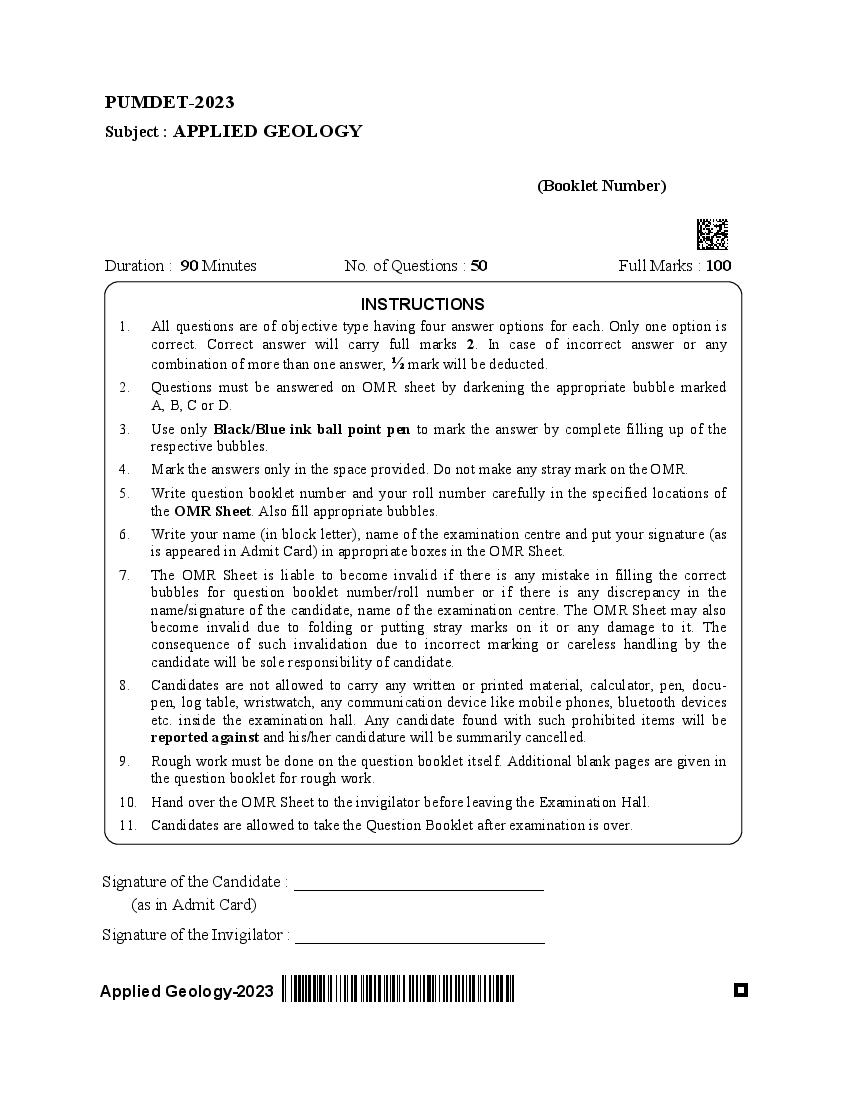
(Booklet Number)
Duration : 90 Minutes No. of Questions : 50 Full Marks : 100
INSTRUCTIONS
1. All questions are of objective type having four answer options for each. Only one option is
correct. Correct answer will carry full marks 2. In case of incorrect answer or any
combination of more than one answer, ½ mark will be deducted.
2. Questions must be answered on OMR sheet by darkening the appropriate bubble marked
A, B, C or D.
3. Use only Black/Blue ink ball point pen to mark the answer by complete filling up of the
respective bubbles.
4. Mark the answers only in the space provided. Do not make any stray mark on the OMR.
5. Write question booklet number and your roll number carefully in the specified locations of
the OMR Sheet. Also fill appropriate bubbles.
6. Write your name (in block letter), name of the examination centre and put your signature (as
is appeared in Admit Card) in appropriate boxes in the OMR Sheet.
7. The OMR Sheet is liable to become invalid if there is any mistake in filling the correct
bubbles for question booklet number/roll number or if there is any discrepancy in the
name/signature of the candidate, name of the examination centre. The OMR Sheet may also
become invalid due to folding or putting stray marks on it or any damage to it. The
consequence of such invalidation due to incorrect marking or careless handling by the
candidate will be sole responsibility of candidate.
8. Candidates are not allowed to carry any written or printed material, calculator, pen, docu-
pen, log table, wristwatch, any communication device like mobile phones, bluetooth devices
etc. inside the examination hall. Any candidate found with such prohibited items will be
reported against and his/her candidature will be summarily cancelled.
9. Rough work must be done on the question booklet itself. Additional blank pages are given in
the question booklet for rough work.
10. Hand over the OMR Sheet to the invigilator before leaving the Examination Hall.
11. Candidates are allowed to take the Question Booklet after examination is over.
Signature of the Candidate : ______________________________
(as in Admit Card)
Signature of the Invigilator : ______________________________
Applied Geology-2023
Page 2
Applied Geology 2
Page 3
(A) Attrition (B) Corrasion
(C) Corrosion (D) Deflation
2. Which of the following is an Eon of the geological time scale ?
(A) Proterozoic (B) Paleozoic
(C) Mesozoic (D) Cenozoic
3. Which of the following is associated with divergent plate margins ?
(A) Island arcs (B) Deep sea trenches
(C) Deep focus earthquakes (D) Rift valleys
4. Which one of the following primary features is unimportant in distinguishing the top
from bottom in stratigraphy ?
(A) Truncated Cross bedding (B) Graded bedding
(C) Mud cracks (D) Pillow structure in basalt
5. The Supercontinent Pangea existed during the _________.
(A) Proterozoic times
(B) Proterozoic - early Palaeozoic times
(C) Late Palaeozoic – early Mesozoic times
(D) Late Mesozoic - early Cenozoic times
6. Which of the following is a phosphorite mine ?
(A) Khetri (B) Zawar
(C) Jhamarkotra (D) Jaduguda
Applied Geology 3
Page 4
(A) Hornfelsic rock (B) Greenschist rock
(C) Amphibolite (D) Eclogite
8. Connate water refers to
(A) Meteoric water
(B) Magmatic water
(C) Hydrothermal water
(D) Water trapped in the pores of the sediments
9. Bouguer anomaly is associated with
(A) Seismic method (B) Gravity method
(C) Magnetic method (D) Electrical method
10. Sinistral Gastropod is represented by
(A) Turritella (B) Physa
(C) Unio (D) Conus
11. Flash figure is produced when
(A) mineral section is cut perpendicular to the optic axis.
(B) mineral section is cut parallel to the optic axis.
(C) mineral section is cut at an angle of 25° to the optic axis.
(D) mineral section is cut at an angle of 40° to the optic axis.
12. Pick out the correct answer.
(A) Inner core is liquid. (B) Outer core is liquid.
(C) Upper mantle is liquid. (D) Lower crust is liquid.
Applied Geology 4
Page 5
(A) Singhbhum (B) Kerala
(C) Meghalaya (D) Bastar
14. Which of the following are examples of hotspots ?
(A) Aleutian Islands (B) Hawaiian Islands
(C) Andaman and Nicobar Islands (D) Java and Sumatra Islands
15. Decollements refer to deformation structures that involve :
(A) Independent styles of deformation in the rock above and below it.
(B) Vertical fault plane
(C) Horizontal fault plane
(D) Folded unconformity
16. Which of the following is correct older to younger order of the stratigraphic units of the
Singhbhum Granitic complex ?
(A) Older Metamorphic Group, Iron Ore Group, Dhanjori Group, Kolhan Group
(B) Iron Ore Group, Older Metamorphic Group, Dhanjori Group, Kolhan Group
(C) Older Metamorphic Group, Iron Ore Group, Kolhan Group, Dhanjori Group
(D) Iron Ore Group, Older Metamorphic Group, Kolhan Group, Dhanjori Group
17. Stratiform chromite occurs in
(A) Early magmatic deposits (B) Late magmatic deposits
(C) Pegmatitic deposits (D) Hydrothermal deposits
Applied Geology 5
Page 6
specific yield Sy is mathematically expressed as
Wy Wy
(A) Sy = (B) Sy =
V V
V V
(C) Sy = (D) Sy =
Wy Wy
19. Isostasy refers to
(A) Plate convergence
(B) Floating equilibrium among several crustal blocks
(C) Tripple plate juncture
(D) Plate divergence
20. The Earth’s magnetic field is due to
(A) Convection currents in the outer mantle
(B) Convection currents in the inner mantle
(C) Convection currents in the outer core
(D) Convection currents in the inner core
21. Aristottle’s lantern is found in
(A) Ammonoids (B) Gastropods
(C) Echinoids (D) Pelecypods
22. ‘Melatopes’ refer to
(A) Patchy extinction (B) Parallel extinction
(C) Melanocratic minerals (D) Points of emergence of optic axes
Applied Geology 6
Page 7
(A) Ventifact – Wind (B) Burchan - Glacier
(C) U-shaped Valley - Glacier (D) V-shaped Valley - Glacier
24. The horizontal component of the dip separation of a fault is known as the
(A) Throw (B) Heave
(C) Strike-slip (D) Dip-slip
25. Which one of the following is not a common fault plane feature ?
(A) Slickenside (B) Mylonite
(C) Varve (D) Pseudo tachyllite
26. By which of the following processes the Talchir Boulder beds of the Gondwana
Supergroups are believed to have deposited ?
(A) Fluvial (B) Glacial
(C) Lacustrine (D) Shallow Marine
27. In which of the following rocks could the diamond be found ?
(A) Kimberlite (B) Gabbro
(C) Syenite (D) Granite
28. Which of the following rocks will serve as a good aquifer ?
(A) Well sorted, cement free sandstone
(B) Unsorted sandstone containing ferruginous cement
(C) Well sorted sandstone containing ferruginous cement
(D) Unsorted, cement free sandstone
Applied Geology 7
Page 8
(A) Gutenberg discontinuity
(B) Moho discontinuity
(C) Conrad discontinuity
(D) Hofmann’s discontinuity
30. Which of the following is known as the half horse ?
(A) Eohippus (B) Epihippus
(C) Orohippus (D) Mesohippus
31. Which doesn’t belong to the definition of a mineral ?
(A) Definite crystal structure
(B) Definite or a range of chemical composition
(C) Naturally occurring
(D) Inorganic compound in solid or liquid state
32. Which of the following planets has lowest density ?
(A) Venus (B) Earth
(C) Jupiter (D) Saturn
33. A fold having 15° N40E plunging hinge line and 70° NW dipping axial plane will be
described as
(A) Gently plunging, steeply inclined fold
(B) Moderately plunging, steeply inclined fold
(C) Gently plunging, moderately inclined fold
(D) Moderately plunging, moderately inclined fold
Applied Geology 8
Page 9
(A) Dip fault (B) Inclined fault
(C) Vertical fault (D) Reverse fault
35. An arenite is made up of 75% quartz, 20% feldspar and 5% rock fragments. According to
Folk’s sandstone classification, it is a/an _______.
(A) Sublitharenite (B) Subarkose
(C) Arkose (D) Lithic arkose
36. The hardest oxide mineral is
(A) Magnetite (B) Hematite
(C) Corundum (D) Ilmenite
37. In a biaxial mineral X vibration direction is formed to be the acute bisectrix. The mineral
is
(A) Optically positive (B) Optically negative
(C) Neither negative nor positive (D) Isotropic
38. Four most abundant elements in the Earth’s continental crust, in decreasing order of
abundance are
(A) O, Si, Al and Fe (B) O, Si, Fe and Al
(C) Si, O, Al and Fe (D) Si, O, Fe and Al
39. In an unconformity, a lower group of strata is folded while the upper group of strata is
horizontal. The type of unconformity in this case is best described as
(A) Disconformity (B) Non-conformity
(C) Angular unconformity (D) Para conformity
Applied Geology 9
Page 10
(A) Sillimanite deposit (B) Coal deposit
(C) Copper deposit (D) Kyanite deposit
41. Uniaxial minerals incorporate crystal that crystallize in
(A) Trigonal, Tetragonal and Hexagonal systems
(B) Monoclinic and Triclinic system
(C) Triclinic system
(D) Orthorombic system
42. Which of the following layers of the atmosphere contains maximum ozone ?
(A) Troposphere (B) Stratosphere
(C) Mesosphere (D) Thermosphere
43. Gouge is associated with
(A) Paraconformity (B) Non- conformity
(C) Recumbent fold (D) Fault
44. Find out the incorrect pair.
(A) Magnesite – placer deposit (B) Gypsum – evaporite deposit
(C) Gold – placer deposit (D) Diamond – dissemination deposit
45. A crystal face intersects ‘a’ axis at half of its unit length, ‘b’ axis at its unit length and
runs parallel to the ‘c’ axis. The miller indices of the crystal face would be
(A) (012) (B) (120)
(C) (210) (D) (121)
Applied Geology 10
Page 11
(A) 3.5% (B) 6.5%
(C) 9.5% (D) 12.5%
47. A glassy material found on some large faults is formed by melting caused by fractional
heating is known as the _____________.
(A) Slickenside (B) Tachyte
(C) Pseudotachylyte (D) Mylonite
48. Which of the following mica contains lithium ?
(A) Biotite (B) Muscovite
(C) Lepidolite (D) Phlogopite
49. A type of relatively fast landslide in which the slip surface is concave is termed as
(A) Topple (B) Sheet slide
(C) Slump (D) Block slide
50. Popular gemstone Ruby is a variety of _________.
(A) Garnet (B) Tourmaline
(C) Quartz (D) Corundum
____________
Applied Geology 11
Page 12
Applied Geology 12
Document Details
| Board / Org | WBJEEB |
| Exam | PUMDET |
| Type | Question Paper |
| Pages | 12 |
| Updated | 22 Jul 2026 |