Uttrakhand Board Class 12 Syllabus 2020-21
Finished viewing? Save it for later —
Download Uttrakhand Board Class 12 Syllabus 2020-21 (PDF · 80 pages)About Uttrakhand Board Class 12 Syllabus 2020-21
Uttrakhand Board Class 12 Syllabus 2020-21 is available here for free download. Published by Uttarakhand Board for Class 12, this syllabus can be viewed online or downloaded as a PDF (80 pages). Candidates preparing for Class 12 can use Uttrakhand Board Class 12 Syllabus 2020-21 to understand the exam pattern, the type of questions asked, and the overall difficulty level.
Frequently Asked Questions
How can I download Uttrakhand Board Class 12 Syllabus 2020-21?
Open this page and click the Download button to save Uttrakhand Board Class 12 Syllabus 2020-21 as a PDF. It is completely free on AglaSem Docs.
Is Uttrakhand Board Class 12 Syllabus 2020-21 free to download?
Yes. Uttrakhand Board Class 12 Syllabus 2020-21 can be viewed online and downloaded as a PDF free of cost on AglaSem Docs.
How many pages does Uttrakhand Board Class 12 Syllabus 2020-21 have?
Uttrakhand Board Class 12 Syllabus 2020-21 contains 80 pages, which you can read online or download together as a single PDF.
Where can I find more Class 12 study material?
You can find more Class 12 question papers, sample papers, syllabus, and answer keys on AglaSem Docs.
Uttrakhand Board Class 12 Syllabus 2020-21 – Text
Read the full text of this syllabus below — useful to quickly search, copy and reference the content online without downloading the PDF.
📄 View text version (80 pages)
Page 1
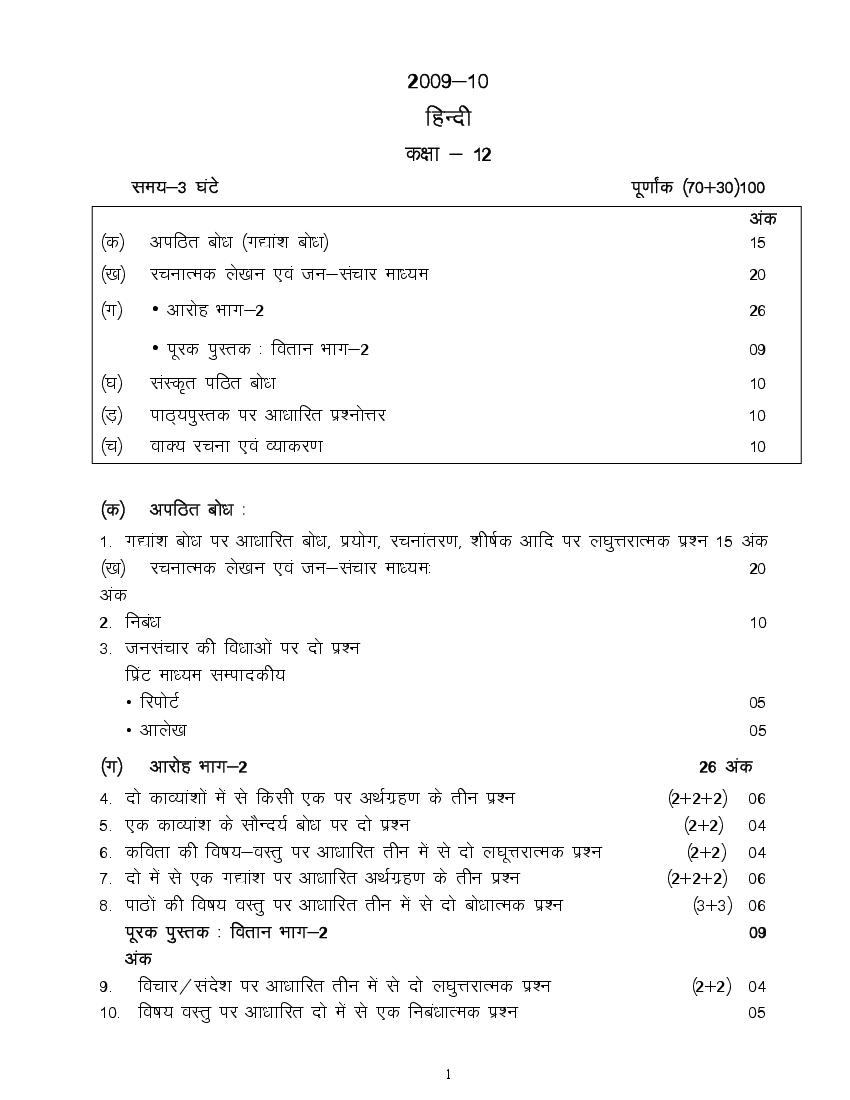
fgUnh
d{kk & 12
le;&3 ?kaVs iw.kkZad ¼70$30½100
vad
¼d½ vifBr cks/k ¼x|ka”k cks/k½ 15
¼[k½ jpukRed ys[ku ,oa tu&lapkj ek/;e 20
¼x½ Û vkjksg Hkkx&2 26
Û iwjd iqLrd % forku Hkkx&2 09
¼?k½ laLd`r ifBr cks/k 10
¼M+½ ikB~;iqLrd ij vk/kkfjr iz”uksÙkj 10
¼p½ okD; jpuk ,oa O;kdj.k 10
¼d½ vifBr cks/k %
1- x|ka”k cks/k ij vk/kkfjr cks/k] iz;ksx] jpukarj.k] “kh’kZd vkfn ij y?kqÙkjkRed iz”u 15 vad
¼[k½ jpukRed ys[ku ,oa tu&lapkj ek/;e% 20
vad
2- fuca/k 10
3- tulapkj dh fo/kkvksa ij nks iz”u
fiazV ek/;e lEikndh;
Û fjiksVZ 05
Û vkys[k 05
¼x½ vkjksg Hkkx&2 26 vad
4- nks dkO;ka”kksa esa ls fdlh ,d ij vFkZxzg.k ds rhu iz”u ¼2$2$2½ 06
5- ,d dkO;ka”k ds lkSUn;Z cks/k ij nks iz”u ¼2$2½ 04
6- dfork dh fo’k;&oLrq ij vk/kkfjr rhu esa ls nks y?kwÙkjkRed iz”u ¼2$2½ 04
7- nks esa ls ,d x|ka”k ij vk/kkfjr vFkZxzg.k ds rhu iz”u ¼2$2$2½ 06
8- ikBksa dh fo’k; oLrq ij vk/kkfjr rhu esa ls nks cks/kkRed iz”u ¼3$3½ 06
iwjd iqLrd % forku Hkkx&2 09
vad
9- fopkj@lans”k ij vk/kkfjr rhu esa ls nks y?kqÙkjkRed iz”u ¼2$2½ 04
10- fo’k; oLrq ij vk/kkfjr nks esa ls ,d fuca/kkRed iz”u 05
1
Page 2
vad
¼I½ laLd`r ikB~;iqLrd ds iznÙk x|ka”k ij vk/kkfjr pkj y?kqÙkjh; iz”uksa esa ls
rhu iz”uksa ds mÙkj ¼2$2$2½ 06
¼II½ ikB~;iqLrd ds iznÙk “yksd ds vk/kkj ij vk/kkfjr rhu y?kqÙkjh; iz”uksa esa ls
nks iz”uksa ds mÙkj ¼2$2½ 04
¼M+½ laLd`r ikB~;&iqLrd ij vk/kkfjr iz”uksÙkj 10
vad
ikB~;&iqLrdksa ds ikBksa ij vk/kkfjr vkB y?kqÙkjh; iz”uksa esa ls ik¡p iz”uksa ds laLd`r esa iw.kZ
okD;ksa esa mÙkj ¼2$2$2$2$2½ 10
¼p½ laLd`r okD; jpuk 04
vad
fn;s x;s lqcUr] frMUr] vO;; vkfn ls lEcfU/kr nl inksa esa ls pkj inksa dks ysdj pkj
okD;ksa dh jpuk djuk ¼1$1$1$1½ 04
¼N½ laLd`r O;kdj.k 06
vad
lekl] dkjd] “kCn :i /kkrq :i vkfn ls lEcfU/kr y?kqÙkjh; iz”u ¼1$1$1$1½ 04
folxZ lfU/k & foltZuh;L; l% lltq’kksl% vrksjksjIyqrknIyqrs 02
vad
vFkok
dksbZ d.BLFk “yksd fy[kdj mldk fgUnh vuqokn djuk ¼3$3½ 06
fu/kkZfjr iqLrdsa %
1- vkjksg Hkkx & 2
2- forku Hkkx & 2
3- vfHkO;fDr vkSj ek/;e
4- laLd`r ikB~; iqLrd & izcksf/kuh Hkkx & 2
fuEukafdr ikBksa dk ewY;kadu ugha fd;k tk;sxk %&
1& vkjksg&2 1- “ke”ksj cgknqj flag & m’kk
2- pkyhZ pSifyu ;kuh ge lc& fo’.kq [kjs
3- igyoku dh <ksyd& Q.kha”oj ukFk js.kq
2& forku Hkkx&2 1- Mk;jh ds iUus& ,su QzSad
2
Page 3
ikB~;Øe ls 30 izfr”kr dh dVkSrh fuEuor~ dh tkrh gS%&
Class – XII
DELETED SYLLABUS
(For the Session of 2020-21 Only)
HINDI
(THEORY)
dkO; [k.M ¼vkjksg Hkkx& 2½ lw;Zdkar f=ikBh fujkyk & ckny jkx
gfjoa”kjk; cPpu & vkRe ifjp;
vkyksd /kUok & irax
dq¡oj ukjk;.k & ckr lh/kh Fkh ij
mek”kadj tks”kh & ¼d½ NksVk esjk [ksr
¼[k½ cxqyksa ds ia[k
x| [k.M ¼vkjksg Hkkx& 2½ fo’.kq [kjs & pkyhZ pSfIyu ;kuh ge lc
gtkjh izlkn f}osnh & f”kjh’k ds Qwy
laLd`r izcksf/kuh ¼Hkkx& 2½ fo|kyL; okf’kZdksRlo%
y{;Sdn`f’V
Jhd`’.kL; nkSR;e~
3
Page 4
ENGLISH
Class XII
Time : 3 Hours
One Paper Marks : 100
Unitwise Weightage
Marks
Unit/Areas of Learning
Section A
Reading Skills 20
Reading unseen prose passages and note making
Section B
Advanced Writing Skills 35
Section C (Prescribed Books)
(i) Flamingo 30
(ii) Supplementary Reader - Vistas 15
SECTION-A
Reading unseen Passages and Note Note-making 20 Marks
Two unseen passages with a variety of questions including 03 marks for vocabulary such as
word formation and inferring meaning and 05 marks for notenote-making.
The total length of the two passages will be between 950
950-1200
1200 words. The passages will
include two of the following:
(a) Factual Passages e.g. instructions, descriptions, reports.
(b) Discursive passage involving opinion e.g. argumentative, persuasive or interpretative text.
(c) Literary passage e.g. extract from fiction, drama, poetry, essay or biogr
biography
aphy
Summary - Class XII
Unseen No. of Testing Areas Marks Allotted
passages words
1. 600-700 Short answer type
questions to test local,
global and inferential 09
comprehension, 12
Vocabulary 03
2. 350-500 Note-making in an appropriate format
05 08
Abstraction 03
A passage of about 600
600-700
700 words carrying 12 marks and another passage of about 350-
350
500 words carrying 08 marks
1. A passage to test reading comprehension. The passage can be literary, factual or discursive.
The length of the passage should be between 600-700 words. 12
2. A shorter passage of 350
350-500 words for note-making
making and abstraction. 08
4
Page 5
Advanced Writing Skills 35 Marks
3. One out of two short compositions of not more than 50 words 5
each e.g. advertisement and notices, designing or drafting posters, writing formal and
informal invitations and replies.
4. A report or a factual description based on verbal input provided 10
(one out of two) (100-125 words)
5. Writing one out of two letters based on verbal input. 10
Letter types include:
(a) business or official letters (for making enquiries, registering complaints, asking for and
giving information, placing orders and sending replies):
(b) letters to the editor (giving suggestions on an issue)
(c) application for a job
6. One out of two compositions based on visual and/or verbal input 10
(150-200 words). Output may be descriptive or argumentative in nature such as an article, or
a speech.
SECTION C
Text Books 45 Marks
Prescribed Books:
Flamingo 30
7. One out of two extracts based on poetry from the text to test comprehension and appreciation
4
8. Three out of four short questions from the poetry section to test local and global
comprehension of text. 6
9. Five short answer questions based on the lessons from prescribed text. (2x5) 10
10. One out of two long answer type questions based on the text to test global comprehension
and extrapolation beyond the set text. (Expected word limit about 125-150 words each) 10
Snapshots 15
11. One out of two long answer type question based on Supplementary 7
Reader to test comprehension and extrapolation of theme, character
and incidents (Expected word limit about 125-150 words)
12. Four short answer questions from the Supplementary Reader (2x4) 8
Prescribed Books
1. Flamingo : English Reader
2. Vistas : Supplementary Reader
5
Page 6
ikB~;Øe ls 30 izfr”kr dh dVkSrh fuEuor~ dh tkrh gS%&
Class – XII
DELETED SYLLABUS
(For the Session of 2020-21 Only)
ENGLISH
(THEORY)
Reading
Note Making & Summarizing
Literature
FLAMINGO
Poets and Pancakes 1. A Roadside Stand
The Interview
Going Places
VISTAS
1. The Tiger King
2. Journey to the end of the Earth
3. Memories of Childhood
Writing
Poster Making
Business or Official letters for making enquiries, registering complaints, asking for and giving in orders and
sending replies.
Speech
6
Page 7
laLd`r
d{kk & 12
ikB~;Øe % ijh{kkfunsZ”kk”p
le;&3 ?kaVs vof/k% gksjk=;e~ iw.kkZad 100
,de~ iz”ui=e~
vad
vfLeu iz”ui=s pRokj% [k.Mk% Hkfo’;fUr
[k.M% ßdÞ vifBrka”k&vocks/ke~ 10
[k.M% ß[kÞ jpukReddk;Ze~ 15
[k.M% ßxÞ vuqiz;qäO;kdj.ke~ 30
[k.M% ß?kÞ 45
¼v½ ifBrka”k&vocks/kue~ 35
¼c½ laLd`rlkfgR;sfrgklL; ifjp;% 10
izfr[k.Ma foLr`rfooj.ke~
[k.M% *d*
¼vifBrka”kkocks/kue~½
80&10 “kCnifjfer% ,dljy% vifBr% x|ka”k% 10
iz”uoSfo/;e~
I. ,dinsu mÙkje~ 2
II. iw.kZokD;su mÙkje~ 2
III. loZukeLFkkus laKkiz;ksx% 1
IV. dr`ZfØ;k&inp;ue~ 1
V. fo”ks’k.k&fo”ks’;@i;kZ;@foyksekfnp;ue~ 2
VI. leqfpr”kh’kZdiznkue~ 2
[k.M% *[k*
¼laLd`rsu jpukReda fyf[krdk;Ze~½ 15
I. vkukSipkfjda i=e@izkFkZuki=e~ 5
II. y?kqdFkk ¼”kCnlwphlkgk¸;su] fjäLFkkuiwfrZ&ek/;esu½ 5
III. ladsrk/kkfjre~ vuqPNsnys[kue~ 5
¼fp=ef/kd`R;@fufnZ’V”kCnlwph&lkgk¸;su½
7
Page 8
¼vuqiz;qäO;kdj.ke~~½ 30
I. ikBk/kkfjrk% lfU/kPNsnk% ¼2$2$2½ 6
LojlfU/k%] O;atulfU/k%] folxZlfU/k%
II. ikBk/kkfjrleLrinkuka foxzgk% 6
vO;;hHkko%] f}xq%] }U}%] rRiq#’k%] deZ/kkj;%] cgqozhfg%
III. izR;;k%
v/kksfyf[krizR;;;ksxsu okD;la;kstue~@l³~dsrk/kkfjrfjäLFkkuiwfrZ%
IV. ¼v½ d`r&Dr] äor`q] DRok] rqequ] Y;i~] rO;r~] vuh;j~] 5
fDru~] “kr`] “kkup~
¼vk½ rf)r&erqi~] bu~] Bd~] B¥~] Ro] ry~ 3
V. vfUofr%
drkZ & fØ;k&vfUofr%@fo”ks’k.k&fo”ks’;&vfUofr% 5
miinfoHkfäiz;ksx% ¼ikB~;iqLrde~ vk/k`R;½ 5
[k.M% *?k*
Hkkx% (I)
¼vifBrka”k&vocks/kue~~½ 35
1- ¼v½ va”k=;e~ 15
I. ,d% x|ka”k% 5
II. ,d% ukV~;ka”k% 5
III. ,d% i|ka”k% 5
¼vk½ iz”uoSfo/;e~&
I. ,dinsu mÙkje~ 1
II. iw.kZokD;su mÙkje~ 1
III. fo”ks’k.k&fo”ks’;&vfUofr%@i;kZ;@foyksekfnp;ue~ 1
IV. loZukeLFkkus laKkiz;ksx% 1
V. dr`Z&fØ;k&inp;ue~ 1
I. m)`rka”kkuke~ izl³~xlUnHkZy[s kue~ d% de~ dFk;fr@lUnHkZxzUFkL; ys[kdL;p
ukeksYys[kue~ 4
II. iznÙks HkkokFkZ=;s “kq)HkkokFkZp;ue~@iznÙks HkkokFksZ fjäLFkkuiwfrZ% 4
III. mn~/k`r”yksdkuke~ vUo;s’kq fjäLFkkuiwfrZ% 4
IV. iznÙkokD;kuka Øek;kstue~ 4
V. iznÙkiafä’kq izl³~xkuqlkja f”y’Vinkuke~@inkuke~ vFkZys[kue~ 4
[k.M% ?k
Hkkx% (II)
8
Page 9
1- ¼v½ ikB~;iqLrdsa ladfyrikB~;ka”kkuka dohuka d`rhuka laLd`rsu ifjp;% ¼1 X5½
¼vk½ laLd`rs x|&i|&ukVdkfnfo/kkuka eq[;fo”ks’krkuka ifjp;% 5
dksfoM 19 egkekjh ds dkj.k “kSf{kd l= 2020&21 gsrq fo’k;& laLd`r ¼d{kk&12½ esa mijksDr
ikB~;Øe ls 30 izfr”kr dh dVkSrh fuEuor~ dh tkrh gS%&
Class – XII
DELETED SYLLABUS
(For the Session of 2020-21 Only)
Sanskrit
(THEORY)
d{kk&12 ikB~;iqLrd&HkkLorh v/;k;&¼1½ gYnh?kkVh
¼2½ enkylk
¼3½ izrh{kk
¼4½ fo|kLFkkufu
9
Page 10
HISTORY
CLASS XII
Time : 3 Hours
One Paper Marks : 100
Units Marks
Section A: Archaeology & Ancient India 25
Units 1 - 4
Section B: Medieval India 30
Units 5 - 9
Section C: Modern India 35
Units 10 - 15
Unit 16 : Map Work 10
Class XII: Themes in Indian History
Themes Objectives
SECTION A: ARCHAEOLOGY &
ANCIENT INDIA Familiarize the learner with early . urban
1. The Story of the First Cities: centres as economic and social
Harappan Archaeology institutions.
Introduce the ways in which new data can
Broad overview: Early urban centres lead to a revision of . existing notions of
Story of discovery: Harappan civilization history.
Illustrate how archaeological reports are
Excerpt: Archaeological report on a major site analyzed and interpreted by scholars.
Discussion: how it has been utilized by
archaeologists/historians
2. Political and Economic History: How
Inscriptions tell a story.
Broad overview: Political and economic history Familiarize the learner with major trends
from the Mauryan to the Gupta period in the political and . economic history of
Story of discovery: Inscriptions and the the subcontinent.
decipherment of the script. Shifts in the under
standing of political and economic history. Introduce inscriptional analysis and the
Excerpt: Asokan inscription and Gupta period ways in which these have shaped the
and grant. understanding of political and economic
Discussion: Interpretation of inscriptions by processes
historians
10
Page 11
Broad overview: Issues in social history, Familiarize the learner with issues in
including caste, class, kinship and gender social history.
Story of discovery: Transmission and Introduce strategies of textual . analysis
publications of the Mahabharat and their use in reconstructing social
Excerpt: from the Mahabharata, illustrating history.
how it has been used by historians.
Discussion: Other sources for reconstructing
social history.
4. A History of Buddhism: Sanchi Stupa
Broad overview: (a) A brief review of religious Discuss the major religious developments
histories of Vedic religion, Jainism, Vaisnavism, in early India.
Saivism. (b) Focus on Buddhism Introduce strategies of visual analysis and
Story of discovery: Sanchi stupa their use in reconstructing histories of .
Excerpt: Reproduction of sculptures from religion.
Sanchi
Discussion: Ways in which sculpture has been
interpreted by historians, other sources for
reconstructing the history of Buddhism
SECTION B: MEDIEVAL INDIA
5. Agrarian Relations: The Ain-i- Akbari Discuss developments in agrarian
Broad overview: (a) Structure of agrarian relations.
relations in the 16th and 17th centuries. (b) Discuss how to supplement official
Patterns of change over the period. documents with other . sources.
Story of Discovery: Account of the compilation
and translation of Ain-i-Akbari
Excerpt: from theAin-i-Akbari
Discussion: Ways in which historians have used
the text to reconstruct history.
6. The Mughal Court: Reconstructing
Histories through Chronicles Familiarize the learner with the major
Broad Overview: (a) Outline of political landmarks in political history
history 15th-17th centuries. (b) Discussion of the Show how chronicles and other
Mughal court and politics. sources are used to reconstruct the
Story of Discovery: Account of the production histories of political institutions.
of court chronicles, and ‘their subsequent
translation and transmission.
Excerpts: from the Akbarnama and
Padshahnama.
Discussion: Ways in which historians have used
the texts to reconstruct political histories.
11
Page 12
Broad Overview: (a) Outline of new buildings Familiarize the learner with the new
duringVijayanagarperiod-temples, forts, buildings that were built during the time.
irrigation facilities. (b) Relationship between Discuss the ways in which architecture
architecture and the political system.. can be analyzed to . reconstruct history.
Story of Discovery: Account of how Hampi
was found
Excerpt: Visuals of buildings at Hampi
Discussion: Ways in which historians have
analyzed and interpreted these structures
8. Religious Histories: The Bhakti-Sufi
tradition Familiarize the learner with religious
Broad Overview: (a) Outline of religious developments.
developments during this period. (b) Ideas and Discuss ways of analyzing devotional
practices of the Bhakti-Sufi saints. literature as sources of history.
Story of Transmission: How Bhakti-Sufi
compositions have been preserved.
Excerpt: Extracts from selected Bhakti Sufi
works.
Discussion: Ways in which these have been
interpreted by historians.
9. Medieval Society Through Travellers'
Accounts Familiarize the learner with the accounts.
Broad Overview: Outline of social and cultural salient features of social histories
life as they appear in travellers’ described by the travellers.
Story of their writings: A discussion of where Discuss how travellers’ accounts can be
they travelled, why they travelled, what they used as sources of social history.
wrote, and for whom they wrote.
Excerpts: from Alberuni, Ibn Batuta, Bernier.
Discussion: What these travel accounts can tell
us and how they have been interpreted by
historians.
SECTION C: MODERN INDIA
10. Colonialism and-Rural Society: Evidence
from Official Reports
Broad overview : (a). Life of zamindars,
peasants and artisans in the late 18 century (b) Discuss how colonialism affected
East India Company, revenue settlements and Zamindars, peasants and artisans.
surveys. (c) Changes over the nineteenth century. Understand the problems and limits of
Story of official records: An account of why using official sources for understanding
official investigations into rural societies were the lives of people.
under taken and the types of records and reports
produced.
12
Page 13
Accounts of Frances Buchanan-Hamilton, and
Deccan Riots Report,
Discussion: What the official records tell and do
not tell, and how they have been used by
historians.
11. Representations of 1857
Broad Overview: (a) The events of 1857-58. Discuss how the events of 1857 are
(b) How these events were recorded and being reinterpreted.
narrated. Discuss how visual material can be used
Focus: Lucknow. by historians
Excerpts: Pictures of 1857. Extracts from
contemporary accounts.
Discussion: How the pictures of 1857 shaped
British opinion of what had happened.
12. Colonialism and Indian Towns:
Town Plans and Municipal Reports
Broad Overview: The growth of Mumbai, Familiarize the learner with the history
Chennai, hill stations and cantonments in the of modern urban centres.
18th and 19th century. Discuss how urban histories can be
Excerpts: Photographs and paintings. Plans of written by drawing on different types of
cities. Extract from town plan reports. Focus on sources.
Kolkata town planning.
Discussion: How the above sources can be used
to reconstruct the history of towns. What these
sources do not reveal.
13. Mahatma Gandhi through Contemporary
Eyes Familiarize the learner with significant
Broad Overview: (a) The nationalist movement elements of the nationalist movement and
1918 - 48, (b) The nature of Gandhian politics the nature of Gandhian leadership.
and leadership. Discuss how Gandhi was perceived by
Focus: Mahatma Gandhi in 1931. different groups.
Excerpts: Reports from English and Indian Discuss how historians need to read and
language newspapers and other contemporary interpret newspapers, diaries and letters
writings. as historical source.
Discussion: How newspapers can be a source of
history.
14. Partition through Oral Sources
Broad Overview: (a) The history of the 1940s; Discuss the last decade of the national
(b) Nationalism. Communalism and Partition. movement, the growth of communalism
Focus: Punjab and Bengal. and the story of Partition.
Excerpts: Oral testimonies of those who Understand the events through the
experienced partition. experience of those who lived through
Discussion: Ways in which these have been these years of communal violence.
analyzed to reconstruct the history of the event. Show the possibilities and limits of oral
sources.
13
Page 14
Broad Overview: (a) Independence and the Familiarize students with the history of
newnation state. (b) The making of the the early years after independence.
constitution. . Focus: The Constitutional Discuss how the founding ideals of the
Assembly debates. Excerpts: from the debates new nation state were debated and
Discussion: What such debates reveal and formulated.
howthey can be analyzed. Understand how such debates and
discussions can be read by historians.
16. Map Work on Units 1-15
dksfoM 19 egkekjh ds dkj.k “kSf{kd l= 2020&21 gsrq fo’k;& bfrgkl ¼d{kk&12½ esa mijksDr
ikB~;Øe ls 30 izfr”kr dh dVkSrh fuEuor~ dh tkrh gS%&
Class – XII
DELETED SYLLABUS
(For the Session of 2020-21 Only)
HISTORY
(THEORY)
THEMES IN INDIAN HISTORY
S.No. Topics Theme Deleted Portion
(according to Book)
1 Through the Eyes of Travellers Theme – 5 Complete Chapter
Book - Part II
2 Peasants, Zamindars and the State Theme - 8 Complete Chapter
Book - Part II
A Revolt in the
Countryside – The
Theme – 10 Bombay Deccan
3 Colonialism and the Countryside
Book - Part III (Unit-3), The Deccan
Riots Commission
(Unit-4)
4 Colonial Cities Theme – 12 Complete Chapter
Book - Part III
5 Understanding Partition Theme – 14 Complete Chapter
Book - Part III
` No Change in Map Work
14
Page 15
Page 16
HISTORY
CLASS XII
Time : 3 Hours
One Paper Marks : 100
Units Marks
Section A: Archaeology & Ancient India 25
Units 1 - 4
Section B: Medieval India 30
Units 5 - 9
Section C: Modern India 35
Units 10 - 15
Unit 16 : Map Work 10
Class XII: Themes in Indian History
Themes Objectives
SECTION A: ARCHAEOLOGY &
ANCIENT INDIA Familiarize the learner with early . urban
1. The Story of the First Cities: centres as economic and social
Harappan Archaeology institutions.
Introduce the ways in which new data can
Broad overview: Early urban centres lead to a revision of . existing notions of
Story of discovery: Harappan civilization history.
Illustrate how archaeological reports are
Excerpt: Archaeological report on a major site analyzed and interpreted by scholars.
Discussion: how it has been utilized by
archaeologists/historians
2. Political and Economic History: How
Inscriptions tell a story.
Broad overview: Political and economic history Familiarize the learner with major trends
from the Mauryan to the Gupta period in the political and . economic history of
Story of discovery: Inscriptions and the the subcontinent.
decipherment of the script. Shifts in the under
standing of political and economic history. Introduce inscriptional analysis and the
Excerpt: Asokan inscription and Gupta period ways in which these have shaped the
and grant. understanding of political and economic
Discussion: Interpretation of inscriptions by processes
historians
16
Page 17
Broad overview: Issues in social history, Familiarize the learner with issues in
including caste, class, kinship and gender social history.
Story of discovery: Transmission and Introduce strategies of textual . analysis
publications of the Mahabharat and their use in reconstructing social
Excerpt: from the Mahabharata, illustrating history.
how it has been used by historians.
Discussion: Other sources for reconstructing
social history.
4. A History of Buddhism: Sanchi Stupa
Broad overview: (a) A brief review of religious Discuss the major religious developments
histories of Vedic religion, Jainism, Vaisnavism, in early India.
Saivism. (b) Focus on Buddhism Introduce strategies of visual analysis and
Story of discovery: Sanchi stupa their use in reconstructing histories of .
Excerpt: Reproduction of sculptures from religion.
Sanchi
Discussion: Ways in which sculpture has been
interpreted by historians, other sources for
reconstructing the history of Buddhism
SECTION B: MEDIEVAL INDIA
5. Agrarian Relations: The Ain-i- Akbari Discuss developments in agrarian
Broad overview: (a) Structure of agrarian relations.
relations in the 16th and 17th centuries. (b) Discuss how to supplement official
Patterns of change over the period. documents with other . sources.
Story of Discovery: Account of the compilation
and translation of Ain-i-Akbari
Excerpt: from theAin-i-Akbari
Discussion: Ways in which historians have used
the text to reconstruct history.
6. The Mughal Court: Reconstructing
Histories through Chronicles Familiarize the learner with the major
Broad Overview: (a) Outline of political landmarks in political history
history 15th-17th centuries. (b) Discussion of the Show how chronicles and other
Mughal court and politics. sources are used to reconstruct the
Story of Discovery: Account of the production histories of political institutions.
of court chronicles, and ‘their subsequent
translation and transmission.
Excerpts: from the Akbarnama and
Padshahnama.
Discussion: Ways in which historians have used
the texts to reconstruct political histories.
17
Page 18
Broad Overview: (a) Outline of new buildings Familiarize the learner with the new
duringVijayanagarperiod-temples, forts, buildings that were built during the time.
irrigation facilities. (b) Relationship between Discuss the ways in which architecture
architecture and the political system.. can be analyzed to . reconstruct history.
Story of Discovery: Account of how Hampi
was found
Excerpt: Visuals of buildings at Hampi
Discussion: Ways in which historians have
analyzed and interpreted these structures
8. Religious Histories: The Bhakti-Sufi
tradition Familiarize the learner with religious
Broad Overview: (a) Outline of religious developments.
developments during this period. (b) Ideas and Discuss ways of analyzing devotional
practices of the Bhakti-Sufi saints. literature as sources of history.
Story of Transmission: How Bhakti-Sufi
compositions have been preserved.
Excerpt: Extracts from selected Bhakti Sufi
works.
Discussion: Ways in which these have been
interpreted by historians.
9. Medieval Society Through Travellers'
Accounts Familiarize the learner with the accounts.
Broad Overview: Outline of social and cultural salient features of social histories
life as they appear in travellers’ described by the travellers.
Story of their writings: A discussion of where Discuss how travellers’ accounts can be
they travelled, why they travelled, what they used as sources of social history.
wrote, and for whom they wrote.
Excerpts: from Alberuni, Ibn Batuta, Bernier.
Discussion: What these travel accounts can tell
us and how they have been interpreted by
historians.
SECTION C: MODERN INDIA
10. Colonialism and-Rural Society: Evidence
from Official Reports
Broad overview : (a). Life of zamindars,
peasants and artisans in the late 18 century (b) Discuss how colonialism affected
East India Company, revenue settlements and Zamindars, peasants and artisans.
surveys. (c) Changes over the nineteenth century. Understand the problems and limits of
Story of official records: An account of why using official sources for understanding
official investigations into rural societies were the lives of people.
under taken and the types of records and reports
produced.
18
Page 19
Accounts of Frances Buchanan-Hamilton, and
Deccan Riots Report,
Discussion: What the official records tell and do
not tell, and how they have been used by
historians.
11. Representations of 1857
Broad Overview: (a) The events of 1857-58. Discuss how the events of 1857 are
(b) How these events were recorded and being reinterpreted.
narrated. Discuss how visual material can be used
Focus: Lucknow. by historians
Excerpts: Pictures of 1857. Extracts from
contemporary accounts.
Discussion: How the pictures of 1857 shaped
British opinion of what had happened.
12. Colonialism and Indian Towns:
Town Plans and Municipal Reports
Broad Overview: The growth of Mumbai, Familiarize the learner with the history
Chennai, hill stations and cantonments in the of modern urban centres.
18th and 19th century. Discuss how urban histories can be
Excerpts: Photographs and paintings. Plans of written by drawing on different types of
cities. Extract from town plan reports. Focus on sources.
Kolkata town planning.
Discussion: How the above sources can be used
to reconstruct the history of towns. What these
sources do not reveal.
13. Mahatma Gandhi through Contemporary
Eyes Familiarize the learner with significant
Broad Overview: (a) The nationalist movement elements of the nationalist movement and
1918 - 48, (b) The nature of Gandhian politics the nature of Gandhian leadership.
and leadership. Discuss how Gandhi was perceived by
Focus: Mahatma Gandhi in 1931. different groups.
Excerpts: Reports from English and Indian Discuss how historians need to read and
language newspapers and other contemporary interpret newspapers, diaries and letters
writings. as historical source.
Discussion: How newspapers can be a source of
history.
14. Partition through Oral Sources
Broad Overview: (a) The history of the 1940s; Discuss the last decade of the national
(b) Nationalism. Communalism and Partition. movement, the growth of communalism
Focus: Punjab and Bengal. and the story of Partition.
Excerpts: Oral testimonies of those who Understand the events through the
experienced partition. experience of those who lived through
Discussion: Ways in which these have been these years of communal violence.
analyzed to reconstruct the history of the event. Show the possibilities and limits of oral
sources.
19
Page 20
Broad Overview: (a) Independence and the Familiarize students with the history of
newnation state. (b) The making of the the early years after independence.
constitution. . Focus: The Constitutional Discuss how the founding ideals of the
Assembly debates. Excerpts: from the debates new nation state were debated and
Discussion: What such debates reveal and formulated.
howthey can be analyzed. Understand how such debates and
discussions can be read by historians.
16. Map Work on Units 1-15
dksfoM 19 egkekjh ds dkj.k “kSf{kd l= 2020&21 gsrq fo’k;& bfrgkl ¼d{kk&12½ esa mijksDr
ikB~;Øe ls 30 izfr”kr dh dVkSrh fuEuor~ dh tkrh gS%&
Class – XII
DELETED SYLLABUS
(For the Session of 2020-21 Only)
HISTORY
(THEORY)
THEMES IN INDIAN HISTORY
S.No. Topics Theme Deleted Portion
(according to Book)
1 Through the Eyes of Travellers Theme – 5 Complete Chapter
Book - Part II
2 Peasants, Zamindars and the State Theme - 8 Complete Chapter
Book - Part II
A Revolt in the
Countryside – The
Theme – 10 Bombay Deccan
3 Colonialism and the Countryside
Book - Part III (Unit-3), The Deccan
Riots Commission
(Unit-4)
4 Colonial Cities Theme – 12 Complete Chapter
Book - Part III
5 Understanding Partition Theme – 14 Complete Chapter
Book - Part III
` No Change in Map Work
20
Page 21
Page 22
REVISED SYLLABUS
(For the Session of 2020-21 Only)
Geography
(THEORY)
A. Fundamentals of Human Geography
Unit 1: Human Geography: Nature and Scope
Unit 2: People
Population — distribution, density and growth
Population change-spatial patterns and structure; determinants of population change;
Age-sex ratio; rural-urban composition;
Human development - concept; selected indicators, international comparisons
Unit 3: Human Activities
Primary activities - concept and changing trends; gathering, pastoral, mining, subsistence
agriculture, modern agriculture; people engaged in agricultural and allied activities – some
examples from selected countries.
Tertiary activities-concept; trade, transport and communication; services; people engaged in
tertiary activities - some examples from selected countries
Quaternary activities-concept; knowledge based industries; people engaged in quaternary
activities - some examples from selected countries
Unit 5: Human Settlements
Settlement types - rural and urban; morphology of cities (case study); distribution of mega
cities; problems of human settlements in developing countries.
Unit 6: Map Work on identification of features based on above units on the
outline Political map of World.
Part B. India: People and Economy
Unit 7: People
Population : distribution, density and growth; composition of population - linguistic,
religious; sex, rural-urban and occupational– polulation change through time and regional
variations;
Migration: international, national-causes and consequences;
Human development: selected indicators and regional patterns;
Population, environment and development.
Unit 8: Human Settlements
Rural settlements - types and distribution;
Urban settlements - types, distribution and functional classification.
22
Page 23
Water resources-availability and utilization-irrigation, domestic, industrial and other uses;
scarcity of water and conservation methods-rain water harvesting and watershed management
(one case study related with participatory watershed management to be introduced).
Mineral and energy resources: distribution of metallic (Ironore, Copper, Bauxite, Manganese)
non-metallic (Mica, Salt) minerals; conventional (Coal, Petroleum, Natural gas and Hydro
electricity) and non-conventional energy sources (solar, wind, biogas).
Planning in India- target area planning (case study); idea of sustainable development (case
study)
Unit 11: Geographical Perspective on Selected Issues and Problems (One case
study to be introduced for each topic)
Environmental pollution; urban-waste disposal.
Urbanisation rural-urban migration; problem of slum.
Land Degradation.
23
Page 24
on outline political map of India
C. Practical Work
Unit I : Processing of Data and Thematic Mapping
Sources of data.
Tabulating and processing of data; calculation of averages, measures of central tendency,
deviation and rank correlation;
Representation of data- construction of diagrams: bars, circles and flowchart; thematic maps;
construction of dot; choropleth and isopleth maps.
Use of computers in data processing and mapping.
Unit II : Survey (Chain Table Survey and Plane Table Survey)
Unit III: Field Study or Spatial Information Technology
Field visit and study: map orientation, observation and preparation of sketch; survey on any
one of the local concerns; pollution, ground water changes, land use and land-use changes, poverty,
energy issues, soil degradation, impact of floods and drought, catchment area of school, Market
survey and Household survey (any one topic of local concern may be taken up for the study;
observation and questionnaire survey may be adopted for the data collection; collected data may be
tabulated and analysed with diagrams and maps).
OR
Spatial Information Technology
Introduction to GIS; hardware requirements and software modules; data formats; raster and vector
data, data input, editing & topology building; data analysis; overlay & buffer
24
Page 25
REVISED SYLLABUS
(For the Session of 2020-21 Only)
Economics
(THEORY)
Part A : Introductory Microeconomics
Unit 1: Introduction
What is an economy? Central problems of an economy : what, how and for whom to produce; and
opportunity cost.
Distinctions between (a) planned and market economies, (b) positive and normative perspectives in
economics, and (c) microeconomics and macroeconomics .
(Non-evaluative topics: Some basic tools in the study of economics - equation of a line, slope of
aline, slope of a curve.)
Unit 2: Consumer Equilibrium and Demand
Consumer's equilibrium – meaning of utility, marginal utility, law of diminishing marginal utility,
conditions of consumer's equilibrium using marginal utility analysis.
Indifference curve analysis of consumer's equilibrium-the consumer's budget (budget set and budget
line), preferences of the consumer (indifference curve, indifference map) and conditions of
consumer's equilibrium.
Demand, market demand, determinants of demand, demand schedule, demand curve, movement
along and shifts in the demand curve; price elasticity of demand - factors affecting price elasticity of
demand; measurenment of price elasticity of demand – (a) percentage-change method and (b)
geometric method (linear demand curve); relationship between price elasticity of demand and total
expenditure.
Unit 3: Producer Behaviour and Supply
Production function: Total Product, Average Product and Marginal Product.
Returns to a Factor.
Cost and Revenue: Short run costs - total cost, total fixed cost, total variable cost; Average fixed cost,
average variable cost and marginal cost-meaning and their relationship. Revenue - total, average and
marginal revenue.
Supply, market supply, determinants of supply, supply schedule, supply curve, movements along and
shifts in supply curve, price elasticity of supply; measurement of price elasticity of supply – (a)
percentagechange method and (b) geometric methods.
Unit 4: Forms of Market and Price Determination
Perfect competition - meaning and features.
25
Page 26
in demand and supply.
Unit 5: Simple applications of Tools of demand and supply (not to be examined)
26
Page 27
Unit 6: National Income and related aggregates
Macroeconomics: Its meaning.
Some basic concepts of macroeconomics: consumption goods, capital goods, final goods,
intermediate goods; stocks and flows; gross investment and depreciation.
Circular flow of income; Methods of calculating National Income – Value Added or Product method,
Expenditure method, Income method.
Concepts and aggregates related to National Income:
Gross National Product (GNP), Net National Product (NNP), Gross and Net Domestic Product (GDP
and NDP) - at market price, at factor cost; National Disposable Income (gross and net), Private
Income, Personal Income and Personal Disposable Income; Real and Nominal GDP. GDP and
Welfare
Unit 7: Money and Banking
Money – its meaning and function.
Supply of money – Currency held by the public and net demand deposits held by commercial banks.
Money creation by the commercial banking system.
Central banking and its functions (example of the Reserve Bank of India).
Unit 8: Determination of Income and Employment
Aggregate demand and its components.
Propensity to consume and propensity to save (average and marginal).
Short–run fixed price in product market, equilibrium output; investment or output multiplier and the
multiplier mechanism.
Meaning of full employment and involuntary unemployment.
Problems of excess demand and deficient demand; measures to correct them - change in
government spending, availability of credit.
Unit 9: Government Budget and the Economy
Government budget - meaning, objectives and components.
Classification of receipts - revenue receipt and capital receipt; classification of expenditure -
revenue expenditure and capital expenditure.
Various measures of government deficit - revenue deficit, fiscal deficit, primary deficit:their
meaning and implications.
Fiscal policy and its role (non-evaluative topic).
Unit 10: Balance of Payments
Balance of payments account - meaning and components.
Foreign exchange rate – meaning of fixed and flexible rates and managed floating.
27
Page 28
REVISED SYLLABUS
(For the Session of 2020-21 Only)
Home Science
(THEORY)
Unit I: Know Little Children (0-3 years)
Some specific characteristics: physical and motor-height, weight and body proportions;
motordevelopment during 0-3 months, 3-6 months, 6-9 months, 9-12 months and 1-3 years
(milestones only); social developments.
Protection from preventable diseases: immunization - concept and types (natural and
acquired),breast feeding (one of the ways to develop natural immunity); immunization chart;
symptoms and incubation period of childhood diseases - TB, DPT, polio, measles, cholera,
diarrhoea.
Substitute care at home and outside: siblings, grand parents, neighbours creche, day care centres
etc: Integrated Child Development Scheme (ICDS) - objectives and functions.
Unit II : Nutrition for Self and Family
Planning meals for the family: meaning and importance of meal planning, principles and
factorsaffecting meal planning, planning meals for the family; keeping in mind the needs of
individual members, including children, pregnant women, lactating mother, members suffering from
fever and diarrhoea; role and preparation of ORS.
Ways to ensure good health for the family: using safe drinking water-importance of potable
waterfor good health, qualities of safe drinking water; household methods of making water safe for
drinking; boiling, filtering, use of alum and chlorine tablet role of hygiene for food handlers at home
level. Safety against food adulteration, definition and meaning of food adulteration as given by PFA;
common adulterants present in cereals, pulses, milk and milk products. Ill effects of some of the
adulterants present in the foods: kesari dal, metanil yellow, argemone seeds.
Unit III : Money Management and Consumer Education
Family Income: various sources of family income: (i) money income, (ii) real income, direct
andindirect; need and procedure for keeping household accounts.
Savings and Investment: meaning and importance of savings; ways/methods of investment-
banks,post-office, LIC, Units, PPF, PF.
28
Page 29
Act (1986) and Services; Consumer aids: levels, standardization marks, advertising,
guidebooks/leaflets.
29
Page 30
Clothing and its relation to personality: Elements of design: balance, rhythm, proportion,
harmony, emphasis; factors that influence the selection of clothes: personality, age, climate,
occupation, figure, occasion, fashion; selection and purchase of fabrics. Purpose, quality, cost,
season, reliable shop.
Checking size and quality in ready-made garments, need and criteria: seams, hem, plackets,
fasteners, workmanship, design, drape.
Care of clothes: General principles and precautions to be followed while removing stains and
washing:
Cleansing agents: soaps and detergents (basic differences); Storage of clothes.
Unit V: Things I can do with my Home Science Education
Application of knowledge of Home Science in everyday life.
Usefulness of some of the skills learnt here for supplementing family income.
Skills learnt here can be gainfully used for employment (self-employment, apprenticeship).
Further training required to make this field a career: various sources and facilities available for
training.
30
Page 31
REVISED SYLLABUS
(For the Session of 2020-21 Only)
Political Science
(THEORY)
Part A: Contemporary world Politics
Course Content:
1. Cold War Era in World Politics
Emergence of two power blocs after the second world war. Arenas of the cold war.
Challenges to Bipolarity: Non Aligned Movement, quest for new international economic
order. India and the cold war.
2. Disintegration of the ‘Second World’ and the Collapse of Bipolarity.
New entities in world politics: Russia, Balkan states and Central Asian states, Introduction of
democratic politics and capitalism in post-communist regimes. India’s relations with Russia
and other post-communist countries.
3. US Dominance in World Politics:
Growth of unilateralism: Afghanistan, first Gulf War, response to 9/11 and attack on Iraq.
Dominance and challenge to the US in economy and ideology. India’s renegotiation of its
relationship with the USA.
4. Alternative Centres of Economic and Political Power:
Rise of China as an economic power in post-Mao era, creation and expansion of European
Union, ASEAN. India’s changing relations with China.
5. South Asia in the Post-Cold War Era:
Democratisation and its reversals in Pakistan and Nepal. Ethnic conflict in Sri Lanka, Impact
of economic globalization on the region. Conflicts and efforts for peace in South Asia.
India’s relations with its neighbours.
6. International Organizations in a unipolar World:
Restructuring and the future of the UN. India’s position in the restructured UN. Rise of new
international actors: new international economic organisations, NGOs. How democratic and
accountable are the new institutions of global governance?
9- Globalisation and Its Critics.
Economic, cultural and political manifestations. Debates on the nature of consequences of
globalisation. Anti-globalisation movements. India as an arena of globalization and struggle
against it.
31
Page 32
10. Nation-Building and Its Problems:
Nehru’s approach to nation-building: Legacy of partition: challenge of ‘refugee’ resettlement,
the Kashmir problem. Organisation and reorganization of states; Political conflicts over
language.
11. Era of One-Party Dominance:
First three general elections, nature of Congress dominance at the national level, uneven
dominance at the state level, coalitional nature of Congress. Major opposition parties.
12. Politics of Planned Development
Expansion of state sector and the rise of new economic interests. Famine and suspension of
five year plans. Green revolution and its political fallouts.
14- Challenge to and Restoration of Congress System:
Political succession after Nehru. Non-Congressism and electoral upset of 1967, Congress
split and reconstitution, Congress’ victory in 1971 elections, politics of ‘garibi hatao’.
15- Crisis of the Constitutional Order:
Search for ‘committed’ bureaucracy and judiciary. Navnirman movement in Gujarat and the
Bihar movement. Emergency: context, constitutional and extra-constitutional dimensions,
resistance to emergency. 1977 elections and the formation of Janata Party. Rise of civil
liberties organisations.
18- Recent Developments in Indian politics:
Participatory upsurge in 1990s. Rise of the JD and the BJP. Increasing role of regional parties
and coalition politics. UF and NDA governments. Elections 2004 and UPA government.
Challenge of and responses to globalization: new economic policy and its opposition. Rise of
OBCs in North Indian politics. Dalit politics in electoral and non-electoral arena. Challenge of
communalism: Ayodhya dispute, Gujarat riots.
32
Page 33
REVISED SYLLABUS
(For the Session of 2020-21 Only)
Psychology
(THEORY)
Psychology, Self and Society
Unit I : Intelligence and Aptitude
The unit aims at studying how people differ with respect to intelligence and aptitude.
Individual differences in intelligence: Theories of Intelligence; Culture and Intelligence;
Emotional intelligence; Aptitude: Nature and types: Assessment of psychological attributes.
Unit II : Self and Personality
This unit focuses on the study of self and personality in the context of different approaches in
an effort to appraise the person. The assessment of personality will also be discussed.
Aspects of self: self concept: Self-esteem and Self-regulation; Culture and self; Personality:
Concept; Approaches to Personality: Type and Trait, Psychodynamic, Humanistic,
Behavioural and Cultural; Assessment of Personality: Self-report Measures, Behavioural
Analysis, and Projective Measures.
Unit III : Human Strengths and Meeting Life Challenges
This unit deals with the nature of stress and how responses to stress depend on an
individual’s appraisal of stressors. Strategies to cope with stress will also be dealt with.
Life challenge and adjustment; Concept of adaptation; Human strengths and virtues: Nature,
types and effects on psychological functioning; Coping with stress; Concepts of health and
well-being; Life style, health and well-being.
Unit IV: Psychological Disorders
This unit discusses the concepts of normality and abnormality and the major psychological
disorders.
Concepts of abnormality and psychological disorder, Causal factors associated with
abnormal behaviour, Classification of disorder, Major psychological disorders: Anxiety,
Somato-form Dissociative, Mood, Schizophrenic, Developmental and Behavioural Substance
Related.
Unit V : Therapeutic Approaches
This unit discuses the goals, techniques and effectiveness of different approaches to treat
psychological disorders.
Nature and process of therapy; Nature of therapeutic relationship; Humanistic, Cognitive,
Behaviour; Alternative therapies: Yoga, Meditation; Zen; Rehabilitation of mentally ill
people.
33
Page 34
This unit focuses on the formation and change of attitudes, cultural influences on
attributional tendencies and conditions influencing pro-social behaviour.
Explaining behaviour through attributions; Nature and components of attitudes; Attitude
formation and change; Behaviour in the presence of others: Pro-social Behaviour; Prejudice
and discrimination; Strategies for handling prejudice.
Unit VII : Social Influence and Group Processes
The unit deals with the concept of group, its functions and the dynamics of social influence
process like conformity, obedience and compliance. Different conflict resolution strategies
will also be discussed.
Influence Processess: Groups: Nature, formation and types; Influence of group on individual
behaviour.
34
Page 35
Page 36
PUNJABI (107)
Class XII
One Paper 3 Hours Marks: 100
Unit/Areas of Learning Marks
A. Reading Skills (Comprehension of an unseen passage 10
B. Writing Skills 25
C. Applied Grammer 15
D. Literature 50
LANGUAGE Marks
Section A : Reading Skills 10
One unseen passage of about 150 words followed by 4-5 questions to test
comprehension and inferring meanings. A suggestive heading may be asked
and vocabulary may be tested
Section B : Writing Skills 25
1. An essay of 200-225 words on a current topic related to social or
cultural issue 10
2. Story building, composing messages and factual description of
people, places or objects in 100-125 words 07
3. Letter to the editor (100-125 words) 08
Section C : Applied Grammer 15
1. Idioms 03
2. Proverbs 02
3. Marking punctuation marks in a small paragraph 03
4. Analysis of Sentences 04
5. Correction of Sentences 03
Section D : Literature
Poetry 15
1. Four short type questions based on one out of two extracts taken from
the poem (4x2) 08
2. One out of two long questions to test factual comprehension and
Interpretation 07
36
Page 37
1. Four short type questions based on one out of two extracts taken from
the drama (4x2) 08
2. A long question to test the theme, plot, character and setting based on
the drama 07
Short Story 10
1. 2-3 short type questions based on one out of two extracts taken from the
story 05
2. A question to test the theme/character based on the short story 05
History of Punjabi Literature 10
The origin, growth, development and characteristics of Punjabi Literature with
special reference to the following literature movements and forms : Adikal,
Gurmat Kav, Sufi Kav, Modern Poetry, Novel, Drama, Prose and Short story.
Text and Couurses in Literature :
Poetry :
Kav Kirti published by Guru Nanak Dev University, Amritsar
The following poets are to be studied :
1 Bhai Veer Singh 2 Dhani Ram Chatrik
3 Puran Singh 4 Prof. Mohan Singh
5 Amrita Pritam 6 Pritam Singh Safir
7 Bawa Balwant 8 Harbhajan Singh
9 Shiv Kumar 10 Tara Singh
Drama :
Shobha Shakti by Dr. Harcharan Singh, published by Arsee Publishers, Pleasure Garden
Chandni Chowk, Delhi
Short Story
Katha Kahani, published by Punjabi Academy, New Delhi- 55
dksfoM 19 egkekjh ds dkj.k “kSf{kd l= 2020&21 gsrq fo’k;& iatkch ¼d{kk&12½ esa mijksDr
ikB~;Øe ls 30 izfr”kr dh dVkSrh fuEuor~ dh tkrh gS%&
Class – XII
DELETED SYLLABUS
(For the Session of 2020-21 Only)
37
Page 38
(THEORY)
iqLrd dk uke & dFkk dgkuh
1- br Hk[kkls
2- frM+fd;k gks;k “kh”kk
3- dkj f[kMks.kk
4- nq/k nhvka ufgjka
iqLrd dk uke & dkO; dhjrh
1- izhre flag lQhj dh lHkh dfork,¡A
2- ckck cyoar dh lHkh dfork,¡A
3- f”ko dqekj cVkoyh dh lHkh dfork,¡A
4- e0l0 eh”kk lQhj dh lHkh dfork,¡A
38
Page 39
URDU Code No. 106
CLASS XII
One Paper 3 Hours Marks: 100
Section – A
Marks : 60
1. Reading Skills :
(i) Comprehension of an unseenpassage (factual) of about 150 10
wordsfollowed by five questions.
2. Writing Skills : 50
a) Essay 15
b) Letter writing (Personal, Business, and Official connected with
daily life and Application writing) 10
c) Precis Writing 10
d) Sentence making with the help of idiomatic phrases 10
e) Advertisements 05
Section – B
Marks : 40
A. Book I 20
Jangal Ki Ek Rat
(i) One out of two extracts from the prescribed book followed by short 07
answer type questions for comprehension
(ii) One essay type question about 100 words on content/theme. 05
(iii) Four short answer type questions on the lesson of prescribed lessons. 08
B. Book II 20
Heroine Ki Talash
(i) One essay type question about 100 words on content/theme. 10
(ii) Four short answer type questions on characters/event/evaluative in
Nature 10
39
Page 40
1. Jangal Ki Ek Rat by Rehan Ahmed Abbasi
published by Maktaba Payam-e-Ta’leem, New Delhi
2. Heroine Ki Talash by Prof. M.Mujeeb
published by Maktaba Jamia, New Delhi
Recommended books :
(i) Urdu Qawaid, Published by the NCERT, New Delhi
dksfoM 19 egkekjh ds dkj.k “kSf{kd l= 2020&21 gsrq fo’k;& mnwZ ¼d{kk&12½ esa mijksDr
ikB~;Øe ls 30 izfr”kr dh dVkSrh fuEuor~ dh tkrh gS%&
Class: 12, Urdu (Sub. Code 106)
Syllabus
Deleted Portion
(For the Session of 2020-21 Only)
Section – A
Writing Skills : Advertisements
1- Letter writing : Personal and Business.
2- Sentence making with the help of idiomatic phrases.
Section – B
Book I : Jangal Ki Ek Raat By Rehan Ahmad Abbasi.
(i) Zebra.
(ii) Haryal.
(iii) Jungli Murgh.
(iv) Hud-Hud.
(v) Reechh.
Book II : Heroine Ki Talash By Prof. M. Mujeeb.
Features of Mohammad Mujeeb’s Drama.
40
Page 41
REVISED SYLLABUS
(For the Session of 2020-21 Only)
Agriculture for F2
(THEORY)
d`f’k Hkkx&nks ¼f}rh; o’kZ½
‘k’Be iz”u&i=
“kL; foKku ¼flapkbZ] ty fudkl ,oa “kkd rFkk Qy lao/kZu½
flapkbZ rFkk ty fudkl&Qlyksa dks ikuh dh vko”;drk] tyeku izLrko ,oa mldk e`nk
xBu ls lEcU/kA
flapkbZ dh iz.kkfy;ka ,oa fof/k;ka& Fkkyk fof/k] ckSNkjh flapkbZ] fMªi flapkbZ ,oa rksM+ flapkbZ]
izR;sd ds ykHk vkSj lhek;saA
flapkbZ ty dh eki&ch dVko ,oa dqykok gsDVs;j] ls0eh0A
ty fudkl dh vko”;drk& Hkwfe fodkj ,oa lq/kkj ¼vkyh; fefÍ;ka] mudk cuuk] jksdFkke
,oa lq/kkj½ izcU/k dh lekU; tkudkjhA
nSoh vkink;sa& ck<+] HkwdEi vkfn dk Lo:i] laosnu”khy {ks=] gkfu] fu;a=.k ds mik;A
“kkd rFkk Qy lao)Zu& fuEufyf[kr “kkdksa rFkk Qyksa dh Qlyksa dk v/;;u] laLrqr
iztkfr;ka rFkk muds eq[; xq.k] izns”k ds mi;qDr {ks=] cksus dk le;] cht cksus dh fof/k] [kkn nsuk] flapkbZ
djuk] jksx ,oa dhV igpku ,oa fuokj.k] mit ,oa chtksRiknuA
¼d½ xksHkh oxhZ; Qlysa&QwyxksHkh] ikr xksHkhA
¼[k½ cYo Qlysa&I;kt] yglquA
¼x½ o;qdqjfoV& yksdh] díqA
¼?k½ tM+ Qlysa& xktj] ewyh] “kyteA
¼³½ e”k:e dh [ksrhA
¼p½ yX;we&eVjA
¼N½ elkys&yky fepZA
¼t½ fofo/k&osxu] VekVjA
¼>½ dsyk] lsc] yhph] vke] ve:n] iihrkA
______________
41
Page 42
¼d`f’k&vFkZ”kkL=½
fl)kUr
¼d½ izkjfEHkd vFkZ”kkL=&fl)kUr] vFkZ”kkL= dk vFkZ vkSj {ks=] jk’Vªh; fu;kstu esa d`f’k vFkZ”kkL= dk
egRoA
¼1½ mRiknu ds miknku] izfrQy fu;e] izns”k ds izeq[k mRiknu vkadM+s&
Hkwfe& bldh fo”ks’krk;sa] Hkwfe dk mRiknu ds lk/ku ds :i esa egRo] l?ku rFkk foLr`r
[ksrhA
Je& Je dh fo”ks’krk;saA
iwath& iawth dk oxhZdj.k] d`f’k esa iwath dk egRoA
¼2½ fofue;& ifjHkk’kk ,oa izdkj] fofue; ds ykHk] cktkj ds izdkj] cktkj vkSj lkekU; ewY;]
ek¡x vkSj iwfrZ dk fu;eA
¼3½ forj.k&ifjHkk’kk ,oa fu/kkZj.k ds fl)kUr&yxkuA
¼4½ miHkksx& ifjHkk’kk] muds y{k.k] àkleku] rqf’Vxq.k fu;e] ekax dk fu;eA
¼[k½ lgdkfjrk dk izkfjEHkd Kku] lgdkfjrk dk fl)kUr] d`f’k lgdkfjrk ds :i] muds laxBu ,oa
xzkeh.k cSadksa dk d`f’k esa ;ksxnkuA
¼x½ izkjfEHkd xzkeh.k lekt”kkL=] xzke thou dk mn~Hko vkSj fodkl] xzkeksa dk lkekftd xBu]
lkekftd xfr”khyrk rFkk lkekftd ifjorZuA tula[;k nckc ,oa csjkstxkjh leL;k dk lek/kkuA
¼?k½ iapo’khZ; ;kstuk esa d`f’k dk LFkkuA
v’Ve~ iz”u&i=
42
Page 43
fl)kUr
1& ¼v½ ltho] futhZo esa HksnA
¼c½ vehck tSls&tUrqvksa }kjk thfor inkFkZ dk v/;;uA
2& fuEufyf[kr ds ckã vkdkj] LoHkko rFkk thou&o`Ùk dk v/;;u&
¼d½ vd”ks#dh;& dspqvk] js”ke dk dhV] e/kqeD[khA
¼[k½ d”ks#dh;&fdlh ,d i{kh rFkk ,d Lru/kkjh ¼fxygjh ;k [kjxks”k½A
3& fuEufyf[kr dh vkUrfjd lajpuk&
dspqvk rFkk [kjxks”kA
4& ¼d½ Lru/kkjh ds vkek”k; rFkk :f/kj dh fgLVksykth dk izkjfEHkd v/;;uA
¼[k½ ikpu rFkk mRltZu dh fØ;k&foKku dk lk/kkj.k KkuA
5& ¼d½ vuqPNsn&2 ds tUrqvksa dk oxhZdj.kA
¼[k½ ekuo vuqokaf”kdh dk izkjfEHkd KkuA
¼x½ dks”kk foHkkstu dk egRoA
______________
uoe~ iz”u&i=
43
Page 44
fl)kUr
i”kqvksa ds izeq[k uLyksa ds fooj.k dk v/;;u] mnkgj.kkFkZ&xk;] HkSal] cdjh] HksM+ rFkk eqxhZA
xk;ksa vkSj cSyksa ds “kjhj dh ckã jpuk vkSj mudk “kkjhfjd fØ;k ls lEcU/k] i”kqvksa dh vk;q vkadukA
mÙke nw/k nsrh xk; rFkk HkSal ds y{k.kA
xkfHku xk;] C;kus ds le; xk;] uotkr cPpksa] gky dh C;kuh xk;ksa vkSj nw/k nsrh xk;ksa
rFkk i”kqvksa dk ca/;kdj.k ¼cf/k;kdj.k½A
fofHkUu oxZ ds i”kqvksa rFkk cNM+k&cNM+h] xkfHku xk;ksa] nw/k nsrh xk;ksa] lkaM+ksa vkSj cSyksa rFkk
eqfxZ;ksa ds fy;s vkgkj lEcU/kh lkekU; fl)kUrA xk;ksa dks nksgus ds fy;s lkQ djuk vkSj rS;kj djuk]
xkS”kkykvksa dh lQkbZ vkSj jksxk.kq jfgr djus ij lkekU; fopkjA nksgu ds fl)kUr vkSj fof/k;ka rFkk nw/k
dk LoPNrk ls mRiknu] d`f=e nw/k dh igpku] nw/k vfHkys[k.kA
nw/k ls cuus okys inkFkksZ tSls Øhe] eD[ku] iuhj] ngh] ?kh dh lkekU; tkudkjhA
i”kq iztuu] mís”; ,oa fof/k;ksa dh lkekU; tkudkjhA
mipkj ds fy;s Ik”kqvksa dks lEHkkyuk] fxjkuk vkSj cka/kuk] cNM+ksa dks cf/k;k djukA
______________
n”ke~ iz”u&i=
44
Page 45
fl)kUr
iz”u&i= fuEufyf[kr izdkj ls rhu Hkkxksa eas foHkkftr gksxk&¼1½ HkkSfrd jlk;u] ¼2½
vdkcZfud jlk;u] ¼3½ dkcZfud jlk;uA
HkkSfrd jlk;u&
¼1½ HkkSfrd o jlk;fud ifjorZuA
¼2½ jkl;fud la;ksx ds fu;e ¼vkafdad iz”u jfgr½A
nzo dh vfoukf”krk dk fu;e] fLFkj vuqikr dk fu;e] xqf.kr vuqikr dk fu;e] O;qRØe
vuqikr dk fu;e o xSlksa dk vk;ru lEcU/kh fu;eA mifjfyf[kr fu;eksa dh vk/kqfud ijek.kq fl)kUr ds
vk/kkj ij O;k[;kA
¼3½ ijek.kq fl)kUr vk/kqfud ,oa izkphu /kkj.kk;sa ¼izkjfEHkd fopkj½A
¼4½ fuEufyf[kr dh ifjHkk’kk] ljy O;k[;k o ijLij lEcU/k&la;kstdrk] ijek.kq Hkkj] v.kqHkkj
,oa rqY;kad HkkjA
¼7½ vk;uokn&fl)kUr] ijek.kq vkSj vk;u eas vUrj vkSj fuEu dh vk;uokn dh lgk;rk ls
O;k[;k&oS|qr vi?kVu] vEy] {kkj] yo.k] ty vi?kVu vkSj mnklhuhdj.kA
¼9½ e`nk ijh{k.k dh lkekU; tkudkjh&PHeku] thoka”k inkFkZ ,oa e`nk ds vEyh;] {kkjh; xq.kksa
dk rqyukRed v/;;uA
vdkcZfud jlk;u
[1]rRoksa dk vkorhZ oxhZdj.k&
ty&LFkk;h ,oa vLFkk;h dBksjrk o dBksj ty dks e`nq cukus dh fof/k;kaA ty dh flapkbZ dk;Z esa
mi;qDrrkA
fuEu rRo muds ;kSfxdksa dh mifLFkfr xq.k o mi;ksfxrk ds fo”ks’k lUnHkZ esaA
v/;;u& ukbVªkstu] veksfu;k] ukbfVªd vEy] dkcZu] dkcZu Mkb vkDlkbM] QklQksjl] QklQksjl
vEyA
fuEufyf[kr ds izkfIr LFky xq.k vksj mi;ksx rFkk ikS/kksa esa dk;Z] lksfM;e] lksfM;e DyksjkbM]
lksfM;e dkcksZuV] lksfM;e ckbZ dkcksZusV] lksfM;e ukbVªsV] iksVSf”k;e] iksVSf”k;e ukbVªsV] iksVSf”k;e lYQsV]
dSyf”k;e vkDlkbM] dSyf”k;e dkcksZusV] dSyf”k;e lYQsV] yksgk] vk;ju lYQsV] ,Y;wfefu;e QkLQSV]
,Y;wfefu;e lYQsVA
ukbVªkstu pØ] Hkwfe esa ukbVªkstu dk fLFkjhdj.k ,oa QklQksjl ,oa iksVk”k dk ikS/kksa esa dk;Z]
d`f’k esa mi;ksx gksus okyh lkekU; [kknsaA
45
Page 46
dkcZfud jlk;u dh ifjHkk’kk ,oa egRo] dkcZfud ;kSfxdksa dh jpuk ,oa lzksr] HkkSfrd xq.k
oxhZdj.k rFkk ukedj.kA
fuEufyf[kr ;kSfxdksa dk lkekU; Kku] lkekU; lw= cukus dh ljy fof/k;ka] lkekU; xq.k
rFkk eq[;&eq[; mi;ksx] jpukRed lw= ¼[kfut rsy] olk] dkcksZgkbMsªV rFkk izksVhu dks NksM+dj½A
gkbMªkstu dkcZu&lar`Ir rFkk vlar`IrA
vYdksgy&,fFky vYdksgy rFkk fXyljhuA
,yMhgkbM rFkk dhVksu&QkesZYMhgkbMA
vEy&,flfVd rFkk vkDtSfyd vEyA olk rFkk rsy] lkcqu ,oa lkcquhdj.k] dkcksgkbMsªV] Xywdksl]
QDVksl] csUthu rFkk fQuksy ds cukus dh lkekU; fof/k;ka rFkk lkeU; xq.kA
2009&10
CLASS XII
46
Page 47
One Paper Marks : 70
fgUnh ¼d`f’k oxZ gsrq½
¿b.VjehfM,V f}o’khZ; ikB~;Øe@vad foHkktuÀ fo’k; dksM & 102
,d iz”ui= ikB~; fooj.k@vad fu/kkZj.k vf/kdre vad
le; & 3 ?kaVs 100
d vifBr cks/k ¼x|ka”k½ 15 vad
[k jpukRed ys[ku ,oa tulapkj ek/;e 20 vad
x vkjksg Hkkx & 1
vkjksg Hkkx & 2 26 vad
iwjd iqLrd % forku Hkkx & 1
forku Hkkx & 2 09 vad
?k laLd`r ifBr cks/k % laLd`r izcksf/kuh Hkkx & 1 10 vad
laLd`r izcksf/kuh Hkkx & 2
M+ laLd`r izcksf/kuh Hkkx & 1 o Hkkx & 2 ij vk/kkfjr 10 vad
iz”uksÙkj
p okD; jpuk ,oa O;kdj.k 10 vad
d- vifBr x|ka”k cks/k
x|ka”k cks/k ij vk/kkfjr cks/k] iz;ksx] jpukUrj.k] “kh’kZd vkfn ij y?kqÙkjkRed iz”u 15
[k- jpukRed ys[ku ,oa tu&lapkj ek/;e
Û fucU/k 10
tulapkj dh fo/kkvksa ij nks iz”u
fizaV ek/;e lEikndh;
Û fjiksVZ 05
Ûvkys[k 05
¼x½ Û vkjksg Hkkx & 1
,d dkO;ka”k ij vFkZ xzg.k lEcU/kh rhu iz”uksa esa ls nks iz”u 1½$1½ = 3
47
Page 48
,d dkO;ka”k ij vFkZ xzg.k lEcU/kh rhu iz”uksa esa ls nks iz”u 1½$1½ = 3
vkjksg Hkkx & 1
dkO;ka”k ds lkSUn;Z cks/k ij ,d iz”u 2
vkjksg Hkkx & 2
dkO;ka”k ds lkSUn;Z cks/k ij ,d iz”u 2
vkjksg Hkkx & 1
dfork dh fo’k; oLrq ij vk/kkfjr nks esa ls ,d iz”u 2
vkjksg Hkkx & 2
dfork dh fo’k; oLrq ij vk/kkfjr nks esa ls ,d iz”u 2
vkjksg Hkkx & 1
,d x|ka”k esa ls vFkZ xzg.k lEcU/kh nks iz”u 2
vkjksg Hkkx & 2
,d x|ka”k esa ls vFkZ xzg.k lEcU/kh nks iz”u 2
vkjksg Hkkx & 1
ikBksa dh fo’k; oLrq ij vk/kkfjr nks esa ls ,d iz”u 2
vkjksg Hkkx & 2
ikBksa dh fo’k; oLrq ij vk/kkfjr nks esa ls ,d iz”u 2
iwjd iqLrd forku Hkkx & 1
fopkj@lans”k ij vk/kkfjr nks iz”uksa esa ls ,d iz”u 2
iwjd iqLrd forku Hkkx & 2
fopkj@lans”k ij vk/kkfjr nks iz”uksa esa ls ,d iz”u 2
fo’k; oLrq ij vk/kkfjr nks esa ls ,d fucU/kkRed iz”u
¼forku&Hkkx&1 o forku Hkkx&2½ 5
?k- laLd`r ifBr cks/k &
laLd`r izcksf/kuh Hkkx & 1 ds iznÙk x|ka”k ij vk/kkfjr rhu iz”uksa esa ls nks iz”u
1½$1½=3
laLd`r izcksf/kuh Hkkx & 2 ds iznÙk x|ka”k ij vk/kkfjr rhu iz”uksa esa ls nks iz”u
1½$1½=3
ikB~; iqLrd ij vk/kkfjr iz”uksÙkj &
laLd`r izcksf/kuh Hkkx&1 esa ls “yksd ij vk/kkfjr nks iz”uksa esa ls ,d iz”u dk mÙkj 2
48
Page 49
M+- laLd`r ikB~; iqLrd ij vk/kkfjr iz”uksÙkj &
laLd`r izcksf/kuh Hkkx&1
pkj iz”uksa esa ls nks iz”uksa ds mÙkj 2½$2½=5
laLd`r izcksf/kuh Hkkx&2
pkj iz”uksa esa ls nks iz”uksa ds mÙkj 2½$2½=5
p- laLd`r okD; jpuk &
fn;s x;s lqoUr] frM+Ur] vO;; vkfn ls lEcfU/kr nl inksa esa ls pkj inksa dh okD; jpuk
djukA 4
N- laLd`r O;kdj.k
O;atu lfU/k o folxZ lfU/k] lekl] dkjd] “kCn :i] /kkrq :i vkfn ls lEcfU/kr y?kqÙkjh;
iz”uA 6
vFkok
dksbZ d.BLFk “yksd fy[kdj mldk fgUnh vuqokn fy[kuk 3$3¾6
fu/kkZfjr iqLrdsa&
i. vkjksg Hkkx & 1 ii.vkjksg Hkkx & 2 iii. forku Hkkx & 1
iv.forku Hkkx & 2 v. laLd`r izcksf/kuh & 1 vi.laLd`r izcksf/kuh & 2
fuEu ikBksa dk ewY;kadu ugha fd;k tk;sxk &
vkjksg Hkkx & 1 i. vkRek dk rki
ii vIiw ds lkFk <kbZ lky
iii f=ykspu dh dfork
forku Hkkx & 1 i. yrk eaxs”kdj
vkjksg Hkkx & 2 i. “ke”ksj cgknqj flag & Å’kk
ii. pkyhZ pSifyu ;kuh ge lc& fo’.kq ukxj
iii. igyoku dh <ksyd& Q.kha”oj ukFk js.kq
forku Hkkx&2 i. Mk;jh ds iUus& ,su QzSad
dksfoM 19 egkekjh ds dkj.k “kSf{kd l= 2020&21 gsrq fo’k;& d`f’k fgUnh ¼d{kk&12½ esa mijksDr
ikB~;Øe ls 30 izfr”kr dh dVkSrh fuEuor~ dh tkrh gS%&
49
Page 50
DELETED SYLLABUS
(For the Session of 2020-21 Only)
Agriculture Hindi
(THEORY)
dkO; [k.M ¼vkjksg Hkkx& 1½ f=ykspu & paik dkys dkys vPNj ugha phUgrh
vDd egknsoh & ¼d½ gs Hkw[k! er epy]
¼[k½ gs esjs twgh ds Qwy tSls
bZ”oj
dkO; [k.M ¼vkjksg Hkkx& 2½ vorkj flag ik”k&lcls [krjukd
lw;Zdkar f=ikBh fujkyk & ckny jkx
gfjoa”kjk; cPpu & vkRe ifjp;
vkyksd /kUok & irax
dq¡oj ukjk;.k & ckr lh/kh Fkh ij
mek”kadj tks”kh & ¼d½ NksVk esjk [ksr
¼[k½ cxqyksa ds ia[k
x| [k.M ¼vkjksg Hkkx& 1½ lR;ftr jk; & viw ds lkFk <+kbZ lky
lS;n gSnj jtk & vkRek dk rki
jke ujs”k f=ikBh & ifFkd
ckyeqdqan xqIr & fonkbZ laHkk’k.k
x| [k.M ¼vkjksg Hkkx& 2½
eUuw HkaMkjh & jtuh
fo’.kq [kjs & pkyhZ pSfIyu ;kuh ge lc
gtkjh izlkn f}osnh & f”kjh’k ds Qwy
laLd`r izcksf/kuh ¼Hkkx& 1½ iz”uksÙkj&fouksn%
izk.ksH;% laLd`fr% Js’Bk
50
Page 51
laLd`r izcksf/kuh ¼Hkkx& 2½
fo|kyL; okf’kZdksRlo%
y{;Sdn`f’V
Jhd`’.kL; nkSR;e~
51
Page 52
REVISED SYLLABUS
(For the Session of 2020-21 Only)
Computer Science
(THEORY)
UNIT 1: PROGRAMMING IN C++
REVIEW: C++ covered In Class -XI,
Object Oriented Programming:
Concept of Object Oriented Programming – Data hiding, Data encapsulation, Class and Object,
Abstract class and Concrete class, Polymorphism (Implementation of polymorphism using Function
overloading as an example in C++); Inheritance, Advantages of Object Oriented Programming over
earlier programming methodologies,
Implementation of Object Oriented Programming concepts in C++:
Definition of a class, Members of a class - Data Members and Member Functions (methods), Using
Private and Public visibility modes, default visibility mode (private); Member function definition:
inside class definition and outside class definition using scope resolution operator (::); Declaration of
objects as instances of a class; accessing members from object(s), Array of type class, Objects as
function arguments - pass by value and pass by reference;
Constructor and Destructor:
Constructor: Special Characteristics, Declaration and Definition of a constructor, Default
Constructor, Overloaded Constructors, Copy Constructor, Constructor with default arguments;
Destructor: Special Characteristics, Declaration and definition of destructor;
Inheritance (Extending Classes):
Concept of Inheritance, Base Class, Derived Class, Defining derived classes, protected visibility
mode; Single level inheritance, Multilevel inheritance and Multiple inheritance, Privately derived,
Publicly derived and Protectedly derived class, accessibility of members from objects and within
derived class(es);
Data File Handling:
Need for a data file, Types of data files – Text file and Binary file;
Text File: Basic file operations on text file: Creating/Writing text into file, Reading and
manipulation of text from an already existing text File (accessing sequentially);
Binary File: Creation of file, Writing data into file, Searching for required data from file, Appending
data to a file, Insertion of data in sorted file, Deletion of data from file, Modification of data in a file;
Implementation of above mentioned data file handling in C++; Components of C++ to be used with
file handling:
52
Page 53
classes; Opening a text file in in, out, and app modes;
Using cascading operators for writing text to the file and reading text from the file; open(), get(),
put(), getline() and close() functions; Detecting end-of-file (with or without using eof()
function);Opening a binary file using in, out, and app modes;
open(), read(), write() and close() functions; Detecting end-of-file (with or without using eof()
function); tellg(), tellp(), seekg(), seekp() functions Pointers:
UNIT 2: DATA STRUCTURES
Arrays:
One and two Dimensional arrays: Sequential allocation and address calculation;
One dimensional array: Traversal, Searching (Linear, Binary Search), Insertion of an element in an
array, deletion of an element from an array, Sorting (Insertion, Selection, Bubble sort), concatenation
of two linear arrays, merging of two sorted arrays;
Two-dimensional arrays: Traversal, Finding sum/difference of two NxM arrays containing numeric
values, Interchanging Row and Column elements in a two dimensional array;
Stack (Array and Linked implementation of Stack):
Operations on Stack (PUSH and POP) and its Implementation in C++, Converting expressions from
INFIX to POSTFIX notation and evaluation of Postfix expression;
UNIT 3: DATABASES AND SQL
Database Concepts:
Relational data model: Concept of domain, tuple, relation, key, primary key, alternate key, candidate
key;
Structured Query Language:
General Concepts: Advantages of using SQL, Data Definition Language and Data Manipulation
Language;
Data types: NUMBER, CHARACTER, DATE;
SQL commands:
CREATE TABLE, DROP TABLE, ALTER TABLE, UPDATE...SET..., INSERT, DELETE;
SELECT, DISTINCT, FROM, WHERE, IN, BETWEEN, GROUP BY, HAVING, ORDER BY;
SQL functions: SUM, AVG, COUNT, MAX and MIN;
Note: Implementation of the above mentioned commands could be done on any SQL supported
software on one or two tables.
UNIT 4: BOOLEAN ALGEBRA
Binary-valued Quantities, Boolean Variable, Boolean Constant and Boolean Operators: AND, OR,
NOT; Truth Tables; Closure Property, Commutative Law, Associative Law, Identity law, Inverse
law, Principle of Duality, Idem potent Law, Distributive Law, Absorption Law, Involution law,
DeMorgan’s Law and their applications;
53
Page 54
Basic Logic Gates (NOT, AND, OR, NAND, NOR) and their use in circuits.
UNIT 5: COMMUNICATION AND OPEN SOURCE CONCEPTS
Evolution of Networking: ARPANET, Internet, Interspace;
Different ways of sending data across the network with reference to switching techniques;
Data Communication terminologies:
Concept of Channel, Baud, Bandwidth (Hz, KHz, MHz) and Data transfer rate (bps, kbps, Mbps,
Gbps, Tbps);
Transmission media:
Twisted pair cable, coaxial cable, optical fiber, infrared, radio link, microwave link and satellite link.
Network devices:
Modem, RJ45 connector, Ethernet Card, Hub, Switch,
Gateway; Network Topologies and types:
Bus, Star, Tree; Concepts of LAN, WAN, MAN
Network Protocol:
TCP/IP, File Transfer Protocol (FTP), PPP, Level-Remote Login (Telnet), Internet, Wireless/ Mobile
Communication, GSM, CDMA, WLL, 3G, SMS, Voice mail, Application Electronic Mail, Chat,
Video Conferencing;
Network Security Concepts:
Threats and prevention from Viruses, Worms, Trojan horse, Spams
Use of Cookies, Protection using Firewall;
India IT Act, Cyber Law, Cyber Crimes, IPR issues, Hacking.
54
Page 55
REVISED SYLLABUS
(For the Session of 2020-21 Only)
Business Studies
(THEORY)
Part A: Principles and Functions of Management
Unit I: Nature and significance of Management
• Management - concept, objectives, importance
• Management as Science, Art, Profession.
• Levels of management
• Management functions - planning, organizing, staffing, directing and controlling
• Coordination - nature and importance
Unit 2: Principles of Management
• Principles of Management - meaning, nature and significance
• Fayol’s principles of management
• Taylor’s Scientific Management - Principles and Techniques
Unit 3: Business Environment
• Business Environment - meaning and importance
• Dimensions of Business Environment - Economic, Social, Technological, Political
and Legal
Unit 4: Planning
• Meaning, features, importance, limitations
• Planning process
Unit 5: Organising
• Meaning and importance.
• Steps in the process of organising.
• Structure of organization - functional and divisional.
• Delegation: meaning, elements and importance.
• Decentralization: meaning and importance.
Unit 6: Staffing
• Meaning and importance of staffing
• Staffing process
• Recruitment - meaning and sources
• Selection - meaning and process
• Training and Development - meaning and need. Methods of training
55
Page 56
• Meaning, importance and principles
• Elements of Directing
- Supervision - meaning and importance
- Motivation - meaning and importance, Maslow’s hierarchy of needs;
Financial and non-financial incentives.
- Leadership - meaning, importance; qualities of a good leader
-Communication - meaning and importance, formal and
informal communication.
Unit 8: Controlling
• Meaning and importance
• Steps in the process of control
• Techniques of controlling : budgetary control,
Part B : Business Finance and Marketing
Unit 9: Financial Management
• Meaning, role, objectives of financial management
• Financial decisions : meaning and factors affecting
• Financial planning - meaning and importance.
• Capital Structure - meaning and factors
• Fixed and Working Capital -Meaning and factors affecting its requirements.
Unit 10: Financial Markets
• Concept of Financial Market: Money Market and its instruments.
• Capital market and types - primary and secondary market
• Distinction between capital market and money market.
• Stock Exchange - meaning, functions, NSEl, OCTEI, Trading Procedure.
• Securities and Exchange Board of India (SEBI)- Objectives, Functions.
Unit 11: Marketing Management
• Marketing - meaning, functions and role, marketing and selling
• Marketing management philosophies.
• Marketing mix - elements
- Product - nature, classification, branding, labeling and packaging
- Price - Factors determining fixation of price
- Promotion -Elements of promotion mix; Advertising - role, limitations,
objections against advertising. Personal selling - meaning, importance; Sales
promotion - merits, limitations, methods ; Publicity - meaning and role.
Unit 12: Consumer Protection
• Consumer rights
• Consumer responsibilities
• Ways and means of consumer protection - Legal redressal with reference to
Consumer Protection Act.
56
Page 57
Page 58
REVISED SYLLABUS
(For the Session of 2020-21 Only)
Accountancy
(THEORY)
Part A:
Accounting for Not-For-Profit Organisations, Partnership
Firms and Companies.
Unit 1: Accounting for Not-for-profit Organisations
Meaning and features of not for profit organisations.
Receipts and payments Account
Preparation of Income and Expenditure Account
Unit 2: Accounting for Partnership firms
Nature of Partnership firm, Partnership Deed-meaning, importance.
Partners' Capital Accounts : Fixed vs Fluctuating Capital, Division of Profit among
partners, Profit and Loss Appropriation Account.
Unit 3: Reconstitution of Partnership
Changes in Profit Sharing Ratio among the existing partners- Sacrificing Ratio and
Gaining Ratio.
Accounting for Revaluation of Assets and Liabilities and distribution of
reserves (Accumulated Profits).
Goodwill: Nature, Factors affecting and methods of valuation: Average profit, Super
profit.
Admission of a Partner: Effect of Admission of Partner, Change in Profit
SharingRatio, Accounting Treatment for Goodwill (as per AS 10), Revaluation of
Assets and Liabilities, Adjustment of Capitals.
Retirement of a Partner: Change in Profit Sharing ratio, accountingtreatment of
Goodwill, Revaluation of Assets and Liabilities, Dissolution of a partnership firm.
Unit 4: Accounting for Share Capital and Debenture
Share Capital: Meaning and Types.
Accounting for share capital: Issue and Allotment of Equity
Shares; public subscription of shares : over subscription and under subscription;
issue at par, premium and at discount; calls in arrears, issue of shares for
consideration other than cash.
Forfeiture of shares : accounting treatment, re-issue of forfeited shares.
Issue of debentures at par; Premium and at discount; writing of discount and loss on
issue of debentures; issue of debentures for consideration other than cash.
58
Page 59
Unit 5: Analysis of Financial Statements
Financial Statements of a Company: preparation of simple balance sheet of a
company in the prescribed form with major headings only.
Financial Statement Analysis: meaning, significance, limitations,
Tools for Financial Statement Analysis: Accounting Ratios: meaning and
objectives, types of ratios:
Liquidity Ratios: Current Ratio, Liquid Ratio
Solvency Ratios: Debt to Equity, Proprietary Ratio
Activity Ratios: Inventory Turnover, Debtors Turnover, Payables
Turnover
Profitability Ratio: Gross Profit, Operating, Net Profit, Return on
Investment
Unit 6: Cash Flow Statement
Cash Flow Statement: Meaning and objectives, preparation, adjustments related to
depreciation, dividend and tax, sale and purchase of non-current assets (as per
revised standard issued by ICAI)
Unit 7: Project Work in Accounting
OR
Part C: Computerised Accounting
Unit 5: Overview of Computerized Accounting System
Concept and types of Computerised Accounting System (CAS)
Features of a Computerized Accounting System
Unit 6: Accounting using Database Management System (DBMS)
Concept of DBMS
Objects in DBMS: Tables, Queries, Forms, Reports
Creating data tables for accounting
Using queries, forms and reports for generating accounting information.
Applications of DBMS in generating accounting information such as
shareholders’ records, sales reports, customers’ profile, suppliers’ profile, payroll.
Unit 7: Accounting Applications of Electronic Spreadsheet
Concept of an Electronic Spreadsheet (ES)
Features offered by Electronic Spreadsheet
Applications of Electronic Spreadsheet in generating accounting information.
Unit 8: Practical Work in Computerised Accounting
59
Page 60
Page 61
REVISED SYLLABUS
(For the Session of 2020-21 Only)
Biology
(THEORY)
UNIT-I
I REPRODUCTION
Reproduction in organisms : Sexual reproduction in flowering plants : Structure of
flower, pollination, fertilization, development of seeds and fruits, apomixis and
polyembryony.
Human reproduction :Reproductive system in male and female, menstrual cycle,production
of gametes, fertilization, implantation, embryo development, pregnancy, parturition and
lactation.
Reproductive Health :Population and birth control, contraception and MTP;
sexuallytransmitted diseases, infertility.
UNIT-II
II GENETICS AND EVOLUTION
Mendelian inheritance.
Chromosome theory of inheritance, deviations from Mendelian ratio (gene interaction-
incomplete dominance, co-dominance, multiple alleles).
Sex determination in human beings: XX, XY.
Linkage and crossing over.
Inheritance pattern : Mendelian disorders and chromosomal disorders in humans.
DNA and RNA, search for genetic material, replication, transcription, genetic code,
translation.
Gene expression and regulation.
Genome and Human Genome Project.
DNA fingerprinting.
UNIT -III
III BIOLOGY AND HUMAN WELFARE
Basic concepts of immunology, vaccines.
Pathogens, Parasites
Cancer and AIDS
Adolescence and drug / alcohol abuse.
61
Page 62
generation, biocontrol agents and biofertilizers.
UNIT -IV
IV BIOTECHNOLOGY AND ITS APPLICATION
Principles and Processes; Recombinant DNA technology; Application in Health and
Agriculture; genetically modified (GM) organisms; biosafety issues.
UNIT -V
V ECOLOGY & ENVIRONMENT
Organism and Population : Organisms and its environment, population and ecological
adaptations.
Centres of diversity and conservation for biodiversity, Biosphere reserves, National parks
and sancturaries.
62
Page 63
REVISED SYLLABUS
(For the Session of 2020-21 Only)
Chemistry
(THEORY)
Unit I: Solid State
Classification of solids based on different binding forces: molecular, ionic, covalent and
metallic solids, amorphous and crystalline solids (elementary idea), unit cell in two
dimensional and three dimensional lattices, calculation of density of unit cell, packing in
solids, voids, number of atoms per unit cell in a cubic unit cell, point defects.
Unit II: Solutions
Types of solutions, expression of concentration of solutions of solids in liquids, solubility of
gases in liquids, solid solutions, colligative properties – relative lowering of vapour pressure,
elevation of Boiling Point, depression of freezing point, osmotic pressure, determination of
molecular masses using colligative properties.
Unit III: Electrochemistry
Redox reactions, conductance in electrolytic solutions, specific and molar conductivity
variations of conductivity with concentration, Kohlrausch’s Law, electrolysis, EMF of a cell,
standard electrode potential, Nernst equation and its application to chemical cells.
Unit IV: Chemical Kinetics
Rate of a reaction (average and instantaneous), factors affecting rate of reaction;
concentration, temperature, catalyst; order and molecularity of a reaction; rate law and
specific rate constant, integrated rate equations and half life (only for zero and first order
reactions).
Unit V: Surface Chemistry
Adsorption – physisorption and chemisorption; factors affecting adsorption of gases on
solids; colloidal state: distinction between true solutions, colloids and suspensions; lyophilic,
lyophobic, multimolecular and macromolecular colloids; properties of colloids; Tyndall
effect, Brownian movement, electrophoresis, coagulation.
63
Page 64
Group 15 elements: General introduction, electronic configuration, occurrence,
oxidationstates, trends in physical and chemical properties; nitrogen - preparation, properties
and uses; compounds of nitrogen: preparation and properties of ammonia and nitric acid.
Group 16 elements: General introduction, electronic configuration, oxidation states,
occurrence, trends in physical and chemical properties; dioxygen: preparation, properties and
uses; simple oxides; Ozone. Sulphur - allotropic forms; compounds of sulphur: preparation,
properties and uses of sulphur dioxide.
Group 17 elements: General introduction, electronic configuration, oxidation
states,occurrence, trends in physical and chemical properties; compounds of halogens:
preparation, properties and uses of chlorine and hydrochloric acid, interhalogen compounds,
oxoacids of halogens (structures only).
Group 18 elements: General introduction, electronic configuration. Occurrence, trends
inphysical and chemical properties, uses.
Unit VIII: d and f Block Elements
General introduction ,electronic configuration, occurrence and characteristics of transition
metals, general trends in properties of the first row transition metals – metallic character,
ionization enthalpy,
oxidation states, ionic radii, colour catalytic property, magnetic properties, interstitial
compounds, alloy formation
Lanthanoids - electronic configuration, oxidation states and lanthanoid
contraction.
Unit IX: Coordination Compounds
Coordination compounds - Introduction, ligands, coordination number, colour, magnetic
properties and shapes, IUPAC nomenclature of mononuclear coordination compounds.
bonding; isomerism.
Unit X: Haloalkanes and Haloarenes.
Haloalkanes:
Nomenclature, nature of C-X bond, physical and chemical properties, mechanism of
substitution reactions.
Haloarenes:
Nature of C-X bond, substitution reactions (directive influence of halogen for
monosubstituted compounds only)
64
Page 65
Alcohols: Nomenclature, methods of preparation, physical and chemical properties
(ofprimary alcohols only); identification of primary, secondary and tertiary alcohols;
mechanism of dehydration.
Phenols :Nomenclature, methods of preparation, physical and chemical properties,
acidicnature of phenol, electrophillic substitution reactions, uses of phenols.
Ethers: Nomenclature, methods of preparation, physical and chemical properties, uses.
Unit XII: Aldehydes, Ketones and Carboxylic Acids
Aldehydes and Ketones: Nomenclature, nature of carbonyl group, methods of
preparation,physical and chemical properties mechanism of nucleophilic addition, reactivity
of alpha hydrogen in aldehydes; uses.
Carboxylic Acids: Nomenclature, acidic nature, methods of preparation, physical
andchemical properties; uses.
Unit XIII: Organic compounds containing Nitrogen
Amines: Nomenclature, classification, structure, methods of preparation, physical
andchemical properties, uses, identification of primary, secondary and tertiary amines.
Cyanides and Isocyanides - will be mentioned at relevant places in context.
Unit XIV: Biomolecules
Carbohydrates - Classification (aldoses and ketoses), monosaccahrides (glucose
andfructose).
Proteins - Elementary idea ofα- amino acids, peptide bond, polypeptides, proteins, structure
of amines-primary, secondary, tertiary structure and quaternary structures (qualitative idea
only), denaturation of proteins.
Nucleic Acids: DNA and RNA .
65
Page 66
REVISED SYLLABUS
(For the Session of 2020-21 Only)
Physics
(THEORY)
Unit I: Electrostatics
Electric Charges; Conservation of charge, Coulomb’s law-force between two point
charges, forces between multiple charges; superposition principle and continuous
charge distribution.
Electric field, electric field due to a point charge, electric field lines; electric dipole,
electric field due to a dipole; torque on a dipole in uniform electric field.
Electric flux, statement of Gauss’s theorem and its applications to find field due to
infinitely long straight wire, uniformly charged infinite plane sheet.
Electric potential, potential difference, electric potential due to a point charge, a
dipole and system of charges; equipotential surfaces, electrical potential energy of a
system of two point charges and of electric dipole in an electrostatic field.
Conductors and insulators, free charges and bound charges inside a conductor.
Dielectrics and electric polarisation, capacitors and capacitance, combination of
capacitors in series and in parallel, capacitance of a parallel plate capacitor with and
without dielectric medium between the plates, energy stored in a capacitor.
Unit II: Current Electricity
Electric current, flow of electric charges in a metallic conductor, drift velocity,
mobility and their relation with electric current; Ohm’s law, electrical resistance, V-I
characteristics (linear and non-linear), electrical energy and power, electrical
resistivity and conductivity. Temperature dependence of resistance.
Internal resistance of a cell, potential difference and emf of a cell, combination of
cells in series and in parallel.
Kirchhoff’s laws and simple applications. Wheatstone bridge, metre bridge.
Potentiometer - principle and its applications to measure potential difference and for
comparing emf of two cells; measurement of internal resistance of a cell.
Unit III: Magnetic Effects of Current and Magnetism
Concept of magnetic field, Oersted’s experiment.
Biot - Savart law and its application to current carrying circular loop.
66
Page 67
solenoids.
Force on a moving charge in uniform magnetic and electric fields.
Force on a current-carrying conductor in a uniform magnetic field. Force between two
parallel current-carrying conductors-definition of ampere. Torque experienced by a
current loop in uniform magnetic field; moving coil galvanometer-its current
sensitivity and conversion to ammeter and voltmeter.
Current loop as a magnetic dipole and its magnetic dipole moment. Magnetic dipole
moment of a revolving electron. Bar magnet as an equivalent solenoid, magnetic field
lines; Earth’s magnetic field and magnetic elements.
Unit IV: Electromagnetic Induction and Alternating Currents
Electromagnetic induction; Faraday’s law, induced emf and current; Lenz’s Law,
Eddy currents. Self and mutual inductance.
Need for displacement current.
Alternating currents, peak and rms value of alternating current/voltage; reactance and
impedance; LC oscillations (qualitative treatment only), LCR series circuit, resonance;
AC generator and transformer.
Unit V: Electromagnetic waves
Electromagnetic waves and their characteristics (qualitative ideas only). Transverse
nature of electromagnetic waves.
Electromagnetic spectrum (radio waves, microwaves, infrared, visible, ultraviolet, X-
rays, gamma rays) including elementary facts about their uses.
Unit VI: Optics
Refraction of light, total internal reflection and its applications, optical fibres,
refraction at spherical surfaces, lenses, thin lens formula, lensmaker’s formula.
Magnification, power of a lens, combination of thin lenses in contact. Refraction and
dispersion of light through a prism.
Wave optics: wave front and Huygens’ principle, reflection and refraction of plane
wave at a plane surface using wave fronts. Proof of laws of reflection and refraction
using Huygens’ principle.Interference, Young’s double slit experiment and expression
for fringe width, coherent sources and sustained interference of light. Diffraction due
to a single slit, width of central maximum. Resolving power of microscopes and
astronomical telescopes.
Unit VII: Dual Nature of Matter and Radiation
Dual nature of radiation. Photoelectric effect, Hertz and Lenard’s observations;
Einstein’s photoelectric equation-particle nature of light.
Matter waves-wave nature of particles, de Broglie relation.
Unit VIII: Atoms & Nuclei
Alpha-particle scattering experiment; Rutherford’s model of atom; Bohr model, energy
levels, hydrogen spectrum.
Composition and size of nucleus, atomic masses, isotopes, isobars; isotones. Mass-
energy relation, mass defect; binding energy per nucleon and its variation with mass
number; nuclear fission, nuclear reactor, nuclear fusion.
Unit IX: Electronic Devices
Semiconductors; semiconductor diode – I-V characteristics in forward and reverse
bias, diode as a rectifier; I-V characteristics of LED, photodiode, solar cell.Logic gates
(OR, AND, NOT, NAND and NOR).
67
Page 68
REVISED SYLLABUS
(For the Session of 2020-21 Only)
Mathematics
(THEORY)
UNIT I. RELATIONS AND FUNCTIONS
1. Relations and Functions :
Types of relations: reflexive, symmetric, transitive and equivalence relations. One to
one and onto functions. Binary operations.
2. Inverse Trigonometric Functions:
Definition, range, domain, principal value branches.
UNIT-II: ALGEBRA
1. Matrices:
Concept, notation, order, equality, types of matrices, zero matrix, transpose of a
matrix, symmetric and skew symmetric matrices. Addition, multiplication and scalar
multiplication of matrices, simple properties of addition, multiplication and scalar
multiplication. Non-commutativity of multiplication of matrices (restrict to square
matrices of order 2). Invertible matrices (Here all matrices will have real entries).
2. Determinants:
Determinant of a square matrix (up to 3 x 3 matrices), minors, cofactors and
applications of determinants in finding the area of a triangle.Adjoint and inverse of a
square matrix. Solving system of linear equations in two or three variables (having
unique solution) using inverse of a matrix.
UNIT-III: CALCULUS
1. Continuity and Differentiability:
Continuity and differentiability, derivative of composite functions, chain rule,
derivatives of inverse trigonometric functions, derivative of implicit function.Concept
of exponential and logarithmic functions and their derivative. Logarithmic
differentiation. Derivative of functions expressed in parametric forms. Second order
derivatives.
68
Page 69
Applications of derivatives: increasing/decreasing functions, tangents & normals,
maxima and minima (first derivative test motivated geometrically and second
derivative test given as a provable tool). Simple problems (that illustrate basic
principles and understanding of the subject as well as real-life situations).
3. Integrals:
Integration as inverse process of differentiation. Integration of a variaty of functions
by substitution, by partial fractions and by parts, only simple integrals of the type
to be evaluated.
Fundamental Theorem of Calculus (without proof). Basic properties of definite
integrals and evaluation of definite integrals.
4. Applications of the Integrals:
Applications in finding the area under simple curves, especially lines, areas of circles/
parabolas/ ellipses (in standard form only), (the region should be clearly identifiable).
5. Differential Equations:
Definition, order and degree, general and particular solutions of a differential
equation. Solution of differential equations by method of separation of variables,
homogeneous differential equations of first order and first degree. Solutions of linear
differential equation of the type
UNIT-IV: VECTORS AND THREE-DIMENSIONAL GEOMETRY
1. Vectors:
Vectors and scalars, magnitude and direction of a vector. Direction cosines/ratios of
vectors. Types of vectors (equal, unit, zero, parallel and collinear vectors), position
vector of a point, negative of a vector, components of a vector, addition of vectors,
multiplication of a vector by a scalar, position vector of a point dividing a line
segment in a given ratio. Scalar (dot) product of vectors, projection of a vector on a
line. Vector (cross) product of vectors.
69
Page 70
Direction cosines/ratios of a line joining two points. Cartesian and vector equation of
a line, coplanar and skew lines, shortest distance between two lines. Cartesian and
vector equation of a plane. Distance of a point from a plane.
UNIT-V: LINEAR PROGRAMMING
1. Linear Programming: Introduction, definition of related terminology such
asconstraints, objective function, optimization, different types of linear programming
(L.P.) problems, graphical method of solution for problems in two variables, feasible
and infeasible regions, feasible and infeasible solutions, optimal feasible solutions (up
to three non-trivial constraints).
UNIT-VI: PROBABILITY
1. Probability:
Multiplication theorem on probability. Conditional probability, independent events,
total probability, Baye's theorem, Random variable and its probability distribution,
Repeated independent (Bernoulli) trials.
70
Page 71
REVISED SYLLABUS
(For the Session of 2020-21 Only)
Geology
(THEORY)
UNIT - I
1- ifjp; & ,d ifjp; HkwxHkZ foKku
2- HkwxHkZ foKku dk {ks= (Scope)
UNIT -II - “kSy foKku
1- ifjp; & “kSy foKku D;k gS \
2- vkXus; “kSy & ifjHkk’kk] mnkgj.k] xBu ,oa lajpuk,aA
3- volknh “kSy & ifjHkk’kk] mnkgj.k] xBu ,oa lajpuk,aA
4- dk;kUrjh “kSy& ifjHkk’kk] mnkgj.k] xBu ,oa lajpuk,aA
5- “kSyksa dk oxhZdj.k] HkkSfrd xq.k] lajpuk,a] vfuok;Z [kfut xBu rFkk mi;ksxA
6- eq[; “kSy&
1- ekjcy& HkkSfrd xq.k] vfuok;Z [kfut xBu lajpuk,a ,oa mi;ksxA
2- dkaXyksejsV& HkkSfrd xq.k] vfuok;Z [kfut xBu lajpuk,a ,oa mi;ksxA
3- xzsukbV& HkkSfrd xq.k] vfuok;Z [kfut xBu lajpuk,a ,oa mi;ksxA
4- ckyw iRFkj& HkkSfrd xq.k] vfuok;Z [kfut xBu lajpuk,a ,oa mi;ksxA
5- pwuk iRFkj& HkkSfrd xq.k] vfuok;Z [kfut xBu lajpuk,a ,oa mi;ksxA
6- [kfM+;k& HkkSfrd xq.k] vfuok;Z [kfut xBu lajpuk,a ,oa mi;ksxA
7- MksysjkbV& HkkSfrd xq.k] vfuok;Z [kfut xBu lajpuk,a ,oa mi;ksxA
8- iSXesVkbV& HkkSfrd xq.k] vfuok;Z [kfut xBu lajpuk,a ,oa mi;ksxA
9- czsf”k;k& HkkSfrd xq.k] vfuok;Z [kfut xBu lajpuk,a ,oa mi;ksxA
UNIT - III - thok”e foKku
1- ifjp; % thok”e foKku D;k gS \
thok”e fdls dgrs gSa \
4- thok”e ds mi;ksx rFkk muds }kjk “kSyksa dh vk;q Kkr djukA
71
Page 72
1- ifjp; & Lrjh; foKku D;k gS \
3- dM+Iik “kSy lewg & ** ** ** **
4- vkdhZ;u “kSy lewg & ** ** ** **
5- f”kokfyd “kSy lewg & ** ** ** **
UNIT - V - vkfFkZd HkwxHkZ foKku
1- ifjp;
2- v;Ld & ifjHkk’kk] HkkSfrd xq.k] jlk;fud xq.k muds forj.k rFkk mi;ksx
4- dks;yk & dks;ys ds izdkj] Hkkjr esa dks;ys dk forj.k rFkk mi;ksxA
5- iSVªksfy;e & Hkkjr eas forj.k izkfIr rFkk mi;ksxA
72
Page 73
REVISED SYLLABUS
(For the Session of 2020-21 Only)
Military Science
(THEORY)
UNIT 1 LFky lsuk ¼iSny lsuk½
I. LFky lsuk ds vax] LFky lsuk dk laxBu ¼;q)dkyhu] “kkfUrdkyhu½] izf”k{k.k ls LFkku
II. iSny lsuk dh fo”ks’krk;sa
III. Hkkjrh; iSny lsuk ds dk;Z ,oa {kerk
UNIT 2 rksi[kkuk
IV. ifjp; rFkk egRo
V. fo”ks’krk;sa rFkk ifjlhek,¡
VI. rksi[kkus ds dk;Z rFkk iz;ksx
VII. fofHkUu izdkj ds rksi[kkus
UNIT 3 dop;qDr lsuk,¡
VIII. VSadksa dk fodkl
IX. fo”ks’krk;sa rFkk ifjlhek;sa
X. dk;Z rFkk iz;ksx
XI. Hkkjrh; lsuk ds izeq[k VSad
UNIT 4 izfrj{kk dh f}rh; iafDr
XII. us”kuy dSMsV dksj (N.C.C.)
XIII. lhek lqj{kk cy (B.S.F.)
XIV. Hkkjrh; frCcr lhek iqfyl cy (I.T.B.P)
XV. dsUnzh; vkjf{kr iqfyl cy (C.R.P.F.)
UNIT 5 ok;qlsuk
18- Hkkjrh; ok;qlsuk dk fodkl ,oa bfrgkl
19- Hkkjrh; ok;qlsuk dh {kerk ,oa fo”ks’krk;sa
20- Hkkjrh; lqj{kk esa ok;qlsuk dh Hkwfedk
21- Hkkjr ds izeq[k ;q)d foeku
73
Page 74
23- Hkkjrh; ukSlsuk dk fodkl ,oa bfrgkl
24- Hkkjrh; ukSlsuk dh {kerk ,oa fo”ks’krk,sa
25- Hkkjrh; lqj{kk esa ukSlsuk dh Hkwfedk
26- Hkkjr ds izeq[k ;q) iksr
UNIT 7 ejkBk lSU; i)fr
27- f”kokth dh Nkikekj ;q)dyk ds lanHkZ esa
UNIT 8 flD[k lSU; i)fr
28- lksejko dk laxzke ¼10 Qjojh 1846½
UNIT 9 fczfV”k lSU; i)fr
29- Iyklh dh yM+kbZ ¼1757 bZ0½
UNIT 10 Hkkjr dk izFke Lora=rk laxzke ¼1857 bZ0½
30- vkfFkZd jktuSfrd o /kkfeZd dkj.k
UNIT 11 ;q) ds fl)kUr
32- ;q) ds fl)kUr rFkk dk;Zokgh
UNIT 12 Lora= Hkkjr ds ;q)
33- izFke Hkkjr&ikd ;q) ¼1947&48½
34- Hkkjr&phu ;q) ¼1962 bZ-½
35- Hkkjr&ikd ;q) ¼1965 bZ-½
36- Hkkjr&ikd ;q) ¼1971 bZ-½
37- dkjfxy ;q) ¼1999 bZ-½
74
Page 75
REVISED SYLLABUS
(For the Session of 2020-21 Only)
Sociology
(THEORY)
INDIAN SOCIETY
Unit 1 : Introducing Indian Society
Colonialism, Nationalism, Class and Community
Unit 2: Demographic Structure And Indian Society
Rural-Urban Linkages and Divisions
Unit 3: Social Institutions: Continuity & Change
Family and Kinship
The Caste System
Unit 5: Pattern of Social Inquality & Exclusion
Caste Prejudice, Scheduled Castes and Other Backward Classes
Marginalization of Tribal Communities
The Struggle for Women’s Equality
The Protection of Religious Minorities
Caring for the Differently Abled
Unit 6: The Challenges Of Cultural Diversity
Problems of Communalism, Regionalism, Casteism & Patriarchy
Role of the State in a Plural and Unequal Society
What We Share
Unit 7: Suggestions For Project Work
B. CHANGE AND DEVELOPMENT IN INDIA
Unit 8: Structural Change
Colonialism, Industrialization, Urbanization.
Unit 9: Cultural Change
Modernization, Westernization, Sanskritisation, Secularization .
Social Reform Movements & Laws
75
Page 76
Land Reforms, Green Revolution and Agrarian Society
Unit 12: Change And Development In Industrial Society
From Planned Industrialization to Liberalization
Changes in the Class Structure
Unit 15: Social Movements
Class-Based Movements: Workers, Peasants.
Caste-Based Movements: Dalit Movement, Backward Castes, Trends in Upper Caste
Responses.
Women’s Movements in Independent India.
Tribal Movements.
Environmental Movements.
76
Page 77
Page 78
REVISED SYLLABUS
(For the Session of 2020-21 Only)
Education
(THEORY)
[k.M *v* ¼f”k{kk ds fl)kUr½
1- bdkbZ& 1 “kSf{kd fopkj/kkjk dk fodkl
¼v½ izkphu Hkkjrh; f”k{kk&oSfnd f”k{kk] ckS) dkyhu f”k{kk
¼c½ e/;dkyhu Hkkjrh; f”k{kk ¼eqfLye f”k{kk½
¼n½ jk’Vªh; f”k{kk uhfr 1968
¼;½ubZ f”k{kk uhfr 1986
2- bdkbZ&2 Hkkjrh; f”k{kk “kkL=h vkSj mudk ;ksxnku
¼v½ johUnz ukFk VSxksj
¼c½ egkRek xk¡/kh
¼l½ ,suh cslsUV
¼n½ ia0 enu eksgu ekyoh;
3- bdkbZ&3 i;kZoj.k f”k{kk
¼v½ vo/kkj.kk] Lo:i] vko”;drk] egRo
¼c½ i;kZoj.k iznw’k.k dh leL;k,¡ ,oa mudk fujkdj.k
¼l½ i;kZoj.k dks izHkkfor djus okyh vkink,a& vkx] lw[kk] ck<+] HkwdEi] leqnzh ygjsa vkfn dh
tkudkjh] izHkko rFkk cpko ds mik;A
4- bdkbZ& 4 f”k{kk dh leL;k,¡
¼c½ L=h f”k{kk & leL;k,¡ o vfHkuo iz;kl ¼,u-ih-bZ-th-bZ-,y-]
dLrwjck xk¡/kh fo|ky; vkfn½
¼n½ “kSf{kd Lrj dh leL;k
¼;½tula[;k f”k{kk
¼j½ f”k{kk esa uokpkj ¼[ksy iz.kkyh] fl)kUr] “kSf{kd egRo] xq.k&nks’k½ lesfdr f”k{kkA
78
Page 79
5- bdkbZ&5 izsj.kk ,oa ewy izo`fÙk;k¡
¼v½ izsj.kk & vFkZ] “kSf{kd egRo] #fp] vo/kku iqjLdkj ,oa n.M
6- bdkbZ&6 ekufld LokLF; ,oa ekufld LokLF; foKku
¼v½ vFkZ] ekufld LokLF; ds rRo] fo”ks’krk,a
¼l½ v/;kid dk ekufld LokLF;
¼n½ ekufld LokLF; foKku& vFkZ] vko”;drk
7- bdkbZ&7 ijh{k.k ,oa fujh{k.k
¼v½ cqf) ,oa c`f) ijh{k.k
¼l½ O;fDrRo ,oa O;fDrRo ijh{k.k
8- bdkbZ&8 funsZ”ku
¼v½ vFkZ] egRo] “kSf{kd funsZ”ku] O;kolkf;d funsZ”ku
79
Page 80
Document Details
| Board / Org | Uttarakhand Board |
| Exam | Class 12 |
| Type | Syllabus |
| Pages | 80 |
| Updated | 22 Jul 2026 |