WBJEE 2023 Question Paper Physics Chemistry
Finished viewing? Save it for later —
Download WBJEE 2023 Question Paper Physics Chemistry (PDF · 32 pages)About WBJEE 2023 Question Paper Physics Chemistry
WBJEE 2023 Question Paper Physics Chemistry is available here for free download. Published by WBJEEB for West Bengal Joint Entrance Examination, this question paper can be viewed online or downloaded as a PDF (32 pages). Candidates preparing for West Bengal Joint Entrance Examination can use WBJEE 2023 Question Paper Physics Chemistry to understand the exam pattern, the type of questions asked, and the overall difficulty level.
Frequently Asked Questions
How can I download WBJEE 2023 Question Paper Physics Chemistry?
Open this page and click the Download button to save WBJEE 2023 Question Paper Physics Chemistry as a PDF. It is completely free on AglaSem Docs.
Is WBJEE 2023 Question Paper Physics Chemistry free to download?
Yes. WBJEE 2023 Question Paper Physics Chemistry can be viewed online and downloaded as a PDF free of cost on AglaSem Docs.
How many pages does WBJEE 2023 Question Paper Physics Chemistry have?
WBJEE 2023 Question Paper Physics Chemistry contains 32 pages, which you can read online or download together as a single PDF.
Where can I find more West Bengal Joint Entrance Examination study material?
You can find more West Bengal Joint Entrance Examination question papers, sample papers, syllabus, and answer keys on AglaSem Docs.
WBJEE 2023 Question Paper Physics Chemistry – Text
Read the full text of this question paper below — useful to quickly search, copy and reference the content online without downloading the PDF.
📄 View text version (32 pages)
Page 1
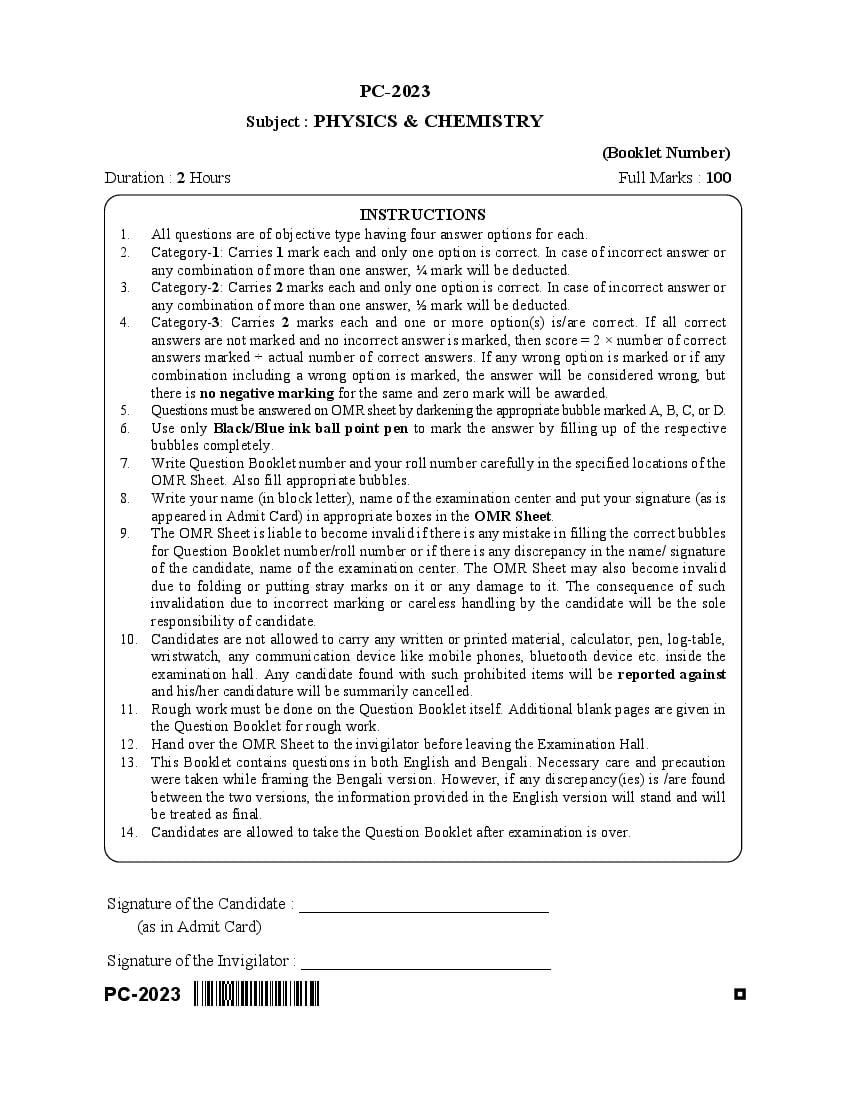
(Booklet Number)
Duration : 2 Hours Full Marks : 100
INSTRUCTIONS
1. All questions are of objective type having four answer options for each.
2. Category-1: Carries 1 mark each and only one option is correct. In case of incorrect answer or
any combination of more than one answer, ¼ mark will be deducted.
3. Category-2: Carries 2 marks each and only one option is correct. In case of incorrect answer or
any combination of more than one answer, ½ mark will be deducted.
4. Category-3: Carries 2 marks each and one or more option(s) is/are correct. If all correct
answers are not marked and no incorrect answer is marked, then score = 2 × number of correct
answers marked ÷ actual number of correct answers. If any wrong option is marked or if any
combination including a wrong option is marked, the answer will be considered wrong, but
there is no negative marking for the same and zero mark will be awarded.
5. Questions must be answered on OMR sheet by darkening the appropriate bubble marked A, B, C, or D.
6. Use only Black/Blue ink ball point pen to mark the answer by filling up of the respective
bubbles completely.
7. Write Question Booklet number and your roll number carefully in the specified locations of the
OMR Sheet. Also fill appropriate bubbles.
8. Write your name (in block letter), name of the examination center and put your signature (as is
appeared in Admit Card) in appropriate boxes in the OMR Sheet.
9. The OMR Sheet is liable to become invalid if there is any mistake in filling the correct bubbles
for Question Booklet number/roll number or if there is any discrepancy in the name/ signature
of the candidate, name of the examination center. The OMR Sheet may also become invalid
due to folding or putting stray marks on it or any damage to it. The consequence of such
invalidation due to incorrect marking or careless handling by the candidate will be the sole
responsibility of candidate.
10. Candidates are not allowed to carry any written or printed material, calculator, pen, log-table,
wristwatch, any communication device like mobile phones, bluetooth device etc. inside the
examination hall. Any candidate found with such prohibited items will be reported against
and his/her candidature will be summarily cancelled.
11.
Question work must be done on the Question Booklet itself. Additional blank pages are given in
Rough
Bookletthe Question Booklet for rough work. PC-2023
Series
12. Hand over the OMR Sheet to the invigilator before leaving the Examination Hall.
13. This Booklet containsSubject : PHYSICS
questions & and
in both English CHEMISTRY
Bengali. Necessary care and precaution
were taken while framing the Bengali version. However, if any discrepancy(ies) is /are found
between the two versions, the information provided in the English version will stand and will
be treated as final.
14. Candidates are allowed to take the Question Booklet after examination is over.
Signature of the Candidate : ______________________________
(as in Admit Card)
Signature of the Invigilator : ______________________________
A 1 P.T.O.
PC-2023 A
Page 2
A 2
Page 3
Category-1 (Q. 1 to 30)
(Carry 1 mark each. Only one option is correct. Negative marks : – ¼)
1. In a simple harmonic motion, let f be the acceleration and T be the time period. If x denotes
the displacement, then |f T| vs. x graph will look like,
HL¢V plm c¡mN¢al rœ f q'm aÆlZ J T q'm fkÑ¡uL¡m z k¢c x qu plZ ah |f T| he¡j x
mM¢Qœ¢V qh,
|f T|
|f T|
(A) (B)
x x
|f T| |f T|
(C) (D)
x x
2. The displacement of a plane progressive wave in a medium, travelling towards positive
x-axis with velocity 4 m/s at t = 0 is given by y = 3 sin 2 . Then the expression for
x
3
the displacement at a later time t = 4 sec will be
HL¢V j¡dÉj de¡aÈL x-Ar A¢ij¤M 4 m/s hN N¢an£m HL¢V pjam Qmal‰l t = 0 pju
plZl pj£LlZ y = 3 sin 2 x z a¡qm t = 4 pL™ pju plZl l¡¢n¢V qh,
3
x 16 x 16
(A) y = 3 sin 2 (B) y = 3 sin 2
3 3
x 1 x 1
(C) y = 3 sin 2 (D) y = 3 sin 2
3 3
A 3 P.T.O.
Page 4
arms of a U-tube of uniform cross-section when at rest. If
the U-tube moves with an acceleration ‘f’ towards right,
the difference between liquid heights between two arms
of the U-tube will be, (acceleration due to gravity = g)
¢Qœ fËc¢nÑa ¢ÙÛl AhÙÛ¡u pjfËÙÛµRck¤š² U-eml c¤¢V h¡ýa
HL¢V alm pj¡e EµQa¡u b¡L z k¢c U-em¢V ‘f’ aÆlZ
X¡e¢cL N¢an£m qu ah U-eml c¤C h¡ýl alml EµQa¡l
f¡bÑLÉ qh, (A¢iLoÑS aÆlZ = g)
f g
(A) a (B) a (C) a (D) 0
g f
4. Six molecules of an ideal gas have velocities 1, 3, 5, 5, 6 and 5 m/s respectively. At any
given temperature, if V and Vrms represent average and rms speed of the molecules, then
HL¢V BcnÑ NÉ¡pl Ru¢V AZ¤l hN kb¡œ²j 1, 3, 5, 5, 6 J 5 m/s z k¢c V J Vrms L¡e ¢e¢cÑø
a¡fj¡œ¡u AZ¤…¢ml NshN J rms hN h¡T¡u ah,
2
(A) V = 5 m/s (B) Vrms > V (C) Vrms V2 (D) Vrms = V
5.
As shown in the figure, a pump is designed as horizontal cylinder with a piston having area
A and an outlet orifice having an area ‘a’. The piston moves with a constant velocity under
the action of force F. If the density of the liquid is ρ, then the speed of the liquid emerging
from the orifice is, (assume A >> a)
¢Qœ fËc¢nÑa HL¢V f¡Çf Ae¤i¨¢jL Q¡Pl BL¡l N¢Wa k¡l ¢føel fËÙÛµRcl rœgm A J
¢eNÑje j¤Ml fËÙÛµRcl rœgm ‘a’ z HL¢V ¢ÙÛl hm F-Hl fËu¡N ¢føe¢V ¢ÙÛl hN ANËpl qu z
alml OeaÆ k¢c ρ qu ah f¡Çfl j¤M bL ¢eNÑa alml hN qh (dl e¡J A >> a),
F a F 2F A 2F
(A) (B) (C) (D)
ρA A ρA ρA a ρA
A 4
Page 5
temperature θ of the substances with time t is shown in the figure. Choose the correct
statement.
θ
(A) Specific heat of A is greater than that of B.
B
(B) Specific heat of B is greater than that of A.
(C) Both have same specific heat. A
(D) None of the above is true. t
0
HLC ill c¤¢V fc¡bÑ A J B L HLC q¡l Ešç Ll¡ qµR z pju (t)-Hl p¡b a¡fj¡œ¡ (θ)-Hl
f¢lhaÑe ¢Qœ cM¡e¡ quR z prœ p¢WL E¢š²¢V ¢ehÑ¡Qe Ll z
(A) B-Hl Qu A-Hl Bf¢rL a¡f h¢n z
(B) A-Hl Qu B-Hl Bf¢rL a¡f h¢n z
(C) c¤¢V fc¡bÑlC Bf¢rL a¡f pj¡e z
(D) Efll L¡e¡ E¢š²C p¢WL eu z
7. A given quantity of gas is taken from A to C in two ways; p
a) directly from A → C along a straight line and b) in two A
steps, from A → B and then from B → C. Work done and heat
absorbed along the direct path A→C is 200 J and 280 J
B C
respectively.
V
If the work done along A→B→C is 80 J, then heat absorbed
along this path is,
HL¢V ¢e¢cÑø f¢lj¡Z NÉ¡pL A bL C AhÙÛ¡e c¤C i¡h ¢eu k¡Ju¡ q'm, a) A → C plm lM¡
hl¡hl J b) A → B J B → C HC c¤C d¡f z A→C fb L«a L¡kÑÉ J n¡¢oa a¡f kb¡œ²j 200 J
J 280 J z A→B→C fb L«a L¡kÑÉ k¢c 80 J qu ah I fb n¡¢oa a¡f qh,
(A) 80 J (B) 0 (C) 160 J (D) 120 J
A 5 P.T.O.
Page 6
non-uniformly distributed along the rod with a linear charge
density 0 sin (0 is a positive constant). The electric field R
θ
at the centre P of the semicircle is, x
HL¢V pl¦ Ly¡Ql c™L R hÉ¡p¡dÑl AdÑhš
ª ¡L¡l hy¡L¡e¡ q'm z c™¢Va
Apj ¢hÙ¹«a Bd¡e k¤š² BR k¡l °l¢ML OeaÆ q'm 0 sin (0 HL¢V de¡aÈL dËh¤ L) z prœ
AdÑhªšl L¾cÊ P-a a¢sv rœl j¡e qh,
o o o o
(A) – ^j (B) ^j (C) ^i (D) – ^i
8oR 8oR 8oR 8oR
9. Consider a positively charged infinite cylinder with uniform volume charge
Q
density ρ > 0. An electric dipole consisting of + Q and ˗ Q charges attached to
opposite ends of a massless rod is oriented as shown in the figure. At the
˗Q
instant as shown in the figure, the dipole will experience,
(A) a force to the left and no torque.
(B) a force to the right and a clockwise torque.
(C) a force to the right and a counter clockwise torque.
(D) no force but only a clockwise torque.
je Ll de¡aÈL Bd¡ek¤š² HL¢V A¢a c£OÑ Q¡Pl Bua¢eL Bd¡e OeaÆ ρ > 0 z Bh¡l HL¢V ilq£e
c™l c¤C fË¡¿¹ + Q J ˗ Q Bd¡e k¤š² HL¢V a¢sv ¢àjl¦ ¢Qœ fËc¢nÑa A¢ij¤M l¡M¡ BR z ¢Qœ
fËc¢nÑa j¤q¨aÑ a¢sv ¢àjl¦¢Vl Efl ¢œ²u¡ Llh,
(A) h¡j A¢ij¤M HL¢V hm ¢L¿¹¥ L¡e¡ ï¡jL eu z
(B) X¡e A¢ij¤M HL¢V hm J O¢sl Ly¡V¡l A¢ij¤M HL¢V ï¡jL z
(C) X¡e A¢ij¤M HL¢V hm J O¢sl Ly¡V¡l ¢hfl£a A¢ij¤M HL¢V ï¡jL z
(D) L¡e hm eu, öd¤ O¢sl Ly¡V¡l A¢ij¤M HL¢V ï¡jL z
A 6
Page 7
12 μC 6 μC
having same cross-sectional area and placed face to face close
to each other as shown in the figure. The resulting charge
distribution in μC on surfaces A, B, C and D are respectively,
¢Qœ fËc¢nÑa HLC fËÙÛµRc k¤š² c¤¢V f¢lh¡q£ f¡aL kb¡œ²j
A
12 μC J 6 μC Bd¡e cJu¡ q'm Hhw M¤h L¡R¡L¡¢R j¤M¡j¤¢M l¡M¡ B C D
q'm z prœ A, B, C J D fªù h¢¸Va Bd¡el j¡e (μC HLL)
qh kb¡œ²j,
(A) 9, 3, – 3, 9 (B) 3, 9, – 9, 3 (C) 6, 6, – 6, 12 (D) 6, 6, 3, 3
A wire carrying a steady current I is kept in the x-y plane along the curve y A sin x .
2π
11.
λ
A magnetic field B exists in the z-direction. The magnitude of the magnetic force in the
portion of the wire between x = 0 and x = λ is
¢ÙÛl a¢svfËh¡q I k¤š² HL¢V pl¦ a¡lL x-y am y A sin 2π x hœ²lM¡ hl¡hl l¡M¡ q'm z I
λ
ÙÛ¡e z-Ar A¢ij¤M HL¢V Q±ðL rœ B ¢œ²u¡ Ll z a¡qm a¡l¢Vl x = 0 J x = λ -Hl jdÉha£Ñ
Awnl Efl k Q±ðL hm ¢œ²u¡ Ll a¡l j¡e q'm,
(A) 0 (B) 2IB (C) IB (D) IB/2
12. The figure represents two equipotential lines in x-y y(cm) 2 Volt
plane for an electric field. The x-component Ex of the 3
4 Volt
electric field in space between these equipotential lines 2
is,
1
x-y am HL¢V a¢sarœl jdÉ c¤¢V pj¢hih lM¡ ¢Qœ
0 x(cm)
cM¡e¡ quR z I c¤¢V lM¡l jdÉhaÑ£ ÙÛ¡e a¢svrœl 2 4 6 8
x-Ef¡wn Ex-Hl j¡e q'm,
(A) 100 V/m (B) –100 V/m (C) 200 V/m (D) –200 V/m
A 7 P.T.O.
Page 8
13. An electric dipole of dipole moment p is placed at the origin of the co-ordinate system
along the z-axis. The amount of work required to move a charge ‘q’ from the point (a, 0,
0) to the point (0, 0, a) is,
p ¢àjl¦ ï¡jLl HL¢V a¢sv-¢àjl¦ L¡VÑS£u ¢ecÑna¿»l j§m¢h¾c¤a l¡M¡ BR z ¢àjl¦¢Vl A¢ij¤M
z-Ar hl¡hl z a¡qm HL¢V ‘q’ Bd¡eL (a, 0, 0) ¢h¾c¤ bL (0, 0, a) ¢h¾c¤a ¢eu ka fËu¡Se£u
L«aL¡kÑÉ q'm,
pq pq pq
(A) (B) 0 (C) (D)
4 ε 0 a 4ε 0a 2 4ε 0a 2
14. The electric field of a plane electromagnetic wave of wave number k and angular frequency
ω is given by E = E0(^i + ^j) sin(kz – t). Which of the following gives the direction of the
associated magnetic field B ?
al‰ pwMÉ¡ k J ω ®L±¢ZL LÇf¡ˆl HL¢V pjam a¢sv ®Q±ðL£u al‰l a¢svrœ
E = E0(^i + ^j) sin(kz – t) z a¡qm ¢eQl L¡e¢V Be¤p¢‰L Q±ðLrœ B-Hl ¢cL ¢ecÑn Ll ?
(A) k^ (B) – ^i + ^j (C) – ^i – ^j (D) ^i – k^
15. A charged particle in a uniform magnetic field B = B0k^ starts moving from the origin with
velocity v = 3^i + 4k^ m/s. The trajectory of the particle and the time t at which it reaches
2 m above x-y plane are,
(A) Circular path, ½ sec. (B) Helical path, ½ sec.
(C) Circular path, 2/3 sec. (D) Helical path, 2/3 sec.
p¤¤oj a¢svrœ B = B0k^ -Hl jdÉ HL¢V B¢qa LZ¡ j§m¢h¾c¤ bL v = 3^i + 4k^ m/s hN Qma
öl¦ Ll z LZ¡¢Vl Njefb J k pju t-a LZ¡¢V x-y-aml 2 m EµQa¡u f±yRh a¡ q'm,
(A) hªš¡L¡l fb, ½ pL™ (B) L¥™m¡¢ua fb, ½ pL™
(C) hªš¡L¡l fb, 2/3 pL™ (D) L¥™m¡¢ua fb, 2/3 pL™
A 8
Page 9
resistance of the voltmeter is,
¢Qœ fËc¢nÑa haÑe£l fl£r¡u i¡ÒV¢jV¡l 8 V f¡W cu z a¡qm i¡ÒV¢jV¡ll l¡d La ?
(A) 20 Ω (B) 320 Ω (C) 160 Ω (D) 1.44 k Ω
17. An interference pattern is obtained with two coherent sources of intensity ratio n:1. The
I I
ratio Max Min will be maximum if
I Max I Min
fË¡hmÉl Ae¤f¡a n:1 ¢h¢nø c¤¢V p¤¤pwNa Evp à¡l¡ HL¢V hÉ¡¢aQ¡l f¢V N¢Wa q'm z prœ
I Max I Min
Ae¤f¡a¢V phÑ¡µQ qh kMe,
I Max I Min
(A) n = 1 (B) n=2 (C) n=3 (D) n = 4
18. A circular coil is placed near a current carrying conductor, both Up
lying on the plane of the paper. The current is flowing through the
conductor in such a way that the induced current in the loop is
clockwise as shown in the figure. The current in the wire is,
(A) time dependent and downward.
(B) steady and upward. I
(C) time dependent and upward.
(D) An alternating current. Down
HL¢V hªš¡L¡l L¥™m£L HL¢V a¢svh¡q£ f¢lh¡q£l L¡R l¡M¡ q'm; EiuC L¡NSl am Ah¢ÙÛa z
f¢lh¡q£l jdÉ ¢cu a¢sv Hje i¡h fËh¡¢qa qµR k L¥™m£a B¢hø a¢sv fËh¡ql A¢ij¤M O¢sl
Ly¡V¡l ¢cL (¢Qœ fËc¢nÑa) z prœ f¢lh¡q£l jdÉ a¢svfËh¡q
(A) pjul p¡b f¢lhaÑen£m J ¢ejj À ¤M£
(B) FdÑÄj¤M£ J ¢ÙÛlfËh¡q
(C) pjul p¡b f¢lhaÑen£m J FdÑÄj¤M£
(D) HL¢V f¢lhaÑ£ a¢svfËh¡q
A 9 P.T.O.
Page 10
length f are placed in a straight line separated
by a distance f from each other. An object is
located at f/2 in front of the leftmost lens. Object
Then,
(A) Final image will be at f/2 behind the rightmost lens and its magnification will be −1.
(B) Final image will be at f/2 behind the rightmost lens and its magnification will be +1.
(C) Final image will be at f behind the rightmost lens and its magnification will be −1.
(D) Final image will be at f behind the rightmost lens and its magnification will be +1.
f g¡L¡p °cOÑÉl ¢ae¢V A¢iæ Ešm m¾pL HL¢V plm lM¡u HL Afl bL f c§laÄ ÙÛ¡fe Ll¡
q'm z hy¡ ¢cLl fËbj m¾p¢Vl p¡je f/2 c§laÄ HL¢V hÙ¹¥ l¡M¡ q'm z prœ,
(A) A¢¿¹j fË¢a¢hð¢V X¡e¢cLl no m¾pl ¢fRe f/2 c§laÄ pª¢ø qh Hhw ¢hhdÑe qh −1
(B) A¢¿¹j fË¢a¢hð¢V X¡e¢cLl no m¾pl ¢fRe f/2 c§laÄ pª¢ø qh Hhw ¢hhdÑe qh +1
(C) A¢¿¹j fË¢a¢hð¢V X¡e¢cLl no m¾pl ¢fRe f c§laÄ pª¢ø qh Hhw ¢hhdÑe qh −1
(D) A¢¿¹j fË¢a¢hð¢V X¡e¢cLl no m¾pl ¢fRe f c§laÄ pª¢ø qh Hhw ¢hhdÑe qh +1
20. A ray of monochromatic light is incident on the plane
surface of separation between two media X and Y with sin r
angle of incidence ‘i’ in medium X and angle of refraction
‘r’ in medium Y. The given graph shows the relation
between sin i and sin r. If VX and VY are the velocities of
the ray in media X and Y respectively, then which of the
following is true ? 30O
1 0 sin i
(A) VX = VY
3
(B) VX = 3 VY
(C) Total internal reflection can happen when the light is incident in medium X.
(D) X 3 Y , where νX and νY are frequencies of the light in medium X and Y
respectively.
HL¢V HLhZÑ£ Bm¡l l¢nÈ X J Y c¤¢V j¡dÉjl pjam ¢hµRc aml Efl Bf¢aa q'm, kM¡e X
j¡dÉj Bfae L¡Z ‘i’ J Y j¡dÉj fË¢aplZ L¡Z ‘r’ z sin i J sin r-Hl jdÉ pÇfLÑ ¢Qœ cM¡e¡
quR z k¢c VX J VY kb¡œ²j X J Y j¡dÉj l¢nÈ¢Vl hN qu ah ¢eQl L¡e E¢š²¢V p¢WL ?
1
(A) VX = VY
3
(B) VX = 3 VY
(C) l¢nÈ¢V X j¡dÉj Bf¢aa q'm BiÉ¿¹l£Z f§ZÑ fË¢agme qa f¡l z
(D) X 3 Y , kM¡e νX J νY q'm kb¡œ²j X J Y j¡dÉj Bm¡Ll LÇf¡ˆ z
A 10
Page 11
then the total energy of n = ∞ state is,
q¡CXÊ¡Se flj¡Z¤l fËbj EŸ£¢fa Ù¹ll ¢ÙÛ¢an¢š² n§eÉ dlm n = ∞ Ù¹l j¡V n¢š² qh
(A) 3.4 eV (B) 6.8 eV (C) 0 (D) ∞
22.
In the given circuit, find the voltage drop VL in the load resistance RL.
fËcš haÑe£a m¡X RL-H ¢hih fËic VL-Hl j¡e La ?
(A) 5 V (B) 3V (C) 9V (D) 6 V
23.
Consider the logic circuit with inputs A, B, C and output Y. How many combinations of
A, B and C gives the output Y = 0 ?
Cef¤V A, B, C J BEVf¤V Y-Hl fËcš haÑe£¢V ¢hhQe¡ Ll z A, B J C-Hl La lLjl rœ
Y = 0 qh ?
(A) 8 (B) 5 (C) 7 (D) 1
24. X-rays of wavelength λ gets reflected from parallel
planes of atoms in a crystal with spacing d between θ
two planes as shown in the figure. If the two d
reflected beams interfere constructively, then the
condition for maxima will be, (n is the order of
interference fringe)
λ al‰°cOÉÑl X-l¢nÈ HL¢V Lm¡pl pj¡¿¹l¡m c¤¢V am (k¡cl jdÉ c§laÄ q'm d) bL fË¢ag¢ma
q'm z fË¢ag¢ma l¢nÈc¤¢Vl NWej§mL hÉ¢aQ¡ll naÑ qh, (n q'm hÉ¢aQ¡l f¢Vl œ²j)
(A) d tan = n (B) d sin = n (C) 2d cos = n (D) 2d sin = n
A 11 P.T.O.
Page 12
axis). If the angle of projection θ is varied keeping all other parameters same, then
magnitude of angular momentum (L) at its maximum height about the point of projection
varies with θ as,
m ill HL¢V hÙ¹¥LZ¡L u hN Ae¤i¨¢jL (x-Arl) p‰ θ L¡Z fËrf Ll¡ q'm z AeÉ pjÙ¹
¢LR¥ HLC lM k¢c öd¤ fËrfL¡Z θ f¢lhaÑe Ll¡ qu ah I hÙ¹¥LZ¡l phÑ¡µQ AhÙÛ¡e fËrf
¢h¾c¤l p¡fr L±¢ZL ilhNl (L) f¢lhaÑe ¢eQl L¡e mM¢Qœ¢V à¡l¡ ¢ecÑn Ll¡ k¡u ?
(A) (B)
(C) (D)
26. A body of mass 2 kg moves in a horizontal circular path of radius 5 m. At an instant, its
speed is 2√5 m/s and is increasing at the rate of 3 m/s2. The magnitude of force acting on
the body at that instant is,
2 kg ill HL¢V hÙ¹¥ 5 m hÉ¡p¡dÑl Ae¤i¨¢jL hªš¡L¡l fb O¤lR z L¡e¡ HL j¤q¨aÑ hÙ¹¥¢Vl ⤢a
2√5 m/s Hhw I ⤢a 3 m/s2 q¡l hª¢Ü f¡µR z I j¤q¨aÑ hÙ¹¥¢Vl Efl ¢œ²u¡la hml j¡e q'm,
(A) 6 N (B) 8N (C) 14 N (D) 10 N
27. In an experiment, the length of an object is measured to be 6.50 cm. This measured value
can be written as 0.0650 m. The number of significant figures on 0.0650 m is
HL¢V fl£r¡u HL¢V hÙ¹¥l °cOÑÉ jf f¡Ju¡ Nm 6.50 cm z f¢lj¡fl j¡e¢Vl HLL f¢lhaÑe Ll
mM¡ k¡u 0.0650 m z 0.0650 m-H a¡vfkÑf§ZÑ AˆpwMÉ¡ q'm
(A) 3 (B) 4 (C) 2 (D) 5
A 12
Page 13
I and radius R. The fractional loss of angular velocity of the fan as a result is,
m ill HL¢V Cyc¤l R hÉ¡p¡dÑ J I S¡XÉï¡jL ¢h¢nø HL¢V O¤ZÑ¡uj¡e ¢p¢mw gÉ¡el h¢qxfË¡¿¹ m¡g
¢cu EWm z a¡qm gÉ¡e¢Vl L±¢ZL hNl Bw¢nL qÊÊ¡p La qh ?
mR 2 I I mR 2 I mR 2
(A) (B) (C) (D)
I mR 2 I mR 2 I I mR 2
29. Acceleration due to gravity at a height H from the surface of a planet is the same as that at
a depth of H below the surface. If R be the radius of the planet, then H vs. R graph for
different planets will be,
HL¢V NËql fªù bL H EµQa¡u J HLC Ni£la¡u A¢iLoÑS aÄlZl j¡e pj¡e z NËq¢Vl hÉ¡p¡dÑ
k¢c R qu ah ¢h¢iæ NËql SeÉ H he¡j R mM¢Qœ¢V qh,
(A) (B)
(C) (D)
30. A uniform rope of length 4 m and mass 0.4 kg is held on a frictionless table in such a way
that 0.6 m of the rope is hanging over the edge. The work done to pull the hanging part of
the rope on to the table is, (Assume g = 10 m/s2)
0.4 kg ill J 4 m °cOÉÑl HL¢V c¢sL HL¢V OoÑZ ¢hq£e V¢hml Efl Hje i¡h l¡M¡ BR k
c¢s¢Vl 0.6 m Awn V¢hml h¡Cl T¥mR z c¢s¢VL V¢hml Efl Ve a¥ma La L¡kÑÉ Lla
qh ? (dl e¡J g = 10 m/s2)
(A) 0.36 J (B) 0.24 J (C) 0.12 J (D) 0.18 J
A 13 P.T.O.
Page 14
(Carry 2 marks each. Only one option is correct. Negative marks : – ½)
31. There are n elastic balls placed on a smooth horizontal plane. The masses of the balls are
m m m
m, , 2 ,.... n 1 respectively. If the first ball hits the second ball with velocity v0, then
2 2 2
the velocity of the nth ball will be,
HL¢V jpªZ Ae¤i¨¢jL aml Efl n pwMÉL ¢ÙÛ¢aÙÛ¡fL hm l¡M¡ q'm z hm…¢ml il kb¡œ²j
m m m
m, , 2 ,.... n 1 z fËbj hm¢V k¢c ¢àa£u hmL v0 hN A¡O¡a Ll a¡qm n-aj hml hN qh,
2 2 2
n n 1
4 4 4
(A) v0 (B) v0 (C) v0 (D) v0
3 3 3
32. An earth’s satellite near the surface of the earth takes about 90 min per revolution. A
satellite orbiting the moon also takes about 90 min per revolution. Then which of the
following is true ?
(A) ρm < ρe
(B) ρ m > ρe
(C) ρm = ρ e
(D) No conclusion can be made about the densities.
[where ρm is density of the moon and ρe is density of the earth.]
fª¢bh£ fªùl L¡R¡L¡¢R HL¢V EfNÊq 90 min-H HLh¡l fª¢bh£L fËc¢rZ Ll z Q¾cÊfªùl L¡R¡L¡¢R
HL¢V EfNÊqJ 90 min-H HLh¡l Q¾cÊL fËc¢rZ Ll z prœ ¢eQl L¡e¢V p¢WL ?
(A) ρm < ρe
(B) ρm > ρe
(C) ρm = ρe
(D) OeaÄ pÇfLÑ L¡e¡ Efpwq¡l Ll¡ pñh eu z
[kM¡e ρm q'm Q¾cÊl OeaÄ J ρe q'm fª¢bh£l OeaÄ z]
A 14
Page 15
horizontal ring of conducting wire as shown in figure. Which of the
following graph best represents the speed (v) vs. time (t) graph of the bar
magnet ?
¢Qœ fËc¢nÑa f¢lh¡q£ a¡ll HL¢V Ae¤i¨¢jL ¢lw-Hl L¾cÊ hl¡hl HL¢V
c™Q¥ðLL A¢iLoÑl fËi¡h Eõð i¡h ¢eQ gm¡ q'm z a¡qm ¢eQl L¡e¢V
phQu p¢WL i¡h c™Q¥ðL¢Vl hN (v) he¡j pju (t) mM¢Qœ¢V ¢ecÑn Ll ?
(A) (B)
(C) (D)
34. An amount of charge Q passes through a coil of resistance R. If the current in the coil
decreases to zero at a uniform rate during time T, then the amount of heat generated in the
coil will be,
R l¡dl HL¢V L¥äm£l jdÉ ¢cu Q Bd¡e Nje Ll z k¢c T pju L¥äm£a fËh¡q p¤¤oj q¡l Lj
n§eÉ qu a¡qm L¥äm£a Evfæ a¡fl f¢lj¡Z qh,
4Q2R 2QR Q 2T
(A) (B) (C) (D) Q2RT
3T 3T 4R
GM A
35. A modified gravitational potential is given by V 2 . If the constant A is
r r
expressed in terms of gravitational constant (G), mass (M) and velocity of light (c), then
from dimensional analysis, A is,
GM A
je Ll HL¢V f¢lh¢aÑa jq¡LoÑ£u ¢hihl j¡e cJu¡ BR V 2 z dˤhL A-L k¢c
r r
jq¡LoÑ£u dˤhL (G) il (M) J A¡m¡Ll hN (c)-Hl p¡q¡kÉ ¢eZÑu Ll¡ k¡u a¡qm A q'm
G 2M 2 GM
(A) (B)
c 2
c2
1
(C) (D) Dimensionless (j¡œ¡¢hq£e)
c2
A 15 P.T.O.
Page 16
(Carry 2 marks each. One or more options are correct. No negative marks)
36. p T 2
3
3
1 2 1
v S
A cyclic process is shown in p-v diagram and T-S diagram. Which of the following
statement(s) is/are true ?
(A) 1→2: Isobaric, 2→3: Isothermal.
(B) 3→1: Isochoric, 2→3: adiabatic.
(C) Work done by the system in the complete cyclic process is non-zero.
(D) The heat absorbed by the system in the complete cyclic process is non-zero.
HL¢V Qœ²£u fË¢œ²u¡L p-v mM¢Qœ J T-S mM¢Qœl p¡q¡kÉ cM¡e¡ quR z ¢eQl L¡e
E¢š²(…¢m) p¢WL ?
(A) 1→2: pjQ¡f£, 2→3: pj¡o·
(B) 3→1: pj¡uae£, 2→3: l©Üa¡f
(C) pÇf¨ZÑ Qœ²£u fË¢œ²u¡¢Va L«a L¡kÑÉ n§eÉ eu z
(D) pÇf¨ZÑ Qœ²£u fË¢œ²u¡a a¿»¢V à¡l¡ n¡¢oa a¡f n§eÉ eu z
37. The figure shows two identical parallel plate capacitors A and B K
of capacitances C connected to a battery. The key K is initially
closed. The switch is now opened and the free spaces between C C
V
the plates of the capacitors are filled with a dielectric constant 3. A B
Then which of the following statement(s) is/are true ?
(A) When the switch is closed, total energy stored in the two capacitors is CV 2.
(B) When the switch is opened, no charge is stored in the capacitor B.
3
(C) When the switch is opened, energy stored in capacitor B is CV2.
2
5
(D) When the switch is opened, total energy stored in two capacitors is CV2.
3
¢Qœ fËc¢nÑa C d¡lLaÄ ¢h¢nø A J B c¤¢V pj¡¿¹l¡m f¡a d¡lLL HL¢V hÉ¡V¡l£l c¤C fË¡¿¹ k¤š² Ll¡
quR z K Q¡¢h¢V fËbj hå Ll¡ BR z Hh¡l Q¡¢h¢V M¤m ¢cu d¡lL c¤¢Vl f¡a c¤¢Vl jdÉ 3
fl¡°hc¤É¢aL ¢ÙÛl¡ˆ ¢h¢nø j¡dÉj ¢cu f§ZÑ Ll¡ q'm z a¡qm ¢eQl L¡eÚ E¢š²(…¢m) p¢WL ?
(A) Q¡¢h¢V hå b¡L¡l pju d¡lLc¤¢Va p¢’a j¡V n¢š² q'm CV2
(B) Q¡¢h¢V kMe M¡m¡ qu aMe B d¡lL L¡e¡ Bd¡e p¢’a b¡L e¡ z
3
(C) Q¡¢h¢V kMe M¡m¡ qu aMe B d¡lL p¢’a n¢š² q'm CV2
2
5
(D) Q¡¢h¢V kMe M¡m¡ qu aMe d¡lL c¤¢Va p¢’a j¡V n¢š² q'm CV2
3
A 16
Page 17
vertical cylindrical region of radius R where magnetic field varies as B = (4t2 – 2t + 6)k^ ,
where t is time. Then which of the following statement(s) is/are true ?
(A) Induced electric field lines form closed loops.
(B) Electric field varies linearly with r if r < R, where r is the radial distance from the
centerline of the cylinder.
(C) The charged particle will move in clockwise direction when viewed from top.
7q
(D) Acceleration of the charged particle is when t = 2 sec.
2m
R hÉ¡p¡dÑ ¢h¢nø HL¢V Eõð Q¡P¡L«¢a ÙÛ¡e Q±ðL rœ B = (4t2 – 2t + 6)k^ Ae¤k¡u£ f¢lh¢aÑa qu,
kM¡e t q'm pju z pM¡e q Bd¡e J m il ¢h¢nø HL¢V hÙ¹¥LZ¡L Q¡Pl ArlM¡ bL 2R
c§laÄ l¡M¡ q'm z a¡qm ¢eQl L¡e E¢š²(…¢m) p¢WL ?
(A) B¢hø a¢svhmlM¡…¢m hÜ m¤fl BL¡l qu z
(B) a¢svrœl j¡e r-Hl p‰ plm°l¢ML pÇfLÑ f¢lh¢aÑa qu k¢c r < R qu, kM¡e r q'm
Q¡Pl ArlM¡ bL hÉ¡p hl¡hl c§laÄ z
(C) Efl bL cMm LZ¡¢V O¢sl Ly¡V¡l ¢cL O¤lh z
7q
(D) t = 2 sec pju LZ¡¢Vl aÄlZ q'm z
2m
A 17 P.T.O.
Page 18
with velocity v enters the region in a direction perpendicular to the magnetic field.
Considering Bohr angular momentum quantization, which of the following statement(s)
is/are true ?
(A) The radius of nth orbit rn n .
qB
(B) The minimum velocity of the electron is .
m
(C) Energy of the nth level En n.
(D) Transition frequency ω between two successive levels is independent of n.
L¡e¡ ÙÛ¡e HL¢V p¤¤oj Q±ðL rœ B luR z I ÙÛ¡e HL¢V m il J q Bd¡epÇfæ CmƒÊe Q±ðL
rœl Eõð ¢cL hl¡hl v hN fËhn Llm z h¡ll L±¢ZL ilhNl L¡u¡¾V¡CSne naÑ Ae¤k¡u£
¢eQl L¡eÚ E¢š²(…¢m) p¢WL ?
(A) n-aj Lrl hÉ¡p¡dÑ rn n .
qB
(B) CmƒÊel eɨeaj hN
m
(C) n-aj Lrl n¢š² En n.
(D) flØfl c¤¢V d¡fl jdÉ ÙÛ¡e¡¿¹l LÇf¡ˆ ω, n-Hl Efl ¢eiÑln£m eu z
40. A train is moving along the tracks at a constant speed u. A girl on the train throws a ball
of mass m straight ahead along the direction of motion of the train with speed v with respect
to herself. Then
(A) Kinetic energy of the ball as measured by the girl on the train is mv 2/2.
(B) Work done by the girl in throwing the ball is mv 2/2.
(C) Work done by the train is mvu.
(D) The gain in kinetic energy of the ball as measured by a person standing by the rail
track is mv2/2.
HL¢V VÊe u ¢ÙÛl hN QmR z VÊel k¡œ£ HL¢V h¡¢mL¡ m ill HL¢V hmL VÊel N¢al A¢ij¤M
pl¡p¢l p¡jel ¢cL v hN Ry¥s ¢cm z a¡qm
(A) VÊel k¡œ£ h¡¢mL¡l p¡fr hm¢Vl N¢an¢š² qh mv2/2 z
(B) hm¢V Ry¡s¡l SeÉ h¡¢mL¡ à¡l¡ L«a L¡kÑÉ q'm mv2/2 z
(C) VÊe¢V à¡l¡ L«a L¡kÑÉ q'm mvu z
(D) lmm¡Cel d¡l cy¡s¡e¡ L¡e¡ hÉ¢š²l p¡fr hm¢Vl N¢an¢š² q'm mv2/2 z
A 18
Page 19
Category-1 (Q 41 to 70)
(Carry 1 mark each. Only one option is correct. Negative marks : – ¼)
41. The correct order of boiling points of N-ethylethanamine (I), ethoxyethane (II) and
butan-2-ol (III) is
N-Cb¡CmCb¡eÉ¡¢je (I), Cb¢„Cbe (II) Hhw ¢hEV¡e-2-Am (III)-Hl Øg¥Ve¡ˆl p¢WL œ²j qm
(A) III < II < I (B) II < III < I
(C) II < I < III (D) III < I < II
42. H2, Lindlar Catalyst Ozonolysis
M N O+P
(CH3CO)2O
Ammoniacal AgNO3 CH3COONa
White precipitate
Cinnamic acid
Structure of M is,
M-Hl NWe q'm
(A) Ph – C CH (B) Ph – C C – CH3
(C) H3C – C CH (D) H3C – C C – CH3
OH OH OH OH
43.
CH3 NMe2 CH2
CH = CH
CH NO2
2
(I) (II) (III) (IV)
The correct order of acidity of above compounds is
Ef¢l¢õ¢Ma k±N…¢ml B¢ÇmLa¡l p¢WL œ²j qm
(A) II > IV > I > III (B) III > IV > II > I
(C) IV > II > III > I (D) IV > III > I > II
A 19 P.T.O.
Page 20
Br2/AcOH Br2/NaOH
X Y+Z
CH3 CH3
The correct option for the above reaction is
Efl¡š² ¢h¢œ²u¡u p¢WL ¢hLÒf¢V q'm
O
(A) Y= CHBr3 Z= CH3CO2Na
X=
CH3 CH2Br
O
O
(B) Y= CHBr3 Z= CH3CO2Na
X=
CH3 CBr3
O
(C) Y= CHBr3 Z= CH2CO2Na
X=
CH3 CH2Br
Br
O
(D) Y= CHBr3 Z= CH2CO2Na
X=
CH2 CH2
Br
BrBr Br
45. H3CH2C
aqueous H3C SO2Cl
NaOH NaI
H Cl C4H10O C11H16SO3 C 4 H9 I
pyridine acetone
H3 C F
E
If all the nucleophilic substitution reactions at saturated carbon atoms in the above
sequence of reactions follow SN2 mechanism, then E and F will be respectively,
k¢c Efl h¢ZÑa ¢h¢œ²u¡œ²j pÇf«š² L¡hÑe flj¡Z¤a O¢Va phL'¢V ¢eJ¢LÓJ¢g¢mL fË¢aÙÛ¡fe ¢h¢œ²u¡
SN2 ¢œ²u¡L±nm Ae¤plZ Ll, ah E Hhw F qh kb¡œ²j
H3CH2C H3CH2C CH2CH3 H3C
OH and I HO H and I
H H H
H3 C CH3 H3CH2C
H3 C
(A) (B) H3CH2C
CH2CH3 CH2CH3 CH2CH3
and I
HO H and I H HO H H
H3C
CH3 CH3 CH3
(C) (D)
A 20
Page 21
uniform velocity, but the velocity of m2 is 1.5 times that of m1 . The ratio of de Broglie
wavelengths m 1 : m 2 is given by
c¤C¢V hphm (il m1 = 100 NË¡j, Hhw m2 = 50 NË¡j) Ry¡s¡ qm z fËaÉL¢VC ¢ÙÛl hN N¢an£m z
¢L¿¹¥ m2 -Hl N¢ahN m1 -Hl bL 1.5 …Z h¢n z hphm c¤C¢Vl p‰ k¤š² ¢X hËN¢m al‰°cOÑÉ-Hl
Ae¤f¡a m1 : m 2 qm
(A) 4 : 3 (B) 3:4 (C) 2:1 (D) 1 : 2
47. What is the edge length of the unit cell of a body centred cubic crystal of an element whose
atomic radius is 75 pm ?
HL¢V cqL¢¾cÊL OeL¡L¡l Lm¡pl HL¢V j±ml flj¡Z¤l hÉ¡p¡dÑ 75 pm z I Lm¡pl HLL
L¡ol fË¡¢¿¹L£l °cOÑÉ La ?
(A) 170 pm (B) 175 pm (C) 178 pm (D) 173.2 pm
48. The root mean square (rms) speed of X2 gas is x m/s at a given temperature. When the
temperature is doubled, the X2 molecules dissociated completely into atoms. The root
mean square speed of the sample of gas then becomes (in m/s)
HL¢V ¢e¢cÑø Eo·a¡u X2 -Hl Ns hNÑ⤢al hNÑj§m qm x m/s z Eo·a¡ ¢à…Z Llm X2 -Hl AZ¤…¢m
flj¡Z¤a ¢hu¡¢Sa qu z HC AhÙÛ¡u HC NÉ¡pl Ns hNÑ⤢al hNÑj§m (m/s HLL) qh
(A) x/2 (B) x (C) 2x (D) 4x
49. Arrange the following in order of increasing mass
I. 1 mole of N2 II. 0.5 mole of O3
III. 3.011 1023 molecules of O2 IV. 0.5 gram atom of O2
ill EÜÑœ²j¡e¤p¡l p¡S¡J
I. 1 j¡m N2 II. 0.5 j¡m O3
III. O2 -Hl 3.011×10²³ pwMÉL AZ¤ IV. 0.5 NË¡j flj¡Z¤ O2
(A) IV < III < II < I (B) IV < I < III < II
(C) III < II < IV < I (D) I < III < II < IV
A 21 P.T.O.
Page 22
¢eQl L¡e fÔV¢V (lM¡¢Qœ¢V) plm°l¢ML qh ?
(A) k vs T (B) k vs 1/T (C) ln k vs T (D) ln k vs 1/T
(k is the rate constant of an elementary reaction and T is temp. in absolute scale)
(k HL d¡f ¢h¢œ²u¡l N¢adËh¤ L, T flj a¡fj¡œ¡)
51. The equivalent conductance of NaCl, HCl and CH3COONa at infinite dilution are 126.45,
426.16 and 91 ohm–1cm2eq–1 respectively at 25C. The equivalent conductance of acetic
acid (at infinite dilution) would be
(A) 461.61 ohm–1 cm2 eq–1 (B) 390.71 ohm–1 cm2 eq–1
(C) cannot be determined from the given data. (D) 208.71 ohm–1 cm2 eq–1
Ap£j mO¤a¡u NaCl, HCl Hhw CH3COONa -Hl a¥mÉ¡wL f¢lh¡¢qa¡ kb¡œ²j 126.45, 426.16
Hhw 91 ohm–1cm2eq–1 (25℃ -H) z HLC AhÙÛ¡u AÉ¡p¢VL AÉ¡¢pXl a¥mÉ¡wL f¢lh¡¢qa¡
(A) 461.61 ohm–1 cm2 eq–1 (B) 390.71 ohm–1 cm2 eq–1
(C) k¡ abÉ cJu¡ quR a¡ bL hl Ll¡ k¡h e¡ z(D) 208.71 ohm–1 cm2 eq–1
52. For the reaction A + B → C, we have the following data :
Initial concentration of A Initial concentration of B Rate (initial)
(in molarity) (in molarity) (Relevant unit)
1 10 100
1 1 1
10 1 10
The order of the reaction with respect to A and B are
(A) Not possible to tell with the given data.
(B) First order with respect to both A and B.
(C) First order with respect to A and second order with respect to B.
(D) Second order with respect to A and first order with respect to B.
A J B Hl jdÉ A + B → C ¢h¢œ²u¡¢Vl N¢ahN pÇfLÑ ¢eQl abÉ…¢m S¡e¡ BR z
A -Hl fË¡l¢ñL N¡taÄ B -Hl fË¡l¢ñL N¡taÄ ¢h¢œ²u¡l fË¡l¢ñL N¢ahN
(j¡m¡¢l¢Va) (j¡m¡¢l¢Va) (Efk¤š² HLL)
1 10 100
1 1 1
10 1 10
prœ A J B -Hl p¡fr ¢h¢œ²u¡¢Vl œ²j
(A) hm¡l ja kbø abÉ cJu¡ eC z
(B) A J B c¤Cul p¡frC œ²j HL z
(C) A-Hl p¡fr HL Hhw B-Hl p¡fr c¤C z
(D) A-Hl p¡fr c¤C Hhw B-Hl p¡fr HL z
A 22
Page 23
2Cr(OH)3 + 4OH – + KIO3 2CrO42– + 5H2O + KI
fËcš ¢h¢œ²u¡u 2Cr(OH)3 + 4OH – + KIO3 2CrO42– + 5H2O + KI,
KIO3-Hl a¥mÉ¡ˆ il (M = Be¢hL il)
(A) M (B) M/2 (C) M/6 (D) M/8
54. At STP, the dissociation reaction of water is H2O H+ (aq.) + OH– (aq.) , and the pH
of water is 7.0. The change of standard free energy (∆G°) for the above dissociation process
is given by
STP naÑ, Sml ¢hu¡Se ¢h¢œ²u¡¢V qm H2O H+ (aq.) + OH– (aq.), Hhw Sml pH qm
7.0 z Ef¢lš² ¢hu¡Se ¢h¢œ²u¡u BcnÑ j¤š²n¢š²l f¢lhaÑe (∆G°) qm
(A) 20301 cal/mol (B) 19091cal/mol (C) 20096 cal/mol (D) 21301 cal/mol
55. Na2CO3 is prepared by Solvay process but K2CO3 cannot be prepared by the same because
(A) K2CO3 is highly soluble in H2O (B) KHCO3 is sparingly soluble
(C) KHCO3is appreciably soluble (D) KHCO3 decomposes
Na 2 CO3 fËÙ¹¥¢aa pmÚi fÜ¢a hýmhÉhq©a qmJ K 2 CO3 fËÙ¹¥¢aa hÉhq¡l Ll¡ k¡u e¡ L¡lZ
(A) K2CO3 Sm A¢a j¡œ¡u â¡hÉ (B) KHCO3üÒfâ¡hÉ
(C) KHCO3 kbø j¡œ¡u â¡hÉ (D) KHCO3 ¢hu¡¢Sa qu k¡u
56. If in case of a radio isotope the value of half-life (T1/2) and decay constant (λ) are identical
in magnitude, then their value should be
k¢c HL¢V aS¢ûu BCp¡V¡fl AdÑ¡u¤×L¡m (T1/2) Hhw ru¡ˆ (λ)-Hl j¡e f¢lj¡ZNai¡h pj¡e
qu, a¡qm pC j¡e¢V qJu¡ E¢Qv
(A) 0.693/2 (B) (0.693)1/2 (C) (0.693)2 (D) 0.693
57. Suppose a gaseous mixture of He, Ne, Ar and Kr is treated with photons of the frequency
appropriate to ionize Ar. What ion(s) will be present in the mixture ?
HL¢V h¡uh£u ¢jnËZl jdÉ He, Ne, Ar Hhw Kr haÑj¡e z HC ¢jnËZl jdÉ Ar-L Bu¢ea Lla
f¡l HlLj LÇf¡ˆl g¡Ve f¡W¡e¡ qm z HMe ¢jnËZl jdÉ k Bue…¢m b¡Lh a¡l¡ qm
(A) Ar+ (B) Ar+ + Kr+
(C) Ar+ + He+ + Ne+ (D) He+ + Ar+ + Kr+
58. A solution containing 4g of polymer in 4.0 litre solution at 27C shows an osmotic pressure
of 3.0×10 – 4 atm. The molar mass of the polymer in g/mol is
27℃ Eo·a¡u 4.0 L âhZ HL¢V f¢mj¡ll 4.0 g âh£i¨a b¡Lm 3.0×10 – 4 atm A¢ipËhe Q¡fl
pª¢ø qu z f¢mj¡l¢Vl Be¢hL il (NË¡j/j¡m HLL) qh
(A) 820000 (B) 82000 (C) 8200 (D) 820
A 23 P.T.O.
Page 24
(A) the same with 2, 0 and 1 lone pairs of electrons on the central atoms, respectively.
(B) the same with 1, 1 and 1 lone pairs of electrons on the central atoms, respectively.
(C) different with 0, 1 and 2 lone pairs of electrons on the central atoms, respectively.
(D) different with 1, 0 and 2 lone pairs of electrons on the central atoms, respectively.
SF4, CF4 Hhw XeF4 Hl Be¢hL BL«¢a qm
(A) HLC Hhw L¾cÊ£u flj¡Z¤l ¢exp‰ CmLVÊe S¡s kb¡œ²j 2, 0 Hhw 1 z
(B) HLC Hhw L¾cÊ£u flj¡Z¤l ¢exp‰ CmLVÊe S¡s kb¡œ²j 1, 1 Hhw 1 z
(C) Bm¡c¡ Hhw L¾cÊ£u flj¡Z¤l ¢exp‰ CmLVÊe S¡s kb¡œ²j 0, 1 Hhw 2 z
(D) Bm¡c¡ Hhw L¾cÊ£u flj¡Z¤l ¢exp‰ CmLVÊe S¡s kb¡œ²j 1, 0 Hhw 2 z
60. The species in which nitrogen atom is in a state of sp hybridisation is
e£Ql L¡eÚ k±N e¡CVÊ¡Se flj¡Z¤¢V sp pwLl¡¢ua (hybridised)
(A) NO3– (B) NO2 (C) NO2+ (D) NO2–
3
The correct statement about the magnetic properties of Fe CN 6 and FeF6
3
61. is
(A) Both are paramagnetic
(B) Both are diamagnetic
3
Fe CN 6 is diamagnetic, FeF6 is paramagnetic
3
(C)
3
Fe CN 6 is paramagnetic, FeF6
3
(D) is diamagnetic
3
Fe CN 6 Hhw FeF6 3 Hl Q±ðL djÑ pÇf¢LÑa p¢WL hš²hÉ¢V qm
(A) c¤¢V k±NC EfQ¥ðL£u
(B) c¤¢V k±NC AfQ¥ðL£u
3
Fe CN 6 AfQ¥ðL£u, FeF6
3
(C) EfQ¥ðL£u
3
(D) Fe CN 6 EfQ¥ðL£u, FeF6 3 AfQ¥ðL£u
A 24
Page 25
The calculated spin-only magnetic moment values in BM for FeCl 4 and Fe CN 6
62.
are
3
FeCl 4 Hhw Fe CN 6 Hl NZe¡L«a ¢Øfe Q¥ðL£u ï¡jL (spin magnetic moment) (BM)
qm
(A) 5.9 BM, 1.732 BM (B) 4.89 BM, 1.732 BM
(C) 3.87 BM, 1.732 BM (D) 1.732 BM, 2.82 BM
63. BrF3 self ionises as following
BrF3 ¢ejÀ¡š²i¡h üaxBu¢ea qu
(A) 2BrF3 BrF+ + BrF5– (B) 2BrF3 BrF2+ + BrF4–
(C) 2BrF3 BrF4+ + BrF2– (D) 2BrF3 BrF3+ + BrF3–
64. 4f2 electronic configuration is found in
L¡eÚ¢Vl rœ 4f2 CmLVÊe ¢heÉ¡p cM¡ k¡u ?
(A) Pr (B) Pr3+ (C) Nd3+ (D) Pm3+
65. Which of the following statements is incorrect ?
VF6
3
(A)A is paramagnetic with 2 unpaired electrons.
(B)B CuCl4
2
is paramagnetic with 1 unpaired electron.
3
(C)C Co NH 3 6 is diamagnetic
(D)D CoF6
3
is paramagnetic with 2 unpaired electrons.
¢ej¢À m¢Ma L¡e ¢hhª¢a¢V p¢WL eu ?
VF6 EfQ¥ðL£u, 2¢V S¡sq£e CmLVÊe pja
3
(A)A
(B)B CuCl4 EfQ¥ðL£u, 1¢V S¡sq£e CmLVÊe pja
2
3
(C)C Co NH 3 6 AfQ¥ðL£u
(D)D CoF6
3
EfQ¥ðL£u, 2¢V S¡sq£e CmLVÊe pja
A 25 P.T.O.
Page 26
66.
O O O
I II III
The correct order of C O bond length in ethyl propanoate (I), ethyl propenoate (II) and
ethenyl propanoate (III) is
Cb¡Cm fË¡f¡e¡uV (I), Cb¡Cm fË¡¢fe¡uV (II) Hhw C¢be¡Cm fË¡f¡e¡uV (III) -H C O håe
°cOÑÉl p¢WL œ²j qm
(A) I > II > III (B) III > II > I (C) I > III > II (D) II > I > III
67. Select the molecule in which all the atoms may lie on a single plane is
(A) 4-Nitrobenzaldehyde (B) 4-Methoxybenzaldehyde
(C) 4-Methylnitrobenzene (D) 4-Nitroacetophenone
¢ej¡À š² k AZ¤a pLm flj¡Z¤…¢m HL¢V j¡œ am AhÙÛ¡e Ll p¢V qm
(A) 4-e¡CVÊ¡h”É¡m¢Xq¡CX (B) 4-¢jb¢„h”É¡m¢Xq¡CX
(C) 4-¢jb¡Cme¡CVÊ¡h¢”e (D) 4-e¡CVÊ¡AÉ¡¢pV¡ge¡e
68. The IUPAC name of CH 3CH= C– CH2–CH3 is :
|
CHO
(A) 3-Formyl-2-pentene (B) 2-Ethylbut-2-enal
(C) 3-Ethylbut-3-enal (D) 2-Ethylcrotonaldehyde
CH3CH= C– CH2–CH3 k±N¢Vl e¡j q'm:
|
CHO
(A) 3-glj¡Cm-2-f¢¾Ve (B) 2-Cb¡Cm¢hEV-2-CeÉ¡m
(C) 3-Cb¡Cm¢hEV-3-CeÉ¡m (D) 2-Cb¡Cmœ²¡V¡eÉ¡m¢Xq¡CX
A 26
Page 27
¢ejÀ¢m¢Ma L¡hÑ¡LÉ¡V¡ue…¢ml ÙÛ¡u£aÄl p¢WL œ²j qm
H2C – CH = CH – CH3 CH2 – CH = CH – BMe2
I II
H2C – CH = CH – NMe2 H2C – CH = CH – OMe
III IV
(A) II > I > III > IV (B) III > I > II > IV
(C) III > IV > I > II (D) IV > III > II > I
HO
70. H
H OH
1
and
And
CO2H HO2C
CH3 C2H5
2 Br C2H5 and
And Br H
H CH3
3
And
The relationship between the pair of compounds shown above are respectively,
(A) enantiomer, diastereomer, diastereomer
(B) enantiomer, enantiomer, diastereomer
(C) enantiomer, homomer (identical), diastereomer
(D) homomer (identical), diastereomer, geometrical isomer
Efl¡š² k±NS¡s…¢ml jdÉ pÇfLÑ qm kb¡œ²j
(A) He¡e¢nJj¡l (fË¢a¢hð pj¡huh), X¡u¡¢ØV¢lJj¡l, X¡u¡¢ØV¢lJj¡l
(B) He¡e¢nJj¡l (fË¢a¢hð pj¡huh), He¡e¢nJj¡l (fË¢a¢hð pj¡huh), X¡u¡¢ØV¢lJj¡l
(C) He¡e¢nJj¡l (fË¢a¢hð pj¡huh), q¡j¡j¡l, X¡u¡¢ØV¢lJj¡l
(D) q¡j¡j¡l, X¡u¡¢ØV¢lJj¡l, SÉ¡¢j¢aL pj¡huh
A 27 P.T.O.
Page 28
(Carry 2 marks each. Only one option is correct. Negative marks : – ½)
71.
(i) OH/H2O,
C6H12O2 H + I
(ii) H3O+
G
CrO3/H+
‘G’ in the above sequence of reactions is
Efl¡š² ¢h¢œ²u¡œ²j ‘G’ q'm
(A) (CH3)2CHCOOCH2CH3 (B) CH3CH2CH2COOCH2CH3
(C) CH3CH2COOCH2CH2CH3 (D) CH3CH2COOCH(CH3)2
72. Case – 1: An ideal gas of molecular weight M at temperature T.
Case – 2: Another ideal gas of molecular weight 2M at temperature T/2.
Identify the correct statement in context of above two cases.
(A) Average kinetic energy and average speed will be the same in the two cases.
(B) Both the averages are halved.
(C) Both the averages are doubled.
(D) Only average speed is halved in the second case.
fËbj rœ : M Be¢hL ill HL¢V BcnÑ NÉ¡p T Eo·a¡u z
¢àa£u rœ : 2M Be¢hL ill HL¢V BcnÑ NÉ¡p T/2 Eo·a¡u z
Hl©f f¢l¢ÙÛ¢aa p¢WL hš²hÉ¢V ¢el©fZ Ll:
(A) Ns N¢an¢š² J Ns ⤢a Eiurœ HLC b¡Lh z
(B) Eiu l¡¢nl f¢lj¡f AdÑL qh z
(C) Eiu l¡¢nl f¢lj¡f ¢à…Z qh z
(D) Lhm Ns ⤢al f¢lj¡e ¢àa£u rœ AdÑL qh z
73. 63 g of a compound (Mol. Wt. = 126) was dissolved in 500 g distilled water. The density
of the resultant solution as 1.126 g/ml. The molarity of the solution is
HL¢V k±Nl (Be¢hL il =126) 63 NË¡j ¢eu 500 NË¡j f¡¢aa Sm âh£i¨a Ll¡ qm
âhZl OeaÄ qm 1.126 NË¡j/¢j¢m z I âhZl j¡m¡¢l¢V qm
(A) 1.25 M (B) 1.0 M (C) 0.75 M (D) 1.1 M
A 28
Page 29
complex NiX 4 . The hybridisation involved and number of unpaired electrons present
2
in the complex are respectively
(A) sp3, two (B) dsp2, zero (C) dsp2, one (D) sp3, one
¢eLm HL¢V HLL GZ¡aÈL Bd¡ek¤š² HLk¡S£ ¢mNÉ¡äl ( X ) p‰ k¤š² qu HL¢V EfQ¥ðL£u
k±N NiX 4 2 NWe Ll z k±N¢Va ¢eLml pwLl¡uZ (hybridisation) Hhw Ak¤NÈ CmLVÊel
pwMÉ¡ qm
(A) sp3, c¤¢V (B) dsp2, HL¢VJ eu (C) dsp2, HL¢V (D) sp3, HL¢V
(i) PhMgBr CrO3/H Ph3 P = CH2
75. L M N Ph2 C = CH2
═ (ii) H3O ═ ═
‘L’ in the above sequence of reaction is/are (where L ≠ M ≠ N)
(A) Benzaldehyde (B) Methyl benzoate
(C) Benzoyl chloride (D) Benzonitrile
Efl¡š² ¢h¢œ²u¡œ²j ‘L’ q'm (HM¡e L ≠ M ≠ N)
(A) h”É¡m¢Xq¡CX (B) ¢jb¡Cm h”¡uV
(C) h”¡¢um LÓ¡l¡CX (D) h”¡e¡CVÊ¡Cm
Category-3 (Q 76 to 80)
(Carry 2 marks each. One or more options are correct. No negative marks)
76. The correct set(s) of reactions to synthesize benzoic acid starting from benzene is/are
A i Br2 / Fe ii Mg / dry ether iii CO2 iv (iv)
H3OH3O
B i Br2 / Fe ii NH3 , 25o C iii NaNO2 , dil. HCl, 0o to 5o C
(iv) CuCN / KCN (v) dil.HCl,
C i CH3Cl, Anhydrous AlCl3 ii KMnO
(ii) KMn O4 4 O H, (iii) H 3 O
H 3 O H3O
(D) (i) CH 3COCl, Anhydrous AlCl3 (ii) Br2 , NaOH (iii) (iii)
h¢”e bL öl¦ Ll h”¢uL AÉ¡¢pX pwnÔoZl SeÉ p¢WL ¢h¢œ²u¡ œ²j¢V/œ²j…¢m q'm
ö×L Cb¡l (iv) H3O
mO¤
mO¤ HCl,
Ae¡âÑ AlCl3 (ii) KMnO4
Ae¡âÑ AlCl3 (iii) H3O
A 29 P.T.O.
Page 30
(A) A gas cannot be liquified.
(B) Surface tension of a liquid is very high.
(C) A liq. phase cannot be distinguished from a gas phase.
(D) Density changes continuously with P or V.
pwLV a¡fj¡œ¡l Jfl L¡eÚ ¢hhª¢a¢V/¢hhª¢a…¢m fËk¡SÉ ?
(A) L¡e¡ NÉ¡pL alm Ll¡ k¡u e¡ z
(B) alml fªùV¡e M¤h h¢n qu z
(C) NÉ¡p h¡ almL Bm¡c¡ i¡h Qe¡ k¡u e¡ z
(D) OeaÄ, P Abh¡ V-Hl p‰ d¡l¡h¡¢qLi¡h f¢lhaÑe qu z
78. Which of the following mixtures act(s) as buffer solution ?
¢ej¢À m¢Ma ¢jnËZ…¢ml jdÉ L¡e¢V/L¡e…¢m h¡g¡l âhZ ¢qp¡h L¡S Llh ?
(A) NaOH + CH3COOH (1 : 1 mole ratio)
(B) NH4OH + HCl (2 : 1 mole ratio)
(C) CH3COOH + NaOH (2 : 1 mole ratio)
(D) CH3COOH + NaOH (1 : 2 mole ratio)
79. An electron in the 5d orbital can be represented by the following (n, l, m ℓ,) values
5d EfLrl (orbital) HL¢V CmLVÊeL ¢ejÀ¢m¢Ma (n, l, mℓ,) Hl j¡e…¢m à¡l¡ hm¡ k¡u
(A) (5, 2, 1) (B) (5, 1, –1) (C) (5, 0, 1) (D) (5, 2, –1)
80. The conversion(s) that can be carried out by bromine in carbon tetrachloride solvent is/are
L¡hÑe VVÊ¡LÓ¡l¡CX â¡hL hË¡¢je k l©f¡¿¹l¢VL/l©f¡¿¹l…¢mL pÇfæ Lla f¡l p…¢m q'm
(A) PhCH = CHCH3 PhCHBrCHBrCH3
COOH COOH
(B)
Br
(C) CH3CH2COOH CH3CHBrCOOH
Br
COOAg
(D)
_____________
A 30
Page 31
A 31 P.T.O.
Page 32
pju: 2 O¾V¡ f§ZÑj¡e : 100
¢ecÑn¡hm£
1. HC fËnÀfœ pjÙ¹ fËnC À AhS¢ƒi fËnÀ Hhw fË¢a¢V fËnÀl Q¡l¢V pñ¡hÉ Ešl cJu¡ BR z
2. Category-1 : HL¢V Ešl p¢WL z p¢WL Ešl ¢cm 1 eðl f¡h z i¥m Ešl ¢cm Abh¡ k L¡e
HL¡¢dL Ešl ¢cm ¼ eðl L¡V¡ k¡h z
3. Category-2 : HL¢V Ešl p¢WL z p¢WL Ešl ¢cm 2 eðl f¡h z i¥m Ešl ¢cm Abh¡ k L¡e
HL¡¢dL Ešl ¢cm ½ eðl L¡V¡ k¡h z
4. Category-3: HL h¡ HL¡¢dL Ešl p¢WL z ph L¢V p¢WL Ešl ¢cm 2 eðl f¡h z k¢c L¡e i¥m
Ešl e¡ b¡L Hhw p¢WL EšlJ ph L¢V e¡ b¡L a¡qm f¡h 2 k L¢V p¢WL Ešl cJu¡ quR
a¡l pwMÉ¡ Bpm k L¢V Ešl p¢WL a¡l pwMÉ¡ z k¢c L¡e¡ i¥m Ešl cJu¡ qu h¡ HL¡¢dL Ešll
jdÉ HL¢VJ i¥m b¡L a¡qm Ešl¢V i¥m dl eJu¡ qh z ¢L¿¹¥ prœ L¡e¡ eðl L¡V¡ k¡h e¡,
AbÑ¡v n§eÉ eðl f¡h z
5. OMR fœ A, B, C, D ¢Q¢q²a p¢WL Ol¢V il¡V Ll Ešl ¢ca qh z
6. OMR fœ Ešl ¢ca öd¤j¡œ L¡m¡ h¡ e£m L¡¢ml hm fu¾V fe hÉhq¡l Llh z
7. OMR fœ ¢e¢cÑø ÙÛ¡e R¡s¡ AeÉ L¡b¡J L¡e c¡N ch e¡ z
8. OMR fœ ¢e¢cÑø ÙÛ¡e fËnÀfœl eðl Hhw ¢eSl l¡m eðl A¢a p¡hd¡ea¡l p¡b ¢mMa qh Hhw
fËu¡Se£u Ol…¢m f§lZ Lla qh z
9. OMR fœ ¢e¢cÑø ÙÛ¡e ¢eSl e¡j J fl£r¡ L¾cÊl e¡j ¢mMa qh Hhw ¢eSl (Admit Card-H
Eõ¢Ma) pÄ¡rl Lla qh z
10. fËnÀfœl eðl h¡ l¡m eðl i¥m ¢mMm Abh¡ i¥m Ol il¡V Llm, fl£r¡bÑ£l e¡j, fl£r¡ L¾cÊl e¡j
h¡ pÄ¡rl L¡e i¥m b¡Lm Ešl fœ h¡¢am qu ka f¡l z OMR fœ¢V i¡yS qm h¡ a¡a Ae¡hnÉL
c¡N fsmJ h¡¢am qu ka f¡l z fl£r¡bÑ£l HC dlel i¥m h¡ ApaÑLa¡l SeÉ Ešlfœ h¡¢am
qm HLj¡œ fl£r¡bÑ£ ¢eSC a¡l SeÉ c¡u£ b¡Lh z
11. j¡h¡Cmg¡e, LÉ¡mL¥mVl, pÔ¡CXl¦m, mNVhm, q¡aO¢s, lM¡¢Qœ, NË¡g h¡ L¡e dlZl a¡¢mL¡ fl£r¡
Lr Be¡ k¡h e¡ z Bem p¢V h¡Su¡ç qh Hhw fl£r¡bÑ£l JC fl£r¡ h¡¢am Ll¡ qh z
12. fËnf À œ l¡g L¡S Ll¡l SeÉ gy¡L¡ S¡uN¡ cJu¡ BR z AeÉ L¡e L¡NS HC L¡S hÉhq¡l Ll¡ k¡h
e¡ z
13. fl£r¡ Lr R¡s¡l BN OMR fœ AhnÉ C f¢lcnÑLL ¢cu k¡h z
14. HC fËnf À œ Cwl¡S£ J h¡wm¡ Eiu i¡o¡aC fËnÀ cJu¡ BR z h¡wm¡ j¡dÉj fËnÀ °al£l pju fËu¡Se£u
p¡hd¡ea¡ J paLÑa¡ Ahmðe Ll¡ quR z a¡ pšÄJ k¢c L¡e Ap‰¢a mrÉ Ll¡ k¡u, prœ Cwl¡S£
j¡dÉj cJu¡ fËnÀ ¢WL J Q¨s¡¿¹ hm ¢hh¢Qa qh z
15. fl£r¡ ®no fl£r¡b£Ñl¡ fËnÀfœ¢V ¢eu k¡h z
A 32
A
Document Details
| Board / Org | WBJEEB |
| Exam | West Bengal Joint Entrance Examination |
| Type | Question Paper |
| Pages | 32 |
| Updated | 09 Oct 2026 |