Page 1
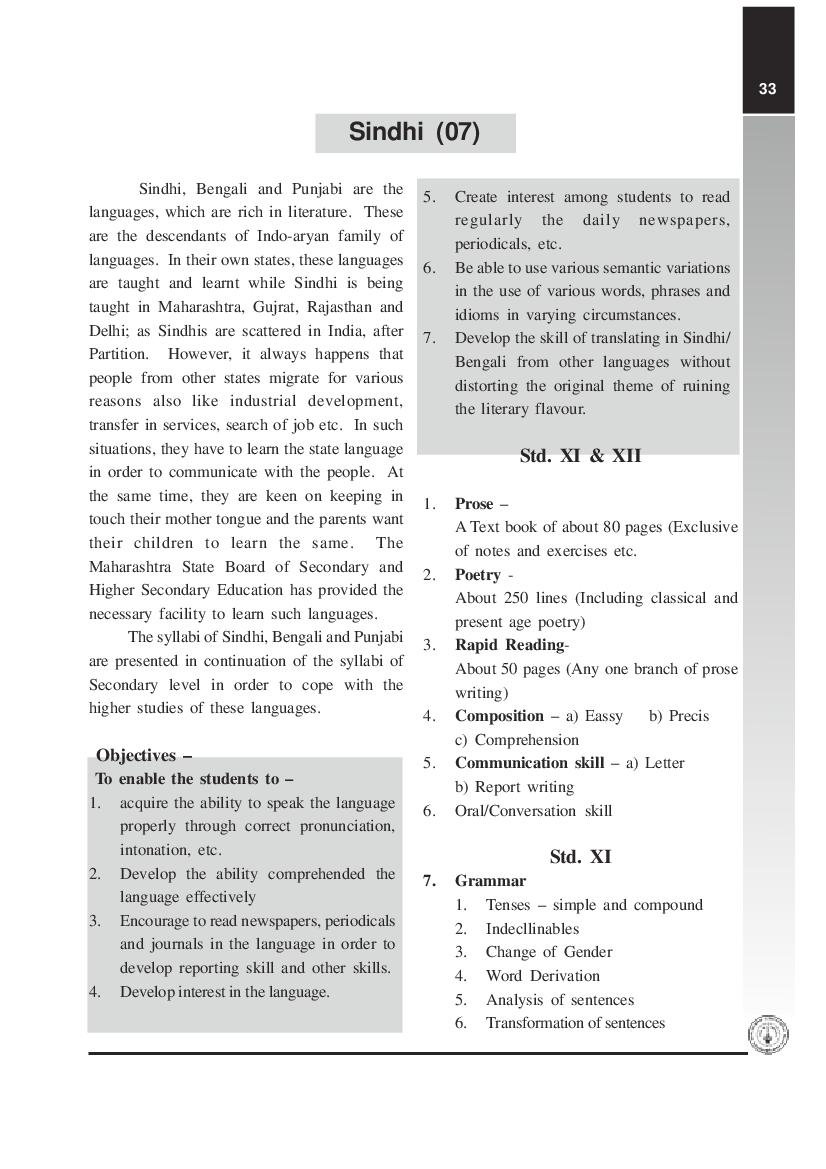
33 Sindhi (07) Sindhi, Bengali and Punjabi are the 5. Create interest among students to read languages, which are rich in literature. These regularly the daily newspapers, are the descendants of Indo-aryan family of periodicals, etc. languages. In their own states, these languages 6. Be able to use various semantic variations are taught and learnt while Sindhi is being in the use of various words, phrases and taught in Maharashtra, Gujrat, Rajasthan and idioms in varying circumstances. Delhi; as Sindhis are scattered in India, after 7. Develop the skill of translating in Sindhi/ Partition. However, it always happens that Bengali from other languages without people from other states migrate for various distorting the original theme of ruining reasons also like industrial development, the literary flavour. transfer in services, search of job etc. In such situations, they have to learn the state language Std. XI & XII in order to communicate with the people. At the same time, they are keen on keeping in 1. Prose – touch their mother tongue and the parents want A Text book of about 80 pages (Exclusive their children to learn the same. The of notes and exercises etc. Maharashtra State Board of Secondary and 2. Poetry - Higher Secondary Education has provided the About 250 lines (Including classical and necessary facility to learn such languages. present age poetry) The syllabi of Sindhi, Bengali and Punjabi 3. Rapid Reading- are presented in continuation of the syllabi of About 50 pages (Any one branch of prose Secondary level in order to cope with the writing) higher studies of these languages. 4. Composition – a) Eassy b) Precis c) Comprehension Objectives – 5. Communication skill – a) Letter To enable the students to – b) Report writing 1. acquire the ability to speak the language 6. Oral/Conversation skill properly through correct pronunciation, intonation, etc. Std. XI 2. Develop the ability comprehended the 7. Grammar language effectively 1. Tenses – simple and compound 3. Encourage to read newspapers, periodicals 2. Indecllinables and journals in the language in order to 3. Change of Gender develop reporting skill and other skills. 4. Word Derivation 4. Develop interest in the language. 5. Analysis of sentences 6. Transformation of sentences
Page 2
34 7. Idioms, proverbs, phrases as arising out 8. Grammar of texts 1. Tenses-simple and compound 8. Figures of speech 2. Indeclinable 9. Punctuation 3. Change of Gender 10. compound verbs 4. Word Derivation 11. Somas 5. Analysis of sentences 12. Synonyms/Antonyms 6. Transformation of sentences 13. Upasarga 7. Idioms, Provers, Phrases as arising 14. sindhi-vowels and consonants out of texts 15. Correction of sentences. 8. Figures of speech 9. Punctuation Std. XII 10. compound verbs, 11. somas 12. Synonyms/Antonyms 13. Upasarga 14. Sindhi-vowels and consonants 15. Correction of sentences 16. Comprehension and expansion of sentences Oral Skills Listening activities : develop the sub-skills of listening, provide practice in ear-training. Loud-reading : following the features of loud reading, provide practice in loud-reading. Speaking : creating confidence in speaking. Using narration and description. Conversation : ability to converse confidently and effectively, provide practice in conversation. Formal testing in oral skills will be administered. ��� Introduction