NCERT Book Class 9 Social Science (Understanding Society India and Beyond PART-I) Chapter 6 Democracy
Finished viewing? Save it for later —
Download NCERT Book Class 9 Social Science (Understanding Society India and Beyond PART-I) Chapter 6 Democracy (PDF · 24 pages)About NCERT Book Class 9 Social Science (Understanding Society India and Beyond PART-I) Chapter 6 Democracy
NCERT Book Class 9 Social Science (Understanding Society India and Beyond PART-I) Chapter 6 Democracy is available here for free download. Published by NCERT for Class 9, this books can be viewed online or downloaded as a PDF (24 pages). Candidates preparing for Class 9 can use NCERT Book Class 9 Social Science (Understanding Society India and Beyond PART-I) Chapter 6 Democracy to understand the exam pattern, the type of questions asked, and the overall difficulty level.
Frequently Asked Questions
How can I download NCERT Book Class 9 Social Science (Understanding Society India and Beyond PART-I) Chapter 6 Democracy?
Open this page and click the Download button to save NCERT Book Class 9 Social Science (Understanding Society India and Beyond PART-I) Chapter 6 Democracy as a PDF. It is completely free on AglaSem Docs.
Is NCERT Book Class 9 Social Science (Understanding Society India and Beyond PART-I) Chapter 6 Democracy free to download?
Yes. NCERT Book Class 9 Social Science (Understanding Society India and Beyond PART-I) Chapter 6 Democracy can be viewed online and downloaded as a PDF free of cost on AglaSem Docs.
How many pages does NCERT Book Class 9 Social Science (Understanding Society India and Beyond PART-I) Chapter 6 Democracy have?
NCERT Book Class 9 Social Science (Understanding Society India and Beyond PART-I) Chapter 6 Democracy contains 24 pages, which you can read online or download together as a single PDF.
Where can I find more Class 9 study material?
You can find more Class 9 question papers, sample papers, syllabus, and answer keys on AglaSem Docs.
NCERT Book Class 9 Social Science (Understanding Society India and Beyond PART-I) Chapter 6 Democracy – Text
Read the full text of this books below — useful to quickly search, copy and reference the content online without downloading the PDF.
📄 View text version (1 page)
Page 1
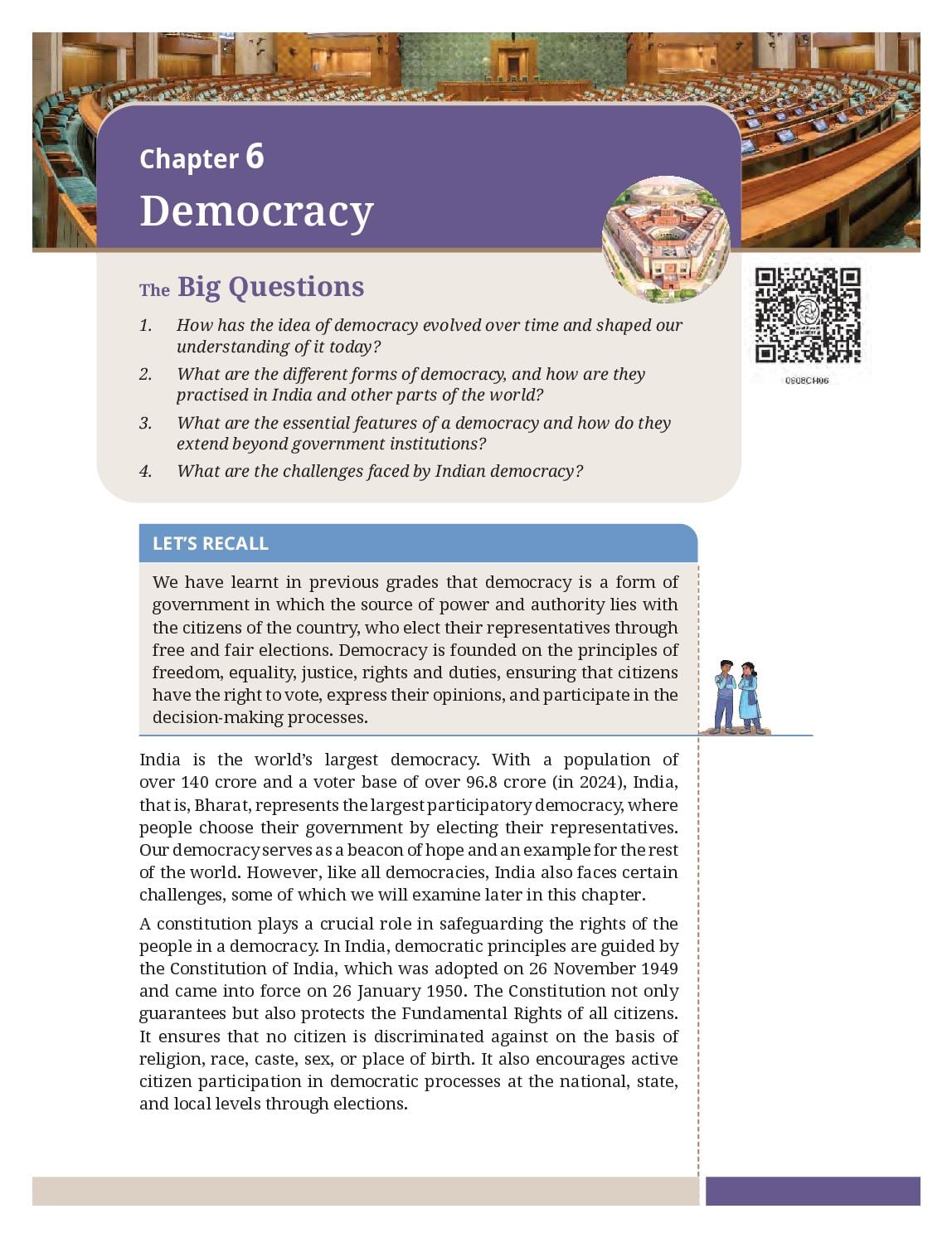
Democracy
The Big Questions
1. How has the idea of democracy evolved over time and shaped our
understanding of it today?
2. What are the different forms of democracy, and how are they
practised in India and other parts of the world?
3. What are the essential features of a democracy and how do they
extend beyond government institutions?
4. What are the challenges faced by Indian democracy?
LET’S RECALL
We have learnt in previous grades that democracy is a form of
government in which the source of power and authority lies with
the citizens of the country, who elect their representatives through
free and fair elections. Democracy is founded on the principles of
freedom, equality, justice, rights and duties, ensuring that citizens
have the right to vote, express their opinions, and participate in the
decision-making processes.
India is the world’s largest democracy. With a population of
over 140 crore and a voter base of over 96.8 crore (in 2024), India,
that is, Bharat, represents the largest participatory democracy, where
people choose their government by electing their representatives.
Our democracy serves as a beacon of hope and an example for the rest
of the world. However, like all democracies, India also faces certain
challenges, some of which we will examine later in this chapter.
A constitution plays a crucial role in safeguarding the rights of the
people in a democracy. In India, democratic principles are guided by
the Constitution of India, which was adopted on 26 November 1949
and came into force on 26 January 1950. The Constitution not only
guarantees but also protects the Fundamental Rights of all citizens.
It ensures that no citizen is discriminated against on the basis of
religion, race, caste, sex, or place of birth. It also encourages active
citizen participation in democratic processes at the national, state,
and local levels through elections.
Showing the first page only. Download the PDF above for the complete document.
Document Details
| Board / Org | NCERT |
| Exam | Class 9 |
| Type | Books |
| Pages | 24 |
| Language | english |
| Updated | 24 Sep 2026 |