Karnataka PGCET 2023 Syllabus
Finished viewing? Save it for later —
Download Karnataka PGCET 2023 Syllabus (PDF · 4 pages)About Karnataka PGCET 2023 Syllabus
Karnataka PGCET 2023 Syllabus is available here for free download. Published by KEA for Karnataka Post Graduate Common Entrance Test, this syllabus can be viewed online or downloaded as a PDF (4 pages). Candidates preparing for Karnataka Post Graduate Common Entrance Test can use Karnataka PGCET 2023 Syllabus to understand the exam pattern, the type of questions asked, and the overall difficulty level.
Frequently Asked Questions
How can I download Karnataka PGCET 2023 Syllabus?
Open this page and click the Download button to save Karnataka PGCET 2023 Syllabus as a PDF. It is completely free on AglaSem Docs.
Is Karnataka PGCET 2023 Syllabus free to download?
Yes. Karnataka PGCET 2023 Syllabus can be viewed online and downloaded as a PDF free of cost on AglaSem Docs.
How many pages does Karnataka PGCET 2023 Syllabus have?
Karnataka PGCET 2023 Syllabus contains 4 pages, which you can read online or download together as a single PDF.
Where can I find more Karnataka Post Graduate Common Entrance Test study material?
You can find more Karnataka Post Graduate Common Entrance Test question papers, sample papers, syllabus, and answer keys on AglaSem Docs.
Karnataka PGCET 2023 Syllabus – Text
Read the full text of this syllabus below — useful to quickly search, copy and reference the content online without downloading the PDF.
📄 View text version (4 pages)
Page 1
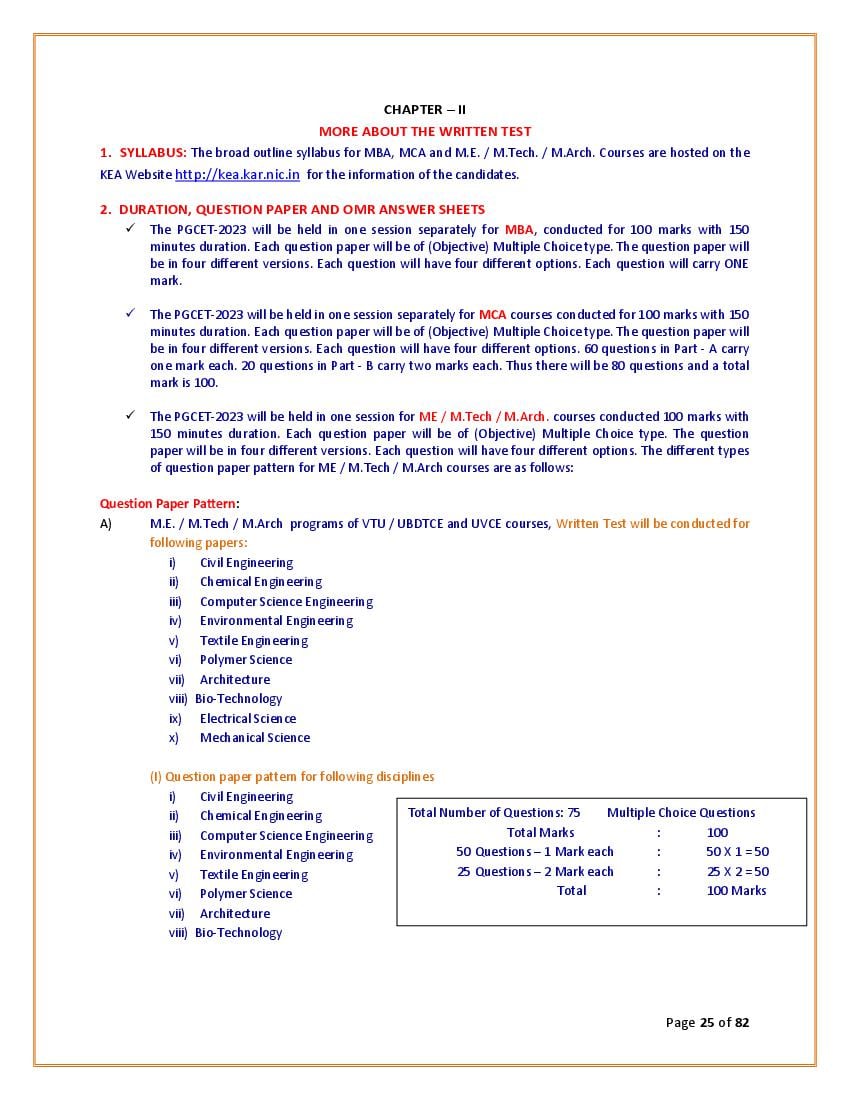
MORE ABOUT THE WRITTEN TEST
1. SYLLABUS: The broad outline syllabus for MBA, MCA and M.E. / M.Tech. / M.Arch. Courses are hosted on the
KEA Website http://kea.kar.nic.in for the information of the candidates.
2. DURATION, QUESTION PAPER AND OMR ANSWER SHEETS
The PGCET-2023 will be held in one session separately for MBA, conducted for 100 marks with 150
minutes duration. Each question paper will be of (Objective) Multiple Choice type. The question paper will
be in four different versions. Each question will have four different options. Each question will carry ONE
mark.
The PGCET-2023 will be held in one session separately for MCA courses conducted for 100 marks with 150
minutes duration. Each question paper will be of (Objective) Multiple Choice type. The question paper will
be in four different versions. Each question will have four different options. 60 questions in Part - A carry
one mark each. 20 questions in Part - B carry two marks each. Thus there will be 80 questions and a total
mark is 100.
The PGCET-2023 will be held in one session for ME / M.Tech / M.Arch. courses conducted 100 marks with
150 minutes duration. Each question paper will be of (Objective) Multiple Choice type. The question
paper will be in four different versions. Each question will have four different options. The different types
of question paper pattern for ME / M.Tech / M.Arch courses are as follows:
Question Paper Pattern:
A) M.E. / M.Tech / M.Arch programs of VTU / UBDTCE and UVCE courses, Written Test will be conducted for
following papers:
i) Civil Engineering
ii) Chemical Engineering
iii) Computer Science Engineering
iv) Environmental Engineering
v) Textile Engineering
vi) Polymer Science
vii) Architecture
viii) Bio-Technology
ix) Electrical Science
x) Mechanical Science
(I) Question paper pattern for following disciplines
i) Civil Engineering
ii) Chemical Engineering Total Number of Questions: 75 Multiple Choice Questions
iii) Computer Science Engineering Total Marks : 100
iv) Environmental Engineering 50 Questions – 1 Mark each : 50 X 1 = 50
v) Textile Engineering 25 Questions – 2 Mark each : 25 X 2 = 50
vi) Polymer Science Total : 100 Marks
vii) Architecture
viii) Bio-Technology
Page 25 of 82
Page 2
a) Electrical and Electronics Engineering (E & E)
b) Electronics and Communication Engineering (E & C)
c) Telecommunication Engineering (TC)
d) Instrumentation Technology (IT)
e) Bio-Medical Engineering (BME)
f) Medical Electronics (ME)
g) Allied branches of Electrical Science (ABE)
Question paper will consist of part-A and part-B.
Part-A is common to above all subjects, i.e., (E & E), (E & C), (TC), (IT), (BME), (ME)
Total Number of Questions : 45 Marks: 60
30 Questions Carrying 1 mark each : 30 X 1 = 30
15 Questions carrying 2 mark each : 15 X 2 = 30
Part-B is specific to candidates belonging to respective branch of specialization of engineering and
consists of total number of questions: 30 Marks: 40
20 Questions carrying 1 mark each : 20 X 1 = 20
10 Questions carrying 2 mark each : 10 X 2 = 20
Marks = 40
Grand Total Part – A + Part-B = 75 Questions = 100 marks
x) Mechanical Science, this includes
a) Mechanical Engineering (MC)
b) Industrial and Production Engineering (IPE)
c) Industrial and Engineering Management (IEM)
d) Automobile Engineering (AE)
e) Manufacturing Science and Engineering (MSE)
f) Allied Branches of Mechanical Science (ABM)
Question paper will consist of Part-A and Part-B.
Part-A is common to (a) M.E. (b) IPE (c) IEM (d) AE (e) MSE (f) ABM
Total number of questions : 45 Marks: 60
30 questions carrying 1 mark each : 30 X 1 = 30
15 questions carrying 2 mark each : 15 X 2 = 30
Total: 60 Marks
Part-B is specific to candidates belonging to respective branch of specialization of engineering and
consists of
Total number of questions : 30 Marks: 40
20 Questions carrying 1 Mark each : 20 X 1 = 20
10 Questions carrying 2 mark each : 10 X 2 = 20
Total: 40 Marks
Grand Total: Part-A + Part-B = 75 questions Marks = 100
Page 26 of 82
Page 3
examination hall Possession of these items in the examination hall is considered as malpractice and disciplinary
action will be taken by the concerned examination conducting authorities. (Only Non-programmable calculators
are allowed for M.E. / M.Tech / M.Arch examination) All questions are compulsory. In other words, there is no
choice among questions. Candidate is expected to attempt all the questions, in order to obtain maximum marks.
All questions are compulsory. In other words, there is no choice among questions. Candidate is expected to
attempt all the questions, in order to obtain maximum marks. THERE WILL BE NO NEGATIVE EVALUATION WITH
REGARD TO WRONG ANSWERS BUT MARKS WILL NOT BE AWARDED IN RESPECT OF MULTIPLE ANSWERS. The
version code of the question paper will be boldly printed on facing sheet of the question paper.
1. Important Instructions to Candidates - On the days of examination:
Candidates will have to mark correct options on the Optical Mark Reader (OMR) answer sheet, which will be
supplied at the beginning of the test. The entries pertaining to PGCET No., Subject, Version code etc are to be
checked twice before proceeding to mark the answers.
Among the four options provided against a question, only one answer will be correct. The candidate should mark
the correct answer by completely shading only one circle against a question number, using BLUE or BLACK ink ball
point pen. More details about precautions to be taken while filling the particulars on OMR answer sheet is given
below. The OMR answer sheet comprises of two sheets. The top sheet will be used for the purpose of marking
correct answers and later scanning & evaluation and the bottom sheet will be returned to the candidates after
completion of the test. The bottom sheet is coated with a special kind of chemical which acts as Carbon. When the
candidate fills the circles on the top sheet, the pressure on the bottom sheet will automatically create a replica of
the top sheet.
2. Optical Mark Reader sheets as Answer Sheets
The need for the replica has compelled us to design OMR sheet in such a way that all the information and the
answers are marked only on one side. The top portion of the sheet is meant for furnishing the particulars about
the candidates such as the Name, PGCET Number, Version code and serial number of the question booklet. The
bottom portion is meant for marking the answers, affixing the signature of the room Invigilator & candidates and
also for affixing the Left Hand Thumb Impression of the candidate. The space meant for the subject would have
been pre-marked. The square blocks in each item should be filled by the candidate in capital letters and numbers.
The circles corresponding to the letters or numbers are meant to be completely shaded using blue or black ink
ballpoint pen only.
Page 27 of 82
Page 4
Remember, we are allowing the candidates to carry home a replica or facsimile of the OMR answer sheet and the
OMR answer paper comes in a set of two sheets. When you shade the top sheet, the pressure will create a dark
mark on the bottom sheet on the corresponding circle. If a pen with a nib is used, the pressure on the top sheet
will not be sufficient to activate the chemical on the bottom sheet. On the other hand, a ballpoint pen exerts
sufficient pressure to convert the bottom sheet chemical into a dark spot. That is why we want you to use a blue /
black ink ballpoint pen only.
Important precautions to be taken while shading answers portion of OMR Answer sheet.
After the initial TEN minutes 120 minutes will be given to a candidate for shading the answers on the bottom
portion of the OMR answer sheet. Against each question number, four circles will be provided corresponding to
four options of the question paper. The candidates are required to shade only one circle corresponding to the
correct answer.
The scanner is so sensitive to black and blue ink shades that even a slight residual ink mark or an unintended ink
dot within a circle on the OMR answer sheet will be taken by it, as filled / shaded, at the time of scanning.
Consequently, the candidate may lose marks. Therefore, please do not make any stray pen marks on the OMR
answer sheets. As the scoring done by the scanner and the computer in tandem is final, a plea for erasing or
neglecting the ink mark on a circle cannot be entertained. Therefore, candidates are advised to take extra
precaution while shading the circles on the bottom portion.
THINK BEFORE YOU INK!
Once you darken a circle, there is no way to erase or to remove it. That way, your decision about a correct answer
will be final. The invigilator will not permit you to use marker, white fluid or any other device to hide the shading
already done and you will not be supplied with one more set of OMR sheet. If you spoil a sheet in your attempt to
rub off the shading done on a circle, you may ruin your opportunities. If two circles are shaded in a row and even if
one of the circles is partially rubbed off, the scanner will take it as a multiple attempt. Therefore, think twice
before you shade a circle with ink. Darken only one circle for each question as shown against the CORRECT
METHOD.
METHOD OF SHADING
The candidates should invariably preserve their ‘PGCET 2023’ OMR answer sheet replica
for a minimum period of one year from the date of obtaining the admission order.
Page 28 of 82
Document Details
| Board / Org | KEA |
| Exam | Karnataka Post Graduate Common Entrance Test |
| Type | Syllabus |
| Pages | 4 |
| Updated | 09 Jun 2026 |