Goa Board Class 12 Question Paper Mar 2019 Sociology _CWSN_
Finished viewing? Save it for later —
Download Goa Board Class 12 Question Paper Mar 2019 Sociology _CWSN_ (PDF · 11 pages)About Goa Board Class 12 Question Paper Mar 2019 Sociology _CWSN_
Goa Board Class 12 Question Paper Mar 2019 Sociology _CWSN_ is available here for free download. Published by Goa Board for Class 12, this question paper can be viewed online or downloaded as a PDF (11 pages). Candidates preparing for Class 12 can use Goa Board Class 12 Question Paper Mar 2019 Sociology _CWSN_ to understand the exam pattern, the type of questions asked, and the overall difficulty level.
Frequently Asked Questions
How can I download Goa Board Class 12 Question Paper Mar 2019 Sociology _CWSN_?
Open this page and click the Download button to save Goa Board Class 12 Question Paper Mar 2019 Sociology _CWSN_ as a PDF. It is completely free on AglaSem Docs.
Is Goa Board Class 12 Question Paper Mar 2019 Sociology _CWSN_ free to download?
Yes. Goa Board Class 12 Question Paper Mar 2019 Sociology _CWSN_ can be viewed online and downloaded as a PDF free of cost on AglaSem Docs.
How many pages does Goa Board Class 12 Question Paper Mar 2019 Sociology _CWSN_ have?
Goa Board Class 12 Question Paper Mar 2019 Sociology _CWSN_ contains 11 pages, which you can read online or download together as a single PDF.
Where can I find more Class 12 study material?
You can find more Class 12 question papers, sample papers, syllabus, and answer keys on AglaSem Docs.
Goa Board Class 12 Question Paper Mar 2019 Sociology _CWSN_ – Text
Read the full text of this question paper below — useful to quickly search, copy and reference the content online without downloading the PDF.
📄 View text version (11 pages)
Page 1
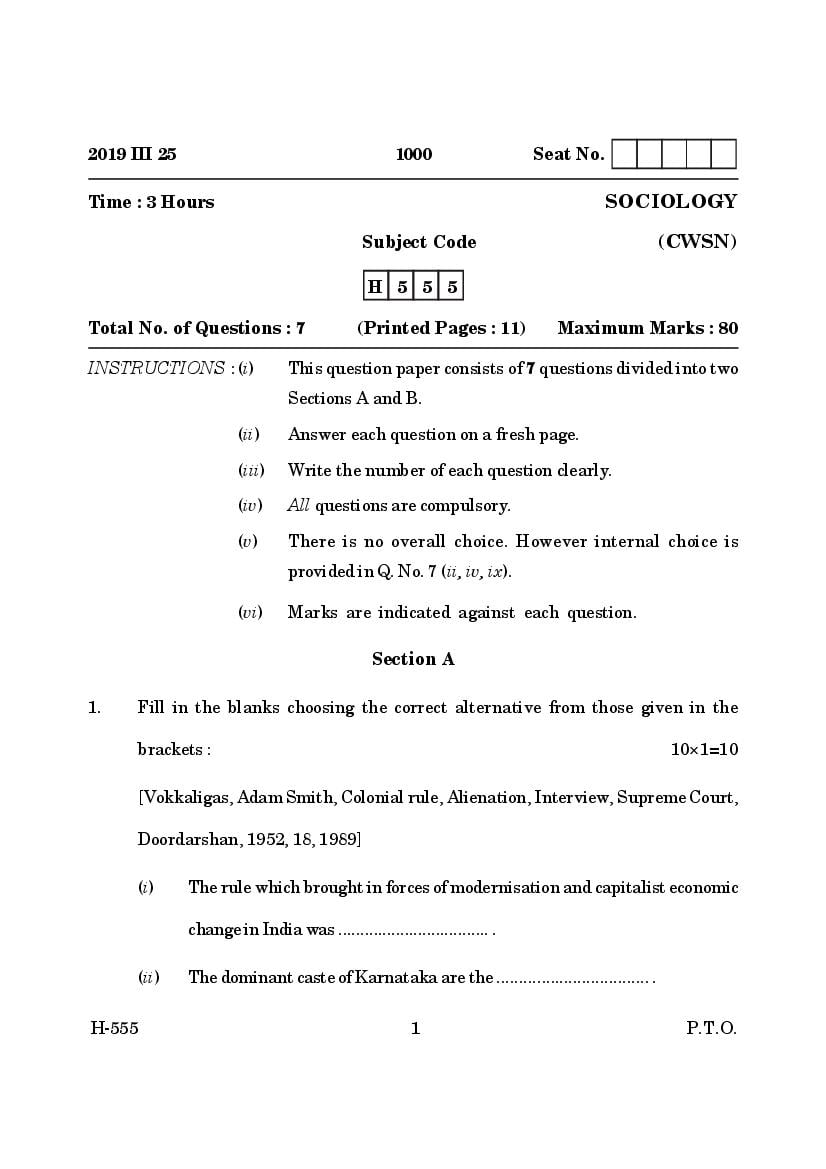
Time : 3 Hours SOCIOLOGY
Subject Code (CWSN)
H 5 5 5
Total No. of Questions : 7 (Printed Pages : 11) Maximum Marks : 80
INSTRUCTIONS : (i) This question paper consists of 7 questions divided into two
Sections A and B.
(ii) Answer each question on a fresh page.
(iii) Write the number of each question clearly.
(iv) All questions are compulsory.
(v) There is no overall choice. However internal choice is
provided in Q. No. 7 (ii, iv, ix).
(vi) Marks are indicated against each question.
Section A
1. Fill in the blanks choosing the correct alternative from those given in the
brackets : 10×1=10
[Vokkaligas, Adam Smith, Colonial rule, Alienation, Interview, Supreme Court,
Doordarshan, 1952, 18, 1989]
(i) The rule which brought in forces of modernisation and capitalist economic
change in India was .................................. .
(ii) The dominant caste of Karnataka are the .................................. .
H-555 1 P.T.O.
Page 2
(iv) The Scheduled Caste and Scheduled Tribe Prevention of Atrocities Act
was enacted in ................................... .
(v) The research method which is very flexible is ................................... .
(vi) The ultimate interpreter of the Constitution in India is the ........................... .
(vii) When people do not enjoy the work they do and do it only to survive. This
condition is called .................................... .
(viii) The Population Policy in India was first announced in the year
........................ .
(ix) The number of languages which have been officially recognised by the
8th Schedule of the Constitution are ................................ .
(x) The first state controlled TV Channel in India was ............................. .
2. Give a suitable name for the following : 10×1=10
(i) Name the person under whose direction the Census of 1901 was carried
out in India.
(ii) Who fulfills the responsibility of recording the statistics of birth and death
in a village of India ?
H-555 2
Page 3
Public sector companies.
(iv) Name the first popular channel for entertainment on AIR.
(v) Name the English political economist who outlined the theory of population
growth.
(vi) Name the state approaching universal literacy according to the census of
2001.
(vii) Name the form of family based on size which consists only of one set of
parents and their children.
(viii) Name the Indian leader who saw Gram Swaraj as an ideal model to be
followed after Independence.
(ix) Name the process whereby the management of a company shuts the gate
and prevents workers from working.
(x) Name the national leader who called upon the media to function as a
‘watchdog of democracy’.
H-555 3 P.T.O.
Page 4
below : 1×10=10
(i) The main carriers of nationalism who led the campaign for freedom were
the ............................... .
(a) rural lower classes
(b) rural middle classes
(c) urban lower classes
(d) urban middle classes
(ii) When the newly married couple stays with the man’s parents after
marriage it is called ............................... .
(a) Patriarchal
(b) Patrilocal
(c) Matriarchal
(d) Matrilocal
(iii) A place where kins meet to arrange marriage and exchange gossip in a
tribal area is called ......................... .
(a) Fields
(b) Weekly haat
(c) Durbar council
(d) Forest hunt
H-555 4
Page 5
................................... .
(a) Stereotype
(b) Inequality
(c) Discrimination
(d) Prejudice
(v) A research method which can collect data from a large number of
people is ............................. .
(a) Survey
(b) Observation
(c) Interview
(d) Participant observation
(vi) The second most populous country in the world after China according to
the 2001 Census is ........................ .
(a) Italy
(b) Japan
(c) India
(d) France
H-555 5 P.T.O.
Page 6
free India was ................................. .
(a) Internet
(b) Print Media
(c) Radio
(d) Television
(viii) The process whereby multinationals produce products in other countries
which provide cheap labour to reduce cost is called ............................ .
(a) Liberalization
(b) Disinvestment
(c) Outsourcing
(d) Taylorism
(ix) Panchayati Raj translates literally to governance by ..........................
individuals.
(a) Five
(b) Fifteen
(c) Fifty
(d) Fifty five
H-555 6
Page 7
as :
(a) Communalism
(b) Regionalism
(c) Multilingualism
(d) Secularism
4. State whether the following statements are True or False : 10×1=10
(i) Caste is a matter of choice.
(ii) The term Dalit literally means downtrodden.
(iii) The 3rd stage of demographic transition takes place in underdeveloped
and technologically backward societies.
(iv) A bill of exchange which allows merchants to engage in long distance
trade in traditional India was Hundi.
(v) When individuals are cut off from full involvement in the wider society it
is referred to as Social Exclusion.
(vi) A research method wherein a researcher may systematically watch and
record what is happening in a situation is called Interview.
H-555 7 P.T.O.
Page 8
Society.
(viii) The agarbatti making industry is a home based industry.
(ix) The basic norm from which all rules and authority flow is the Supreme
Court.
(x) The first printing press using modern technology was developed in India.
Section B
5. (A) Match the items in Column A with the appropriate items in Column B
and rewrite : 5
Column A Column B
(i) Punjab (a) Caste Disabilities Removal
Act
(ii) Scientific Management (b) Caste traditionally involved
of work in trade and business
(iii) Vaisyas (c) Lowest Child Sex Ratio
(iv) Act of 1850 (d) Government of India Act
(v) Act of 1935 (e) Frederick Winslow Taylor
H-555 8
Page 9
and rewrite : 5
Column A Column B
(i) 1984 (a) No on the spot adjustment
possible
(ii) 1992 (b) Anti-Sikh Riots
(iii) Johannes Gutenberg (c) Collective Ownership of
resources
(iv) Tribes (d) Panchayati Raj introduced
(v) Survey method (e) Printing Press
6. Answer the following questions in one sentence each : 1×10=10
(i) State any one reason for the decline of death rates after 1921.
(ii) What was the new name given to the National Population Policy ?
(iii) What is meant by the term ‘Endogamy’ ?
(iv) What is the annual Pushkar fair in Rajasthan internationally marketed
as ?
(v) Who wrote the book ‘Sultana’s Dream’ ?
(vi) Who is the chief architect of the Indian Constitution ?
H-555 9 P.T.O.
Page 10
authority to hear.
(viii) Which tribe in Meghalaya has a Council at the clan level called ‘Durbar
Kur’ ?
(ix) State any one problem faced by workers working in underground mines.
(x) State any one problem faced by workers in the unorganized sector.
7. Answer the following questions in two sentences each : 2×10=20
(i) State any two features of caste.
(ii) Mention any two measures adopted by the state to reduce death from
famines.
Or
Mention two reasons for the declining sex ratio in India.
(iii) Give two reasons for communalism being a source of tension in India.
(iv) Write a note on the role played by Jyotiba Phule in the 19th Century
social reform movement.
Or
Write a note on the reasons for increased incidence of disability among
the poor.
(v) Mention the two types of Interviews.
H-555 10
Page 11
India.
(vii) State the role of the 73rd and 74th Amendment of the Constitution in
enfranchising women.
(viii) Write a note on the effect of Globalisation on Print Media.
(ix) What does the Mines Act of 1952 specify ?
Or
What are the problems faced by miners working in overground mines ?
(x) What is the effect of globalisation on Radio ?
H-555 11 P.T.O.
Document Details
| Board / Org | Goa Board |
| Exam | Class 12 |
| Type | Question Paper |
| Pages | 11 |
| Updated | 22 Jul 2026 |