MBSE Class 10 Syllabus 2022 Maths
Finished viewing? Save it for later —
Download MBSE Class 10 Syllabus 2022 Maths (PDF · 6 pages)About MBSE Class 10 Syllabus 2022 Maths
MBSE Class 10 Syllabus 2022 Maths is available here for free download. Published by Mizoram Board for Class 10, this syllabus can be viewed online or downloaded as a PDF (6 pages). Candidates preparing for Class 10 can use MBSE Class 10 Syllabus 2022 Maths to understand the exam pattern, the type of questions asked, and the overall difficulty level.
Frequently Asked Questions
How can I download MBSE Class 10 Syllabus 2022 Maths?
Open this page and click the Download button to save MBSE Class 10 Syllabus 2022 Maths as a PDF. It is completely free on AglaSem Docs.
Is MBSE Class 10 Syllabus 2022 Maths free to download?
Yes. MBSE Class 10 Syllabus 2022 Maths can be viewed online and downloaded as a PDF free of cost on AglaSem Docs.
How many pages does MBSE Class 10 Syllabus 2022 Maths have?
MBSE Class 10 Syllabus 2022 Maths contains 6 pages, which you can read online or download together as a single PDF.
Where can I find more Class 10 study material?
You can find more Class 10 question papers, sample papers, syllabus, and answer keys on AglaSem Docs.
MBSE Class 10 Syllabus 2022 Maths – Text
Read the full text of this syllabus below — useful to quickly search, copy and reference the content online without downloading the PDF.
📄 View text version (6 pages)
Page 1
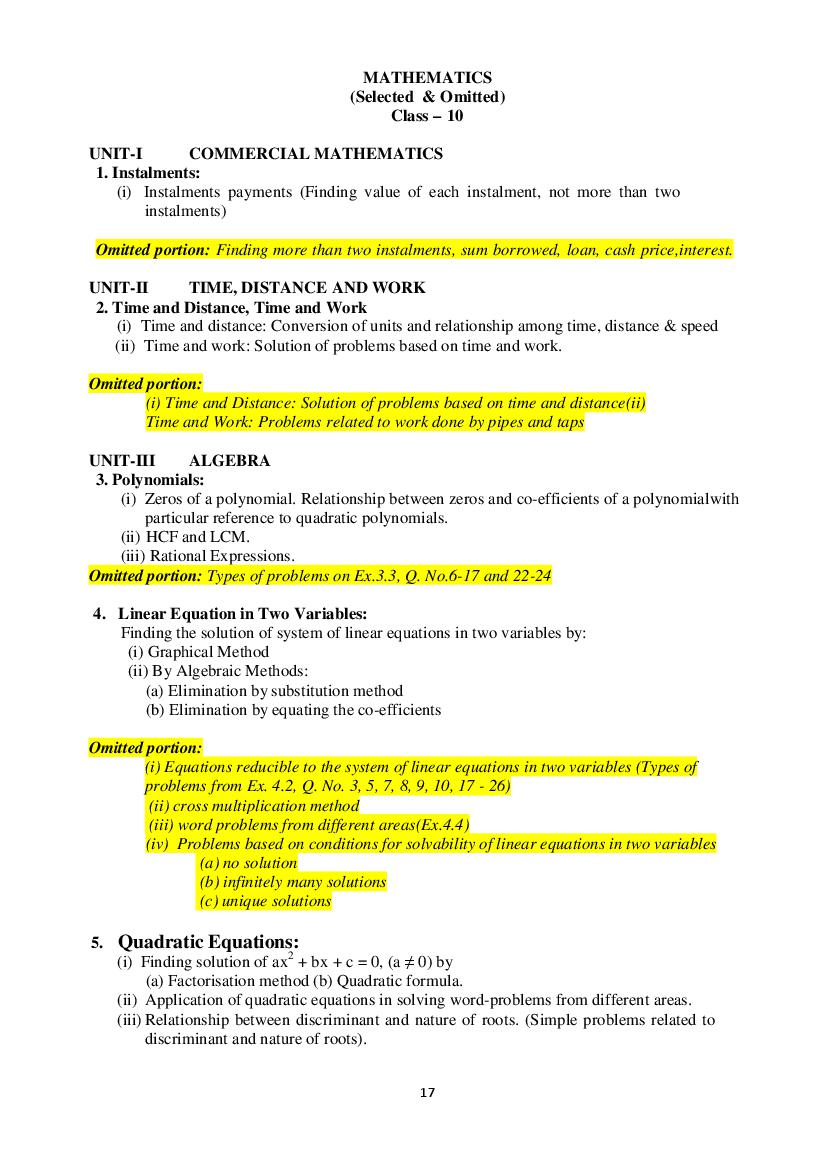
(Selected & Omitted)
Class – 10
UNIT-I COMMERCIAL MATHEMATICS
1. Instalments:
(i) Instalments payments (Finding value of each instalment, not more than two
instalments)
Omitted portion: Finding more than two instalments, sum borrowed, loan, cash price,interest.
UNIT-II TIME, DISTANCE AND WORK
2. Time and Distance, Time and Work
(i) Time and distance: Conversion of units and relationship among time, distance & speed
(ii) Time and work: Solution of problems based on time and work.
(i) Time and Distance: Solution of problems based on time and distance(ii)
Time and Work: Problems related to work done by pipes and taps
UNIT-III ALGEBRA
3. Polynomials:
(i) Zeros of a polynomial. Relationship between zeros and co-efficients of a polynomialwith
particular reference to quadratic polynomials.
(ii) HCF and LCM.
(iii) Rational Expressions.
Omitted portion: Types of problems on Ex.3.3, Q. No.6-17 and 22-24
4. Linear Equation in Two Variables:
Finding the solution of system of linear equations in two variables by:
(i) Graphical Method
(ii) By Algebraic Methods:
(a) Elimination by substitution method
(b) Elimination by equating the co-efficients
(i) Equations reducible to the system of linear equations in two variables (Types of
problems from Ex. 4.2, Q. No. 3, 5, 7, 8, 9, 10, 17 - 26)
(ii) cross multiplication method
(iii) word problems from different areas(Ex.4.4)
(iv) Problems based on conditions for solvability of linear equations in two variables
(a) no solution
(b) infinitely many solutions
(c) unique solutions
5. Quadratic Equations:
(i) Finding solution of ax2 + bx + c = 0, (a ≠ 0) by
(a) Factorisation method (b) Quadratic formula.
(ii) Application of quadratic equations in solving word-problems from different areas.
(iii) Relationship between discriminant and nature of roots. (Simple problems related to
discriminant and nature of roots).
17
Page 2
No 19, 20, 21, etc.) and accordingly word problems which involved reducible equations.
(ii) Types of problems based on discriminant & nature of roots from Ex. 5.3 Q. No. 4- 12,
14-18
6. Arithmetic Progression (AP):
(i) Introduction to AP by pattern of number.
(ii) General term of an AP, sum to n-terms of an AP.
Omitted portion: Application in solving daily life problems (Types of problems from Ex.6.2 Q.
No.24-27) and Ex.6.3 Q. No.13-25
7. Sets:
Revision.
(i) Venn Diagrams (not more than three sets).
(ii) Complement of a set, operations on sets (union, intersection and difference of
twosets)
Omitted portion: No Omission
UNIT – IV GEOMETRY
8. Triangles:
(i) Numerical problems based on Thales theorem and Pythagoras theorem.
Omitted portion: Omitted the whole chapter with the exception of numerical problems basedon
Thales theorem and Pythagoras theorem.
9. Circles :
(i) (Prove) The angles subtended by an arc at the centre is double the angle subtended byit
at any point on the remaining part of the circle.
(ii) (Prove) The angle in a semi circle is a right angle.
(iii) (Prove) Angles in the same segment of a circle are equal.
(iv) (Prove) The sum of either pair of the opposite angles of a cyclic quadrilateral is
180°.
(v) (Prove) The lengths of tangents drawn from an external point to a circle are equal.
(vi) Motivate The tangent at any point of a circle is perpendicular to the radius through the
point of contact.
(vii) (Motivate) If a line segment joining two points subtends equal angle at other two points
lying on the same side of the line containing the segment, the four points lieon a circle.
(viii) (Motivate) If two arcs of a circle are congruent, their corresponding chords are equal and
its converse.
(ix) (Motivate) If an arc of a circle subtends a right angle at any point of the circle in its
alternate segment, then it is a semicircle.
(x) (Motivate) If the sum of a pair of opposite angles of a quadrilateral is 180°, the
quadrilateral is cyclic.
(xi) (Motivate) If two chords of a circle intersect inside or outside a circle, then the rectangle
formed by two parts of one chord is equal in area to the rectangle formed by the two parts
of the other.
(xii) (Motivate) If a line touches a circle and from the point of contact a chord is drawn, the
angles which this chord makes with the given tangent are equal respectively to the angles
formed in the corresponding alternate segments.
(Motivate means application of the theorem excluding its theoretical proof)
18
Page 3
(i) Segment theorem: If two chords of a circle intersect inside or outside a circle, then the
rectangle formed by two parts of one chord is equal in area to the rectangle formed by the
two parts of the other.
(ii) Alternate segment theorem: If a line touches a circle and from the point of contact a
chord is drawn, the angles which this chord makes with the given tangent are equal
respectively to the angles formed in the corresponding alternate segments.
10. Constructions :
(i) Internal division of a line segment in a given ratio.
(ii) Construction of tangent(s) to a circle
(a) At a point on it without using the centre.
(b) At a point on it using the centre.
(c) From a point outside it.
[Constructions using ruler and compasses only].
(iii) Construction of a triangle, given its base, vertical angle and either altitude or
median through the vertex.
Omitted portion: - Construction of a triangle similar to a given triangle
UNIT-V CO-ORDINATE GEOMETRY
11. Co-ordinate Geometry:
(i) Review the concepts of coordinate geometry done earlier including graphs of linear
equations. Awareness of geometrical representation of quadratic polynomials.
(ii) Distance between two points and section formula (internal)
Omitted portion: - Area of a triangle (Ex.11.3)
UNIT VI TRIGONOMETRY
12. Trigonometric identities
(a) Proving simple identities based on the following: (proofs not required)
(i) sin2A + cos2A = 1
(ii) l + tan2A = sec2A
2
(iii) 1 + cot A = cosec2A
Omitted portion: Question of the type Ex.12 Q. No.43 – 49
13. T-ratios of Complementary Angles
(b) Trigonometric ratios of complementary angles:
(i) sin (90°- A) = cos A
(ii) cos (90°- A) = sin A
(iii) tan (90° - A) = cot A
(iv) cot (90° - A) = tan A
(v) sec (90° - A) = cosec A
(vi) cosec (90° - A) = sec A
(c) Problems based on the relations given above (b).
19
Page 4
14. Heights and Distances:
- Simple problems on heights and distances.
(i) Problems should not involve more than two right triangles and it must be of thetypes
as the figures given below :
(a) (b) (c)
(ii) Angles of elevation/depression should be only 30°, 45°, 60°
Omitted portion: Problems other than mentioned in the revised course (above)
UNIT - VII MENSURATION
15. Areas Related to Circle:
(i) Problems based on areas and circumferences of a circles. (Ex.15.1)
(i) Areas of sectors and segments of a circle (Ex 15.2)(ii)
Areas of combination of plane figures (Ex 15.3)
16. Surface Areas and Volumes:
(i) Problems on finding surface areas and volumes of combinations of any two of the
following-cubes, cuboids, spheres, hemispheres and right circular cylinders/cones.
(Problems with combination of not more than two different solids be taken).
(ii) Problems involving converting one type of solid into another and other mixed
problems.
Omitted portion: Frustum of a cone (Ex. 16.3)
UNIT - VIII STATISTICS AND PROBABILITY
17. Mean:
(i) Mean of grouped data
(ii) Median of grouped data
(i) Mean of a discrete frequency distribution(ii)
Mean of inclusive Class Interval
(iii) Finding of mode of grouped data
18. Probability:
(i) Elementary idea of probability as a measure of uncertainty.
Omitted portion: No Omission
19. Pictorial representation of data:
Construction of pie chart (sub parts of pie chart should not exceed five).Degrees of
central angle should be multiples of 5.
Omitted portion: - Reading of pie chart
20
Page 5
Sl/no. Form of Questions No. of Questions Marks for each question Total Marks
2.1 Objective type 24 1 24
2.2 Short Answer I 10 2 20
2.3 Short Answer II 07 3 21
2.4 Long Answer 03 5 15
TOTAL 44 80
Weightage to Content Area :
Sl/no. Topic Marks
3.1 Arithmetic 08
3.2 Algebra 18
3.3 Sets 03
3.4 Geometry 15
3.5 Coordinate Geometry 08
3.6 Trigonometry 10
3.7 Mensuration 10
3.8 Statistics 08
TOTAL 80
Scheme of Options : All questions shall be compulsory i.e. there shall not be any overall choice in
the questions paper. However, internal choices have been provided in 2 questions of 3 marks each
and 1 question of 5 marks. These choices may be given from within the same topic.
21
Page 6
Document Details
| Board / Org | Mizoram Board |
| Exam | Class 10 |
| Type | Syllabus |
| Pages | 6 |
| Updated | 22 Jul 2026 |