KSET Syllabus Performing Arts
Finished viewing? Save it for later —
Download KSET Syllabus Performing Arts (PDF · 7 pages)About KSET Syllabus Performing Arts
KSET Syllabus Performing Arts is available here for free download. Published by Karnataka Exams for Karnataka State Eligibility Test, this syllabus can be viewed online or downloaded as a PDF (7 pages). Candidates preparing for Karnataka State Eligibility Test can use KSET Syllabus Performing Arts to understand the exam pattern, the type of questions asked, and the overall difficulty level.
Frequently Asked Questions
How can I download KSET Syllabus Performing Arts?
Open this page and click the Download button to save KSET Syllabus Performing Arts as a PDF. It is completely free on AglaSem Docs.
Is KSET Syllabus Performing Arts free to download?
Yes. KSET Syllabus Performing Arts can be viewed online and downloaded as a PDF free of cost on AglaSem Docs.
How many pages does KSET Syllabus Performing Arts have?
KSET Syllabus Performing Arts contains 7 pages, which you can read online or download together as a single PDF.
Where can I find more Karnataka State Eligibility Test study material?
You can find more Karnataka State Eligibility Test question papers, sample papers, syllabus, and answer keys on AglaSem Docs.
KSET Syllabus Performing Arts – Text
Read the full text of this syllabus below — useful to quickly search, copy and reference the content online without downloading the PDF.
📄 View text version (7 pages)
Page 1
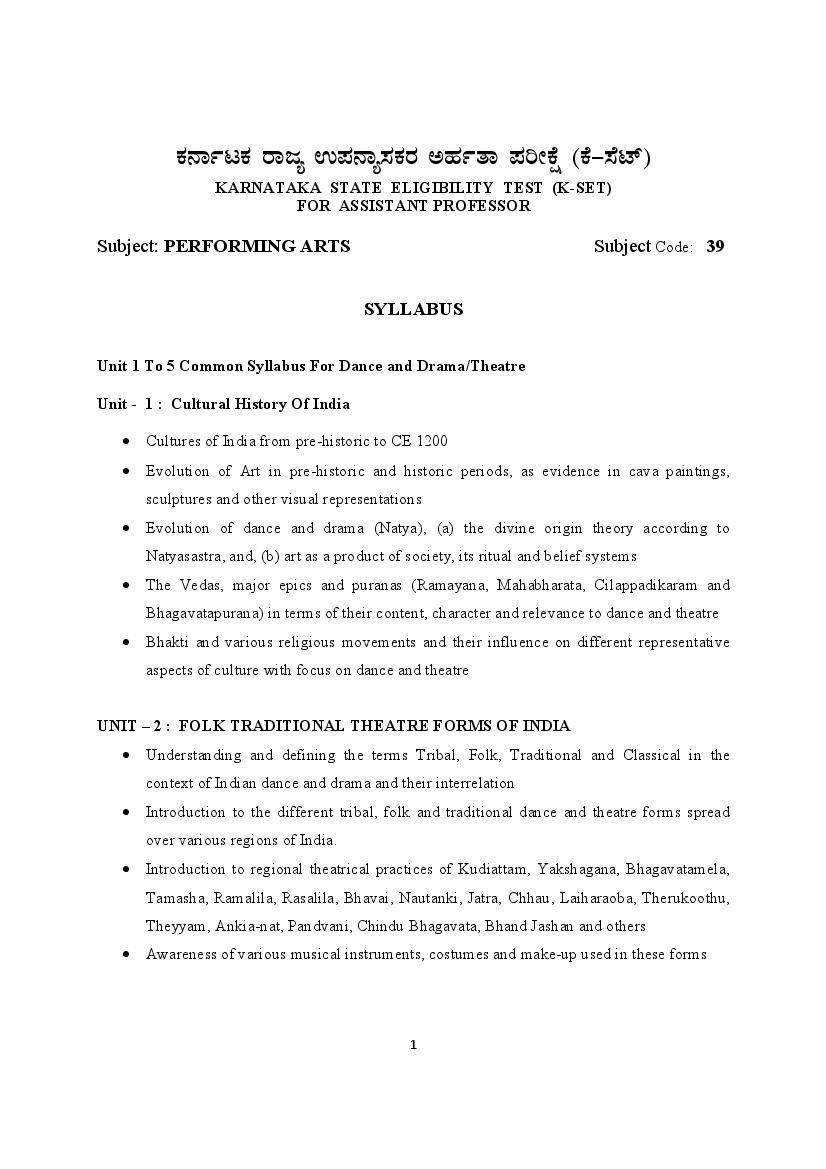
KARNATAKA STATE ELIGIBILITY TEST (K-SET)
FOR ASSISTANT PROFESSOR
Subject: PERFORMING ARTS Subject Code: 39
SYLLABUS
Unit 1 To 5 Common Syllabus For Dance and Drama/Theatre
Unit - 1 : Cultural History Of India
Cultures of India from pre-historic to CE 1200
Evolution of Art in pre-historic and historic periods, as evidence in cava paintings,
sculptures and other visual representations
Evolution of dance and drama (Natya), (a) the divine origin theory according to
Natyasastra, and, (b) art as a product of society, its ritual and belief systems
The Vedas, major epics and puranas (Ramayana, Mahabharata, Cilappadikaram and
Bhagavatapurana) in terms of their content, character and relevance to dance and theatre
Bhakti and various religious movements and their influence on different representative
aspects of culture with focus on dance and theatre
UNIT – 2 : FOLK TRADITIONAL THEATRE FORMS OF INDIA
Understanding and defining the terms Tribal, Folk, Traditional and Classical in the
context of Indian dance and drama and their interrelation
Introduction to the different tribal, folk and traditional dance and theatre forms spread
over various regions of India.
Introduction to regional theatrical practices of Kudiattam, Yakshagana, Bhagavatamela,
Tamasha, Ramalila, Rasalila, Bhavai, Nautanki, Jatra, Chhau, Laiharaoba, Therukoothu,
Theyyam, Ankia-nat, Pandvani, Chindu Bhagavata, Bhand Jashan and others
Awareness of various musical instruments, costumes and make-up used in these forms
1
Page 2
Knowledge of Natyasastra and the concept of Natya and Nritta
Study of chapters relating to the eleven aspects (ekadash sangraha) such as, Abhinayas,
Dharmis, Vrittis, Pravrittis and Aatodyas. Samanya and Chitrabhinayas and their
classification
Dasarupakas
Natyagruha (Playhouse ) and Ranga – Construction, types and different elements
Poorvarangavidhi and Stage Conventions viz. Kakshya Vibhag etc.
UNIT – 4 : ART AND AESTHETICS
‘Rasasutra’ of Bharata
Elaboration of the theory of Rasa by commentators like Bharttalollata, Sri Sankuka,
Bhattanayaka Nad Abhinavagupta.
Rasa and its constituent elements, viz., sthayi, sanchari and sattavika bhavas and their
Correspomding Vibhavas and Anubhavas
Definition, Purpose and elements of Art
A brief introduction to Performance studies and significant western theories on Art : ‘Art
As Imitation/Catharsis’, ‘as Imagination’, ‘as Beauty’, ‘as Communication’ and ‘as
Utility’ put forth by various philosophers
UNIT– 5 : DANCE AND THEATRE FORMS OF EAST AND SOUTH ASIAN
COUNTIRES
An overview of dance and theatre forms of east Asian (China, Japan and Korea), South
Asian ( Bangladesh, Pakistan and Sri Lanka) and South –East Asian (Indonesia,
Thailand, Vietnam, Cambodia, Myanmar, Philippines and Laos) countries
History and presentation techniques of various popular theatre and dance forms of the
above countries
2
Page 3
UNIT. 6 : DANCE IN SANSKRIT LITERATURE AND TREATISES
A brief study of references to dance in the works of Kalidasa, Bhasa, Sudraka and others
General understanding of the concepts relating to dance from texts of ancient and
medieval period – Natyasastra, Abhinaya Darpana, Sangeeta Ratnakara, Nritta Ratnavali
and Nartana Nirnaya. Concpets include Natya, Nritta, Nritya, Lasya, Tandava, Marga,
Desi, Baddha, Anibaddha, Nartaki Lakshana, Sabha Lakshana and the like. Also specific
study of the Padas, Hastas, Caris, Mandalas and Karanas, and Anga, Upanga and
Pratyanga movements
Detailed study of Abhinaya Darpana along with introduction to other region/form
specific texts like Hasta Lakshana Deepika, Balarama Bharatam, Abhinaya Chandrika,
Srihaasta Muktavali and others
The various categories and typologies of Nayakas and Nayikas and their avasthas
according to Bharata’s Natyasastra, Saradatnaya’s Bhavaprakasana, Bhanudatta’s
Rasamanjari and Akbar Shah’s Sringaramanjari
UNIT – 7 : INDIA CLASSICAL DANCE
Origin and history of Indian classical dance
Evolution, Technique, Costumes, Music, Gurus and pioneers of Bharatanatyam, Kathak,
Kathakali, Kuchipudi, Manipuri, Mohiniattam, Odissi And Sattriya
General Understanding of major Talas of Hinsustani and Carnatic music traditions
A brief study of Composers / Vaggeyakaras and their works including Jayadeva,
Narayanateertha, Surdas, Meera Bai, Tulasidas, Vanamalidas, Kshetryya, Srimanta
Shankar Deva, Govindadas, Vidyapati, and others.
Study of the role Rabindranath Tagore, Rukmini Devi Arundale, Vallathole Narayana
Menon, Madame Menaka and others in the revival and reconstruction of classical dance
3
Page 4
An overview of major Gurus, performers, their works and important institutions in
Independence India
Institutionalization of dance and its effect on form, pedagogy, repertoire etc.
The new wave in Indian dance – its development through the works of uday shanker and
Ram Gopal and the later major contemporary artists and their works. (Eg. Shantibardhan,
Narendra Sharma, Sachin Shanker, Mrinalini Sarabhai, Maya Rao, Kumudini Lakhia,
Manjusri Chaki Sarkar, Chandralekha, Astad Deboo and others)
Indian Classical Dances in diaspora
Patronage to Dance – the role of government and private bodies
Awareness of important dance festivals, awardees and current happenings in dance
UNIT – 9 : Dance Education, Pedagogy and Research
Dance as part of curriculum in school education and Universities
Movement Analysis based on kinesthtics and Laban System
Eminent scholars and their works, who contributed significantly to the knowledge of
Indian dance
Key inroads in dance training and research in India from the 1930’ to the present like
applied area of dance, therapy, cross-cultural training etc.
UNIT – 10 : INTERNATIONAL DANCE AND INTERACTIONS
Study of the history and development of classical ballet in Europe, Russia and America
Emergence of Modern Dance in the west and major personalities involved
Influence of the West on Indian dance in terms of production design.
DRAMA/ THEATRE
Unit – 6: Drama and its theories : Indian and Western
Concept of Drama – Indian And Western
Elements and structure of drama according to Indian and Western Dramaturgy
4
Page 5
comedy, melodrama and farce
A Brief introduction to various ‘isms’ in relation to drama including realism, naturalism,
symbolism, expressionism, absurd and epic
Playwrights and their contribution:
Sanskrit – Kalidasa, Bhasa, Sudraka, Bhavabhuti, Visakhadutta, Bhattanarayana; Ancient
Greek And Roman – Aeschylus, Sophocles, Euripides, Aristophanes, Seneca Western –
Shakespeare, Moliere, Ibsen, Brecht, Pirandello, Miller, Chekov, Beckett, Lonesco
Unit – 7 : Modern Indian Theatre
Origin and development of modern Indian theatre with reference to region, state and
personalities
A brief study of new trends in theatre since independence movement both at natoinal and
regional level, such as, IPTA Movement, Navanatya movement, Root Theatre
Movement, Thrid Theatre, Alternate Theatre, Street Theatre, Theatre of the oppressed,
Applied Theatre, Forum Theatre, Site Specific Theatre
An overview of major playwrights, directors and other contributing personalities of
various regions, whose plays are widely performed at the national level.
Popular Play House, Theatre Companies, Institutions And Groups In India and Their
Contribution
UNIT – 8 : ACTING AND DIRECTION
(A)
Different schools of acting – Western And Eastern
1. Early Period – Greek, Roman, Elizabethan, Commedia Dell’ arte
2. Modern Period – Representational, Stanislavsky, Meyerhold, Brecht, Grotowski
3. Eastern – Sanskrit, Peking Opera, Noh, Kabuki
Role of Mime, Voice, Speech, Improvisation and Physical Theatre in actor’s training
(B)
Different directorial innovations and methods
5
Page 6
Fundamentals of play direction: Balance, emphasis, composition, picturisation, movement,
tempo and rhythm
Process of production : script to performance
(C)
Ideas on Production
1. Realistic : Duke Of Sexe Meiningen, Stanislavsky, Elia Kazan, Antione
2. Non-Realistic : Brecht, Meyerhold, Peter Brook, Augusto Boal
Impact of above ideas on post independent Indian Theatre movements
UNIT – 9 : THEATRE DESIGN AND TECHNIQUES
(A)
Theatre Architecture : Greek, Roman, Elizabethan, Thrust Stage, Proscenium, Arena,
Open Stage.
Sanskrit : Vikrishta – Madhyam Natyagruha
Chinese, Japanese play houses of classical era
(B)
Stage craft : Fundamentals and Functions of sets, lights, costumes, make-up, sound,
props, other arts and theatre music in terms of various kinds of play production
Aharya and Nepathya vidhi in classical Indian, Chinese, Japanese and Indian Traditional
Theatre
(C)
Theatre Management Organization
(D)
Children’s theatre, applied theatre, community theatre, theatre in education, Theatre of
oppressed and feminist theatre
6
Page 7
Theatre as part of curriculum from primary education and in University System
Relevance of traditional theatre training
Movement analysis based on kinesthetics, Yoga, Theatre Game, Martial Arts, Folk,
Puppetry and other forms
Eminent scholars and their works who contributed to the knowledge of Indian Theatre
Trends In Indian Theatre Research and Scholarship in India
Patronization to theatre – major institutions, organizations, Government, corporate, private
bodies and personalities after independence
Awareness of important theatre festivals, awardees and current affairs in theatre
7
Document Details
| Board / Org | Karnataka Exams |
| Exam | Karnataka State Eligibility Test |
| Type | Syllabus |
| Pages | 7 |
| Updated | 24 Sep 2026 |