KSET Syllabus Sociology
Finished viewing? Save it for later —
Download KSET Syllabus Sociology (PDF · 8 pages)About KSET Syllabus Sociology
KSET Syllabus Sociology is available here for free download. Published by Karnataka Exams for Karnataka State Eligibility Test, this syllabus can be viewed online or downloaded as a PDF (8 pages). Candidates preparing for Karnataka State Eligibility Test can use KSET Syllabus Sociology to understand the exam pattern, the type of questions asked, and the overall difficulty level.
Frequently Asked Questions
How can I download KSET Syllabus Sociology?
Open this page and click the Download button to save KSET Syllabus Sociology as a PDF. It is completely free on AglaSem Docs.
Is KSET Syllabus Sociology free to download?
Yes. KSET Syllabus Sociology can be viewed online and downloaded as a PDF free of cost on AglaSem Docs.
How many pages does KSET Syllabus Sociology have?
KSET Syllabus Sociology contains 8 pages, which you can read online or download together as a single PDF.
Where can I find more Karnataka State Eligibility Test study material?
You can find more Karnataka State Eligibility Test question papers, sample papers, syllabus, and answer keys on AglaSem Docs.
KSET Syllabus Sociology – Text
Read the full text of this syllabus below — useful to quickly search, copy and reference the content online without downloading the PDF.
📄 View text version (8 pages)
Page 1
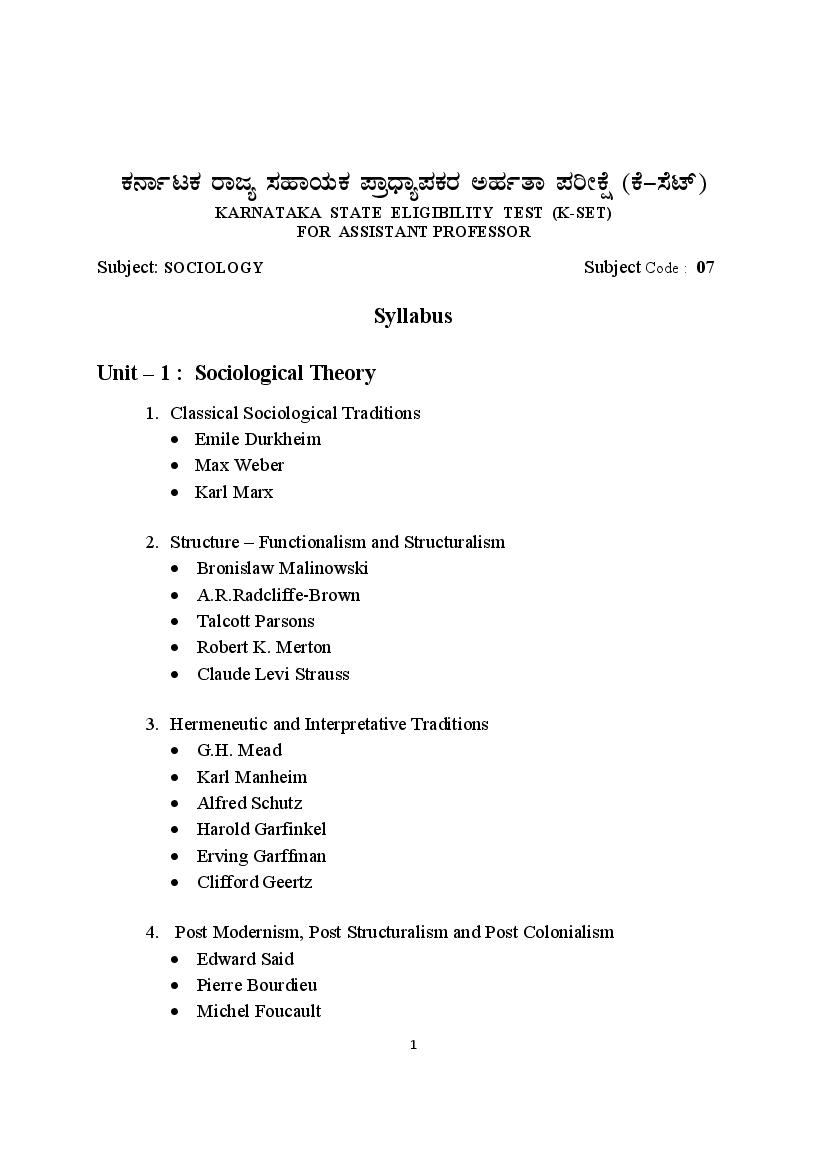
KARNATAKA STATE ELIGIBILITY TEST (K-SET)
FOR ASSISTANT PROFESSOR
Subject: SOCIOLOGY Subject Code : 07
Syllabus
Unit – 1 : Sociological Theory
1. Classical Sociological Traditions
Emile Durkheim
Max Weber
Karl Marx
2. Structure – Functionalism and Structuralism
Bronislaw Malinowski
A.R.Radcliffe-Brown
Talcott Parsons
Robert K. Merton
Claude Levi Strauss
3. Hermeneutic and Interpretative Traditions
G.H. Mead
Karl Manheim
Alfred Schutz
Harold Garfinkel
Erving Garffman
Clifford Geertz
4. Post Modernism, Post Structuralism and Post Colonialism
Edward Said
Pierre Bourdieu
Michel Foucault
1
Page 2
Anthony Giddens
Manuel Castells
5. Indian Thinkers
` M.K. Gandhi
B.R. Ambedkar
Radha Kamal Mukherjee
G. S. Ghurye
M.N. Srinivas
Irawati Karve
Unit – 2 : Research Methodology and Methods
1. Conceptualizing Social Reality
Philosophy of Science
Scientific Method and Epistemology in Social Science
Hermeneutic Traditions
Objectivity and Reflexivity in Social Science
Ethics and Politics
2. Formulating Research Design
Reading Social Science Research, Data and Documents
Induction And Deduction
Fact, Concept and Theory
Hypotheses, Research Questions, Objectives
3. Quantitative and Qualitative Methods
Ethnography
Survey Method
Historical Method
Comparative Method
2
Page 3
Sampling
Questionnaire and Schedule
Statistical Analysis
Observation, Interview and Case study
Interpretation, Date Analysis and Report Writing
Unit - 3 : Basic Concepts and Institutions
1. Sociological Concepts
Social Structure
Culture
Network
Status and Role
Identity
Community
Diaspora
Values, Norms and Rules
Personhood, Habits and Agency
Bureaucracy, Power and Authority
2. Social Institutions
Marriage, Family and Kinship
Economy
Polity
Religion
Education
Law and Customs
3. Social Stratification
Social Difference, Hierarchy, Inequality and Marginalization
Caste and Class
3
Page 4
Race, Tribe and Ethnicity
4. Social Change and Processes
Evolution and Diffusion
Modernization and Development
Social Transformations and Globalization
Social Mobility
Unit – 4 : Rural and Urban Transformation
1. Rural and Peasant Society
Caste – Tribe Settlements
Agrarian Social Structure and Emergent Class Relations
Land Ownership and Agrarian Relations
Decline of Agrarian Economy, De-Peasantization and Migration
Agrarian Unrest and Peasant Movements
Changing Inter – Community Relations and Violence
2. Urban Society
Urbanism, Urbanity and Urbanization
Towns, Cities and Meg – Cities
Industry, Service and Business
Neighbourhood, Slums and Ethnic Enclaves
Middle Class and Gated Communities
Urban Movements and Violence
Unit – 5 : State, Politics and Development
1. Political Processes in India
Tribe, Nation State and Border
4
Page 5
Governance and Development
Public Policy: Health, Education and Livelihoods
Political culture
Grass –root Democracy
Law and Society
Gender and Development
Corruption
Role of International Development Organizations
2. Social Movements and Protests
Political Factions, Pressure Groups
Movements based on Caste, Ethnicity, Ideology, Gender, Disability,
Religion and Region
Civil Society and Citizenship
NGOs, Activism and Leadership
Reservations and Politics
Unit – 6 : Economy and Society
Exchange, Gift, Capital, Labour and Market
Mode of Production Debates
Property and Property Relations
State and Market: Welfarism and Neoliberalism
Models of Economic Development
Poverty and Exclusion
Factory and Industry Systems
Changing Nature of Labour Relations
Gendre and Labour Process
Business and Family
Digital Economy, E-Commerce
5
Page 6
Tourism
Consumption
Unit – 7 : Environment and Society
Social and Cultural Ecology: Diverse Forms
Technological Change, Agriculture and Biodiversity
Indigenous Knowledge Systems and Ethno – Medicine
Gender and Environment
Forest Policies, Adivasis and Exclusion
Ecological Degradation and Migration
Development, Displacement and Rehabilitation
Water and Social Exclusion
Disasters and Community Responses
Environmental Pollution, Public Health and Disability
Climate Change and International Policies
Environmental Movements
Unit – 8 : Family, Marriage and Kinship
Theoretical Approaches: Structure-Functionalist, Alliance and
Cultural
Gender Relations and Power Dynamics
Inheritance, Succession and Authority
Gender, Sexuality and Reproduction
Children, Youth and Elderly
Emotions and Family
Emergent Forms of Family
Changing Marriage Practices
Changing Care and Support Systems
Family Laws
Domestic Violence and Crime against Women
6
Page 7
Unit – 9 : Science, Technology and Society
History of Technological Development
Changing notions of Time and Space
Flows and Boundaries
Virtual Community
Media: Print and Electronic, Visual and Social Media
E-Governance and Surveillance Society
Technology and Emerging Political Processes
State Policy, Digital Divide and Inclusion
Technology and Changing Family Relations
Technology and Changing Health System
Food and Technology
Cyber Crime
Unit – 10 : Culture and Symbolic Transformations
Signs and Symbols
Rituals, Beliefs and Practices
Changing Material Culture
Moral Economy
Education: Formal and Informal
Religious Organizations, Piety and Spirituality
Commodification of Rituals
Communalism and Secularism
Cultural Identity and Mobilization
Culture and Politics
Gender, Body and Culture
Art and Aesthetics
Ethics and Morality
Sports and Culture
Pilgrimage and Religious Tourism
7
Page 8
Culture and Environment
New Religious Movements
***
8
Document Details
| Board / Org | Karnataka Exams |
| Exam | Karnataka State Eligibility Test |
| Type | Syllabus |
| Pages | 8 |
| Updated | 24 Sep 2026 |