KSET Syllabus Education
Finished viewing? Save it for later —
Download KSET Syllabus Education (PDF · 7 pages)About KSET Syllabus Education
KSET Syllabus Education is available here for free download. Published by Karnataka Exams for Karnataka State Eligibility Test, this syllabus can be viewed online or downloaded as a PDF (7 pages). Candidates preparing for Karnataka State Eligibility Test can use KSET Syllabus Education to understand the exam pattern, the type of questions asked, and the overall difficulty level.
Frequently Asked Questions
How can I download KSET Syllabus Education?
Open this page and click the Download button to save KSET Syllabus Education as a PDF. It is completely free on AglaSem Docs.
Is KSET Syllabus Education free to download?
Yes. KSET Syllabus Education can be viewed online and downloaded as a PDF free of cost on AglaSem Docs.
How many pages does KSET Syllabus Education have?
KSET Syllabus Education contains 7 pages, which you can read online or download together as a single PDF.
Where can I find more Karnataka State Eligibility Test study material?
You can find more Karnataka State Eligibility Test question papers, sample papers, syllabus, and answer keys on AglaSem Docs.
KSET Syllabus Education – Text
Read the full text of this syllabus below — useful to quickly search, copy and reference the content online without downloading the PDF.
📄 View text version (7 pages)
Page 1
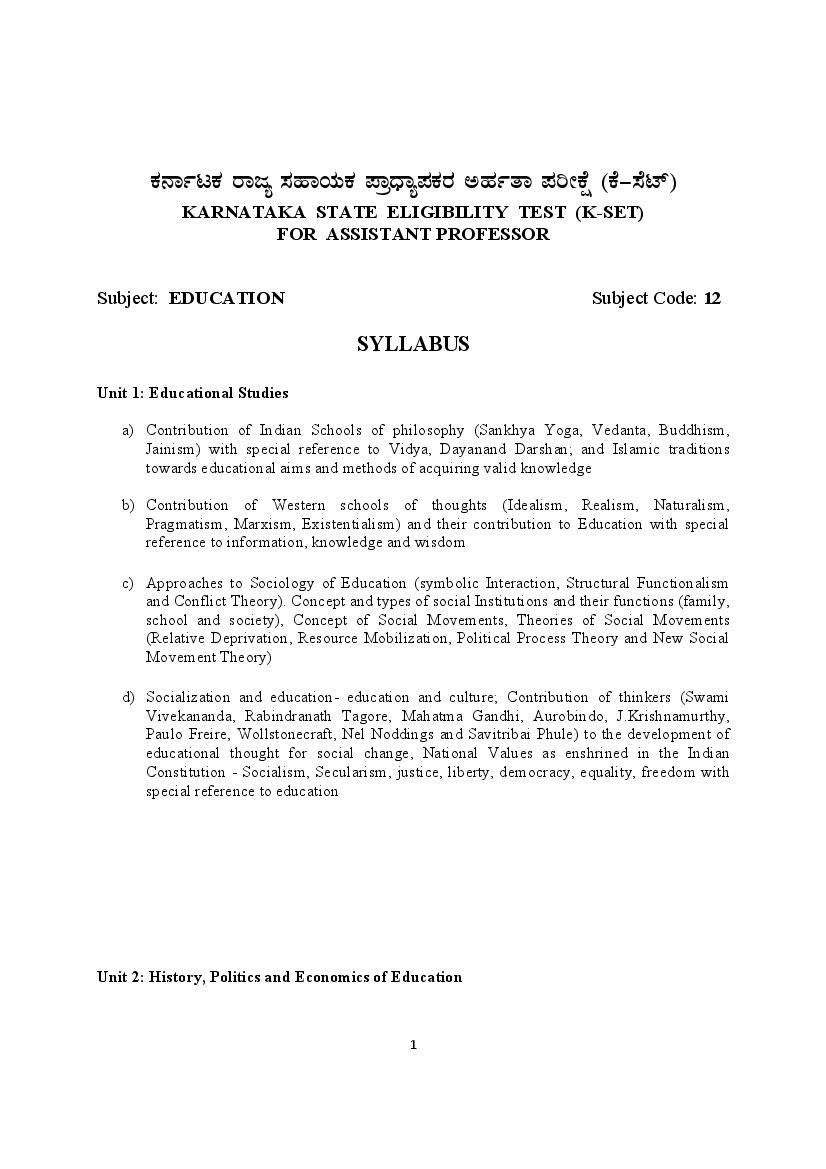
KARNATAKA STATE ELIGIBILITY TEST (K-SET)
FOR ASSISTANT PROFESSOR
Subject: EDUCATION Subject Code: 12
SYLLABUS
Unit 1: Educational Studies
a) Contribution of Indian Schools of philosophy (Sankhya Yoga, Vedanta, Buddhism,
Jainism) with special reference to Vidya, Dayanand Darshan; and Islamic traditions
towards educational aims and methods of acquiring valid knowledge
b) Contribution of Western schools of thoughts (Idealism, Realism, Naturalism,
Pragmatism, Marxism, Existentialism) and their contribution to Education with special
reference to information, knowledge and wisdom
c) Approaches to Sociology of Education (symbolic Interaction, Structural Functionalism
and Conflict Theory). Concept and types of social Institutions and their functions (family,
school and society), Concept of Social Movements, Theories of Social Movements
(Relative Deprivation, Resource Mobilization, Political Process Theory and New Social
Movement Theory)
d) Socialization and education- education and culture; Contribution of thinkers (Swami
Vivekananda, Rabindranath Tagore, Mahatma Gandhi, Aurobindo, J.Krishnamurthy,
Paulo Freire, Wollstonecraft, Nel Noddings and Savitribai Phule) to the development of
educational thought for social change, National Values as enshrined in the Indian
Constitution - Socialism, Secularism, justice, liberty, democracy, equality, freedom with
special reference to education
Unit 2: History, Politics and Economics of Education
1
Page 2
Commission (1953), Kothari Education Commission (1964-66), National Policy of
Education (1986,1992), National Commission on Teachers (1999), National Curriculum
Framework 2005, National Knowledge Commission (2007), Yashpal Committee Report
(2009), National Curriculum Framework for Teacher Education (2009), Justice Verma
Committee Report (2012)
b) Relationship between Policies and Education, Linkage between Educational Policy and
National Development, Determinants of Educational Policy and Process of Policy
formulation: Analysis of the existing situation, generation of policy options, evaluation of
policy options, making the policy decision, planning of policy implementation, policy
impact assessment and subsequent policy cycles.
c) Concept of Economics of Education: Cost Benefit Analysis Vs Cost Effective Analysis in
Education, Economic returns to Higher Education Signaling Theory Vs Human Capital
Theory, Concept of Educational Finance; Educational finance at Micro and Macro
Levels, Concept of Budgeting
d) Relationship Between Politics and Education, Perspectives of Politics of Education
Liberal, Conservative and Critical, Approaches to understanding Politics
(Behaviouralism, Theory of Systems Analysis and Theory of Rational Choice), Education
for Political Development and Political Socialization
Unit 3: Learner and Learning Process
a) Growth and Development: Concept and principles ,Cognitive Processes and stages of
Cognitive Development , Personality: Definitions and theories (Freud, Carl Rogers,
Gordon Allport, Max Wertheimer, Kurt Koffka) , Mental health and Mental hygiene
b) Approaches to Intelligence from Unitary to Multiple: Concepts of Social intelligence,
multiple intelligence, emotional intelligence Theories of Intelligence by Sternberg,
Gardner, Assessment of Intelligence, Concepts of Problem Solving, Critical thinking,
Metacognition and Creativity
c) Principles and Theories of learning: Behaviouristic, Cognitive and Social theories of
learning, Factors affecting social learning, social competence, Concept of social
cognition, understanding social relationship and socialization goals
d) Guidance and Counselling: Nature, Principles and Need, Types of guidance (educational,
vocational, personal, health and social & Directive, Non-directive and Eclectic),
Approaches to counselling – Cognitive-Behavioural (Albert Ellis – REBT) &
Humanistic, Personcentred Counselling (Carl Rogers) - Theories of Counselling
(Behaviouristic, Rational, Emotive and Reality)
2
Page 3
a) Meaning, Nature and Scope of Teacher Education; Types of Teacher Education
Programs, The Structure of Teacher Education Curriculum and its Vision in Curriculum
Documents of NCERT and NCTE at Elementary, Secondary and Higher Secondary
Levels , Organization of Components of Pre-service Teacher Education Transactional
Approaches (for foundation courses) Expository, Collaborative and Experiential learning
b) Understanding Knowledge base of Teacher Education from the view point of Schulman,
Deng and Luke & Habermas, Meaning of Reflective Teaching and Strategies for
Promoting Reflective Teaching, Models of Teacher Education - Behaviouristic,
Competency-based and Inquiry Oriented Teacher Education Models
c) Concept, Need, Purpose and Scope of In-service Teacher Education, Organization and
Modes of In-service Teacher Education, Agencies and Institutions of In-service Teacher
Education at District, State and National Levels (SSA, RMSA, SCERT, NCERT, NCTE
and UGC), Preliminary Consideration in Planning in-service teacher education
programme (Purpose, Duration, Resources and Budget)
d) Concept of Profession and Professionalism, Teaching as a Profession, Professional Ethics
of Teachers, Personal and Contextual factors affecting Teacher Development, ICT
Integration, Quality Enhancement for Professionalization of Teacher Education,
Innovation in Teacher Education
Unit 5: Curriculum Studies
a) Concept and Principles of Curriculum, Strategies of Curriculum Development, Stages in
the Process of Curriculum development, Foundations of Curriculum Planning -
Philosophical Bases (National, democratic), Sociological basis (socio cultural
reconstruction), Psychological Bases (learner’s needs and interests),Bench marking and
Role of National level Statutory Bodies - UGC, NCTE and University in Curriculum
Development
b) Models of Curriculum Design: Traditional and Contemporary Models (Academic /
Discipline Based Model, Competency Based Model, Social Functions / Activities Model
[social reconstruction], Individual Needs & Interests Model, Outcome Based Integrative
Model , Intervention Model, C I P P Model (Context, Input, Process, Product Model
c) Instructional System, Instructional Media, Instructional Techniques and Material in
enhancing curriculum Transaction, Approaches to Evaluation of Curriculum :
Approaches to Curriculum and Instruction (Academic and Competency Based
Approaches), Models of Curriculum Evaluation: Tyler’s Model, Stakes’ Model, Scriven’s
Model, Kirkpatrick’s Model
d) Meaning and types of Curriculum change, Factors affecting curriculum change,
Approaches to curriculum change, Role of students, teachers and educational
3
Page 4
Types of Research in Curriculum Studies
Unit 6: Research in Education
a) Meaning and Scope of Educational Research, Meaning and steps of Scientific Method,
Characteristics of Scientific Method (Replicability, Precision, Falsifiability and
Parsimony), Types of Scientific Method (Exploratory, Explanatory and Descriptive),
Aims of research as a scientific activity: Problem-solving, Theory Building and
Prediction, Types of research (Fundamental, Applied and Action), Approaches to
educational research (Quantitative and Qualitative), Designs in educational research
(Descriptive, Experimental and Historical)
b) Variables: Meaning of Concepts, Constructs and Variables, Types of Variables
(Independent, Dependent, Extraneous, Intervening and Moderator), Hypotheses -
Concept, Sources, Types (Research, Directional, Non-directional, Null), Formulating
Hypothesis, Characteristics of a good hypothesis, Steps of Writing a Research Proposal,
Concept of Universe and Sample, Characteristics of a good Sample, Techniques of
Sampling (Probability and Non-probability Sampling), Tools of Research - Validity,
Reliability and Standardisation of a Tool, Types of Tools (Rating scale, Attitude scale,
Questionnaire, Aptitude test and Achievement Test, Inventory), Techniques of Research
(Observation, Interview and Projective Techniques)
c) Types of Measurement Scale (Nominal, Ordinal, Interval and Ratio), Quantitative Data
Analysis - Descriptive data analysis (Measures of central tendency, variability, fiduciary
limits and graphical presentation of data), Testing of Hypothesis (Type I and Type II
Errors), Levels of Significance, Power of a statistical test and effect size, Parametric
Techniques, Non- Parametric Techniques , Conditions to be satisfied for using parametric
techniques, Inferential data analysis, Use and Interpretation of statistical techniques:
Correlation, t-test, z-test, ANOVA, chi-square (Equal Probability and Normal Probability
Hypothesis). Qualitative Data Analysis - Data Reduction and Classification, Analytical
Induction and Constant Comparison, Concept of Triangulation
d) Qualitative Research Designs: Grounded Theory Designs (Types, characteristics, designs,
Steps in conducting a GT research, Strengths and Weakness of GT) - Narrative Research
Designs (Meaning and key Characteristics, Steps in conducting NR design), Case Study
(Meaning, Characteristics, Components of a CS design, Types of CS design, Steps of
conducting a CS research, Strengths and weaknesses), Ethnography (Meaning,
Characteristics, Underlying assumptions, Steps of conducting ethnographic research,
Writing ethnographic account, Strengths and weaknesses), Mixed Method Designs:
Characteristics, Types of MM designs (Triangulation, explanatory and exploratory
designs), Steps in conducting a MM designs, Strengths and weakness of MM research.
Unit 7: Pedagogy, Andragogy and Assessment
4
Page 5
Need and its implications in Teacher Education, Organizing Teaching: Memory Level
(Herbartian Model), Understanding Level (Morrison teaching Model), Reflective Level
(Bigge and Hunt teaching Model), Concept of Andragogy in Education: Meaning,
Principles, Competencies of Self-directed Learning, Theory of Andragogy (Malcolm
Knowles), The Dynamic Model of Learner Autonomy
b) Assessment – Meaning, nature, perspectives (assessment for Learning, assessment of
learning and Assessment of Learning) - Types of Assessment (Placement, formative,
diagnostic, summative) Relations between objectives and outcomes , Assessment of
Cognitive (Anderson and Krathwohl), Affective (Krathwohl) and psychomotor domains
(R.H. Dave) of learning
c) ) Assessment in Pedagogy of Education: Feedback Devices: Meaning, Types, Criteria,
Guidance as a Feedback Devices: Assessment of Portfolios, Reflective Journal, Field
Engagement using Rubrics, Competency Based Evaluation, Assessment of Teacher
Prepared ICT Resources
d) Assessment in Andragogy of Education - Interaction Analysis: Flanders’ Interaction
analysis, Galloway’s system of interaction analysis (Recording of Classroom Events,
Construction and Interpretation of Interaction Matrix), Criteria for teacher evaluation
(Product, Process and Presage criteria, Rubrics for Self and Peer evaluation (Meaning,
steps of construction).
Unit 8: Technology in/ for Education
a) Concept of Educational Technology (ET) as a Discipline: (Information Technology,
Communication Technology & Information and Communication Technology (ICT) and
Instructional Technology, Applications of Educational Technology in formal, non formal
(Open and Distance Learning), informal and inclusive education systems, Overview of
Behaviourist, Cognitive and Constructivist Theories and their implications to
Instructional Design (Skinner, Piaget, Ausubel, Bruner, Vygotsky), Relationship between
Learning Theories and Instructional Strategies (for large and small groups, formal and
non formal groups )
b) Systems Approach to Instructional Design, Models of Development of Instructional
Design (ADDIE, ASSURE, Dick and Carey Model Mason’s), Gagne’s Nine Events of
Instruction and Five E’s of Constructivism, Nine Elements of Constructivist Instructional
Design, Application of Computers in Education: CAI, CAL, CBT, CML, Concept,
Process of preparing ODLM, Concept of e learning, Approaches to e learning (Offline,
Online, Synchronous, Asynchronous, Blended learning, mobile learning)
c) Emerging Trends in e learning: Social learning (concept , use of web 2.0 tools for
learning, social networking sites, blogs, chats, video conferencing, discussion forum),
5
Page 6
and application), E Inclusion - Concept of E Inclusion, Application of Assistive
technology in E learning , Quality of E Learning – Measuring quality of system:
Information, System, Service, User Satisfaction and Net Benefits (D&M IS Success
Model, 2003), Ethical Issues for E Learner and E Teacher - Teaching, Learning and
Research
d) Use of ICT in Evaluation, Administration and Research: E portfolios, ICT for Research -
Online Repositories and Online Libraries, Online and Offline assessment tools (Online
survey tools or test generators) – Concept and Development.
Unit 9: Educational Management, Administration and Leadership
a) Educational Management and Administration – Meaning, Principles, Functions and
importance, Institutional building, POSDCORB, CPM, PERT, Management as a system,
SWOT analysis, Taylorism, Administration as a process, Administration as a
bureaucracy, Human relations approach to Administration, Organisational compliance,
Organinsational development, Organisational climate
b) Leadership in Educational Administration: Meaning and Nature, Approaches to
leadership: Trait, Transformational, Transactional, Value based, Cultural, Psychodynamic
and Charismatic, Models of Leadership (Blake and Mouton’s Managerial Grid, Fiedler’s
Contingency Model, Tri-dimensional Model, Hersey and Blanchard’s Model, Leader-
Member Exchange Theory)
c) Concept of Quality and Quality in Education: Indian and International perspective,
Evolution of Quality: Inspection, Quality Control, Quality Assurance, Total Quality
Management (TQM), Six sigma, Quality Gurus: Walter Shewart, Edward Deming, C.K
Pralhad
d) Change Management: Meaning, Need for Planned change, ThreeStep-Model of Change
(Unfreezing, Moving, Refreezing), The Japanese Models of Change: Just-in-Time, Poka
yoke, Cost of Quality: Appraisal Costs, Failure costs and Preventable costs, Cost Benefit
Analysis, Cost Effective Analysis, Indian and International Quality Assurance Agencies:
Objectives, Functions, Roles and Initiatives (National Assessment Accreditation Council
[NAAC], Performance Indicators, Quality Council of India [QCI] , International Network
for Quality Assurance Agencies in Higher Education [INQAAHE].
Unit 10: Inclusive Education
6
Page 7
Including Marginalized group and Learners with Disabilities), Evolution of the
Philosophy of Inclusive Education: Special, Integrated, Inclusive Education, Legal
Provisions: Policies and Legislations (National Policy of Education (1986), Programme
of Action of Action (1992), Persons with Disabilities Act (1995), National Policy of
Disabilities (2006), National Curriculum Framework (2005), Concession and Facilities to
Diverse Learners (Academic and Financial), Rehabilitation Council of India Act (1992),
Inclusive Education under Sarva Shiksha Abhiyan (SSA), Features of UNCRPD (United
Nations Convention on the Rights of Persons with Disabilities) and its Implication
b) Concept of Impairment, Disability and Handicap, Classification of Disabilities based on
ICF Model, Readiness of School and Models of Inclusion, Prevalence, Types,
Characteristics and Educational Needs of Diverse learners’ Intellectual, Physical and
Multiple Disabilities, Causes and prevention of disabilities, Identification of Diverse
Learners for Inclusion, Educational Evaluation Methods, Techniques and Tools
c) Planning and Management of Inclusive Classrooms: Infrastructure, Human Resource and
Instructional Practices, Curriculum and Curricular Adaptations for Diverse Learners,
Assistive and Adaptive Technology for Diverse learners: Product (Aids and Appliances)
and Process (Individualized Education Plan, Remedial Teaching), ParentProfessional
Partnership: Role of Parents, Peers, Professionals, Teachers, School
d) Barriers and Facilitators in Inclusive Education: Attitude, Social and Educational, Current
Status and Ethical Issues of inclusive education in India, Research Trends of Inclusive
Education in India
7
Document Details
| Board / Org | Karnataka Exams |
| Exam | Karnataka State Eligibility Test |
| Type | Syllabus |
| Pages | 7 |
| Updated | 24 Sep 2026 |