JEE Main 2022 Syllabus Physics
Finished viewing? Save it for later —
Download JEE Main 2022 Syllabus Physics (PDF · 4 pages)About JEE Main 2022 Syllabus Physics
JEE Main 2022 Syllabus Physics is available here for free download. Published by NTA for Joint Entrance Examination Main, this syllabus can be viewed online or downloaded as a PDF (4 pages). Candidates preparing for Joint Entrance Examination Main can use JEE Main 2022 Syllabus Physics to understand the exam pattern, the type of questions asked, and the overall difficulty level.
Frequently Asked Questions
How can I download JEE Main 2022 Syllabus Physics?
Open this page and click the Download button to save JEE Main 2022 Syllabus Physics as a PDF. It is completely free on AglaSem Docs.
Is JEE Main 2022 Syllabus Physics free to download?
Yes. JEE Main 2022 Syllabus Physics can be viewed online and downloaded as a PDF free of cost on AglaSem Docs.
How many pages does JEE Main 2022 Syllabus Physics have?
JEE Main 2022 Syllabus Physics contains 4 pages, which you can read online or download together as a single PDF.
Where can I find more Joint Entrance Examination Main study material?
You can find more Joint Entrance Examination Main question papers, sample papers, syllabus, and answer keys on AglaSem Docs.
JEE Main 2022 Syllabus Physics – Text
Read the full text of this syllabus below — useful to quickly search, copy and reference the content online without downloading the PDF.
📄 View text version (4 pages)
Page 1
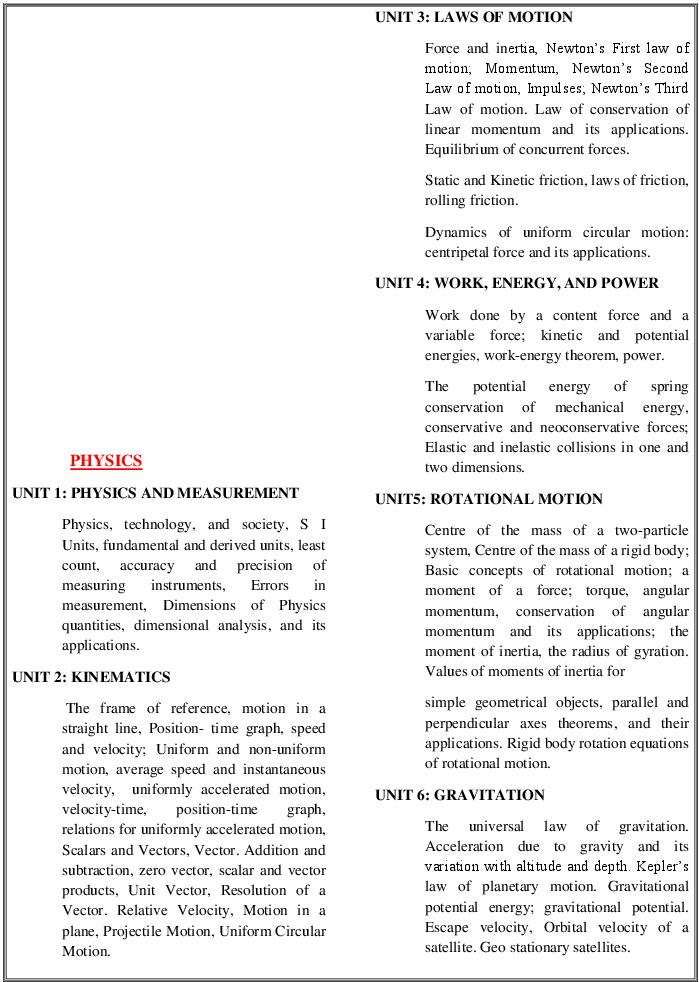
Force and inertia, Newton’s First law of
motion; Momentum, Newton’s Second
Law of motion, Impulses; Newton’s Third
Law of motion. Law of conservation of
linear momentum and its applications.
Equilibrium of concurrent forces.
Static and Kinetic friction, laws of friction,
rolling friction.
Dynamics of uniform circular motion:
centripetal force and its applications.
UNIT 4: WORK, ENERGY, AND POWER
Work done by a content force and a
variable force; kinetic and potential
energies, work-energy theorem, power.
The potential energy of spring
conservation of mechanical energy,
conservative and neoconservative forces;
Elastic and inelastic collisions in one and
PHYSICS two dimensions.
UNIT 1: PHYSICS AND MEASUREMENT UNIT5: ROTATIONAL MOTION
Physics, technology, and society, S I Centre of the mass of a two-particle
Units, fundamental and derived units, least system, Centre of the mass of a rigid body;
count, accuracy and precision of Basic concepts of rotational motion; a
measuring instruments, Errors in moment of a force; torque, angular
measurement, Dimensions of Physics momentum, conservation of angular
quantities, dimensional analysis, and its momentum and its applications; the
applications. moment of inertia, the radius of gyration.
UNIT 2: KINEMATICS Values of moments of inertia for
The frame of reference, motion in a simple geometrical objects, parallel and
straight line, Position- time graph, speed perpendicular axes theorems, and their
and velocity; Uniform and non-uniform applications. Rigid body rotation equations
motion, average speed and instantaneous of rotational motion.
velocity, uniformly accelerated motion, UNIT 6: GRAVITATION
velocity-time, position-time graph,
relations for uniformly accelerated motion, The universal law of gravitation.
Scalars and Vectors, Vector. Addition and Acceleration due to gravity and its
subtraction, zero vector, scalar and vector variation with altitude and depth. Kepler’s
products, Unit Vector, Resolution of a law of planetary motion. Gravitational
Vector. Relative Velocity, Motion in a potential energy; gravitational potential.
plane, Projectile Motion, Uniform Circular Escape velocity, Orbital velocity of a
Motion. satellite. Geo stationary satellites.
Page 2
field due to infinitely long uniformly charged
Elastic behaviour, Stress-strain relationship, Hooke's
straight wire, uniformly charged infinite plane sheet,
Law. Young's modulus, bulk modulus, modulus of
and uniformly charged thin spherical shell. Electric
rigidity. Pressure due to a fluid column; Pascal's law
potential and its calculation for a point charge,
and its applications. Viscosity. Stokes' law. terminal
electric dipole and system of charges; Equipotential
velocity, streamline, and turbulent flow. Reynolds
surfaces, Electrical potential energy of a system of
number. Bernoulli's principle and its applications.
two point charges in an electrostatic field.
Surface energy and surface tension, angle of contact,
application of surface tension - drops, bubbles, and Conductors and insulators. Dielectrics and electric
capillary rise. Heat, temperature, thermal expansion; polarization, capacitor, the combination of capacitors
specific heat capacity, calorimetry; change of state, in series and parallel, capacitance of a parallel plate
latent heat. Heat transfer-conduction, convection, capacitor with and without dielectric medium
and radiation. Newton's law of cooling. between the plates. Energy stored in a capacitor.
UNIT 8: THERMODYNAMICS UNIT 12: CURRENT ELECTRICITY
Thermal equilibrium, zeroth law of thermodynamics, Electric current. Drift velocity. Ohm's law. Electrical
the concept of temperature. Heat, work, and internal resistance. Resistances of different materials. V-l
energy. The first law of thermodynamics. The characteristics of Ohmic and non-ohmic conductors.
second law of thermodynamics: reversible and Electrical energy and power. Electrical resistivity.
irreversible processes. Carnot engine and its Colour code for resistors; Series and parallel
efficiency. combinations of resistors; Temperature dependence
UNIT 9: KINETIC THEORY OF GASES of resistance.
Equation of state of a perfect gas, work done on Electric Cell and its Internal resistance, potential
compressing a gas, Kinetic theory of gases - difference and emf of a cell, a combination of cells
assumptions, the concept of pressure. Kinetic energy in series and parallel. Kirchhoff’s laws and their
and temperature: RMS speed of gas molecules: applications. Wheatstone bridge. Metre Bridge.
Degrees of freedom. Law of equipartition of energy, Potentiometer - principle and its applications.
applications to specific heat capacities of gases;
Mean free path. Avogadro's number. UNIT 13: MAGNETIC EFFECTS OF CURRENT AND
MAGNETISM
UNIT 10: OSCILLATIONS AND WAVES
Biot - Savart law and its application to current
Periodic motion - period, frequency, displacement as carrying circular loop. Ampere's law and its
a function of time. Periodic functions. Simple applications to infinitely long current carrying
harmonic motion (S.H.M.) and its equation; phase: straight wire and solenoid. Force on a moving charge
oscillations of a spring -restoring force and force in uniform magnetic and electric fields. Cyclotron.
constant: energy in S.H.M. - Kinetic and potential
energies; Simple pendulum - derivation of Force on a current-carrying conductor in a uniform
expression for its time period: Free, forced and magnetic field. The force between two parallel
damped oscillations, resonance. currents carrying conductors-definition of ampere.
Torque experienced by a current loop in a uniform
Wave motion. Longitudinal and transverse waves, magnetic field: Moving coil galvanometer, its
speed of a wave. Displacement relation for a current sensitivity, and conversion to ammeter and
progressive wave. Principle of superposition of voltmeter.
waves, a reflection of waves. Standing waves in
strings and organ pipes, fundamental mode and Current loop as a magnetic dipole and its magnetic
harmonics. Beats. Doppler Effect in sound dipole moment. Bar magnet as an equivalent
solenoid, magnetic field lines; Earth's magnetic field
UNIT 11: ELECTROSTATICS and magnetic elements. Para-, dia- and
ferromagnetic substances. Magnetic susceptibility
Electric charges: Conservation of charge. Coulomb's
and permeability. Hysteresis. Electromagnets and
law forces between two point charges, forces
permanent magnets.
between multiple charges: superposition principle
and continuous charge distribution.
UNIT 14: ELECTROMAGNETIC INDUCTION AND
Electric field: Electric field due to a point charge, ALTERNATING CURRENTS
Electric field lines. Electric dipole, Electric field due Electromagnetic induction: Faraday's law. Induced
to a dipole. Torque on a dipole in a uniform electric emf and current: Lenz’s Law, Eddy currents. Self
field. and mutual inductance. Alternating currents, peak
Page 3
reactance and impedance: LCR series circuit, oscillator. Logic gates (OR. AND. NOT. NAND and
resonance: Quality factor, power in AC circuits, NOR). Transistor as a switch.
wattless current. AC generator and transformer.
UNIT 15: ELECTROMAGNETIC WAVES UNIT 20: COMMUNICATION SYSTEMS
Electromagnetic waves and their characteristics, Propagation of electromagnetic waves in the
Transverse nature of electromagnetic waves, atmosphere; Sky and space wave propagation. Need
Electromagnetic spectrum (radio waves, for modulation. Amplitude and Frequency
microwaves, infrared, visible, ultraviolet. X-rays. Modulation, Bandwidth of signals. the bandwidth of
Gamma rays), Applications of e.m. waves. Transmission medium, Basic Elements of a
Communication System (Block Diagram only).
UNIT 16: OPTICS
Reflection and refraction of light at plane and UNIT 21: EXPERIMENTAL SKILLS
spherical surfaces, mirror formula. Total internal Familiarity with the basic approach and observations
reflection and its applications. Deviation and of the experiments and activities:
Dispersion of light by a; prism; Lens Formula. 1. Vernier calipers-its use to measure the internal
Magnification. Power of a Lens. Combination of thin and external diameter and depth of a vessel.
lenses in contact. Microscope and Astronomical 2. Screw gauge-its use to determine thickness/
Telescope (reflecting and refracting ) and their diameter of thin sheet/wire.
magnifying powers. 3. Simple Pendulum-dissipation of energy by
plotting a graph between the square of
Wave optics: wavefront and Huygens' principle.
amplitude and time.
Laws of reflection and refraction using Huygens
4. Metre Scale - the mass of a given object by the
principle. Interference, Young's double-slit
principle of moments.
experiment and expression for fringe width, coherent
5. Young's modulus of elasticity of the material of
sources, and sustained interference of light.
a metallic wire.
Diffraction due to a single slit, width of central
6. Surf ace tension of water by capillary rise and
maximum. Resolving power of microscopes and
effect of detergents,
astronomical telescopes. Polarization, plane-
7. Co-efficient of Viscosity of a given viscous
polarized light: Brewster's law, uses of plane-
liquid by measuring terminal velocity of a given
polarized light and Polaroid.
spherical body,
UNIT 17: DUAL NATURE OF MATTER AND 8. Plotting a cooling curve for the relationship
RADIATION between the temperature of a hot body and time.
Dual nature of radiation. Photoelectric effect. Hertz 9. Speed of sound in air at room temperature using
and Lenard's observations; Einstein's photoelectric a resonance tube,
equation: particle nature of light. Matter waves-wave 10. Specific heat capacity of a given (i) solid and
nature of particle, de Broglie relation. Davisson- (ii) liquid by method of mixtures.
Germer experiment. 11. The resistivity of the material of a given wire
using a metre bridge.
UNIT 18: ATOMS AND NUCLEI 12. The resistance of a given wire using Ohm's law.
Alpha-particle scattering experiment; Rutherford's 13. Potentiometer-
model of atom; Bohr model, energy levels, hydrogen i. Comparison of emf of two primary cells.
spectrum. Composition and size of nucleus, atomic ii. Determination of internal resistance of a
masses, isotopes, isobars: isotones. Radioactivity- cell.
alpha. beta and gamma particles/rays and their
properties; radioactive decay law. Mass-energy 14. Resistance and figure of merit of a galvanometer
relation, mass defect; binding energy per nucleon by half deflection method.
and its variation with mass number, nuclear fission, 15. The focal length of;
and fusion. (i) Convex mirror
(ii) Concave mirror, and
UNIT 19: ELECTRONIC DEVICES
(ii) Convex lens,
Semiconductors; semiconductor diode: 1-V
characteristics in forward and reverse bias; diode as using the parallax
a rectifier; I-V characteristics of LED. the method.
photodiode, solar cell, and Zener diode; Zener diode 16. The plot of the angle of deviation vs angle of
as a voltage regulator. Junction transistor, transistor incidence for a triangular prism.
action, characteristics of a transistor: transistor as an 17. Refractive index of a glass slab using a
Page 4
18. Characteristic curves of a p-n junction diode in and metallic solids, amorphous and crystalline
forward and reverse bias. solids (elementary idea); Bragg's Law and its
19. Characteristic curves of a Zener diode and applications: Unit cell and lattices, packing in solids
finding reverse break down voltage. (fcc, bcc and hcp lattices), voids, calculations
20. Characteristic curves of a transistor and finding involving unit cell parameters, an imperfection in
solids; Electrical and magnetic properties.
current gain and voltage gain.
21. Identification of Diode. LED, Transistor. IC. UNIT 3: ATOMIC STRUCTURE
Resistor. A capacitor from a mixed collection of
such items. Thomson and Rutherford atomic models and their
22. Using a multimeter to: limitations; Nature of electromagnetic radiation,
photoelectric effect; Spectrum of the hydrogen
(i) Identify the base of a transistor atom. Bohr model of a hydrogen atom - its
(ii) Distinguish between NPN and PNP type postulates, derivation of the relations for the energy
transistor of the electron and radii of the different orbits,
(iii) See the unidirectional current in case of a limitations of Bohr's model; Dual nature of matter,
diode and an LED. de Broglie's relationship. Heisenberg uncertainty
(iv) Check the correctness or otherwise of a principle. Elementary ideas of quantum mechanics,
given electronic component (diode, quantum mechanics, the quantum mechanical model
transistor, or IC). of the atom, its important features. Concept of
atomic orbitals as one-electron wave functions:
CHEMISTRY Variation of and 2 with r for 1s and 2s orbitals;
various
quantum numbers (principal, angular momentum,
PHYSICAL CHEMISTRY and magnetic quantum numbers) and their
significance; shapes of s, p, and d - orbitals, electron
UNIT I: SOME BASIC CONCEPTS IN CHEMISTRY
spin and spin quantum number: Rules for filling
Matter and its nature, Dalton's atomic theory: electrons in orbitals – Aufbau principle. Pauli's
Concept of atom, molecule, element, and exclusion principle and Hund's rule, electronic
compound: Physical quantities and their configuration of elements, extra stability of half-
measurements in Chemistry, precision, and filled and completely filled orbitals.
accuracy, significant figures. S.I.Units, dimensional
analysis: Laws of chemical combination; Atomic UNIT 4: CHEMICAL BONDING AND MOLECULAR
and molecular masses, mole concept, molar mass, STRUCTURE
percentage composition, empirical and molecular Kossel - Lewis approach to chemical bond
formulae: Chemical equations and stoichiometry. formation, the concept of ionic and covalent bonds.
UNIT 2: STATES OF MATTER Ionic Bonding: Formation of ionic bonds, factors
Classification of matter into solid, liquid, and affecting the formation of ionic bonds; calculation
gaseous states. of lattice enthalpy.
Covalent Bonding: Concept of electronegativity.
Gaseous State:
Fajan’s rule, dipole moment: Valence Shell Electron
Measurable properties of gases: Gas laws - Boyle's Pair Repulsion (VSEPR ) theory and shapes of
law, Charle’s law. Graham's law of diffusion. simple molecules.
Avogadro's law, Dalton's law of partial pressure;
Quantum mechanical approach to covalent bonding:
Concept of Absolute scale of temperature; Ideal gas
Valence bond theory - its important features, the
equation; Kinetic theory of gases (only postulates); concept of hybridization involving s, p, and d
Concept of average, root mean square and most orbitals; Resonance.
probable velocities; Real gases, deviation from Ideal
behaviour, compressibility factor, and van der Molecular Orbital Theory - Its important features.
Waals equation. LCAOs, types of molecular orbitals (bonding,
antibonding), sigma and pi-bonds, molecular orbital
Liquid State: electronic configurations of homonuclear diatomic
Properties of liquids - vapour pressure, viscosity and molecules, the concept of bond order, bond length,
surface tension, and effect of temperature on them and bond energy.
(qualitative treatment only). Elementary idea of metallic bonding. Hydrogen
Solid State: bonding and its applications.
UNIT 5: CHEMICAL THERMODYNAMICS
Document Details
| Board / Org | NTA |
| Exam | Joint Entrance Examination Main |
| Type | Syllabus |
| Pages | 4 |
| Language | english |
| Updated | 09 Jun 2026 |