JEE Main 2023 Syllabus for Mathematics
Finished viewing? Save it for later —
Download JEE Main 2023 Syllabus for Mathematics (PDF · 3 pages)About JEE Main 2023 Syllabus for Mathematics
JEE Main 2023 Syllabus for Mathematics is available here for free download. Published by NTA for JEE Main, this syllabus can be viewed online or downloaded as a PDF (3 pages). Candidates preparing for JEE Main can use JEE Main 2023 Syllabus for Mathematics to understand the exam pattern, the type of questions asked, and the overall difficulty level.
Frequently Asked Questions
How can I download JEE Main 2023 Syllabus for Mathematics?
Open this page and click the Download button to save JEE Main 2023 Syllabus for Mathematics as a PDF. It is completely free on AglaSem Docs.
Is JEE Main 2023 Syllabus for Mathematics free to download?
Yes. JEE Main 2023 Syllabus for Mathematics can be viewed online and downloaded as a PDF free of cost on AglaSem Docs.
How many pages does JEE Main 2023 Syllabus for Mathematics have?
JEE Main 2023 Syllabus for Mathematics contains 3 pages, which you can read online or download together as a single PDF.
Where can I find more JEE Main study material?
You can find more JEE Main question papers, sample papers, syllabus, and answer keys on AglaSem Docs.
JEE Main 2023 Syllabus for Mathematics – Text
Read the full text of this syllabus below — useful to quickly search, copy and reference the content online without downloading the PDF.
📄 View text version (3 pages)
Page 1
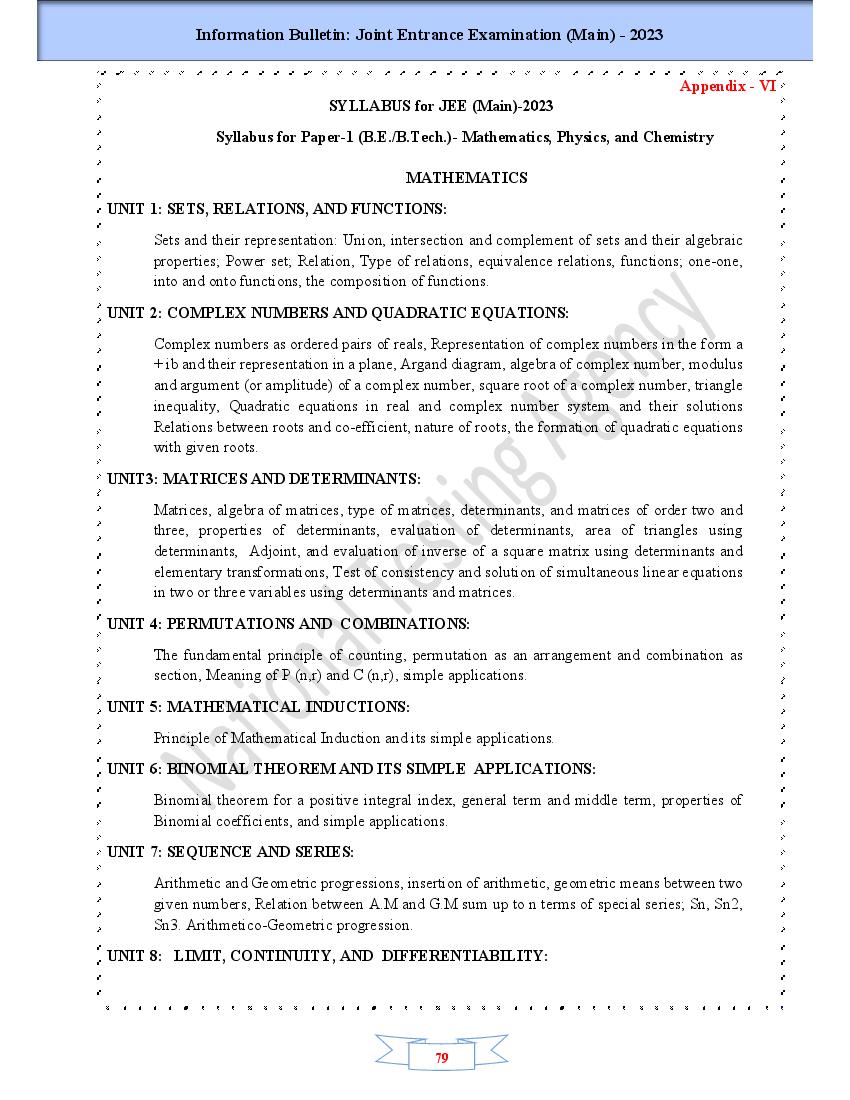
SYLLABUS for JEE (Main)-2023
Syllabus for Paper-1 (B.E./B.Tech.)- Mathematics, Physics, and Chemistry
MATHEMATICS
UNIT 1: SETS, RELATIONS, AND FUNCTIONS:
Sets and their representation: Union, intersection and complement of sets and their algebraic
properties; Power set; Relation, Type of relations, equivalence relations, functions; one-one,
into and onto functions, the composition of functions.
UNIT 2: COMPLEX NUMBERS AND QUADRATIC EQUATIONS:
Complex numbers as ordered pairs of reals, Representation of complex numbers in the form a
+ ib and their representation in a plane, Argand diagram, algebra of complex number, modulus
and argument (or amplitude) of a complex number, square root of a complex number, triangle
inequality, Quadratic equations in real and complex number system and their solutions
Relations between roots and co-efficient, nature of roots, the formation of quadratic equations
with given roots.
UNIT3: MATRICES AND DETERMINANTS:
Matrices, algebra of matrices, type of matrices, determinants, and matrices of order two and
three, properties of determinants, evaluation of determinants, area of triangles using
determinants, Adjoint, and evaluation of inverse of a square matrix using determinants and
elementary transformations, Test of consistency and solution of simultaneous linear equations
in two or three variables using determinants and matrices.
UNIT 4: PERMUTATIONS AND COMBINATIONS:
The fundamental principle of counting, permutation as an arrangement and combination as
section, Meaning of P (n,r) and C (n,r), simple applications.
UNIT 5: MATHEMATICAL INDUCTIONS:
Principle of Mathematical Induction and its simple applications.
UNIT 6: BINOMIAL THEOREM AND ITS SIMPLE APPLICATIONS:
Binomial theorem for a positive integral index, general term and middle term, properties of
Binomial coefficients, and simple applications.
UNIT 7: SEQUENCE AND SERIES:
Arithmetic and Geometric progressions, insertion of arithmetic, geometric means between two
given numbers, Relation between A.M and G.M sum up to n terms of special series; Sn, Sn2,
Sn3. Arithmetico-Geometric progression.
UNIT 8: LIMIT, CONTINUITY, AND DIFFERENTIABILITY:
79
Page 2
and exponential functions, inverse function. Graphs of simple functions. Limits, continuity,
and differentiability. Differentiation of the sum, difference, product, and quotient of two
functions. Differentiation of trigonometric, inverse trigonometric, logarithmic, exponential,
composite and implicit functions; derivatives of order up to two, Rolle’s and Lagrange's Mean
value Theorems, Applications of derivatives: Rate of change of quantities, monotonic-
Increasing and decreasing functions, Maxima and minima of functions of one variable, tangents
and normal.
UNIT 9: INTEGRAL CALCULAS:
Integral as an anti-derivative, Fundamental Integrals involving algebraic, trigonometric,
exponential, and logarithms functions. Integrations by substitution, by parts, and by partial
functions. Integration using trigonometric identities.
Evaluation of simple integrals of the type
( )
∫ , ∫ ,∫ , ∫√ , ∫ ,∫ √ , ∫ ,
±
( )
∫√ ∫ 𝑎 ± 𝑥 𝑑𝑥 , ∫ √𝑥 − 𝑎 𝑑𝑥
Integral as limit of a sum. The fundamental theorem of calculus, properties of definite integrals.
Evaluation of definite integrals, determining areas of the regions bounded by simple curves in
standard form.
UNIT 10: DIFFRENTIAL EQUATIONS
Ordinary differential equations, their order, and degree, the formation of differential equations,
solution of differential equation by the method of separation of variables, solution of a
homogeneous and linear differential equation of the type
+ 𝑝(𝑥)𝑦 = 𝑞(𝑥)
UNIT 11: CO-ORDINATE GEOMETRY
Cartesian system of rectangular coordinates in a plane, distance formula, sections formula,
locus, and its equation, translation of axes, the slope of a line, parallel and perpendicular lines,
intercepts of a line on the co-ordinate axis.
Straight line
Various forms of equations of a line, intersection of lines, angles between two lines, conditions
for concurrence of three lines, the distance of a point form a line, equations of internal and
external by sectors of angles between two lines co-ordinate of the centroid, orthocentre, and
circumcentre of a triangle, equation of the family of lines passing through the point of
intersection of two lines.
Circle, conic sections
80
Page 3
and central, equation of a circle when the endpoints of a diameter are given, points of
intersection of a line and a circle with the centre at the origin and condition for a line to be
tangent to a circle, equation of the tangent, sections of conics, equations of conic sections
(parabola, ellipse, and hyperbola) in standard forms, condition for Y = mx +c to be a tangent
and point (s) of tangency.
UNIT 12: THREE DIMENSIONAL GEOMETRY
Coordinates of a point in space, the distance between two points, section formula, directions
ratios, and direction cosines, the angle between two intersecting lines. Skew lines, the shortest
distance between them, and its equation. Equations of a line and a plane in different forms, the
intersection of a line and a plane, coplanar lines.
UNIT 13: VECTOR ALGEBRA
Vectors and scalars, the addition of vectors, components of a vector in two dimensions and
three-dimensional space, scalar and vector products, scalar and vector triple product.
UNIT 14: STATISTICS AND PROBABILITY
Measures of discretion; calculation of mean, median, mode of grouped and ungrouped data
calculation of standard deviation, variance and mean deviation for grouped and ungrouped
data.
Probability: Probability of an event, addition and multiplication theorems of probability, Baye's
theorem, probability distribution of a random variate, Bernoulli trials, and binomial
distribution.
UNIT 15: TRIGONOMETRY
Trigonometrical identities and equations, trigonometrical functions, inverse trigonometrical
functions, and their properties, heights, and distance.
UNIT 16: MATHEMATICAL REASONING
Statement logical operations and, or, implies, implied by, if and only if, understanding of
tautology, contradiction, converse, and contrapositive.
81
Document Details
| Board / Org | NTA |
| Exam | JEE Main |
| Type | Syllabus |
| Pages | 3 |
| Updated | 24 Sep 2026 |