CUSAT CAT 2018 Question Paper Ststistics
Finished viewing? Save it for later —
Download CUSAT CAT 2018 Question Paper Ststistics (PDF · 23 pages)About CUSAT CAT 2018 Question Paper Ststistics
CUSAT CAT 2018 Question Paper Ststistics is available here for free download. Published by Cochin University for CUSAT Common Admission Test, this question paper can be viewed online or downloaded as a PDF (23 pages). Candidates preparing for CUSAT Common Admission Test can use CUSAT CAT 2018 Question Paper Ststistics to understand the exam pattern, the type of questions asked, and the overall difficulty level.
Frequently Asked Questions
How can I download CUSAT CAT 2018 Question Paper Ststistics?
Open this page and click the Download button to save CUSAT CAT 2018 Question Paper Ststistics as a PDF. It is completely free on AglaSem Docs.
Is CUSAT CAT 2018 Question Paper Ststistics free to download?
Yes. CUSAT CAT 2018 Question Paper Ststistics can be viewed online and downloaded as a PDF free of cost on AglaSem Docs.
How many pages does CUSAT CAT 2018 Question Paper Ststistics have?
CUSAT CAT 2018 Question Paper Ststistics contains 23 pages, which you can read online or download together as a single PDF.
Where can I find more CUSAT Common Admission Test study material?
You can find more CUSAT Common Admission Test question papers, sample papers, syllabus, and answer keys on AglaSem Docs.
CUSAT CAT 2018 Question Paper Ststistics – Text
Read the full text of this question paper below — useful to quickly search, copy and reference the content online without downloading the PDF.
📄 View text version (23 pages)
Page 1
Subject Answer
Q Id Questions
Code Key
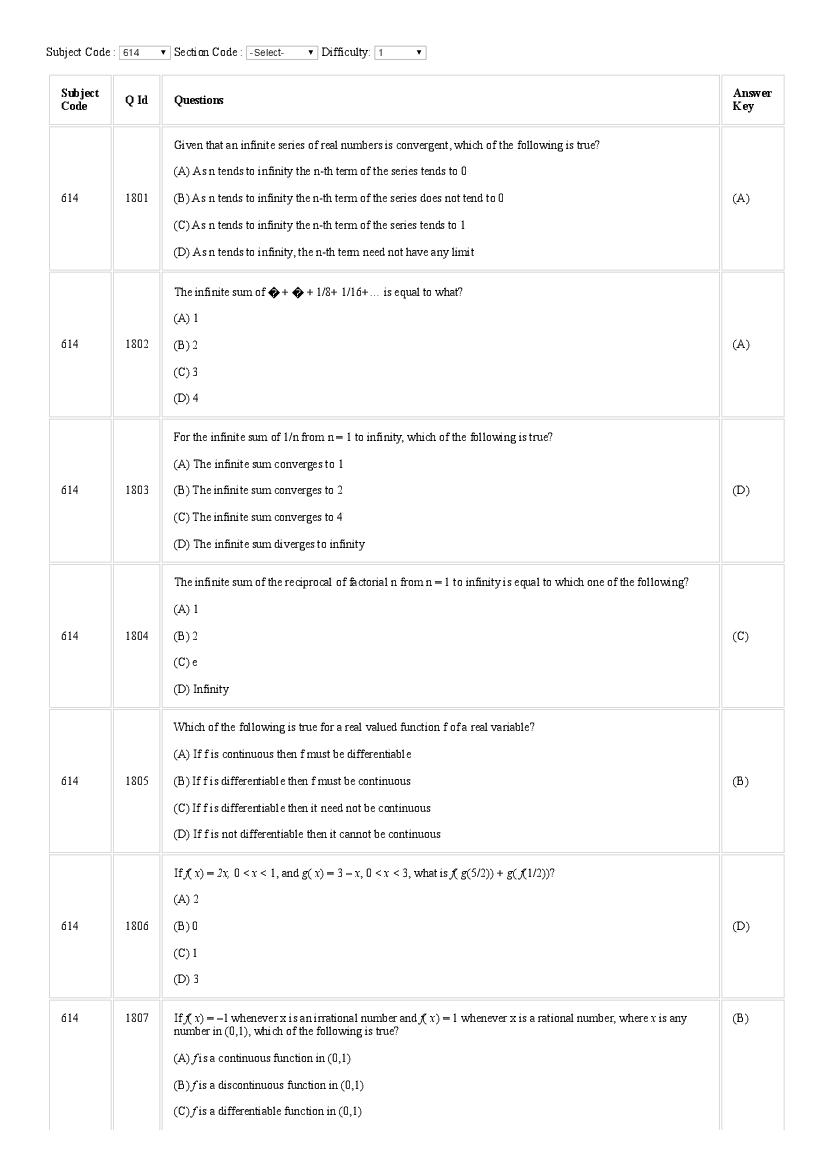
Given that an infinite series of real numbers is convergent, which of the following is true?
(A) As n tends to infinity the n-th term of the series tends to 0
614 1801 (B) As n tends to infinity the n-th term of the series does not tend to 0 (A)
(C) As n tends to infinity the n-th term of the series tends to 1
(D) As n tends to infinity, the n-th term need not have any limit
The infinite sum of � + � + 1/8+ 1/16+… is equal to what?
(A) 1
614 1802 (B) 2 (A)
(C) 3
(D) 4
For the infinite sum of 1/n from n = 1 to infinity, which of the following is true?
(A) The infinite sum converges to 1
614 1803 (B) The infinite sum converges to 2 (D)
(C) The infinite sum converges to 4
(D) The infinite sum diverges to infinity
The infinite sum of the reciprocal of factorial n from n = 1 to infinity is equal to which one of the following?
(A) 1
614 1804 (B) 2 (C)
(C) e
(D) Infinity
Which of the following is true for a real valued function f of a real variable?
(A) If f is continuous then f must be differentiable
614 1805 (B) If f is differentiable then f must be continuous (B)
(C) If f is differentiable then it need not be continuous
(D) If f is not differentiable then it cannot be continuous
If f( x) = 2x, 0 < x < 1, and g( x) = 3 – x, 0 < x < 3, what is f( g(5/2)) + g( f(1/2))?
(A) 2
614 1806 (B) 0 (D)
(C) 1
(D) 3
614 1807 If f( x) = –1 whenever x is an irrational number and f( x) = 1 whenever x is a rational number, where x is any (B)
number in (0,1), which of the following is true?
(A) f is a continuous function in (0,1)
(B) f is a discontinuous function in (0,1)
(C) f is a differentiable function in (0,1)
Page 2
If f( x) = exp(– x), x > 0, where exp(.) is the exponential function, what is integral of f( x) dx over 0 to infinity?
(A) 0
614 1808 (B) 0.5 (C)
(C) 1
(D) Infinity
If f( x) = | x|, –1 < x < 1, what is the minimum value of 1/ f( x)?
(A) 0
614 1809 (B) –1 (C)
(C) 1
(D) None of the above
What is limit as n tends to infinity of the n-th power of (1 + 1/ n)?
(A) 1
614 1810 (B) Limit does not exist (D)
(C) Infinity
(D) e
What is limit as n tends to infinity of (1 + � + 1/ 3 + … + 1/ n)?
(A) 1
614 1811 (B) 3/2 (C)
(C) Infinity
(D) 0
Which of the following is true with reference to the series (1 + 1/2^2 + 1/3^2 + 1/4^2 + …), where ^ denotes
`power of'?
(A) The series converges
614 1812 (A)
(B) The series diverges
(C) The series neither converges nor diverges
(D) The series diverges to infinity
If A is a matrix with 4 rows and 5 columns, which of the following statements is true with reference to the rank
of A?
(A) Rank of A is the number of nonzero rows of A
614 1813 (D)
(B) Rank of A is the number of nonzero columns of A
(C) Rank of A is the minimum of the number of nonzero rows of A and the number of nonzero columns of A
(D) Rank of A is the number of linearly independent rows of A
If A is a real, square matrix, which of the following must be true for the sum of A and its transpose?
(A) The sum of A and its transpose is not defined
614 1814 (B) The sum of A and its transpose is symmetric C (B)
(C) The sum of A and its transpose need not be symmetric
(D) The sum of A and its transpose is not symmetric
Page 3
(A) Determinant of A is not equal to zero
(B) Inverse of A exists
(C) Determinant of A is equal to zero
(D) A has full row rank
When is a square matrix A said to idempotent?
(A) When A^2 = A, where ^ denotes `power of'
614 1816 (B) When transpose of A = A (A)
(C) When 2A = A
(D) When determinant of A is equal to zero
With reference to Rank of matrix AB for which AB is defined, which of the following is not correct?
(A) Rank of AB is at the most Rank of A
614 1817 (B) Rank of AB is at the most Rank of B (D)
(C) Rank of AB is at the most minimum of Rank of A and Rank of B
(D) Rank of AB is at least minimum of Rank of A and Rank of B
For any matrix A, which of the following need not be true?
(A) The product of A and its transpose is symmetric
614 1818 (B) The product of transpose of A with A is symmetric (C)
(C) The product of transpose of A with A is idempotent
(D) Both the product of transpose of A with A and the product of A with its transpose are symmetric
Which of the following defines rank of a matrix?
(A) The number of non-zero rows
614 1819 (B) The number of non-zero columns (D)
(C) The number of linearly dependent rows
(D) The number of linearly independent rows
614 1820 (C)
(A) (0, 9, 16)
(B) (0, 12, 15)
(C) (0, –12, 12)
(D) (0, 15, 16)
Which of the following is not true for any matrix A?
(A) Row rank is the number of linearly independent rows of A
614 1821 (B) Row rank of A is always equal to column rank of A (D)
(C) Column rank of A is the number of linearly independent columns of A
(D) Row rank of A is less than column rank of A
Page 4
following is not true?
(A) Rank of the matrix A augmented with the vector b is the same as rank of A
(B) Rank of the matrix A augmented with the vector b is 1 + rank of A
(C) The vector b belongs to the column space of A
(D) The system has a solution
With reference to the 2�2 matrix A with the first row as (0 1) and the second row as (1 0), which of the
following is not true?
(A) A has rank 2
614 1823 (D)
(B) Determinant of A is non-zero
(C) Inverse of A is A
(D) A is idempotent
For which of the following matrices, the rank is equal to the sum of the leading diagonal entries?
(A) Square matrix
614 1824 (B) Symmetric matrix (C)
(C) Idempotent matrix
(D) Square, symmetric matrix
Given two vectors a and b of the same dimension, which of the following is not true?
(A) Vectors a and b orthogonal implies that a and b are linearly independent
614 1825 (B) Vectors a and b orthogonal does not, in general, imply that a and b are linearly independent (B)
(C) Vectors a and b orthogonal implies that dot product between a and b is zero
(D) Vectors a and b orthogonal, means that the sum of the component-wise products of a and b is equal to zero
Given a set of vectors of the same dimension, which of the following is true?
(A) If the set is linearly independent, then every subset is linearly independent
614 1826 (B) If the set is linearly independent, then every superset is linearly independent (A)
(C) If the set is linearly dependent, then every subset is linearly dependent
(D) If the set is linearly dependent, then every superset is llinearly independent
Given that P(A)=1/2, P(B) = �, P(A|B) = 1/3, what is the value of P(A U B)?
(A) 2/5
614 1827 (B) � (C)
(C) 2/3
(D) 5/12
Given that A and B are independent events, which of the following is true?
(A) P(A) =P(A|B)
614 1828 (A)
(B) P(A)
(C) P(A)>P(A|B)
(D) P(A)=P(A|B)P(B)
614 1829 If A and B are independent events, which of the following gives P(A U B)? (A)
(A) 1 – P(A^c)P(B^c), where A^c is complement of A
Page 5
(C) 2 – P(A^c) – P(B^c)
(D) P(A) + P(B) + P(AB)
Which of the following is not a consequence of the axioms of probability?
(A) P(A) = 1 – P(A^c), where A^c is complement of A.
614 1830 (B) P(A U B) = P(A) + P(B) – P(AB), where AB means A intersection B. (C)
(C) P(AB) = P(A)P(B).
(D) P(AB) = 1 – P(A^c U B^c).
If event A implies event B, which of the following is true?
(A) P(A^c) is less than or equal to P(B^c), where A^c is the complement of A.
614 1831 (B) P(A^c) is more than or equal to P(B^c). (B)
(C) P(AB) = P(B), where AB denotes intersection of A and B.
(D) P(AB) is greater than or equal to P(B).
If A and B are independent events, which of the following is not true?
(A) P(A U B) = P(A)P(B^c) + P(B), where B^c denotes complement of B
614 1832 (B) P(AB) = 1 – P(A^c) – P(B^c) + P(A^c)P( B^c), where AB denotes intersection of A and B (C)
(C) P(A U B) = P(A) + P(B)
(D) P(AB) = 1 – P(A^c U B^c)
Which of the following statements is not true with reference to Probability?
(A) Probability is a set function
614 1833 (B) Probability is a [0,1]-valued function (D)
(C) Probability is an additive function
(D) Probability is a linear function
If A and B are independent events with P(B) > 0, which of the following is true with reference to the conditional
probability of A given B?
(A) It is equal to P(A)
614 1834 (A)
(B) It is equal to P(B)
(C) It is equal to P(AB)
(D) It is equal to P(A).P(B)
If two fair coins are thrown simultaneously once, what is the probability of getting at least one heads?
(A) �
614 1835 (B) � (C)
(C) �
(D) 1/3
614 1836 If a fair coin is thrown repeatedly till Heads appears, what is the probability that Heads appears for the first time (A)
at the 12th throw?
(A) 1/4096
(B) 1/256
Page 6
(D) 1/12
If two six-sided dice whose faces are numbered with numbers from 1 to 6, are thrown simultaneously, what is
the probability that the sum of numbers on the two dice facing up is even?
(A) 1/6
614 1837 (B) 1/3 (C)
(C) �
(D) 1/12
If X is a random variable with P(X = –1) = 1/3 = 1–P(X=1), then which of the following is true?
(A) E(X) = 1/3, V(X) = 1/9
614 1838 (B) E(X) = 2/3, V(X) = 1 (D)
(C) E(X) = 0, V(X) = 2/9
(D) E(X) = 1/3, V(X) = 8/9
If X is a random variable with E(X) = –1 and V(X) = 1, then what is E(X^2), where ^ denotes `power of'?
(A) 0
614 1839 (B) 2 (B)
(C) 1
(D) 4
If X is a random variable with P(X = k) = 1/2^k, k = 1, 2, …., what is the variance of X?
(A) 2
614 1840 (B) 4 (A)
(C) 6
(D) 8
If X_0, X_1, X_2, … are standard Bernoulli random variables with probability of success �, what is the
distribution of X_0 + X_1 + X_2 + … + X_9?
(A) Binomial with parameters 9 and �
614 1841 (B)
(B) Binomial with parameters 10 and �
(C) Binomial with parameters 9 and 1
(D) Binomial with parameters 10 and 1
If X and Y are independent Poisson random variables with mean 1, which of the following is not correct?
(A) X+ Y is a Poisson random variable with mean 2
614 1842 (B) X+Y is a Poisson random variable with variance 2 (C)
(C) X+Y is a Poisson random variable with variance 4
(D) X+ Y is a Poisson random variable with coefficient of variation equal to reciprocal of square root of 2
614 1843 If X and Y are independent Poisson random variables with variance 1/2, what is the coefficient of variation of (A)
X+Y?
(A) 1
(B) �
Page 7
(D) 2
If X is a standard normal random variable, what is the distribution of the square of X?
(A) Normal
614 1844 (B) Chi-square (B)
(C) F
(D) t
If X is a random variable with P(X = k) = exp(–1) / k!, k = 0, 1, 2, …., where ! denotes factorial, what is the
mean of X + 2?
(A) 1
614 1845 (C)
(B) 2
(C) 3
(D) 4
If X is the uniform random variable over the interval (0,1), what is the coefficient of variation of X?
(A) Reciprocal of square root of 2
614 1846 (B) Reciprocal of square root of 3 (B)
(C) �
(D) �
If X has standard exponential distribution, what is the second moment E(X^2) of X?
(A) 1
614 1847 (B) 2 (B)
(C) 3
(D) 4
If X has uniform distribution over (0,1), what is the distribution of – ln (X), where ln is the natural logarithm to
base e?
(A) Uniform over (0,1).
614 1848 (B)
(B) Standard exponential
(C) Standard normal.
(D) Standard log-normal.
If X_1, X_2, …, X_n are independent random variables, all having standard normal distribution, what is the
distribution of their mean (X_1 + ...+ X_n) / n?
(A) Standard normal
614 1849 (C)
(B) Normal with mean 0 and variance 1
(C) Normal with mean 0 and variance 1/ n
(D) Normal with mean 0 and variance n
614 1850 If X and Y are independent random variables having the same moment generating function M(.), what is the (B)
moment generating function of X+Y?
(A) 2M(.)
(B) M^2(.)
(C) M(.)
Page 8
If P(.) denotes the probability generating function of a discrete random variable X taking values 0, 1, 2, …, what
is P(0)?
(A) P(X = 0)
614 1851 (A)
(B) 1
(C) 0
(D) P(X = 1)
In a completely randomized design, the number of sources with respect to which the yield of interest varies is
what?
(A) 1
614 1852 (A)
(B) 2
(C) 3
(D) 0
Which of the following is not a fundamental principle of design of statistical experiments?
(A) Local control
614 1853 (B) Replication (D)
(C) Randomization
(D) Global control
If there are 5 treatments in a completely randomized design with 10 observations, the degrees of freedom for the
error is what?
(A) 5
614 1854 (A)
(B) 10
(C) 6
(D) 15
In a randomized block design with 4 treatments and 6 blocks, the degrees of freedom for the error is what?
(A) 9
614 1855 (B) 8 (D)
(C) 10
(D) 15
Which of these is compared in an analysis of variance technique?
(A) Means
614 1856 (B) Medians (A)
(C) Covariances
(D) Variances
614 1857 Yates' algorithm in a factorial experiment is used to calculate which of these? (D)
(A) Observation totals
(B) Treatment totals
(C) Block totals
(D) Factorial effect totals
Page 9
(A) The number of sources with respect to which the yield under consideration varies is one
614 1858 (B) The number of sources with respect to which the yield under consideration varies is two (B)
(C) The number of sources with respect to which the yield under consideration varies is three
(D) The number of sources with respect to which the yield under consideration varies is four
Which of the following is not a treatment contrast, if treatment effects are denoted by a_1, a_2, a_3, a_4, a_5 in
a completely randomized design?
(A) a_1 – a_2
614 1859 (C)
(B) 2a_1 – a_2 – a_3
(C) a_1 – a_2 + a_3 – a_4 + a_5
(D) 2a_1 – a_2 + a_3 – a_4 – a_5
The value of the correlation coefficient between two variables X and Y is zero implies what?
(A) X and Y are always independent
614 1860 (B) X and Y are linearly related (C)
(C) X and Y are not linearly related
(D) X and Y are always dependent
If r and b denote respectively, the correlation coefficient and the regression coefficient, which of the following is
true?
(A) Both r and b have the same sign
614 1861 (A)
(B) Both r and b have opposite signs
(C) r = b
(D) r
The regression line of Y given X=x represents what?
(A) Conditional mean response given X
614 1862 (B) Conditional expectation of X given Y (A)
(C) Conditional variance of response given X
(D) Unconditional mean response
In a randomized block design, which of the following is true?
(A) The only functions of treatment effects that are estimable are treatment contrasts
614 1863 (B) Every function of treatment effects is estimable (A)
(C) No function of treatment effects is estimable
(D) Every linear parametric function is estimable
Chebyshev's inequality relates to which of these?
(A) Probability and Covariance
614 1864 (B) Probability and Correlation (D)
(C) Expectation and Variance
(D) Probability and Expectation
614 1865 If a sequence of random variables converges in probability, then which one of the following statements must be (A)
true?
Page 10
(B) The sequence must converge almost surely
(C) The sequence must converge in expectation
(D) The sequence must converge in variance
Which of the following is the distribution of the limit random variable in the central limit theorem?
(A) Poisson
614 1866 (B) Chi-square (C)
(C) Normal
(D) Student's t
If a random variable X has F distribution with degrees of freedom 1 and 2, then what is the distribution of its
reciprocal 1/X?
(A) F with degrees of freedom 1 and 2
614 1867 (C)
(B) F with degrees of freedom 1 and �
(C) F distribution with degrees of freedom 2 and 1
(D) Chi-square distribution with degrees of freedom 3
If X and Y are independent standard exponential random variables, what is the distribution of X+Y?
(A) Exponential with mean 2
614 1868 (B) Gamma with parameter 2 (B)
(C) F distribution
(D) Standard normal distribution
With reference to mean and standard deviation, which of the following is true?
(A) Both are measured in same units
614 1869 (B) Both are measured in different units (A)
(C) Both are absolute measures without any unit of measurement
(D) Standard deviation is measured in square of unit of measurement of mean
Given that the sum of the upper and lower quartiles is 25 in a frequency distribution, their difference is 13 and
the median is 10, what is the coefficient of skewness?
(A) 0.03865
614 1870 (B)
(B) 0.3846
(C) 0.4536
(D) 0.4889
Which of the following is a suitable measure of spread for an ordinal data?
(A) Mean deviation from mean
614 1871 (B) Mean deviation from median (D)
(C) Standard deviation
(D) Quartile deviation
614 1872 In a univariate data, if each of the observations is increased by 10, then what happens to the variance of the new (C)
observations?
(A) Increases by 10
Page 11
(C) Same as the variance of the original observations
(D) 10 times the variance of the original observations
Which of the following statements is not true for a diagonal matrix A?
(A) A can be non-singular
614 1873 (B) A can be singular (D)
(C) A is a square matrix
(D) A must be non-singular
For which of the following random variables is 6 times variance equal to its mean?
(A) Uniform over (0,1)
614 1874 (B) Standard exponential (A)
(C) Standard Bernoulli with success probability equal to �
(D) Poisson with parameter 1
Which of the following is equal to the coefficient of variation?
(A) Mean divided by standard deviation, provided standard deviation is not zero
614 1875 (B) Standard deviation divided by mean, provided mean is not zero (B)
(C) Variance divided by mean provided mean is not zero
(D) Mean divided by variance provided variance is not zero
Given that X and Y are independent random variables with E(X) =0, standard deviation of X equal to 2, E(Y) =
1 and standard deviation of Y equal to 4, what are the values of Var(X-Y) and Var(X+Y), respectively?
(A) 20 and 20
614 1876 (A)
(B) 2 and 4
(C) 16 and 20
(D) 16 and 16
Given that X and Y are independent, normal random variables with means 1 and 2 respectively and common
variance 1, what is the distribution of X – Y?
(A) Normal with mean 1 and variance 1
614 1877 (B)
(B) Normal with mean –1 and variance 2
(C) Normal with mean –1 and variance 1
(D) Normal with mean 1 and variance 2
Which of the following distribution has coefficient of variation equal to 1?
(A) Uniform over (0,1)
614 1878 (B) Standard normal (C)
(C) Standard exponential
(D) Standard Cauchy
614 1879 What is the expansion of the word CENSUS? (D)
(A) Central Statistical Surveys
(B) Central Economic National Surveys
Page 12
(D) Complete Enumeration Surveys
In sampling theory, proportional allocation, Neyman allocation, optimum allocation refer to allocation of which
of these?
(A) Sample size
614 1880 (A)
(B) Sample mean
(C) Sampling cost
(D) Sample standard error
Which of the following refer to types of systematic sample?
(A) Linear and nonlinear
614 1881 (B) Linear and circular (B)
(C) Random and linear
(D) Random and circular
If U,V,W,X are independent and identically distributed observations from a normal random variable with mean a
and variance 1 with a unknown, what is the maximum likelihood estimator of a?
(A) U+V+W+X
614 1882 (B)
(B) (U+V+W+X)/4
(C) Median of U V, W, X
(D) Mode of U, V, W, X
Which of these is the likelihood function of a random sample of size n from a distribution having probability
density function (pdf) f with parameter a?
(A) Function of the sample for a fixed a
614 1883 (D)
(B) Joint pdf of the sample
(C) Is the pdf of a for a fixed sample
(D) Is the function of a for a given sample
What is the power of the test for testing a null hypothesis H_0?
(A) Probability of rejecting H_0 when it is true
614 1884 (B) Probability of accepting H_0 when it is false (C)
(C) Probability of rejecting H_0 when it is false
(D) Probability of rejecting the alternative when it is true
What does NSSO stand for?
(A) National Statistics Survey Organization
614 1885 (B) National Sample Survey Office (B)
(C) National Sample Survey Ordinance
(D) National Statistics Survey Office
614 1886 On which curve is population growth plotted? (A)
(A) Logistic curve
(B) Logarithmic curve
(C) Pareto curve
Page 13
Which are the two broad domains under which a time series is analyzed?
(A) Time and space
614 1887 (B) Time and frequency (B)
(C) Series and frequency
(D) Spectral and frequency
Which of these affect population growth?
(A) Births and deaths only
614 1888 (B) Births, deaths and immigration only (C)
(C) Births, deaths, immigration and emigration only
(D) Immigration and emigration only
Which of these is Fisher's ideal index number associated with?
(A) Prices of commodities
614 1889 (B) Quantities of commodities (D)
(C) Prices and quality of commodities
(D) Prices and quantities of commodities
Which of the following is not a method of estimation?
(A) Least squares
614 1890 (B) Maximum likelihood (D)
(C) Moment
(D) Characteristic
Which of these relate to confidence interval?
(A) It is a probability statement
614 1891 (B) It is not a probability statement (A)
(C) It is a statement about conditional probability
(D) It is a statement about conditional expectation
Given that the coefficient of variation is 1, which of the following is true?
(A) Mean and variance are same
614 1892 (B) Mean and standard deviation are same (B)
(C) Square of mean is equal to variance
(D) Square of variance is equal to mean
If X and Y are independent standard Bernoulli random variables with the same parameter p, what is the
distribution of X+Y?
(A) Binomial with parameters 2 and p
614 1893 (A)
(B) Binomial with parameters n and p
(C) Binomial with parameters 2 and 2p
(D) Binomial with parameters 2 and p/2
Page 14
(A) The infinite sum does not exist
(B) It is equal to 0
(C) It is equal to 1
(D) It is equal to –1
What is the value of the integral of the function x raised to 3 over the limits –1 to 1 ?
(A) –1/2
614 1895 (B) � (C)
(C) 0
(D) 2
What is integral of the function 1/log x over the limits 1 to infinity?
(A) Converges to 0
614 1896 (B) Converges to the number e (C)
(C) Diverges to infinity
(D) Diverges to – infinity
If determinant of a matrix A is equal to 0, which of the following is not true?
(A) A is a singular matrix
614 1897 (B) A is a non-singular matrix (B)
(C) Inverse of A does not exist
(D) A may be null matrix.
If A and B are non-singular square matrices of same order, then which of the following is true for AB?
(A) AB is non-singular
614 1898 (B) AB is singular (A)
(C) AB is square and singular
(D) AB is not defined
Which of the following is true in a 2^2-factorial experiment?
(A) There are four factors
614 1899 (B) There are four levels (C)
(C) There are two factors each considered at two levels
(D) There are four factors each considered at four levels
Given a vector space V, which of the following need not be true?
(A) V is closed under vector addition
614 1900 (B) V is closed under scalar multiplication (C)
(C) V is closed under vector multiplication
(D) V is closed under linear combinations of vectors
614 1901 What are the characteristic roots of the identity matrix of order 2? (C)
(A) 0 and 1
(B) 0 and 0
Page 15
(D) –1 and 1
If A and B are any two symmetric matrices of the same order, which of the following need not be true?
(A) A+B is symmetric
614 1902 (B) A – B is symmetric (C)
(C) AB = BA
(D) A^T + B^T is symmetric, where A^T denotes transpose of A
Which of the following is measured without any unit of measurement?
(A) Standard deviation
614 1903 (B) Mean deviation about mean (D)
(C) Mean deviation about median
(D) Coefficient of variation
If X has binomial distribution with paramters 2 and �, which of the following is true?
(A) Mean of X is less than variance of X
614 1904 (B) Mean of X is equal to variance of X (C)
(C) Mean of X is strictly greater than variance of X
(D) Variance of X is strictly greater than mean of X
If X has Poisson distribution with mean 1, then what is the expected value of X^2?
(A) 0
614 1905 (B) 1 (C)
(C) 2
(D) square root of 2
A most powerful test is considered when
(A) both null and alternative hypotheses are composite
614 1906 (B) null hypothesis is simple and alternative is composite (D)
(C) null hypothesis is composite and alternative is simple
(D) both null and alternative are simple
The power under alternative hypothesis of a most powerful test of size 0.05 cannot be
(A) 0.06
614 1907 (B) 0.03 (B)
(C) 0.08
(D) 0.1
614 1908 (B)
(A)
Page 16
(C)
(D)
A non parametric test based on empirical distribution functions is
(A) Kolmogrov-Smirnov test
614 1909 (B) Mann-Whitney U test (A)
(C) Wilcoxon test
(D) Kruskal Wallis test
Which of the following theorem finds application in non parametric tests?
(A) Neyman Factorization theorem
614 1910 (B) Glivenko-Cantelli theorem (B)
(C) Neyman Pearson lemma
(D) Cochran’s theorem
Which of the following non parametric tests can be used for testing the goodness of fit?
(A) Sign Test
614 1911 (B) Run Test (D)
(C) Median Test
(D) Kolmogrov-Smirnov test
(A)
(B)
614 1912 (A)
(C)
(D)
614 1913 (D)
(A)
Page 17
(C)
(D)
(A) the first order statistic
614 1914 (A)
(B) the sample mean
(C) the sample median
(D) the largest order statistic
Cramer Rao inequality gives a bound for
(A) the bias of an estimator
614 1915 (B) the variance of an unbiased estimator (B)
(C) the variance of a sufficient statistic
(D) the variance of any statistic
Choose the correct statement
(A) Consistent estimator is unique
614 1916 (B) Unbiased estimator is unique (C)
(C) Consistency is a large sample property
(D) unbiasedness is a large sample property
In simple random sampling with replacement, the number of times the ith population unit appears in the sample
is
(A) Binomial distribution
614 1917 (A)
(B) Hypergeometric distribution
(C) Geometric distribution
(D) Negative binomial distribution
(A)
614 1918 (B) (D)
(C)
(D)
614 1919 Under what condition sample mean is unbiased for the population mean in stratified random sampling (D)
(A) Always
(B) Never
Page 18
(D) when stratum sampling fractions coincide with population sampling fraction
Given that the systematic sample corresponding to start 4 contains units with labels 4,9,14,19,24. The
population size is
(A) 20
614 1920 (B)
(B) 25
(C) 15
(D) 30
(A)
(B)
614 1921 (D)
(C)
(D)
In systematic sampling, when N=16 and n=4 the probability of including 7th and 9th units in the sample is
(A) 0
(B) 1
(C)
614 1922 (A)
(D)
(A)
614 1923 (B) (B)
(C)
(D)
614 1924 (A)
Page 19
(B) –2
(C) 0
(D) 48
(A)
614 1925 (B) (B)
(C)
(D)
(A)
(B)
614 1926 (A)
(C)
(D)
(A) 7
614 1927 (C)
(B) –7
(C) 0
(D) 12
614 1928 (C)
(A) x=2 only
(B) x=4 only
(C) for any x different from 2
Page 20
Choose the correct statement
(A) Distribution functions are always continuous
614 1929 (B) In a distribution function jumps indicate positive mass at those points (B)
(C) In a distribution function jumps indicate zero mass at those points
(D) Distribution functions can never be continuous
(A) 5/7
614 1930 (B)
(B) 2/7
(C) 1
(D) 0
Choose the correct statement:
(A) P(AB) cannot exceed P(A)
614 1931 (B) A density function can never take value exceeding zero (A)
(C) A density function can take negative values
(D) disjointness of events is same as independence
(A) 4
614 1932 (A)
(B) 2
(C) 8
(D) 16
(A) 7
614 1933 (C)
(B) 21
(C) –21
(D) –7
In a randomized block design with 6 blocks and 7 treatments the degrees of freedom for error is given by
(A) 30
614 1934 (B) 40 (A)
(C) 42
(D) 21
614 1935 (A)
Page 21
(B)
(C)
(D)
For which of the following choices binomial distribution has positive skewness?
(A)
(B)
614 1936 (B)
(C)
(D)
Choose the correct statement.
(A) Poisson distribution is a skewed distribution.
(B) Difference of two independent Poisson variates has Poisson distribution
614 1937 (A)
(C) Poisson distribution is unimodal distribution.
(D)
Choose the correct statement.
(A) Sum of Independently and Identically distributed geometric random variables has geometric distribution.
(B) Sum of Independently and Identically distributed geometric random variables has negative binomial
614 1938 distribution (B)
(C) Sum of Independently and Identically distributed geometric random variables has binomial distribution
(D) Sum of Independently and Identically distributed geometric random variables has hyper geometric
distribution
The distribution arising from sampling without replacement is
(A) Binomial distribution
614 1939 (B) Hyper geometric distribution (B)
(C) Geometric distribution
(D) Negative binomial distribution
614 1940 If the variance of a chisquare statistic is 16 then its mean is (A)
(A) 8
Page 22
(C) 4
(D) 16
If the maximum ordinate of a normal distribution is one then the standard deviation is
(A)
(B)
614 1941 (C)
(C)
(D)
(A) standard normal distribution
614 1942 (C)
(B) Cauchy distribution with location zero
(C) chi square distribution
(D) Uniform distribution over [0,1]
614 1943 (B)
(A) 0.56
(B) –0.56
(C) 0.24
(D) –0.24
614 1944 (A) Always convergent (D)
(B) Always divergent
(C) Convergent if p=1
(D) Convergent if p>1
614 1945 (C)
(A)
Page 23
(C)
(D)
(A) 5
614 1946 (B)
(B) 120
(C) 720
(D) 24
(A)
(B)
614 1947 (B)
(C)
(D)
Karl Pearson formula for coefficient of correlation can be used for
(A) Measuring linear relationship between two variables
614 1948 (B) Measuring nonlinear relationship between two variables (A)
(C) Measuring correlation between any two ordinal variables
(D) Measuring the relationship between two binary variables
Blocking in randomised block design is meant for ensuring
(A) Randomization
614 1949 (B) Replication (C)
(C) Local Control
(D) all of them
Analysis of variance is meant for testing
(A) the equality of several variances
614 1950 (B) the equality of several means (B)
(C) given normal populations are identical
(D) the equality of several proportions
Document Details
| Board / Org | Cochin University |
| Exam | CUSAT Common Admission Test |
| Type | Question Paper |
| Pages | 23 |
| Updated | 30 Apr 2026 |