XAT 2027 Sample Paper
Finished viewing? Save it for later —
Download XAT 2027 Sample Paper (PDF · 34 pages)About XAT 2027 Sample Paper
XAT 2027 Sample Paper is available here for free download. Published by XLRI for Xavier Aptitude Test, this sample paper can be viewed online or downloaded as a PDF (34 pages). Candidates preparing for Xavier Aptitude Test can use XAT 2027 Sample Paper to understand the exam pattern, the type of questions asked, and the overall difficulty level.
Frequently Asked Questions
How can I download XAT 2027 Sample Paper?
Open this page and click the Download button to save XAT 2027 Sample Paper as a PDF. It is completely free on AglaSem Docs.
Is XAT 2027 Sample Paper free to download?
Yes. XAT 2027 Sample Paper can be viewed online and downloaded as a PDF free of cost on AglaSem Docs.
How many pages does XAT 2027 Sample Paper have?
XAT 2027 Sample Paper contains 34 pages, which you can read online or download together as a single PDF.
Where can I find more Xavier Aptitude Test study material?
You can find more Xavier Aptitude Test question papers, sample papers, syllabus, and answer keys on AglaSem Docs.
XAT 2027 Sample Paper – Text
Read the full text of this sample paper below — useful to quickly search, copy and reference the content online without downloading the PDF.
📄 View text version (34 pages)
Page 1
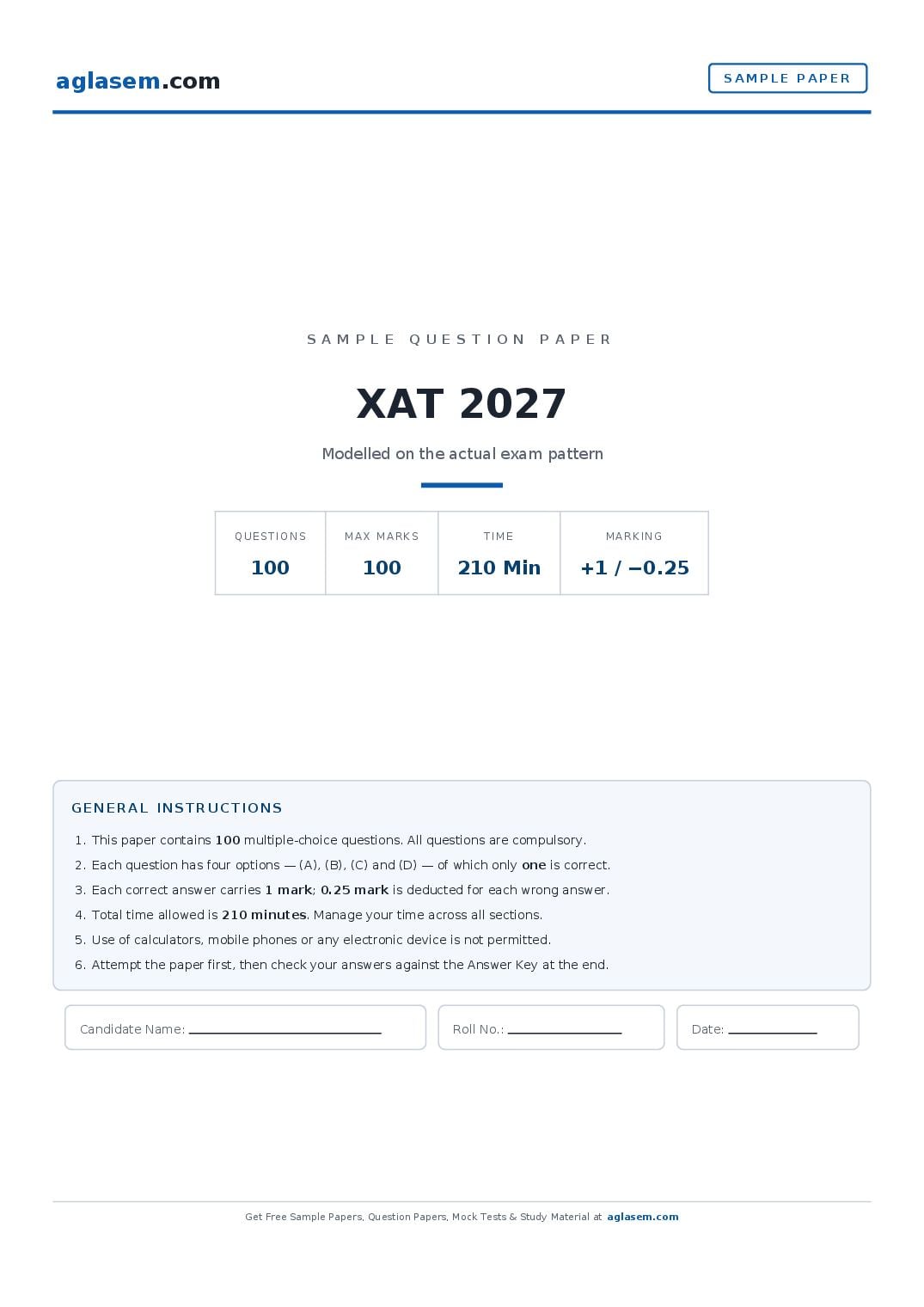
S A M P L E Q U E S T I O N P A P E R
XAT 2027
Modelled on the actual exam pattern
.
QUESTIONS MAX MARKS TIME MARKING
100 100 210 Min +1 / −0.25
GENERAL INSTRUCTIONS
1. This paper contains 100 multiple-choice questions. All questions are compulsory.
2. Each question has four options — (A), (B), (C) and (D) — of which only one is correct.
3. Each correct answer carries 1 mark; 0.25 mark is deducted for each wrong answer.
4. Total time allowed is 210 minutes. Manage your time across all sections.
5. Use of calculators, mobile phones or any electronic device is not permitted.
6. Attempt the paper first, then check your answers against the Answer Key at the end.
Candidate Name: Roll No.: Date:
Page 2
XAT 2027
SAMPLE QUESTION PAPER
Questions 100 Max Marks 100 Time 210 Min Marking +1 / −0.25
Attempt all questions. Choose the one correct option for each.
VERBAL & LOGICAL ABILITY
1. As the post-World War II generation of liberal democratic leaders forged new, highly successful domestic and
international institutions and policies throughout the West, the weaknesses of liberal democracy that dominated the
two decades after World War I faded from view. But they did not disappear. First, because liberal democracy restrains
majorities, it slows the achievement of goals that majorities support. This generates frustration with institutional
restraints, and an unacknowledged envy of authoritarian systems that can act quickly and decisively. China can build
huge cities in the time that it takes the United States to review the environmental impact of small highway projects.
Liberal democracy requires more patience than many possess. Second, liberal democracy requires tolerance for
minority views and ways of life to which many citizens are deeply opposed. It is natural to feel that if we consider
certain views or ways of life to be odious, we should use public power to suppress them. In many such cases, liberal
democracy requires us to restrain this impulse, a psychological burden that some will find unbearable. This leads
directly to the third inherent problem of liberal democracy—the distinction it requires us to make between civic
identity and personal or group identity. For example, although we may consider certain religious views false and even
dangerous, we must, for civic purposes, accept those who hold these views as our equals. They may freely express
these views; they may organize to promote them; they may vote, and their votes are given the same weight as ours.
The same goes for race, ethnicity, gender, and all the particularities that distinguish us from one another. This
requirement often goes against the grain of natural sentiments. We want the public sphere to reflect what we find
most valuable about our private commitments. Liberal democracy prevents us from fully translating our personal
identities into our public lives as citizens. This too is not always easy to bear. The quest for wholeness—for a political
community, or even a world, that reflects our most important commitments—is a deep yearning to which illiberal
leaders can always appeal. Nor is the fourth inherent difficulty of liberal democracy—the necessity of
compromise—easy to bear. If what I want is good and true, why should I agree that public decisions must incorporate
competing views? James Madison gives us the answer: in circumstances of liberty, diversity of views is inevitable, and
unless those who agree with us form a majority so large as to be irresistible, the alternative to compromise is inaction,
which is often more damaging, or oppression, which always is. According to the passage, which of the following
reasons BEST explains why “necessity of compromise” is a difficulty for liberal democracy?
(A) We do not like compromising on anything we badly want.
(B) Since our core beliefs define who we are, we want to see that reflected in public space.
(C) Liberal democracy makes us endure divergent behaviours in public sphere.
(D) While we believe our views are correct, to accept that others’ views deserve merit is not always easy.
2. This fluidity and situational dependence is uniquely human. In other species, in-group/outgroup distinctions reflect
degrees of biological relatedness, or what evolutionary biologists call “kin selection.” Rodents distinguish between a
sibling, a cousin, and a stranger by smell—fixed, genetically determined pheromonal signatures—and adapt their
cooperation accordingly. Those murderous groups of chimps are largely made up of brothers or cousins who grew up
together and predominantly harm outsiders. Humans are plenty capable of kin-selective violence themselves, yet
human group mentality is often utterly independent of such instinctual familial bonds. Most modern human societies
rely instead on cultural kin selection, a process allowing people to feel closely related to what are, in a biological
sense, total strangers. Often, this requires a highly active process of inculcation, with its attendant rituals and
vocabularies. Consider military drills producing “bands of brothers,” unrelated college freshmen becoming sorority
“sisters,” or the bygone value of welcoming immigrants into “the American family.” This malleable, rather than
genetically fixed, path of identity formation also drives people to adopt arbitrary markers that enable them to spot
Page 3
hair. The hipster beard, the turban, and the “Make America Great Again” hat all fulfill this role by sending strong
signals of tribal belonging. Moreover, these cultural communities are arbitrary when compared to the relatively fixed
logic of biological kin selection. Few things show this arbitrariness better than the experience of immigrant families,
where the randomness of a visa lottery can radically reshuffle a child’s education, career opportunities, and cultural
predilections. Had my grandparents and father missed the train out of Moscow that they instead barely made, maybe
I’d be a chain-smoking Russian academic rather than a Birkenstock-wearing American one, moved to tears by the
heroism during the Battle of Stalingrad rather than that at Pearl Harbor. Scaled up from the level of individual family
histories, our big-picture group identities—the national identities and cultural principles that structure our lives—are
just as arbitrary and subject to the vagaries of history. Based on the passage, how are rodents and humans similar to
each other?
(A) Both rodents and humans carry a genetically determined pheromonal signature.
(B) Both rodents and humans can reign their instincts.
(C) Both rodents and humans make their groups exclusive of brothers and cousins.
(D) Both rodents and humans divide the world between “us” and “them.”
3. Look how you turned on the ceiling fan—it’s too high, see how it shakes and trembles. You walk into this room with
your hot ideas and the ceiling fan has to work harder to cool down the room for us. You walk into this room with your
crazy eyes and the ceiling fan wants to fly loose. It dreams of becoming a spider lily. What does the author BEST
mean, when she says, “You walk into this room with your hot ideas and the ceiling fan has to work harder to cool
down the room for us?”
(A) That the person’s presence makes the ceiling fan lose its ability to handle intense energy.
(B) That the person brings with him passionate intellectual and emotional energy
(C) That the person’s presence develops self-doubt in others.
(D) That the person’s hostile presence makes others feel unwelcomed
4. You may laugh at a hat, but what you are making fun of, in this case, is not the piece of felt or straw, but the shape
that men have given it, -- the human caprice whose mould it has assumed. It is strange that so important a fact, and
such a simple one too, has not attracted to a greater degree the attention of philosophers. Several have defined man
as "an animal which laughs." They might equally well have defined him as an animal which is laughed at; for if any
other animal, or some lifeless object, produces the same effect, it is always because of some resemblance to man, of
the stamp he gives it or the use he puts it to. Here I would point out, as a symptom equally worthy of notice, the
ABSENCE OF FEELING which usually accompanies laughter. It seems as though the comic could not produce its
disturbing effect unless it fell, so to say, on the surface of a soul that is thoroughly calm and unruffled. Indifference is
its natural environment, for laughter has no greater foe than emotion. I do not mean that we could not laugh at a
person who inspires us, with pity, for instance, or even with affection, but in such a case we must, for the moment,
put our affection out of court and impose silence upon our pity. In a society composed of pure intelligences there
would probably be no more tears, though perhaps there would still be laughter; whereas highly emotional souls, in
tune and unison with life, in whom every event would be sentimentally prolonged and re-echoed, would neither know
nor understand laughter. Try, for a moment, to become interested in everything that is being said and done; act, in
imagination, with those who act, and feel with those who feel; in a word, give your sympathy its widest expansion: as
though at the touch of a fairy wand you will see the flimsiest of objects assume importance, and a gloomy hue spread
over everything. Now step aside, look upon life as a disinterested spectator: many a drama will turn into a comedy. It
is enough for us to stop our ears to the sound of music, in a room where dancing is going on, for the dancers at once
to appear ridiculous. How many human actions would stand a similar test? Should we not see many of them suddenly
pass from grave to gay, on isolating them from the accompanying music of sentiment? To produce the whole of its
effect, then, the comic demands something like a momentary anesthesia of the heart. Its appeal is to intelligence,
pure and simple. Based on the passage, which of the following statements CANNOT be inferred?
(A) Comic happens in a setting of emotional detachment, having a sense of distance.
(B) Inanimate objects can become a subject of laughter because they may project human characteristics
Page 4
(D) When you laugh at a hat, you laugh at a human being it represents
5. Recently, a team of social scientists launched an experiment to test that hypothesis. They recruited 1,500
entrepreneurs in West Africa—a mix of women and men in their 30s, 40s, and 50s—who were running small startups in
manufacturing, service, and commerce. They randomly assigned the founders to one of three groups. One was a
control group: they went about their business as usual. The other two were training groups: they spent a week
learning new concepts, analyzing them in case studies of other entrepreneurs, and applying them to their own
startups through role-play and reflection exercises. What differed was whether the training focused on cognitive skills
or character skills. In cognitive skills training, the founders took an accredited business course created by the
International Finance Corporation. They studied finance, accounting, HR, marketing, and pricing, and practiced using
what they learned to solve challenges and seize opportunities. In character skills training, the founders attended a
class designed by psychologists to teach personal initiative. They studied proactivity, discipline, and determination,
and practiced putting those qualities into action. Character skills training had a dramatic impact. After founders had
spent merely five days working on these skills, their firms’ profits grew by an average of 30 percent over the next two
years. That was nearly triple the benefit of training in cognitive skills. Finance and marketing knowledge might have
equipped founders to capitalize on opportunities, but studying proactivity and discipline enabled them to generate
opportunities. They learned to anticipate market changes rather than react to them. They developed more creative
ideas and introduced more new products. When they encountered financial obstacles, instead of giving up, they were
more resilient and resourceful in seeking loans. Along with demonstrating that character skills can propel us to
achieve greater things, this evidence reveals that it’s never too late to build them … Character doesn’t set like
plaster—it retains its plasticity. Character is often confused with personality, but they’re not the same. Personality is
your predisposition—your basic instincts for how to think, feel, and act. Character is your capacity to prioritize your
values over your instincts. Knowing your principles doesn’t necessarily mean you know how to practice them,
particularly under stress or pressure. It’s easy to be proactive and determined when things are going well. The true
test of character is whether you manage to stand by those values when the deck is stacked against you. If personality
is how you respond on a typical day, character is how you show up on a hard day. Personality is not your destiny—it’s
your tendency. Character skills enable you to transcend that tendency to be true to your principles. It’s not about the
traits you have—it’s what you decide to do with them. Wherever you are today, there’s no reason why you can’t grow
your character skills starting now. Which of the following views would the author BEST agree with?
(A) Putting our values and principles to practice requires transcending our personality.
(B) Our values and principles are always put to test by our personality.
(C) Our behavior is a function of our character not our personality.
(D) Character skills risk abandoning your personality along with your instincts.
6. Work, for many on the career track, is greedy. The individual who puts in overtime, weekend time, or evening time
will earn a lot more—so much more that, even on an hourly basis, the person is earning more.…The greediness of work
means that couples with children or other care responsibilities would gain by doing a bit of specialization. This
specialization doesn’t mean catapulting back to the world of Leave It to Beaver. Women will still pursue demanding
careers. But one member of the couple will be on call at home, ready to leave the office or workplace at a moment’s
notice. That person will have a position with considerable flexibility and will ordinarily not be expected to answer an e-
mail or a call at ten p.m. That parent will not have to cancel an appearance at soccer practice for an M&A. The other
parent, however, will be on call at work and do just the opposite. The potential impact on promotion, advancement,
and earnings is obvious. The work of professionals and managers has always been greedy. Lawyers have always
burned the midnight oil. Academics have always been judged for their cerebral output and are expected not to turn
their brains off in the evenings. Most doctors and veterinarians were once on call 24/7. The value of greedy jobs has
greatly increased with rising income inequality, which has soared since the early 1980s. Earnings at the very upper
end of the income distribution have ballooned. The worker who jumps the highest gets an ever-bigger reward. The
jobs with the greatest demands for long hours and the least flexibility have paid disproportionately more, while
earnings in other employments have stagnated. Thus, positions that have been more difficult for women to enter in
the first place, such as those in finance, are precisely the ones that have seen the greatest increases in income in the
Page 5
difficult modeling, and who went to every meeting and late-night dinner, will have maximum chance for a big bonus
and the sought-after promotion. Rising inequality in earnings may be one important reason why the gender pay gap
among college graduates has remained flat in the last several decades, despite improvements in women’s credentials
and positions. It may be the reason why the gender earnings gap for college graduates became larger than that
between men and women in the entire population in the late 1980s and early 1990s. Women have been swimming
upstream, holding their own but going against a strong current of endemic income inequality. Greedy work also means
that couple equity has been, and will continue to be, jettisoned for increased family income. And when couple equity is
thrown out the window, gender equality generally goes with it, except among same-sex unions. Gender norms that we
have inherited get reinforced in a host of ways to allot more of the childcare responsibility to mothers, and more of
the family care to grown daughters. Which of the following about greedy work is CORRECT, as per the passage?
(A) Organizations prefer only those who surrender their everything to the organization
(B) With more women coming into the workforce, work itself is becoming greedier.
(C) Work that requires more time investment and dedication tend to pay more, and hence are sought after
(D) Greedy work is a result of greedy corporations, who reward greedy people
7. Look how you turned on the ceiling fan—it’s too high, see how it shakes and trembles. You walk into this room with
your hot ideas and the ceiling fan has to work harder to cool down the room for us. You walk into this room with your
crazy eyes and the ceiling fan wants to fly loose. It dreams of becoming a spider lily. Which of the following
statements BEST conveys the theme of the poem?
(A) The poem talks about inner conflict resolved by an attempt to restore balance
(B) The poem conveys fear and anxiety due to the loss of stability.
(C) The poem conveys a subtle art of argumentation and counter-argumentation
(D) The poem talks about a conflict between transformation and escapism
8. Read the following sentences carefully. 1. The hybrid workplace is failing to live up to expectations in a number of
ways. 2. By one estimate, spending an average of three days each week in the office can limit encounters between any
two workers by 64% compared with pre-pandemic norms. 3. Many people hanker after the socializing, camaraderie
and shared experience, even if getting used to it may take time. 4. For one thing, it is no substitute for the buzz and
the chatter of the pre-pandemic office. 5. Even small amount of remote work can have a big impact on the frequency
of face-to-face interactions in the office. Which of the following options BEST arranges the above sentences in a logical
sequence?
(A) 5,1,2,4,3
(B) 1,4,3,5,2
(C) 1,4,2,5,3
(D) 2,5,3,4,1
9. As the post-World War II generation of liberal democratic leaders forged new, highly successful domestic and
international institutions and policies throughout the West, the weaknesses of liberal democracy that dominated the
two decades after World War I faded from view. But they did not disappear. First, because liberal democracy restrains
majorities, it slows the achievement of goals that majorities support. This generates frustration with institutional
restraints, and an unacknowledged envy of authoritarian systems that can act quickly and decisively. China can build
huge cities in the time that it takes the United States to review the environmental impact of small highway projects.
Liberal democracy requires more patience than many possess. Second, liberal democracy requires tolerance for
minority views and ways of life to which many citizens are deeply opposed. It is natural to feel that if we consider
certain views or ways of life to be odious, we should use public power to suppress them. In many such cases, liberal
democracy requires us to restrain this impulse, a psychological burden that some will find unbearable. This leads
directly to the third inherent problem of liberal democracy—the distinction it requires us to make between civic
identity and personal or group identity. For example, although we may consider certain religious views false and even
Page 6
these views; they may organize to promote them; they may vote, and their votes are given the same weight as ours.
The same goes for race, ethnicity, gender, and all the particularities that distinguish us from one another. This
requirement often goes against the grain of natural sentiments. We want the public sphere to reflect what we find
most valuable about our private commitments. Liberal democracy prevents us from fully translating our personal
identities into our public lives as citizens. This too is not always easy to bear. The quest for wholeness—for a political
community, or even a world, that reflects our most important commitments—is a deep yearning to which illiberal
leaders can always appeal. Nor is the fourth inherent difficulty of liberal democracy—the necessity of
compromise—easy to bear. If what I want is good and true, why should I agree that public decisions must incorporate
competing views? James Madison gives us the answer: in circumstances of liberty, diversity of views is inevitable, and
unless those who agree with us form a majority so large as to be irresistible, the alternative to compromise is inaction,
which is often more damaging, or oppression, which always is. According to the passage, how does the second
problem of liberal democracy lead to the third problem?
(A) While some find certain views personally distasteful, they will permit those views to exist in the public sphere.
(B) The more we find some views unacceptable, the more liberal democracy forces us to accept it in a public space.
(C) We tolerate unpopular views since the view holder has a right to express and follow them.
(D) By tolerating the views we disagree with, we suffer from multiple identities.
10. When people who are talking don't share the same culture, knowledge, values, and assumptions, mutual
understanding can be especially difficult. Such understanding is possible through the negotiation of meaning. To
negotiate meaning with someone, you have to become aware of and respect both the differences in your backgrounds
and when these differences are important. You need enough diversity of cultural and personal experience to be aware
that divergent world views exist and what they might be like. You also need patience, a certain flexibility in world
view, and a generous tolerance for mistakes, as well as a talent for finding the right metaphor to communicate the
relevant parts of unshared experiences or to highlight the shared experiences while deemphasizing the others.
Metaphorical imagination is a crucial skill in creating rapport and in communicating the nature of unshared
experience. This skill consists, in large measure, of the ability to bend your world view and adjust the way you
categorize your experience. Problems of mutual understanding are not exotic; they arise in all extended conversations
where understanding is important. When it really counts, meaning is almost never communicated according to the
CONDUIT metaphor, that is, where one person transmits a fixed, clear proposition to another by means of expressions
in a common language, where both parties have all the relevant common knowledge, assumptions, values, etc. When
the chips are down, meaning is negotiated: you slowly figure out what you have in common, what it is safe to talk
about, how you can communicate unshared experience or create a shared vision. With enough flexibility in bending
your world view and with luck and skill and charity, you may achieve some mutual understanding. Communication
theories based on the CONDUIT metaphor turn from the pathetic to the evil when they are applied indiscriminately on
a large scale, say, in government surveillance or computerized files. There, what is most crucial for real understanding
is almost never included, and it is assumed that the words in the file have meaning in themselves—disembodied,
objective, understandable meaning. When a society lives by the CONDUIT metaphor on a large scale,
misunderstanding, persecution, and much worse are the likely products. Which of the following statements BEST
conveys the premise of the passage?
(A) Large-scale communication systems, built on the CONDUIT metaphor, fuel misunderstanding and fracture social order.
(B) Effective communication is not merely an exchange of information, but it is an exchange of overview.
(C) For actual understanding in human interactions, we should acknowledge the limits of our own world view.
(D) For human interaction, effortless understanding is a rare convenience.
11. You may laugh at a hat, but what you are making fun of, in this case, is not the piece of felt or straw, but the
shape that men have given it, -- the human caprice whose mould it has assumed. It is strange that so important a fact,
and such a simple one too, has not attracted to a greater degree the attention of philosophers. Several have defined
man as "an animal which laughs." They might equally well have defined him as an animal which is laughed at; for if
any other animal, or some lifeless object, produces the same effect, it is always because of some resemblance to man,
Page 7
ABSENCE OF FEELING which usually accompanies laughter. It seems as though the comic could not produce its
disturbing effect unless it fell, so to say, on the surface of a soul that is thoroughly calm and unruffled. Indifference is
its natural environment, for laughter has no greater foe than emotion. I do not mean that we could not laugh at a
person who inspires us, with pity, for instance, or even with affection, but in such a case we must, for the moment,
put our affection out of court and impose silence upon our pity. In a society composed of pure intelligences there
would probably be no more tears, though perhaps there would still be laughter; whereas highly emotional souls, in
tune and unison with life, in whom every event would be sentimentally prolonged and re-echoed, would neither know
nor understand laughter. Try, for a moment, to become interested in everything that is being said and done; act, in
imagination, with those who act, and feel with those who feel; in a word, give your sympathy its widest expansion: as
though at the touch of a fairy wand you will see the flimsiest of objects assume importance, and a gloomy hue spread
over everything. Now step aside, look upon life as a disinterested spectator: many a drama will turn into a comedy. It
is enough for us to stop our ears to the sound of music, in a room where dancing is going on, for the dancers at once
to appear ridiculous. How many human actions would stand a similar test? Should we not see many of them suddenly
pass from grave to gay, on isolating them from the accompanying music of sentiment? To produce the whole of its
effect, then, the comic demands something like a momentary anesthesia of the heart. Its appeal is to intelligence,
pure and simple. What does the author BEST mean when they say, “it seems as though the comic could not produce
its disturbing effect unless it fell, so to say, on the surface of a soul that is thoroughly calm and unruffled?”
(A) Comics are the most effective when the audience is unaware of the context.
(B) Unless one is emotionally detached from the event, it is impossible to appreciate a comical view.
(C) Relaxed people tend to find edgy or disturbing comedy funnier
(D) To appreciate humour with an unsettling tone, people benefit from being in a calm state.
12. Disparate as these targets might initially appear, there is a through line in the trolls’ targeting practices: the
concept of exploitability. Trolls believe that nothing should be taken seriously, and therefore regard public displays of
sentimentality, political conviction, and/or ideological rigidity as a call to trolling arms. In this way, lulz functions as a
pushback against any and all forms of attachment, a highly ironic stance given how attached trolls are to the pursuit
of lulz. The final marker of trolling is the trolls’ insistence on and celebration of anonymity. The ability to obscure one’
s offline identity has a number of immediate behavioral implications. Most obviously, anonymity allows trolls to
engage in behaviors they would never replicate in professional or otherwise public settings, either because the
specific behaviors would be considered socially unacceptable, or because the trolls’ online persona would clash with
their offline circumstances — for example, if the troll in question were a schoolteacher or nurse. Even if the person
behind the troll avoided explicitly bigoted speech or behavior, his or her extracurricular interests would likely upset or
merely baffle family members and coworkers, further reinforcing the importance, perhaps even necessity, of keeping
one’ s real-life identity under wraps. Conversely, successful trolling is often dependent on the target’s lack of
anonymity, or at least their willingness to disclose real-life attachments, interests, and vulnerabilities. This, according
to the troll, is grounds for immediate trolling, since in the trolls’ minds, the Internet is — at least should be — an
attachment-free zone. The trolling mantra “Nothing should be taken seriously” suggests as much, and functions both
as a rallying cry and post hoc justification for trollish behavior. Trolls believe that, by wearing their hearts (or political
affiliations, or sexual preferences, or other aspects of identity) on their sleeves, their targets are asking to be taught
a lesson. Trolling is thus framed by trolls in explicitly pedagogical terms. Maybe next time, trolls argue, the target
won’ t be so stupid. Maybe next time they won’ t be such obvious trollbait. In this way, trolls are — at least in their
own minds — doing their targets a favor. Based on the passage, which of the following can be BEST inferred about the
behaviour of trolls?
(A) Trolls target those who are weak and likely to be hurt by the attacks.
(B) Trolls aggressively engage with those who are invested in what they care about.
(C) Trolls gravitate towards public forums to magnify the impact of their attacks.
(D) Trolls use offensive and provocative comments to emotionally upset the targets.
Page 8
less cars on the road today. B. She is nicer than her
sister. C. I have been here from Monday. D. I know how to
swim. E. She is the girl that won the case competition. F.
The media are divided on the issue. Which of the
following options contains only grammatically CORRECT
sentences?
(A) D, E & F
(B) A, D & F
(C) B, C & E
(D) B, D & F
14. This fluidity and situational dependence is uniquely human. In other species, in-group/outgroup distinctions reflect
degrees of biological relatedness, or what evolutionary biologists call “kin selection.” Rodents distinguish between a
sibling, a cousin, and a stranger by smell—fixed, genetically determined pheromonal signatures—and adapt their
cooperation accordingly. Those murderous groups of chimps are largely made up of brothers or cousins who grew up
together and predominantly harm outsiders. Humans are plenty capable of kin-selective violence themselves, yet
human group mentality is often utterly independent of such instinctual familial bonds. Most modern human societies
rely instead on cultural kin selection, a process allowing people to feel closely related to what are, in a biological
sense, total strangers. Often, this requires a highly active process of inculcation, with its attendant rituals and
vocabularies. Consider military drills producing “bands of brothers,” unrelated college freshmen becoming sorority
“sisters,” or the bygone value of welcoming immigrants into “the American family.” This malleable, rather than
genetically fixed, path of identity formation also drives people to adopt arbitrary markers that enable them to spot
their cultural kin in an ocean of strangers—hence the importance various communities attach to flags, dress, or facial
hair. The hipster beard, the turban, and the “Make America Great Again” hat all fulfill this role by sending strong
signals of tribal belonging. Moreover, these cultural communities are arbitrary when compared to the relatively fixed
logic of biological kin selection. Few things show this arbitrariness better than the experience of immigrant families,
where the randomness of a visa lottery can radically reshuffle a child’s education, career opportunities, and cultural
predilections. Had my grandparents and father missed the train out of Moscow that they instead barely made, maybe
I’d be a chain-smoking Russian academic rather than a Birkenstock-wearing American one, moved to tears by the
heroism during the Battle of Stalingrad rather than that at Pearl Harbor. Scaled up from the level of individual family
histories, our big-picture group identities—the national identities and cultural principles that structure our lives—are
just as arbitrary and subject to the vagaries of history. What does the author BEST mean when they refer to the Battle
of Stalingrad and Pearl Harbour?
(A) Our identities and emotional attachments are subject to erratic interpretation of history.
(B) Humans’ relationship with any specific place depends upon their lineage and ancestry
(C) Humans do not follow any specific logic when they develop association with a particular cultural community
(D) Humans’ interpretation of specific events depends on their emotional association with them.
15. Disparate as these targets might initially appear, there is a through line in the trolls’ targeting practices: the
concept of exploitability. Trolls believe that nothing should be taken seriously, and therefore regard public displays of
sentimentality, political conviction, and/or ideological rigidity as a call to trolling arms. In this way, lulz functions as a
pushback against any and all forms of attachment, a highly ironic stance given how attached trolls are to the pursuit
of lulz. The final marker of trolling is the trolls’ insistence on and celebration of anonymity. The ability to obscure one’
s offline identity has a number of immediate behavioral implications. Most obviously, anonymity allows trolls to
engage in behaviors they would never replicate in professional or otherwise public settings, either because the
specific behaviors would be considered socially unacceptable, or because the trolls’ online persona would clash with
their offline circumstances — for example, if the troll in question were a schoolteacher or nurse. Even if the person
behind the troll avoided explicitly bigoted speech or behavior, his or her extracurricular interests would likely upset or
merely baffle family members and coworkers, further reinforcing the importance, perhaps even necessity, of keeping
Page 9
anonymity, or at least their willingness to disclose real-life attachments, interests, and vulnerabilities. This, according
to the troll, is grounds for immediate trolling, since in the trolls’ minds, the Internet is — at least should be — an
attachment-free zone. The trolling mantra “Nothing should be taken seriously” suggests as much, and functions both
as a rallying cry and post hoc justification for trollish behavior. Trolls believe that, by wearing their hearts (or political
affiliations, or sexual preferences, or other aspects of identity) on their sleeves, their targets are asking to be taught
a lesson. Trolling is thus framed by trolls in explicitly pedagogical terms. Maybe next time, trolls argue, the target
won’ t be so stupid. Maybe next time they won’ t be such obvious trollbait. In this way, trolls are — at least in their
own minds — doing their targets a favor. Based on the passage, which of the following statements BEST conveys why
trolls prefer anonymity?
(A) Anonymity frees trolls from biographical constraints to create caricatured versions of themselves.
(B) Anonymity allows trolls to express their impulses, aggressions and fascinations.
(C) Anonymity lets trolls go against the social norms and express their repressed selves covertly.
(D) Anonymity grants trolls freedom to pursue the interests they shy away from their visible lives.
16. Later, I realized that reviewing the history of nuclear physics served another purpose as well: It gave the lie to the
naive belief that the physicists could have come together when nuclear fission was discovered (in Nazi Germany!) and
agreed to keep the discovery a secret, thereby sparing humankind the nuclear burden. No. Given the development of
nuclear physics up to 1938, development that physicists throughout the world pursued in all innocence of any
intention of finding the engine of a new weapon of mass destruction—only one of them, the remarkable Hungarian
physicist Leo Szilard, took that possibility seriously—the discovery of nuclear fission was inevitable. To stop it, you
would have had to stop physics. If German scientists hadn’t made the discovery when they did, British, French,
American, Russian, Italian, or Danish scientists would have done so, almost certainly within days or weeks. They were
all working at the same cutting edge, trying to understand the strange results of a simple experiment bombarding
uranium with neutrons. Here was no Faustian bargain, as movie directors and other naifs still find it intellectually
challenging to imagine. Here was no evil machinery that the noble scientists might have hidden from the politicians
and the generals. To the contrary, here was a new insight into how the world works, an energetic reaction, older than
the earth, that science had finally devised the instruments and arrangements to coax forth. “Make it seem inevitable,”
Louis Pasteur used to advise his students when they prepared to write up their discoveries. But it was. To wish that it
might have been ignored or suppressed is barbarous. “Knowledge,” Niels Bohr once noted, “is itself the basis for
civilization.” You cannot have the one without the other; the one depends upon the other. Nor can you have only
benevolent knowledge; the scientific method doesn’t filter for benevolence. Knowledge has consequences, not always
intended, not always comfortable, not always welcome. The earth revolves around the sun, not the sun around the
earth. “It is a profound and necessary truth,” Robert Oppenheimer would say, “that the deep things in science are not
found because they are useful; they are found because it was possible to find them.” ...Bohr proposed once that the
goal of science is not universal truth. Rather, he argued, the modest but relentless goal of science is “the gradual
removal of prejudices.” The discovery that the earth revolves around the sun has gradually removed the prejudice
that the earth is the center of the universe. The discovery of microbes is gradually removing the prejudice that
disease is a punishment from God. The discovery of evolution is gradually removing the prejudice that Homo sapiens is
a separate and special creation. Based on the passage, which of the following statements is DEFINITELY NOT true?
(A) Science gradually removes false beliefs about the world.
(B) Scientific discoveries are driven by utility not by the pursuit of truth.
(C) For a civilization, knowledge creation is its core activity regardless of its nature.
(D) Science does not promise only positive outcomes.
Page 10
were late. 2. I will ask you if I need help. 3. Please revert underlying message of the cartoon?
to me at the earliest possible. 4. The report that the
committee submitted was well received. 5. She is
accustomed to work late. Which of the following options
consists of only grammatically CORRECT sentences?
(A) 4, 5
(B) 1, 3
(C) 1, 4
(D) 2, 4 (A) The truth is more powerful than manipulation.
(B) It is easier to trust selfish assurances, than altruistic
promises.
(C) People prioritize certitude even if their interests are at
stake.
(D) People submit to the honest hypocrites.
19. Read the following passage and answer the question that follows. Of the six American winners of science Nobels
this year, three were born outside the United States. In this century, the émigré fraction of U.S. Nobels in physics,
chemistry and medicine now stands at 40 percent. The nation’s long history of scientific feats, exemplified by Nobels,
helped build a number of trillion-dollar companies in Silicon Valley as well as the world’s most dynamic economy and
its wealth of social benefits, economists say. Which of the following can be BEST concluded from the above passage?
(A) Immigration is the key to all scientific achievement in the USA.
(B) Silicon Valley must ensure that the government does not block immigration to the USA.
(C) Any government policy, that dissuades immigration of good talent to the USA, will impact the American economy.
(D) Immigrants have contributed immensely to the wealth of the USA through their scientific contributions.
20. Read the following statements and answer the question that follows. A. Whatever that might be on Europa—far
from the Sun, and beneath kilometers of ice —it will not be sunlight. B. The final ingredient for a habitable world is a
source of energy for life to exploit. C. On Earth almost every living thing ultimately depends on photosynthesis for its
energy, including the rich ecosystems in the ocean depths, discovered in the 1980s and which helped the idea of life
on Europa gain a foothold. D. Their inhabitants do not benefit from sunlight directly, but their metabolisms are
powered by chemicals created in the photosynthesizing, oxygen-rich surface oceans far above. E. That is a bit of a
problem. Which of the following sequences is the MOST logically ordered?
(A) D, E, C, B, A
(B) C, E, B, A, D
(C) A, B, E, D, C
(D) B, A, E, C, D
21. Beware of the old newspapers stacked on that little three legged stool over there. Don’t disturb them. I know it for
a fact that snakes have spawned in between these sheets. Don’t even look in that direction. It’s not because of breeze
that their corners are fluttering. It’s alive, that nest of newspapers. New born snakes, coiling and uncoiling, are
turning their heads to look at you. That white corner has spread its hood. A forked tongue shoots out of its mouth.
Keep your eyes closed. Get rid of the whole goddamn pile if you want to in the morning. Which of the following BEST
captures what the poet communicates when he says, “Keep your eyes closed./ Get rid of the whole goddamn pile if
you/ want to/ in the morning?”
(A) Acting on an unsettling past can help in overcoming the fear it instils.
(B) Staying away from the past helps in escaping what is unsettling.
(C) Being delusional about the disturbing past is the solution to handle it.
Page 11
22. Work, for many on the career track, is greedy. The individual who puts in overtime, weekend time, or evening time
will earn a lot more—so much more that, even on an hourly basis, the person is earning more.…The greediness of work
means that couples with children or other care responsibilities would gain by doing a bit of specialization. This
specialization doesn’t mean catapulting back to the world of Leave It to Beaver. Women will still pursue demanding
careers. But one member of the couple will be on call at home, ready to leave the office or workplace at a moment’s
notice. That person will have a position with considerable flexibility and will ordinarily not be expected to answer an e-
mail or a call at ten p.m. That parent will not have to cancel an appearance at soccer practice for an M&A. The other
parent, however, will be on call at work and do just the opposite. The potential impact on promotion, advancement,
and earnings is obvious. The work of professionals and managers has always been greedy. Lawyers have always
burned the midnight oil. Academics have always been judged for their cerebral output and are expected not to turn
their brains off in the evenings. Most doctors and veterinarians were once on call 24/7. The value of greedy jobs has
greatly increased with rising income inequality, which has soared since the early 1980s. Earnings at the very upper
end of the income distribution have ballooned. The worker who jumps the highest gets an ever-bigger reward. The
jobs with the greatest demands for long hours and the least flexibility have paid disproportionately more, while
earnings in other employments have stagnated. Thus, positions that have been more difficult for women to enter in
the first place, such as those in finance, are precisely the ones that have seen the greatest increases in income in the
last several decades. The private equity associate who sees the deal through from beginning to end, who did the
difficult modeling, and who went to every meeting and late-night dinner, will have maximum chance for a big bonus
and the sought-after promotion. Rising inequality in earnings may be one important reason why the gender pay gap
among college graduates has remained flat in the last several decades, despite improvements in women’s credentials
and positions. It may be the reason why the gender earnings gap for college graduates became larger than that
between men and women in the entire population in the late 1980s and early 1990s. Women have been swimming
upstream, holding their own but going against a strong current of endemic income inequality. Greedy work also means
that couple equity has been, and will continue to be, jettisoned for increased family income. And when couple equity is
thrown out the window, gender equality generally goes with it, except among same-sex unions. Gender norms that we
have inherited get reinforced in a host of ways to allot more of the childcare responsibility to mothers, and more of
the family care to grown daughters. Based on the passage, which of the following options BEST summarizes the
author’s views?
(A) In heterosexual unions, women must pay a price to see their husbands rise to fame.
(B) Greedy work reinforces extant gender norms, leading to gender pay gap.
(C) Greedy work is the single most important reason for the gender pay gap we see in the society.
(D) Greedy work results in a men’s club, ensuring that women do not get to be a part.
23. This fluidity and situational dependence is uniquely human. In other species, in-group/outgroup distinctions reflect
degrees of biological relatedness, or what evolutionary biologists call “kin selection.” Rodents distinguish between a
sibling, a cousin, and a stranger by smell—fixed, genetically determined pheromonal signatures—and adapt their
cooperation accordingly. Those murderous groups of chimps are largely made up of brothers or cousins who grew up
together and predominantly harm outsiders. Humans are plenty capable of kin-selective violence themselves, yet
human group mentality is often utterly independent of such instinctual familial bonds. Most modern human societies
rely instead on cultural kin selection, a process allowing people to feel closely related to what are, in a biological
sense, total strangers. Often, this requires a highly active process of inculcation, with its attendant rituals and
vocabularies. Consider military drills producing “bands of brothers,” unrelated college freshmen becoming sorority
“sisters,” or the bygone value of welcoming immigrants into “the American family.” This malleable, rather than
genetically fixed, path of identity formation also drives people to adopt arbitrary markers that enable them to spot
their cultural kin in an ocean of strangers—hence the importance various communities attach to flags, dress, or facial
hair. The hipster beard, the turban, and the “Make America Great Again” hat all fulfill this role by sending strong
signals of tribal belonging. Moreover, these cultural communities are arbitrary when compared to the relatively fixed
logic of biological kin selection. Few things show this arbitrariness better than the experience of immigrant families,
where the randomness of a visa lottery can radically reshuffle a child’s education, career opportunities, and cultural
Page 12
I’d be a chain-smoking Russian academic rather than a Birkenstock-wearing American one, moved to tears by the
heroism during the Battle of Stalingrad rather than that at Pearl Harbor. Scaled up from the level of individual family
histories, our big-picture group identities—the national identities and cultural principles that structure our lives—are
just as arbitrary and subject to the vagaries of history. What does the author BEST mean when they say, “This fluidity
and situational dependence is uniquely human?”
(A) Humans' kin selection is not based on instinctual familial bonds while relating to strangers.
(B) Humans use cognitive architecture to detect any potential cues about social coalitions and alliances.
(C) Humans are uniquely progressive and ever evolving.
(D) The implicit traits that humans associate with can change over time
24. Read the following statements and answer the question that follows. A. The treaty tests of a budget deficit no
bigger than 3% of the GDP and a public debt converging towards a ceiling of 60% of a GDP seemed impossible for Italy
to pass by 1999. B. That Belgium also had a public debt above 100 percent of GDP helped, as did a special euro tax Mr.
Prodi introduced. C. Into the uncompromising environment came the first of a series of external shocks. One of the
earliest was entry into the European single currency, the euro, in 1999. D. But when it became clear in 1997 that Spain
was determined to join from the start, Romano Prodi, then Italian prime minister, decided that Italy, as a founder
member of the bloc, must be there too. E. Germany had more or less designed the 1992 Maastricht treaty’s
convergence criteria to keep out a profligate, chronically indebted Italy. Which of the following sequences is the MOST
logically ordered?
(A) A, B, C, D, E
(B) C, E, A, D, B
(C) E, A, B, C, D
(D) E, D, B, A, C
25. Read the following sentences carefully. A. The dean
asked for additional funding. B. The boss discussed about
the new project with his team. C. Radhika is good in data
interpretation. D. Neil is transitioning into a new phase of
life. E. Rajat emphasized on the need for consistency in
XAT preparation. F. This car is superior to the previous
one in terms of efficiency. Which of the following options
contains only grammatically CORRECT sentences?
(A) B, C & D
(B) B, C & F
(C) C, E & F
(D) A, B & C
26. Read the following excerpt carefully. Reliability is magnetic because humans are hardwired to avoid risk, so once
you prove yourself trustworthy and reliable, you become the default choice for opportunities without ever asking for
them. Which of the following options, IF TRUE, will BEST CONTRADICT the idea of the excerpt?
(A) People gravitate towards those who consistently reduce uncertainty.
(B) Being dependable turns a person into the most favourite one.
(C) Predictability becomes a competitive advantage in a chaotic world.
(D) Opportunities only come to those who actively chase them.
Page 13
27. Mr. Screwvala, a highly successful investment banker, had a career of nearly 25 years. In his circle, he was
respected for his straight-shooter image and industrious behaviour. Screwvala loved travelling; he travelled
extensively, both for his job and personal interests. He always wanted to share his life experiences with people at
large. He chanced upon such an opportunity when his old friend, Mr. Patel, a well-known publisher, offered Screwvala
to publish a book based on his life experiences. Screwvala grabbed the opportunity; however, given his thorough
nature, he took a three-year long sabbatical to finish the book. During that period, Patel guided Screwvala at every
step, reviewing every chapter personally. At the end, the book was probably as much Patel’s, as it was Screwvala’s!
On publication, the book turned out to be a bestseller, and Screwvala became famous. Patel had a new proposal for
Screwvala: he wanted Screwvala to work on a detective novel. Patel proposed that Screwvala would only write the
final chapter of the detective novel, after his co-authors. Screwvala accepted the offer. Though the project started on
time, a few of the authors could not manage to submit their chapters within the given timeline. Hence, it created a
delay for the authors to follow. Having to wait endlessly for the other authors to finish their chapters, with no end in
sight, Screwvala started getting impatient. In the meantime, he was offered another proposal from a rival publisher to
write a travelogue on a country of his choice, which would involve all-expense-paid trips. Because of his love for
travel, Screwvala felt inclined to accept the offer. However, this would mean getting out of the contract of the
detective novel, which could cause a serious friction with Patel. Which of the following, IF TRUE, will be the MOST
compelling reason for Screwvala to continue with the detective-novel project?
(A) Screwvala has already invested considerable time in the detective novel.
(B) Patel did tell Screwvala that writing the detective novel would test his patience.
(C) Screwvala believes that he owes it to Patel for the help he has received in his journey as a writer.
(D) The rival publisher is not as well-known as Patel.
28. Mr. Screwvala, a highly successful investment banker, had a career of nearly 25 years. In his circle, he was
respected for his straight-shooter image and industrious behaviour. Screwvala loved travelling; he travelled
extensively, both for his job and personal interests. He always wanted to share his life experiences with people at
large. He chanced upon such an opportunity when his old friend, Mr. Patel, a well-known publisher, offered Screwvala
to publish a book based on his life experiences. Screwvala grabbed the opportunity; however, given his thorough
nature, he took a three-year long sabbatical to finish the book. During that period, Patel guided Screwvala at every
step, reviewing every chapter personally. At the end, the book was probably as much Patel’s, as it was Screwvala’s!
On publication, the book turned out to be a bestseller, and Screwvala became famous. Patel had a new proposal for
Screwvala: he wanted Screwvala to work on a detective novel. Patel promised him good money but proposed that
Screwvala would only write the final chapter of the novel, after his co-authors had completed the first nine chapters.
Screwvala was surprised at the offer, since he never tried writing anything creative, and definitely not fiction. He
wanted to be sure whether he could actually measure up with the co-authors who were established creative writers.
Which of the following, IF TRUE, will be the MOST compelling reason for Screwvala to accept the offer?
(A) Screwvala is earning a decent royalty on the sales of his first book.
(B) Patel is an experienced publisher who mentored many successful writers in the past.
(C) Screwvala loved taking up challenging assignments during his stint as an investment banker.
(D) Writing the novel will pay Screwvala to travel across the globe.
29. Sundaram Stores operated in a gated community, situated about 30 Kilometers away from the main town. The
store owner Mr. Sundareswaran Pichaimuthu, or Sundaram as he was called by everyone, secured a space in the gated
society through a competitive bidding process. The residents’ association, led by Mr. Thangamoorthy Selvaganapathy,
selected Sundaram over three other bidders, based on his willingness to pay the highest rent. Desperate to augment
his post-retirement income, Sundaram agreed to pay a very high rent, banking on the prospect of generating
exceptional revenue from the gated community. Sundaram was awarded the contract to establish the store, with
provisions for a review every three years. Feeling elated during the meeting with the residents’ association to finalize
the contract, he enthusiastically committed to offering a 15% discount on all groceries and stationary, cementing
goodwill and reinforcing the partnership established through the contract. The association was delightedly taken
Page 14
were strong during the initial months, he soon realized that the SUV-owning residents of the gated community
primarily made their purchases at large, branded retail chains in the main town. These stores offered deeper
discounts, which he could not afford to compete with. However, gradually, Sundaram store became their go-to store
for daily essentials and occasional urgent big purchases such as replacing a broken mixer-grinder. Sundaram is a
happy man now. He has managed to get contracts with two more nearby gated communities. He feels like the grocery
king of the suburb. However, his happiness is short-lived as Rush’em, a new startup, begins making waves among
gated communities. This app-based startup promises to deliver any grocery item within 15 minutes, leveraging its own
large warehouses. Earlier, Rush’em was confined to the main town, but now, the startup has expanded its delivery
services to the suburbs, including gated communities where Sundaram operates. Of course, for the suburbs, Rush’em
promises delivery within 60 minutes, given the distance. Though not an official slogan, the rumour in the market is
that Rush’em’s founder inspired her employees by shouting “Rush’em or Crash’em, but Push’em through that door!”
Sundaram started losing business to Rush’em. He felt rushed, pushed, and was wondering if his business would come
crashing. What should Sundaram BEST do to ensure that his revenues do not come down due to Rush’em?
(A) Sundaram should not bother since the nearest town is 30 kilometers away.
(B) Sundaram should explore starting his own delivery startup Finish’em, dedicated to the suburb, competing with Rush’em.
(C) Sundaram should employ a few helpers who will do home delivery of his products within 10 minutes across the three gated
communities.
(D) Sundaram should demand that his rent be reduced to one-third since Rush’em has free access to these societies
30. KindCare hospital, located in the small industrial town of Chinar, is one of the largest hospitals within 50-
kilometers radius. It is well-regarded among the locals for emergency services. However, for critical surgeries, they
prefer to travel to the nearest city Shamili, which is 100 kilometers away. When KindCare was established 50 years
ago, the town was still in its early stages of development. Consequently, the hospital needed to incorporate several
facilities within its premises, including a 24-hour cafeteria, to accommodate needs of the patients and their relatives
who would come from nearby places. Another facility that KindCare built and takes pride in is its state-of-the-art
testing lab. It is the most sought-after testing lab in Chinar even today when many independent labs have come up
around KindCare. Moreover, many other facilities have also come up in the surrounding area of the hospital such as
pharmacies, food joints, hotels etc. Further, a standalone pharmacy chain has gained a strong foothold in Chinar as
they expand their reach into Tier-3 cities. When it comes to KindCare, a significant proportion of its patients are
outpatients with a substantial number seeking emergency services. As the sole 600-bed hospital in the region,
KindCare plays a crucial role in medical services, and receives generous funding from two major corporations
operating locally, further enabling KindCare to cater to the growing medical needs of the community. During the
COVID-19 pandemic, KindCare made significant investment in enhancing internet connectivity, enabling many doctors,
and the majority of administrative staff, to seamlessly work remotely. This investment also allowed KindCare to bring
in doctors from other cities through remote care. Further, COVID-19 was a wakeup call for KindCare to enhance their
infrastructure. Though KindCare made significant improvements, they kept the major renovations on hold due to the
constant flow of patients. KindCare believes that if the held renovations are not taken up on an urgent basis now, the
operations at the hospital will get obstructed. KindCare feels that it needs to be better prepared before a similar
situation like COVID-19 chances upon the city again. The hospital decides to invest immediately in improving their
infrastructure. However, this would mean that, temporarily, it should either reduce, or shut down the operations of a
few departments. It is considering the following options: A) Reduce their outpatient capacity to half B) Shut down the
cafeteria for the period of renovation C) Ask their administrative staff to work remotely D) Strip the pharmacy
operations down to emergency and critical medications E) Shut down the medical lab, and arrange medical tests from
a local lab Which of the following combinations will LEAST affect the functioning of the hospital?
(A) ACD
(B) BCD
(C) ABC
(D) BCE
Page 15
recruiting talent to expand in North and West India. The organization’s head of talent acquisition, Premnarayan,
entrusts the interview process, a key stage in the recruitment process, to his line managers who take the
responsibility of selecting candidates. Premnarayan, however, lays down stringent rules that the line managers need
to follow to achieve consistent outcomes. Joginder Mahato, a line manager, has been interviewing candidates. During
the interview, Joginder realizes that one of the candidates, Animisha, called for the interview, does not satisfy the
necessary condition of five years experience. Upon enquiring, he finds out that this happened due to an oversight by
an inexperienced secretary who was asked to prepare the shortlist for the interview. However, as Animisha is present
for the interview, he decides to conduct her interview. Joginder finds Animisha’s candidature to be the best among the
candidates he has interviewed so far. Joginder wants to recommend Animisha for selection despite her not fulfilling
the experience criterion. Which of the following reasons, IF TRUE, will BEST convince Joginder to recommend
Animisha?
(A) The HR department has increased the experience criterion from 3 years to 5 years only this year.
(B) Animisha interned with one of the verticals of Fine Elements Inc. during her graduation.
(C) Animisha has a lucrative offer from a competing firm, for a similar role.
(D) Joginder was selected in his current role, a decade back, even though he had not satisfied many of the eligibility criteria.
32. Aarya had always been a mediocre student. Luckily, after finishing her undergraduate degree from a tier-two
engineering college, she secured a decent but modestly paying job at a reputable IT company. However, after a year
on the job, Aarya found her role mundane. When her best friend at the company, Shruti, left to pursue an MBA from a
top-tier business school, citing significant career growth and potential salary increase upon graduation, Aarya felt
intrigued and inspired to follow the same path. Shruti appreciated Aarya’s aspirations, telling her that doing an MBA
from a top-tier business school could not only land Aarya a lucrative job but also it could fast-track her career
progression. However, Aarya was concerned whether she would be able to balance between her MBA entrance exam
preparation and her current job. Aarya considered resigning to focus entirely on MBA entrance exam preparation, but
Shruti cautioned her that top-tier business schools might view a career break unfavourably, as they prefer continuous
professional engagement. The CEO of Aarya’s IT firm tied up with a premier business school to reserve thirty seats in
an online management certificate program, aimed at grooming working professionals. The CEO, however, declared
that the employees participating in this program will have to sign a three-year bond with the firm. Further, the CEO
added that though good performance was a criterion for selection, he would hold authority to take a final call. Aarya,
well aware of her academic limitations, was unsure about the time available to prepare for the MBA entrance exams.
She contemplated going for the management certificate program, instead of preparing for the MBA entrance exams.
Which of the following considerations will BEST help Aarya decide whether to apply for the online management
certificate program?
(A) Aarya keeps getting appreciated for her performance by the HR department.
(B) Shruti attempted the MBA entrance exams twice, before she could get selected.
(C) Aarya feels that the online program is light enough to manage while working full time.
(D) Aarya wants to be part of a very good alumni network.
33. Mr. Zubin Mistry is the owner and the chief editor of the newspaper The Pluralist, renowned for its high reporting
standards and outstanding writing quality. The Pluralist’s authentic reporting distinguishes it from other newspapers
that sensationalize news. They are responsible employers, known to be highly supportive towards their employees. Its
news editing team is led by Ms. Ramya Kattabomman, a respected veteran in the newspaper reporting industry,
wellknown for her stringent adherence to the ethical standards of newspaper reporting. Mr. Aditya Swaroop Verma, an
award-winning senior journalist, has brought in an exposé into the activities of a mining company, operating in an
ecologically vulnerable area. In his hardhitting reporting style, he has presented interviews with tens of people,
delineating how the mining company has used illegal means to start mining in that area. These mining activities may
lead to the destruction of the local ecological balance. However, Aditya Swaroop is unable to obtain an interview with
the management of the mining company. Aditya Swaroop’s investigative report article offers significant revelations
about the alleged illegal activities of the mining company which were hardly covered in the media otherwise.
Page 16
article. While publishing the article may enhance the reputation of The Pluralist, there are possibilities of political and
economic backlash for reporting on the powerful mining company. She has consulted the legal team of the newspaper,
who have warned that the report, relying mostly on anonymous sources, is likely to be legally vulnerable. On the other
hand, Aditya Swaroop is a senior journalist, well known and well respected for the quality of his investigative
reporting. The topic of the report is time sensitive: if the report is not published within the next 2-3 days, the mining
company would get an important government project in the same area. Which of the following reasons will BEST
enable Ramya to publish the article?
(A) Ramya should publish the article because her legal team is mostly over cautious about any possibility of backlashes.
(B) Ramya should publish the article given the time-sensitive nature of the report.
(C) Ramya should publish the article because any investigation by Aditya Swaroop has enhanced the reputation of The Pluralist
till date.
(D) Ramya should publish the article because a similar article was published on another mining company last week in another
news daily.
34. Aarya had always been a mediocre student. Luckily, after finishing her undergraduate degree from a tier-two
engineering college, she secured a decent but modestly paying job at a reputable IT company. However, after a year
on the job, Aarya found her role mundane. When her best friend at the company, Shruti, left to pursue an MBA from a
top-tier business school, citing significant career growth and potential salary increase upon graduation, Aarya felt
intrigued and inspired to follow the same path. Shruti appreciated Aarya’s aspirations, telling her that doing an MBA
from a top-tier business school could not only land Aarya a lucrative job but also it could fast-track her career
progression. However, Aarya was concerned whether she would be able to balance between her MBA entrance exam
preparation and her current job. Aarya considered resigning to focus entirely on MBA entrance exam preparation, but
Shruti cautioned her that top-tier business schools might view a career break unfavourably, as they prefer continuous
professional engagement. After working hard on MBA entrance exam preparations for one year, Aarya received an
admission offer from the two-year agribusiness program of a premier business school. While she aspired to be a part
of that premier business school, she had no interest in agribusiness. While deliberating, she received an offer from a
brand new, but buzzworthy, global one-year executive MBA program in General Management, in a mid-tier business
school. The program boasted excellent placement for its first batch of students. While the program was typically
geared towards students with a considerable industry experience, being new, it also allowed some exceptions for
“well-deserving students” with little or no experience. Aarya was worried whether, being a candidate with a minimal
experience, she would be a good fit in the executive MBA program. Which of the following considerations would BEST
help Aarya in taking admission in the one-year executive MBA program?
(A) The executive MBA program offers generous scholarships to women with IT experience.
(B) Aarya does not have the confidence to spend another year in MBA entrance-exam preparation.
(C) The agribusiness program is not the flagship program of the premier business school.
(D) Aarya has a better chance of furthering her career in a field of her interest through the executive MBA program.
35. MultiKrack, one of the oldest FMCG companies in Eastern India, was run by the Malhotras, a traditional business
family, for generations. The organization believed that key positions should be held only by family members and close
friends. But, as the organization grew in size, the top management decided to bring in fresh thinking and fill key
positions from premier management institutions. The need for such a decision was also brought upon by changes in
consumer preferences, which the top management felt could be best handled by recruiting premier talent from the
younger generation (Gen Z). MultiKrack drew the best talent, from premier management institutions, by offering
highly attractive salaries. The first batch of Gen Z management trainees joined MultiKrack. Anindita was one of the
seven management trainees recruited. She reported to Uday, a senior manager, who directly reported to the top
management. A few months passed. Anindita was a valuable member of her team and the top management was
impressed with her. However, the other management trainees left the organization. In their exit interviews, they
shared the condescending behavior of senior management as the reason for their departure. Some even left
MultiKrack to join organizations that paid lesser than what MultiKrack paid. The top management understood that the
Page 17
top management felt it was high time to do something about the senior management’s behavior towards the juniors.
Which of the following actions, considered by the top management, will BEST enable change in the senior
management's behavior?
(A) Keep management trainees in mostly independent roles to limit their interactions with senior management.
(B) Ask Gen Z to rate the senior management on their behavior every quarter.
(C) Hire more Gen Z and fast track them to senior management based on performance.
(D) Invest in diversity, equity and inclusion training, using mass exodus as a turning point for the organization to embrace.
36. Business schools’ (B schools) curriculums are filled with group assignments and case competitions. Even when
students have just joined the B schools, corporate houses try to catch good talent early by promising them internships
based on case competitions. These competitions involve comprehending the problems presented by the organizations,
analyzing the challenges they currently face, and presenting solutions in a manner that convinces the organizations’
representatives who visit the B schools to evaluate various teams that present their solutions on such problems. For
students who are just joining a B school, the capability to actually solve such problems is quite limited. Because of
that, the corporate houses generally are more focused on the presentations made by groups. Hence, the groups that
communicate better, most often, win these competitions. Abirami joins MBS, a B school. As a fresher, she believes she
needs to learn a lot about how organizations work and wants to work with others who have joined MBS and have work
experience. The first step that Abirami wants to take is to join a group, having members with extensive work
experience. Meanwhile, students with prior work experience have come together and formed groups. She reaches out
to one such group. However, the group members are not interested since she is a fresher. They are unsure whether
she can bring any value to case competitions that involve understanding, recommending and presenting solutions to
organizational problems. Which of the following reasons, IF TRUE, will BEST convince the group members that Abirami
will be a valuable member of the group for case competitions?
(A) She has closely observed her mother working and hence understands the way organizations work.
(B) The MNC, where her father is employed, floats the most popular case competition for MBS students.
(C) She is a good debater who can logically think and argue on the go.
(D) She is a good listener, and can grasp key aspects of the problem at hand very quickly.
37. TrueColor, an event management company in eastern India, had been in a business of inviting Tollywood singers to
a city called Tivanna, and made money out of selling tickets of their concerts. The stars were paid a fixed fee
regardless of the number of tickets sold. The company had a specialized team that negotiated the singers’ fee with
their managers. However, for selling the tickets of such events, they were reliant on an external media agency called
Zedius. Zedius had a long-standing relationship with TrueColor, and had been instrumental in achieving a target of
50,000 tickets for each of the flagship events. Mr. Sukanta Rao joined TrueColor as an inhouse sales and marketing
manager, a position exclusively created for him. The CEO, Mr. Adil Banerjee, had assigned a task of increasing the
sales of tickets to 100,000. In Sukanta’s earlier stint, he had seen that similar cities sell more than 75,000 tickets for
such events. He felt that, over time, reaching 100,000 was plausible for TrueColor. Just two weeks before the flagship
event, Adil received a few emails from competing media agencies that accused Zedius of selling phony tickets in the
“black” market. When Adil enquired with the security agency in charge of gatekeeping the events, they told him that
they had no mechanism to check the authenticity of tickets. Which of the following options will BEST help Adil to
ignore the accusations from the competing media agencies, and maintain status quo?
(A) In Tivanna, the competing media agencies keep defaming each other out of fierce competition.
(B) Zedius promises a particular threshold of ticket sales as decided by TrueColor.
(C) Zedius is the largest media agency in Tivanna.
(D) Some attendees admitted to paying cash to gate keepers to get in.
38. Ned Flanders and Homer Simpson Partners Limited is a law firm, known for its unwavering commitment to client
satisfaction. They treat the clients as family members who have grown along with the firm. Further, they are highly
Page 18
flamboyant, while Ned Flanders is serious. Together, they bring a dynamic balance to the team. The organization
believes in a strong socialization ritual that bonds the new lawyers (newcomers) with the existing members. Also, the
socialization ritual ensures that newcomers fully understand the nature of their work and integrate seamlessly into
the company’s culture. During their first week, newcomers are overloaded with a barrage of artificial tasks,
unexpected client calls, and a challenging meeting with the founders. This results in newcomers getting overwhelmed,
and doubting their decision to join the firm, only for the founders to meet them and reveal that this is one big prank
and a way to welcome them to the organization. This socialization ritual has served them well for the past two
decades. However, not all the newcomers appreciate the utility of this ritual. One of the lawyers, Ms. Lisa Simpleton,
who joined in 2023 and went through the same socialization ritual, found it unwelcoming. She believes that other
newcomers might also share the same opinion. Lisa thinks that the current generation, especially post-COVID, needs
more friendly welcome, and the firm must put an end to this ritual. When a new batch of lawyers joins in 2024, Lisa
feels that it is her moral responsibility to reprieve the newcomers from the ensuing stress. However, Lisa, like the
others who joined along with her, is on probation for two years. During the probation period, her skills and
performance are under evaluation. Upon successful completion of this twoyear assessment, she will be eligible for
confirmation. Since she is yet to be confirmed, she wants to be seen as fitting within the organization’s culture. Which
of the following options will BEST enable Lisa to save the newcomers from the socialization ritual, without being
singled out for questioning the organization’s culture?
(A) Seek a meeting with Ned Flanders, suggesting him to put an end to this practice.
(B) Meet one of the newcomers in secret and tell her about this practice.
(C) Organize a generic workshop for newcomers regarding workplace politics.
(D) Join a team of lawyers, petitioning to the founders to end this practice.
39. Mr. Zubin Mistry is the owner and the chief editor of the newspaper The Pluralist, renowned for its high reporting
standards and outstanding writing quality. The Pluralist’s authentic reporting distinguishes it from other newspapers
that sensationalize news. They are responsible employers, known to be highly supportive towards their employees. Its
news editing team is led by Ms. Ramya Kattabomman, a respected veteran in the newspaper reporting industry,
wellknown for her stringent adherence to the ethical standards of newspaper reporting. Mr. Aditya Swaroop Verma, an
award-winning senior journalist, has brought in an exposé into the activities of a mining company, operating in an
ecologically vulnerable area. In his hardhitting reporting style, he has presented interviews with tens of people,
delineating how the mining company has used illegal means to start mining in that area. These mining activities may
lead to the destruction of the local ecological balance. However, Aditya Swaroop is unable to obtain an interview with
the management of the mining company. Aditya Swaroop’s investigative report article offers significant revelations
about the alleged illegal activities of the mining company which were hardly covered in the media otherwise.
Nevertheless, his sources have requested for complete anonymity. After the article is published in The Pluralist, the
mining company pushes back with a public declaration, contesting some of the findings of the article. This has hit
Aditya Swaroop’s reputation because he trusted unreliable sources. Nevertheless, he is confident about the illegal
activities of the mining company; he wants to redeem himself. He approaches Zubin with a request to go back to the
mining company project to find new sources and rewrite an article with reliable pieces of evidence. Though his fresh
investigation will require time and money, it might also enhance the reputation of the newspaper. Zubin respects
Aditya Swaroop and wants his reputation to be restored. However, Zubin is confident that continuing to work on the
mining company project will not yield any results. Which of the following actions by Zubin will BEST enable Aditya
Swaroop to enhance his diminishing reputation?
(A) Assign Aditya Swaroop to work as an anonymous journalist for the next few months, until he feels confident of himself.
(B) Ask Aditya Swaroop to start his own YouTube channel, since more people are aware of him now than before.
(C) Tell Aditya Swaroop that he plans to delegate the mining company project to a fresh team, who will work in consultation with
Aditya Swaroop.
(D) Ask Aditya Swaroop to focus on mentoring new and young journalists instead of working on any investigative report for some
time.
Page 19
students have just joined the B schools, corporate houses try to catch good talent early by promising them internships
based on case competitions. These competitions involve comprehending the problems presented by the organizations,
analyzing the challenges they currently face, and presenting solutions in a manner that convinces the organizations’
representatives who visit the B schools to evaluate various teams that present their solutions on such problems. For
students who are just joining a B school, the capability to actually solve such problems is quite limited. Because of
that, the corporate houses generally are more focused on the presentations made by groups. Hence, the groups that
communicate better, most often, win these competitions. Abirami joins MBS, a B school. As a fresher, she believes she
needs to learn a lot about how organizations work and wants to work with others who have joined MBS and have work
experience. Abirami cannot join groups having members with work experience; they reject her for being a fresher.
Meanwhile, three of her batchmates, all freshers, are interested in forming a group with her. Abirami likes being with
them as two of them are from her undergraduate college; however, Abirami fears that they may all come up with
similar ideas during case discussions. Which of the following reasons, IF TRUE, will BEST persuade Abirami to join
them?
(A) These three batchmates are Abirami’s closest friend at MBS.
(B) These three batchmates were toppers in their respective streams during graduation.
(C) MBS’s professors generally appreciate these three batchmates’ inputs during case discussions.
(D) Students with work experience have formed their own groups, rejecting freshers.
41. Ned Flanders and Homer Simpson Partners Limited is a law firm, known for its unwavering commitment to client
satisfaction. They treat the clients as family members who have grown along with the firm. Further, they are highly
regarded in the industry, consulted by the country’s top organizations. Among the founders, Homer Simpson is
flamboyant, while Ned Flanders is serious. Together, they bring a dynamic balance to the team. The organization
believes in a strong socialization ritual that bonds the new lawyers (newcomers) with the existing members. Also, the
socialization ritual ensures that newcomers fully understand the nature of their work and integrate seamlessly into
the company’s culture. During their first week, newcomers are overloaded with a barrage of artificial tasks,
unexpected client calls, and a challenging meeting with the founders. This results in newcomers getting overwhelmed,
and doubting their decision to join the firm, only for the founders to meet them and reveal that this is one big prank
and a way to welcome them to the organization. This socialization ritual has served them well for the past two
decades. However, not all the newcomers appreciate the utility of this ritual. One of the lawyers, Ms. Lisa Simpleton,
who joined in 2023 and went through the same socialization ritual, found it unwelcoming. She believes that other
newcomers might also share the same opinion. Lisa thinks that the current generation, especially post-COVID, needs
more friendly welcome, and the firm must put an end to this ritual. It is 2025: a new batch of lawyers has joined the
firm. Some lawyers from the 2024 batch have approached the founders to express their appreciation for the intent
behind the socialization ritual. They shared that the experience offered them a glimpse of the world they are about to
enter. However, they feel that the ritual has become archaic in its execution, showing its age and necessitating some
fresh thinking. As they leave, Ned feels that the time has come to abandon the ritual due to changing times. However,
Homer disagrees; he thinks that exposing the employees to what the profession has to offer, in the first week, is very
critical. Moreover, it helps the organization know whether the newcomer is ready for such a profession. Further, he
adds that the socialization ritual has been effectively helping them for decades in grooming the talents of their
organization. Which of the following actions should the founders BEST take, if they still want to welcome their
newcomers by exposing them to the harsh reality of the profession, while being empathetic to the demands of the
times?
(A) They should, in their website, share details about how tough the workload is going to be.
(B) They should get a mental health professional to design their socialization ritual.
(C) They should stick to what they are doing but hire a mental health professional who the newcomers can refer to if they feel
the need.
(D) They should invite suggestions from their young lawyers regarding formulating a new socialization ritual.
Page 20
recruiting talent to expand in North and West India. The organization’s head of talent acquisition, Premnarayan,
entrusts the interview process, a key stage in the recruitment process, to his line managers who take the
responsibility of selecting candidates. Premnarayan, however, lays down stringent rules that the line managers need
to follow to achieve consistent outcomes. Joginder Mahato, a line manager, has been interviewing candidates. During
the interview, Joginder realizes that one of the candidates, Animisha, called for the interview, does not satisfy the
necessary condition of five years experience. Upon enquiring, he finds out that this happened due to an oversight by
an inexperienced secretary who was asked to prepare the shortlist for the interview. However, as Animisha is present
for the interview, he decides to conduct her interview. Joginder finds Animisha’s candidature to be the best among the
candidates he has interviewed so far. Joginder recommends Animisha’s candidature only to be turned down by
Premnarayan. However, he wants Premnarayan to reconsider his decision. Hence, Joginder has compiled a list of
reasons to persuade Premnarayan to reconsider Animisha’s selection: A. Animisha is academically strong and a gold
medalist during her graduation. B. Animisha's experience is falling short only by a few months for the role she has
applied for. C. The number of applicants applied for the role she has applied for is very small. D. Animisha’s college is
known for producing the best business leaders for past many years. E. Before he retired, Animisha’s maternal uncle
was associated with Fine Elements Inc. for over 10 years. F. Average industry experience for the role she has applied
for is much lower than what Fine Elements Inc. has advertised. Which of the following combination of reasons will
BEST convince Premnarayan to reconsider his decision regarding Animisha’s selection for the role?
(A) B, C, E
(B) C, D, F
(C) A, D, E
(D) A, B, D
43. MultiKrack, one of the oldest FMCG companies in Eastern India, was run by the Malhotras, a traditional business
family, for generations. The organization believed that key positions should be held only by family members and close
friends. But, as the organization grew in size, the top management decided to bring in fresh thinking and fill key
positions from premier management institutions. The need for such a decision was also brought upon by changes in
consumer preferences, which the top management felt could be best handled by recruiting premier talent from the
younger generation (Gen Z). MultiKrack drew the best talent, from premier management institutions, by offering
highly attractive salaries. The first batch of Gen Z management trainees joined MultiKrack. Anindita was one of the
seven management trainees recruited. She reported to Uday, a senior manager, who directly reported to the top
management. Anindita was passionate about bringing a change in her organization. Thus, she went thoroughly
prepared for every meeting. However, she soon realized that her ideas were not taken up for discussions during
meetings. She often felt looked down upon by Uday who dismissed her suggestions without even hearing them out.
When she discussed her experience with other management trainees from other departments, she came to know that
this was a common practice across MultiKrack. They wanted to do something about it; however, they were clueless
about the course of action, since their seniors did not seem to be interested in listening to them. Which of the
following actions by the management trainees will be MOST effective in improving the treatment of Gen Z at
MultiKrack?
(A) Focus on proving themselves professionally, and be patient until attitudes change in general.
(B) Reach out to the top management and explain how the attitude of the seniors is affecting their morale.
(C) Seek informal meetings with seniors belonging to Gen X and try to explain the Gen Z point of view.
(D) Create an informal support group to deal with the duress of handling the MultiKrack seniors.
44. Sundaram Stores operated in a gated community, situated about 30 Kilometers away from the main town. The
store owner Mr. Sundareswaran Pichaimuthu, or Sundaram as he was called by everyone, secured a space in the gated
society through a competitive bidding process. The residents’ association, led by Mr. Thangamoorthy Selvaganapathy,
selected Sundaram over three other bidders, based on his willingness to pay the highest rent. Desperate to augment
his post-retirement income, Sundaram agreed to pay a very high rent, banking on the prospect of generating
exceptional revenue from the gated community. Sundaram was awarded the contract to establish the store, with
Page 21
the contract, he enthusiastically committed to offering a 15% discount on all groceries and stationary, cementing
goodwill and reinforcing the partnership established through the contract. The association was delightedly taken
aback by his generous assurance. Sundaram hoped to make up the difference through volume. Although his sales
were strong during the initial months, he soon realized that the SUV-owning residents of the gated community
primarily made their purchases at large, branded retail chains in the main town. These stores offered deeper
discounts, which he could not afford to compete with. However, gradually, Sundaram store became their go-to store
for daily essentials and occasional urgent big purchases such as replacing a broken mixer-grinder. To increase his
profits, Sundaram diversified into selling vegetables. Earlier, a vegetable vendor used to visit the gated community
once every week. The vendor, after seeing dismal sales ever since Sundaram started selling vegetables, stopped
visiting the gated community. The residents’ association did not like losing the rent they were receiving from the
vendor. Additionally, the maintenance staff of the gated community benefitted from receiving vegetables either for
free or at extremely low prices, as the vendor, reluctant to take back the unsold stock, chose to distribute them at
little to no cost. This enabled the residents’ association to retain maintenance staff whose attrition rate was
increasing with more gated communities coming up in the nearby area. Which of the following options will BEST
address the concerns of the residents’ association arising out of Sundaram getting into selling vegetables?
(A) The residents’ association should request for bids from various shop owners to open another grocery store in the vacant
place.
(B) The residents’ association should ask Sundaram to use the erstwhile space for selling vegetables and pay rent for the same.
(C) The residents’ association should impose a fine on Sundaram since he was not contracted to sell vegetables.
(D) The residents’ association should discount the rent for the vegetable vendor to increase competition and ask him to continue.
45. Selvam Tutorials offers exclusive face-to-face evening classes from Monday to Friday for students who are
preparing for various entrance exams. Selvam Dindigul, the owner, operates from his ancestral house, situated in the
middle of the city. There are several instructors, but each teaches only one of the following courses: quantitative
ability, verbal ability and decision making. Selvam usually recruits fresh graduates, or those instructors who are
working with other tutorials and seeking a job change. As Selvam Tutorials has been expanding aggressively over the
past few years, managing it alone becomes challenging for Selvam. Hence, he recruits Kanmani Gunaa, his niece, who
has an online MBA with specializations in Accountancy and HR, as a manager. He asks Kanmani to introduce modern
HR practices at Selvam Tutorials while managing cost effectively. One of the instructors meets Kanmani and urgently
requests for a week-long leave because he needs to take care of his ailing father in a nearby village. Kanmani grants
him leave. However, on the very next day, she is chastised by Selvam. He tells Kanmani, “while all instructors are
legally eligible for leave, we cannot grant leave to instructors, given the tight schedule and continuous classes.”
Selvam instructs Kanmani to ensure that, when classes are on, leaves are not granted. Kanmani wants to allow
instructors to avail leaves whenever they need them; however, she understands that there should be contingency
arrangements in place so that the deliverables are not compromised. Kanmani is contemplating the following
contingency arrangements for the classes that may not be conducted due to faculty leave. Which of the following will
be the BEST contingency arrangement at the lowest possible cost without compromising on the deliverables?
(A) She should ask instructors, who want to take leave, to conduct make up classes for the missed classes over the weekend.
(B) She should ask instructors, who want to take leave, to find replacements from outside the tutorial, if at all they want to take
leave.
(C) She should hire one extra instructor in each course and use them whenever any instructor needs leave.
(D) She should reward every instructor who does not take leave, with 2% of their wage, to encourage them not to take leave.
46. Mr. Zubin Mistry is the owner and the chief editor of the newspaper The Pluralist, renowned for its high reporting
standards and outstanding writing quality. The Pluralist’s authentic reporting distinguishes it from other newspapers
that sensationalize news. They are responsible employers, known to be highly supportive towards their employees. Its
news editing team is led by Ms. Ramya Kattabomman, a respected veteran in the newspaper reporting industry,
wellknown for her stringent adherence to the ethical standards of newspaper reporting. Mr. Aditya Swaroop Verma, an
award-winning senior journalist, has brought in an exposé into the activities of a mining company, operating in an
Page 22
delineating how the mining company has used illegal means to start mining in that area. These mining activities may
lead to the destruction of the local ecological balance. However, Aditya Swaroop is unable to obtain an interview with
the management of the mining company. Aditya Swaroop’s investigative report article offers significant revelations
about the alleged illegal activities of the mining company which were hardly covered in the media otherwise.
Nevertheless, his sources have requested for complete anonymity. After the article is published next morning in The
Pluralist, it goes viral. However, the mining company pushes back with a public declaration, contesting some of the
findings of the article. While the potential inaccuracies do not entirely invalidate the article, they substantially
undermine its message if proven true. When Ramya asks Aditya Swaroop to bring in further proof to publish a
rebuttal, he informs her that his sources, for a vital part of the article, were two employees recently fired by the
mining company. And, they now admit that they were not completely honest in their initial interaction with him.
Though some points raised in the article might still be valid, it is difficult to separate the inaccuracies given the
unreliability of the sources. Ramya immediately brings it to the attention of Zubin, while admitting that she hastily
permitted the publication of the article. What is the MOST responsible action should Zubin take, keeping in view the
recent developments due to the inaccuracies of the article?
(A) Retract the entire article, and publish Ramya’s apology in the newspaper.
(B) Retract the entire article, and publish that Aditya Swaroop will no longer be with the newspaper.
(C) Publish a follow-up article disclosing the identity of the sources used for the article, attributing the responsibility of the errors
to them.
(D) Publish an article accusing the mining company of bullying witnesses to change their versions.
47. Aarya had always been a mediocre student. Luckily, after finishing her undergraduate degree from a tier-two
engineering college, she secured a decent but modestly paying job at a reputable IT company. However, after a year
on the job, Aarya found her role mundane. When her best friend at the company, Shruti, left to pursue an MBA from a
top-tier business school, citing significant career growth and potential salary increase upon graduation, Aarya felt
intrigued and inspired to follow the same path. Shruti appreciated Aarya’s aspirations, telling her that doing an MBA
from a top-tier business school could not only land Aarya a lucrative job but also it could fast-track her career
progression. However, Aarya was concerned whether she would be able to balance between her MBA entrance exam
preparation and her current job. Aarya considered resigning to focus entirely on MBA entrance exam preparation, but
Shruti cautioned her that top-tier business schools might view a career break unfavourably, as they prefer continuous
professional engagement. After working hard on MBA entrance exam preparations for one year, Aarya received two
admission offers: one from the two-year agribusiness program of a premier business school, and another one from a
brand new, but buzzworthy, global one-year executive MBA program in General Management in a mid-tier business
school. As she did not have much interest in agribusiness, Aarya opted to enrol in the one-year executive MBA
program, and promptly submitted her first instalment of fees towards admission. She was very happy that she would
soon embark on her MBA journey. To her shock, a few days later, she received a call from the authorities of the mid-
tier business school. They informed her that due to a technical glitch in their system, more admission offers were
made than the available seats. Consequently, candidates lower on the merit list, including Aarya, were being offered a
choice from the following options: a deferred admission next year to the same program, or a full refund of the fees.
They also said, if interested, Aarya could right now join a similar program, starting in a newly launched campus of the
same business school, where many seats were available. Aarya considered the whole episode a breach of trust, and
wondered, if it would at all be worthwhile to be associated with this business school now or in the future. Which of the
following considerations will BEST restore her faith in this business school?
(A) A deferment by a year will give her a chance to build on her work experience.
(B) The business school runs many management training programs on ethical leadership for corporates.
(C) A similar incident happened three years back in another business school, and all deferred candidates eventually got good
placements.
(D) Many mid-tier business schools give offers to more candidates than available seats to tackle rejections.
Page 23
48. An investment company, WinLose, recruits employees to trade in the share market. For newcomers, they have a
one-year probation period. During this period, the employees are given Rs. 1 lakh per month to invest the way they
see fit. They are evaluated at the end of every month, using the following criteria: 1. If the total loss in any span of
three consecutive months exceeds Rs. 20,000, their services are terminated at the end of that 3-month period, 2. If
the total loss in any span of six consecutive months exceeds Rs. 10,000, their services are terminated at the end of
that 6-month period. Further, at the end of the 12-month probation period, if there are losses on their overall
investment, their services are terminated. Ratan, Shri, Tamal and Upanshu started working for WinLose in January.
Ratan was terminated after 4 months, Shri was terminated after 7 months, Tamal was terminated after 10 months,
while Upanshu was not terminated even after 12 months. The table below, partially, lists their monthly profits (In Rs.
‘000) over the 12-month period, where x, y and z are masked information. Note: 1. A negative profit value indicates a
loss. 2. The value in any cell is an integer. Illustration: As Upanshu is continuing after March, that means his total
profit during January-March (2z+2z+0) ≥ ─ Rs.20,000. Similarly, as he is continuing after June, his total profit during
January-June ≥ ─ Rs.10,000, as well as his total profit during April-June ≥ ─ Rs.20,000.
What BEST
can be said about the profit generated by Upanshu at the end of his probation period?
(A) At least Rs. 107,000
(B) At least Rs. 147,000
(C) Rs. 109,000 exactly
(D) Rs. 107,000 exactly
49. GadRev is a firm that reviews different latest gadgets through a team of four reviewers (R1, R2, R3, and R4).
Recently the reviewers reviewed four different tech gadgets (A, B, C, and D) on a scale of 1 to 5 (all integer values)
where 1 denotes poor and 5 denotes excellent. The table below shows the ratings, along with the average rating given
by each reviewer and the average rating received by each gadget. Some of the individual ratings in the table have
been deleted. GadRev ratings table: reviewers R1-R4 against gadgets A-D, with some ratings deleted and row/column
averages shown In how many different ways
could Reviewer R2 have rated Gadget B so that the ratings lead to the same averages for the gadgets and the
reviewers as shown in the table?
(A) 1
(B) 5
(C) 2
(D) 4
50. There are five dustbins along a circular path at different places. Ramesh takes multiple rounds of the path every
morning, always at the same speed. He noticed that it took him a different number of steps to walk between any two
consecutive dustbins. Ramesh also noticed that starting from any of the dustbins, it took a minimum 800 steps to
reach every second dustbin. On the other hand, starting from any of the dustbins, it took a maximum 1260 steps to
Page 24
following can be the radius of the circular path?
(A) 230 metres
(B) 240 metres
(C) 260 metres
(D) 250 metres
51. An archer, from the point A, is aiming at a target, placed on the top of a 56 feet tall tree. The base of the tree is at
the point C. From the archer’s position, the angle of elevation to the target is 45° from his eye level. The archer,
facing the tree, moves backwards on the straight line joining the points A and C, to a new position at the point B. From
the point B, the angle of elevation from his eye level to the target becomes 30°. How far did the archer move from A to
B (in feet) if his eye level is at a height of 6 feet from the ground?
(A) 50√(3)
(B) 56√(3)
(C) 50(√(3)- 1)
(D) 50(1-1√(3))
52. Light Chemicals is an industrial paint supplier with presence in three locations: Mumbai, Hyderabad and
Bengaluru. The sunburst chart below shows the distribution of the number of employees of different departments of
Light Chemicals. There are four departments: Finance, IT, HR and Sales. The employees are deployed in four ranks:
junior, mid, senior and executive. The chart shows four levels: location, department, rank and gender (M: male, F:
female). At every level, the number of employees at any location/department/rank/gender are proportional to the
corresponding area of the region represented in the chart. Due to some issues with the software, the data on junior
female employees have gone missing. Notice that there are junior female employees in Mumbai HR, Sales and IT
departments, Hyderabad HR department, and Bengaluru IT and Finance departments: the corresponding missing
numbers are marked u, v, w, x, y and z in the diagram, respectively. It is also known that: a) Light Chemicals has a
total of 210 junior employees. b) Light Chemicals has a total of 146 employees in the IT department. c) Light
Chemicals has a total of 77 employees in the Hyderabad office. d) In the Mumbai office, the number of junior female
employees is 55. Based on the given information and the sunburst chart, which of the following
has the HIGHEST number of employees?
(A) IT department, all offices together
(B) Bengaluru office
(C) Sales department of Mumbai office
(D) Cannot be answered uniquely based on the given information
53. Let f:R2arrow R be a real-valued function defined as
f(0, y)=y+1 and f(x+1, y)=f(x, f(x, y))+ x . What is the
value of f(2, 2) ?
(A) 6
(B) 7
(C) None of the other options is correct
(D) 5
Page 25
and the length, width and height of the second tank are n meters each. However, the length, width and height of the
third tank are m meters, n meters and 1 meter, respectively.Initially, the first tank is full of water, while the second
and the third are empty. When the second and the third tanks are completely filled with water transferred from the
first tank, 85,000 liters of water is still left in the first tank. If both m and n are positive integers, what is the value of
m? (1 meter 3 =1000 liters)
(A) None of the other options is correct
(B) 7
(C) 5
(D) 6
55. GadRev is a firm that reviews different latest gadgets through a team of four reviewers (R1, R2, R3, and R4).
Recently the reviewers reviewed four different tech gadgets (A, B, C, and D) on a scale of 1 to 5 (all integer values)
where 1 denotes poor and 5 denotes excellent. The table below shows the ratings, along with the average rating given
by each reviewer and the average rating received by each gadget. Some of the individual ratings in the table have
been deleted. GadRev ratings table: reviewers R1-R4 against gadgets A-D, with some ratings deleted and row/column
averages shown What rating provided by
Reviewer R1 to Gadget A can help determining the remaining ratings uniquely?
(A) 1
(B) 4
(C) 2
(D) 5
56. Let a <a <.... <a be the list of all prime numbers
1 2 n
less than 25. Define X =b a , where b is the sum of all a
i i i i k
where k ranges from 1 to n, k ≠ i . Let B be the set of all
integer-valued X . What is the Smallest element of B?
i
(A) 1
(B) 19
(C) 11
(D) 17
57. Brijbhushan, a microfinancier, lends money at the rate of Rs.10 per square meter to small farmers at a village. He
charges an annual interest rate of 10%. All the farming plots in that village are rectangular, with areas varying
between a minimum of 1000 square meters and a maximum of 10,000 square meters. This year, Brijbhushan has lent
money only to five farmers: Aditya, Binod, Chhuttan, Dabloo and Govind. The perimeter of Chhuttan’s plot is 250
meters, with the length and width being at a ratio of 4:1. Aditya’s plot has an area three times the area of Govind’s
plot. The area of Aditya’s plot is also the average of the areas of Govind’s plot and Dabloo’s plot. The plots belonging
to Aditya, Binod and Dabloo are of the same width, but of different lengths. Moreover, the length of Binod’s plot is the
sum of the lengths of Aditya’s plot and Dabloo’s plot. What is the interest owed by Chhuttan to Brijbhushan at the end
of the year?
(A) Rs. 2000
Page 26
(C) Rs. 5000
(D) Rs. 4000
58. In an 8-week course, a professor administered a test at the end of each week. Each of the eight tests was scored
out of 4 marks, and a student could only receive a non-negative integer score. Two students, Ravi and Sumana, took
the eight tests. In the first test, Ravi and Sumana scored the same marks. From the second to eighth tests, Ravi
scored the exact same non-zero marks. Sumana scored the same marks as Ravi from the fifth test onwards. Ravi's
total marks in the first three tests was the same as Sumana's total marks in the first two tests. Also, Sumana's marks
in the first test, total marks of the first two tests, and total marks of the eight tests are in a geometric progression.
Which of the following CAN be true?
(A) Ravi scored 4 marks in the third test
(B) Sumana scored 2 marks in the first test
(C) Ravi scored 0 marks in the fifth test
(D) Sumana scored 3 marks in the second test
59. Brijbhushan, a microfinancier, lends money at the rate of Rs.10 per square meter to small farmers at a village. He
charges an annual interest rate of 10%. All the farming plots in that village are rectangular, with areas varying
between a minimum of 1000 square meters and a maximum of 10,000 square meters. This year, Brijbhushan has lent
money only to five farmers: Aditya, Binod, Chhuttan, Dabloo and Govind. The perimeter of Chhuttan’s plot is 250
meters, with the length and width being at a ratio of 4:1. Aditya’s plot has an area three times the area of Govind’s
plot. The area of Aditya’s plot is also the average of the areas of Govind’s plot and Dabloo’s plot. The plots belonging
to Aditya, Binod and Dabloo are of the same width, but of different lengths. Moreover, the length of Binod’s plot is the
sum of the lengths of Aditya’s plot and Dabloo’s plot. What is the MAXIMUM possible value of the total loan
Brijbhushan has given to these five farmers?
(A) None of the other options is correct
(B) Rs. 250,000
(C) Rs. 237,500
(D) Rs. 232,500
60. How many solutions (x, y, z) of the equation x+y2+z3
=50 exist, where x, y and z are positive integers?
(A) 17
(B) 15
(C) 16
(D) None of the other options is correct
61. Two buses travel between Jamshedpur and Kolkata in the opposite directions, on the same road. On that road, the
maximum allowed speeds are different (but constant) for the opposite directions. Usually, both buses travel at the
respective maximum allowed speeds to their respective destinations: the bus from Jamshedpur to Kolkata takes 4
hours, while the bus from Kolkata to Jamshedpur takes 3 hours. One day, the two buses start at the same time.
However, one hour after starting, the bus from Jamshedpur to Kolkata reduces its speed to half of its maximum
allowed speed due to congestion on the road. If both buses do not stop anywhere in between, how many hours after
starting do they meet?
(A) 2 hours
(B) 23/12 hours
(C) 12/5 hours
(D) 21/11 hours
Page 27
then which of the following conditions is BOTH (1)/(6) of the price via UPI and (1)/(3) of the price via
NECESSARY AND SUFFICIENT for the expression √[3]3a · cash. He agreed to pay the balance amount a year later.
213a-b · 492b+c to be a positive integer? While paying back the balance amount, Ramesh paid 10%
interest on the balance amount. If the interest paid was
(A) a - b + 2c is divisible by 3
Rs. 6000, what was the original price of the mobile?
(B) None of the other conditions is both necessary and
sufficient (A) Rs. 120000
(C) a , b , and c are divisible by 3 (B) Rs. 110000
(D) a - b = c (C) Rs. 100000
(D) Rs. 90000
64. Ronny uses a 5-digit key for a combination lock, where 5 digits need to be entered in a fixed sequence. While he
remembers that the 5 digits are 9, 8, 7, 5 and 4, he has forgotten the sequence he uses. He also remembers that the
sum of the first three digits is a multiple of 3, and so is the sum of the last three digits. Further, the sum of the last
four digits is a multiple of 4. Which of the following is DEFINITELY FALSE?
(A) 4 is the fourth digit of the key
(B) 9 is the third digit of the key
(C) 8 is the fourth digit of the key
(D) 4 is the second digit of the key
65. Light Chemicals is an industrial paint supplier with presence in three locations: Mumbai, Hyderabad and
Bengaluru. The sunburst chart below shows the distribution of the number of employees of different departments of
Light Chemicals. There are four departments: Finance, IT, HR and Sales. The employees are deployed in four ranks:
junior, mid, senior and executive. The chart shows four levels: location, department, rank and gender (M: male, F:
female). At every level, the number of employees at any location/department/rank/gender are proportional to the
corresponding area of the region represented in the chart. Due to some issues with the software, the data on junior
female employees have gone missing. Notice that there are junior female employees in Mumbai HR, Sales and IT
departments, Hyderabad HR department, and Bengaluru IT and Finance departments: the corresponding missing
numbers are marked u, v, w, x, y and z in the diagram, respectively. It is also known that: a) Light Chemicals has a
total of 210 junior employees. b) Light Chemicals has a total of 146 employees in the IT department. c) Light
Chemicals has a total of 77 employees in the Hyderabad office. d) In the Mumbai office, the number of junior female
employees is 55. Based on the given information and the sunburst chart, which of the following
statements CANNOT BE TRUE?
(A) In the Hyderabad office, the number of senior employees is more than the number of junior employees.
(B) All three offices put together, the number of Sales employees is less than the number of Finance employees.
(C) In the Bengaluru office, the number of Finance employees is more than the number of IT employees.
(D) Number of female junior employees at Finance and IT departments in the Bengaluru office are equal.
Page 28
1
k is some real number. The straight line L intersects Moon from an e-store. Both the pieces of land have the
1
another straight line L at the point (5, 8) . If L has a same perimeters, but Adu's piece of land is in the shape
2 2
slope of 1, which of the following is definitely FALSE? of a square, while Amu's piece of land is in the shape of a
circle. The ratio of the areas of Adu's piece of land to
(A) The distance between the y-intercepts of the two lines is
Amu's piece of land is:
6
(B) The distance from the origin to one of the lines is (A) 1:1
(3)/(√2) (B) π2:4
(C) The line L passes through the point (1, 0) (C) 1:π
1
(D) The distance between the x-intercepts of the two lines is (D) π:4
4
68. The diagram below represents a road network connecting five towns, namely Meereen, Lannisport, Winterfell,
Oldtown, and Gulltown. The maximum speed limits along any stretch of road are as shown in the diagram. A straight
road connects Meereen to Gulltown, passing through Oldtown. Another straight road, running west to east, connects
Meereen to Winterfell, passing through Lannisport. Two roads, perpendicular to the Meereen-Winterfell road and
running south to north, connect Lannisport to Oldtown and Winterfell to Gulltown, respectively. Driving at the
maximum speed, it takes 1 hour from Meereen to Oldtown, 2 hours from Oldtown to Gulltown, and 45 minutes from
Gulltown to Winterfell. Road network connecting Meereen, Lannisport, Winterfell, Oldtown and Gulltown, with
maximum speed limits marked on each stretch Tyrion Lannister drove from
Meereen to Oldtown, then from Oldtown to Lannisport, and finally from Lannisport to Winterfell, always taking the
shortest paths. He always drove at a speed 10 km/hr below the maximum speed limits for the stretches he took. What
was his total driving time closest to?
(A) 3 hrs 19 mins
(B) 4 hrs 20 mins
(C) 7 hrs 28 mins
(D) 6 hrs 42 mins
69. In a multiple-choice examination, there are 20
questions. Each correct answer is worth 4 marks, while 2
marks are to be deducted for every wrong answer.
Further, 1 mark is to be deducted for every unattempted
question. One student receives a total of 46 marks in the
examination. However, before releasing the marks, the
professor realizes that she has, by mistake, deducted 2
marks for every unattempted question and 1 mark for
every wrong answer. After correction, how many marks
will the student get?
(A) 42
(B) 44
(C) 48
(D) 46
Page 29
of India in the years 2005 and 2015. The ten cities, marked A-J in the records, are of different population sizes. For a
fair comparison, to adjust for inflation, incomes for both the periods are scaled to 2025 prices. Each red dot represents
the female average monthly income for a particular city and year, while each blue dot represents the male average
monthly income. The gender gap is the absolute value of male income minus female income for a given year. Average
monthly incomes (Rs. '000, 2025 prices) of males and females in ten Indian cities, 2005 and 2015
Rs. 100 in 2025 is worth Rs. 60 in 2015 prices, and Rs. 25 in 2005
prices. Based on the given plots, which of the following statements, about the unscaled incomes, i.e., the incomes
before scaling to 2025 prices, CANNOT be correct?
(A) Average unscaled income for both genders increased in all 10 cities from 2005 to 2015
(B) Average unscaled income of women was about Rs. 15,000 in 2015 in City H
(C) Average unscaled income of men in City E increased by about 140% from 2005 to 2015
(D) Average unscaled income of women in City G increased by about 120% from 2005 to 2015
71. A triangular plot is such that two of its sides, of lengths 90m (meter) and 60m, are perpendicular to each other.
There is a housing complex in a rectangular region within the plot. The area of the rectangular region is 4/9th of the
area of the triangular plot. Additionally, two sides of the rectangular region lie on the two perpendicular sides of the
triangle, and one vertex is on the hypotenuse. The members of the housing complex want to construct a wall along the
perimeter of the rectangular region. If the cost of construction is Rs. 5000/m, what is the MINIMUM possible cost of
building the wall?
(A) Rs. 777,777
(B) Rs. 700,000
(C) Rs. 666,667
(D) Rs. 766,667
72. An investment company, WinLose, recruits employees to trade in the share market. For newcomers, they have a
one-year probation period. During this period, the employees are given Rs. 1 lakh per month to invest the way they
see fit. They are evaluated at the end of every month, using the following criteria: 1. If the total loss in any span of
three consecutive months exceeds Rs. 20,000, their services are terminated at the end of that 3-month period, 2. If
the total loss in any span of six consecutive months exceeds Rs. 10,000, their services are terminated at the end of
that 6-month period. Further, at the end of the 12-month probation period, if there are losses on their overall
investment, their services are terminated. Ratan, Shri, Tamal and Upanshu started working for WinLose in January.
Ratan was terminated after 4 months, Shri was terminated after 7 months, Tamal was terminated after 10 months,
while Upanshu was not terminated even after 12 months. The table below, partially, lists their monthly profits (In Rs.
‘000) over the 12-month period, where x, y and z are masked information. Note: 1. A negative profit value indicates a
loss. 2. The value in any cell is an integer. Illustration: As Upanshu is continuing after March, that means his total
profit during January-March (2z+2z+0) ≥ ─ Rs.20,000. Similarly, as he is continuing after June, his total profit during
January-June ≥ ─ Rs.10,000, as well as his total profit during April-June ≥ ─ Rs.20,000.
What BEST
Page 30
(A) y = 58
(B) y = 56 or 58
(C) y is an even number less than 60
(D) y = 56
73. An investment company, WinLose, recruits employees to trade in the share market. For newcomers, they have a
one-year probation period. During this period, the employees are given Rs. 1 lakh per month to invest the way they
see fit. They are evaluated at the end of every month, using the following criteria: 1. If the total loss in any span of
three consecutive months exceeds Rs. 20,000, their services are terminated at the end of that 3-month period, 2. If
the total loss in any span of six consecutive months exceeds Rs. 10,000, their services are terminated at the end of
that 6-month period. Further, at the end of the 12-month probation period, if there are losses on their overall
investment, their services are terminated. Ratan, Shri, Tamal and Upanshu started working for WinLose in January.
Ratan was terminated after 4 months, Shri was terminated after 7 months, Tamal was terminated after 10 months,
while Upanshu was not terminated even after 12 months. The table below, partially, lists their monthly profits (In Rs.
‘000) over the 12-month period, where x, y and z are masked information. Note: 1. A negative profit value indicates a
loss. 2. The value in any cell is an integer. Illustration: As Upanshu is continuing after March, that means his total
profit during January-March (2z+2z+0) ≥ ─ Rs.20,000. Similarly, as he is continuing after June, his total profit during
January-June ≥ ─ Rs.10,000, as well as his total profit during April-June ≥ ─ Rs.20,000.
What BEST
can be said about the value of x?
(A) x is a non-negative even number less than or equal to 10
(B) x is an even number between 10 and 14, both inclusive
(C) x is a positive even number
(D) x is a non-negative even number less than or equal to 14
74. There are 25 rooms in a hotel. Each room can 75. Consider a seven-digit number 735x6y4, divisible by
accommodate at the most three people. For each room, 44, where the two digits x and y are unknown. Consider
the single occupancy charge is Rs. 2000 per day, the the following two additional pieces of information: I. x
double occupancy charge is Rs. 3000 per day, and the and y are even numbers II. x and y are equal To
triple occupancy charge is Rs. 3500 per day. If there are determine the values of x and y UNIQUELY, which of the
55 people staying in the hotel today, what is the above pieces of information is/are MINIMALLY
maximum possible revenue from room occupancy charges SUFFICIENT?
today?
(A) I only
(A) Rs. 72500 (B) Both I and II together
(B) Rs. 82500 (C) II only
(C) Rs. 77500 (D) Either I or II, by itself, is minimally sufficient
(D) Rs. 92500
Page 31
76. What is the name of the AI-based app recently 77. Which company recently acquired MGM Studios to
launched by the central government of India to provide enhance its streaming service content?
study materials in regional languages?
(A) Jio
(A) Bhasha Sangam (B) Amazon
(B) Diksha (C) Netflix
(C) Prabandh (D) Disney
(D) Anuvadini
78. Which of the following BEST describes a startup that 79. Which of the following GST slabs was abolished,
is resilient, built for a long-term survival, and is not during GST rationalization, in September 2025?
focused on hyped-up valuation?
(A) 25 Percent
(A) Pegasus (B) 12 Percent
(B) Unicorn (C) 18 Percent
(C) Tortoise (D) 5 Percent
(D) Leech
80. Which term is commonly used to describe the 81. Which major Indian infrastructure project, featuring
strategy employed by firms where they reduce the the world's highest railway arch bridge over the Chenab
product size or quality while maintaining the same price? River, was fully integrated into the national network in
2025?
(A) Reduflation
(B) Skimpflation (A) Diamond Quadrilateral
(C) Shrinkflation (B) Namo Bharat RRTS (Regional Rapid Transit System)
(D) Inflation (C) Char Dham Highway Project
(D) Bharatmala Project
82. Which Indian city has become home to the country’s 83. Which of the following is NOT true about octopuses?
first Semiconductor Innovation Museum?
(A) Their blood emits a radium-like glow under moonlight.
(A) Kolkata (B) They have three hearts.
(B) Pune (C) They can eject a cloud of ink which creates smoke-
(C) Mumbai screen effect, to escape predators.
(D) Hyderabad (D) They usually have a lifespan of around 1-5 years.
84. In which country is Mount Marapi Volcano, which 85. India recently launched its first indigenous 64-bit
recently erupted, located? dual-core microprocessor. What is it named?
(A) Mexico (A) DHRUV64
(B) China (B) VEGA-X
(C) Panama (C) SHAKTI-64
(D) Indonesia (D) ARYA-Core
Page 32
missile-frigate, commissioned on Dec 9, 2024? to the Earth in December, 2025?
(A) Honkong United Dockyards, Hong Kong (A) C/2025 A6
(B) Guangzhou Shipyard International, China (B) C/2024 G3
(C) Yantar Shipyard, Russia (C) 3I/ATLAS
(D) Naval Group Shipyard, France (D) C/2025 R2
88. In which state is Dhimsa recognized as the official 89. Match the following renowned Indian personalities
folk dance? with their respective awards. Names | Award 1. Shri
Ratan Naval Tata | A. Dadasaheb Phalke Award 2.
(A) Maharashtra
Manmohan Singh | B. Grammy Awards 3. Zakir Hussain |
(B) Jharkhand
C. Carnegie Medal of Philanthropy 4. Shyam Benegal | D.
(C) Chhattisgarh World Statesman Award
(D) Himachal Pradesh
(A) 1-C, 2-D, 3-B, 4-A
(B) 1-C, 2-A, 3-D, 4-B
(C) 1-A, 2-C, 3-B, 4-D
(D) 1-D, 2-B, 3-A, 4-C
90. What is the primary objective of “Project Suncatcher” 91. Where is the world’s only floating national park
that Google CEO Sundar Pichai announced recently? located?
(A) Building solar-powered smartphones. (A) Tripura
(B) Deploying solar-powered AI data centers in space. (B) Jharkhand
(C) Launching a global network of solar-powered drones. (C) Manipur
(D) Creating a new AI model for weather prediction. (D) Assam
92. Which two players made history by winning India's 93. Match the legendary Indian Musician in Column A with
first ever medal at the Asian Table Tennis the musical instruments they are famously associated
Championships? with in Column B. Column A | Column B 1. Pandit Shiv
Kumar Sharma | a. Sarod 2. Ustad Amjad Ali khan | b.
(A) Manika Batra & Sathiyan Gnanasekaran
Flute 3. Pandit Hariprasad Chaurasia | c. Santoor 4. Ustad
(B) Sreeja Akula & Mouma Das
Bismillah Khan | d. Shehnai 5. U Srinivas | e. Mandolin
(C) Neha Aggarwai & Ankita Das
(A) 1-c, 2-d, 3-b, 4-e, 5-a
(D) Madhurka Patkar & Archana Kamath
(B) 1-b, 2-e, 3-d, 4-a, 5-c
(C) 1-b, 2-a, 3-c, 4-e, 5-d
(D) 1-c, 2-a, 3-b, 4-d, 5-e
94. Who won the SVERIGES RIKSBANK PRIZE in 95. Arrange the following generations from the oldest to
ECONOMIC Sciences in memory of Alfred Nobel 2024 for the youngest: 1. Generation X 2. Silent Generation 3.
studies of how institutions are formed and affect Generation Alpha 4. Baby Boomers 5. Millennials
prosperity?
(A) 2, 4, 5, 1, 3
(A) Daron Acemoglu, Simon Johnson & James A. Robinson (B) 1, 2, 4, 5, 3
(B) Claudia Goldin (C) 2, 1, 4, 5, 3
(C) Ben Bernanke, Douglas Diamond & Phillip Dybvig (D) 4, 2, 1, 5, 3
(D) Paul R Milgrom & Robert B Wilson
Page 33
the World Chess Championship 2024? they are headquartered? Airlines | Countries 1. AirAsia |
A. Singapore 2. AZAL | B. South Korea 3. Jeju Air | C.
(A) Ding Liren
Azerbaijan 4. Indigo | D. India 5. Tigerair | E. Malaysia
(B) Hiraku Nakamura
(A) 1-D, 2-C, 3-E, 4-A, 5-B
(C) Deep Blue Supercomputer
(B) 1-B, 2-E, 3-D, 4-A, 5-C
(D) Ian Nepomniachtchi
(C) 1-A, 2-D, 3-C, 4-E, 5-B
(D) 1-E, 2-C, 3-B, 4-D, 5-A
98. Who was the player of the tournament in the ICC 99. As of December 31 2024, which of the following
Women’s World Cup 2025? countries is not a NATO member?
(A) Shafali Verma (A) Poland
(B) Deepti Sharma (B) Ukraine
(C) Smriti Mandhana (C) Lithuania
(D) Sara Tendulkar (D) Italy
100. What is common among the following celebrities:
Val Kilmer, Diane Keaton, Robert Redford, Dharmendra
Deol and B. Saroja Devi?
(A) These celebrities were the co-actors of Kamal Haasan in
his 100th movie.
(B) These celebrities are posthumously nominated for 2026
Bharat Ratna Award.
(C) These celebrities passed away in 2025.
(D) These celebrities were born in the same year.
ANSWER KEY
1. (-) 2. (D) 3. (-) 4. (-) 5. (A) 6. (C) 7. (B)
8. (B) 9. (D) 10. (C) 11. (B) 12. (B) 13. (D) 14. (D)
15. (C) 16. (B) 17. (D) 18. (C) 19. (C) 20. (D) 21. (A)
22. (B) 23. (-) 24. (B) 25. (-) 26. (D) 27. (C) 28. (C)
29. (C) 30. (B) 31. (D) 32. (-) 33. (C) 34. (D) 35. (D)
36. (C) 37. (A) 38. (D) 39. (-) 40. (C) 41. (D) 42. (D)
43. (B) 44. (D) 45. (A) 46. (A) 47. (-) 48. (A) 49. (-)
50. (D) 51. (C) 52. (A) 53. (B) 54. (B) 55. (B) 56. (B)
57. (-) 58. (B) 59. (C) 60. (C) 61. (D) 62. (-) 63. (A)
64. (-) 65. (D) 66. (A) 67. (D) 68. (C) 69. (C) 70. (-)
71. (B) 72. (A) 73. (-) 74. (C) 75. (C) 76. (D) 77. (B)
78. (-) 79. (B) 80. (C) 81. (-) 82. (D) 83. (A) 84. (D)
85. (A) 86. (C) 87. (C) 88. (-) 89. (A) 90. (B) 91. (C)
Page 34
99. (B) 100. (C)
Document Details
| Board / Org | XLRI |
| Exam | Xavier Aptitude Test |
| Type | Sample Paper |
| Pages | 34 |
| Language | english |
| Updated | 24 Sep 2026 |