HBSE Class 11 Sample Paper 2027 Psychology with Marking Scheme
Finished viewing? Save it for later —
Download HBSE Class 11 Sample Paper 2027 Psychology with Marking Scheme (PDF · 13 pages)About HBSE Class 11 Sample Paper 2027 Psychology with Marking Scheme
HBSE Class 11 Sample Paper 2027 Psychology with Marking Scheme is available here for free download. Published by Haryana Board for Class 11, this sample paper can be viewed online or downloaded as a PDF (13 pages). Candidates preparing for Class 11 can use HBSE Class 11 Sample Paper 2027 Psychology with Marking Scheme to understand the exam pattern, the type of questions asked, and the overall difficulty level.
Frequently Asked Questions
How can I download HBSE Class 11 Sample Paper 2027 Psychology with Marking Scheme?
Open this page and click the Download button to save HBSE Class 11 Sample Paper 2027 Psychology with Marking Scheme as a PDF. It is completely free on AglaSem Docs.
Is HBSE Class 11 Sample Paper 2027 Psychology with Marking Scheme free to download?
Yes. HBSE Class 11 Sample Paper 2027 Psychology with Marking Scheme can be viewed online and downloaded as a PDF free of cost on AglaSem Docs.
How many pages does HBSE Class 11 Sample Paper 2027 Psychology with Marking Scheme have?
HBSE Class 11 Sample Paper 2027 Psychology with Marking Scheme contains 13 pages, which you can read online or download together as a single PDF.
Where can I find more Class 11 study material?
You can find more Class 11 question papers, sample papers, syllabus, and answer keys on AglaSem Docs.
HBSE Class 11 Sample Paper 2027 Psychology with Marking Scheme – Text
Read the full text of this sample paper below — useful to quickly search, copy and reference the content online without downloading the PDF.
📄 View text version (14 pages)
Page 1
HBSE Class 11 Sample
Paper 2027 Psychology
with Marking Scheme
EXAM YEAR TYPE SUBJECT
Haryana Class 11 2027 Sample Paper Psychology
Notes · Sample Papers · Previous Year Papers · Mock Tests
Page 2
. s e
em l a
as a g
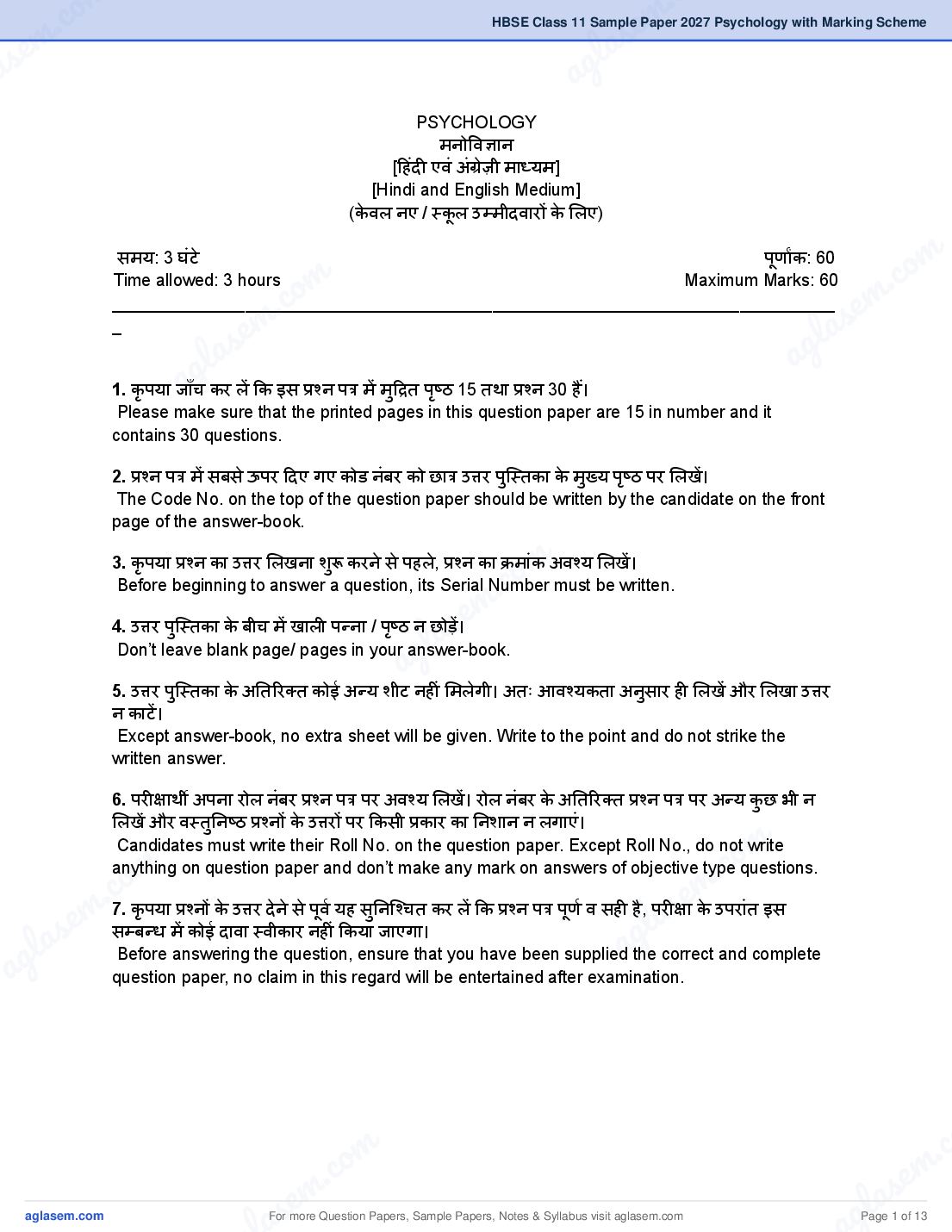
PSYCHOLOGY
मनोविज्ञान
[हिंदी एवं अंग्रेज़ी माध्यम]
[Hindi and English Medium]
(केवल नए / स्कूल उम्मीदवारों के लिए)
m
co
समय: 3 घंटे पर्णां
ू क: 60
Time allowed: 3 hours
.c om Maximum Marks: 60
e m .
m a s
____________________________________________________________________________
s e g l
a
_
g l a
aच कर लें कि इस प्रश्न पत्र में मद्रिु त पष्ृ ठ 15 तथा प्रश्न 30 हैं।
1. कृपया जाँ
Please make sure that the printed pages in this question paper are 15 in number and it
contains 30 questions.
2. प्रश्न पत्र में सबसे ऊपर दिए गए कोड नंबर को छात्र उत्तर पस्ति
ु का के मख्
ु य पष्ृ ठ पर लिखें।
The Code No. on the top of the question paper should be written by the candidate on the front
page of the answer-book.
m
co
3. कृपया प्रश्न का उत्तर लिखना शरू
ु करने से पहले, प्रश्न का क्रमांक अवश्य लिखें।
m.
Before beginning to answer a question, its Serial Number must be written.
का के बीच में खाली पन्ना / पष्ृ ठ न छोड़ेंs।e
la
4. उत्तर पस्ति
ु
a g
Don’t leave blank page/ pages in your answer-book.
5. उत्तर पस्ति
ु का के अतिरिक्त कोई अन्य शीट नहीं मिलेगी। अतः आवश्यकता अनस
ु ार ही लिखें और लिखा उत्तर
न काटें ।
Except answer-book, no extra sheet will be given. Write to the point and do not strike the
written answer.
6. परीक्षार्थी अपना रोल नंबर प्रश्न पत्र पर अवश्य लिखें। रोल नंबर के अतिरिक्त प्रश्न पत्र पर अन्य कुछ भी न
लिखें और वस्तनि ु ष्ठ प्रश्नों के उत्तरों पर किसी प्रकार का निशान न लगाएं।
m
m c. o
Candidates must write their Roll No. on the question paper. Except Roll No., do not write
c.7.oकृपया प्रश्नों के उत्तर देने से पर्वू यह सनिु श्चित कर लें कि प्रश्न पत्र पर्णू व सही है, परीक्षा m
anything on question paper and don’t make any mark on answers of objective type questions.
m सम्बन्ध में कोई दावा स्वीकार नहीं किया जाएगा। s e
s e g l a के उपरांत इस
gl a Before answering the question, ensure that you have been suppliedathe correct and complete
a question paper, no claim in this regard will be entertained after examination.
m . c
c. o s e m
m a
se
For more Question Papers, Sample Papers, Notes & Syllabus visit
g l Page 1 of 13
Page 3
(वस्तनि
ु ष्ठ प्रश्न / Objective Questions)
1. पहली मनोविज्ञान प्रयोगशाला की स्थापना किसने की?
(A) विलियम जेम्स
(B) विलियम वट ंु
(C) विलियम मैकडूगल
(D) सिग्मंड फ्रॉयड
Who established the first Psychological Lab?
(A) Willium James
(B) Willium Woundt
(C) Willium MecDugal
(D) Sigmond Freud
2. मनोविज्ञान मानसिक प्रक्रियाओं, __________ और व्यवहार का अध्ययन करता है ।
Psychology is the study of mental process, __________, and behaviour.
3. रोगी-केंद्रित चिकित्सा सिद्धांत किस मनोवैज्ञानिक ने दी?
Who invented Client-Centred Theory?
4. अनस
ु ध
ं ान का उद्दे श्य __________ चर के बारे में पर्वा
ू नम ु ान लगाना होता है ।
The purpose of research is to predict about __________ variable.
5. पहचान का निर्माण विकास की किस अवस्था की विशेषता है ?
(A) शैशवावस्था
(B) बाल्यावस्था
(C) किशोरावस्था
(D) प्रौढ़ावस्था
In which stage of development does formation of identity occur?
(A) Infancy Stage
(B) Childhood Stage
(C) Adolescence Stage
(D) Adulthood Stage
6. व्यक्ति की आँखों और त्वचा के रं ग को क्या कहा जाता है ?
(A) फेनोटाइप
(B) जीनोटाइप
(C) पॉलीजेनिक
(D) उपरोक्त में से कोई नहीं
Eye and skin colour of an individual is called
(A) Genotype
(B) Phenotype
For more Question Papers, Sample Papers, Notes & Syllabus visit Page 2 of 13
Page 4
. s e
em l a
as a g
(C) Polygenic
(D) None of these
7. ऊँचाई, वज़न आदि में वद्
ृ धि को क्या कहते हैं?
__________ refers to an increase in the size of body parts or of the organism as a whole.
m
co
9. फ़िल्टर-अटे न्यए
ू शन सिद्धांत किसने दिया?
.c om
Who developed filter-attenuation theory?
e m .
ु ोधन m
e(Classical Conditioning) का अध्ययन किसने किया? l a s
(A) जे. बी. वॉटसनs g
10. प्राचीन अनब
g la a
a स्किनर
(B) इवान पावलोव
(C) बी. एफ.
(D) विलियम वट ंु
Who investigated classical conditioning?
(A) J.B Watson
(B) Ivan P Pavlov
(C) B.F. Skinner
(D) Willium Woundt
m
11. संवेदी स्मति
ृ की भंडारण क्षमता क्या होती है ?
. co
em
(A) 30 सेकंड से कम
(B) 1 सेकंड से कम
l a s
(C) 1 मिनट तक
(D) जीवनभर a g
Sensory memory has a storage capacity:
(A) Less than 30 sec
(B) Less than 1 sec
(C) Upto 1 minute
(D) Life Long
m
12. विस्मरण पर पहला प्रयोगात्मक अध्ययन किसने किया?
m c. o
Who conducted the first experimental study on forgetting?
c. o s e m
em
प्रश्न 13 Assertion (A): भारत 15 अगस्त 1947 को स्वतंत्र हुआ। यह घोषणात्मक स्मति ृ है ।
s la
ag
Reason (R): सभी जानकारियाँ जिनमें तथ्य, नाम, तिथि आदि हों, घोषणात्मक स्मति ृ कहलाती हैं।
gla Options: (A) ‘A’ और ‘R’ दोनों सत्य हैं और ‘R’, ‘A’ का सही स्पष्टीकरण है ।
a (B) ‘A’ और ‘R’ दोनों सत्य हैं लेकिन ‘R’, ‘A’ का सही स्पष्टीकरण नहीं है ।
(C ‘A’ सत्य है लेकिन ‘R’ असत्य है ।
(D) ‘A’ असत्य है लेकिन ‘R’ सत्य है ।
Assertion: (A) India became independent on 15th August 1947, is declarative memory.
Reason: (R) All information pertaining to facts, names, dates is called declarative memory.
Options; (a) Both ‘A’ and ‘R’ are true, and ‘R’ is the correct explanation of ‘A’
(b) Both ‘A’ and ‘R’ are true, and ‘R’ is not the correct explanation of ‘A’
m . c
c. o s e m
m a
se
For more Question Papers, Sample Papers, Notes & Syllabus visit
g l Page 3 of 13
Page 5
(d) ‘A’ is false, but ‘R’ is true.
प्रश्न 14 Assertion (A): रचनात्मक चिंतन हमेशा असाधारण कार्यों में प्रकट नहीं होता।
Reason (R): रचनात्मक होने के लिए व्यक्ति को वैज्ञानिक या कलाकार होना आवश्यक नहीं है ।
Options: (A) ‘A’ और ‘R’ दोनों सत्य हैं और ‘R’, ‘A’ का सही स्पष्टीकरण है ।
(B) ‘A’ और ‘R’ दोनों सत्य हैं लेकिन ‘R’, ‘A’ का सही स्पष्टीकरण नहीं है ।
(C) ‘A’ सत्य है लेकिन ‘R’ असत्य है ।
(D) ‘A’ असत्य है लेकिन ‘R’ सत्य है ।
Assertion:- (A)Creative thinking is not always expressed in extraordinary work.
Reason:- ( R) One does have to be a scientist or an artist to be creative.
Options:- (a) Both ‘A’ and ‘R’ are true, and ‘R’ is the correct explanation of ‘A’
(b) Both ‘A’ and ‘R’ are true, and ‘R’ is not the correct explanation of ‘A’
(c) ‘A’ is true, but ‘R’ is false.
(d) ‘A’ is false, but ‘R’ is true.
प्रश्न 15 Assertion (A): चिंतन सभी संज्ञानात्मक क्रियाओं या प्रक्रियाओं का आधार है ।
Reason (R): चिंतन एक उच्च मानसिक प्रक्रिया है ।
Options: (A) ‘A’ और ‘R’ दोनों सत्य हैं और ‘R’, ‘A’ का सही स्पष्टीकरण है ।
(B) ‘A’ और ‘R’ दोनों सत्य हैं लेकिन ‘R’, ‘A’ का सही स्पष्टीकरण नहीं है ।
(C) ‘A’ सत्य है लेकिन ‘R’ असत्य है ।
(D) ‘A’ असत्य है लेकिन ‘R’ सत्य है ।
Assertion:- (A) Thinking is the base of all cognitive activities or processes.
Reason:- (R) Thinking is a higher mental process
Options:- (a)Both ‘A’ and ‘R’ are true, and ‘R’ is the correct explanation of ‘A’
(b)Both ‘A’ and ‘R’ are true, and ‘R’ is not the correct explanation of
‘A’ (c) A’ is true, but ‘R’ is false.
(d)‘A’ is false, but ‘R’ is true
Part B containing Very Short Answer Type Questions (प्रत्येक प्रश्न – 2 अंक).
भाग – ब (अति लघु उत्तरीय प्रश्न)
प्रत्येक प्रश्न का उत्तर 30 शब्दों से अधिक नहीं होना चाहिए।
16. अंतः निरीक्षण (Introspection) से आप क्या समझते हैं?
What is introspection?
17. पर्यावरणीय मनोविज्ञान से आप क्या समझते हैं?
What is environmental psychology?
18. परिकल्पना क्या होती है ?
What is hypothesis?
या
For more Question Papers, Sample Papers, Notes & Syllabus visit Page 4 of 13
Page 6
. s e
em l a
as a g
प्रायोगिक तथा नियंत्रित समह
ू में क्या अंतर होता है ?
What is the difference between experimental and controlled group?
19. मनोमितिकी का अध्ययन विषय क्या होता है ?
What is the study subject of psychometrics?
m
co
20. मल
ु र-लायर भ्रांति क्या है ?
.com
What is the Müller-Lyer illusion?
e m .
m
eMethod? l a s
s g
21. खंडन विधि (Chunking Method) से आप क्या समझते हैं?
g l
What is Chunking
a a
a संरचना के विकास में सिर से पाँव तक तथा केंद्र से छोर तक के सिद्धांत का क्या महत्त्व है?
22. मस्तिष्क
Explain the theory of Cephalocaudal and Proximodistal.
या
मनो-सांस्कृतिक कारक विकास को कैसे प्रभावित करते हैं?
How do psycho-culture factors influence development?
23. अनप्र
ु त्यभा क्या होती है ? यह कितने प्रकार की होती है ?
What is after image? What are the types of after image?
o m
ू याँ (Schedules of Reinforcement). अनब
c
24. पन
ु र्बलन अनस
ु चि
e m ु ोधन को किस प्रकार प्रभावित करती हैं?
l a s
How do the schedules of reinforcement affect conditioning?
अधिगम सिद्धांतों का अनप्र
ु योग कहाँ होता a
है ? g या
What are the applications of learning principles?
25. संकल्पना क्या होती है ?
What is a ‘concept’?
26. झठ
ू ी स्मति
ृ से आप क्या समझते हैं?
m
What is false memory?
m c. o
c. o m
27. रचनात्मक चिंतन की प्रक्रिया कैसे पर्ण
ू होती है ?
s e
em 28. मनोवैज्ञानिक अन्वेषण का उद्देश्य क्या है? la
How is the process of creative thinking completed?
s
la What is the goal of psychological enquiry? ag
ag या
बाह्य कारकों को नियंत्रित करने के लिए शोधकर्ता कौन-सी तकनीकें अपनाते हैं?
What are the different techniques adopted by the researchers to control the extraneous
variables?
29. व्यस्कावस्था में प्रवेश करते समय व्यक्ति को किन मख्
ु य चन
ु ौतियों का सामना करना पड़ता है ?
m . c
c. o s e m
m a
se
For more Question Papers, Sample Papers, Notes & Syllabus visit
g l
Page 5 of 13
Page 7
या
विकास की परिभाषा एवं विशेषताओं को विस्तार से समझाइए।
Explain the definition and characteristics of development in detail.
30. प्रेरणा से आप क्या समझते हैं? मनोसामाजिक प्रेरक व्यक्तित्व को कैसे प्रभावित करते हैं?
What do you understand by ‘Motivation’? How do psycho-social motivators affect personality?
या
नकारात्मक भावनाओं को नियंत्रित करने की क्या रणनीतियाँ अपनाई जा सकती हैं?
What strategies can be adopted to manage negative emotions?
For more Question Papers, Sample Papers, Notes & Syllabus visit Page 6 of 13
Page 8
. s e
em l a
as a g
Psychology Modal Paper
उत्तर कंु जी (Answer Key)
m
प्रश्न संख्या उत्तर
co
1. विलियम वटंु
.c om e m .
m s
2. अनभ
ु व
s e g l a
l a
3. कार्ल रोजर्स
a
ag
4. आश्रित
5. व्यस्कता
6. प्रकट लक्षण
7. वद्
ृ धि
m
8. 380–780 नैनोमीटर
. co
s em
l a
9. ट्राइस्मैन
10. इवान पाव्लोव a g
11.1 मिनट से कम
12. एबिंगहॉस
13. A
14. B
m
15. C
c. o
निर्देश (Answer Guidelines for Part B, C, D)
m
c. o m
16. अंतः निरीक्षण : विलियम वट ंु द्वारा प्रयोग की गई विधि जिसमें व्यक्ति अपनी मानसिक प्रक्रियाओं का वर्णन
s e
em
करता है ।
s la
ag
17. पर्यावरणीय मनोविज्ञान: यह अध्ययन करता है कि तापमान, आर्द्रता, प्रदष ू ण एवं प्राकृतिक आपदाएं मानव
gla व्यवहार को कैसे प्रभावित करती हैं।
a 18. परिकल्पना: यह समस्या का एक अस्थायी उत्तर होता है जिसे शोधकर्ता द्वारा विकसित किया जाता है ।
या
• प्रायोगिक समह ू : जिस पर स्वतंत्र चर का प्रयोग किया जाता है ।
• नियंत्रित समहू : तल ु नात्मक समह ू , जिस पर प्रयोग नहीं किया जाता।
19. मनोमितिकी: उत्तेजनाओं और उनके द्वारा उत्पन्न संवेदनाओं के बीच संबध ं ों का अध्ययन करती है । इसे
सायकोफिज़िक्स भी कहा जाता है ।
m . c
c. o s e m
m a
se
For more Question Papers, Sample Papers, Notes & Syllabus visit
g l Page 7 of 13
Page 9
सार्वभौमिक भ्रम है ।
21. खंडन विधि : सच ू ना को छोटे -छोटे समह
ू ों में बाँटकर अल्पकालिक स्मति
ृ की क्षमता को बढ़ाया जा सकता है ।
22. विकास में कारकों का प्रभाव:
• Cephalocaudal: विकास सिर से पैर की ओर होता है ।
• Proximodistal: विकास शरीर के केंद्र से छोरों की ओर होता है ।
23. अनप्र ु त्यभा (After Image):दृश्य उत्तेजना हटने के बाद भी उसकी छवि बनी रहती है ।
प्रकार: सकारात्मक और नकारात्मक
24. पन ु र्बलन अनस ु चि
ू याँ: यह निर्धारित करती हैं कि कब और कितनी बार पन ु र्बलन दिया जाएगा।
प्रकार: निरं तर और आंशिक अनस ु चि
ू याँ
या
1. संस्थानों में
2. व्यवहारिक समस्याओं के उपचार में
3. बच्चों के पालन-पोषण में
4. विद्यालयी शिक्षा में
25. संकल्पना (Concept): वह मानसिक श्रेणी जिसमें एक या एक से अधिक समान गण ु ों वाले वस्तए
ु ं व घटनाएं
आती हैं।
प्रकार: कृत्रिम (Artificial), प्राकृतिक (Natural)
26. झठ ू ी स्मति ृ : ऐसी स्मति ृ जो कभी हुई ही नहीं, लेकिन कल्पना के कारण वास्तविक प्रतीत होती है ।
उदाहरण: कल्पना विस्फोट (Imagination Inflation)
27. रचनात्मक चिंतन की प्रक्रिया:
1. तैयारी
2. निषेचन (Incubation)
3. प्रबोधन (Illumination)
4. सत्यापन (Verification)
28. मनोवैज्ञानिक अन्वेषण के लक्ष्य:
A) वर्णन (Description)
B) पर्वा
ू नम ु ान (Prediction)
C) व्याख्या (Explanation)
D) नियंत्रण (Control)
E) अनप्र ु योग (Application) या
A) उन्मल ू न (Elimination)
B) निरं तर प्रभाव
C) मिलान (Matching)
D) संतल ु न (Counter-balancing)
E) रैंडमाइजेशन (Randomization)
29. वयस्कावस्था की चन ु ौतियाँ:
1. अपराध प्रवत्ति ृ
2. मादक पदार्थों का दरु ु पयोग
3. भोजन संबध ं ी विकार या
विकास की विशेषताएं:
• यह जीवन भर चलता है
• विभिन्न प्रक्रियाओं में होता है
• बहु-दिशात्मक होता है
For more Question Papers, Sample Papers, Notes & Syllabus visit Page 8 of 13
Page 10
. s e
em l a
as a g
• अत्यधिक लचीलापन होता है
• ऐतिहासिक परिस्थितियों से प्रभावित
30. प्रेरणा: किसी कार्य को करने की आवश्यकता या इच्छा जो व्यवहार को दिशा दे ती है ।
मनोसामाजिक प्रेरक:
1. सामाजिक जड़ ु ाव की आवश्यकता
m
2. शक्ति की आवश्यकता
co
उपलब्धि की आवश्यकता
om .
3.
c m
जिज्ञासा और अन्वेषण
. e
4.
m s
या
a
s e
1. आत्म-जागरूकता बढ़ाना
g l
l
2. वस्तनि
aु ष्ठ रूप से स्थितियों का मल् ू यांकन
a
ag
3. आत्म-निरीक्षण
4. आत्म-मॉडलिंग
5. संवेदी पन ु र्गठन
6. सज ृ नात्मकता
7. अच्छे संबध ं ों का विकास
8. सहानभ ु ति
ू
9. सामद ु ायिक सेवा में भागीदारी
m
. co
s em
g l a
a
m
m c. o
c. o s e m
s em la
gla ag
a
m . c
c. o s e m
m a
se
For more Question Papers, Sample Papers, Notes & Syllabus visit
g l Page 9 of 13
Page 11
1 Willium Woundt
2 Experiences
3 Carl Rogers
4 Dependent
5 Adulthood
6 Phenotype
7 Growth
8 380–780 Nanometer
9 Triesman
10 Ivan Pavlov
11 Less than 1 minute
12 Abinghose
13 A
14 B
15 C
16. Introspection: A method used by Wilhelm Wundt in which a person describes their own
mental processes.
17. Environmental Psychology: Studies how factors like temperature, humidity, pollution, and
natural disasters affect human behavior.
18. Hypothesis: A temporary answer to a problem developed by the researcher.
Experimental Group: The group on which the independent variable is applied.
Control Group: A comparative group on which no experiment is conducted.
19. Psychophysics: Studies the relationship between stimuli and the sensations they produce.
Also known as psychophysics.
20. Müller-Lyer Illusion: Even though two lines are of the same length, one appears shorter
than the other – a universal illusion.
21. Chunking Method: Breaking information into smaller chunks can enhance the capacity of
short-term memory.
22. Influence of Factors in Development:
● Cephalocaudal: Development occurs from head to toe.
For more Question Papers, Sample Papers, Notes & Syllabus visit Page 10 of 13
Page 12
. s e
em l a
as a g
● Proximodistal: Development occurs from the center of the body to the extremities.
23. After Image: The image remains even after the visual stimulus is removed.
Types: Positive and Negative
m
co
24. Reinforcement Schedules: These determine when and how often reinforcement is given.
c om m .
Types: Continuous and Partial Schedules
Also used in:
m . se
s e g l a
a
l of behavioral problems a
1. Institutions
a g
2. Treatment
3. Child-rearing
4. School education
m
25. Concept: A mental category in which objects or events with one or more common features
c. o
are included.
mnever actually happened but feels real due to
Types: Artificial, Natural
s e
l a
26. False Memory: A memory of something that
ag
imagination.
Example: Imagination Inflation
27. Process of Creative Thinking:
1. Preparation
2. Incubation
m
c. o
3. Illumination
m
c. o 4. Verification s e m
s em la
gla 28. Goals of Psychological Inquiry: ag
a A) Description
B) Prediction
C) Explanation
D) Control
E) Application Or
m . c
c. o s e m
m a
se
For more Question Papers, Sample Papers, Notes & Syllabus visit
g l
Page 11 of 13
Page 13
A) Elimination
B) Constant effect
C) Matching
D) Counter-balancing
E) Randomization
29. Challenges of Adulthood:
1. Criminal tendencies
2. Substance abuse
3. Eating disorders Or
Characteristics of Development:
1. Lifelong process
2. Involves various processes
3. Multidirectional
4. Highly flexible
5. Influenced by historical contexts
30. Motivation: The need or desire to perform an action that gives direction to behavior.
Psychosocial Motivators:
1. Need for social affiliation
2. Need for power
3. Need for achievement
4. Curiosity and exploration
Or
1. Enhancing self-awareness
2. Objectively evaluating situations
For more Question Papers, Sample Papers, Notes & Syllabus visit Page 12 of 13
Page 14
. s e
em l a
as a g
3. Self-introspection
4. Self-modeling
5. Sensory restructuring
m
m . co
6. Creativity
c. orelationships se m
em a
7. Developing good
s g l
g la
8. Empathy
a
a
9. Participation in community service
m
. co
s em
g l a
a
m
m c. o
c. o s e m
s em la
gla ag
a
m . c
c. o s e m
m a
se
For more Question Papers, Sample Papers, Notes & Syllabus visit
g l
Page 13 of 13
Document Details
| Board / Org | Haryana Board |
| Exam | Class 11 |
| Type | Sample Paper |
| Pages | 13 |
| Updated | 03 Nov 2026 |