CBSE Class 10 Question Paper 2025 Mathematics Standard
Finished viewing? Save it for later —
Download CBSE Class 10 Question Paper 2025 Mathematics Standard (PDF · 27 pages)About CBSE Class 10 Question Paper 2025 Mathematics Standard
CBSE Class 10 Question Paper 2025 Mathematics Standard is available here for free download. Published by CBSE for Class 10, this question paper can be viewed online or downloaded as a PDF (27 pages). Candidates preparing for Class 10 can use CBSE Class 10 Question Paper 2025 Mathematics Standard to understand the exam pattern, the type of questions asked, and the overall difficulty level.
Frequently Asked Questions
How can I download CBSE Class 10 Question Paper 2025 Mathematics Standard?
Open this page and click the Download button to save CBSE Class 10 Question Paper 2025 Mathematics Standard as a PDF. It is completely free on AglaSem Docs.
Is CBSE Class 10 Question Paper 2025 Mathematics Standard free to download?
Yes. CBSE Class 10 Question Paper 2025 Mathematics Standard can be viewed online and downloaded as a PDF free of cost on AglaSem Docs.
How many pages does CBSE Class 10 Question Paper 2025 Mathematics Standard have?
CBSE Class 10 Question Paper 2025 Mathematics Standard contains 27 pages, which you can read online or download together as a single PDF.
Where can I find more Class 10 study material?
You can find more Class 10 question papers, sample papers, syllabus, and answer keys on AglaSem Docs.
CBSE Class 10 Question Paper 2025 Mathematics Standard – Text
Read the full text of this question paper below — useful to quickly search, copy and reference the content online without downloading the PDF.
📄 View text version (27 pages)
Page 1
. - >
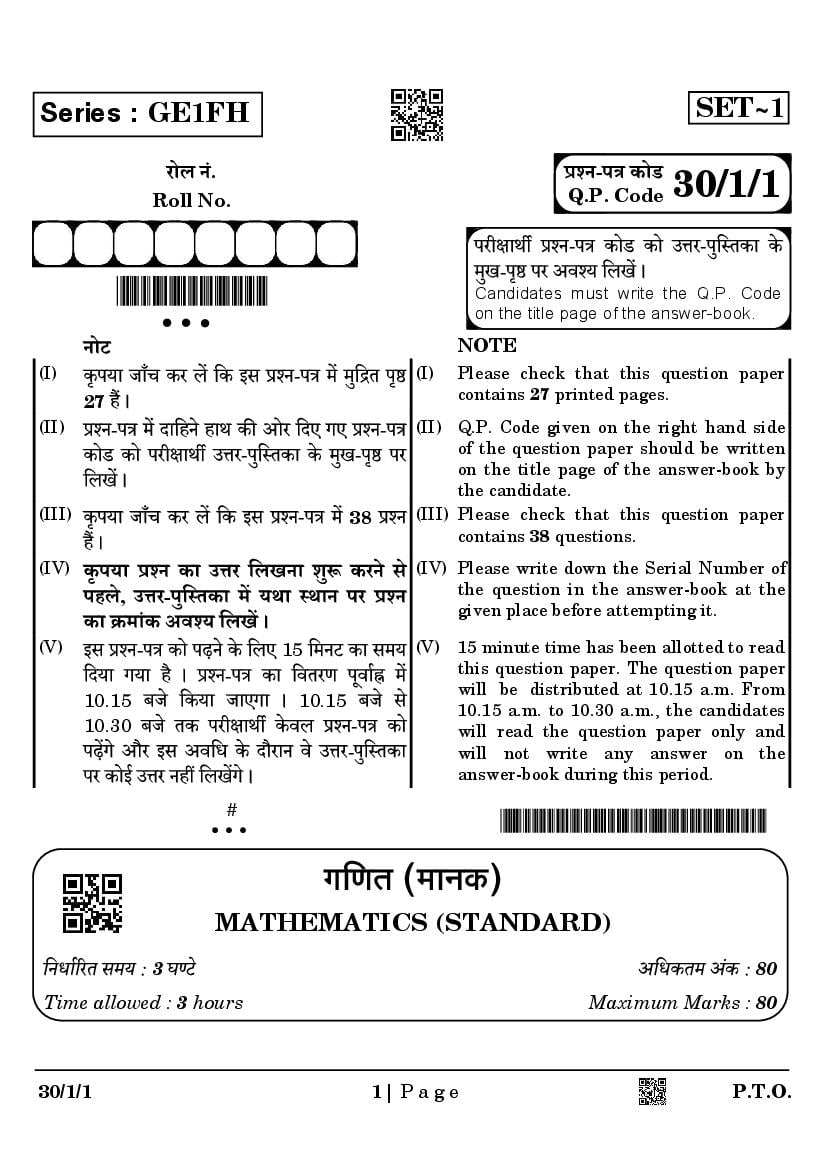
Roll No. Q.P. Code 30/1/1
- -
-
Candidates must write the Q.P. Code
on the title page of the answer-book.
> NOTE
(I) - (I) Please check that this question paper
27 contains 27 printed pages.
(II) - - (II) Q.P. Code given on the right hand side
- - of the question paper should be written
on the title page of the answer-book by
the candidate.
(III) - 38 (III) Please check that this question paper
contains 38 questions.
(IV) (IV) Please write down the Serial Number of
, - the question in the answer-book at the
given place before attempting it.
(V) - 15 (V) 15 minute time has been allotted to read
- this question paper. The question paper
will be distributed at 10.15 a.m. From
10.15 10.15 10.15 a.m. to 10.30 a.m., the candidates
10.30 - will read the question paper only and
- will not write any answer on the
answer-book during this period.
#
J{UV (_mZH$)
MATHEMATICS (STANDARD)
3 80
Time allowed : 3 hours Maximum Marks : 80
30/1/1 # 1| P a g e P.T.O.
Page 2
(ii) - , , ,
(iii) 1 18 (MCQ) 19 20
1
(iv) 21 25 - (VSA) 2
(v) 26 31 - (SA) 3
(vi) 32 35 - (LA) 5
(vii) 36 38 4
2
(viii) - , 2 , 2 ,
2 3
(ix) = ,
(x)
20 (MCQ) , 1 20 1=20
1. , 3x2 + 6x + k + + = , k
(A) 8
(B) 8
(C) 4
(D) 4
30/1/1 # 2| P a g e
Page 3
Read the following instructions very carefully and strictly follow them :
(i) This question paper contains 38 questions. All questions are compulsory.
(ii) This question paper is divided into five Sections A, B, C, D and E.
(iii) In Section A, Questions no. 1 to 18 are multiple choice questions (MCQs)
and questions number 19 and 20 are Assertion-Reason based questions of
1 mark each.
(iv) In Section B, Questions no. 21 to 25 are very short answer (VSA) type
questions, carrying 2 marks each.
(v) In Section C, Questions no. 26 to 31 are short answer (SA) type
questions, carrying 3 marks each.
(vi) In Section D, Questions no. 32 to 35 are long answer (LA) type questions
carrying 5 marks each.
(vii) In Section E, Questions no. 36 to 38 are case study based questions
carrying 4 marks each. Internal choice is provided in 2 marks questions in
each case study.
(viii) There is no overall choice. However, an internal choice has been provided
in 2 questions in Section B, 2 questions in Section C, 2 questions in
Section D and 3 questions in Section E.
(ix) Draw neat diagrams wherever required. Take = wherever required,
if not stated.
(x) Use of calculator is not allowed.
SECTION A
This section has 20 Multiple Choice Questions (MCQs) carrying 1 mark each. 20 1=20
1. If and are the zeroes of polynomial 3x2 + 6x + k such that
+ + = , then the value of k is :
(A) 8
(B) 8
(C) 4
(D) 4
30/1/1 # 3| P a g e P.T.O.
Page 4
,
(A) a = 2b
(B) 2a = b
(C) a + 2b = 0
(D) 2a + b = 0
3. P( 4, 5) Q(4, 6) -
(A) x-
(B) y-
(C) -
(D) x- y-
4. 7 + 4 sin =9 , :
(A) 90
(B) 30
(C) 45
(D) 60
5. tan2 :
(A) 1
(B) 0
(C) 1
(D) 2
6. HCF(98, 28) = m LCM(98, 28) = n , n 7m :
(A) 0
(B) 28
(C) 98
(D) 198
30/1/1 # 4| P a g e
Page 5
and 2x + 3y b = 0, then :
(A) a = 2b
(B) 2a = b
(C) a + 2b = 0
(D) 2a + b = 0
3. The mid-point of the line segment joining the points P( 4, 5) and Q(4, 6)
lies on :
(A) x-axis
(B) y-axis
(C) origin
(D) neither x-axis nor y-axis
4. If is an acute angle and 7 + 4 sin = 9, then the value of is :
(A) 90
(B) 30
(C) 45
(D) 60
5. The value of tan2 is :
(A) 1
(B) 0
(C) 1
(D) 2
6. If HCF(98, 28) = m and LCM(98, 28) = n, then the value of n 7 m is :
(A) 0
(B) 28
(C) 98
(D) 198
30/1/1 # 5| P a g e P.T.O.
Page 6
(A)
(B)
(C)
(D)
8. ABC DEF , B= E, F= C AB = 3 DE ,
(A)
(B)
(C)
(D)
9. ( 1)n + ( 1)8 = 0 , n:
(A)
(B)
(C)
(D)
10. ,
(A) 3 (B) 5
(C) 2 (D) 4
30/1/1 # 6| P a g e
Page 7
always :
(A) parallel
(B) perpendicular
(C) equal
(D) intersecting
8. In triangles ABC and DEF, B= E, F= C and AB = 3 DE. Then,
the two triangles are :
(A) congruent but not similar
(B) congruent as well as similar
(C) neither congruent nor similar
(D) similar but not congruent
9. If ( 1)n + ( 1)8 = 0, then n is :
(A) any positive integer
(B) any negative integer
(C) any odd number
(D) any even number
10. Two polynomials are shown in the graph below. The number of distinct
zeroes of both the polynomials is :
(A) 3 (B) 5
(C) 2 (D) 4
30/1/1 # 7| P a g e P.T.O.
Page 8
(A) 10
(B) 9
(C) 12
(D) 4
12. 15x 18x
(A) x
(B) 11x
(C) 17x
(D) 34x
13. 52
(A)
(B)
(C)
(D)
14. - ?
(A) 1·4142387954012 . . . .
(B)
(C)
(D) 1·857142
30/1/1 # 8| P a g e
Page 9
(A) 10
(B) 9
(C) 12
(D) 4
12. Mode and Mean of a data are 15x and 18x, respectively. Then the median
of the data is :
(A) x
(B) 11x
(C) 17x
(D) 34x
13. A card is selected at random from a deck of 52 playing cards. The
probability of it being a red face card is :
(A)
(B)
(C)
(D)
14. Which of the following is a rational number between 3 and ?
(A) 1·4142387954012 . . . .
(B)
(C)
(D) 1·857142
30/1/1 # 9| P a g e P.T.O.
Page 10
(A) 200
(B) 100
(C) 20
(D) 10
16. , O P - PA
POB = 115 , APO :
(A) 25
(B) 65
(C) 90
(D) 35
17. 150 m
30 :
(A) 100 m
(B) 300 m
(C) 150 m
(D) 150 m
30/1/1 # 10| P a g e
Page 11
72 , the radius of the circle is :
(A) 200 units
(B) 100 units
(C) 20 units
(D) 10 2 units
16. In the given figure, PA is a tangent from an external point P to a circle
with centre O. If POB = 115 , then APO is equal to :
(A) 25
(B) 65
(C) 90
(D) 35
17. A kite is flying at a height of 150 m from the ground. It is attached to a
string inclined at an angle of 30 to the horizontal. The length of the
string is :
(A) 100 m
(B) 300 m
(C) 150 m
(D) 150 m
30/1/1 # 11| P a g e P.T.O.
Page 12
18. 20 cm cm
:
(A) 30
(B) 60
(C) 90
(D) 50
19 20
(A) (R) (A), (B),
(C) (D)
(A) (A) (R) (R), (A)
(B) (A) (R) , (R), (A)
(C) (A) , (R)
(D) (A) , (R)
19. (A) 1 20 1
(R) E , P(E) = 1 , E
20. (A) ,
(R) r 3 r2
30/1/1 # 12| P a g e
Page 13
radius cm. The angle subtended by the arc at the centre of the circle
is :
(A) 30
(B) 60
(C) 90
(D) 50
Questions number 19 and 20 are Assertion and Reason based questions. Two
statements are given, one labelled as Assertion (A) and the other is labelled as
Reason (R). Select the correct answer to these questions from the codes (A), (B),
(C) and (D) as given below.
(A) Both Assertion (A) and Reason (R) are true and Reason (R) is the
correct explanation of the Assertion (A).
(B) Both Assertion (A) and Reason (R) are true, but Reason (R) is not
the correct explanation of the Assertion (A).
(C) Assertion (A) is true, but Reason (R) is false.
(D) Assertion (A) is false, but Reason (R) is true.
19. Assertion (A) : The probability of selecting a number at random from the
numbers 1 to 20 is 1.
Reason (R): For any event E, if P(E) = 1, then E is called a sure event.
20. Assertion (A) : If we join two hemispheres of same radius along their
bases, then we get a sphere.
Reason (R): Total Surface Area of a sphere of radius r is 3 r2.
30/1/1 # 13| P a g e P.T.O.
Page 14
21. x cos 60 + y cos 0 + sin 30 cot 45 = 5 , x + 2y
22. p(x) = x2 + x
23. (2a, a 7) (11, 9)
10 ,
24. ABC PQR AB = 6 cm, BC = 4 cm, AC = 8 cm
PR = 6 cm , (PQ + QR)
, = 1= 2 , PQS TQR.
30/1/1 # 14| P a g e
Page 15
This section has 5 Very Short Answer (VSA) type questions carrying 2 marks
each. 5 2=10
21. (a) If x cos 60 + y cos 0 + sin 30 cot 45 = 5, then find the value of
x + 2y.
OR
(b) Evaluate :
22. Find the zeroes of the polynomial p(x) = x2 + x .
23. The coordinates of the centre of a circle are (2a, a 7). Find the value(s)
9) and has diameter
10 units.
24. (a) If ABC PQR in which AB = 6 cm, BC = 4 cm, AC = 8 cm and
PR = 6 cm, then find the length of (PQ + QR).
OR
(b) In the given figure, = and 1= 2, show that
PQS TQR.
30/1/1 # 15| P a g e P.T.O.
Page 16
A B 10 m PA PB
-
6 - (SA) , 3 6 3=18
26. ,O BCD C -
BAC + ACD = 90 .
-
30/1/1 # 16| P a g e
Page 17
from the centre of the ground. He found that his distances from the
points A and B on the ground are 10 m (PA and PB are tangents to the
circle). Find the radius of the circular ground.
SECTION C
This section has 6 Short Answer (SA) type questions carrying 3 marks each. 6 3=18
26. (a) In the given figure, O is the centre of the circle and BCD is tangent
to it at C. Prove that BAC + ACD = 90 .
OR
(b) Prove that opposite sides of a quadrilateral circumscribing a circle
subtend supplementary angles at the centre of the circle.
30/1/1 # 17| P a g e P.T.O.
Page 18
27. : + = 1 + sec cosec
: + =
28. y- (5, 6) ( 1, 4)
29.
30.
, m3 ,
( = )
31. 2
4 - (LA) , 5 4 5=20
32. A B , 8% 9% ,
- 1,860 ,
, 20
30/1/1 # 18| P a g e
Page 19
OR
(b) Prove that : + =
28. Find the ratio in which the y-axis divides the line segment joining the
points (5, 6) and ( 1, 4). Also find the point of intersection.
29. Prove that is an irrational number.
30. A room is in the form of a cylinder surmounted by a hemispherical dome.
The base radius of the hemisphere is half of the height of the cylindrical
part. If the room contains m3 of air, find the height of the
cylindrical part. (Use = ).
31. Two dice are thrown at the same time. Determine the probability that the
difference of the numbers on the two dice is 2.
SECTION D
This section has 4 Long Answer (LA) type questions carrying 5 marks each. 4 5=20
32. Vijay invested certain amounts of money in two schemes A and B, which
offer interest at the rate of 8% per annum and 9% per annum,
respectively. He received 1,860 as the total annual interest. However,
had he interchanged the amounts of investments in the two schemes, he
would have received 20 more as annual interest. How much money did
he invest in each scheme ?
30/1/1 # 19| P a g e P.T.O.
Page 20
E BC DF EF = FB FA.
ABC , AD BC AD2 = BD DC ,
BAC = 90 .
34. 60 cm 25 cm
480 km 8 km/h
, 3
35. , 18
11 13 7
13 15 6
15 17 9
17 19 13
19 21 f
21 23 5
23 25 4
30/1/1 # 20| P a g e
Page 21
segment AE at the point F, where E is any point on the side BC.
Prove that DF EF = FB FA.
OR
(b) In ABC, if AD BC and AD2 = BD DC, then prove that
BAC = 90 .
34. (a) The perimeter of a right triangle is 60 cm and its hypotenuse is
25 cm. Find the lengths of other two sides of the triangle.
OR
(b) A train travels a distance of 480 km at a uniform speed. If the
speed had been 8 km/h less, then it would have taken 3 hours more
to cover the same distance. Find the speed of the train.
35. in the following table, if the mean of the
given data is 18. Hence find the mode.
Daily Allowance Number of Children
11 13 7
13 15 6
15 17 9
17 19 13
19 21 f
21 23 5
23 25 4
30/1/1 # 21| P a g e P.T.O.
Page 22
1
36.
,
300 ,
50 ,
350 , 400
10
(i) , 1
(ii) 8 1
(iii) 10 2
(iii) 6 ,
2
30/1/1 # 22| P a g e
Page 23
This section has 3 case study based questions carrying 4 marks each. 3 4=12
Case Study 1
36. A school is organizing a charity run to raise funds for a local hospital.
The run is planned as a series of rounds around a track, with each round
being 300 metres. To make the event more challenging and engaging, the
organizers decide to increase the distance of each subsequent round by
50 metres. For example, the second round will be 350 metres, the third
round will be 400 metres and so on. The total number of rounds planned
is 10.
Based on the information given above, answer the following questions :
(i) Write the fourth, fifth and sixth term of the Arithmetic Progression
so formed. 1
(ii) Determine the distance of the 8th round. 1
(iii) (a) Find the total distance run after completing all 10 rounds. 2
OR
(iii) (b) If a runner completes only the first 6 rounds, what is the
total distance run by the runner ? 2
30/1/1 # 23| P a g e P.T.O.
Page 24
37. ,
,
, 35 mm
5 , 10 ,
(i) 1
(ii) ACB 1
(iii) 2
(iii) 2
30/1/1 # 24| P a g e
Page 25
37. A brooch is a decorative piece often worn on clothing like jackets, blouses
or dresses to add elegance. Made from precious metals and decorated
with gemstones, brooches come in many shapes and designs.
One such brooch is made with silver wire in the form of a circle with
diameter 35 mm. The wire is also used in making 5 diameters which
divide the circle into 10 equal sectors as shown in the figure.
Based on the above given information, answer the following questions :
(i) Find the central angle of each sector. 1
(ii) Find the length of the arc ACB. 1
(iii) (a) Find the area of each sector of the brooch. 2
OR
(iii) (b) Find the total length of the silver wire used. 2
30/1/1 # 25| P a g e P.T.O.
Page 26
38.
60 , 40
45
(i) CD h , BD 1
(ii) BC 1
(iii) CE [ = 1·73 ] 2
(iii) AC = 100 m , AE 2
30/1/1 # 26| P a g e
Page 27
38. Amrita stood near the base of a lighthouse, gazing up at its towering
height. She measured the angle of elevation to the top and found it to be
60 . Then, she climbed a nearby observation deck, 40 metres higher than
her original position and noticed the angle of elevation to the top of
lighthouse to be 45 .
Based on the above given information, answer the following questions :
(i) 1
(ii) 1
(iii) (a) Find the height CE of the lighthouse [Use = 1·73] 2
OR
(iii) (b) Find distance AE, if AC = 100 m. 2
30/1/1 # 27| P a g e P.T.O.
Document Details
| Board / Org | CBSE |
| Exam | Class 10 |
| Type | Question Paper |
| Pages | 27 |
| Updated | 24 Sep 2026 |